

Log-based Anomaly Detection Without Log Parsing
Open accessThe DOI matches its Crossref record; 58 of the 64 references it cites were found in a registry or an index; 12 of the 36 sources its claims cite were checked for support.
Abstract
Software systems often record important runtime information in system logs for troubleshooting purposes. There have been many studies that use log data to construct machine learning models for detecting system anomalies. Through our empirical study, we find that existing log-based anomaly detection approaches are significantly affected by log parsing errors that are introduced by 1) OOV (out-of-vocabulary) words, and 2) semantic misunderstandings. The log parsing errors could cause the loss of important information for anomaly detection. To address the limitations of existing methods, we propose NeuralLog, a novel log-based anomaly detection approach that does not require log parsing. NeuralLog extracts the semantic meaning of raw log messages and represents them as semantic vectors. These representation vectors are then used to detect anomalies through a Transformer-based classification model, which can capture the contextual information from log sequences. Our experimental results show that the proposed approach can effectively understand the semantic meaning of log messages and achieve accurate anomaly detection results. Overall, NeuralLog achieves F1-scores greater than 0.95 on four public datasets, outperforming the existing approaches.
Overview
CoChat Summary
TL;DR
NeuralLog is a log-based anomaly detection approach that skips log parsing by encoding raw log messages with BERT/WordPiece and classifying log sequences with a Transformer. It reports F1-scores above 0.95 on four public datasets and outperforms SVM, LR, IM, LogRobust, and Log2Vec on BGL, Thunderbird, and Spirit.
Key findings
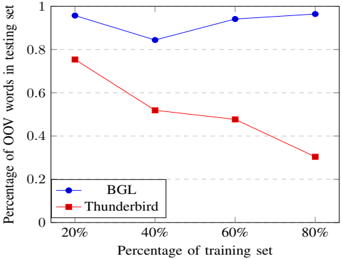
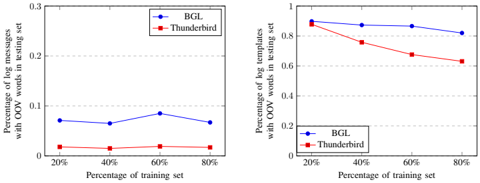
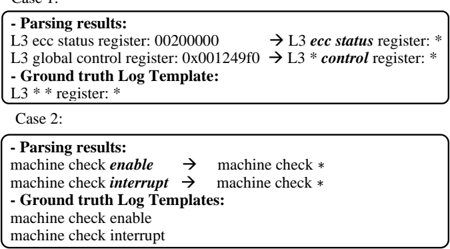
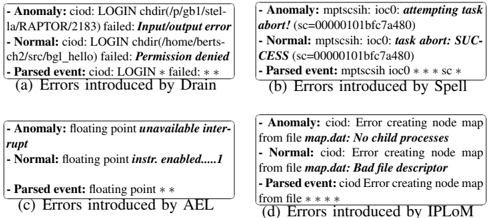
- An empirical study on BGL and Thunderbird found that existing log parsers suffer from OOV words and semantic misunderstanding; on a 60/40 BGL split, 94.12% of unique testing words were unseen in training, and these OOV words produced 1,304 unseen log events, accounting for 86.59% of testing log events.
- NeuralLog achieved F1-scores greater than 0.95 on all four public datasets: HDFS 0.98, BGL 0.98, Thunderbird 0.96, and Spirit 0.97; it was best on BGL, Thunderbird, and Spirit and comparable on HDFS.
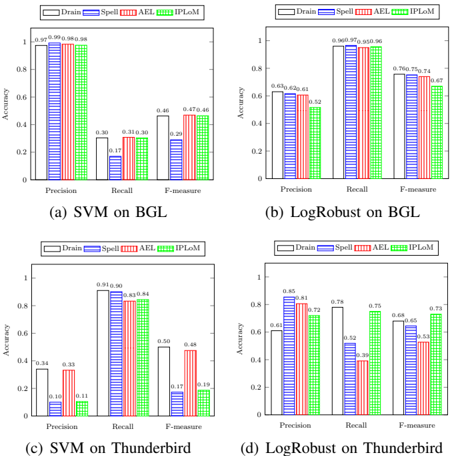
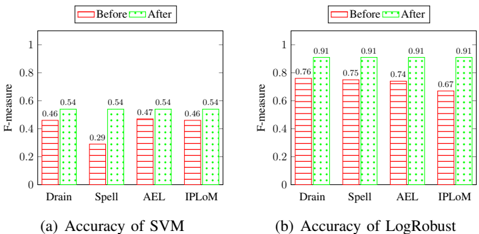
- Parsing errors degraded baselines: SVM with Drain achieved F1 0.46 on BGL and 0.50 on Thunderbird, while LogRobust achieved F1 0.75 on BGL and 0.68 on Thunderbird; manually fixing parsing errors improved LogRobust by 25% and SVM by 29% on average on BGL.
- Ablations showed NeuralLog’s raw-message encoding mattered: NeuralLog-Template reached F1 0.90 on BGL and 0.90 on Thunderbird versus NeuralLog’s 0.98 and 0.96, and NeuralLog-Word2Vec reached F1 0.80 on Thunderbird versus NeuralLog’s 0.96.
Methods
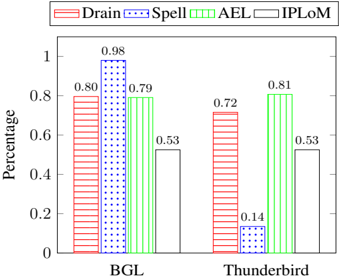
- The paper first empirically studies log parsing errors on BGL and Thunderbird (14,672,653 log messages total, 353,394 labeled anomalies), evaluating Drain, AEL, IPLoM, and Spell and their impact on SVM and LogRobust.
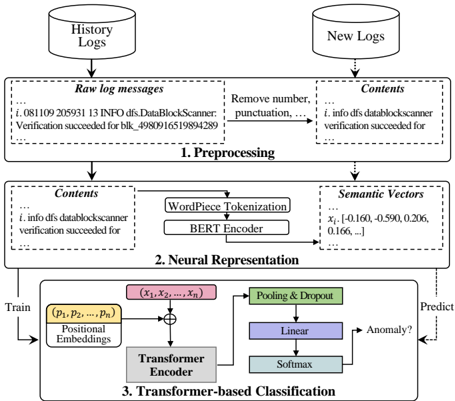
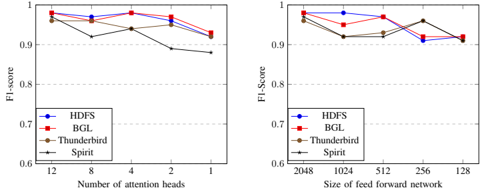
- NeuralLog preprocesses raw log messages, applies WordPiece tokenization, encodes messages with BERT base (12 transformer layers, 768 hidden units), adds positional encoding, and uses a Transformer encoder-based classifier (12 attention heads, feed-forward size 2048) for anomaly detection.
- Evaluation uses four public datasets: HDFS, BGL, Thunderbird, and Spirit. HDFS sequences are built by block ID with an 80/20 train-test split; BGL, Thunderbird, and Spirit use the first 80% of time-sorted messages for training and the last 20% for testing, with sliding windows of length 20 and step size 1; metrics are Precision, Recall, and F1-score.
Limitations
- Stated: the subject datasets come from a distributed system and supercomputers, so the number of systems is limited and does not cover all domains.
- Stated: tool comparison relies on implementations and default settings from prior work, and manual labeling of the public datasets may introduce noise.
- Stated: preprocessing removes numeric and special-character tokens, which may discard useful information such as node ID, task ID, IP address, or exit code. No additional limitations are evident from the text beyond those stated.
Model-written summary. Check it against the paper before relying on it.
Integrity signals
Registry
Cites
Statistics
Figures
Verification
Claims the paper makes
1 Valid · 8 Not valid · 18 Not checked · 105 Own results and interpretations
The cited sources that could be checked couldn’t confirm or dispute this claim.
In the paper
“Moreover, DeepLog [5], using the indexes of log templates to predict the next log event, considers all new log events as anomalies because they cannot be predicted by the model.”
What the sources say
- Could not verifycites [5] matched to “FastText.zip: Compressing text classification models” (2016) sourceExperimental — accuracy not yet measured
The Introduction (p. 1) and Related Work (p. 2) discuss text classification and model compression, not DeepLog. Searches for DeepLog and for unseen log templates and anomaly detection found no passage addressing whether new log events are treated as anomalies. (LLM, conf=0.76)
plainstates a cause- Asserted: passes — The authors put it forward as true.
- Checkable: passes — It can be checked against evidence.
- Load-bearing: passes — The paper’s conclusions depend on it.
- Based: passes — The paper gives a reason why it holds.
- Could not verify
The cited sources that could be checked couldn’t confirm or dispute this claim.
In the paper
“The main reason is that LogRobust utilizes the Drain log parser [24] to obtain log templates. As aforementioned in Section III-C, the Drain parser could inaccurately parse a noticeable number of log messages on BGL and Thunderbird datasets.”
What the sources say
- Could not verifycites [24] matched to “Generalizing Word Embeddings using Bag of Subwords” (2018) sourceExperimental — accuracy not yet measured
The citation is attached to the identification of Drain as the log parser LogRobust uses. Our copy’s Results and Conclusion discuss subword word embeddings, not Drain or LogRobust; searches for those names and for log-template parsing found no relevant passage. It also provides no evidence about parsing errors on BGL or Thunderbird. (LLM, conf=0.76)
hedgedstates a cause- Asserted: passes — The authors put it forward as true.
- Checkable: passes — It can be checked against evidence.
- Load-bearing: passes — The paper’s conclusions depend on it.
- Based: passes — The paper gives a reason why it holds.
- Could not verify
The cited sources that could be checked couldn’t confirm or dispute this claim.
In the paper
“Therefore, Log2Vec could not effectively handle some domain-specific words, such as technical terms or entity names [50], [51], [52].”
What the sources say
- Could not verifycites [50] matched to “Mimicking Word Embeddings using Subword RNNs” (2017) sourceExperimental — accuracy not yet measured
The Introduction (page not available) discusses the general difficulty word-embedding methods face with out-of-vocabulary terms. Searches for Log2Vec, domain-specific words, technical terms, and entity names found no passage assessing whether Log2Vec handles those words effectively. (LLM, conf=0.78)
- Could not verifycites [51] matched to “LogBERT: Log Anomaly Detection via BERT” (2021) sourceExperimental — accuracy not yet measured
The References (p. 11) list Log2vec, but the paper does not describe its ability to handle domain-specific words. Searches for Log2vec alongside technical terms, entity names, and vocabulary limitations found no passage addressing the claimed limitation. (LLM, conf=0.76)
- Could not verifycites [52] matched to “Decoupled Weight Decay Regularization” (2017) sourceExperimental — accuracy not yet measured
Section 4.2 (p. 6) examines weight decay in SGD and Adam, while Section 4.5 (p. 8) discusses applications of AdamW. Searches for Log2Vec, domain-specific words, technical terms, and entity names found no passage addressing whether Log2Vec handles those words effectively. (LLM, conf=0.76)
hedged- Asserted: passes — The authors put it forward as true.
- Checkable: passes — It can be checked against evidence.
- Load-bearing: passes — The paper’s conclusions depend on it.
- Based: passes — The paper gives a reason why it holds.
- Could not verify
The cited sources support only part of this claim — read each source’s verdict below.
In the paper
“However, it is hard to extract contextual information from characters to form meaningful words [50], [51], [52].”
What the sources say
- Partly supportedcites [50] matched to “Mimicking Word Embeddings using Subword RNNs” (2017) sourceExperimental — accuracy not yet measured
The Introduction (page unavailable) says character-based word models struggle in some settings, including where the mapping from form to meaning is complex. It does not say that extracting contextual information from characters is generally hard; the claim extends a specific limitation to a broader one. (LLM, conf=0.78)
- Could not verifycites [51] matched to “LogBERT: Log Anomaly Detection via BERT” (2021) sourceExperimental — accuracy not yet measured
The Framework (pp. 3–4) describes extracting log keys from log messages and learning contextual relations among those keys. The Introduction (p. 1) discusses a different difficulty: RNNs do not encode context from both sides of a log entry. Searches for character-level context and forming words found no passage addressing the claimed difficulty. (LLM, conf=0.76)
- Could not verifycites [52] matched to “Decoupled Weight Decay Regularization” (2017) sourceExperimental — accuracy not yet measured
Section 4.3 (p. 7) discusses AdamW’s generalization, and Section 4.5 (p. 8) mentions its use in natural-language-understanding models. Neither addresses the difficulty of extracting context from characters to form words. Searches for the claim’s wording and for character-level word formation found no supporting passage. (LLM, conf=0.76)
plain- Asserted: passes — The authors put it forward as true.
- Checkable: passes — It can be checked against evidence.
- Load-bearing: passes — The paper’s conclusions depend on it.
- Based: passes — The paper gives a reason why it holds.
- Partly supported
The cited sources that could be checked couldn’t confirm or dispute this claim.
In the paper
“Besides, Log2Vec also adopts MIMICK [49], an approach of inducing word embedding from character-level features to handle OOV words to improve anomaly detection performance.”
What the sources say
- Could not verifycites [49] matched to “Detecting large-scale system problems by mining console logs” (2009) sourceExperimental — accuracy not yet measured
The Workflow (p. 4) and Anomaly Detection (p. 8) describe feature vectors and PCA-based log anomaly detection, not Log2Vec. Searches for MIMICK, OOV words, and character-level word embeddings found no passage addressing the claimed adoption or its effect on performance. (LLM, conf=0.78)
plainstates a cause- Asserted: passes — The authors put it forward as true.
- Checkable: passes — It can be checked against evidence.
- Load-bearing: passes — The paper’s conclusions depend on it.
- Based: passes — The paper gives a reason why it holds.
- Could not verify
79 more claims
Create a free account to see all 132 claims and every source verdict.
- It may state two separate claims as one. 30
- Probably not a substantial claim. 18
- The quote only partly states this claim. 4
Claims other papers make about this one
Each is checked against this paper’s own text: does it say what the citing paper says it does?
The cited source says what the claim attributes to it.
In the citing paper
“Logs are a crucial source of information in software systems, capturing system runtime behavior and aiding in software engineering tasks like program comprehension [1], [2], anomaly detection [3]- [6], and failure diagnosis [7], [8].”
From Practitioners’ expectations on log anomaly detection (2025) · cites this paper as [3]
Citations
Cites
Vaswani, A., Shazeer, N., Parmar, N., Uszkoreit, J., Jones, L., Gomez, A. N., Kaiser, L., & Polosukhin, I. (2017) · arXiv · doi:10.48550/arxiv.1706.03762 · Cited by 120,404
Exploiting Generative AI to Scale up Intelligent Tutoring Systems
Jakubův, J., Chvalovský, K., Goertzel, Z., Kaliszyk, C., Olšák, M., Piotrowski, B., Schulz, S., Suda, M., & Urban, J. (2023) · DROPS (Schloss Dagstuhl – Leibniz Center for Informatics) · doi:10.4230/lipics.itp.2023.19 · Cited by 76,658
BERT: Pre-training of Deep Bidirectional Transformers for Language Understanding
Devlin, J., Chang, M.-W., Lee, K., & Toutanova, K. (2018) · arXiv · doi:10.48550/arxiv.1810.04805 · Cited by 73,173
BERT: Pre-training of Deep Bidirectional Transformers for Language Understanding
Devlin, J., Chang, M.-W., Lee, K., & Toutanova, K. (2019) · Proceedings of the 2019 Conference of the North American Chapter of the Association for Computational Linguistics: Human Language Technologies, Volume 1 (Long and Short Papers) · doi:10.18653/v1/n19-1423 · Cited by 54,325
Efficient Estimation of Word Representations in Vector Space
Mikolov, T., Chen, K., Corrado, G., & Dean, J. (2013) · arXiv · doi:10.48550/arxiv.1301.3781 · Cited by 26,568 · cited 1×
“adopt Word2vec model [13] to obtain embedding vectors of log events, then applied an LSTM model to detect anomalies.”
MethodDistilBERT, a distilled version of BERT: smaller, faster, cheaper and lighter
Sanh, V., Debut, L., Chaumond, J., & Wolf, T. (2019) · arXiv · doi:10.48550/arxiv.1910.01108 · Cited by 13,823
Decoupled Weight Decay Regularization
Loshchilov, I., & Hutter, F. (2017) · arXiv · doi:10.48550/arxiv.1711.05101 · Cited by 12,522
Term-weighting approaches in automatic text retrieval
Salton, G., & Buckley, C. (1988) · Information Processing & Management · doi:10.1016/0306-4573(88)90021-0 · Cited by 9,740 · cited 3×
“LogRobust [8] incorporates a pre-trained Word2vec model, namely FastText [31], and combines with TF-IDF weight [32] for learning the representation vectors of log templates, which are generated by Drain [24].”
MethodUnsupervised Cross-lingual Representation Learning at Scale
Conneau, A., Khandelwal, K., Goyal, N., Chaudhary, V., Wenzek, G., Guzmán, F., Grave, E., Ott, M., Zettlemoyer, L., & Stoyanov, V. (2020) · Proceedings of the 58th Annual Meeting of the Association for Computational Linguistics · doi:10.18653/v1/2020.acl-main.747 · Cited by 5,637 · cited 4×
“For GPT2 and Roberta encoders, we use their base model with 12 layers, 12 attention heads, and 768 hidden units.”
MethodInfluentialGoogle's Neural Machine Translation System: Bridging the Gap between Human and Machine Translation
Wu, Y., Schuster, M., Chen, Z., Le, Q. V., Norouzi, M., Macherey, W., Krikun, M., Cao, Y., Gao, Q., Macherey, K., et al. (2016) · arXiv · doi:10.48550/arxiv.1609.08144 · Cited by 5,319 · cited 4×
“In our work, we adopt the WordPiece tokenization [36], [37], which is widely used in many recent language modeling studies [38], [39], [40].”
MethodInfluential
Research works printed but not linked: 2
- radford, 2019, Language models are unsupervised multitask learners, OpenAIRE blog, 1, 9
- 2021, Bert pretrained models
Cited by
Items 101–200 of 292
Xu, W., Luo, J., Huang, T., Sui, K., Geng, J., Ma, Q., Akasaka, I., Shi, X., Tang, J., & Cai, P. (2025) · IEEE/ACM International Conference on Automated Software Engineering (ASE) · doi:10.1109/ase63991.2025.00310 · Cited by 33
“Recent work by Le et al. [11], [12] introduced parser-independent Transformer-based methods that improve generalization by avoiding reliance on log parsing.”
Speed and Performance of Parserless and Unsupervised Anomaly Detection Methods on Software Logs
Nyyssölä, J., & Mäntylä, M. (2024) · IEEE International Conference on Software Quality, Reliability and Security (QRS) · doi:10.1109/qrs62785.2024.00071 · Cited by 14
“NeuralLog achieves great results on several datasets but it employs a BERT encoder and transformer-based classification [16] which are relatively time consuming approaches.”
BackgroundLLM Meets ML: Data-efficient Anomaly Detection on Unstable Logs
Hadadi, F., Xu, Q., Bianculli, D., & Briand, L. (2026) · ACM Transactions on Software Engineering and Methodology · doi:10.1145/3771283 · Cited by 37
DeepUserLog: Deep Anomaly Detection on User Log Using Semantic Analysis and Key-Value Data
Wang, W., Lu, S., Luo, J., & Wu, C. (2023) · Proceedings/Proceedings - International Symposium on Software Reliability Engineering · doi:10.1109/issre59848.2023.00046 · Cited by 7
“Furthermore, the implementations of PCA, IM, SVM, Decision Tree, and LogCluster rely on loglizer [22], the implementations of DeepLog and LogRobust rely on the open source repository Deep-loglizer [23], and the implementation of NeuralLog relies on the original author’s open-source code [11].”
BackgroundMethodInfluentialEnhancements to Language Modeling Techniques for Adaptable Log Message Classification
Shehu, Y., & Harper, R. (2022) · IEEE Transactions on Network and Service Management · doi:10.1109/tnsm.2022.3192756 · Cited by 6
“Le and Zhang [29] proposed a novel log-based anomaly detection method, called NeuralLog that leverages the Transformer -based classification model, which can capture contextual information without log parsing.”
MethodMulti-Parameter Log Anomaly Detection with an Unsupervised Learning Approach
Uchida, H., Tominaga, K., Itai, H., Li, Y., & Nakatoh, Y. (2024) · International Symposium on Parallel Computing and Distributed Systems (PCDS) · doi:10.1109/pcds61776.2024.10743635 · Cited by 7
“Some papers have pointed out the problem of discarding parameter information [4, 5].”
BackgroundBridging the Gap: LLM-Powered Transfer Learning for Log Anomaly Detection in New Software Systems
Sui, Y., Wang, X., Cui, T., Xiao, T., He, C., Zhang, S., Zhang, Y., Yang, X., Sun, Y., & Pei, D. (2025) · IEEE International Conference on Data Engineering (ICDE) · doi:10.1109/icde65448.2025.00331 · Cited by 20
AdaptParse: Adaptive Contextual Aware Attention Network for Log Parsing via Word Classification
Yang, H., Sun, D., Wang, Y., Zhao, N., Zhang, S., & Huang, W. (2023) · International Joint Conference on Neural Networks (IJCNN) · doi:10.1109/ijcnn54540.2023.10191155 · Cited by 5
HEART: Heterogeneous Log Anomaly Detection Using Robust Transformers
Mvula, P. K., Branco, P., Jourdan, G.-V., & Viktor, H. L. (2023) · Lecture notes in computer science · doi:10.1007/978-3-031-45275-8_45 · Cited by 6
An Anomaly Detection Framework for System Logs Based on Ensemble Learning
Xiong, W., Chen, W., Liu, J., & Zhao, K. (2023) · Lecture notes in computer science · doi:10.1007/978-981-99-7019-3_6 · Cited by 5
SecureSense : AI/ML Based Anomaly Detection Tool
Katurde, A. D., Musale, J. C., Lohar, A. T., Kolapkar, S. V., Shinde, B. B., Shinde, K., Tamboli, Z. J., & Kshirsagar, R. G. (2024) · International Conference on Intelligent Systems for Cybersecurity (ISCS) · doi:10.1109/iscs61804.2024.10581060 · Cited by 8
LogPal: A Generic Anomaly Detection Scheme of Heterogeneous Logs for Network Systems
Sun, L., & Xu, X. (2023) · Security and Communication Networks · doi:10.1155/2023/2803139 · Cited by 10
“Te LogMerge anomaly detection method proposed by Zhang et al. [13] combines LSTM and CNN methods to efectively extract the backward and forward dependencies of log sequences, yet signifcantly reduces the impact brought by noise in log sequences.”
BackgroundInfluentialAnomaly Detection Algorithms for Real-Time Log Data Analysis at Scale
Horváth, A., Oláh, A., Pintér, A., Siklósi, B., Lukács, G., Reguly, I. Z., Tornai, K., Zsedrovits, T., & Máthé, Z. (2025) · IEEE Access · doi:10.1109/access.2025.3594469 · Cited by 8
“NeuralLog [34] completely eliminates the need for log parsing by leveraging BERT, a widely used pre-trained language model, to capture the semantic meaning and contextual information of raw log messages.”
Ladle: a method for unsupervised anomaly detection across log types
Mylläri, J., Aalto, T., & Nurminen, J. K. (2025) · Automated Software Engineering · doi:10.1007/s10515-025-00504-w · Cited by 11
“NeuralLog (Le and Zhang 2021) is a supervised learning method that omits log parsing and embeds log entries directly using BERT.”
Cheng, K., Tang, W., Tan, L., Yang, J., & Chen, J. (2025) · IEEE Transactions on Network and Service Management · doi:10.1109/tnsm.2025.3605764 · Cited by 8
“In addition, due to the strong semantic feature compression capacity of the BERT model, NeuralLog [27] and LAnoBERT [26] omitted the log template parsing step, using BERT to directly extract semantic features from log word embeddings in order to preserve as much of the original semantic feature…”
Kong, H., Li, T., Ge, J., Zhang, L., & Li, L. (2024) · Automated Software Engineering · doi:10.1007/s10515-024-00445-w · Cited by 9
A Multi-Source Log Hidden Anomaly Detection Method Integrating Trans-Encoder and LSTM
Luo, C., Jiang, H., Zhou, P., Wang, X., Shao, Z., & Sun, W. (2025) · IEEE Access · doi:10.1109/access.2025.3556959 · Cited by 7
“Le et al. [11] demonstrated that parsed logs may suffer from OOV errors or semantic misinterpretation in subsequent anomaly detection.”
LogVm: Variable Semantics Miner for Log Messages
Huo, Y., Su, Y., & Lyu, M. R.-T. (2022) · IEEE International Symposium on Software Reliability Engineering Workshops (ISSREW) · doi:10.1109/issrew55968.2022.00053 · Cited by 4
“To unlock the critical bottleneck of mining such semantics from log messages, this study proposes LogVM with three components: (1) an encoder to capture the context information; (2) a pair matcher to resolve variable semantics; and (3) a word scorer to disambiguate different semantic roles.”
MethodRobust Log-Based Anomaly Detection with Hierarchical Contrastive Learning
Zhao, Y., Yang, R., Yang, N., Lin, T., Fu, Q., & Ma, Y. (2023) · IEEE International Conference on Acoustics Speech and Signal Processing · doi:10.1109/icassp49357.2023.10094961 · Cited by 5
“Tokenization We tokenize each raw log message into a list of tokens with three steps inspired by [17].”
MethodGraph-Based Log Anomaly Detection via Adversarial Training
He, Z., Tang, Y., Zhao, K., Liu, J., & Chen, W. (2023) · Lecture notes in computer science · doi:10.1007/978-981-99-8664-4_4 · Cited by 8
Cross-System Categorization of Abnormal Traces in Microservice-Based Systems via Meta-Learning
Wang, Y., Mäntylä, M., Demeyer, S., Beyazıt, M., Kisaakye, J., & Nyyssölä, J. (2025) · Proceedings of the ACM on software engineering. · doi:10.1145/3715742 · Cited by 8
“We use the same neural representation method [Le and Zhang 2021] as in our framework to handle textual span and log attributes in all baselines, although some of the previous studies referenced in our baselines utilized parsing and template approaches.”
InfluentialAI-Driven Log Analysis: Advances and Challenges
Wang, Y., Gan, W., & Yu, P. S. (2025) · IEEE International Conference on Big Data (BigData) · doi:10.1109/bigdata66926.2025.11401507 · Cited by 5
“NeuralLog [57] adopts the BERT model [58] to perform word embeddings for all words in log messages, averages all word vectors in log messages to obtain feature vectors for log messages, and finally inputs them into Transformer-based models for training and prediction.”
TeleDAL: a regression-based template-less unsupervised method for finding anomalies in log sequences
Horväth, G., Mészáros, A., & Szilágyi, P. (2023) · The Journal of Supercomputing · doi:10.1007/s11227-023-05379-w · Cited by 4
“18399 1 3 TeleDAL: a regression‑based template‑less unsupervised… In NeuralLog [15] the log lines are transformed to numeric vectors with an offthe-shelf BERT model, then a transformer is fed by the sequence of these vectors and performs the classification.”
MethodEnhancing Reasoning Capacity of SLM Using Cognitive Enhancement
Pan, J., Wong, S. L., Chia, X. W., & Yuan, Y. (2025) · International Conference on Artificial Intelligence in Information and Communication (ICAIIC) · doi:10.1109/icaiic64266.2025.10920811 · Cited by 6
“Hence log analysis requires semantic comprehension [12][5] and to overcome the constraints of having limitedly available information about the form of anomalies that could occur.”
Silalahi, S., Ahmad, T., Studiawan, H., Anthi, E., & Williams, L. (2025) · IEEE Access · doi:10.1109/access.2025.3580056 · Cited by 4
Peng, Y., Li, X., Arya, S., & Wang, Y. N. (2024) · IEEE Open Journal of the Communications Society · doi:10.1109/ojcoms.2024.3471709 · Cited by 3
“This approach leverages the syntactic and semantic information within log entries to improve the accuracy of intrusion detection systems (IDS) [38].”
BackgroundLi, L., Fu, Z., Zou, G., Mu, Z., Zhang, Q., Wang, G., & Wang, P. (2022) · International Conference on Computers and Artificial Intelligence Technology (CAIT) · doi:10.1109/cait56099.2022.10072069 · Cited by 4
“In [82], NLP is introduced into intrusion detection system, and a NeuralLog framework is put forward, which extracts the original log information into semantic vectors, and then classifies these semantic vectors by multi-Transformer model to identify the abnormal information.”
MethodGELog: a GPT-Enhanced Log Representation Method for Anomaly Detection
Xu, W., Wang, P., Shi, H., Zhou, G., Yao, J., & Zhang, X. (2025) · IEEE International Conference on Program Comprehension (ICPC) · doi:10.1109/icpc66645.2025.00062 · Cited by 3
“The unsupervised learning methods include DeepLog [12] and LogAnomaly [14], while the supervised learning methods include CNN [31], LogRobust [13], and NeuralLog [16].”
SSDALog: Semi-Supervised Domain Adaptation for Incremental Log-Based Anomaly Detection
Tian, J., Li, M., Chen, L., Wang, Z., Nie, X., & Qin, J. (2025) · IEEE Transactions on Information Forensics and Security · doi:10.1109/tifs.2025.3583483 · Cited by 5
“Log-based Anomaly detection methods oriented towards unstable evolutionary logs have gained attention, including semantic similarity-based methods [9], [10], [11], [12], [13], [20], [21], [22], [23], [24], [25], and dynamic updates-based methods [15], [16], [17], [26], [27].”
A Log Anomaly Detection Method Based on the Pre-Training and Fine-Tuning Framework
Li, G., Mo, J., Zhou, G., & Li, C. (2025) · IEEE China Conference on System Simulation Technology and its Applications (CCSSTA) · doi:10.1109/ieeeconf65522.2025.11136981 · Cited by 2
“Similar approaches include LogAnomaly [4], PLELog [5], and NeuralLog [6], which combine template semantics with sequential information and represent mainstream solutions for log anomaly detection.”
Multimodal Anomaly Detection for Microservice Systems via Grassmann Manifolds-Based Graph Fusion
He, S., Feng, K., Meng, K., Xie, K., & Zhao, X. (2026) · IEEE Transactions on Services Computing · doi:10.1109/tsc.2026.3665382 · Cited by 5
Janus: A Dual-Mask Attention Transformer for Log-based Anomaly Detection in Cellular Networks
Kulkarni, U., & Fahmy, S. (2026) · Proceedings of the ACM on Measurement and Analysis of Computing Systems · doi:10.1145/3788096 · Cited by 2
Lightweight Techniques for Federated Anomaly Detection in Log Data
Pustozerova, A., Gómez, A. G., Landauer, M., Wurzenberger, M., Skopik, F., Weippl, E. R., Mayer, R. L., & Ekelhart, A. (2026) · IEEE Transactions on Reliability · doi:10.1109/tr.2026.3677674 · Cited by 4
“Prominent examples include LogBERT [17] and NeuralLog [32], which implement BERT-type strategies, alongside LogGPT [19], a model based on a Generative Pretrained Transformer for predictive tasks.”
The Sub-Sequence Summary Method for Detecting Anomalies in Logs
Horväth, G., Kádár, A., & Szilágyi, P. (2023) · IEEE Access · doi:10.1109/access.2023.3266990 · Cited by 4
“Transformer-based methods include LogBERT [4], HitAnomaly [7] and Neu-ralLog [8], all using BERT to represent log lines, and LogSy [12], which is template based and uses a spherical loss function.”
MethodContainer cascade fault detection based on spatial–temporal correlation in cloud environment
Chen, N., Zhong, Q., Liu, Y., et al. (2023) · Journal of Cloud Computing Advances Systems and Applications · doi:10.1186/s13677-023-00438-2 · Cited by 2
“The P-R curves [12] show the correlation between the recall and precision of the model.”
MethodLogKT: Hybrid Log Anomaly Detection Method for Cloud Data Center
Ou, X., & Liu, J. (2023) · IEEE Annual International Computer Software and Applications Conference (COMPSAC) · doi:10.1109/compsac57700.2023.00030 · Cited by 2
“95 on four public datasets, outperforming the existing approaches [11].”
BackgroundLogDAPT: Log Data Anomaly Detection with Domain-Adaptive Pretraining (industry track)
Zheng, H., Chu, G., Sun, H., Wang, J., Tao, S., & Yang, H. (2023) · International Middleware Conference · doi:10.1145/3626562.3626830 · Cited by 4
“Our work is mainly based on NeuralLog by Le et al. [10], which is a log anomaly detection method without the need for a log parser.”
BackgroundMethodInfluentialSutthipanyo, T., Lamsan, T., Thawornsusin, W., & Susutti, W. (2023) · IEEE Region 10 Conference (TENCON) · doi:10.1109/tencon58879.2023.10322478 · Cited by 4
Polo: Adaptive Trie-Based Log Parser for Anomaly Detection
Zhou, Y., & Su, Y. (2023) · Mathematics · doi:10.3390/math11234797 · Cited by 3
LogContrast: A Weakly Supervised Anomaly Detection Method Leveraging Contrastive Learning
Zhang, T., Huang, X., Zhao, W. P., Mo, G., & Bian, S. (2023) · IEEE International Conference on Software Quality, Reliability and Security (QRS) · doi:10.1109/qrs60937.2023.00015 · Cited by 4
“It is generally observed that supervised learning methods exhibit superior performance compared to semi-supervised and unsupervised methods, such as LogRobust [10] and NeuralLog [2].”
BackgroundInfluentialSemLog: A Semantics-based Approach for Anomaly Detection in Big Data System Logs
Tan, X., Han, N., Lu, S., Chen, W., & Wang, D. (2023) · IEEE International Conference on Parallel and Distributed Systems (ICPADS) · doi:10.1109/icpads60453.2023.00174 · Cited by 3
“Although embeddings pre-trained on large-scale natural language corpora are commonly used in various downstream task models [4], [29], [30].”
MethodLandscape and Taxonomy of Online Parser-Supported Log Anomaly Detection Methods
Lupton, S., Washizaki, H., Yoshioka, N., & Fukazawa, Y. (2024) · IEEE Access · doi:10.1109/access.2024.3387287 · Cited by 9
“Parser selection can significantly affect the performance of log anomaly detection workflows [168].”
BackgroundMachine Learning and Anomaly Detection for an Automated Monitoring of Log Data
Falzone, S., Gühring, G., & Jung, B. (2024) · Springer eBooks · doi:10.1007/978-3-031-57452-8_13 · Cited by 3
Liao, Y., Xu, M., Lin, Y., Teoh, X., Xie, X., Feng, R., Liaw, F., Zhang, H., & Dong, J. S. (2024) · IEEE/ACM International Conference on Automated Software Engineering (ASE) · doi:10.1145/3691620.3695024 · Cited by 7
“Given that the frontend code can be tampered in an unexpected way, it leaves great challenges to decide the granularity of the log features (e.g., tokenization [26], normalization [8], and word embedding [46]).”
Self-citationTemporal Decay Loss for Adaptive Log Anomaly Detection in Cloud Environments
Jilcha, L. A., Kim, D.-H., & Kwak, J. (2025) · Sensors · doi:10.3390/s25092649 · Cited by 7
“Several methods have been developed, including CNN-based [22,25,26], RNN-based [10,11,26], and attention-based [11,13,23,24,26] approaches.”
InfluentialLeveraging Deep Learning for Fault Detection and Localization in Distributed Systems
Ghosh, D., & Singh, J. P. (2025) · IEEE Access · doi:10.1109/access.2025.3587529 · Cited by 3
“In this study, we utilize automated log parsers like Drain [30] and LogPai [27] to derive event templates and structured representations from raw log data.”
Mitigating Voice Assistant Eavesdropping via Event Source Review on Mobile Devices
Huang, W., Ren, J., Cao, H., Chen, H., Jiang, H., & Fu, Z. (2025) · IEEE Transactions on Information Forensics and Security · doi:10.1109/tifs.2025.3597552 · Cited by 3
“Given that eavesdropping detection fundamentally involves distinguishing between illicit and legitimate data, these illicit data are well-suited for identification using machine learning [57], [58].”
LogAD: A Multi-Feature Fusion Approach for Log Anomaly Detection
Wang, G., Zhang, L., Wang, J., Wo, T., Wang, X., & Hu, C. (2025) · IEEE International Conference on Joint Cloud Computing (JCC) · doi:10.1109/jcc67032.2025.00016 · Cited by 3
“For instance, LogRobust [4] combined TF-IDF-weighted embeddings with bidirectional LSTMs, while NeuralLog [5] employed Transformer architectures for raw log analysis.”
ALPHA: LLM-Enabled Active Learning for Human-Free Network Anomaly Detection
Luo, X., Jha, S. M. N., Sinha, A., Li, Z., & Liu, Y. (2025) · IEEE International Performance, Computing, and Communications Conference · doi:10.1109/ipccc66453.2025.11304694 · Cited by 7
“[9] proposes a Transformer-based framework that leverages BERT to directly learn semantic representations from raw log messages, enabling effective log anomaly detection without relying on log parsing.”
United We Stand: Towards End-to-End Log-based Fault Diagnosis via Interactive Multi-Task Learning
He, M., Duan, C., Xiao, P., Jia, T., Yu, S., Zhang, L., Hong, W., Han, J., Wu, Y., Li, Y., et al. (2025) · IEEE/ACM International Conference on Automated Software Engineering (ASE) · doi:10.1109/ase63991.2025.00061 · Cited by 11
“Chimera performs end-to-end training by integrating the above-mentioned loss functions: Here, λ 1 , λ 2 , λ 3 , λ 4 are hyperparameters used to balance the loss functions.”
Log Based Anomaly Detection: Relation Between The Logs
Sunil, S., Suresh, A., & Hemamalini, V. (2023) · International Conference on Networking and Communications (ICNWC) · doi:10.1109/icnwc57852.2023.10127571 · Cited by 4
Enhancing Log Anomaly Detection through Knowledge Graph Integration
Chen, G.-F., Yang, T.-J., & Chen, C. C. (2024) · IEEE International Conference on Semantic Computing (ICSC) · doi:10.1109/icsc59802.2024.00038 · Cited by 2
GRU-TextCNN-Based Anomaly Detection Method for Log Sequences
胡, 标. (2023) · Computer Science and Application · doi:10.12677/csa.2023.135098 · Cited by 1
ASGNet: Adaptive Semantic Gate Networks for Log-Based Anomaly Diagnosis
Yang, H., Sun, D., Liu, W., Li, Y., Wang, Y., & Huang, W. (2023) · Lecture notes in computer science · doi:10.1007/978-981-99-8070-3_16 · Cited by 3
“For instance, on the BGL dataset, our model outperforms base-line model NeuralLog [23] by 2.17% in F1-Score (p 0.05 on student t-test).”
MethodResultInfluentialLog anomaly detection based on parallel fusion of CNN and GRU
Cheng, L., Mo, J., Zhou, G., & Li, G. (2024) · International Joint Conference on Neural Networks (IJCNN) · doi:10.1109/ijcnn60899.2024.10650038 · Cited by 2
“Drawing insights from Le et al.’s work [8], we adopted a specific data preprocessing methodology.”
BackgroundMethodInfluentialLog Anomaly Detection with a Frequency-based Encoding Approach
Nong, L., Li, T., & Hu, A. (2024) · doi:10.1109/icsip61881.2024.10671530 · Cited by 1
“There are also transformer-based log anomaly studies [7][10][11] that do not use log parsers.”
BackgroundMethodEvent-level Anomaly Detection on Software logs: Role of Algorithm, Threshold, and Window Size
Nyyssölä, J., & Mäntylä, M. (2024) · IEEE International Conference on Software Quality, Reliability and Security (QRS) · doi:10.1109/qrs62785.2024.00070 · Cited by 1
“Various studies have used the BGL dataset as a benchmark for evaluating their approach for software anomaly detection [1]-[8].”
BackgroundMethodResultInfluentialSemantiLog: Log-based Anomaly Detection with Semantic Similarity
Shavit, Y., Razmadze, K., Mataev, G., Shteingart, H., Zahavi, E., & Binshtock, Z. (2024) · IEEE/ACM International Conference on Automated Software Engineering (ASE) · doi:10.1145/3691620.3695317 · Cited by 1
“However, relying on a fixed vocabulary derived from log templates is error-prone due to semantic misunderstanding and out-of-vocabulary (OOV) messages [2].”
Pre-LogMGAE: Identification of Log Anomalies Using a Pre-Trained Masked Graph Autoencoder
Wu, A., & Kwon, Y. (2024) · IEEE Symposium on Reliable Distributed Systems (SRDS) · doi:10.1109/srds64841.2024.00036 · Cited by 1
“For example, LogRobust [13] and NeuralLog [14] detect anomalies by representing raw logs as semantic vectors and using a Bi-LSTM or Transformer-based classification model.”
Not All Exceptions Are Created Equal: Triaging Error Logs in Real-World Enterprises
Liu, J., Yao, M., Li, S., Yang, D., Wu, Z., Qu, X., Zhang, Z., Li, D., Guo, Y., & Chen, X. (2025) · ACM Transactions on Software Engineering and Methodology · doi:10.1145/3721126 · Cited by 4
“Log anomaly detection for large-scale systems has been extensively studied in the literature [9, 17, 23, 24, 37, 38, 42, 43, 71, 72].”
LogSI: A Benchmark for System-Incremental Log Analysis
Zhou, M., Yang, W., Ma, L., Jiang, S., Xu, B., & Xiao, Y. (2025) · IEEE International Conference on Acoustics Speech and Signal Processing · doi:10.1109/icassp49660.2025.10890641 · Cited by 1
“The system-specific model methods [6]–[8], which develop a separate model for each new system, is inefficient, resource-intensive, and lacks scalability.”
An Unsupervised Malicious Web Request Detection Based on Transformer and Contrastive Learning
He, S., Zhang, Y., Liang, D., & Sharma, P. K. (2025) · IEEE Transactions on Network and Service Management · doi:10.1109/tnsm.2025.3563089 · Cited by 4
“Le and Zhang [27] propose a log-based anomaly detection method without log parsing (NeuralLog), which uses BERT to extract semantic feature and Transformer to detect log anomalies.”
A Real-Time Semi-Supervised Log Anomaly Detection Framework for ALICE O2 Facilities
Techaviseschai, A., Tarnpradab, S., Barroso, V. C., & Phunchongharn, P. (2025) · Applied Sciences · doi:10.3390/app15115901 · Cited by 1
“Techniques such as Autoencoders with Isolation Forest [3], LSTM-based models like DeepLog [4], CNNs [5], and transformer-based approaches like NeuralLog [6] have achieved notable success.”
Wu, X., Li, H., & Khomh, F. (2025) · Automated Software Engineering · doi:10.1007/s10515-025-00527-3 · Cited by 5
“To verify the correctness of our implementation and assess whether our proposed method achieves competitive performance against other Transformer-based approaches, we include NeuralLog [13] as an additional baseline.”
InfluentialLog-Based Event Analysis for Network Forensics: An Ensemble Approach with Heterogeneous Logs
Hajamydeen, A. I., Suthas, S., & Abdullah, M. I. (2025) · IEEE International Conference on Automatic Control and Intelligent Systems (I2CACIS) · doi:10.1109/i2cacis65476.2025.11100324 · Cited by 1
“The process proposed by Le and Zhang [4] avoids the struggle of processing large logs by working with the log files as they come.”
Research on Online Log Anomaly Detection Model Based on Informer
Guo, Y., Sun, Y., & Xiong, P. (2025) · Concurrency and Computation Practice and Experience · doi:10.1002/cpe.70300 · Cited by 2
Towards Context-Aware Log Anomaly Detection Using Fine-Tuned Large Language Models
Breniaux, H., & Mouheb, D. (2025) · Lecture notes in computer science · doi:10.1007/978-3-032-07884-1_5 · Cited by 1
FedLAD: A Modular and Adaptive Testbed for Federated Log Anomaly Detection
Liao, Y., Keung, J., Mao, Z., Zhang, J., & Li, J. (2025) · IEEE International Conference on Autonomic Computing and Self-Organizing Systems Companion (ACSOS-C) · doi:10.1109/acsos-c66519.2025.00066 · Cited by 1
“…extensibility : FedLAD supports benchmark datasets (BGL [10], HDFS [11], Thunderbird [10]), LAD models (DeepLog [12], LogAnomaly [13], Neu-ralLog [14]), and aggregation strategies (FedAvg [15], Scaffold [16], FedAdam [17], FedProx [18]) under both IID and non-IID settings [19], while offering…”
Log-based anomaly detection using BiLSTM-Autoencoder
Bekkouche, M., Meski, M., Khodja, Y., Benslimane, S. M., & Tronci, E. (2025) · International Conference on Networking and Advanced Systems (ICNAS) · doi:10.1109/icnas68168.2025.11298040 · Cited by 1
DualBERT: Fusing Symbolic and Temporal Dynamics for High-Precision Log Anomaly Detection
Alzamil, A. A., Guesmi, R., AlGhadhban, A., Guesmi, T., & Kachouri, A. (2026) · IEEE Access · doi:10.1109/access.2026.3653996 · Cited by 4
“The self-attention mechanism at the core of the Transformer allows it to capture complex, long-range dependencies and contextual relationships across an entire log sequence, overcoming the limitations of RNNs [20], [21], [22], [23], [24], [25].”
Log Anomaly Detection via Transformers Pre-Trained on Massive Unlabeled Data
Yan, S., Shi, L., Ren, J., Wang, W., Sun, L., & Zhang, W. (2026) · IEEE Transactions on Network Science and Engineering · doi:10.1109/tnse.2026.3654089 · Cited by 5
“Le et al. [32] propose to leverage the BERT model to process and analyze raw logs, reducing the reliance on log parsers.”
Tadi, G., & Mittal, A. (2025) · Cyber Awareness and Research Symposium (CARS) · doi:10.1109/cars67163.2025.11337561 · Cited by 1
LogPilot: Intent-aware and Scalable Alert Diagnosis for Large-scale Online Service Systems
Jiang, Z., Liu, J., Li, Y., Huang, H., He, X., Zhang, T., Chen, J., Li, Y., Shi, R., & Lyu, M. R. (2025) · IEEE/ACM International Conference on Automated Software Engineering (ASE) · doi:10.1109/ase63991.2025.00272 · Cited by 5
LogMoE: Lightweight Expert Mixture for Cross-System Log Anomaly Detection
Qi, J., Luan, Z., Huang, S., Fung, C., Wang, Y., Wang, A., Zhang, H., Yang, H., & Qian, D. (2025) · IEEE/ACM International Conference on Automated Software Engineering (ASE) · doi:10.1109/ase63991.2025.00035 · Cited by 3
“To mitigate this, recent efforts explore parser-free approaches [20], [21] that operate directly on raw log messages.”
Self-citationSTGraph: Spatio-Temporal Graph Mining for Anomaly Detection in Distributed System Logs
Li, T., Zhang, S., Feng, Y., Xu, J., Dang, Z., Liu, Y., & Ma, J. (2025) · International Symposium on Research in Attacks, Intrusions and Defenses (RAID) · doi:10.1109/raid67961.2025.00051 · Cited by 3
“Specifically, these methods include LogRobust [12], NeuralLog [15], and PLELog [16].”
HybridLog: LLM-Powered Log Anomaly Analysis with Heterogeneous Semantic Collaboration Training
Zuo, H., Tang, F., Li, Y., Zhao, M., Wang, R., & Liu, J. (2025) · IEEE Smart World Congress (SWC) · doi:10.1109/swc65939.2025.00123 · Cited by 1
“Deep learning models [2], [6], [7], [8] typically incur high training costs and exhibit limited cross-domain transferability.”
InfluentialSmall Is Beautiful: A Practical and Efficient Log Parsing Framework
Wang, M., & Huo, Y. (2026) · Proceedings of the ACM on software engineering. · doi:10.1145/3797145 · Cited by 2
“Answer to RQ4: Despite its additional cache updating and correction module, EFParser is more efficient than most semantic-based baselines.”
NovaADLS: Semi-supervised Anomaly Detection in Log Series
Roqaya, N., Jabeen, H., & Papenbrock, T. (2026) · Lecture notes in networks and systems · doi:10.1007/978-3-032-32726-0_14 · Cited by 1
Network Abnormal Log Clustering Algorithm Based on DBSCAN
Wei, Y., Nong, Y., Li, Z., et al. (2023) · International Conference on Intelligent Communications and Computing (ICICC) · doi:10.1109/icc59986.2023.10420855 · Cited by 1
“Machine learning methods have the capability to learn automatically but require large amounts of labeled data and careful feature engineering [8] [9] [10].”
BackgroundEfficient Log Anomaly Detection Based on Dimension Reduction and Attention Aware TCN
Xu, Z., Shi, Y., Su, Z., Song, L., Zhang, J., Wang, X., & Li, H. (2024) · Lecture notes in computer science · doi:10.1007/978-981-97-2303-4_33 · Cited by 1
Unsupervised Microservice Log Anomaly Detection Method Based on Graph Neural Network
Liang, X., Li, L., & Peng, H. (2024) · Lecture notes in computer science · doi:10.1007/978-981-97-7184-4_17 · Cited by 2
TurboLog: A Turbocharged Lossless Compression Method for System Logs via Transformer
Chang, B., Wang, Z., Li, S., Zhou, F., Yu, W., & Zhang, B. (2024) · International Joint Conference on Neural Networks (IJCNN) · doi:10.1109/ijcnn60899.2024.10649957 · Cited by 3
“Since system logs provide detailed records of activities and ∗ Yu Wen is the corresponding author. events within computer systems, they serve as a crucial source of information for intrusion detection [19], [27], [28] and forensic analysis [13], [21], [35], [36].”
BackgroundLabelEase: A Semi-Automatic Tool for Efficient and Accurate Trace Labeling in Microservices
Zhang, S., Che, Z., Pan, Z., Nie, X., Sun, Y., Pan, L., & Pei, D. (2024) · Proceedings/Proceedings - International Symposium on Software Reliability Engineering · doi:10.1109/issre62328.2024.00032 · Cited by 2
“Subsequently, we utilize the feature extraction capabilities of a pre-trained BERT model to obtain semantic vectors [25], representing the span’s service and operation names.”
VCRLog: Variable Contents Relationship Perception for Log-based Anomaly Detection
Wang, J., Li, T., Zhang, R., Tang, Z., Wu, D., & Yang, Z. (2024) · Proceedings/Proceedings - International Symposium on Software Reliability Engineering · doi:10.1109/issre62328.2024.00025 · Cited by 3
“Due to the limited variety of constant contents, existing methods require a large amount of data for training to learn sufficient features [9] [18].”
InfluentialLiu, Z., & Liao, N. (2025) · International Conference on Electronic Engineering and Information Systems (EEISS) · doi:10.1109/eeiss65394.2025.11085929 · Cited by 1
Sun, Y., Keung, J., Yu, H. K., Liu, S., Liao, Y., & Zhang, J. (2025) · IEEE Annual International Computer Software and Applications Conference (COMPSAC) · doi:10.1109/compsac65507.2025.00173 · Cited by 5
“In this paper, we systematically evaluate seven representative models— DeepLog [11], Hi-tAnomaly [17], NeuralLog [18], LogRobust [16], PLELog [13], LogBERT [19], and SemiRALD [20]—by comparing their anomaly detection performance under two settings: with and without log parsing.”
Zhang, H., Yu, D., Zhang, L., Rong, G., Yu, Y., Shen, H., Zhang, H., Shao, D., & Kuang, H. (2025) · Asia-Pacific Symposium on Internetware · doi:10.1145/3755881.3755889 · Cited by 7
Self-citationLogWF: Anomaly Detection for Distributed Systems Based on Log Workflow Mining
Li, T., Zhang, S., Feng, Y., Xu, J., Xie, Y., Qiao, W., & Ma, J. (2025) · IEEE International Conference on Distributed Computing Systems Workshops (ICDCSW) · doi:10.1109/icdcsw63273.2025.00030 · Cited by 1
“The LogWF framework was rigorously evaluated against three state-of-the-art log analysis methodologies: LogRo-bust [15] employing attention-based noise filtering, Neu-ralLog [16] utilizing pretrained language models, and PLELog [17] implementing semi-supervised probabilistic labeling.”
Walk the Talk: Is Your Log-based Software Reliability Maintenance System Really Reliable?
He, M., Jia, T., Duan, C., Xiao, P., Zhang, L., Wang, K., Wu, Y., Li, Y., & Huang, G. (2025) · IEEE/ACM International Conference on Automated Software Engineering (ASE) · doi:10.1109/ase63991.2025.00316 · Cited by 12
“System A LogRobust [16] 75.73 PLELog [19] 52.73 NeuralLog [17] 48.07 SwissLog [18] 66.34 FaithLog 83.28”
InfluentialAsgarnezhad, R., alwali, A. N. K., alsaedi, M. H. S., & albwhusseinsarr, S. A. Z. (2022) · Wasit Journal of Computer and Mathematics Science · doi:10.31185/wjcm.vol1.iss1.25
Toward Efficient Anomaly Detection on Edge Devices with KnowledgePreprint
Nguyen, H., Nguyen, L.-V., & Nguyen, D.-H. (2023) · SSRN Electronic Journal · doi:10.2139/ssrn.4526761
SSADLog: Whole Lifecycle Tuning Anomaly Detection with Small Sample LogsPreprint
Zhou, Z., Zhou, M., Wu, A., Xia, J., & Liu, W. (2023) · Research Square · doi:10.21203/rs.3.rs-3588406/v1
LogCSS: Log anomaly detection based on BERT-CNN with context-semantics-statistics features
Li, Z., Tu, X., Gao, H. Z., Huang, S., & Ma, Z. (2024) · Journal of Intelligent & Fuzzy Systems · doi:10.3233/jifs-235801
“We evaluate the precision, recall, and F1 score of LogCSS on the HDFS and BGL datasets, and compare them with 6 baselines: Logistic Regression (LR) [10], Support Vector Machine (SVM) [11], CNN [4], LogRobust [16], Log2Vec [28], Lightlog [41] and NeuralLog [17].”
LogFold: Enhancing Log Anomaly Detection Through Sequence Folding and Reconstruction
Shi, X., Li, R., Du, Q., He, C., & Tian, F. (2023) · Asia-Pacific Software Engineering Conference (APSEC) · doi:10.1109/apsec60848.2023.00028 · Cited by 1
“Inspired by the work on BERT, some log anomaly detection approaches based on BERT are proposed [15], [16], [19]–[21].”
MethodSSADLog: Whole Lifecycle Tuning Anomaly Detection with Small Sample LogsPreprint
Zhou, Z., Zhou, M., Wu, A., Xia, J., & Liu, W. (2024) · Research Square · doi:10.21203/rs.3.rs-3588406/v2
Addressing a Malicious Tampering Attack on the Default Isolation Level in DBMS
Alhajri, A., & Jhumka, A. (2023) · IEEE International Conference on Trust, Security and Privacy in Computing and Communications (TrustCom) · doi:10.1109/trustcom60117.2023.00371
“Typically, there are two popular approaches in anomaly detection through logs: rule-based (RB) [ 16 ] , [ 11 ] , [ 6 ] and machine learning (ML) which includes deep learning and NLP techniques [ 12 ] , [ 21 ] , [ 10 ] , [ 8 ] .”
A Log Anomaly Detection Based on Incremental Contrastive Learning
Tian, Y. (2024) · Chinese Control and Decision Conference (CCDC) · doi:10.1109/ccdc62350.2024.10587728
Kg-Lad: A Knowledge Graph-Augmented Approach for Effective Log Anomaly DetectionPreprint
Chen, C. C., Yang, T.-J., & Chen, G.-F. (2024) · SSRN Electronic Journal · doi:10.2139/ssrn.4900197
IPLog: An Efficient Log Parsing Method Based on Few-Shot Learning
Liu, S., Yun, L., Nie, S., Zhang, G., & Li, W. (2024) · Electronics · doi:10.3390/electronics13163324 · Cited by 1
Metadata
- Authors
- Le, V.-H., & Zhang, H.
- Affiliations
- University of Newcastle Australia (AU)
- Venue
- 2021 36th IEEE/ACM International Conference on Automated Software Engineering (ASE)
- Publisher
- IEEE
- Published
- 2021-11
- Pages
- 492-504
- OpenAlex
- W4205965165
- Semantic Scholar
- 7c93c88260829ea01429a6944f4525440817896c
- Cited by
- 361
- References
- 64
- Citations by year
- 2026: 85 · 2025: 107 · 2024: 78 · 2023: 66 · 2022: 23 · 2021: 2
- FWCI
- 32.57
- Type
- conference paper
- Language
- en
- Open access
- green
- arxiv.org
- Licence
- Locations
- IEEE/ACM International Conference on Automated Software Engineering (ASE) (publishedVersion)
- arXiv (Cornell University) (submittedVersion, cc-by)
- NOVA (University of Newcastle Australia) (submittedVersion)
- arXiv (Cornell University) (cc-by)
- Funders
- Australian Research Council
- Topics
- Physical Sciences › Computer Science › Computer Networks and Communications › Software System Performance and Reliability
- Physical Sciences › Computer Science › Software › Software Testing and Debugging Techniques
- Physical Sciences › Computer Science › Information Systems › Software Engineering Research
- Keywords
- log anomaly detection, out-of-vocabulary words, system logs, anomaly detection
About these checks
Registry, retraction, Cites and statistics results are computed, not judged, with one exception: a printed reference that no index lists is read once by a model before it counts as a citation error. Claims are extracted by a model and kept only when their quote appears verbatim in the text; each cited source is then checked, with a model’s help, for whether it says what the claim relies on. Those verdicts can be wrong — read the claim’s quote and the cited source before relying on one.
The claim verdicts this report counts are experimental: their accuracy is not yet measured.
A language model drew the claims from the paper on 2026-10-05, under version 3 of the claim definition (model deepseek-v4.1-flash, prompt extract-v3).
A second model labelled each claim on 2026-10-05 (model jev-1.13-20260917, definition revision gold-guideline-v0.2).
Cited sources are checked with a language model’s help (gpt-6-sol).
Statistics and arithmetic are recomputed, not judged.
Confidence bands are shown only for fields calibrated on our annotated test set. None is calibrated yet, so no band is shown.
What counts as a claim ›How we measure confidence ›How we check this ›
Are you an author, or do you see a problem with this page? Request a review
Data sources
Bibliographic data: Semantic Scholar, OpenAlex, Crossref.
Contains information from the Semantic Scholar Academic Graph Datasets, made available under the ODC Attribution License (ODC-BY 1.0).
Semantic Scholar’s data is described in: Kinney, R., et al. (2023). The Semantic Scholar Open Data Platform. arXiv:2301.10140.
