

Log-based Anomaly Detection Without Log Parsing
Open accessThe DOI matches its Crossref record; 58 of the 64 references it cites were found in a registry or an index; 12 of the 36 sources its claims cite were checked for support.
Abstract
Software systems often record important runtime information in system logs for troubleshooting purposes. There have been many studies that use log data to construct machine learning models for detecting system anomalies. Through our empirical study, we find that existing log-based anomaly detection approaches are significantly affected by log parsing errors that are introduced by 1) OOV (out-of-vocabulary) words, and 2) semantic misunderstandings. The log parsing errors could cause the loss of important information for anomaly detection. To address the limitations of existing methods, we propose NeuralLog, a novel log-based anomaly detection approach that does not require log parsing. NeuralLog extracts the semantic meaning of raw log messages and represents them as semantic vectors. These representation vectors are then used to detect anomalies through a Transformer-based classification model, which can capture the contextual information from log sequences. Our experimental results show that the proposed approach can effectively understand the semantic meaning of log messages and achieve accurate anomaly detection results. Overall, NeuralLog achieves F1-scores greater than 0.95 on four public datasets, outperforming the existing approaches.
Overview
CoChat Summary
TL;DR
NeuralLog is a log-based anomaly detection approach that skips log parsing by encoding raw log messages with BERT/WordPiece and classifying log sequences with a Transformer. It reports F1-scores above 0.95 on four public datasets and outperforms SVM, LR, IM, LogRobust, and Log2Vec on BGL, Thunderbird, and Spirit.
Key findings
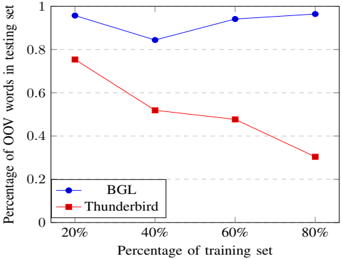
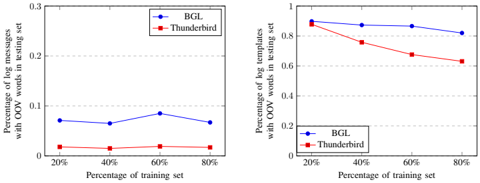
- An empirical study on BGL and Thunderbird found that existing log parsers suffer from OOV words and semantic misunderstanding; on a 60/40 BGL split, 94.12% of unique testing words were unseen in training, and these OOV words produced 1,304 unseen log events, accounting for 86.59% of testing log events.
- NeuralLog achieved F1-scores greater than 0.95 on all four public datasets: HDFS 0.98, BGL 0.98, Thunderbird 0.96, and Spirit 0.97; it was best on BGL, Thunderbird, and Spirit and comparable on HDFS.
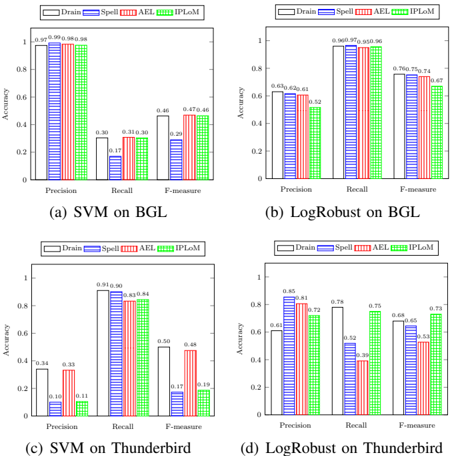
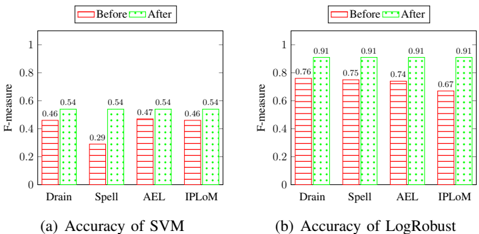
- Parsing errors degraded baselines: SVM with Drain achieved F1 0.46 on BGL and 0.50 on Thunderbird, while LogRobust achieved F1 0.75 on BGL and 0.68 on Thunderbird; manually fixing parsing errors improved LogRobust by 25% and SVM by 29% on average on BGL.
- Ablations showed NeuralLog’s raw-message encoding mattered: NeuralLog-Template reached F1 0.90 on BGL and 0.90 on Thunderbird versus NeuralLog’s 0.98 and 0.96, and NeuralLog-Word2Vec reached F1 0.80 on Thunderbird versus NeuralLog’s 0.96.
Methods
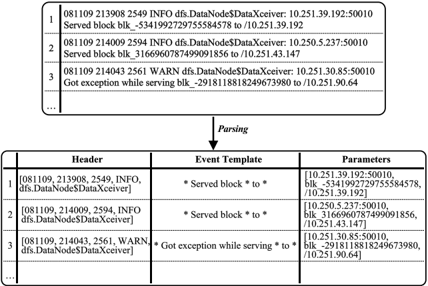
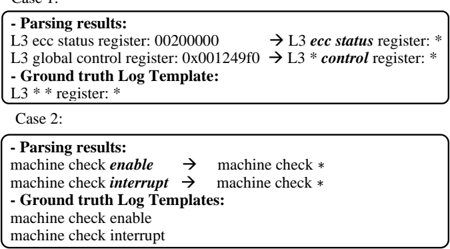
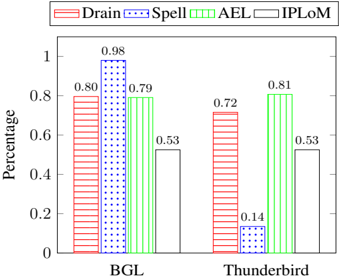
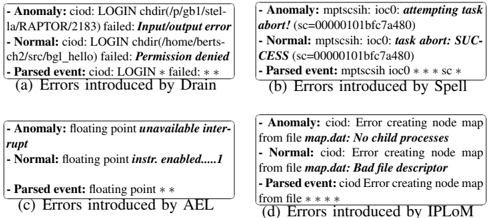
- The paper first empirically studies log parsing errors on BGL and Thunderbird (14,672,653 log messages total, 353,394 labeled anomalies), evaluating Drain, AEL, IPLoM, and Spell and their impact on SVM and LogRobust.
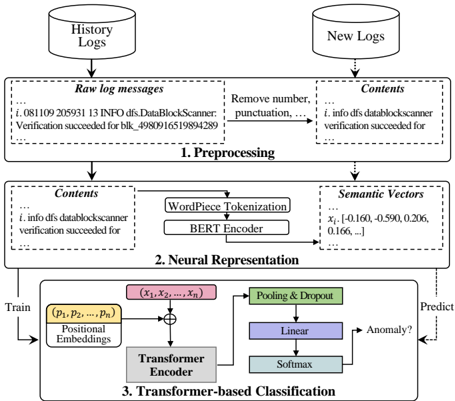
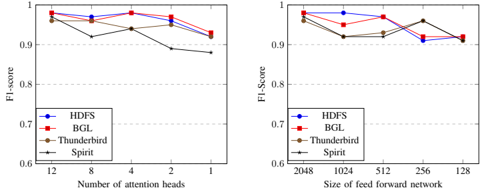
- NeuralLog preprocesses raw log messages, applies WordPiece tokenization, encodes messages with BERT base (12 transformer layers, 768 hidden units), adds positional encoding, and uses a Transformer encoder-based classifier (12 attention heads, feed-forward size 2048) for anomaly detection.
- Evaluation uses four public datasets: HDFS, BGL, Thunderbird, and Spirit. HDFS sequences are built by block ID with an 80/20 train-test split; BGL, Thunderbird, and Spirit use the first 80% of time-sorted messages for training and the last 20% for testing, with sliding windows of length 20 and step size 1; metrics are Precision, Recall, and F1-score.
Limitations
- Stated: the subject datasets come from a distributed system and supercomputers, so the number of systems is limited and does not cover all domains.
- Stated: tool comparison relies on implementations and default settings from prior work, and manual labeling of the public datasets may introduce noise.
- Stated: preprocessing removes numeric and special-character tokens, which may discard useful information such as node ID, task ID, IP address, or exit code. No additional limitations are evident from the text beyond those stated.
Model-written summary. Check it against the paper before relying on it.
Integrity signals
Registry
Cites
Statistics
Figures
Verification
Claims the paper makes
1 Valid · 8 Not valid · 18 Not checked · 105 Own results and interpretations
The cited sources that could be checked couldn’t confirm or dispute this claim.
In the paper
“Moreover, DeepLog [5], using the indexes of log templates to predict the next log event, considers all new log events as anomalies because they cannot be predicted by the model.”
What the sources say
- Could not verifycites [5] matched to “FastText.zip: Compressing text classification models” (2016) sourceExperimental — accuracy not yet measured
The Introduction (p. 1) and Related Work (p. 2) discuss text classification and model compression, not DeepLog. Searches for DeepLog and for unseen log templates and anomaly detection found no passage addressing whether new log events are treated as anomalies. (LLM, conf=0.76)
plainstates a cause- Asserted: passes — The authors put it forward as true.
- Checkable: passes — It can be checked against evidence.
- Load-bearing: passes — The paper’s conclusions depend on it.
- Based: passes — The paper gives a reason why it holds.
- Could not verify
The cited sources that could be checked couldn’t confirm or dispute this claim.
In the paper
“The main reason is that LogRobust utilizes the Drain log parser [24] to obtain log templates. As aforementioned in Section III-C, the Drain parser could inaccurately parse a noticeable number of log messages on BGL and Thunderbird datasets.”
What the sources say
- Could not verifycites [24] matched to “Generalizing Word Embeddings using Bag of Subwords” (2018) sourceExperimental — accuracy not yet measured
The citation is attached to the identification of Drain as the log parser LogRobust uses. Our copy’s Results and Conclusion discuss subword word embeddings, not Drain or LogRobust; searches for those names and for log-template parsing found no relevant passage. It also provides no evidence about parsing errors on BGL or Thunderbird. (LLM, conf=0.76)
hedgedstates a cause- Asserted: passes — The authors put it forward as true.
- Checkable: passes — It can be checked against evidence.
- Load-bearing: passes — The paper’s conclusions depend on it.
- Based: passes — The paper gives a reason why it holds.
- Could not verify
The cited sources that could be checked couldn’t confirm or dispute this claim.
In the paper
“Therefore, Log2Vec could not effectively handle some domain-specific words, such as technical terms or entity names [50], [51], [52].”
What the sources say
- Could not verifycites [50] matched to “Mimicking Word Embeddings using Subword RNNs” (2017) sourceExperimental — accuracy not yet measured
The Introduction (page not available) discusses the general difficulty word-embedding methods face with out-of-vocabulary terms. Searches for Log2Vec, domain-specific words, technical terms, and entity names found no passage assessing whether Log2Vec handles those words effectively. (LLM, conf=0.78)
- Could not verifycites [51] matched to “LogBERT: Log Anomaly Detection via BERT” (2021) sourceExperimental — accuracy not yet measured
The References (p. 11) list Log2vec, but the paper does not describe its ability to handle domain-specific words. Searches for Log2vec alongside technical terms, entity names, and vocabulary limitations found no passage addressing the claimed limitation. (LLM, conf=0.76)
- Could not verifycites [52] matched to “Decoupled Weight Decay Regularization” (2017) sourceExperimental — accuracy not yet measured
Section 4.2 (p. 6) examines weight decay in SGD and Adam, while Section 4.5 (p. 8) discusses applications of AdamW. Searches for Log2Vec, domain-specific words, technical terms, and entity names found no passage addressing whether Log2Vec handles those words effectively. (LLM, conf=0.76)
hedged- Asserted: passes — The authors put it forward as true.
- Checkable: passes — It can be checked against evidence.
- Load-bearing: passes — The paper’s conclusions depend on it.
- Based: passes — The paper gives a reason why it holds.
- Could not verify
The cited sources support only part of this claim — read each source’s verdict below.
In the paper
“However, it is hard to extract contextual information from characters to form meaningful words [50], [51], [52].”
What the sources say
- Partly supportedcites [50] matched to “Mimicking Word Embeddings using Subword RNNs” (2017) sourceExperimental — accuracy not yet measured
The Introduction (page unavailable) says character-based word models struggle in some settings, including where the mapping from form to meaning is complex. It does not say that extracting contextual information from characters is generally hard; the claim extends a specific limitation to a broader one. (LLM, conf=0.78)
- Could not verifycites [51] matched to “LogBERT: Log Anomaly Detection via BERT” (2021) sourceExperimental — accuracy not yet measured
The Framework (pp. 3–4) describes extracting log keys from log messages and learning contextual relations among those keys. The Introduction (p. 1) discusses a different difficulty: RNNs do not encode context from both sides of a log entry. Searches for character-level context and forming words found no passage addressing the claimed difficulty. (LLM, conf=0.76)
- Could not verifycites [52] matched to “Decoupled Weight Decay Regularization” (2017) sourceExperimental — accuracy not yet measured
Section 4.3 (p. 7) discusses AdamW’s generalization, and Section 4.5 (p. 8) mentions its use in natural-language-understanding models. Neither addresses the difficulty of extracting context from characters to form words. Searches for the claim’s wording and for character-level word formation found no supporting passage. (LLM, conf=0.76)
plain- Asserted: passes — The authors put it forward as true.
- Checkable: passes — It can be checked against evidence.
- Load-bearing: passes — The paper’s conclusions depend on it.
- Based: passes — The paper gives a reason why it holds.
- Partly supported
The cited sources that could be checked couldn’t confirm or dispute this claim.
In the paper
“Besides, Log2Vec also adopts MIMICK [49], an approach of inducing word embedding from character-level features to handle OOV words to improve anomaly detection performance.”
What the sources say
- Could not verifycites [49] matched to “Detecting large-scale system problems by mining console logs” (2009) sourceExperimental — accuracy not yet measured
The Workflow (p. 4) and Anomaly Detection (p. 8) describe feature vectors and PCA-based log anomaly detection, not Log2Vec. Searches for MIMICK, OOV words, and character-level word embeddings found no passage addressing the claimed adoption or its effect on performance. (LLM, conf=0.78)
plainstates a cause- Asserted: passes — The authors put it forward as true.
- Checkable: passes — It can be checked against evidence.
- Load-bearing: passes — The paper’s conclusions depend on it.
- Based: passes — The paper gives a reason why it holds.
- Could not verify
79 more claims
Create a free account to see all 132 claims and every source verdict.
- It may state two separate claims as one. 30
- Probably not a substantial claim. 18
- The quote only partly states this claim. 4
Claims other papers make about this one
Each is checked against this paper’s own text: does it say what the citing paper says it does?
The cited source says what the claim attributes to it.
In the citing paper
“Logs are a crucial source of information in software systems, capturing system runtime behavior and aiding in software engineering tasks like program comprehension [1], [2], anomaly detection [3]- [6], and failure diagnosis [7], [8].”
From Practitioners’ expectations on log anomaly detection (2025) · cites this paper as [3]
Citations
Cites
Vaswani, A., Shazeer, N., Parmar, N., Uszkoreit, J., Jones, L., Gomez, A. N., Kaiser, L., & Polosukhin, I. (2017) · arXiv · doi:10.48550/arxiv.1706.03762 · Cited by 120,404
Exploiting Generative AI to Scale up Intelligent Tutoring Systems
Jakubův, J., Chvalovský, K., Goertzel, Z., Kaliszyk, C., Olšák, M., Piotrowski, B., Schulz, S., Suda, M., & Urban, J. (2023) · DROPS (Schloss Dagstuhl – Leibniz Center for Informatics) · doi:10.4230/lipics.itp.2023.19 · Cited by 76,658
BERT: Pre-training of Deep Bidirectional Transformers for Language Understanding
Devlin, J., Chang, M.-W., Lee, K., & Toutanova, K. (2018) · arXiv · doi:10.48550/arxiv.1810.04805 · Cited by 73,173
BERT: Pre-training of Deep Bidirectional Transformers for Language Understanding
Devlin, J., Chang, M.-W., Lee, K., & Toutanova, K. (2019) · Proceedings of the 2019 Conference of the North American Chapter of the Association for Computational Linguistics: Human Language Technologies, Volume 1 (Long and Short Papers) · doi:10.18653/v1/n19-1423 · Cited by 54,325
Efficient Estimation of Word Representations in Vector Space
Mikolov, T., Chen, K., Corrado, G., & Dean, J. (2013) · arXiv · doi:10.48550/arxiv.1301.3781 · Cited by 26,568 · cited 1×
“adopt Word2vec model [13] to obtain embedding vectors of log events, then applied an LSTM model to detect anomalies.”
MethodDecoupled Weight Decay Regularization
Loshchilov, I., & Hutter, F. (2017) · arXiv · doi:10.48550/arxiv.1711.05101 · Cited by 12,522
Term-weighting approaches in automatic text retrieval
Salton, G., & Buckley, C. (1988) · Information Processing & Management · doi:10.1016/0306-4573(88)90021-0 · Cited by 9,740 · cited 3×
“LogRobust [8] incorporates a pre-trained Word2vec model, namely FastText [31], and combines with TF-IDF weight [32] for learning the representation vectors of log templates, which are generated by Drain [24].”
MethodUnsupervised Cross-lingual Representation Learning at Scale
Conneau, A., Khandelwal, K., Goyal, N., Chaudhary, V., Wenzek, G., Guzmán, F., Grave, E., Ott, M., Zettlemoyer, L., & Stoyanov, V. (2020) · Proceedings of the 58th Annual Meeting of the Association for Computational Linguistics · doi:10.18653/v1/2020.acl-main.747 · Cited by 5,637 · cited 4×
“For GPT2 and Roberta encoders, we use their base model with 12 layers, 12 attention heads, and 768 hidden units.”
MethodInfluentialGoogle's Neural Machine Translation System: Bridging the Gap between Human and Machine Translation
Wu, Y., Schuster, M., Chen, Z., Le, Q. V., Norouzi, M., Macherey, W., Krikun, M., Cao, Y., Gao, Q., Macherey, K., et al. (2016) · arXiv · doi:10.48550/arxiv.1609.08144 · Cited by 5,319 · cited 4×
“In our work, we adopt the WordPiece tokenization [36], [37], which is widely used in many recent language modeling studies [38], [39], [40].”
MethodInfluentialDistributed Representations of Sentences and Documents
Le, Q. V., & Mikolov, T. (2014) · arXiv (Cornell University) · doi:10.48550/arxiv.1405.4053 · Cited by 4,934 · cited 5×
“Conventionally, words of log content are further transformed into vectors by using Word2Vec [42], then the representation vector of each sentence would be calculated based on the word vectors.”
MethodInfluential
Research works printed but not linked: 2
- radford, 2019, Language models are unsupervised multitask learners, OpenAIRE blog, 1, 9
- 2021, Bert pretrained models
Cited by
Log-based anomaly detection with deep learning: how far are we?
Le, V.-H., & Zhang, H. (2022) · Proceedings of the 44th International Conference on Software Engineering · doi:10.1145/3510003.3510155 · Cited by 257
“[26] found that log parsing errors can lead to many incorrect log events, thus downgrading anomaly detection performance.”
BackgroundMethodInfluentialSelf-citationEadro: An End-to-End Troubleshooting Framework for Microservices on Multi-source Data
Lee, C., Yang, T., Chen, Z., Su, Y., & Lyu, M. R. (2023) · 2023 IEEE/ACM 45th International Conference on Software Engineering (ICSE) · doi:10.1109/icse48619.2023.00150 · Cited by 149
“Previous anomaly detection approaches are usually based on system logs [58]–[62] or KPIs [63]–[67], or both [68], targeting traditional distributed systems without complex invocation relationships.”
Log Parsing with Prompt-based Few-shot Learning
Le, V.-H., & Zhang, H. (2023) · 2023 IEEE/ACM 45th International Conference on Software Engineering (ICSE) · doi:10.1109/icse48619.2023.00204 · Cited by 129
“Recent studies [16], [33] demonstrate that these pretrained models can be applied to understand the semantic meanings of log messages, thus favouring many downstream log analytics tasks.”
BackgroundMethodInfluentialSelf-citationLogFiT: Log Anomaly Detection Using Fine-Tuned Language Models
Almodovar, C., Sabrina, F., Karimi, S., & Azad, S. (2024) · IEEE Transactions on Network and Service Management · doi:10.1109/tnsm.2024.3358730 · Cited by 111
“Many of the approaches [8], [9], [11], [12] require log parsing, while recent studies [11], [16] suggested that log parsing can reduce accuracy.”
BackgroundMethodInfluentialBrain: Log Parsing With Bidirectional Parallel Tree
Yu, S., He, P., Chen, N., & Wu, Y. (2023) · IEEE Transactions on Services Computing · doi:10.1109/tsc.2023.3270566 · Cited by 126
“, the accuracy of log-based anomaly detection can decrease by more than 20% with just a few parsing errors [15].”
BackgroundBERT-Log: Anomaly Detection for System Logs Based on Pre-trained Language Model
Chen, S., & Liao, H. (2022) · Applied Artificial Intelligence · doi:10.1080/08839514.2022.2145642 · Cited by 87
“NeuralLog (Le and Zhang 2021) proposes a novel log-based anomaly detection approach based on a Transformer-based classification model that does not require log parsing.”
MethodGenerative AI for self-adaptive systems: State of the art and research roadmap
Li, J., Zhang, M., Li, N., Weyns, D., Jin, Z., & Tei, K. (2024) · ACM Transactions on Autonomous and Adaptive Systems · doi:10.1145/3686803 · Cited by 77
Benchmarking Large Language Models for Log Analysis, Security, and Interpretation
Karlsen, E., Luo, X., Zincir-Heywood, N., & Heywood, M. (2024) · Journal of Network and Systems Management · doi:10.1007/s10922-024-09831-x · Cited by 71
“NO RoBERTa Hongchen Guo [18] Drain NO BERT Le [19] Drain NO BERT”
Heterogeneous Anomaly Detection for Software Systems via Semi-supervised Cross-modal Attention
Lee, C., Yang, T., Chen, Z., Su, Y., Yang, Y., & Lyu, M. R. (2023) · 2023 IEEE/ACM 45th International Conference on Software Engineering (ICSE) · doi:10.1109/icse48619.2023.00148 · Cited by 68
“Many efforts have been devoted to automated anomaly detection for large-scale system reliability insurance based on logs and metrics [46]–[53].”
LogEncoder: Log-Based Contrastive Representation Learning for Anomaly Detection
Qi, J., Luan, Z., Huang, S., Fung, C., Yang, H., Li, H., Zhu, D., & Qian, D. (2023) · IEEE Transactions on Network and Service Management · doi:10.1109/tnsm.2023.3239522 · Cited by 75
“Over the years, many methods have been proposed to automatically detect system log anomalies [2], [3], [4], [5].”
MethodDeep Learning or Classical Machine Learning? An Empirical Study on Log-Based Anomaly Detection
Yu, B., Yao, J., Fu, Q., Zhong, Z., Xie, H., Wu, Y., Ma, Y., & He, P. (2024) · Proceedings of the IEEE/ACM 46th International Conference on Software Engineering · doi:10.1145/3597503.3623308 · Cited by 65
“To choose the representative approaches, we reviewed a series of experience reports [16, 33], empirical study [43], surveys [32, 39], and the SOTA methods [21, 42, 52, 85] on log anomaly detection.”
MethodInfluentialAI for DevSecOps: A Landscape and Future Opportunities
Fu, M. C., Pasuksmit, J., & Tantithamthavorn, C. K. (2025) · ACM Transactions on Software Engineering and Methodology · doi:10.1145/3712190 · Cited by 113
“Some existing approaches, as discovered by Le and Zhang [97], rely on a log parser to convert log messages into log events, which are then used to create log sequences.”
CAN-BERT do it? Controller Area Network Intrusion Detection System based on BERT Language Model
Alkhatib, N., Mushtaq, M., Ghauch, H., & Danger, J. (2022) · IEEE/ACS International Conference on Computer Systems and Applications (AICCSA) · doi:10.1109/aiccsa56895.2022.10017800 · Cited by 99
“Inspired by its outstanding performance in modeling sequential data, BERT is recently employed for sequence anomaly detection [6] [7] [8] [9] [10].”
LogGD: Detecting Anomalies from System Logs with Graph Neural Networks
Xie, Y., Zhang, H., & Babar, M. A. (2022) · IEEE International Conference on Software Quality, Reliability and Security (QRS) · doi:10.1109/qrs57517.2022.00039 · Cited by 96
“To evaluate the effectiveness of the approaches, we utilize precision/recall/F1 score as the metrics, which are widely used in many studies [3], [20], [30].”
BackgroundMethodInfluentialSelf-citationImpact of log parsing on deep learning-based anomaly detection
Khan, Z. A., Shin, D., Bianculli, D., & Briand, L. C. (2024) · Empirical Software Engineering · doi:10.1007/s10664-024-10533-w · Cited by 49
“In the future, to develop better log parsing techniques targeting anomaly detection, it would beneficial to focus on distinguishability, which has not been the case so far.”
BackgroundMethodInfluentialLog Parsing: How Far Can ChatGPT Go?
Le, V.-H., & Zhang, H. (2023) · 2023 38th IEEE/ACM International Conference on Automated Software Engineering (ASE) · doi:10.1109/ase56229.2023.00206 · Cited by 51
“Recent studies adopt pre-trained language models for representing [4], [18], [19] log data.”
BackgroundMethodSelf-citationMLog: Mogrifier LSTM-Based Log Anomaly Detection Approach Using Semantic Representation
Fu, Y., Liang, K., & Xu, J. (2023) · IEEE Transactions on Services Computing · doi:10.1109/tsc.2023.3289488 · Cited by 49
Twin Graph-Based Anomaly Detection via Attentive Multi-Modal Learning for Microservice System
Huang, J., Yang, Y., Yu, H., Li, J., & Zheng, X. (2023) · 2023 38th IEEE/ACM International Conference on Automated Software Engineering (ASE) · doi:10.1109/ase56229.2023.00138 · Cited by 50
“Before delving into the details of our model, we first introduce different attention mechanisms used in the following sections.”
MethodInterpretable Online Log Analysis Using Large Language Models with Prompt Strategies
Liu, Y., Tao, S., Meng, W., Wang, J., Ma, W., Chen, Y., Zhao, Y., Yang, H., & Jiang, Y. (2024) · Proceedings of the 32nd IEEE/ACM International Conference on Program Comprehension · doi:10.1145/3643916.3644408 · Cited by 47
“Le et al. [16] use a BERT encoder to directly recognize anomalies in raw logs without the need for log parsing.”
BackgroundResultLLMeLog: An Approach for Anomaly Detection based on LLM-enriched Log Events
He, M., Jia, T., Duan, C., Cai, H., Li, Y., & Huang, G. (2024) · Proceedings/Proceedings - International Symposium on Software Reliability Engineering · doi:10.1109/issre62328.2024.00023 · Cited by 79
“With BERT as the embedding model, the overall anomaly detection precision and recall increase 8% and 9% [5].”
InfluentialRAGLog: Log Anomaly Detection using Retrieval Augmented Generation
Pan, J. Z., Wong, S. L., & Yidi, Y. (2024) · IEEE World Forum on Public Safety Technology (WF-PST) · doi:10.1109/wfpst58552.2024.00034 · Cited by 83
MetaLog: Generalizable Cross-System Anomaly Detection from Logs with Meta-Learning
Zhang, C., Jia, T., Shen, G., Zhu, P., & Li, Y. (2024) · ACM/IEEE International Conference on Software Engineering: Companion Proceedings (ICSE-Companion) · doi:10.1145/3597503.3639205 · Cited by 64
“Block (d) is PLELog, LogRobust PCA [9, 43] and NeuralLog [25] under zero-shot generalization setting, which is trained only by source dataset splits (30% of log sessions of HDFS in Table 1 and all log sessions of BGL in Table 2) but directly tested on target dataset splits.”
MethodLLM-LADE: Large language model-based log anomaly detection with explanation
Zhang, Z., Li, S., Zhang, L., Ye, J., Hu, C., & Yan, L. (2025) · Knowledge-Based Systems · doi:10.1016/j.knosys.2025.114064 · Cited by 42
On the effectiveness of log representation for log-based anomaly detection
Wu, X., Li, H., & Khomh, F. (2023) · Empirical Software Engineering · doi:10.1007/s10664-023-10364-1 · Cited by 53
“Recent work (Le and Zhang 2021) explores omitting the parsing process and extracting and representing information directly from the raw log data.”
BackgroundMethodResultInfluentialKnowLog: Knowledge Enhanced Pre-trained Language Model for Log Understanding
Ma, L., Yang, W., Xu, B., Jiang, S., Fei, B., Liang, J., Zhou, M., & Xiao, Y. (2024) · Proceedings of the IEEE/ACM 46th International Conference on Software Engineering · doi:10.1145/3597503.3623304 · Cited by 35
“Inspired by the success of these pre-trained models in NLP, many works [12, 16, 20, 25, 27, 32, 65] based on pre-trained language models have been proposed to understand logs, improving the performance of a variety of downstream tasks.”
MethodA Review of Advancements and Applications of Pre-Trained Language Models in Cybersecurity
Liu, Z. (2024) · International Symposium on Digital Forensics and Security (ISDFS) · doi:10.1109/isdfs60797.2024.10527236 · Cited by 56
“Le and Zhang [94] proposed NeuralLog, a novel approach that forgoes log parsing by extracting semantic vectors from raw log messages for anomaly detection using a transformer-based model, achieving high accuracy.”
BackgroundAnomaly Detection in Log Files Using Selected Natural Language Processing Methods
Ryciak, P., Wasielewska, K., & Janicki, A. (2022) · Applied Sciences · doi:10.3390/app12105089 · Cited by 54
Early Exploration of Using ChatGPT for Log-based Anomaly Detection on Parallel File Systems Logs
Egersdoerfer, C., Zhang, D., & Dai, D. (2023) · Proceedings of the 32nd International Symposium on High-Performance Parallel and Distributed Computing · doi:10.1145/3588195.3595943 · Cited by 34
“The results are compared to those of NeuralLog, DeepLog, and SentiLog.”
ResultFace It Yourselves: An LLM-Based Two-Stage Strategy to Localize Configuration Errors via Logs
Shan, S., Huo, Y., Su, Y., Li, Y., Li, D., & Zheng, Z. (2024) · ACM SIGSOFT International Symposium on Software Testing and Analysis (ISSTA) · doi:10.1145/3650212.3652106 · Cited by 59
“However, run-time variables provide valuable resources, allowing us to explore software system status further [16, 21].”
BackgroundInvestigating and improving log parsing in practice
Fu, Y., Yan, M. L., Xu, J., Li, J., Liu, Z., Zhang, X., & Yang, D. (2022) · ACM Joint European Software Engineering Conference and Symposium on the Foundations of Software Engineering (ESEC/FSE) · doi:10.1145/3540250.3558947 · Cited by 47
“, [3] [24] [27] [37] [45]), diagnose failures (e.”
Robust and Transferable Log-based Anomaly Detection
Jia, P., Cai, S., Ooi, B. C., Wang, P., & Xiong, Y. (2023) · Proceedings of the ACM on Management of Data · doi:10.1145/3588918 · Cited by 47
“Some similar variants include PLELog [64] and NeuralLog [26], where PLELog replaces LSTMs with GRUs [8] to process the sequential vector, and NeuralLog introduces Transformer [62] to combat out-of-vocabulary words and semantic misunderstandings when extracting semantic vectors.”
MethodLogSummary: Unstructured Log Summarization for Software Systems
Meng, W., Zaiter, F., Zhang, Y., Liu, Y., Zhang, S., Tao, S., Zhu, Y., Han, T., Zhao, Y., Wang, E., et al. (2023) · IEEE Transactions on Network and Service Management · doi:10.1109/tnsm.2023.3236994 · Cited by 32
An Assessment of ChatGPT on Log Data
Mudgal, P., & Wouhaybi, R. H. (2023) · Communications in computer and information science · doi:10.1007/978-981-99-7587-7_13 · Cited by 56
Xie, Y., Zhang, H., & Babar, M. A. (2024) · Proceedings of the ACM on software engineering. · doi:10.1145/3660800 · Cited by 40
“Modern software-intensive systems have grown notably in scale and complexity [29, 43, 57, 62, 65].”
InfluentialSelf-citationOneLog: towards end-to-end software log anomaly detection
Hashemi, S., & Mäntylä, M. (2024) · Automated Software Engineering · doi:10.1007/s10515-024-00428-x · Cited by 24
“HDFS only contains less than 15 event types, while the number is much higher for Hadoop, BGL, and Thun-derbird, resulting in indistinguishable colors in the visualization.”
InfluentialDeep learning-based anomaly detection for precision field crop protection
Cheng, W., Shan, Y., & Zhen, M. (2025) · Frontiers in Plant Science · doi:10.3389/fpls.2025.1576756 · Cited by 36
“Precision crop protection often requires integrating data from multiple sources, such as remote sensing, IoT devices, and weather stations, to effectively detect and respond to anomalies Le and Zhang (2021).”
A Semisupervised Approach for Industrial Anomaly Detection via Self-Adaptive Clustering
Ma, X., Keung, J., He, P., Xiao, Y., Yu, X., & Li, Y. (2023) · IEEE Transactions on Industrial Informatics · doi:10.1109/tii.2023.3280246 · Cited by 27
“To avoid the errors caused by log parsing (e.g., Drain, Spell, AEL, and IPLoM) due to the lack of semantic information and semantic misunderstanding [5], we keep the full information of each log message.”
BackgroundMethodInfluentialTele-Knowledge Pre-training for Fault Analysis
Chen, Z., Wen, Z., Huang, Y., Chen, M., Geng, Y., Yu, H., Bi, Z., Zhang, Y., Yao, Z., Song, W., et al. (2023) · IEEE International Conference on Data Engineering (ICDE) · doi:10.1109/icde55515.2023.00265 · Cited by 44
Yang, L., Chen, J., Gao, S., Gong, Z., Zhang, H., Kang, Y., & Li, H. H. (2024) · ACM Transactions on Software Engineering and Methodology · doi:10.1145/3644386 · Cited by 36
“Log-based anomaly detection is one of the most important tasks in automated log analysis, which aims to automatically detect software anomalies in time based on log data so as to reduce the loss caused by these anomalies [9, 15, 34, 37, 39, 40, 44, 64, 67, 70, 76].”
BackgroundMethodInfluentialSelf-citationPractitioners’ expectations on log anomaly detection
Ma, X., Li, Y., Keung, J., Yu, X., Zou, H., Yang, Z., Sarro, F., & Barr, E. T. (2025) · IEEE Transactions on Software Engineering · doi:10.1109/tse.2025.3586700 · Cited by 21
“L OGS are a crucial source of information in software systems, capturing system runtime behavior and aiding in software engineering tasks like program comprehension [1], [2], anomaly detection [3], [4], [5], [6], and failure diagnosis [7], [8].”
Xiao, R., Li, W., Lu, J., & Jin, S. (2024) · IEEE Transactions on Network and Service Management · doi:10.1109/tnsm.2024.3400283 · Cited by 23
“Many automated log-based anomaly detection methods have been proposed [4], [6], [7], [8], [9], [10], [11], [12], [13], [14], [15], [16] in recent years.”
BackgroundMethodInfluentialAnomaly Detection on Interleaved Log Data With Semantic Association Mining on Log-Entity Graph
Chu, G., Wang, J., Qi, Q., Sun, H., Zhuang, Z., He, B., Jing, Y., Zhang, L., & Liao, J. (2025) · IEEE Transactions on Software Engineering · doi:10.1109/tse.2025.3527856 · Cited by 29
“Recent work such as [10], [11], [12] adopts word embedding techniques and sequence models (e.g., Transformers [13]) for supervised anomaly detection.”
InfluentialA comprehensive study of machine learning techniques for log-based anomaly detection
Ali, S., Boufaied, C., Bianculli, D., Branco, P., & Briand, L. (2025) · Empirical Software Engineering · doi:10.1007/s10664-025-10669-3 · Cited by 50
Zhang, B., Zhang, H., Le, V.-H., Moscato, P., & Zhang, A. (2022) · Automated Software Engineering · doi:10.1007/s10515-022-00370-w · Cited by 24
Self-citationClusterLog: Clustering Logs for Effective Log-based Anomaly Detection
Egersdoerfer, C., Zhang, D., & Dai, D. (2022) · IEEE/ACM Workshop on Fault Tolerance for HPC at eXtreme Scale (FTXS) · doi:10.1109/ftxs56515.2022.00006 · Cited by 30
“The common process of doing so is for logs to be parsed and processed first, then their normal sequence to be learned by sequencebased pattern detection models such as LSTM [18].”
BackgroundInfluentialEvLog: Identifying Anomalous Logs over Software Evolution
Huo, Y., Lee, C. Q. E., Su, Y., Shan, S., Liu, J., & Lyu, M. R.-T. (2023) · Proceedings/Proceedings - International Symposium on Software Reliability Engineering · doi:10.1109/issre59848.2023.00018 · Cited by 38
“ability for many software engineering tasks, such as log-based anomaly detection [24] and code comprehension [25].”
BackgroundLogLG: Weakly Supervised Log Anomaly Detection via Log-Event Graph Construction
Guo, H., Guo, Y., Yang, J., Liu, J., Li, Z., Zheng, T., Zheng, L., Hou, W., & Zhang, B. (2023) · Lecture notes in computer science · doi:10.1007/978-3-031-30678-5_36 · Cited by 32
“In Figure 1, valuable information (Permission denied and Input/output error) is lost after parsing, and these two log events have the same template (ciod: LOGIN ∗ failed: ∗∗) while they come from different classes, which leads to the confusion of semantics as discussed in (Le and Zhang 2021).”
BackgroundMethodSystematic Evaluation of Deep Learning Models for Log-based Failure Prediction
Hadadi, F., Dawes, J. H., Shin, D., Bianculli, D., & Briand, L. (2024) · Empirical Software Engineering · doi:10.1007/s10664-024-10501-4 · Cited by 27
LogRAG: Semi-Supervised Log-based Anomaly Detection with Retrieval-Augmented Generation
Zhang, W., Zhang, Q., Yu, E., Ren, Y., Meng, Y., Qiu, M., & Wang, J. (2024) · IEEE International Conference on Web Services (ICWS) · doi:10.1109/icws62655.2024.00129 · Cited by 19
Leveraging RAG-Enhanced Large Language Model for Semi-Supervised Log Anomaly Detection
Zhang, W., Zhang, Q., Yu, E., Ren, Y., Meng, Y., Qiu, M., & Wang, J. (2024) · Proceedings/Proceedings - International Symposium on Software Reliability Engineering · doi:10.1109/issre62328.2024.00026 · Cited by 37
“NeuralLog [15] detects anomalies in log data by directly converting raw log messages into semantic vectors and using a Transformer-based model, bypassing the need for log parsing and improving accuracy with OOV (out-of-vocabulary) words.”
InfluentialAutomatic Parsing and Utilization of System Log Features in Log Analysis: A Survey
Ma, J., Liu, Y., Wan, H., & Sun, G. (2023) · Applied Sciences · doi:10.3390/app13084930 · Cited by 33
AFALog: A General Augmentation Framework for Log-based Anomaly Detection with Active Learning
Duan, C., Jia, T., Cai, H., Li, Y., & Huang, G. (2023) · 2023 IEEE 34th International Symposium on Software Reliability Engineering (ISSRE) · doi:10.1109/issre59848.2023.00068 · Cited by 17
“In our empirical study, we implement the aforementioned unsupervised anomaly detection models using the four most commonly used sequence prediction models (GRU [5], [14]– [17], LSTM [7], [18]–[21], BiLSTM [22]–[26], Transformer [27]–[31]).”
MethodParameter-Efficient Log Anomaly Detection based on Pre-training model and LORA
He, S., Lei, Y., Zhang, Y., Xie, K., & Sharma, P. K. (2023) · Proceedings/Proceedings - International Symposium on Software Reliability Engineering · doi:10.1109/issre59848.2023.00038 · Cited by 23
“NeuralLog [6] utilizes a pre-training model to extract semantic vectors of raw log messages.”
BackgroundMethodLog Sequence Anomaly Detection Based on Template and Parameter Parsing via BERT
Chai, X., Zhang, H., Zhang, J., Sun, Y., & Das, S. K. (2024) · IEEE Transactions on Dependable and Secure Computing · doi:10.1109/tdsc.2024.3428538 · Cited by 26
“To avoid information loss caused by log parsing errors, NeuralLog [5] directly extracts semantic vectors from original log messages for anomaly detection.”
Self-citationScalaLog: Scalable Log-Based Failure Diagnosis Using LLM
Zhang, L., Jia, T., Jia, M., Wu, Y., Liu, H., & Li, Y. (2025) · IEEE International Conference on Acoustics Speech and Signal Processing · doi:10.1109/icassp49660.2025.10888670 · Cited by 42
“We compare ScalaLog with both graph-based models, including LogKG [10] and LogClus-ter [9], as well as deep learning-based models, including Cloud19 [13] and NeuralLog [12].”
AutoLog: A Log Sequence Synthesis Framework for Anomaly Detection
Huo, Y., Li, Y., Su, Y., He, P., Xie, Z., & Lyu, M. R.-T. (2023) · IEEE/ACM International Conference on Automated Software Engineering (ASE) · doi:10.1109/ase56229.2023.00133 · Cited by 30
Ma, X., Zou, H., He, P., Keung, J., Li, Y., Yu, X., & Sarro, F. (2024) · IEEE Transactions on Software Engineering · doi:10.1109/tse.2024.3513413 · Cited by 22
“We use four commonly used evaluation metrics Recall, Precision, Specificity, and F1-score in previous DLLAD studies [1], [2], [12], [35].”
InfluentialLearning Representations on Logs for AIOps
Gupta, P., Kumar, H., Kar, D., Bhukar, K., Aggarwal, P., & Mohapatra, P. (2023) · IEEE ... International Conference on Cloud Computing · doi:10.1109/cloud60044.2023.00026 · Cited by 36
“LogBERT, BERT-Log, NeuralLog are BERT-based models trained specifically for the task of log anomaly detection [43]–[45].”
MethodXie, X., Jian, S., Huang, C., Yu, F., & Deng, Y. (2023) · Proceedings/Proceedings - International Symposium on Software Reliability Engineering · doi:10.1109/issre59848.2023.00015 · Cited by 18
“Except for the methods using embedding generated from templates, the semantic embedding-based method creating embedding for each log regardless of its template or format is also studied in work [22].”
BackgroundMethodInfluentialUnderstanding Solidity Event Logging Practices in the Wild
Li, L., Liang, Y., Liu, Z., & Yu, Z. (2023) · ACM Joint European Software Engineering Conference and Symposium on the Foundations of Software Engineering (ESEC/FSE) · doi:10.1145/3611643.3616342 · Cited by 19
“Le et al. [19] propose a log-based anomaly detection method that does not demand parse of log messages.”
MethodDemystifying and Extracting Fault-indicating Information from Logs for Failure Diagnosis
Huang, J., Jiang, Z., Liu, J., Huo, Y., Gu, J., Chen, Z., Feng, C., Dong, H., Yang, Z., & Lyu, M. R.-T. (2024) · Proceedings/Proceedings - International Symposium on Software Reliability Engineering · doi:10.1109/issre62328.2024.00055 · Cited by 30
“This is achieved by leveraging PLMs and prompt-tuning, which have been proven effective in recent log studies [29], [42].”
Pedroso, D. F., de Almeida, L., Pulcinelli, L. E. G., Pulcinelli, G., Akihiro, W., Aisawa, A., Dutra, I., & Bruschi, S. M. (2025) · IEEE Access · doi:10.1109/access.2025.3565220 · Cited by 22
“The preprocessing of logs, such as log parsing, grouping, and representation, can introduce significant overhead [12].”
Large Language Models for Security Operations Centers: A Comprehensive Survey
Habibzadeh, A., Feyzi, F., & Atani, R. E. (2026) · Journal of Electrical and Computer Engineering · doi:10.1155/jece/3383674 · Cited by 13
“Unseen or slightly modified log sentences often fail to align with existing templates, which can lead to failures or degraded performance [204].”
Anomaly Detection in Logs Using Deep Learning
Aziz, A., & Munir, K. (2024) · IEEE Access · doi:10.1109/access.2024.3506332 · Cited by 23
“Anomaly detection is a significant challenge in a variety of industries, including manufacturing, medical imaging, and cybersecurity [1].”
SaRLog: Semantic-Aware Robust Log Anomaly Detection via BERT-Augmented Contrastive Learning
Jilcha, L. A., Kim, D.-H., & Kwak, J. (2024) · IEEE Internet of Things Journal · doi:10.1109/jiot.2024.3386183 · Cited by 19
“Recent studies highlight the widespread adoption of BERT and its variants for generating contextual and semantically meaningful representations for log-based anomaly detection tasks [11], [12], [13].”
BackgroundMethodInfluentialAutomated Log Analysis and Anomaly Detection Using Machine Learning
Shah, A. H., Pasha, D., Zadeh, E. H., & Konur, S. (2022) · Frontiers in artificial intelligence and applications · doi:10.3233/faia220378 · Cited by 18
“[6] uses semantic relationships between logs to find those that are anomalous.”
BackgroundMa, L., Yang, W., Li, Y., Fei, B., Zhou, M., Li, S., Jiang, S., Xu, B., & Xiao, Y. (2026) · ACM Transactions on Software Engineering and Methodology · doi:10.1145/3749840 · Cited by 29
“Following previous anomaly detection works [47, 48, 74], we use Precision, Recall, and F1 on the anomaly class as evaluation metrics.”
InfluentialCharacterizing and Mitigating Anti-patterns of Alerts in Industrial Cloud Systems
Yang, T., Shen, J., Su, Y., Ren, X., Yang, Y., & Lyu, M. R.-T. (2022) · International Conference on Dependable Systems & Networks/Proceedings · doi:10.1109/dsn53405.2022.00047 · Cited by 15
Drill: Log-based Anomaly Detection for Large-scale Storage Systems Using Source Code Analysis
Zhang, D., Egersdoerfer, C., Mahmud, T., Zheng, M., & Dai, D. (2023) · IEEE International Parallel and Distributed Processing Symposium (IPDPS) · doi:10.1109/ipdps54959.2023.00028 · Cited by 15
“Hence, many recent studies have focused on leveraging natural language models to turn each runtime log into a vector with enriched features [15], [31], [27].”
BackgroundMethodInfluentialTime Machine: Generative Real-Time Model for Failure (and Lead Time) Prediction in HPC Systems
Alharthi, K. A., Jhumka, A., Di, S., Gui, L., Cappello, F., & McIntosh‐Smith, S. (2023) · International Conference on Dependable Systems & Networks/Proceedings · doi:10.1109/dsn58367.2023.00054 · Cited by 13
“These approaches rely on self-attention-based transformer-decoder [48], self-attention with different transformer-encoder variants [49], [50].”
MethodSpikeLog: Log-Based Anomaly Detection via Potential-Assisted Spiking Neuron Network
Qi, J., Luan, Z., Huang, S., Fung, C., Yang, H., & Qian, D. (2023) · IEEE Transactions on Knowledge and Data Engineering · doi:10.1109/tkde.2023.3347695 · Cited by 15
“(cid:2) NeuralLog [34] is a supervised log-based anomaly detection approach that bypasses log parsing errors.”
BackgroundLogLM: From Task-Based to Instruction-Based Automated Log Analysis
Liu, Y., Ji, Y., Tao, S., He, M., Meng, W., Zhang, S., Sun, Y., Xie, Y., Chen, B., & Yang, H. (2025) · IEEE/ACM International Conference on Software Engineering: Software Engineering in Practice (ICSE-SEIP) · doi:10.1109/icse-seip66354.2025.00041 · Cited by 45
“We designed an LLM-assisted workflow to transform log-label pairs and”
Detecting Anomalies in System Logs With a Compact Convolutional Transformer
Larisch, R., Vitay, J., & Hamker, F. H. (2023) · IEEE Access · doi:10.1109/access.2023.3323252 · Cited by 10
“It has been argued that splitting the dataset into templates and parameters can destroy the context between consecutive log sequences and that falsely created templates and parameter values lead to out-of-vocabulary word errors [10].”
BackgroundMethodResultInfluentialSeverity-Oriented Multiclass Drone Flight Logs Anomaly Detection
Silalahi, S., Ahmad, T., Studiawan, H., Anthi, E., & Williams, L. (2024) · IEEE Access · doi:10.1109/access.2024.3396926 · Cited by 13
“However, employing parsing can remove valuable information within the log messages [25].”
BackgroundMethodGiving Every Modality a Voice in Microservice Failure Diagnosis via Multimodal Adaptive Optimization
Lei, T., Zhang, S., Jia, Z., Sun, J., Ma, M., Li, Z., Sun, Y., Yang, C., Zhang, Y., & Pei, D. (2024) · IEEE/ACM International Conference on Automated Software Engineering (ASE) · doi:10.1145/3691620.3695489 · Cited by 41
“Inspired by NeuralLog[40], we use BERT [38] to obtain the semantic vectors for each log template: To obtain the log representation of a time window while reducing training costs, we sum the vectors in this window using their corresponding weights: Thus, a failure interval should have a log…”
Zhou, J., Ying, S., Wang, S., Zhao, D., Xiang, J., Liang, K., & Liu, P. (2025) · IEEE Transactions on Dependable and Secure Computing · doi:10.1109/tdsc.2025.3548050 · Cited by 17
“In recent years, deep learning-based log anomaly detection methods[3],[4],[5],[6],[7],[8]haveattractedwidespreadatten-tionduetotheirabilitytoautomaticallylearncomplexpatterns andrepresentationsfromlarge-scalelogdata.”
InfluentialWeakly-Supervised Log-Based Anomaly Detection with Inexact Labels via Multi-Instance Learning
He, M., Jia, T., Duan, C.-M., Cai, H.-Q., Li, Y., & Huang, G. (2025) · International Conference on Software Engineering · doi:10.1109/icse55347.2025.00189 · Cited by 14
“Considering the huge scale of the Spirit and Thunderbird datasets, we followed the settings of the previous study [32], [33] and selected the earliest 1 GB and 10 million log messages from the Spirit and Thunderbird datasets, respectively, for experimentation.”
Unsupervised Anomaly Detection in Sequential Process Data: Insights From PIAAC Problem-Solving Tasks
Bulut, O., Gorgun, G., & He, S. (2024) · Zeitschrift für Psychologie · doi:10.1027/2151-2604/a000558 · Cited by 13
Wei, X., Wang, J., Sun, C., Towey, D., Shoufeng, Z., Zuo, W., Yu, Y., Ruan, R., & Song, G. (2024) · Journal of Software Evolution and Process · doi:10.1002/smr.2650 · Cited by 26
An Event Log Repair Method Based on Masked Transformer Model
Wu, P., Fang, X., Fang, H., Gong, Z., & Kan, D. (2024) · Applied Artificial Intelligence · doi:10.1080/08839514.2024.2346059 · Cited by 11
“In (Le and Zhang 2021), a Transformer-based classification model is proposed to detect anomalies, which uses a BERT encoder to capture the semantic meaning of the raw log messages and a Transformer to capture contextual information from the log sequences to obtain accurate anomaly detection results.”
Anomaly Based Intrusion Detection Using Large Language Models
Maasaoui, Z., Merzouki, M., Battou, A., & Lbath, A. (2024) · IEEE/ACS International Conference on Computer Systems and Applications (AICCSA) · doi:10.1109/aiccsa63423.2024.10912623 · Cited by 22
“Building on this perspective, the NeuralLog approach [20] addresses common issues such as log parsing errors and the inability of traditional methods to handle out-of-vocabulary (OOV) words.”
LogRESP-Agent: A Recursive AI Framework for Context-Aware Log Anomaly Detection and TTP Analysis
Lee, J., Jeong, Y., Han, T., & Lee, T. (2025) · Applied Sciences · doi:10.3390/app15137237 · Cited by 18
TCN-based Lightweight Log Anomaly Detection in Cloud-edge Collaborative Environment
Chen, J., Chong, W., Yu, S., Xu, Z., Tan, C., & Chen, N. (2022) · International Conference on Advanced Cloud and Big Data · doi:10.1109/cbd58033.2022.00012 · Cited by 14
“The existing log anomaly detection approaches based on deep learning basically include: LSTM-based [5] [6], GRU-based [10], and Transformer-based [11] [12] [13].”
MethodLogDP: Combining Dependency and Proximity for Log-Based Anomaly Detection
Xie, Y., Zhang, H., Zhang, B., Babar, M. A., & Lu, S. (2021) · Lecture notes in computer science · doi:10.1007/978-3-030-91431-8_47 · Cited by 16
Self-citationLogRESP-Agent: A Recursive AI Framework for Context-Aware Log Anomaly Detection and TTP Analysis
Lee, J., Jeong, Y., Han, T., & Lee, T. (2025) · doi:10.20944/preprints202506.0235.v1 · Cited by 9
End-to-End AutoML for Unsupervised Log Anomaly Detection
Zhang, S., Ji, Y., Luan, J., Nie, X., Chen, Z., Ma, M., Sun, Y., & Pei, D. (2024) · IEEE/ACM International Conference on Automated Software Engineering (ASE) · doi:10.1145/3691620.3695535 · Cited by 31
“For example, DeepLog [12] uses sequences of log events as model input, LogAnomaly [41] uses both vectors of log events and event count vectors to analyze logs, and NeuralLog [29] classifies and detects logs using semantic vectors encoded by BERT.”
InfluentialAugLog: System Log Anomaly Detection Based on Contrastive Learning and Data Augmentation
Zhou, J., & Qian, Y. (2022) · International Conference on Data Science and Information Technology (DSIT) · doi:10.1109/dsit55514.2022.9943918 · Cited by 9
“HDFS dataset was firstly used by PCA-based anomaly detection method [5], and subsequently become a benchmark for log-based anomaly event detection used by several other methods [2], [10], [13], [15].”
BackgroundMethodInfluentialLogLead - Fast and Integrated Log Loader, Enhancer, and Anomaly Detector
Mäntylä, M., Wang, Y., & Nyyssölä, J. (2024) · IEEE International Conference on Software Analysis, Evolution and Reengineering (SANER) · doi:10.1109/saner60148.2024.00046 · Cited by 21
“At the event level, we offer multiple log enhancements such as normalizing log messages, converting log messages into word lists, parsing with Drain [12], Spell [13], and LenMa [14], and transforming log messages into BERT embeddings [15], also referred to as Neural Parser [16].”
MethodEfficient Log-based Anomaly Detection with Knowledge Distillation
Nguyen, H., Nguyen, L.-V., Le, V.-H., Zhang, H., & Le, M.-T. (2024) · IEEE International Conference on Web Services (ICWS) · doi:10.1109/icws62655.2024.00078 · Cited by 12
“Straightforward models tend to lose the accuracy when dealing with these scenarios [11], [20].”
BackgroundMethodInfluentialSelf-citationMaasaoui, Z., Merzouki, M., Battou, A., & Lbath, A. (2025) · Platforms · doi:10.3390/platforms3020007 · Cited by 15
“NeuralLog [38] addresses issues such as log parsing errors and out-of-vocabulary words by eliminating the need for log parsing and directly utilizing raw log messages.”
Log Anomaly Detection Method Based on Transformer and Temporal Convolutional Networks
Liao, N., & Liu, Z. (2025) · IEEE Access · doi:10.1109/access.2025.3561669 · Cited by 13
“NeuralLog [19] represents a method that circumvents the necessity for log parsing.”
OMLog: Online Log Anomaly Detection for Evolving System With Meta-Learning
Tian, J., Li, M., Wang, Z., Chen, L., Qin, J., & Zhang, R. (2025) · IEEE Internet of Things Journal · doi:10.1109/jiot.2025.3569628 · Cited by 10
“Detection methods for unstable evolving logs have received extensive attention, including semantic similarity-based meth-ods [14], [15], [16], [35], [36], [37], [38], [39] and dynamic update-based methods [18], [19], [20], [40], [41].”
LUK: Empowering Log Understanding With Expert Knowledge From Large Language Models
Ma, L., Yang, W., Jiang, S., Fei, B., Zhou, M., Li, S., Zhao, M., Xu, B., & Xiao, Y. (2025) · IEEE Transactions on Software Engineering · doi:10.1109/tse.2025.3594046 · Cited by 17
“Following previous anomaly detection studies [12], [69], we collect datasets from Loghub [39].”
CLDTLog: System Log Anomaly Detection Method Based on Contrastive Learning and Dual Objective Tasks
Tian, G., Luktarhan, N., Wu, H., & Shi, Z. (2023) · Sensors · doi:10.3390/s23115042 · Cited by 15
“[2] showed that log parsing errors can affect subsequent anomaly detection tasks and reduce detection accuracy.”
BackgroundMethodInfluentialLogBASA: Log Anomaly Detection Based on System Behavior Analysis and Global Semantic Awareness
Liao, L., Zhu, K., Luo, J., & Cai, J. (2023) · International Journal of Intelligent Systems · doi:10.1155/2023/3777826 · Cited by 10
LLM meets ML: Data-efficient Anomaly Detection on Unstable Logs
Hadadi, F., Xu, Q., Bianculli, D., & Briand, L. (2024) · arXiv · doi:10.48550/arxiv.2406.07467 · Cited by 7
Yu, Z., Yang, S., Li, Z., Li, L., Luo, H., & Yang, F. (2024) · Frontiers in Physics · doi:10.3389/fphy.2024.1401857 · Cited by 9
LogContrast: Log-based Anomaly Detection Using BERT and Contrastive Learning
Yuan, W., Sun, H., Pang, M., Wang, H., Wu, G., & Zhang, Y. (2024) · IEEE International Conference on Trust, Security and Privacy in Computing and Communications (TrustCom) · doi:10.1109/trustcom63139.2024.00349 · Cited by 9
“A large number of researches have been done based on automated anomaly detection, which can be mainly divided into machine learning-based anomaly detection [7] and deep-learning-based anomaly detection [34-39].”
Cross-System Software Log-based Anomaly Detection Using Meta-Learning
Wang, Y., Mäntylä, M., Nyyssölä, J., Ping, K., & Wang, L. (2025) · IEEE International Conference on Software Analysis, Evolution and Reengineering (SANER) · doi:10.1109/saner64311.2025.00049 · Cited by 16
“CroSysLog employs NeuralLog’s neural representation approach [18] with the pre-trained model BERT and subword tokenization to extract the semantics of logs, enabling a more nuanced understanding of log events in dynamic systems.”
InfluentialCoLA: Model Collaboration for Log-Based Anomaly Detection
Zhu, X., Xiu, T., Wu, S., Li, J., Wang, H., Yao, C., Xu, Q., & Chen, G. (2025) · Proceedings of the VLDB Endowment · doi:10.14778/3749646.3749668 · Cited by 8
Metadata
- Authors
- Le, V.-H., & Zhang, H.
- Affiliations
- University of Newcastle Australia (AU)
- Venue
- 2021 36th IEEE/ACM International Conference on Automated Software Engineering (ASE)
- Publisher
- IEEE
- Published
- 2021-11
- Pages
- 492-504
- OpenAlex
- W4205965165
- Semantic Scholar
- 7c93c88260829ea01429a6944f4525440817896c
- Cited by
- 361
- References
- 64
- Citations by year
- 2026: 85 · 2025: 107 · 2024: 78 · 2023: 66 · 2022: 23 · 2021: 2
- FWCI
- 32.57
- Type
- conference paper
- Language
- en
- Open access
- green
- arxiv.org
- Licence
- Locations
- IEEE/ACM International Conference on Automated Software Engineering (ASE) (publishedVersion)
- arXiv (Cornell University) (submittedVersion, cc-by)
- NOVA (University of Newcastle Australia) (submittedVersion)
- arXiv (Cornell University) (cc-by)
- Funders
- Australian Research Council
- Topics
- Physical Sciences › Computer Science › Computer Networks and Communications › Software System Performance and Reliability
- Physical Sciences › Computer Science › Software › Software Testing and Debugging Techniques
- Physical Sciences › Computer Science › Information Systems › Software Engineering Research
- Keywords
- log anomaly detection, out-of-vocabulary words, system logs, anomaly detection
About these checks
Registry, retraction, Cites and statistics results are computed, not judged, with one exception: a printed reference that no index lists is read once by a model before it counts as a citation error. Claims are extracted by a model and kept only when their quote appears verbatim in the text; each cited source is then checked, with a model’s help, for whether it says what the claim relies on. Those verdicts can be wrong — read the claim’s quote and the cited source before relying on one.
The claim verdicts this report counts are experimental: their accuracy is not yet measured.
A language model drew the claims from the paper on 2026-10-05, under version 3 of the claim definition (model deepseek-v4.1-flash, prompt extract-v3).
A second model labelled each claim on 2026-10-05 (model jev-1.13-20260917, definition revision gold-guideline-v0.2).
Cited sources are checked with a language model’s help (gpt-6-sol).
Statistics and arithmetic are recomputed, not judged.
Confidence bands are shown only for fields calibrated on our annotated test set. None is calibrated yet, so no band is shown.
What counts as a claim ›How we measure confidence ›How we check this ›
Are you an author, or do you see a problem with this page? Request a review
Data sources
Bibliographic data: Semantic Scholar, OpenAlex, Crossref.
Contains information from the Semantic Scholar Academic Graph Datasets, made available under the ODC Attribution License (ODC-BY 1.0).
Semantic Scholar’s data is described in: Kinney, R., et al. (2023). The Semantic Scholar Open Data Platform. arXiv:2301.10140.
