

Log-based Anomaly Detection Without Log Parsing
Open accessThe DOI matches its Crossref record; 58 of the 64 references it cites were found in a registry or an index; 12 of the 36 sources its claims cite were checked for support.
Abstract
Software systems often record important runtime information in system logs for troubleshooting purposes. There have been many studies that use log data to construct machine learning models for detecting system anomalies. Through our empirical study, we find that existing log-based anomaly detection approaches are significantly affected by log parsing errors that are introduced by 1) OOV (out-of-vocabulary) words, and 2) semantic misunderstandings. The log parsing errors could cause the loss of important information for anomaly detection. To address the limitations of existing methods, we propose NeuralLog, a novel log-based anomaly detection approach that does not require log parsing. NeuralLog extracts the semantic meaning of raw log messages and represents them as semantic vectors. These representation vectors are then used to detect anomalies through a Transformer-based classification model, which can capture the contextual information from log sequences. Our experimental results show that the proposed approach can effectively understand the semantic meaning of log messages and achieve accurate anomaly detection results. Overall, NeuralLog achieves F1-scores greater than 0.95 on four public datasets, outperforming the existing approaches.
Overview
CoChat Summary
TL;DR
NeuralLog is a log-based anomaly detection approach that skips log parsing by encoding raw log messages with BERT/WordPiece and classifying log sequences with a Transformer. It reports F1-scores above 0.95 on four public datasets and outperforms SVM, LR, IM, LogRobust, and Log2Vec on BGL, Thunderbird, and Spirit.
Key findings
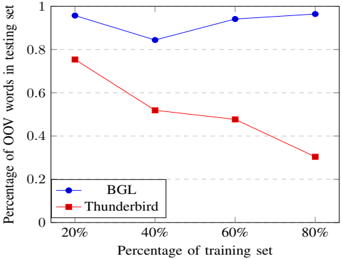
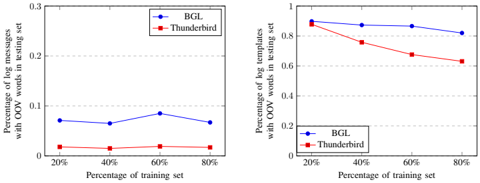
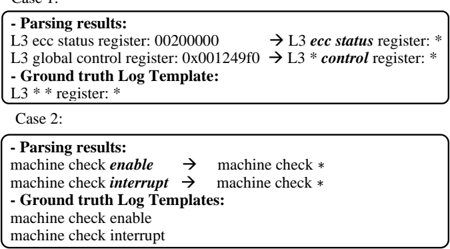
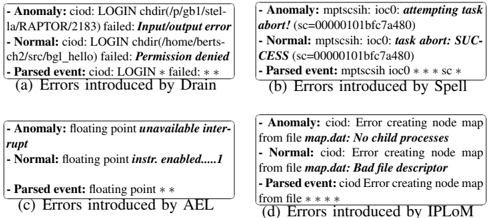
- An empirical study on BGL and Thunderbird found that existing log parsers suffer from OOV words and semantic misunderstanding; on a 60/40 BGL split, 94.12% of unique testing words were unseen in training, and these OOV words produced 1,304 unseen log events, accounting for 86.59% of testing log events.
- NeuralLog achieved F1-scores greater than 0.95 on all four public datasets: HDFS 0.98, BGL 0.98, Thunderbird 0.96, and Spirit 0.97; it was best on BGL, Thunderbird, and Spirit and comparable on HDFS.
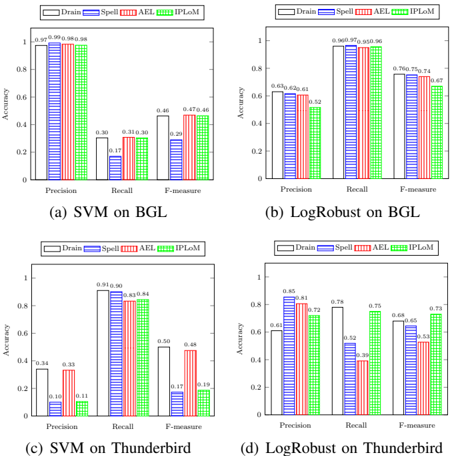
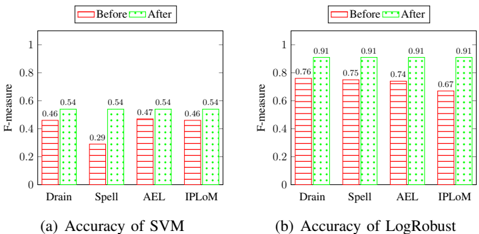
- Parsing errors degraded baselines: SVM with Drain achieved F1 0.46 on BGL and 0.50 on Thunderbird, while LogRobust achieved F1 0.75 on BGL and 0.68 on Thunderbird; manually fixing parsing errors improved LogRobust by 25% and SVM by 29% on average on BGL.
- Ablations showed NeuralLog’s raw-message encoding mattered: NeuralLog-Template reached F1 0.90 on BGL and 0.90 on Thunderbird versus NeuralLog’s 0.98 and 0.96, and NeuralLog-Word2Vec reached F1 0.80 on Thunderbird versus NeuralLog’s 0.96.
Methods
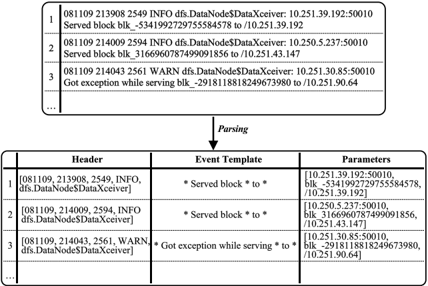
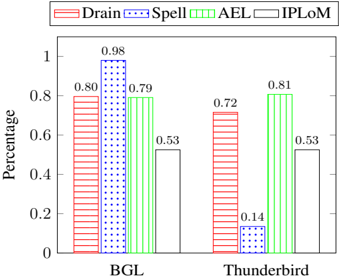
- The paper first empirically studies log parsing errors on BGL and Thunderbird (14,672,653 log messages total, 353,394 labeled anomalies), evaluating Drain, AEL, IPLoM, and Spell and their impact on SVM and LogRobust.
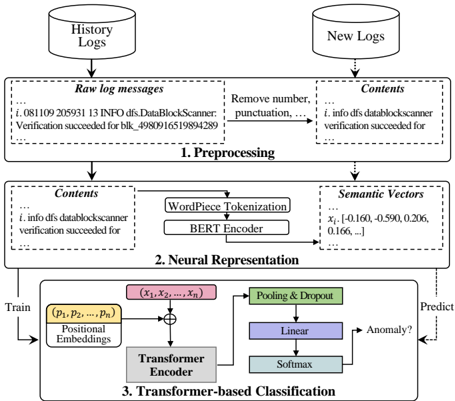
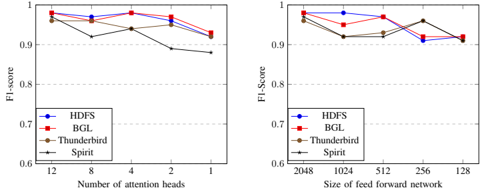
- NeuralLog preprocesses raw log messages, applies WordPiece tokenization, encodes messages with BERT base (12 transformer layers, 768 hidden units), adds positional encoding, and uses a Transformer encoder-based classifier (12 attention heads, feed-forward size 2048) for anomaly detection.
- Evaluation uses four public datasets: HDFS, BGL, Thunderbird, and Spirit. HDFS sequences are built by block ID with an 80/20 train-test split; BGL, Thunderbird, and Spirit use the first 80% of time-sorted messages for training and the last 20% for testing, with sliding windows of length 20 and step size 1; metrics are Precision, Recall, and F1-score.
Limitations
- Stated: the subject datasets come from a distributed system and supercomputers, so the number of systems is limited and does not cover all domains.
- Stated: tool comparison relies on implementations and default settings from prior work, and manual labeling of the public datasets may introduce noise.
- Stated: preprocessing removes numeric and special-character tokens, which may discard useful information such as node ID, task ID, IP address, or exit code. No additional limitations are evident from the text beyond those stated.
Model-written summary. Check it against the paper before relying on it.
Integrity signals
Registry
Cites
Statistics
Figures
Verification
Claims the paper makes
1 Valid · 8 Not valid · 18 Not checked · 105 Own results and interpretations
The cited sources that could be checked couldn’t confirm or dispute this claim.
In the paper
“Moreover, DeepLog [5], using the indexes of log templates to predict the next log event, considers all new log events as anomalies because they cannot be predicted by the model.”
What the sources say
- Could not verifycites [5] matched to “FastText.zip: Compressing text classification models” (2016) sourceExperimental — accuracy not yet measured
The Introduction (p. 1) and Related Work (p. 2) discuss text classification and model compression, not DeepLog. Searches for DeepLog and for unseen log templates and anomaly detection found no passage addressing whether new log events are treated as anomalies. (LLM, conf=0.76)
plainstates a cause- Asserted: passes — The authors put it forward as true.
- Checkable: passes — It can be checked against evidence.
- Load-bearing: passes — The paper’s conclusions depend on it.
- Based: passes — The paper gives a reason why it holds.
- Could not verify
The cited sources that could be checked couldn’t confirm or dispute this claim.
In the paper
“The main reason is that LogRobust utilizes the Drain log parser [24] to obtain log templates. As aforementioned in Section III-C, the Drain parser could inaccurately parse a noticeable number of log messages on BGL and Thunderbird datasets.”
What the sources say
- Could not verifycites [24] matched to “Generalizing Word Embeddings using Bag of Subwords” (2018) sourceExperimental — accuracy not yet measured
The citation is attached to the identification of Drain as the log parser LogRobust uses. Our copy’s Results and Conclusion discuss subword word embeddings, not Drain or LogRobust; searches for those names and for log-template parsing found no relevant passage. It also provides no evidence about parsing errors on BGL or Thunderbird. (LLM, conf=0.76)
hedgedstates a cause- Asserted: passes — The authors put it forward as true.
- Checkable: passes — It can be checked against evidence.
- Load-bearing: passes — The paper’s conclusions depend on it.
- Based: passes — The paper gives a reason why it holds.
- Could not verify
The cited sources that could be checked couldn’t confirm or dispute this claim.
In the paper
“Therefore, Log2Vec could not effectively handle some domain-specific words, such as technical terms or entity names [50], [51], [52].”
What the sources say
- Could not verifycites [50] matched to “Mimicking Word Embeddings using Subword RNNs” (2017) sourceExperimental — accuracy not yet measured
The Introduction (page not available) discusses the general difficulty word-embedding methods face with out-of-vocabulary terms. Searches for Log2Vec, domain-specific words, technical terms, and entity names found no passage assessing whether Log2Vec handles those words effectively. (LLM, conf=0.78)
- Could not verifycites [51] matched to “LogBERT: Log Anomaly Detection via BERT” (2021) sourceExperimental — accuracy not yet measured
The References (p. 11) list Log2vec, but the paper does not describe its ability to handle domain-specific words. Searches for Log2vec alongside technical terms, entity names, and vocabulary limitations found no passage addressing the claimed limitation. (LLM, conf=0.76)
- Could not verifycites [52] matched to “Decoupled Weight Decay Regularization” (2017) sourceExperimental — accuracy not yet measured
Section 4.2 (p. 6) examines weight decay in SGD and Adam, while Section 4.5 (p. 8) discusses applications of AdamW. Searches for Log2Vec, domain-specific words, technical terms, and entity names found no passage addressing whether Log2Vec handles those words effectively. (LLM, conf=0.76)
hedged- Asserted: passes — The authors put it forward as true.
- Checkable: passes — It can be checked against evidence.
- Load-bearing: passes — The paper’s conclusions depend on it.
- Based: passes — The paper gives a reason why it holds.
- Could not verify
The cited sources support only part of this claim — read each source’s verdict below.
In the paper
“However, it is hard to extract contextual information from characters to form meaningful words [50], [51], [52].”
What the sources say
- Partly supportedcites [50] matched to “Mimicking Word Embeddings using Subword RNNs” (2017) sourceExperimental — accuracy not yet measured
The Introduction (page unavailable) says character-based word models struggle in some settings, including where the mapping from form to meaning is complex. It does not say that extracting contextual information from characters is generally hard; the claim extends a specific limitation to a broader one. (LLM, conf=0.78)
- Could not verifycites [51] matched to “LogBERT: Log Anomaly Detection via BERT” (2021) sourceExperimental — accuracy not yet measured
The Framework (pp. 3–4) describes extracting log keys from log messages and learning contextual relations among those keys. The Introduction (p. 1) discusses a different difficulty: RNNs do not encode context from both sides of a log entry. Searches for character-level context and forming words found no passage addressing the claimed difficulty. (LLM, conf=0.76)
- Could not verifycites [52] matched to “Decoupled Weight Decay Regularization” (2017) sourceExperimental — accuracy not yet measured
Section 4.3 (p. 7) discusses AdamW’s generalization, and Section 4.5 (p. 8) mentions its use in natural-language-understanding models. Neither addresses the difficulty of extracting context from characters to form words. Searches for the claim’s wording and for character-level word formation found no supporting passage. (LLM, conf=0.76)
plain- Asserted: passes — The authors put it forward as true.
- Checkable: passes — It can be checked against evidence.
- Load-bearing: passes — The paper’s conclusions depend on it.
- Based: passes — The paper gives a reason why it holds.
- Partly supported
The cited sources that could be checked couldn’t confirm or dispute this claim.
In the paper
“Besides, Log2Vec also adopts MIMICK [49], an approach of inducing word embedding from character-level features to handle OOV words to improve anomaly detection performance.”
What the sources say
- Could not verifycites [49] matched to “Detecting large-scale system problems by mining console logs” (2009) sourceExperimental — accuracy not yet measured
The Workflow (p. 4) and Anomaly Detection (p. 8) describe feature vectors and PCA-based log anomaly detection, not Log2Vec. Searches for MIMICK, OOV words, and character-level word embeddings found no passage addressing the claimed adoption or its effect on performance. (LLM, conf=0.78)
plainstates a cause- Asserted: passes — The authors put it forward as true.
- Checkable: passes — It can be checked against evidence.
- Load-bearing: passes — The paper’s conclusions depend on it.
- Based: passes — The paper gives a reason why it holds.
- Could not verify
79 more claims
Create a free account to see all 132 claims and every source verdict.
- It may state two separate claims as one. 30
- Probably not a substantial claim. 18
- The quote only partly states this claim. 4
Claims other papers make about this one
Each is checked against this paper’s own text: does it say what the citing paper says it does?
The cited source says what the claim attributes to it.
In the citing paper
“Logs are a crucial source of information in software systems, capturing system runtime behavior and aiding in software engineering tasks like program comprehension [1], [2], anomaly detection [3]- [6], and failure diagnosis [7], [8].”
From Practitioners’ expectations on log anomaly detection (2025) · cites this paper as [3]
Citations
Cites
Vaswani, A., Shazeer, N., Parmar, N., Uszkoreit, J., Jones, L., Gomez, A. N., Kaiser, L., & Polosukhin, I. (2017) · arXiv · doi:10.48550/arxiv.1706.03762 · Cited by 120,404
Exploiting Generative AI to Scale up Intelligent Tutoring Systems
Jakubův, J., Chvalovský, K., Goertzel, Z., Kaliszyk, C., Olšák, M., Piotrowski, B., Schulz, S., Suda, M., & Urban, J. (2023) · DROPS (Schloss Dagstuhl – Leibniz Center for Informatics) · doi:10.4230/lipics.itp.2023.19 · Cited by 76,658
BERT: Pre-training of Deep Bidirectional Transformers for Language Understanding
Devlin, J., Chang, M.-W., Lee, K., & Toutanova, K. (2018) · arXiv · doi:10.48550/arxiv.1810.04805 · Cited by 73,173
BERT: Pre-training of Deep Bidirectional Transformers for Language Understanding
Devlin, J., Chang, M.-W., Lee, K., & Toutanova, K. (2019) · Proceedings of the 2019 Conference of the North American Chapter of the Association for Computational Linguistics: Human Language Technologies, Volume 1 (Long and Short Papers) · doi:10.18653/v1/n19-1423 · Cited by 54,325
Efficient Estimation of Word Representations in Vector Space
Mikolov, T., Chen, K., Corrado, G., & Dean, J. (2013) · arXiv · doi:10.48550/arxiv.1301.3781 · Cited by 26,568 · cited 1×
“adopt Word2vec model [13] to obtain embedding vectors of log events, then applied an LSTM model to detect anomalies.”
MethodDistilBERT, a distilled version of BERT: smaller, faster, cheaper and lighter
Sanh, V., Debut, L., Chaumond, J., & Wolf, T. (2019) · arXiv · doi:10.48550/arxiv.1910.01108 · Cited by 13,823
Decoupled Weight Decay Regularization
Loshchilov, I., & Hutter, F. (2017) · arXiv · doi:10.48550/arxiv.1711.05101 · Cited by 12,522
Term-weighting approaches in automatic text retrieval
Salton, G., & Buckley, C. (1988) · Information Processing & Management · doi:10.1016/0306-4573(88)90021-0 · Cited by 9,740 · cited 3×
“LogRobust [8] incorporates a pre-trained Word2vec model, namely FastText [31], and combines with TF-IDF weight [32] for learning the representation vectors of log templates, which are generated by Drain [24].”
MethodUnsupervised Cross-lingual Representation Learning at Scale
Conneau, A., Khandelwal, K., Goyal, N., Chaudhary, V., Wenzek, G., Guzmán, F., Grave, E., Ott, M., Zettlemoyer, L., & Stoyanov, V. (2020) · Proceedings of the 58th Annual Meeting of the Association for Computational Linguistics · doi:10.18653/v1/2020.acl-main.747 · Cited by 5,637 · cited 4×
“For GPT2 and Roberta encoders, we use their base model with 12 layers, 12 attention heads, and 768 hidden units.”
MethodInfluentialGoogle's Neural Machine Translation System: Bridging the Gap between Human and Machine Translation
Wu, Y., Schuster, M., Chen, Z., Le, Q. V., Norouzi, M., Macherey, W., Krikun, M., Cao, Y., Gao, Q., Macherey, K., et al. (2016) · arXiv · doi:10.48550/arxiv.1609.08144 · Cited by 5,319 · cited 4×
“In our work, we adopt the WordPiece tokenization [36], [37], which is widely used in many recent language modeling studies [38], [39], [40].”
MethodInfluentialDistributed Representations of Sentences and Documents
Le, Q. V., & Mikolov, T. (2014) · arXiv (Cornell University) · doi:10.48550/arxiv.1405.4053 · Cited by 4,934 · cited 5×
“Conventionally, words of log content are further transformed into vectors by using Word2Vec [42], then the representation vector of each sentence would be calculated based on the word vectors.”
MethodInfluentialELECTRA: Pre-training Text Encoders as Discriminators Rather Than Generators
Clark, K., Luong, M.-T., Le, Q. V., & Manning, C. D. (2020) · arXiv · doi:10.48550/arxiv.2003.10555 · Cited by 1,844
DeepLog: Anomaly Detection and Diagnosis from System Logs through Deep Learning
Du, M., Li, F., Zheng, G., & Srikumar, V. (2017) · Proceedings of the 2017 ACM SIGSAC Conference on Computer and Communications Security · doi:10.1145/3133956.3134015 · Cited by 1,835 · cited 8×
“For example, DeepLog [5] first applies the Spell [27] parser to extract log templates.”
BackgroundMethodResultInfluentialQuestion Answering For Toxicological Information Extraction
Ferreira, B. C. L., Gonçalo Oliveira, H., Amaro, H., Laranjeiro, Â., & Silva, C. (2022) · DROPS (Schloss Dagstuhl – Leibniz Center for Informatics) · doi:10.4230/oasics.slate.2022.3 · Cited by 1,520
Detecting large-scale system problems by mining console logs
Xu, W., Huang, L., Fox, A., Patterson, D., & Jordan, M. I. (2009) · Proceedings of the ACM SIGOPS 22nd symposium on Operating systems principles · doi:10.1145/1629575.1629587 · Cited by 1,332 · cited 3×
“HDFS dataset [34], [7] contains 11,175,629 log messages collected from a Hadoop Distributed File System on the Amazon EC2 platform.”
MethodDrain: an online log parsing approach with fixed depth tree
He, P., Zhu, J., Zheng, Z., & Lyu, M. R. (2017) · 2017 IEEE International Conference on Web Services (ICWS) · doi:10.1109/icws.2017.13 · Cited by 943 · cited 10×
“Table I shows examples of wrongly parsed log templates by the Drain parser [24].”
BackgroundMethodInfluentialFastText.zip: Compressing text classification models
Joulin, A., Grave, E., Bojanowski, P., Douze, M., Jégou, H., & Mikolov, T. (2016) · arXiv · doi:10.48550/arxiv.1612.03651 · Cited by 887 · cited 7×
“• NeuralLog-Word2Vec: We use a pre-trained Word2vec model [31] to generate the embeddings of log messages.”
MethodInfluentialJapanese and Korean voice search
Schuster, M., & Nakajima, K. (2012) · 2012 IEEE International Conference on Acoustics, Speech and Signal Processing (ICASSP) · doi:10.1109/icassp.2012.6289079 · Cited by 862 · cited 4×
“In our work, we adopt the WordPiece tokenization [36], [37], which is widely used in many recent language modeling studies [38], [39], [40].”
MethodInfluentialRobust log-based anomaly detection on unstable log data
Zhang, X., Xu, Y., Lin, Q., Qiao, B., Zhang, H., Dang, Y., Xie, C., Yang, X., Cheng, Q., Li, Z., et al. (2019) · Proceedings of the 2019 27th ACM Joint Meeting on European Software Engineering Conference and Symposium on the Foundations of Software Engineering · doi:10.1145/3338906.3338931 · Cited by 761 · cited 10×
“In this section, we evaluate the impact of log parsing errors on two representative anomaly detection methods SVM-based method [30], and LogRobust [8].”
BackgroundMethodResultInfluentialSelf-citationLogAnomaly: Unsupervised Detection of Sequential and Quantitative Anomalies in Unstructured Logs
Meng, W., Liu, Y., Zhu, Y., Zhang, S., Pei, D., Liu, Y., Chen, Y., Zhang, R., Tao, S., Sun, P., et al. (2019) · Proceedings of the Twenty-Eighth International Joint Conference on Artificial Intelligence · doi:10.24963/ijcai.2019/658 · Cited by 708 · cited 10×
“However, LogAnomaly [12] has no publicly available implementation and requires operators’ domain knowledge (to manually add domain-specific synonyms and antonyms).”
BackgroundMethodInfluentialWhat Supercomputers Say: A Study of Five System Logs
Oliner, A., & Stearley, J. (2007) · 37th Annual IEEE/IFIP International Conference on Dependable Systems and Networks (DSN'07) · doi:10.1109/dsn.2007.103 · Cited by 620 · cited 4×
“The datasets are collected between 2004 and 2006 from real-world supercomputing systems [33] and consist of 14,672,653 log messages in total, among which 353,394 log messages are manually labeled as anomalies.”
MethodInfluentialExperience Report: System Log Analysis for Anomaly Detection
He, S., Zhu, J., He, P., & Lyu, M. R. (2016) · 2016 IEEE 27th International Symposium on Software Reliability Engineering (ISSRE) · doi:10.1109/issre.2016.21 · Cited by 593 · cited 3×
“) used in the previous work [28], [48], [8].”
MethodTools and benchmarks for automated log parsing
Zhu, J., He, S., Liu, J., He, P., Xie, Q., Zheng, Z., & Lyu, M. R. (2019) · 2019 IEEE/ACM 41st International Conference on Software Engineering: Software Engineering in Practice (ICSE-SEIP) · doi:10.1109/icse-seip.2019.00021 · Cited by 574 · cited 5×
“Log parsers could produce inconsistent results depend on the preprocessing step and the set of parameters [16], [15].”
MethodInfluentialExecution Anomaly Detection in Distributed Systems through Unstructured Log Analysis
Fu, Q., Lou, J.-G., Wang, Y., & Li, J. (2009) · 2009 Ninth IEEE International Conference on Data Mining · doi:10.1109/icdm.2009.60 · Cited by 542 · cited 1×
“He et al [16] evaluated four widely used log parsers, including SLCT [57], IPLoM [26], LKE [58] and LogSig [20].”
MethodLogBERT: Log Anomaly Detection via BERT
Guo, H., Yuan, S., & Wu, X. (2021) · 2021 International Joint Conference on Neural Networks (IJCNN) · doi:10.1109/ijcnn52387.2021.9534113 · Cited by 454 · cited 1×
“automatically detect anomalies by analyzing log data [3], [4], [5], [6], [7], [8], [9].”
MethodA data clustering algorithm for mining patterns from event logs
Vaarandi, R. (2004) · Proceedings of the 3rd IEEE Workshop on IP Operations & Management (IPOM 2003) (IEEE Cat. No.03EX764) · doi:10.1109/ipom.2003.1251233 · Cited by 453 · cited 1×
“He et al [16] evaluated four widely used log parsers, including SLCT [57], IPLoM [26], LKE [58] and LogSig [20].”
MethodFailure diagnosis using decision trees
Chen, M., Zheng, A. X., Lloyd, J., Jordan, M. I., & Brewer, E. (2004) · International Conference on Autonomic Computing, 2004. Proceedings. · doi:10.1109/icac.2004.1301345 · Cited by 433
Spell: Streaming Parsing of System Event Logs
Du, M., & Li, F. (2016) · 2016 IEEE 16th International Conference on Data Mining (ICDM) · doi:10.1109/icdm.2016.0103 · Cited by 423 · cited 5×
“For example, DeepLog [5] first applies the Spell [27] parser to extract log templates.”
BackgroundMethodInfluentialClustering event logs using iterative partitioning
Makanju, A. A. O., Zincir-Heywood, A. N., & Milios, E. E. (2009) · Proceedings of the 15th ACM SIGKDD international conference on Knowledge discovery and data mining · doi:10.1145/1557019.1557154 · Cited by 338 · cited 5×
“He et al [16] evaluated four widely used log parsers, including SLCT [57], IPLoM [26], LKE [58] and LogSig [20].”
BackgroundMethodInfluentialMining invariants from console logs for system problem detection
Lou, J., Fu, Q., Yang, S., Xu, Y., & Li, J. (2010) · Cited by 302
Loghub: a large collection of system log datasets for AI-driven log analytics
Zhu, J., He, S., He, P., Liu, J., & Lyu, M. R. (2023) · 2023 IEEE 34th International Symposium on Software Reliability Engineering (ISSRE) · doi:10.1109/issre59848.2023.00071 · Cited by 302
Failure Prediction in IBM BlueGene/L Event Logs
Liang, Y., Zhang, Y., Xiong, H., & Sahoo, R. (2007) · Seventh IEEE International Conference on Data Mining (ICDM 2007) · doi:10.1109/icdm.2007.46 · Cited by 292 · cited 4×
“In this section, we evaluate the impact of log parsing errors on two representative anomaly detection methods SVM-based method [30], and LogRobust [8].”
BackgroundMethodInfluentialFingerprinting the datacenter: automated classification of performance crises
Bodik, P., Goldszmidt, M., Fox, A., Woodard, D. B., & Andersen, H. (2010) · Proceedings of the 5th European conference on Computer systems · doi:10.1145/1755913.1755926 · Cited by 250 · cited 5×
“We compare the results of NeuralLog and five existing approaches, including Support Vector Machine-based approach (SVM) [6], Logistic Regression-based approach (LR) [10], Invariant Mining (IM) [11], LogRobust [8], and Log2Vec [48].”
MethodResultInfluentialLogCluster - A data clustering and pattern mining algorithm for event logs
Vaarandi, R., & Pihelgas, M. (2015) · 2015 11th International Conference on Network and Service Management (CNSM) · doi:10.1109/cnsm.2015.7367331 · Cited by 246 · cited 1×
“There are many log parsing techniques, including frequent pattern mining [17], [18], [19], clustering [20], [21], [22], language modeling [23], heuristics [24], [25], [26], etc.”
BackgroundLogSig: generating system events from raw textual logs
Tang, L., Li, T., & Perng, C.-S. (2011) · Proceedings of the 20th ACM international conference on Information and knowledge management · doi:10.1145/2063576.2063690 · Cited by 244 · cited 2×
“He et al [16] evaluated four widely used log parsers, including SLCT [57], IPLoM [26], LKE [58] and LogSig [20].”
BackgroundMethodAn Evaluation Study on Log Parsing and Its Use in Log Mining
He, P., Zhu, J., He, S., Li, J., & Lyu, M. R. (2016) · 2016 46th Annual IEEE/IFIP International Conference on Dependable Systems and Networks (DSN) · doi:10.1109/dsn.2016.66 · Cited by 230 · cited 6×
“He et al [16] evaluated four widely used log parsers, including SLCT [57], IPLoM [26], LKE [58] and LogSig [20].”
BackgroundMethodInfluentialReliability and Availability of Cloud Computing
Bauer, E., & Adams, R. (2012) · doi:10.1002/9781118393994 · Cited by 228
LogMine: Fast Pattern Recognition for Log Analytics
Hamooni, H., Debnath, B., Xu, J., Zhang, H., Jiang, G., & Mueen, A. (2016) · Proceedings of the 25th ACM International on Conference on Information and Knowledge Management · doi:10.1145/2983323.2983358 · Cited by 227 · cited 1×
“There are many log parsing techniques, including frequent pattern mining [17], [18], [19], clustering [20], [21], [22], language modeling [23], heuristics [24], [25], [26], etc.”
BackgroundSelf-citationBig code != big vocabulary: open-vocabulary models for source code
Karampatsis, R.-M., Babii, H., Robbes, R., Sutton, C., & Janes, A. (2020) · Proceedings of the ACM/IEEE 42nd International Conference on Software Engineering · doi:10.1145/3377811.3380342 · Cited by 182 · cited 1×
“For example, space/stemming/camel case based tokenization strategies can lead to many OOV words and a big vocabulary [41].”
BackgroundMimicking Word Embeddings using Subword RNNs
Pinter, Y., Guthrie, R., & Eisenstein, J. (2017) · Proceedings of the 2017 Conference on Empirical Methods in Natural Language Processing · doi:10.18653/v1/d17-1010 · Cited by 177 · cited 1×
“Besides, Log2Vec also adopts MIMICK [49], an approach of inducing word embedding from character-level features to handle OOV words to improve anomaly detection performance.”
MethodSelf-Attentive Classification-Based Anomaly Detection in Unstructured Logs
Nedelkoski, S., Bogatinovski, J., Acker, A., Cardoso, J., & Kao, O. (2020) · 2020 IEEE International Conference on Data Mining (ICDM) · doi:10.1109/icdm50108.2020.00148 · Cited by 176 · cited 2×
“[56] proposed Logsy, which is a classification-based method to learn log representations in a way to distinguish between normal data from the target system and anomaly samples from auxiliary log datasets.”
MethodAbstracting log lines to log event types for mining software system logs
Nagappan, M., & Vouk, M. A. (2010) · 2010 7th IEEE Working Conference on Mining Software Repositories (MSR 2010) · doi:10.1109/msr.2010.5463281 · Cited by 171 · cited 1×
“There are many log parsing techniques, including frequent pattern mining [17], [18], [19], clustering [20], [21], [22], language modeling [23], heuristics [24], [25], [26], etc.”
BackgroundLogram: Efficient Log Parsing Using n-Gram Dictionaries
Dai, H., Li, H., Chen, C. S., Shang, W., & Chen, T.-H. (2020) · IEEE Transactions on Software Engineering · doi:10.1109/tse.2020.3007554 · Cited by 170 · cited 1×
“There are many log parsing techniques, including frequent pattern mining [17], [18], [19], clustering [20], [21], [22], language modeling [23], heuristics [24], [25], [26], etc.”
BackgroundSwissLog: Robust and Unified Deep Learning Based Log Anomaly Detection for Diverse Faults
Li, X., Chen, P., Jing, L., He, Z., & Yu, G. (2020) · 2020 IEEE 31st International Symposium on Software Reliability Engineering (ISSRE) · doi:10.1109/issre5003.2020.00018 · Cited by 143 · cited 5×
“Since DeepLog represents log messages as the indexes of log templates, it cannot prevent semantic information loss and could produce many wrong detection results [47], [48].”
BackgroundMethodInfluentialAbstracting Execution Logs to Execution Events for Enterprise Applications (Short Paper)
Jiang, Z. M., Hassan, A. E., Flora, P., & Hamann, G. (2008) · 2008 The Eighth International Conference on Quality Software · doi:10.1109/qsic.2008.50 · Cited by 138 · cited 5×
“SVM achieves better results when using Drain [24] and AEL [25] since these parsers produce a smaller amount of inaccurate log events, as discussed in Section III-B.”
BackgroundMethodInfluentialA systematic literature review on automated log abstraction techniques
El-Masri, D., Petrillo, F. D. S., Guéhéneuc, Y., Hamou‐Lhadj, A., & Bouziane, A. (2020) · Information and Software Technology · doi:10.1016/j.infsof.2020.106276 · Cited by 100 · cited 1×
“These log parsers are widely used in existing studies and have proven their efficiency on real-world datasets [15], [16], [28], [29].”
MethodSyslog processing for switch failure diagnosis and prediction in datacenter networks
Zhang, S., Meng, W., Bu, J., Yang, S., Liu, Y., Pei, D., Xu, J., Chen, Y., Dong, H., Qu, X., et al. (2017) · 2017 IEEE/ACM 25th International Symposium on Quality of Service (IWQoS) · doi:10.1109/iwqos.2017.7969130 · Cited by 92 · cited 1×
“LogAnomaly [12] applies FT-Tree [59] to parse log messages to templates, then proposes template2Vec to encode these templates based on Word2Vec [42].”
MethodFew-Shot Representation Learning for Out-Of-Vocabulary Words
Hu, Z., Chen, T., Chang, K.-W., & Sun, Y. (2019) · Proceedings of the conference - Association for Computational Linguistics. Meeting · doi:10.18653/v1/p19-1402 · Cited by 92 · cited 3×
“Therefore, Log2Vec could not effectively handle some domain-specific words, such as technical terms or entity names [50], [51], [52].”
BackgroundAnomaly Detection from Log Files Using Data Mining Techniques
Breier, J., & Branišová, J. (2015) · Lecture notes in electrical engineering · doi:10.1007/978-3-662-46578-3_53 · Cited by 85 · cited 1×
“automatically detect anomalies by analyzing log data [3], [4], [5], [6], [7], [8], [9].”
MethodLength Matters: Clustering System Log Messages using Length of Words
Shima, K. (2016) · arXiv (Cornell University) · doi:10.48550/arxiv.1611.03213 · Cited by 81 · cited 1×
“There are many log parsing techniques, including frequent pattern mining [17], [18], [19], clustering [20], [21], [22], language modeling [23], heuristics [24], [25], [26], etc.”
BackgroundReliable and Highly Available Distributed Publish/Subscribe Service
Kazemzadeh, R. S., & Jacobsen, H.-A. (2009) · 2009 28th IEEE International Symposium on Reliable Distributed Systems · doi:10.1109/srds.2009.32 · Cited by 67 · cited 1×
“High availability and reliability are essential for largescale software-intensive systems [1], [2].”
BackgroundA Semantic-aware Representation Framework for Online Log Analysis
Meng, W., Liu, Y., Huang, Y., Zhang, S., Zaiter, F., Chen, B., & Pei, D. (2020) · 2020 29th International Conference on Computer Communications and Networks (ICCCN) · doi:10.1109/icccn49398.2020.9209707 · Cited by 63 · cited 7×
“Log2Vec [48] accurately extracts the semantic and syntax information from log messages and leverages the Deeplog [5] model to improve the accuracy of anomaly detection.”
BackgroundMethodResultInfluentialGeneralizing Word Embeddings using Bag of Subwords
Zhao, J., Mudgal, S., & Liang, Y. (2018) · Proceedings of the 2018 Conference on Empirical Methods in Natural Language Processing · doi:10.18653/v1/d18-1059 · Cited by 53 · cited 3×
“Therefore, Log2Vec could not effectively handle some domain-specific words, such as technical terms or entity names [50], [51], [52].”
BackgroundAnomaly Detection via Mining Numerical Workflow Relations from Logs
Zhang, B., Zhang, H., Moscato, P., & Zhang, A. (2020) · IEEE Symposium on Reliable Distributed Systems (SRDS) · doi:10.1109/srds51746.2020.00027 · Cited by 46 · cited 3×
“IM [11] and ADR [4] discover the linear relationships among log events from log count vectors.”
BackgroundMethodSelf-citationA study of the performance of general compressors on log files
Yao, K., Li, H., Shang, W., & Hassan, A. E. (2020) · Empirical Software Engineering · doi:10.1007/s10664-020-09822-x · Cited by 44 · cited 1×
“In this experiment, we leverage 10 million continuous log messages from the Thunderbird dataset, and 1GB log messages from the Spirit dataset, which were also used in prior work [45].”
MethodSubword-based Compact Reconstruction of Word Embeddings
Sasaki, S., Suzuki, J., & Inui, K. (2019) · Conference of the North American Chapter of the Association for Computational Linguistics: Human Language Technologies (NAACL-HLT) · doi:10.18653/v1/n19-1353 · Cited by 33
Towards a neural language model for signature extraction from forensic logs
Thaler, S., Menkonvski, V., & Petković, M. (2017) · International Symposium on Digital Forensics and Security (ISDFS) · doi:10.1109/isdfs.2017.7916497 · Cited by 31 · cited 1×
“There are many log parsing techniques, including frequent pattern mining [17], [18], [19], clustering [20], [21], [22], language modeling [23], heuristics [24], [25], [26], etc.”
BackgroundLogBERT: Log Anomaly Detection via BERT
Guo, H., Yuan, S., & Wu, X. (2021) · arXiv · doi:10.48550/arxiv.2103.04475 · Cited by 7 · cited 1×
“automatically detect anomalies by analyzing log data [3], [4], [5], [6], [7], [8], [9].”
Method
Research works printed but not linked: 2
- radford, 2019, Language models are unsupervised multitask learners, OpenAIRE blog, 1, 9
- 2021, Bert pretrained models
Cited by
Log-based anomaly detection with deep learning: how far are we?
Le, V.-H., & Zhang, H. (2022) · Proceedings of the 44th International Conference on Software Engineering · doi:10.1145/3510003.3510155 · Cited by 257
“[26] found that log parsing errors can lead to many incorrect log events, thus downgrading anomaly detection performance.”
BackgroundMethodInfluentialSelf-citationEadro: An End-to-End Troubleshooting Framework for Microservices on Multi-source Data
Lee, C., Yang, T., Chen, Z., Su, Y., & Lyu, M. R. (2023) · 2023 IEEE/ACM 45th International Conference on Software Engineering (ICSE) · doi:10.1109/icse48619.2023.00150 · Cited by 149
“Previous anomaly detection approaches are usually based on system logs [58]–[62] or KPIs [63]–[67], or both [68], targeting traditional distributed systems without complex invocation relationships.”
Log Parsing with Prompt-based Few-shot Learning
Le, V.-H., & Zhang, H. (2023) · 2023 IEEE/ACM 45th International Conference on Software Engineering (ICSE) · doi:10.1109/icse48619.2023.00204 · Cited by 129
“Recent studies [16], [33] demonstrate that these pretrained models can be applied to understand the semantic meanings of log messages, thus favouring many downstream log analytics tasks.”
BackgroundMethodInfluentialSelf-citationLogFiT: Log Anomaly Detection Using Fine-Tuned Language Models
Almodovar, C., Sabrina, F., Karimi, S., & Azad, S. (2024) · IEEE Transactions on Network and Service Management · doi:10.1109/tnsm.2024.3358730 · Cited by 111
“Many of the approaches [8], [9], [11], [12] require log parsing, while recent studies [11], [16] suggested that log parsing can reduce accuracy.”
BackgroundMethodInfluentialBrain: Log Parsing With Bidirectional Parallel Tree
Yu, S., He, P., Chen, N., & Wu, Y. (2023) · IEEE Transactions on Services Computing · doi:10.1109/tsc.2023.3270566 · Cited by 126
“, the accuracy of log-based anomaly detection can decrease by more than 20% with just a few parsing errors [15].”
Background
Metadata
- Authors
- Le, V.-H., & Zhang, H.
- Affiliations
- University of Newcastle Australia (AU)
- Venue
- 2021 36th IEEE/ACM International Conference on Automated Software Engineering (ASE)
- Publisher
- IEEE
- Published
- 2021-11
- Pages
- 492-504
- OpenAlex
- W4205965165
- Semantic Scholar
- 7c93c88260829ea01429a6944f4525440817896c
- Cited by
- 361
- References
- 64
- Citations by year
- 2026: 85 · 2025: 107 · 2024: 78 · 2023: 66 · 2022: 23 · 2021: 2
- FWCI
- 32.57
- Type
- conference paper
- Language
- en
- Open access
- green
- arxiv.org
- Licence
- Locations
- IEEE/ACM International Conference on Automated Software Engineering (ASE) (publishedVersion)
- arXiv (Cornell University) (submittedVersion, cc-by)
- NOVA (University of Newcastle Australia) (submittedVersion)
- arXiv (Cornell University) (cc-by)
- Funders
- Australian Research Council
- Topics
- Physical Sciences › Computer Science › Computer Networks and Communications › Software System Performance and Reliability
- Physical Sciences › Computer Science › Software › Software Testing and Debugging Techniques
- Physical Sciences › Computer Science › Information Systems › Software Engineering Research
- Keywords
- log anomaly detection, out-of-vocabulary words, system logs, anomaly detection
About these checks
Registry, retraction, Cites and statistics results are computed, not judged, with one exception: a printed reference that no index lists is read once by a model before it counts as a citation error. Claims are extracted by a model and kept only when their quote appears verbatim in the text; each cited source is then checked, with a model’s help, for whether it says what the claim relies on. Those verdicts can be wrong — read the claim’s quote and the cited source before relying on one.
The claim verdicts this report counts are experimental: their accuracy is not yet measured.
A language model drew the claims from the paper on 2026-10-05, under version 3 of the claim definition (model deepseek-v4.1-flash, prompt extract-v3).
A second model labelled each claim on 2026-10-05 (model jev-1.13-20260917, definition revision gold-guideline-v0.2).
Cited sources are checked with a language model’s help (gpt-6-sol).
Statistics and arithmetic are recomputed, not judged.
Confidence bands are shown only for fields calibrated on our annotated test set. None is calibrated yet, so no band is shown.
What counts as a claim ›How we measure confidence ›How we check this ›
Are you an author, or do you see a problem with this page? Request a review
Data sources
Bibliographic data: Semantic Scholar, OpenAlex, Crossref.
Contains information from the Semantic Scholar Academic Graph Datasets, made available under the ODC Attribution License (ODC-BY 1.0).
Semantic Scholar’s data is described in: Kinney, R., et al. (2023). The Semantic Scholar Open Data Platform. arXiv:2301.10140.
