

You Only Look Once: Unified, Real-Time Object Detection
Open accessThe DOI matches its Crossref record; 53 of the 53 references it cites were found in a registry or an index; 8 of the 25 sources its claims cite were checked for support.
Abstract
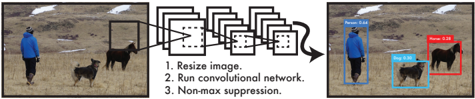
We present YOLO, a new approach to object detection. Prior work on object detection repurposes classifiers to perform detection. Instead, we frame object detection as a regression problem to spatially separated bounding boxes and associated class probabilities. A single neural network predicts bounding boxes and class probabilities directly from full images in one evaluation. Since the whole detection pipeline is a single network, it can be optimized end-to-end directly on detection performance. Our unified architecture is extremely fast. Our base YOLO model processes images in real-time at 45 frames per second. A smaller version of the network, Fast YOLO, processes an astounding 155 frames per second while still achieving double the mAP of other real-time detectors. Compared to state-of-the-art detection systems, YOLO makes more localization errors but is less likely to predict false positives on background. Finally, YOLO learns very general representations of objects. It outperforms other detection methods, including DPM and R-CNN, when generalizing from natural images to other domains like artwork.
Overview
CoChat Summary
TL;DR
YOLO reframes object detection as a single regression problem, using one convolutional network to predict bounding boxes and class probabilities directly from full images. It achieves real-time detection speeds while remaining competitive with, and complementary to, slower region-based detectors.
Key findings
- YOLO runs at 45 FPS on a Titan X GPU, and Fast YOLO runs at 155 FPS; Fast YOLO reaches 52.7% mAP on PASCAL VOC 2007, more than double prior real-time detectors, while YOLO reaches 63.4% mAP.
- On PASCAL VOC 2012, YOLO scores 57.9% mAP; combining Fast R-CNN with YOLO raises Fast R-CNN from 71.8% to 75.0% mAP on VOC 2007, a 3.2% gain.
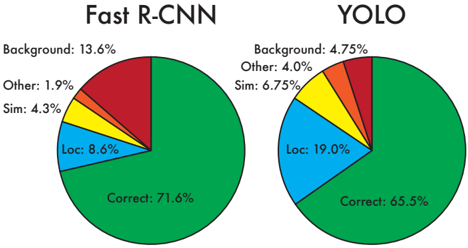
- YOLO makes fewer background false positives than Fast R-CNN: Fast R-CNN has 13.6% background false positives among top detections and is almost 3× more likely to predict background detections than YOLO.
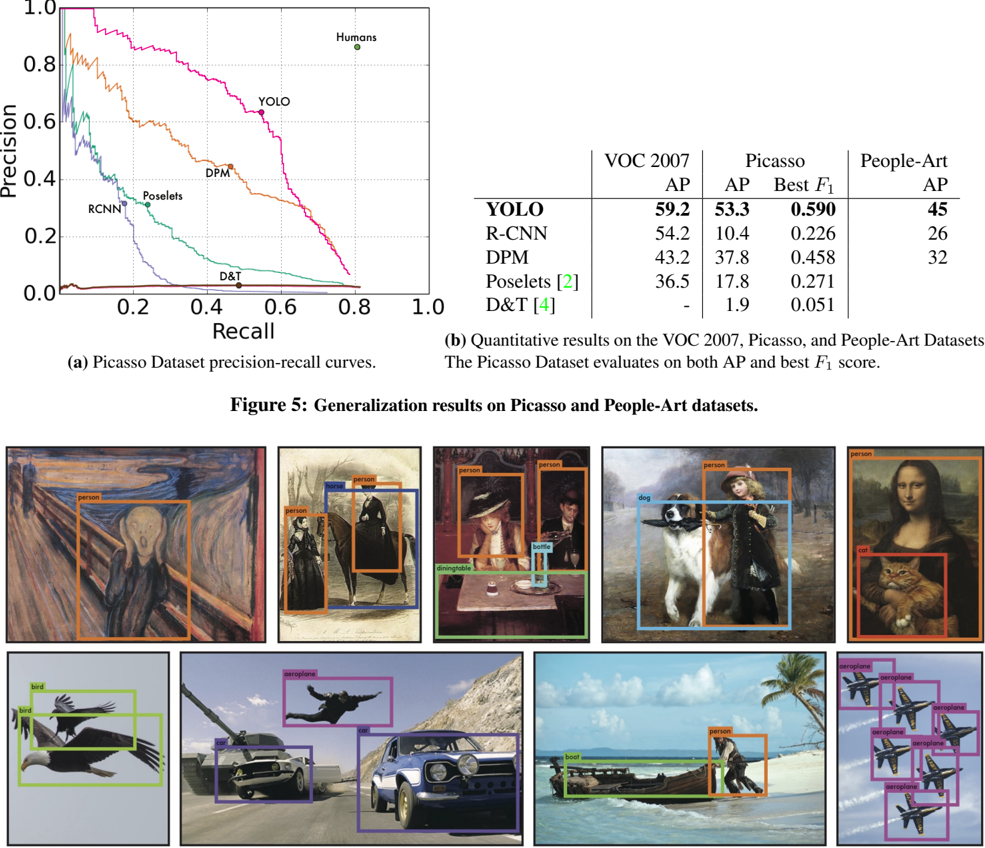
- YOLO generalizes better to artwork: on Picasso, YOLO gets 53.3 AP versus R-CNN’s 10.4 AP and DPM’s 37.8 AP; on People-Art, YOLO gets 45 AP versus R-CNN’s 26 AP and DPM’s 32 AP.
Methods
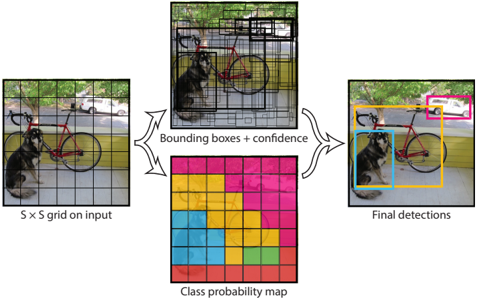
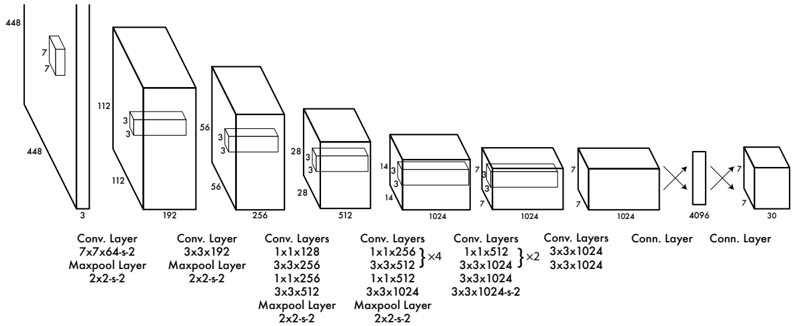
- Detection is modeled as a single CNN regression: the image is divided into an S×S grid; for PASCAL VOC, S=7, B=2, C=20, producing a 7×7×30 tensor of bounding boxes, confidence scores, and class probabilities.
- The base network has 24 convolutional layers followed by 2 fully connected layers; Fast YOLO uses 9 convolutional layers. Convolutional layers are pretrained on ImageNet at 224×224, then detection training uses 448×448 input.
- Training uses PASCAL VOC 2007 and 2012 for about 135 epochs, batch size 64, momentum 0.9, decay 0.0005, sum-squared error with λ_coord=5 and λ_noobj=0.5, dropout, and data augmentation.
Limitations
- The paper states YOLO imposes strong spatial constraints because each grid cell predicts only two boxes and one class, limiting nearby objects and struggling with small objects in groups such as flocks of birds.
- The paper states YOLO struggles to generalize to objects in new or unusual aspect ratios or configurations, uses relatively coarse features due to downsampling, and its loss treats small and large box errors equally; its main error source is incorrect localization.
- The paper states YOLO still lags state-of-the-art detection accuracy and struggles to precisely localize some objects, especially small ones.
Model-written summary. Check it against the paper before relying on it.
Integrity signals
Registry
Cites
Statistics
Figures
Verification
Claims the paper makes
6 Valid · 8 Not valid · 15 Not checked · 92 Own results and interpretations
The cited sources that could be checked couldn’t confirm or dispute this claim.
In the paper
“While it is much faster than R-CNN, it still falls short of real-time and takes a significant accuracy hit from not having good proposals.”
What the sources say
- Could not verifycites [20] [20] K. Lenc and A. Vedaldi. R-cnn minus r. arXiv preprint arXiv:1506.06981 , 2015. 5, 6 - sourceExperimental — accuracy not yet measured
The ConvNet-based Object Detection section identifies R-CNN minus R as a method that uses predefined regions instead of region proposals. It gives no runtime measurement or assessment of whether the method achieves real-time detection; searches for real-time performance and speed did not establish that claim. (LLM, conf=0.76)
plain- Asserted: passes — The authors put it forward as true.
- Checkable: passes — It can be checked against evidence.
- Load-bearing: passes — The paper’s conclusions depend on it.
- Based: passes — The paper gives a reason why it holds.
- Could not verify
The cited sources support only part of this claim — read each source’s verdict below.
In the paper
“To avoid overfitting we use dropout and extensive data augmentation.”
What the sources say
- Partly supportedcites [18] [18] G. E. Hinton, N. Srivastava, A. Krizhevsky, I. Sutskever, and R. R. Salakhutdinov. Improving neural networks by preventing co-adaptation of feature detectors. arXiv preprint arXiv:1207.0580 , 2012. 4 - sourceExperimental — accuracy not yet measured
The paper states that dropout reduces overfitting (p. 1) and describes using dropout with data augmentation for its ImageNet model (H Models for ImageNet, p. 18). It does not establish that YOLO uses either technique or describe YOLO’s augmentation as extensive. (LLM, conf=0.88)
plainstates a cause- Asserted: passes — The authors put it forward as true.
- Checkable: passes — It can be checked against evidence.
- Load-bearing: unclear — It is unclear whether the paper’s conclusions depend on it.
- Based: passes — The paper gives a reason why it holds.
- Partly supported
Every source the paper cites for this claim was checked and supports it.
In the paper
“However, only 30Hz DPM [31] actually runs in real-time.”
What the sources say
- Supportedcites [31] [31] M. A. Sadeghi and D. Forsyth. 30hz object detection with dpm v5. In Computer Vision-ECCV 2014 , pages 65-79. Springer, 2014. 5, 6 - source
The Introduction (p.1) states that 'except for certain objects including face, pedestrians and certain rigid objects, detectors do not currently run at video rate' and that the presented architecture detects the 20 PASCAL VOC categories simultaneously at 30Hz, i.e. at video/real-time rate. The Abstract (p.1) and Table 2 (Method) bound the comparison to other DPM speed-up efforts: reference DPM at 0.07Hz, the fastest GPU 'Vanilla DPM' at ~1Hz, FTVQ at 0.53s, and 'over an order of magnitude faster than the previous fastest DPM implementation', so none of the listed variants reaches real-time. Thus our copy supports both parts of the attribution: that this 30Hz DPM runs in real-time and that it is the only such DPM among the speed-up efforts compared. (LLM, conf=0.82)
plain- Asserted: passes — The authors put it forward as true.
- Checkable: passes — It can be checked against evidence.
- Load-bearing: unclear — It is unclear whether the paper’s conclusions depend on it.
- Based: passes — The paper gives a reason why it holds.
- Supported
The cited sources that could be checked couldn’t confirm or dispute this claim.
In the paper
“While it is much faster than R-CNN, it still falls short of real-time and takes a significant accuracy hit from not having good proposals.”
What the sources say
- Could not verifycites [20] [20] K. Lenc and A. Vedaldi. R-cnn minus r. arXiv preprint arXiv:1506.06981 , 2015. 5, 6 - sourceExperimental — accuracy not yet measured
The ConvNet-based Object Detection section identifies R-CNN minus R and says it uses predefined regions in an SPPnet system, but gives no speed comparison with R-CNN. A search for R-CNN minus R and speed found no passage in our copy establishing that it is much faster. (LLM, conf=0.73)
plainstates a cause- Asserted: passes — The authors put it forward as true.
- Checkable: passes — It can be checked against evidence.
- Load-bearing: unclear — It is unclear whether the paper’s conclusions depend on it.
- Based: passes — The paper gives a reason why it holds.
- Could not verify
The cited sources support only part of this claim — read each source’s verdict below.
In the paper
“While it is much faster than R-CNN, it still falls short of real-time and takes a significant accuracy hit from not having good proposals.”
What the sources say
- Partly supportedcites [20] [20] K. Lenc and A. Vedaldi. R-cnn minus r. arXiv preprint arXiv:1506.06981 , 2015. 5, 6 - sourceExperimental — accuracy not yet measured
The “ConvNet-based Object Detection” section (page unavailable) says R-CNN minus R uses predefined regions instead of region proposals. It does not say that this causes a significant accuracy loss; the paper’s discussion of low accuracy concerns a different system, naïve Faster R-CNN. (LLM, conf=0.83)
plainstates a cause- Asserted: passes — The authors put it forward as true.
- Checkable: passes — It can be checked against evidence.
- Load-bearing: unclear — It is unclear whether the paper’s conclusions depend on it.
- Based: passes — The paper gives a reason why it holds.
- Partly supported
84 more claims
Create a free account to see all 121 claims and to verify the 2 references still open.
- Probably not a substantial claim. 17
- It may state two separate claims as one. 15
Claims other papers make about this one
Each is checked against this paper’s own text: does it say what the citing paper says it does?
The source backs part of the claim, not all of it — or backs it for a different population, condition or comparison.
In the citing paper
“which was not thoroughly investigated in prevIoUs work such as YOLOv1 [20] and YOLOv2 [51] employing MSE/L2 loss (Mean Squared Error).”
From Object Detection in 20 Years: A Survey (2023) · cites this paper as [20]
Experimental — accuracy not yet measuredThe source backs part of the claim, not all of it — or backs it for a different population, condition or comparison.
In the citing paper
“the YOLO series models v2-v5 [144-147] are some of the most advanced object detection methods based on DNN, which have good performance in terms of speed and precision.”
From A survey of model compression strategies for object detection (2023) · cites this paper as [144]
Experimental — accuracy not yet measuredThe source backs part of the claim, not all of it — or backs it for a different population, condition or comparison.
In the citing paper
“As a typical and more widely used new form of applications [9], various deep learning-based intelligent services and applications have changed many aspects of people's lives due to the great advantages of Deep Learning (DL) in the fields of Computer Vision (CV) and Natural Language Processing (NLP) [10].”
From Convergence of Edge Computing and Deep Learning: A Comprehensive Survey (2020) · cites this paper as [9]
Experimental — accuracy not yet measuredThe cited source says what the claim attributes to it.
In the citing paper
“A convolutional neural network predicts the bounding boxes as well as class probabilities for all the objects depicted in an image.”
From Object detection using YOLO: challenges, architectural successors, datasets and applications (2023) · cites this paper as [56]
The cited source says what the claim attributes to it.
In the citing paper
“Authors of YOLO [56] have reframed the problem of object detection as a regression problem instead of classification problem.”
From Object detection using YOLO: challenges, architectural successors, datasets and applications (2023) · cites this paper as [56]
6 more claims about this paper
Create a free account to see every claim other papers make about this one.
Citations
Cites
Faster R-CNN: Towards Real-Time Object Detection with Region Proposal Networks
Ren, S., He, K., Girshick, R., & Sun, J. (2017) · IEEE Transactions on Pattern Analysis and Machine Intelligence · doi:10.1109/tpami.2016.2577031 · Cited by 73,472
Self-citationFaster R-CNN: Towards Real-Time Object Detection with Region Proposal Networks
Ren, S., He, K., Girshick, R., & Sun, J. (2015) · arXiv · doi:10.48550/arxiv.1506.01497 · Cited by 70,812
Self-citationGoing deeper with convolutions
Szegedy, C., Liu, W., Jia, Y., Sermanet, P., Reed, S., Anguelov, D., Erhan, D., Vanhoucke, V., & Rabinovich, A. (2015) · 2015 IEEE Conference on Computer Vision and Pattern Recognition (CVPR) · doi:10.1109/cvpr.2015.7298594 · Cited by 48,562
ImageNet Large Scale Visual Recognition Challenge
Russakovsky, O., Deng, J., Su, H., Krause, J., Satheesh, S., Ma, S., Huang, Z., Karpathy, A., Khosla, A., Bernstein, M., et al. (2015) · International Journal of Computer Vision · doi:10.1007/s11263-015-0816-y · Cited by 39,380 · cited 1×
“We pretrain our convolutional layers on the ImageNet 1000-class competition dataset [29].”
MethodHistograms of Oriented Gradients for Human Detection
Dalal, N., & Triggs, B. (2005) · 2005 IEEE Computer Society Conference on Computer Vision and Pattern Recognition (CVPR'05) · doi:10.1109/cvpr.2005.177 · Cited by 33,584 · cited 2×
“Detection pipelines generally start by extracting a set of robust features from input images (Haar [25], SIFT [23], HOG [4], convolutional features [6]).”
MethodRich Feature Hierarchies for Accurate Object Detection and Semantic Segmentation
Girshick, R., Donahue, J., Darrell, T., & Malik, J. (2014) · 2014 IEEE Conference on Computer Vision and Pattern Recognition · doi:10.1109/cvpr.2014.81 · Cited by 32,684 · cited 2×
“Then, classifiers [35, 21, 13, 10] or localizers [1, 31] are used to identify objects in the feature space.”
MethodSelf-citationGirshick, R. (2015) · 2015 IEEE International Conference on Computer Vision (ICCV) · doi:10.1109/iccv.2015.169 · Cited by 28,105
Self-citationDelving Deep into Rectifiers: Surpassing Human-Level Performance on ImageNet Classification
He, K., Zhang, X., Ren, S., & Sun, J. (2015) · 2015 IEEE International Conference on Computer Vision (ICCV) · doi:10.1109/iccv.2015.123 · Cited by 19,741 · cited 1×
“Convolutional neural networks (CNNs) achieve impressive performance on classification tasks at real-time speeds [13].”
Object recognition from local scale-invariant features
Lowe, D. G. (1999) · Proceedings of the Seventh IEEE International Conference on Computer Vision · doi:10.1109/iccv.1999.790410 · Cited by 16,472 · cited 1×
“Detection pipelines generally start by extracting a set of robust features from input images (Haar [25], SIFT [23], HOG [4], convolutional features [6]).”
MethodRobust Real-Time Face Detection
Viola, P., & Jones, M. J. (2004) · International Journal of Computer Vision · doi:10.1023/b:visi.0000013087.49260.fb · Cited by 14,097 · cited 1×
“Detectors for single classes like faces or people can be highly optimized since they have to deal with much less variation [36].”
Background
Cited by
Items 21,801–21,900 of 51,401
Patch-based Selection and Refinement for Early Object Detection
Zhang, T., Kasichainula, K., Zhuo, Y., Li, B., Seo, J.-S., & Cao, Y. (2024) · IEEE Winter Conference on Applications of Computer Vision · doi:10.1109/wacv57701.2024.00078 · Cited by 16
A safety helmet-wearing detection method based on cross-layer connection
Dong, G., Zhang, Y., Xie, W., & Huang, Y. (2024) · Journal of Real-Time Image Processing · doi:10.1007/s11554-024-01437-5 · Cited by 6
BoostRad: Enhancing Object Detection by Boosting Radar Reflections
Haitman, Y., & Bialer, O. (2024) · IEEE Winter Conference on Applications of Computer Vision · doi:10.1109/wacv57701.2024.00166 · Cited by 8
Mao, W., Li, G., & Li, X. (2024) · Animals · doi:10.3390/ani14081152 · Cited by 9
Multimodal Integration, Fine Tuning of Large Language Model for Autism Support
Pai, K., Jagwani, V., Pandita, S., & Kalbande, D. R. (2024) · International Conference on Mobile Computing and Sustainable Informatics (ICMCSI) · doi:10.1109/icmcsi61536.2024.00099 · Cited by 9
YOLO-FE: A Lightweight Ship Detection Algorithm Based on Improved YOLOv8
Cheng, K., Song, M., Xu, Y., et al. (2023) · International Conference on Robotics, Intelligent Control and Artificial Intelligence (RICAI) · doi:10.1109/ricai60863.2023.10488972 · Cited by 6
Hole Edge Metrology and Inspection by Edge Diffractometry
Lu, K., & Lee, C. (2024) · Journal of Manufacturing Science and Engineering · doi:10.1115/1.4065314 · Cited by 6
Research and Implementation of an Embedded Traffic Sign Detection Model Using Improved YOLOV5
Hu, T., Gong, Z., & Song, J. (2024) · International Journal of Automotive Technology · doi:10.1007/s12239-024-00082-y · Cited by 6
Kiwifruit Counting Using Kiwidetector and Kiwitracker
Xia, Y., Nguyen, M., & Yan, W. Q. (2024) · Lecture notes in networks and systems · doi:10.1007/978-3-031-47724-9_41 · Cited by 6
E-BabyNet: Enhanced Action Recognition of Infant Reaching in Unconstrained Environments
Dechemi, A., & Karydis, K. (2024) · IEEE Transactions on Neural Systems and Rehabilitation Engineering · doi:10.1109/tnsre.2024.3392161 · Cited by 8
Toward Meat Industry 4.0: opportunities and challenges for digitalized red meat processing
Hamill, R. M., Ferragina, A., Mishra, J., Kavanagh, A., Hibbett, M., Gagaoua, M., Colreavy, J., & Rady, A. M. (2024) · Elsevier eBooks · doi:10.1016/b978-0-443-15516-1.00013-x · Cited by 14
TSD: Random feature query design for transformer-based shrimp detector
Gong, B., Jing, L., & Chen, Y. (2024) · Computers and Electronics in Agriculture · doi:10.1016/j.compag.2024.108949 · Cited by 6
Shan, 薛. X., Hongyu, 安. A., Qiongying, 吕. L., et al. (2024) · Infrared and Laser Engineering · doi:10.3788/irla20230472 · Cited by 6
YOLOV9 İLE KAN HÜCRELERİNİN OTOMATİK TANIMLANMASI: OPTİMİZASYON VE ÖĞRENME ORANI ETKİLERİ
Yücel, Z., & Çetintaş, D. (2024) · Adıyaman Üniversitesi Mühendislik Bilimleri Dergisi · doi:10.54365/adyumbd.1388891 · Cited by 6
Improved Painting Image Style Classification of ResNet based on Attention Mechanism
Zeng, L. (2023) · International Conference on Advances in Electrical Engineering and Computer Applications (AEECA) · doi:10.1109/aeeca59734.2023.00133 · Cited by 6
Image Processing based Animal Intrusion Detection System in Agricultural Field using Deep Learning
Gnanasekar, O., Dinesh, P., & Srividhya, K. (2024) · doi:10.1109/incos59338.2024.10527719 · Cited by 6
Su, J., Zhang, H., Przystupa, К., & Кочан, О. В. (2024) · Journal of Electronic Imaging · doi:10.1117/1.jei.33.3.033019 · Cited by 8
APEIOU Integration for Enhanced YOLOV7: Achieving Efficient Plant Disease Detection
Zhao, Y., Lin, C., Wu, N., & Xu, X. (2024) · Agriculture · doi:10.3390/agriculture14060820 · Cited by 9
Multi-Scale Target Detection in Autonomous Driving Scenarios Based on YOLOv5-AFAM
Ma, H., Zhao, W., Liu, B., et al. (2024) · Applied Sciences · doi:10.3390/app14114633 · Cited by 6
Hao, S., Li, W., Ma, X., et al. (2024) · Journal of Real-Time Image Processing · doi:10.1007/s11554-024-01480-2 · Cited by 6
Progressive supervised pedestrian detection algorithm for green edge–cloud computing
She, L., Wang, W., Wang, J., Lin, Z., & Zeng, Y. (2024) · Computer Communications · doi:10.1016/j.comcom.2024.05.022 · Cited by 7
Automated Recognition of Conidia of Nematode-Trapping Fungi Based on Improved YOLOv8
Zhao, E., Zhao, H., Liu, G., Jiang, J., Zhang, F., Zhang, J., Luo, C., Chen, B., & Yang, X.-Y. (2024) · IEEE Access · doi:10.1109/access.2024.3407853 · Cited by 8
Choi, S., Xie, Q., Greeneltch, N. G., et al. (2024) · Annual SEMI Advanced Semiconductor Manufacturing Conference (ASMC) · doi:10.1109/asmc61125.2024.10545512 · Cited by 6
Fish-NET: Advancing Aquaculture Management through AI-Enhanced Fish Monitoring and Tracking
Salako, J., Ojo, F., & Awe, O. O. (2024) · Agris on-line Papers in Economics and Informatics · doi:10.7160/aol.2024.160209 · Cited by 10
Road Damage Dataset Evaluation Using YOLOv8 for Road Inspection System
Mulyanto, A., Sari, R. F., & Muis, A. (2024) · International Conference on Computer and Automation Engineering · doi:10.1109/iccae59995.2024.10569208 · Cited by 6
Proposal of a flood damage road detection method based on deep learning and elevation data
Sakamoto, J. (2024) · Geomatics Natural Hazards and Risk · doi:10.1080/19475705.2024.2375545 · Cited by 8
Lightweight bobbin yarn detection model for auto-coner with yarn bank
Dai, N., Xu, K., Xu, K., Hu, X., Yuan, Y., & Tu, J. (2024) · Scientific Reports · doi:10.1038/s41598-024-67196-2 · Cited by 5
Backlight and dim space object detection based on a novel event camera
Zhou, X., & Bei, C. (2024) · PeerJ Computer Science · doi:10.7717/peerj-cs.2192 · Cited by 7
Real-time medical lesion screening: accurate and rapid detectors
Shao, D., Jiang, J., Ma, L., et al. (2024) · Journal of Real-Time Image Processing · doi:10.1007/s11554-024-01512-x · Cited by 6
BY-SLAM: Dynamic Visual SLAM System Based on BEBLID and Semantic Information Extraction
Zhu, D., Liu, P., Qiu, Q., Wei, J., & Gong, R. (2024) · Sensors · doi:10.3390/s24144693 · Cited by 9
Wu, Y., Wei, Z., Liu, H., et al. (2024) · Applied Sciences · doi:10.3390/app14156621 · Cited by 6
Continuous Adaptation in Person Re-identification for Robotic Assistance
Rollo, F., Zunino, A., Tsagarakis, N., Hoffman, E. M., & Ajoudani, A. (2024) · Proceedings - IEEE International Conference on Robotics and Automation/Proceedings · doi:10.1109/icra57147.2024.10611226 · Cited by 6
Deep Learning-Based Monocular Estimation of Distance and Height for Edge Devices
Gąsienica-Józkowy, J., Cyganek, B., Knapik, M., Głogowski, S., & Przebinda, Ł. (2024) · Information · doi:10.3390/info15080474 · Cited by 6
Robust and Real-Time Ship Object Detection Method Based on Enhanced CNN
Ge, X., Li, X., Zhang, C., Li, J., & Gao, Y. (2024) · IEEE Access · doi:10.1109/access.2024.3442776 · Cited by 8
Object Detection Based on Deep Learning
Yin, H. (2024) · Transactions on Computer Science and Intelligent Systems Research · doi:10.62051/bcefz924 · Cited by 6
Lin, H., Lin, S.-Y., & Tu, K.-C. (2024) · IEEE Access · doi:10.1109/access.2024.3446277 · Cited by 7
Attention-driven YOLOv5 for wildfire smoke detection from camera images
Vaidya, H., Gupta, A., & Ghanshala, K. K. (2024) · Journal of Earth System Science · doi:10.1007/s12040-024-02391-3 · Cited by 6
UNICAD: A Unified Approach for Attack Detection, Noise Reduction and Novel Class Identification
Pellicer, A. L., Giatgong, K., Li, Y., Suri, N., & Angelov, P. P. (2024) · International Joint Conference on Neural Networks (IJCNN) · doi:10.1109/ijcnn60899.2024.10651159 · Cited by 7
EASE-DETR: Easing the Competition among Object Queries
Gao, Y., Sun, Y., Ding, X., Zhao, C., & Liu, S. (2024) · IEEE Computer Society Conference on Computer Vision and Pattern Recognition/Proceedings - IEEE Computer Society Conference on Computer Vision and Pattern Recognition/Proceedings · doi:10.1109/cvpr52733.2024.01636 · Cited by 23
A&B BNN: Add&Bit-Operation-Only Hardware-Friendly Binary Neural Network
Ma, R., Qiao, G., Liu, Y., Meng, L., Ning, N., Liu, Y., & Hu, S. (2024) · IEEE Computer Society Conference on Computer Vision and Pattern Recognition/Proceedings - IEEE Computer Society Conference on Computer Vision and Pattern Recognition/Proceedings · doi:10.1109/cvpr52733.2024.00545 · Cited by 18
Wei, Q., Yang, Y., Zhou, X., et al. (2024) · Drones · doi:10.3390/drones8090486 · Cited by 6
Teixeira, E. H., Melo, M. C., Wellington, B. C., Silva, E. C. C., Cruz, M. R., Pimenta, T. C., Aquino, G. P., & Boas, E. C. V. (2024) · International Conference on Artificial Intelligence, Blockchain, Cloud Computing, and Data Analytics (ICoABCD) · doi:10.1109/icoabcd63526.2024.10704507 · Cited by 8
Zong, G., Yue, Y., & Shan, W. (2024) · Electronics · doi:10.3390/electronics13214155 · Cited by 9
Capacity Constraint Analysis Using Object Detection for Smart Manufacturing
Ahmad, H. M., Rahimi, A., & Hayat, K. (2024) · Automation · doi:10.3390/automation5040031 · Cited by 10
Adaptive Teaching of the Iranian Sign Language Based on Continual Learning Algorithms
Memari, M., & Taheri, A. (2024) · IEEE Access · doi:10.1109/access.2024.3492056 · Cited by 8
Edge Computing for Smart-City Human Habitat: A Pandemic-Resilient, AI-Powered Framework
Choudhury, A., Sarma, K. K., Misra, D. D., Guha, K., & Iannacci, J. (2024) · Journal of Sensor and Actuator Networks · doi:10.3390/jsan13060076 · Cited by 8
DeTra: A Unified Model for Object Detection and Trajectory Forecasting
Casas, S., Agro, B., Mao, J., Gilles, T., Cui, A., Li, T., & Urtasun, R. (2024) · Lecture notes in computer science · doi:10.1007/978-3-031-73223-2_19 · Cited by 22
Road Marking Detection and Instance Segmentation Using YOLOv8 Models
Haimer, Z., Mateur, K., Farhan, Y., & Madi, A. A. (2024) · International Conference on Optimization and Applications (ICOA) · doi:10.1109/icoa62581.2024.10754303 · Cited by 7
Generalization Gap in Data Augmentation: Insights from Illumination
Xiao, J., Guo, W., Liu, J., & Li, M. (2024) · Lecture notes in computer science · doi:10.1007/978-3-031-78444-6_13 · Cited by 14
Tools for Artificial Intelligence
Liu, Z. “. (2025) · Springer eBooks · doi:10.1007/978-3-031-75953-6_2 · Cited by 6
Learning to Filter Object Detections
Prokudin, S., Kappler, D., Nowozin, S., & Gehler, P. (2017) · Lecture notes in computer science · doi:10.1007/978-3-319-66709-6_5 · Cited by 5
Beyond Saliency: Assessing Visual Balance with High-level Cues
Kandemir, B., Zhou, Z., Li, J., & Wang, J. Z. (2017) · Thematic Workshops of ACM Multimedia · doi:10.1145/3126686.3126712 · Cited by 7
Zhou, C., Wu, M., & Lam, S.-K. (2017) · ACM International Conference on Multimedia (ACM MM) · doi:10.1145/3123266.3123303 · Cited by 7
Localizing 3-D Anatomical Landmarks Using Deep Convolutional Neural Networks
Xi, P., Shu, C., & Goubran, R. A. (2017) · Canadian Conference on Computer and Robot Vision · doi:10.1109/crv.2017.11 · Cited by 6
On the study of predictors in Single Shot Multibox Detector
Xie, X., Xu, X. W., Ma, L., et al. (2017) · International Conference on Video and Image Processing (ICVIP) · doi:10.1145/3177404.3177412 · Cited by 6
Quantization and training of object detection networks with low-precision weights and activations
Yang, B., Liu, J., Zhou, L., Wang, Y., & Chen, J. (2018) · Journal of Electronic Imaging · doi:10.1117/1.jei.27.1.013020 · Cited by 7
Semantic Labeling Based Vehicle Detection in Aerial Imagery
Nie, K., Sommer, L. W., Schumann, A., & Beyerer, J. (2018) · IEEE Winter Conference on Applications of Computer Vision · doi:10.1109/wacv.2018.00074 · Cited by 7
An Efficient Object Detection Algorithm Based on Compressed Networks
Li, J., Peng, K., & Chang, C.-C. (2018) · Symmetry · doi:10.3390/sym10070235 · Cited by 6
“Meanwhile, Faster RCNN [3], YOLO [4], SSD [5] and other excellent object detection algorithms [6–10] are constantly presented within a short time.”
BackgroundInfluentialGoossens, B. (2018) · International Journal of Circuit Theory and Applications · doi:10.1002/cta.2494 · Cited by 6
A Novel System for Fingerprint Orientation Estimation
Qu, Z., Liu, J., Liu, Y., et al. (2018) · Communications in computer and information science · doi:10.1007/978-981-13-1702-6_28 · Cited by 6
Automated Tracking System for Time Lapse Observation of C. elegans
Dong, S., Liu, X., Lin, Y., Arai, T., & Kojima, M. (2018) · IEEE International Conference on Mechatronics and Automation (ICMA) · doi:10.1109/icma.2018.8484275 · Cited by 6
Real-time traffic sign detection based on YOLOv2
Zhu, H., & Zhang, C. (2018) · International Conference on Image, Video Processing and Artificial Intelligence (IVPAI) · doi:10.1117/12.2513869 · Cited by 6
Endorsement Recommendation Using Instagram Follower Profiling
Arifianto, A., Bayu, Q. D. P., Sulistiyo, M. D., et al. (2018) · doi:10.1109/icoict.2018.8528724 · Cited by 6
Hyper Feature Fusion Pyramid Network for Object Detection
Huang, S., Li, X., Jiang, Z., Guo, X., & Men, A. (2018) · IEEE International Conference on Multimedia & Expo Workshops (ICMEW) · doi:10.1109/icmew.2018.8551547 · Cited by 8
Pedestrian Detection with Simplified Depth Prediction
Kim, T., Motro, M., Lavieri, P. S., Oza, S. S., Ghosh, J., & Bhat, C. R. (2018) · IEEE International Conference on Intelligent Transportation Systems (ITSC) · doi:10.1109/itsc.2018.8569987 · Cited by 6
A Method of Detect Traffic Police in Complex Scenes
Zheng, Y., Bao, H., Xu, X., et al. (2018) · International Conference on Computational Intelligence and Security (CIS) · doi:10.1109/cis2018.2018.00026 · Cited by 6
Compressing YOLO Network by Compressive Sensing
Wu, Y., Meng, Z.-Y., Shivakumara, P., & Lü, T. (2017) · Asian Conference on Pattern Recognition · doi:10.1109/acpr.2017.11 · Cited by 6
Deep People Detection: A Comparative Study of SSD and LSTM-decoder
Rahman, M. A., Kapoor, P., Laganière, R., Laroche, D., Zhu, C., Xu, X., & Ors, A. O. (2018) · Canadian Conference on Computer and Robot Vision · doi:10.1109/crv.2018.00050 · Cited by 7
Downside Hemisphere Object Detection and Localization of MAV by Fisheye Camera
Zhu, J., Zhu, J., Wan, X., et al. (2018) · International Conference on Control, Automation, Robotics and Vision (ICARCV) · doi:10.1109/icarcv.2018.8581129 · Cited by 6
Enhancing Web-Based CFD Post-Processing using Machine Learning and Augmented Reality
Pullan, G., Chuan, T., Wong, D., et al. (2019) · AIAA SciTech Forum · doi:10.2514/6.2019-2223 · Cited by 6
Hands-Free Assistive Manipulator Using Augmented Reality and Tongue Drive System
Chu, F.-J., Xu, R., Zhang, Z., et al. (2018) · IEEE/RSJ International Conference on Intelligent Robots and Systems (IROS) · doi:10.1109/iros.2018.8594508 · Cited by 6
Research on Text Location and Recognition in Natural Images with Deep Learning
Zhang, P., Shi, Z., & Gao, H. (2018) · International Conference on Advances in Artificial Intelligence (ICAAI) · doi:10.1145/3292448.3292452 · Cited by 6
Multi-scale face detection based on convolutional neural network
Luo, M., Xiao, Y., & Zhou, Y. (2018) · Chinese Automation Congress · doi:10.1109/cac.2018.8623411 · Cited by 8
Research on license plate detection algorithm based on SSD
Wu, P., & Lin, Y.-F. F. (2018) · International Conference on Advances in Image Processing (ICAIP) · doi:10.1145/3239576.3239618 · Cited by 6
Vehicle recognition using multi-task cascaded network
Gong, H., Zhang, Y., Liu, F., & Xu, K. (2019) · Fifth Symposium on Novel Optoelectronic Detection Technology and Application · doi:10.1117/12.2520850 · Cited by 6
Autonomous Aerial Manipulation Using a Hexacopter Equipped with a Robotic Arm
Jiao, R., Dong, M., Chou, W., Yu, H., & Yu, H. (2018) · IEEE International Conference on Robotics and Biomimetics (ROBIO) · doi:10.1109/robio.2018.8664845 · Cited by 8
van Eden, B., & Rosman, B. (2019) · Southern African Universities Power Engineering Conference/Robotics and Mechatronics/Pattern Recognition Association of South Africa (SAUPEC/RobMech/PRASA) · doi:10.1109/robomech.2019.8704781 · Cited by 9
DETECTION OF A HUMAN HEAD ON A LOW-QUALITY IMAGE AND ITS SOFTWARE IMPLEMENTATION
Yudin, D. A., Ivanov, A. I., & Shchendrygin, M. (2019) · The international archives of the photogrammetry, remote sensing and spatial information sciences/International archives of the photogrammetry, remote sensing and spatial information sciences · doi:10.5194/isprs-archives-xlii-2-w12-237-2019 · Cited by 6
Pedestrian Proposal and Refining Based on the Shared Pixel Differential Feature
Shen, J., Zuo, X., Zhu, L., Li, J., Yang, W., & Ling, H. (2018) · IEEE Transactions on Intelligent Transportation Systems · doi:10.1109/tits.2018.2857814 · Cited by 7
Chen, Z., Lu, K., Gao, L., et al. (2019) · Remote Sensing · doi:10.3390/rs11111377 · Cited by 6
Human Rescue Based on Autonomous Robot KUKA YouBot with Deep Learning Approach
Gordon, C. D., Lema, H. P., León, D., & Encalada, P. (2019) · International Conference on eDemocracy & eGovernment · doi:10.1109/icedeg.2019.8734311 · Cited by 6
Yang, J., Zhang, J., Ye, F., & Cheng, X. (2019) · Lecture notes of the Institute for Computer Sciences, Social Informatics and Telecommunications Engineering · doi:10.1007/978-3-030-22971-9_23 · Cited by 6
Fleckmentation: rapid segmentation using repeated 2‐means
Rasche, C. (2019) · IET Image Processing · doi:10.1049/iet-ipr.2018.6060 · Cited by 6
Adapted learning for polarization-based car detection
Blin, R., Aïnouz, S., Canu, S., et al. (2019) · doi:10.1117/12.2523388 · Cited by 6
A Study for Selecting the Best One-Stage Detector for Autonomous Driving
Chun, D., Choi, J., Kim, H., & Lee, H. (2019) · International Technical Conference on Circuits/Systems, Computers and Communications (ITC-CSCC) · doi:10.1109/itc-cscc.2019.8793291 · Cited by 7
Deep Learning with Semi-Synthetic Training Images for Detection of Non-Cooperative UAVs
Briese, C., & Guenther, L. (2019) · International Conference on Unmanned Aircraft Systems (ICUAS) · doi:10.1109/icuas.2019.8797731 · Cited by 6
Intelligent Autonomous Navigation of Robot KUKA YouBot
Gordon, C. D., Encalada, P., Lema, H. P., León, D., Castro, C., & Chicaiza, D. (2019) · Advances in intelligent systems and computing · doi:10.1007/978-3-030-29513-4_70 · Cited by 9
YOLO-based Real-Time Object Detection Scheme Combining RGB Image with LiDAR Point Cloud
Kim, J., & Cho, J. (2019) · The Journal of Korean Institute of Information Technology · doi:10.14801/jkiit.2019.17.8.93 · Cited by 6
Learning Pushing Skills Using Object Detection and Deep Reinforcement Learning
Guo, W., Dong, G., Chen, C., & Li, M. (2019) · IEEE International Conference on Mechatronics and Automation (ICMA) · doi:10.1109/icma.2019.8816481 · Cited by 8
Deep Learning for Object Detection and Grasping: A Survey
Jia, Q., Cai, J., Cao, Z., Wu, Y., Zhao, X., & Yu, J. (2018) · IEEE International Conference on Information and Automation (ICIA) · doi:10.1109/icinfa.2018.8812318 · Cited by 8
MixNet: An Energy-Scalable and Computationally Lightweight Deep Learning Accelerator
Jung, S., Moon, S., Lee, Y., & Kung, J. (2019) · International Symposium on Low Power Electronics and Design (ISLPED) · doi:10.1109/islped.2019.8824978 · Cited by 7
MV-Net: Toward Real-Time Deep Learning on Mobile GPGPU Systems
Tang, Y., Wang, Y., Li, H., & Li, X. (2019) · ACM Journal on Emerging Technologies in Computing Systems · doi:10.1145/3358696 · Cited by 5
Hyper: Distributed Cloud Processing for Large-Scale Deep Learning Tasks
Buniatyan, D. (2019) · Computer Science and Information Technologies (CSIT) · doi:10.1109/csitechnol.2019.8895139 · Cited by 8
Vehicle model recognition using SRGAN for low-resolution vehicle images
Kim, J., Lee, J., Song, K., et al. (2019) · doi:10.1145/3357254.3357284 · Cited by 6
Dangerous behaviors detection based on deep learning
Chang, Y. S., Ze-cheng, D., & Sun, J. (2019) · doi:10.1145/3357254.3357267 · Cited by 6
A Travel Aid for Visually Impaired: R-Cane
Manjari, K., Verma, M., & Singal, G. (2019) · Communications in computer and information science · doi:10.1007/978-981-15-1301-5_32 · Cited by 6
Minimum Delay Object Detection From Video
Lao, D., & Sundaramoorthi, G. (2019) · IEEE/CVF International Conference on Computer Vision (ICCV) · doi:10.1109/iccv.2019.00520 · Cited by 7
Self-Recognition Grasping Operation with a Vision-Based Redundant Manipulator System
Li, T., Zheng, S., Shu, X., Wang, C., & Liu, C. (2019) · Applied Sciences · doi:10.3390/app9235172 · Cited by 6
Review on Text Detection Methods on Scene Images
Brisinello, M., Grbić, R., Vranješ, M., & Vranješ, D. (2019) · International Symposium ELMAR (ELMAR) · doi:10.1109/elmar.2019.8918680 · Cited by 7
Item Ownership Relationship Semantic Learning Strategy for Personalized Service Robot
Wu, H., Chen, Z.-W., Tian, G., Ma, Q., & Jiao, M.-L. (2019) · Machine Intelligence Research · doi:10.1007/s11633-019-1206-7 · Cited by 8
Metadata
- Authors
- Redmon, J., Divvala, S., Girshick, R., & Farhadi, A.
- Affiliations
- University of Washington (US)
- Meta (United States) (US)
- Venue
- 2016 IEEE Conference on Computer Vision and Pattern Recognition (CVPR)
- Publisher
- IEEE
- Published
- 2016-06
- Pages
- 779-788
- ISSN
- 1063-6919 (ISSN-L)
- OpenAlex
- W1483870316
- Cited by
- 53,803
- References
- 42
- Citations by year
- 2026: 5347 · 2025: 8912 · 2024: 8953 · 2023: 8264 · 2022: 6785 · 2021: 5741 · 2020: 4223 · 2019: 3286 · 2018: 1560 · 2017: 635 · 2016: 90
- FWCI
- 644.23
- Type
- conference paper
- Language
- en
- Open access
- green
- arxiv.org
- Locations
- IEEE Computer Society Conference on Computer Vision and Pattern Recognition/Proceedings - IEEE Computer Society Conference on Computer Vision and Pattern Recognition/Proceedings (publishedVersion)
- arXiv (Cornell University) (submittedVersion)
- arXiv (Cornell University)
- Zenodo (CERN European Organization for Nuclear Research) (cc-by)
- Funders
- National Science Foundation (1338054)
- Office of Naval Research (N00014-13-1-0720, N00014)
- Topics
- Physical Sciences › Computer Science › Computer Vision and Pattern Recognition › Advanced Neural Network Applications
- Physical Sciences › Computer Science › Computer Vision and Pattern Recognition › Advanced Image and Video Retrieval Techniques
- Physical Sciences › Computer Science › Computer Vision and Pattern Recognition › Visual Attention and Saliency Detection
- Keywords
- object detection, YOLO, real-time detection, bounding box regression, end-to-end learning, false positive reduction, domain generalization
About these checks
Registry, retraction, Cites and statistics results are computed, not judged, with one exception: a printed reference that no index lists is read once by a model before it counts as a citation error. Claims are extracted by a model and kept only when their quote appears verbatim in the text; each cited source is then checked, with a model’s help, for whether it says what the claim relies on. Those verdicts can be wrong — read the claim’s quote and the cited source before relying on one.
The claim verdicts this report counts are experimental: their accuracy is not yet measured.
A language model drew the claims from the paper on 2026-10-10, under version 3 of the claim definition (model deepseek-v4.1-flash, prompt extract-v3).
A second model labelled each claim on 2026-10-10 (model jev-1.13-20260917, definition revision gold-guideline-v0.2).
Cited sources are checked with a language model’s help (gpt-6-sol and qwen3.8-omni-flash).
Statistics and arithmetic are recomputed, not judged.
Confidence bands are shown only for fields calibrated on our annotated test set. None is calibrated yet, so no band is shown.
What counts as a claim ›How we measure confidence ›How we check this ›
Are you an author, or do you see a problem with this page? Request a review
Data sources
Bibliographic data: Semantic Scholar, OpenAlex, Crossref.
Contains information from the Semantic Scholar Academic Graph Datasets, made available under the ODC Attribution License (ODC-BY 1.0).
Semantic Scholar’s data is described in: Kinney, R., et al. (2023). The Semantic Scholar Open Data Platform. arXiv:2301.10140.
