

You Only Look Once: Unified, Real-Time Object Detection
Open accessThe DOI matches its Crossref record; 53 of the 53 references it cites were found in a registry or an index; 8 of the 25 sources its claims cite were checked for support.
Abstract
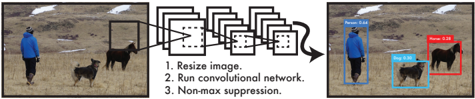
We present YOLO, a new approach to object detection. Prior work on object detection repurposes classifiers to perform detection. Instead, we frame object detection as a regression problem to spatially separated bounding boxes and associated class probabilities. A single neural network predicts bounding boxes and class probabilities directly from full images in one evaluation. Since the whole detection pipeline is a single network, it can be optimized end-to-end directly on detection performance. Our unified architecture is extremely fast. Our base YOLO model processes images in real-time at 45 frames per second. A smaller version of the network, Fast YOLO, processes an astounding 155 frames per second while still achieving double the mAP of other real-time detectors. Compared to state-of-the-art detection systems, YOLO makes more localization errors but is less likely to predict false positives on background. Finally, YOLO learns very general representations of objects. It outperforms other detection methods, including DPM and R-CNN, when generalizing from natural images to other domains like artwork.
Overview
CoChat Summary
TL;DR
YOLO reframes object detection as a single regression problem, using one convolutional network to predict bounding boxes and class probabilities directly from full images. It achieves real-time detection speeds while remaining competitive with, and complementary to, slower region-based detectors.
Key findings
- YOLO runs at 45 FPS on a Titan X GPU, and Fast YOLO runs at 155 FPS; Fast YOLO reaches 52.7% mAP on PASCAL VOC 2007, more than double prior real-time detectors, while YOLO reaches 63.4% mAP.
- On PASCAL VOC 2012, YOLO scores 57.9% mAP; combining Fast R-CNN with YOLO raises Fast R-CNN from 71.8% to 75.0% mAP on VOC 2007, a 3.2% gain.
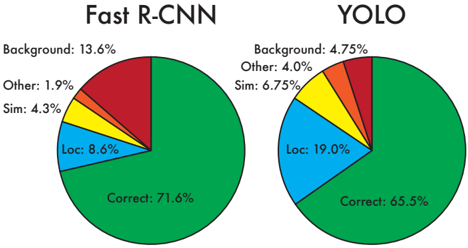
- YOLO makes fewer background false positives than Fast R-CNN: Fast R-CNN has 13.6% background false positives among top detections and is almost 3× more likely to predict background detections than YOLO.
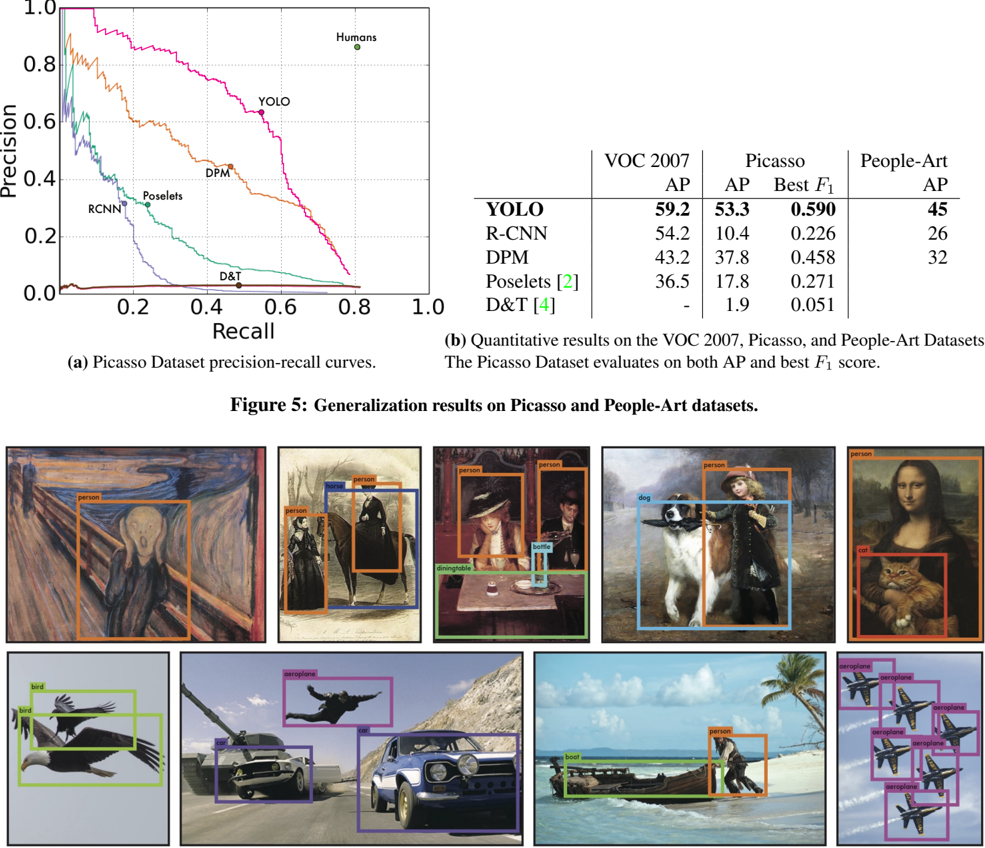
- YOLO generalizes better to artwork: on Picasso, YOLO gets 53.3 AP versus R-CNN’s 10.4 AP and DPM’s 37.8 AP; on People-Art, YOLO gets 45 AP versus R-CNN’s 26 AP and DPM’s 32 AP.
Methods
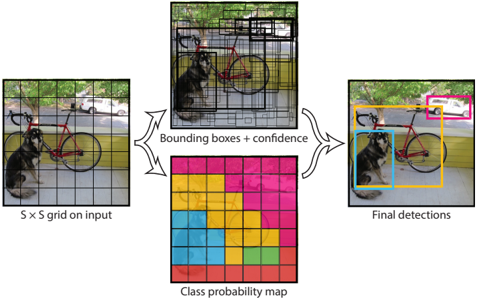
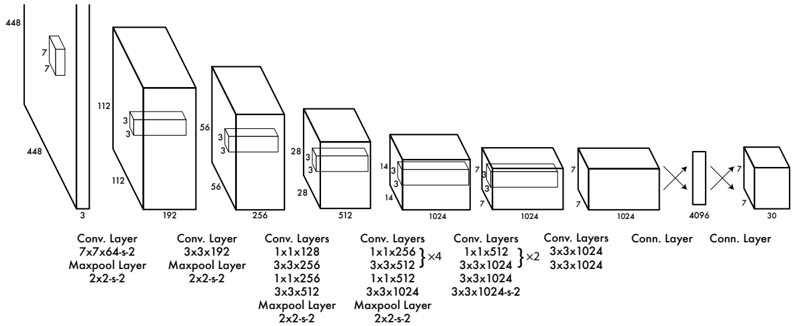
- Detection is modeled as a single CNN regression: the image is divided into an S×S grid; for PASCAL VOC, S=7, B=2, C=20, producing a 7×7×30 tensor of bounding boxes, confidence scores, and class probabilities.
- The base network has 24 convolutional layers followed by 2 fully connected layers; Fast YOLO uses 9 convolutional layers. Convolutional layers are pretrained on ImageNet at 224×224, then detection training uses 448×448 input.
- Training uses PASCAL VOC 2007 and 2012 for about 135 epochs, batch size 64, momentum 0.9, decay 0.0005, sum-squared error with λ_coord=5 and λ_noobj=0.5, dropout, and data augmentation.
Limitations
- The paper states YOLO imposes strong spatial constraints because each grid cell predicts only two boxes and one class, limiting nearby objects and struggling with small objects in groups such as flocks of birds.
- The paper states YOLO struggles to generalize to objects in new or unusual aspect ratios or configurations, uses relatively coarse features due to downsampling, and its loss treats small and large box errors equally; its main error source is incorrect localization.
- The paper states YOLO still lags state-of-the-art detection accuracy and struggles to precisely localize some objects, especially small ones.
Model-written summary. Check it against the paper before relying on it.
Integrity signals
Registry
Cites
Statistics
Figures
Verification
Claims the paper makes
6 Valid · 8 Not valid · 15 Not checked · 92 Own results and interpretations
The cited sources that could be checked couldn’t confirm or dispute this claim.
In the paper
“While it is much faster than R-CNN, it still falls short of real-time and takes a significant accuracy hit from not having good proposals.”
What the sources say
- Could not verifycites [20] [20] K. Lenc and A. Vedaldi. R-cnn minus r. arXiv preprint arXiv:1506.06981 , 2015. 5, 6 - sourceExperimental — accuracy not yet measured
The ConvNet-based Object Detection section identifies R-CNN minus R as a method that uses predefined regions instead of region proposals. It gives no runtime measurement or assessment of whether the method achieves real-time detection; searches for real-time performance and speed did not establish that claim. (LLM, conf=0.76)
plain- Asserted: passes — The authors put it forward as true.
- Checkable: passes — It can be checked against evidence.
- Load-bearing: passes — The paper’s conclusions depend on it.
- Based: passes — The paper gives a reason why it holds.
- Could not verify
The cited sources support only part of this claim — read each source’s verdict below.
In the paper
“To avoid overfitting we use dropout and extensive data augmentation.”
What the sources say
- Partly supportedcites [18] [18] G. E. Hinton, N. Srivastava, A. Krizhevsky, I. Sutskever, and R. R. Salakhutdinov. Improving neural networks by preventing co-adaptation of feature detectors. arXiv preprint arXiv:1207.0580 , 2012. 4 - sourceExperimental — accuracy not yet measured
The paper states that dropout reduces overfitting (p. 1) and describes using dropout with data augmentation for its ImageNet model (H Models for ImageNet, p. 18). It does not establish that YOLO uses either technique or describe YOLO’s augmentation as extensive. (LLM, conf=0.88)
plainstates a cause- Asserted: passes — The authors put it forward as true.
- Checkable: passes — It can be checked against evidence.
- Load-bearing: unclear — It is unclear whether the paper’s conclusions depend on it.
- Based: passes — The paper gives a reason why it holds.
- Partly supported
Every source the paper cites for this claim was checked and supports it.
In the paper
“However, only 30Hz DPM [31] actually runs in real-time.”
What the sources say
- Supportedcites [31] [31] M. A. Sadeghi and D. Forsyth. 30hz object detection with dpm v5. In Computer Vision-ECCV 2014 , pages 65-79. Springer, 2014. 5, 6 - source
The Introduction (p.1) states that 'except for certain objects including face, pedestrians and certain rigid objects, detectors do not currently run at video rate' and that the presented architecture detects the 20 PASCAL VOC categories simultaneously at 30Hz, i.e. at video/real-time rate. The Abstract (p.1) and Table 2 (Method) bound the comparison to other DPM speed-up efforts: reference DPM at 0.07Hz, the fastest GPU 'Vanilla DPM' at ~1Hz, FTVQ at 0.53s, and 'over an order of magnitude faster than the previous fastest DPM implementation', so none of the listed variants reaches real-time. Thus our copy supports both parts of the attribution: that this 30Hz DPM runs in real-time and that it is the only such DPM among the speed-up efforts compared. (LLM, conf=0.82)
plain- Asserted: passes — The authors put it forward as true.
- Checkable: passes — It can be checked against evidence.
- Load-bearing: unclear — It is unclear whether the paper’s conclusions depend on it.
- Based: passes — The paper gives a reason why it holds.
- Supported
The cited sources that could be checked couldn’t confirm or dispute this claim.
In the paper
“While it is much faster than R-CNN, it still falls short of real-time and takes a significant accuracy hit from not having good proposals.”
What the sources say
- Could not verifycites [20] [20] K. Lenc and A. Vedaldi. R-cnn minus r. arXiv preprint arXiv:1506.06981 , 2015. 5, 6 - sourceExperimental — accuracy not yet measured
The ConvNet-based Object Detection section identifies R-CNN minus R and says it uses predefined regions in an SPPnet system, but gives no speed comparison with R-CNN. A search for R-CNN minus R and speed found no passage in our copy establishing that it is much faster. (LLM, conf=0.73)
plainstates a cause- Asserted: passes — The authors put it forward as true.
- Checkable: passes — It can be checked against evidence.
- Load-bearing: unclear — It is unclear whether the paper’s conclusions depend on it.
- Based: passes — The paper gives a reason why it holds.
- Could not verify
The cited sources support only part of this claim — read each source’s verdict below.
In the paper
“While it is much faster than R-CNN, it still falls short of real-time and takes a significant accuracy hit from not having good proposals.”
What the sources say
- Partly supportedcites [20] [20] K. Lenc and A. Vedaldi. R-cnn minus r. arXiv preprint arXiv:1506.06981 , 2015. 5, 6 - sourceExperimental — accuracy not yet measured
The “ConvNet-based Object Detection” section (page unavailable) says R-CNN minus R uses predefined regions instead of region proposals. It does not say that this causes a significant accuracy loss; the paper’s discussion of low accuracy concerns a different system, naïve Faster R-CNN. (LLM, conf=0.83)
plainstates a cause- Asserted: passes — The authors put it forward as true.
- Checkable: passes — It can be checked against evidence.
- Load-bearing: unclear — It is unclear whether the paper’s conclusions depend on it.
- Based: passes — The paper gives a reason why it holds.
- Partly supported
84 more claims
Create a free account to see all 121 claims and to verify the 2 references still open.
- Probably not a substantial claim. 17
- It may state two separate claims as one. 15
Claims other papers make about this one
Each is checked against this paper’s own text: does it say what the citing paper says it does?
The source backs part of the claim, not all of it — or backs it for a different population, condition or comparison.
In the citing paper
“which was not thoroughly investigated in prevIoUs work such as YOLOv1 [20] and YOLOv2 [51] employing MSE/L2 loss (Mean Squared Error).”
From Object Detection in 20 Years: A Survey (2023) · cites this paper as [20]
Experimental — accuracy not yet measuredThe source backs part of the claim, not all of it — or backs it for a different population, condition or comparison.
In the citing paper
“the YOLO series models v2-v5 [144-147] are some of the most advanced object detection methods based on DNN, which have good performance in terms of speed and precision.”
From A survey of model compression strategies for object detection (2023) · cites this paper as [144]
Experimental — accuracy not yet measuredThe source backs part of the claim, not all of it — or backs it for a different population, condition or comparison.
In the citing paper
“As a typical and more widely used new form of applications [9], various deep learning-based intelligent services and applications have changed many aspects of people's lives due to the great advantages of Deep Learning (DL) in the fields of Computer Vision (CV) and Natural Language Processing (NLP) [10].”
From Convergence of Edge Computing and Deep Learning: A Comprehensive Survey (2020) · cites this paper as [9]
Experimental — accuracy not yet measuredThe cited source says what the claim attributes to it.
In the citing paper
“A convolutional neural network predicts the bounding boxes as well as class probabilities for all the objects depicted in an image.”
From Object detection using YOLO: challenges, architectural successors, datasets and applications (2023) · cites this paper as [56]
The cited source says what the claim attributes to it.
In the citing paper
“Authors of YOLO [56] have reframed the problem of object detection as a regression problem instead of classification problem.”
From Object detection using YOLO: challenges, architectural successors, datasets and applications (2023) · cites this paper as [56]
6 more claims about this paper
Create a free account to see every claim other papers make about this one.
Citations
Cites
Faster R-CNN: Towards Real-Time Object Detection with Region Proposal Networks
Ren, S., He, K., Girshick, R., & Sun, J. (2017) · IEEE Transactions on Pattern Analysis and Machine Intelligence · doi:10.1109/tpami.2016.2577031 · Cited by 73,472
Self-citationFaster R-CNN: Towards Real-Time Object Detection with Region Proposal Networks
Ren, S., He, K., Girshick, R., & Sun, J. (2015) · arXiv · doi:10.48550/arxiv.1506.01497 · Cited by 70,812
Self-citationGoing deeper with convolutions
Szegedy, C., Liu, W., Jia, Y., Sermanet, P., Reed, S., Anguelov, D., Erhan, D., Vanhoucke, V., & Rabinovich, A. (2015) · 2015 IEEE Conference on Computer Vision and Pattern Recognition (CVPR) · doi:10.1109/cvpr.2015.7298594 · Cited by 48,562
ImageNet Large Scale Visual Recognition Challenge
Russakovsky, O., Deng, J., Su, H., Krause, J., Satheesh, S., Ma, S., Huang, Z., Karpathy, A., Khosla, A., Bernstein, M., et al. (2015) · International Journal of Computer Vision · doi:10.1007/s11263-015-0816-y · Cited by 39,380 · cited 1×
“We pretrain our convolutional layers on the ImageNet 1000-class competition dataset [29].”
MethodHistograms of Oriented Gradients for Human Detection
Dalal, N., & Triggs, B. (2005) · 2005 IEEE Computer Society Conference on Computer Vision and Pattern Recognition (CVPR'05) · doi:10.1109/cvpr.2005.177 · Cited by 33,584 · cited 2×
“Detection pipelines generally start by extracting a set of robust features from input images (Haar [25], SIFT [23], HOG [4], convolutional features [6]).”
MethodRich Feature Hierarchies for Accurate Object Detection and Semantic Segmentation
Girshick, R., Donahue, J., Darrell, T., & Malik, J. (2014) · 2014 IEEE Conference on Computer Vision and Pattern Recognition · doi:10.1109/cvpr.2014.81 · Cited by 32,684 · cited 2×
“Then, classifiers [35, 21, 13, 10] or localizers [1, 31] are used to identify objects in the feature space.”
MethodSelf-citationGirshick, R. (2015) · 2015 IEEE International Conference on Computer Vision (ICCV) · doi:10.1109/iccv.2015.169 · Cited by 28,105
Self-citationDelving Deep into Rectifiers: Surpassing Human-Level Performance on ImageNet Classification
He, K., Zhang, X., Ren, S., & Sun, J. (2015) · 2015 IEEE International Conference on Computer Vision (ICCV) · doi:10.1109/iccv.2015.123 · Cited by 19,741 · cited 1×
“Convolutional neural networks (CNNs) achieve impressive performance on classification tasks at real-time speeds [13].”
Object recognition from local scale-invariant features
Lowe, D. G. (1999) · Proceedings of the Seventh IEEE International Conference on Computer Vision · doi:10.1109/iccv.1999.790410 · Cited by 16,472 · cited 1×
“Detection pipelines generally start by extracting a set of robust features from input images (Haar [25], SIFT [23], HOG [4], convolutional features [6]).”
MethodRobust Real-Time Face Detection
Viola, P., & Jones, M. J. (2004) · International Journal of Computer Vision · doi:10.1023/b:visi.0000013087.49260.fb · Cited by 14,097 · cited 1×
“Detectors for single classes like faces or people can be highly optimized since they have to deal with much less variation [36].”
Background
Cited by
Items 22,201–22,300 of 51,401
Detecting The Objects on The Road Using Modular Lightweight NetworkPreprint
Cao, S., Liu, Y., Lasang, P., et al. (2018) · arXiv (Cornell University) · doi:10.48550/arxiv.1811.06641 · Cited by 6
NeuNetS: An Automated Synthesis Engine for Neural Network DesignPreprint
Sood, A., Elder, B., Herta, B., Xue, C., Bekas, C., Malossi, A. C. I., Saha, D., Scheidegger, F., Venkataraman, G., Thomas, G., et al. (2019) · arXiv (Cornell University) · doi:10.48550/arxiv.1901.06261 · Cited by 11
6D Object Pose Estimation without PnPPreprint
Liu, J., & He, S. (2019) · arXiv (Cornell University) · doi:10.48550/arxiv.1902.01728 · Cited by 7
Gangwar, A. K., Joshi, A., Joshi, P., & Raghavendra, R. (2019) · arXiv (Cornell University) · doi:10.48550/arxiv.1902.05390 · Cited by 17
Few-shot Adaptive Faster R-CNNPreprint
Wang, T., Zhang, X., Yuan, L., et al. (2019) · arXiv (Cornell University) · doi:10.48550/arxiv.1903.09372 · Cited by 6
Road User Detection in VideosPreprint
Perreault, H., Bilodeau, G.-A., Saunier, N., & Gravel, P. (2019) · arXiv (Cornell University) · doi:10.48550/arxiv.1903.12049 · Cited by 8
Synthetic Data Generation and Adaption for Object Detection in Smart Vending MachinesPreprint
Wang, K., Shi, F., Wang, W., Nan, Y., & Lian, S. (2019) · arXiv (Cornell University) · doi:10.48550/arxiv.1904.12294 · Cited by 8
Robust Real-time Pedestrian Detection in Aerial Imagery on Jetson TX2Preprint
Afifi, M. S., Ali, Y., Amer, K., Shaker, M., & Elhelw, M. (2019) · arXiv (Cornell University) · doi:10.48550/arxiv.1905.06653 · Cited by 10
Grounding Object Detections With TranscriptionsPreprint
Moriya, Y., Sanabria, R., Metze, F., et al. (2019) · arXiv (Cornell University) · doi:10.48550/arxiv.1906.06147 · Cited by 6
CBinfer: Change-Based Inference for Convolutional Neural Networks on Video Data
Cavigelli, L., Degen, P., & Benini, L. (2017) · Repository for Publications and Research Data (ETH Zurich) · doi:10.3929/ethz-b-000219323 · Cited by 11
Object Detection in Videos by High Quality Object LinkingPreprint
Tang, P., Wang, C., Wang, X., et al. (2018) · arXiv (Cornell University) · doi:10.48550/arxiv.1801.09823 · Cited by 6
Xu, Y., & Wang, J. (2019) · arXiv (Cornell University) · doi:10.48550/arxiv.1907.03465 · Cited by 6
Cap2Det: Learning to Amplify Weak Caption Supervision for Object DetectionPreprint
Ye, K., Zhang, M., Kovashka, A., et al. (2019) · arXiv (Cornell University) · doi:10.48550/arxiv.1907.10164 · Cited by 6
Object-Aware Instance Labeling for Weakly Supervised Object DetectionPreprint
Kosugi, S., Yamasaki, T., & Aizawa, K. (2019) · arXiv (Cornell University) · doi:10.48550/arxiv.1908.03792 · Cited by 6
Meta-learning algorithms for Few-Shot Computer VisionPreprint
Bennequin, E. (2019) · arXiv (Cornell University) · doi:10.48550/arxiv.1909.13579 · Cited by 9
Castro, M. D. (2019) · UPM Digital Archive (Technical University of Madrid) · doi:10.20868/upm.thesis.57127 · Cited by 12
PnP-Net: A hybrid Perspective-n-Point NetworkPreprint
Sheffer, R., & Wiesel, A. (2020) · arXiv.org · doi:10.48550/arxiv.2003.04626 · Cited by 9
End-to-end Learning Improves Static Object Geo-localization in Monocular VideoPreprint
Chaâbane, M. A., Gueguen, L., Trabelsi, A., Beveridge, J. R., & O′Hara, S. (2020) · arXiv (Cornell University) · doi:10.48550/arxiv.2004.05232 · Cited by 6
Streaming Object Detection for 3-D Point CloudsPreprint
Han, W., Zhang, Z., Caine, B., Yang, B., Sprunk, C., Alsharif, O., Ngiam, J., Vasudevan, V., Shlens, J., & Chen, Z. (2020) · European Conference on Computer Vision · doi:10.48550/arxiv.2005.01864 · Cited by 37
Benchmarking the Performance and Energy Efficiency of AI Accelerators for AI TrainingPreprint
Wang, Y., Wang, Q., Shi, S., et al. (2019) · arXiv (Cornell University) · doi:10.48550/arxiv.1909.06842 · Cited by 6
When2com: Multi-Agent Perception via Communication Graph GroupingPreprint
Liu, Y., Tian, J., Glaser, N., et al. (2020) · arXiv (Cornell University) · doi:10.48550/arxiv.2006.00176 · Cited by 6
NINEPINS: Nuclei Instance Segmentation with Point AnnotationsPreprint
Yen, T.-A., Hsu, H. C., Pati, P., Gabrani, M., Foncubierta–Rodríguez, A., & Chung, P. C. (2020) · arXiv (Cornell University) · doi:10.48550/arxiv.2006.13556 · Cited by 6
Learning to Take Directions One Step at a TimePreprint
Hu, Q., Wälchli, A., Portenier, T., Zwicker, M., & Favaro, P. (2018) · arXiv (Cornell University) · doi:10.48550/arxiv.1812.01874 · Cited by 10
Mask2CAD: 3D Shape Prediction by Learning to Segment and RetrievePreprint
Kuo, W.-C., Angelova, A., Lin, T.-Y., & Dai, A. (2020) · European Conference on Computer Vision · doi:10.48550/arxiv.2007.13034 · Cited by 97
Chen, C., & Dai, J. (2020) · arXiv (Cornell University) · doi:10.48550/arxiv.2007.12070 · Cited by 6
Towards Unsupervised Crowd Counting via Regression-Detection Bi-knowledge TransferPreprint
Liu, Y., Wang, Z., Shi, M., et al. (2020) · arXiv (Cornell University) · doi:10.48550/arxiv.2008.05383 · Cited by 6
ApproxDet: Content and Contention-Aware Approximate Object Detection for MobilesPreprint
Xu, R., Zhang, C.-L., Wang, P., Lee, J., Mitra, S., Chaterji, S., Li, Y., & Bagchi, S. (2020) · arXiv (Cornell University) · doi:10.48550/arxiv.2010.10754 · Cited by 6
A Study of Image Pre-processing for Faster Object RecognitionPreprint
Shahriar, T., & Li, H. (2020) · arXiv (Cornell University) · doi:10.48550/arxiv.2011.06928 · Cited by 6
Single-shot Path Integrated Panoptic SegmentationPreprint
Hwang, S., Oh, S. W., & Kim, S. J. (2020) · arXiv (Cornell University) · doi:10.48550/arxiv.2012.01632 · Cited by 6
Qiao, S., Pang, S., Luo, G., Pan, S., Wang, X., Wang, M., Zhai, X., & Chen, T. (2020) · arXiv (Cornell University) · doi:10.48550/arxiv.2011.13096 · Cited by 14
Co-mining: Self-Supervised Learning for Sparsely Annotated Object DetectionPreprint
Wang, T., Yang, T., Cao, J., et al. (2020) · arXiv (Cornell University) · doi:10.48550/arxiv.2012.01950 · Cited by 6
Amodal Segmentation Based on Visible Region Segmentation and Shape PriorPreprint
Xiao, Y., Xu, Y., Zhong, Z., Luo, W., Li, J., & Gao, S. (2020) · arXiv (Cornell University) · doi:10.48550/arxiv.2012.05598 · Cited by 6
TGCN: Time Domain Graph Convolutional Network for Multiple Objects TrackingPreprint
Zhang, J. (2021) · arXiv (Cornell University) · doi:10.48550/arxiv.2101.01861 · Cited by 13
General Instance Distillation for Object DetectionPreprint
Dai, X., Jiang, Z., Wu, Z., et al. (2021) · arXiv (Cornell University) · doi:10.48550/arxiv.2103.02340 · Cited by 6
COVID-19 personal protective equipment detection using real-time deep learning methodsPreprint
Khosravipour, S., Taghvaei, E., & Charkari, N. M. (2021) · arXiv (Cornell University) · doi:10.48550/arxiv.2103.14878 · Cited by 9
Research on Mosaic Image Data Enhancement for Overlapping Ship TargetsPreprint
Zeng, G., Yu, W., Wang, R., & Lin, A. (2021) · arXiv (Cornell University) · doi:10.48550/arxiv.2105.05090 · Cited by 6
Revisiting Knowledge Distillation for Object DetectionPreprint
Banitalebi-Dehkordi, A. (2021) · arXiv (Cornell University) · doi:10.48550/arxiv.2105.10633 · Cited by 7
Adaptive Streaming Perception using Deep Reinforcement Learning.Preprint
Ghosh, A., Nambi, A. U., Singh, A., Yvs, H., & Ganu, T. (2021) · arXiv (Cornell University) · Cited by 10
ESAI: Efficient Split Artificial Intelligence via Early Exiting Using Neural Architecture SearchPreprint
Zeinali, B., Zhuang, D., & Chang, J. M. (2021) · arXiv (Cornell University) · doi:10.48550/arxiv.2106.12549 · Cited by 7
Depth-Guided Camouflaged Object Detection.Preprint
Zhang, J., Lv, Y., Xiang, M., Li, A., Dai, Y., & Zhong, Y. (2021) · arXiv (Cornell University) · Cited by 8
MmWave Radar and Vision Fusion for Object Detection in Autonomous Driving: A ReviewPreprint
Wei, Z., Zhang, F., Chang, S., et al. (2021) · arXiv (Cornell University) · doi:10.48550/arxiv.2108.03004 · Cited by 6
Data Analytics for Smart Cities: Challenges and Promises
Mohammadi, F. G., Shenavarmasouleh, F., Amini, M. H., & Arabnia, H. R. (2021) · Wiley eBooks · doi:10.1002/9781119748342.ch2 · Cited by 16
Deep Learning for Component Fault Detection in Electricity Transmission Lines.Preprint
Maduako, I., Igwe, C. F., Abah, J. E., et al. (2021) · Research Square · doi:10.21203/rs.3.rs-1028973/v1 · Cited by 6
Is Deep Image Prior in Need of a Good EducationPreprint
Barbano, R., Leuschner, J., Schmidt, M., et al. (2021) · arXiv (Cornell University) · Cited by 6
Video-Text Pre-training with Learned RegionsPreprint
Yan, R., Shou, M., Ge, Y., Wang, J.-P., Lin, X., Cai, G.-Y., & Tang, J.-H. (2021) · AAAI Conference on Artificial Intelligence · doi:10.48550/arxiv.2112.01194 · Cited by 30
Gonçalves, J. D. P., Pinto, F. D. A. D. C., de Queiroz, D. M., et al. (2020) · doi:10.31219/osf.io/wdb79 · Cited by 6
Abdurahman, F., Fante, K. A., & Mohammed, M. A. (2020) · Research Square · doi:10.21203/rs.3.rs-74079/v1 · Cited by 10
Gesture Recognition using Neural Networks
Kurady, A. (2022) · doi:10.31979/etd.jmhw-h8eh · Cited by 6
Critical Infrastructure Security Using Computer Vision Technologies
Zhang, X., Ebroul Izquierdo, M., & Chandramouli, K. (2022) · Wiley eBooks · doi:10.1002/9781119834175.ch6 · Cited by 8
Long-term High Resolution Image Dataset of Antarctic Coastal Benthic Fauna
Marini, S., Bonofiglio, F., Corgnati, L., et al. (2022) · Scientific Data · doi:10.1038/s41597-022-01865-7 · Cited by 6
A Novel Approach for PV Cell Fault Detection using YOLOv8 and Particle Swarm OptimizationPreprint
Phan, Q. B., & Nguyen, T. T. (2023) · doi:10.36227/techrxiv.22680484.v1 · Cited by 6
Validating the Use of Mixed Reality in Industrial Quality Control: A Case StudyPreprint
da Silva, J. P. L. R., Coelho, P., Saraiva, L., Váz, P., Martins, P., & Henriques, J. (2023) · Preprints.org · doi:10.20944/preprints202308.1909.v1 · Cited by 6
Editorial: Synthetic data for computer vision in agriculture
Afonso, M. V., & Giufrida, V. (2023) · Frontiers in Plant Science · doi:10.3389/fpls.2023.1277073 · Cited by 6
Sufian, M. A., & Varadarajan, J. (2023) · Research Square · doi:10.21203/rs.3.rs-3396662/v1 · Cited by 6
Few-Shot Object Detection: Research Advances and ChallengesPreprint
Xin, Z., Chen, S., Wu, T., et al. (2023) · SSRN Electronic Journal · doi:10.2139/ssrn.4611614 · Cited by 6
Diffusionengine: Diffusion Model is Scalable Data Engine for Object DetectionPreprint
Zhang, M., Wu, J., Ren, Y., Li, M., & Ma, J. (2024) · SSRN Electronic Journal · doi:10.2139/ssrn.4866102 · Cited by 9
Deep Learning Approach for Bubble Detection and Segmentation with YOLOv5Preprint
Sharma, A., Eickhoff, M., Echterhof, T., & Wuppermann, C. (2024) · Preprints.org · doi:10.20944/preprints202408.1050.v1 · Cited by 5
A human single-neuron dataset for object recognition
Cao, R., Brunner, P., Brandmeir, N. J., Willie, J. T., & Wang, S. (2025) · Scientific Data · doi:10.1038/s41597-024-04265-1 · Cited by 8
PCMMD: A Novel Dataset of Plasma Cells to Support the Diagnosis of Multiple Myeloma
Andrade, C. L. B., Ferreira, M. V. F., Alencar, B. M., Filho, J. L. S. B., Guimaraes, M. A., Moraes, I. P. C., Lopes, T. J. S., dos Santos, A. S., dos Santos, M. M., Silva, M. I. C. S. E., et al. (2025) · Scientific Data · doi:10.1038/s41597-025-04459-1 · Cited by 6
A bimodal image dataset for seed classification from the visible and near-infrared spectrum
Kukushkin, M., Bogdan, M., Goertz, S., Callsen, J.-O., Oldenburg, E., Enders, M., & Schmid, T. (2025) · Scientific Data · doi:10.1038/s41597-025-05979-6 · Cited by 9
“In contrast to other studies 33,34 , which employed YOLO 35 -based approaches designed for detecting and classifying multiple seeds within a single image (e.g., entire seed lots), we chose a simpler approach—similar to that of 7,36 —in which each image contains exactly one seed.”
Idama, G., Guo, Y., & Yu, W. (2024) · 2024 33rd International Conference on Computer Communications and Networks (ICCCN) · doi:10.1109/icccn61486.2024.10637599 · Cited by 5
Comparing spatial patterns of marine vessels between vessel-tracking data and satellite imagery
Nakayama, S., Dong, W., Correro, R. G., Selig, E. R., Wabnitz, C. C. C., Hastie, T. J., Leape, J., Yeung, S. Y., & Micheli, F. (2023) · Frontiers in Marine Science · doi:10.3389/fmars.2022.1076775 · Cited by 9
Sensing-Aware Machine Learning Framework for Extended Lifetime of IoT Sensors
Jeon, K. E., & She, J. P. M. (2023) · IEEE Transactions on Mobile Computing · doi:10.1109/tmc.2023.3267846 · Cited by 5
Perception-latency aware distributed target tracking
Aldana‐López, R., Aragüés, R., & Sagüés, C. (2023) · Information Fusion · doi:10.1016/j.inffus.2023.101857 · Cited by 5
Truong, N.-N., Le, M.-H., Do, T.-D., et al. (2023) · International Conference on System Science and Engineering · doi:10.1109/icsse58758.2023.10227078 · Cited by 5
Multi-attribute fusion-based approach for Algerian automatic license plate recognition
Zibani, R., Sebbak, F., Boudaren, M. E. Y., Mataoui, M., Aissa, R. H., & Benaissa, Y. A. (2023) · Multimedia Tools and Applications · doi:10.1007/s11042-023-16789-6 · Cited by 7
Dong, Z., Liu, Y., Wang, Y., et al. (2023) · IEEE Transactions on Geoscience and Remote Sensing · doi:10.1109/tgrs.2023.3326500 · Cited by 5
Safety Helmet Detection of Workers in Construction Site using YOLOv8
Mahmud, S. S., Islam, M. A., Ritu, K. J., et al. (2023) · International Conference on Computer and Information Technology (ICCIT) · doi:10.1109/iccit60459.2023.10441212 · Cited by 5
A Self-Adaptive Automatic Incident Detection System for Road Surveillance Based on Deep Learning
Bartolomé-Hornillos, C., San‐José‐Revuelta, L. M., Aguiar-Pérez, J. M., García-Serrada, C., Vara-Pazos, E., & Casaseca‐de‐la‐Higuera, P. (2024) · Sensors · doi:10.3390/s24061822 · Cited by 7
Zhang, L., Chen, K., Zheng, L., Liao, X., Lu, F., Li, Y., Cui, Y., Wu, Y., Song, Y., & Yan, S. (2024) · Agriculture · doi:10.3390/agriculture14030490 · Cited by 9
A Multi-Scale Defect Detection for Steel Surface Based on Improved Faster R-CNN
Shen, M., Cai, F., & Xie, J. (2023) · China Automation Congress (CAC) · doi:10.1109/cac59555.2023.10451783 · Cited by 5
AI Powered Self Checkout System
Harrison, H., Christina, C., Baiju, A. V., Sreeja, V., & S, V. H. G. (2024) · International Conference on Mobile Computing and Sustainable Informatics (ICMCSI) · doi:10.1109/icmcsi61536.2024.00025 · Cited by 5
Route Positioning System for Campus Shuttle Bus Service Using a Single Camera
An, J. (2024) · Electronics · doi:10.3390/electronics13112004 · Cited by 5
Sun, H., Wang, J., Hu, Z., He, Y., & Xu, Z. (2024) · Arabian Journal for Science and Engineering · doi:10.1007/s13369-024-09188-y · Cited by 6
Cross-modal Adaptive Fusion Object Detection Based on Illumination-Awareness
Xu, J., Mo, B., Zhao, J., Zhao, C., Tao, Y., & Han, S. (2024) · Youth Academic Annual Conference of Chinese Association of Automation (YAC) · doi:10.1109/yac63405.2024.10598791 · Cited by 9
Zhao, D., Su, G., & Wang, P. (2024) · IET Image Processing · doi:10.1049/ipr2.13206 · Cited by 5
ASIPNet: Orientation-Aware Learning Object Detection for Remote Sensing Images
Dong, R., Yin, S., Jiao, L., An, J., & Wu, W. (2024) · Remote Sensing · doi:10.3390/rs16162992 · Cited by 8
Tan, D., Wang, J., Su, Y., Zhang, Z., Peng, X., Zheng, C.-H., & Zhong, W. (2024) · IEEE Transactions on Industrial Informatics · doi:10.1109/tii.2024.3409437 · Cited by 5
Research Progress on Power Visual Detection of Overhead Line Bolt Defects Based on UAV Images
Deng, X., He, M., Zheng, J., Qin, L., & Liu, K. (2024) · Drones · doi:10.3390/drones8090442 · Cited by 8
Elaborate Teacher: Improved Semi-Supervised Object Detection With Rich Image Exploiting
Yang, X., Zhou, Q., Wei, Z., Liu, H. S., Wang, N., & Gao, X. (2024) · IEEE Transactions on Multimedia · doi:10.1109/tmm.2024.3453040 · Cited by 7
Leveraging Neurosymbolic AI for Slice Discovery
Collevati, M., Eiter, T., & Higuera, N. (2024) · Lecture notes in computer science · doi:10.1007/978-3-031-71167-1_22 · Cited by 6
Lite-YOLOv8: a more lightweight algorithm for Tubercle Bacilli detection
Li, Y., Qiu, H., Xian, S., Li, L., Zhao, Z., Deng, Y., & Tang, J. (2024) · Medical & Biological Engineering & Computing · doi:10.1007/s11517-024-03187-9 · Cited by 6
Xu, J., Chen, F., Huang, L., Liu, T., & Peng, Z. (2024) · IET Image Processing · doi:10.1049/ipr2.13231 · Cited by 6
Enhancing Remote Sensing Object Detection Through YOLOV5x6 Model
Pydala, B., Bhavana, B. V., Gamyasree, G., Jyotsna, K., Lohitha, M., & Jyothsna, V. (2024) · World Conference on Communication & Computing (WCONF) · doi:10.1109/wconf61366.2024.10692306 · Cited by 5
Lin, Y., Li, J., Wei, S., & Liu, S. (2024) · Journal of Marine Science and Engineering · doi:10.3390/jmse12101786 · Cited by 7
Daiaeddine, M. J., Badrouss, S., Harti, A. E., et al. (2024) · Foods and raw materials · doi:10.21603/2308-4057-2025-2-650 · Cited by 5
PSRR-MaxpoolNMS++: Fast Non-Maximum Suppression With Discretization and Pooling
Zhang, T., Chen, C., Liu, Y., Geng, X., Aly, M. M. S., & Lin, J. (2024) · IEEE Transactions on Pattern Analysis and Machine Intelligence · doi:10.1109/tpami.2024.3485898 · Cited by 8
WoodYOLO: A Novel Object Detector for Wood Species Detection in Microscopic Images
Nieradzik, L., Stephani, H., Sieburg-Rockel, J., Helmling, S., Olbrich, A., Wrage, S., & Keuper, J. (2024) · Forests · doi:10.3390/f15111910 · Cited by 7
Core Fracture Identification and Dip Angle Calculation Using a Deep Learning Model
Liu, Y., Zhu, W., Liu, X., Wang, J., & Chen, C. (2024) · Rock Mechanics and Rock Engineering · doi:10.1007/s00603-024-04207-8 · Cited by 9
Sasaya, S., Yang, L., HOSHINO, Y., et al. (2024) · AgriEngineering · doi:10.3390/agriengineering6040236 · Cited by 5
Explainability Enhanced Object Detection Transformer With Feature Disentanglement
Yu, W. W. H., Liu, R., Chen, D., & Hu, Q. (2024) · IEEE Transactions on Image Processing · doi:10.1109/tip.2024.3492733 · Cited by 12
Energy-Efficient, Delay-Constrained Edge Computing of a Network of DNNs
Ghasemi, M., Heidari, S., Kim, Y. G., Wu, C.-J., & Vrudhula, S. B. K. (2024) · IEEE Transactions on Computers · doi:10.1109/tc.2024.3500368 · Cited by 6
Wu, S., Song, K., Cobb, J., & Adams, A. T. (2024) · JMIR Biomedical Engineering · doi:10.2196/62770 · Cited by 5
Yang, Y., Song, P., Wang, Y., & Cao, L. (2024) · Sensors · doi:10.3390/s24237711 · Cited by 6
Transforming Sketches of UML Use Case Diagrams to Models
Ražinskas, M., Miliūnas, B., Jurgelaitis, M., Čeponienė, L., & Bisikirskienė, L. (2024) · IEEE Access · doi:10.1109/access.2024.3514455 · Cited by 5
An Interactive Prediction and Planning Method for Lane Change Trajectories
Xiong, W., Chen, J., Zhang, X., Wang, Q., & Qi, Z. (2024) · IEEE Transactions on Intelligent Transportation Systems · doi:10.1109/tits.2024.3513436 · Cited by 9
An Efficient Group Convolution and Feature Fusion Method for Weed Detection
Chen, C., Zang, Y., Jiao, J., Yan, D., Fan, Z., Cui, Z., & Zhang, M. (2024) · Agriculture · doi:10.3390/agriculture15010037 · Cited by 6
Yoshimi, Y., Mine, Y., Yamamoto, K., Okazaki, S., Ito, S., Mizuho, S. A. N. O., Peng, T., Nakamoto, T., Nagasaki, T., Kakimoto, N., et al. (2024) · Dental Materials Journal · doi:10.4012/dmj.2024-186 · Cited by 9
Dynamic Collision Alert System for Collaboration of Construction Equipment and Workers
Dzeng, R., Fan, B., & Hsieh, T.-L. (2024) · Buildings · doi:10.3390/buildings15010110 · Cited by 5
EAFF-Net: Efficient attention feature fusion network for dual-modality pedestrian detection
Shen, Y., Xie, X., Wu, J., Chen, L., & Huang, F. C. (2025) · Infrared Physics & Technology · doi:10.1016/j.infrared.2024.105696 · Cited by 5
Metadata
- Authors
- Redmon, J., Divvala, S., Girshick, R., & Farhadi, A.
- Affiliations
- University of Washington (US)
- Meta (United States) (US)
- Venue
- 2016 IEEE Conference on Computer Vision and Pattern Recognition (CVPR)
- Publisher
- IEEE
- Published
- 2016-06
- Pages
- 779-788
- ISSN
- 1063-6919 (ISSN-L)
- OpenAlex
- W1483870316
- Cited by
- 53,803
- References
- 42
- Citations by year
- 2026: 5347 · 2025: 8912 · 2024: 8953 · 2023: 8264 · 2022: 6785 · 2021: 5741 · 2020: 4223 · 2019: 3286 · 2018: 1560 · 2017: 635 · 2016: 90
- FWCI
- 644.23
- Type
- conference paper
- Language
- en
- Open access
- green
- arxiv.org
- Locations
- IEEE Computer Society Conference on Computer Vision and Pattern Recognition/Proceedings - IEEE Computer Society Conference on Computer Vision and Pattern Recognition/Proceedings (publishedVersion)
- arXiv (Cornell University) (submittedVersion)
- arXiv (Cornell University)
- Zenodo (CERN European Organization for Nuclear Research) (cc-by)
- Funders
- National Science Foundation (1338054)
- Office of Naval Research (N00014-13-1-0720, N00014)
- Topics
- Physical Sciences › Computer Science › Computer Vision and Pattern Recognition › Advanced Neural Network Applications
- Physical Sciences › Computer Science › Computer Vision and Pattern Recognition › Advanced Image and Video Retrieval Techniques
- Physical Sciences › Computer Science › Computer Vision and Pattern Recognition › Visual Attention and Saliency Detection
- Keywords
- object detection, YOLO, real-time detection, bounding box regression, end-to-end learning, false positive reduction, domain generalization
About these checks
Registry, retraction, Cites and statistics results are computed, not judged, with one exception: a printed reference that no index lists is read once by a model before it counts as a citation error. Claims are extracted by a model and kept only when their quote appears verbatim in the text; each cited source is then checked, with a model’s help, for whether it says what the claim relies on. Those verdicts can be wrong — read the claim’s quote and the cited source before relying on one.
The claim verdicts this report counts are experimental: their accuracy is not yet measured.
A language model drew the claims from the paper on 2026-10-10, under version 3 of the claim definition (model deepseek-v4.1-flash, prompt extract-v3).
A second model labelled each claim on 2026-10-10 (model jev-1.13-20260917, definition revision gold-guideline-v0.2).
Cited sources are checked with a language model’s help (gpt-6-sol and qwen3.8-omni-flash).
Statistics and arithmetic are recomputed, not judged.
Confidence bands are shown only for fields calibrated on our annotated test set. None is calibrated yet, so no band is shown.
What counts as a claim ›How we measure confidence ›How we check this ›
Are you an author, or do you see a problem with this page? Request a review
Data sources
Bibliographic data: Semantic Scholar, OpenAlex, Crossref.
Contains information from the Semantic Scholar Academic Graph Datasets, made available under the ODC Attribution License (ODC-BY 1.0).
Semantic Scholar’s data is described in: Kinney, R., et al. (2023). The Semantic Scholar Open Data Platform. arXiv:2301.10140.
