

You Only Look Once: Unified, Real-Time Object Detection
Open accessThe DOI matches its Crossref record; 53 of the 53 references it cites were found in a registry or an index; 8 of the 25 sources its claims cite were checked for support.
Abstract
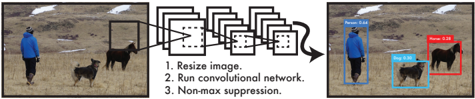
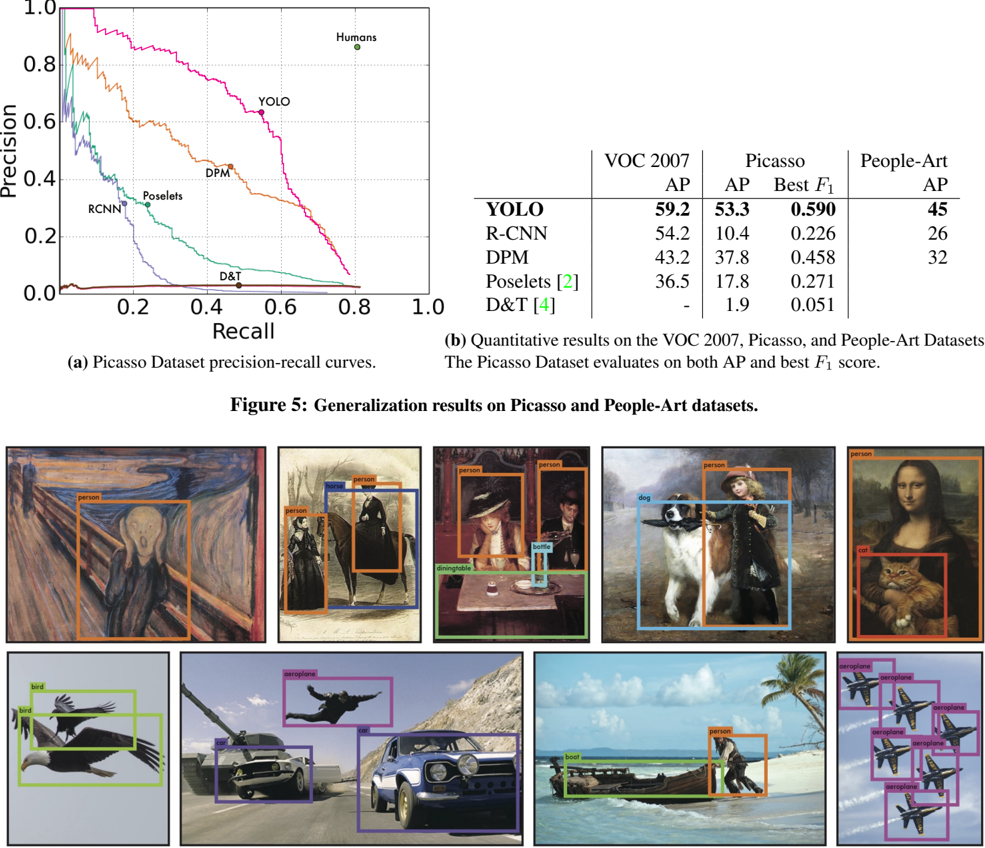
We present YOLO, a new approach to object detection. Prior work on object detection repurposes classifiers to perform detection. Instead, we frame object detection as a regression problem to spatially separated bounding boxes and associated class probabilities. A single neural network predicts bounding boxes and class probabilities directly from full images in one evaluation. Since the whole detection pipeline is a single network, it can be optimized end-to-end directly on detection performance. Our unified architecture is extremely fast. Our base YOLO model processes images in real-time at 45 frames per second. A smaller version of the network, Fast YOLO, processes an astounding 155 frames per second while still achieving double the mAP of other real-time detectors. Compared to state-of-the-art detection systems, YOLO makes more localization errors but is less likely to predict false positives on background. Finally, YOLO learns very general representations of objects. It outperforms other detection methods, including DPM and R-CNN, when generalizing from natural images to other domains like artwork.
Overview
CoChat Summary
TL;DR
YOLO reframes object detection as a single regression problem, using one convolutional network to predict bounding boxes and class probabilities directly from full images. It achieves real-time detection speeds while remaining competitive with, and complementary to, slower region-based detectors.
Key findings
- YOLO runs at 45 FPS on a Titan X GPU, and Fast YOLO runs at 155 FPS; Fast YOLO reaches 52.7% mAP on PASCAL VOC 2007, more than double prior real-time detectors, while YOLO reaches 63.4% mAP.
- On PASCAL VOC 2012, YOLO scores 57.9% mAP; combining Fast R-CNN with YOLO raises Fast R-CNN from 71.8% to 75.0% mAP on VOC 2007, a 3.2% gain.
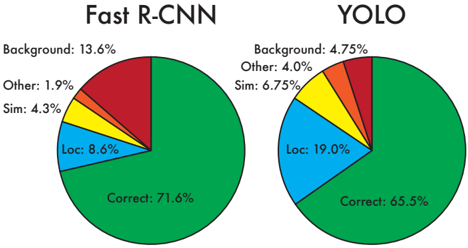
- YOLO makes fewer background false positives than Fast R-CNN: Fast R-CNN has 13.6% background false positives among top detections and is almost 3× more likely to predict background detections than YOLO.
- YOLO generalizes better to artwork: on Picasso, YOLO gets 53.3 AP versus R-CNN’s 10.4 AP and DPM’s 37.8 AP; on People-Art, YOLO gets 45 AP versus R-CNN’s 26 AP and DPM’s 32 AP.
Methods
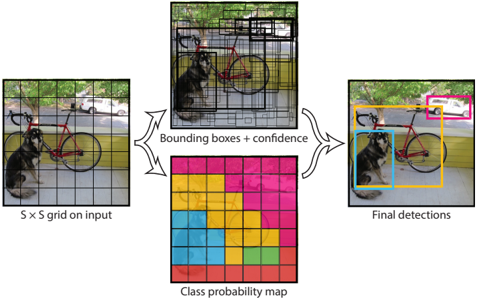
- Detection is modeled as a single CNN regression: the image is divided into an S×S grid; for PASCAL VOC, S=7, B=2, C=20, producing a 7×7×30 tensor of bounding boxes, confidence scores, and class probabilities.
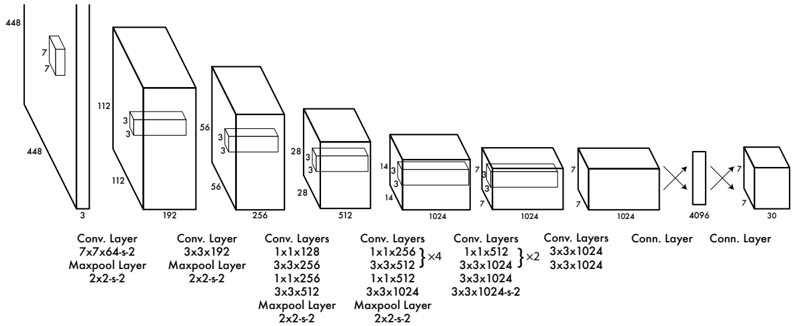
- The base network has 24 convolutional layers followed by 2 fully connected layers; Fast YOLO uses 9 convolutional layers. Convolutional layers are pretrained on ImageNet at 224×224, then detection training uses 448×448 input.
- Training uses PASCAL VOC 2007 and 2012 for about 135 epochs, batch size 64, momentum 0.9, decay 0.0005, sum-squared error with λ_coord=5 and λ_noobj=0.5, dropout, and data augmentation.
Limitations
- The paper states YOLO imposes strong spatial constraints because each grid cell predicts only two boxes and one class, limiting nearby objects and struggling with small objects in groups such as flocks of birds.
- The paper states YOLO struggles to generalize to objects in new or unusual aspect ratios or configurations, uses relatively coarse features due to downsampling, and its loss treats small and large box errors equally; its main error source is incorrect localization.
- The paper states YOLO still lags state-of-the-art detection accuracy and struggles to precisely localize some objects, especially small ones.
Model-written summary. Check it against the paper before relying on it.
Integrity signals
Registry
Cites
Statistics
Figures
Verification
Claims the paper makes
6 Valid · 8 Not valid · 15 Not checked · 92 Own results and interpretations
The cited sources that could be checked couldn’t confirm or dispute this claim.
In the paper
“While it is much faster than R-CNN, it still falls short of real-time and takes a significant accuracy hit from not having good proposals.”
What the sources say
- Could not verifycites [20] [20] K. Lenc and A. Vedaldi. R-cnn minus r. arXiv preprint arXiv:1506.06981 , 2015. 5, 6 - sourceExperimental — accuracy not yet measured
The ConvNet-based Object Detection section identifies R-CNN minus R as a method that uses predefined regions instead of region proposals. It gives no runtime measurement or assessment of whether the method achieves real-time detection; searches for real-time performance and speed did not establish that claim. (LLM, conf=0.76)
plain- Asserted: passes — The authors put it forward as true.
- Checkable: passes — It can be checked against evidence.
- Load-bearing: passes — The paper’s conclusions depend on it.
- Based: passes — The paper gives a reason why it holds.
- Could not verify
The cited sources support only part of this claim — read each source’s verdict below.
In the paper
“To avoid overfitting we use dropout and extensive data augmentation.”
What the sources say
- Partly supportedcites [18] [18] G. E. Hinton, N. Srivastava, A. Krizhevsky, I. Sutskever, and R. R. Salakhutdinov. Improving neural networks by preventing co-adaptation of feature detectors. arXiv preprint arXiv:1207.0580 , 2012. 4 - sourceExperimental — accuracy not yet measured
The paper states that dropout reduces overfitting (p. 1) and describes using dropout with data augmentation for its ImageNet model (H Models for ImageNet, p. 18). It does not establish that YOLO uses either technique or describe YOLO’s augmentation as extensive. (LLM, conf=0.88)
plainstates a cause- Asserted: passes — The authors put it forward as true.
- Checkable: passes — It can be checked against evidence.
- Load-bearing: unclear — It is unclear whether the paper’s conclusions depend on it.
- Based: passes — The paper gives a reason why it holds.
- Partly supported
Every source the paper cites for this claim was checked and supports it.
In the paper
“However, only 30Hz DPM [31] actually runs in real-time.”
What the sources say
- Supportedcites [31] [31] M. A. Sadeghi and D. Forsyth. 30hz object detection with dpm v5. In Computer Vision-ECCV 2014 , pages 65-79. Springer, 2014. 5, 6 - source
The Introduction (p.1) states that 'except for certain objects including face, pedestrians and certain rigid objects, detectors do not currently run at video rate' and that the presented architecture detects the 20 PASCAL VOC categories simultaneously at 30Hz, i.e. at video/real-time rate. The Abstract (p.1) and Table 2 (Method) bound the comparison to other DPM speed-up efforts: reference DPM at 0.07Hz, the fastest GPU 'Vanilla DPM' at ~1Hz, FTVQ at 0.53s, and 'over an order of magnitude faster than the previous fastest DPM implementation', so none of the listed variants reaches real-time. Thus our copy supports both parts of the attribution: that this 30Hz DPM runs in real-time and that it is the only such DPM among the speed-up efforts compared. (LLM, conf=0.82)
plain- Asserted: passes — The authors put it forward as true.
- Checkable: passes — It can be checked against evidence.
- Load-bearing: unclear — It is unclear whether the paper’s conclusions depend on it.
- Based: passes — The paper gives a reason why it holds.
- Supported
The cited sources that could be checked couldn’t confirm or dispute this claim.
In the paper
“While it is much faster than R-CNN, it still falls short of real-time and takes a significant accuracy hit from not having good proposals.”
What the sources say
- Could not verifycites [20] [20] K. Lenc and A. Vedaldi. R-cnn minus r. arXiv preprint arXiv:1506.06981 , 2015. 5, 6 - sourceExperimental — accuracy not yet measured
The ConvNet-based Object Detection section identifies R-CNN minus R and says it uses predefined regions in an SPPnet system, but gives no speed comparison with R-CNN. A search for R-CNN minus R and speed found no passage in our copy establishing that it is much faster. (LLM, conf=0.73)
plainstates a cause- Asserted: passes — The authors put it forward as true.
- Checkable: passes — It can be checked against evidence.
- Load-bearing: unclear — It is unclear whether the paper’s conclusions depend on it.
- Based: passes — The paper gives a reason why it holds.
- Could not verify
The cited sources support only part of this claim — read each source’s verdict below.
In the paper
“While it is much faster than R-CNN, it still falls short of real-time and takes a significant accuracy hit from not having good proposals.”
What the sources say
- Partly supportedcites [20] [20] K. Lenc and A. Vedaldi. R-cnn minus r. arXiv preprint arXiv:1506.06981 , 2015. 5, 6 - sourceExperimental — accuracy not yet measured
The “ConvNet-based Object Detection” section (page unavailable) says R-CNN minus R uses predefined regions instead of region proposals. It does not say that this causes a significant accuracy loss; the paper’s discussion of low accuracy concerns a different system, naïve Faster R-CNN. (LLM, conf=0.83)
plainstates a cause- Asserted: passes — The authors put it forward as true.
- Checkable: passes — It can be checked against evidence.
- Load-bearing: unclear — It is unclear whether the paper’s conclusions depend on it.
- Based: passes — The paper gives a reason why it holds.
- Partly supported
84 more claims
Create a free account to see all 121 claims and to verify the 2 references still open.
- Probably not a substantial claim. 17
- It may state two separate claims as one. 15
Claims other papers make about this one
Each is checked against this paper’s own text: does it say what the citing paper says it does?
The source backs part of the claim, not all of it — or backs it for a different population, condition or comparison.
In the citing paper
“which was not thoroughly investigated in prevIoUs work such as YOLOv1 [20] and YOLOv2 [51] employing MSE/L2 loss (Mean Squared Error).”
From Object Detection in 20 Years: A Survey (2023) · cites this paper as [20]
Experimental — accuracy not yet measuredThe source backs part of the claim, not all of it — or backs it for a different population, condition or comparison.
In the citing paper
“the YOLO series models v2-v5 [144-147] are some of the most advanced object detection methods based on DNN, which have good performance in terms of speed and precision.”
From A survey of model compression strategies for object detection (2023) · cites this paper as [144]
Experimental — accuracy not yet measuredThe source backs part of the claim, not all of it — or backs it for a different population, condition or comparison.
In the citing paper
“As a typical and more widely used new form of applications [9], various deep learning-based intelligent services and applications have changed many aspects of people's lives due to the great advantages of Deep Learning (DL) in the fields of Computer Vision (CV) and Natural Language Processing (NLP) [10].”
From Convergence of Edge Computing and Deep Learning: A Comprehensive Survey (2020) · cites this paper as [9]
Experimental — accuracy not yet measuredThe cited source says what the claim attributes to it.
In the citing paper
“A convolutional neural network predicts the bounding boxes as well as class probabilities for all the objects depicted in an image.”
From Object detection using YOLO: challenges, architectural successors, datasets and applications (2023) · cites this paper as [56]
The cited source says what the claim attributes to it.
In the citing paper
“Authors of YOLO [56] have reframed the problem of object detection as a regression problem instead of classification problem.”
From Object detection using YOLO: challenges, architectural successors, datasets and applications (2023) · cites this paper as [56]
6 more claims about this paper
Create a free account to see every claim other papers make about this one.
Citations
Cites
Faster R-CNN: Towards Real-Time Object Detection with Region Proposal Networks
Ren, S., He, K., Girshick, R., & Sun, J. (2017) · IEEE Transactions on Pattern Analysis and Machine Intelligence · doi:10.1109/tpami.2016.2577031 · Cited by 73,472
Self-citationFaster R-CNN: Towards Real-Time Object Detection with Region Proposal Networks
Ren, S., He, K., Girshick, R., & Sun, J. (2015) · arXiv · doi:10.48550/arxiv.1506.01497 · Cited by 70,812
Self-citationGoing deeper with convolutions
Szegedy, C., Liu, W., Jia, Y., Sermanet, P., Reed, S., Anguelov, D., Erhan, D., Vanhoucke, V., & Rabinovich, A. (2015) · 2015 IEEE Conference on Computer Vision and Pattern Recognition (CVPR) · doi:10.1109/cvpr.2015.7298594 · Cited by 48,562
ImageNet Large Scale Visual Recognition Challenge
Russakovsky, O., Deng, J., Su, H., Krause, J., Satheesh, S., Ma, S., Huang, Z., Karpathy, A., Khosla, A., Bernstein, M., et al. (2015) · International Journal of Computer Vision · doi:10.1007/s11263-015-0816-y · Cited by 39,380 · cited 1×
“We pretrain our convolutional layers on the ImageNet 1000-class competition dataset [29].”
MethodHistograms of Oriented Gradients for Human Detection
Dalal, N., & Triggs, B. (2005) · 2005 IEEE Computer Society Conference on Computer Vision and Pattern Recognition (CVPR'05) · doi:10.1109/cvpr.2005.177 · Cited by 33,584 · cited 2×
“Detection pipelines generally start by extracting a set of robust features from input images (Haar [25], SIFT [23], HOG [4], convolutional features [6]).”
MethodRich Feature Hierarchies for Accurate Object Detection and Semantic Segmentation
Girshick, R., Donahue, J., Darrell, T., & Malik, J. (2014) · 2014 IEEE Conference on Computer Vision and Pattern Recognition · doi:10.1109/cvpr.2014.81 · Cited by 32,684 · cited 2×
“Then, classifiers [35, 21, 13, 10] or localizers [1, 31] are used to identify objects in the feature space.”
MethodSelf-citationGirshick, R. (2015) · 2015 IEEE International Conference on Computer Vision (ICCV) · doi:10.1109/iccv.2015.169 · Cited by 28,105
Self-citationDelving Deep into Rectifiers: Surpassing Human-Level Performance on ImageNet Classification
He, K., Zhang, X., Ren, S., & Sun, J. (2015) · 2015 IEEE International Conference on Computer Vision (ICCV) · doi:10.1109/iccv.2015.123 · Cited by 19,741 · cited 1×
“Convolutional neural networks (CNNs) achieve impressive performance on classification tasks at real-time speeds [13].”
Object recognition from local scale-invariant features
Lowe, D. G. (1999) · Proceedings of the Seventh IEEE International Conference on Computer Vision · doi:10.1109/iccv.1999.790410 · Cited by 16,472 · cited 1×
“Detection pipelines generally start by extracting a set of robust features from input images (Haar [25], SIFT [23], HOG [4], convolutional features [6]).”
MethodRobust Real-Time Face Detection
Viola, P., & Jones, M. J. (2004) · International Journal of Computer Vision · doi:10.1023/b:visi.0000013087.49260.fb · Cited by 14,097 · cited 1×
“Detectors for single classes like faces or people can be highly optimized since they have to deal with much less variation [36].”
Background
Cited by
Items 22,401–22,500 of 51,401
Cross-Domain Object Detection with Hierarchical Multi-Scale Domain Adaptive YOLO
Zhu, S., Zhu, P., Wu, Y., & Qiao, W. (2025) · Sensors · doi:10.3390/s25175363 · Cited by 9
“The mainstream methods for object detection can be categorized into two-stage (e.g., Faster RCNN [2] and Mask RCNN [35]) and one-stage (e.g., SSD [4], FCOS [24], and YOLO series [3]).”
YOLOv11s-CD: An Improved YOLOv11s Method for Catenary Dropper Fault Detection
Luo, C., Tang, H., Li, S., Wan, G., Chen, W., & Guan, J. (2025) · IEEE Transactions on Instrumentation and Measurement · doi:10.1109/tim.2025.3604118 · Cited by 6
Li, H.-L., Ren, Q., Li, J., Wei, H., Liu, Z., & Fan, L. (2025) · Expert Systems with Applications · doi:10.1016/j.eswa.2025.129529 · Cited by 6
Yang, T., Ding, L., Shi, Q., & Jiang, T. (2025) · Scientific Reports · doi:10.1038/s41598-025-17186-9 · Cited by 6
“Since the introduction of YOLOv1 by Joseph Redmon in 2015, the YOLO series has gone through multiple iterations, continually improving detection speed and accuracy 15–21 .”
CT-FSOD: CLIP-Based Text-Guided Few-Shot Object Detection
Chang, H., Lee, W., & Kim, M. (2025) · IEEE Access · doi:10.1109/access.2025.3604521 · Cited by 7
A generative framework for structural crack discovery under limited sensing
Wenhao, S., Li, Q., Xuanxin, T., Guicheng, Z., Li, S., & Ai, S. (2025) · International Journal of Mechanical Sciences · doi:10.1016/j.ijmecsci.2025.110797 · Cited by 7
Obstacle-Avoidant Leader Following with a Quadruped Robot
Scheidemann, C., Werner, L., Reijgwart, V., Cramariuc, A., Chomarat, J., Chiu, J.-R., Siegwart, R., & Hutter, M. (2025) · Proceedings - IEEE International Conference on Robotics and Automation/Proceedings · doi:10.1109/icra55743.2025.11127912 · Cited by 9
Adaptive Computing and Multicasting Optimization for Live 360-Degree Video Streaming
Wang, S., Tan, X., Liu, Z., Tai, Z., Sun, M., Yang, J., & Wu, J. H. (2025) · IEEE Transactions on Vehicular Technology · doi:10.1109/tvt.2025.3605289 · Cited by 5
“Furthermore, video analytics technologies such as YOLO [6] play a crucial role in VR/AR applications.”
Lighter, faster, more focused YOLO fabric defect detection model
Wu, H., Liu, J., Liu, H., & Liang, J. (2025) · Cluster Computing · doi:10.1007/s10586-025-05321-0 · Cited by 6
“The first generation of YOLO, introduced by Joseph Redmon et al. in 2015 [20], simplified the detection process into a single-stage operation, significantly improving detection speed and making it one of the fastest real-time detectors of its time.”
Hsieh, H.-Y., Liu, K., & Kang, S. (2025) · Journal of Civil Engineering and Management · doi:10.3846/jcem.2025.24094 · Cited by 7
Park, J., Kavathekar, V., Bhuduri, S., Amin, M. H., & Devaraj, S. S. (2025) · Sensors · doi:10.3390/s25175544 · Cited by 8
“Among these models, YOLO (You Only Look Once) [35] has gained widespread attention and adoption due to its high inference speed and relatively strong accuracy.”
Metareasoning for Edge-Cloud Collaborative LLM Planning for Efficient Autonomous Navigation
Navardi, M., Gao, S., Walczak, M., Camacho, F., & Mohsenin, T. (2026) · ACM Transactions on Embedded Computing Systems · doi:10.1145/3765750 · Cited by 10
“In contrast, region-free approaches, including YOLO [65], directly predict object locations and classes in a single step without generating region proposals.”
An Enhanced YOLOv8n-Based Method for Fire Detection in Complex Scenarios
Zhao, X., Yu, M., Xu, J., Wu, P., & Yuan, H. (2025) · Sensors · doi:10.3390/s25175528 · Cited by 5
“By contrast, single-stage object detection algorithms, such as YOLO (You Only Look Once) [20] and SSD (Single Shot MultiBox Detector) [21], can directly perform object classification and regression without the need for additional region proposal steps.”
M4MLF-YOLO: A Lightweight Semantic Segmentation Framework for Spacecraft Component Recognition
Yi, W., Zhang, Z., & Chang, L. (2025) · Remote Sensing · doi:10.3390/rs17183144 · Cited by 6
Railway Fastener Defect Detection Model Based on Dual Attention and MobileNetv3
Lv, D., Meng, J., Meng, G., & Shen, Y. (2025) · World Electric Vehicle Journal · doi:10.3390/wevj16090513 · Cited by 5
MSRS-DETR: End-to-End Object Detection for Multi-Scale Remote Sensing
Yuan, J., Feng, S., & Han, H. (2025) · Sensors · doi:10.3390/s25185734 · Cited by 5
“The second trajectory favours speed and is represented by one-stage detectors such as the You Only Look Once (YOLO) series [8].”
Vehicle detection in CCTV with global-guided self-attention and convolution
Guo, Y., Yamamoto, Y., Yaginuma, H., & Taniguchi, Y. (2025) · Complex & Intelligent Systems · doi:10.1007/s40747-025-02073-7 · Cited by 6
Fang, W., Yang, Y. Q., Zhang, W., Wang, T., Feng, J., & Liu, G. (2025) · Measurement Science and Technology · doi:10.1088/1361-6501/ae06bf · Cited by 8
“To address these limitations, researchers have proposed one-stage detection algorithms, such as the single shot multibox detector (SSD) [15], the You Only Look Once (YOLO) series [16], and more recently, the detection transformer (DETR) series based on transformer architectures [17].”
Dawoud, K., Zaheer, M. Z., Khan, M., Nandakumar, K., Saddik, A. E., & Khan, M. H. (2025) · IEEE/CVF Conference on Computer Vision and Pattern Recognition Workshops (CVPRW) · doi:10.1109/cvprw67362.2025.00388 · Cited by 12
“In object centric methods, an object detector framework, e.g. YOLO [36] or Faster RCNN [11], is used to first detect all objects appearing in the input frames.”
CPB-YOLOv8: An Enhanced Multi-Scale Traffic Sign Detector for Complex Road Environment
Zhao, W. G., Li, L., & Gong, X. (2025) · Information · doi:10.3390/info16090798 · Cited by 5
“Algorithms such as SSD [10], RetinaNet [11], and the YOLO [12] series have become mainstream solutions for real-time applications.”
Enhancing Breast Lesion Detection in Mammograms via Transfer Learning
Abdikenov, B., Rakishev, D., Orazayev, Y., & Zhaksylyk, T. (2025) · Journal of Imaging · doi:10.3390/jimaging11090314 · Cited by 40
“State-of-the-art object detection architectures, including the YOLO family [3], Cascade R-CNN [4], RTMDet [5], and transformer-based models like DETR [6], have shown strong performance on natural image benchmarks (e.g., RTMDet-x with mean Average Precision (mAP) scores of 52.8 on COCO [7]),…”
InfluentialSNNTracker: Online High-Speed Multi-Object Tracking With Spike Camera
Zheng, Y., Li, C., Zhang, J., Yu, Z., & Huang, T. (2025) · IEEE Transactions on Pattern Analysis and Machine Intelligence · doi:10.1109/tpami.2025.3610696 · Cited by 9
“Through extensive experiments, we demonstrate that SNNTracker consistently achieves superior performance compared to MOT SOTA [34], [35], [36], [37], [38], including supervised approaches such as YOLOv5 [32], [39].”
Vedhapriyavadhana, R., & Koirala, R. C. (2025) · doi:10.1109/skima66621.2025.11155698 · Cited by 5
“Object detection algorithms such as YOLO (You Only Look Once) [2] have emerged as leading frameworks for tasks requiring both speed and accuracy.”
Harnessing large language models for virtual reality exploration testing: a case study
Qi, Z., Li, H., Qin, H., Peng, K., He, S., & Qin, X. (2025) · Automated Software Engineering · doi:10.1007/s10515-025-00535-3 · Cited by 6
TFP-YOLO: Obstacle and Traffic Sign Detection for Assisting Visually Impaired Pedestrians
Zheng, Z., Cheng, J., & Jin, F. (2025) · Sensors · doi:10.3390/s25185879 · Cited by 10
Wang, Y., Wei, X., Wu, D., et al. (2025) · Automation in Construction · doi:10.1016/j.autcon.2025.106531 · Cited by 5
DKB-SLAM: Dynamic RGB-D Visual SLAM with Efficient Keyframe Selection and Local Bundle Adjustment
Sun, Q., Xu, Z., Li, Y., Zhang, Y., & Ye, F. (2025) · Robotics · doi:10.3390/robotics14100134 · Cited by 6
Miao, H., Zhang, J., Jiang, Y., & Zhou, J. (2025) · Complex & Intelligent Systems · doi:10.1007/s40747-025-02092-4 · Cited by 6
“Notable examples of such algorithms includetheSingleShot MultiboxDetector (SSD) [29], the You Only Look Once (YOLO) series [30], among others.”
Wu, J., Meng, H., Yuan, M., Liu, C., & Lu, Z. (2025) · Scientific Reports · doi:10.1038/s41598-025-19145-w · Cited by 7
“The YOLOv1 algorithm 28 employed a strategy of making individual predictions for each region, dividing an image into multiple grids where each grid predicts objects with centers located within it.”
Crowd Detection: Leveraging YOLO for Human Recognition
Yiğit, G. (2025) · Turkish Journal of Engineering · doi:10.31127/tuje.1627839 · Cited by 6
AMS-YOLO: multi-scale feature integration for intelligent plant protection against maize pests
Deng, L., Fang, D., Ullah, A., Hou, Q., & Yu, H. (2025) · Frontiers in Plant Science · doi:10.3389/fpls.2025.1640405 · Cited by 10
Zhang, M., Hu, Y., Luo, L., Xu, B., Wang, S., & Wang, Y. (2025) · Computers in Industry · doi:10.1016/j.compind.2025.104390 · Cited by 6
End-to-End License Plate Detection and Recognition in Iraq Using a Detection Transformer and OCR
Al-Arbo, Y., Mahmood, H., & Alqassab, A. (2025) · Mesopotamian Journal of Computer Science · doi:10.58496/mjcsc/2025/021 · Cited by 5
An automated method for converting P&IDs in shipbuilding to structured graphs
Han, I.-S., Roh, M.-I., & Kong, M.-C. (2025) · International Journal of Naval Architecture and Ocean Engineering · doi:10.1016/j.ijnaoe.2025.100696 · Cited by 6
Song, L., Zhang, P., Chen, K., Li, Z., Yan, H., & Huang, Y. (2025) · The International Journal of Advanced Manufacturing Technology · doi:10.1007/s00170-025-16650-0 · Cited by 14
“23 Error analysis: Fast R-CNN vs. YOLOv1 [169] of limited weld defect samples in industrial settings by proposing innovative data augmentation techniques.”
Enhancing UAV object detection with an efficient multi-scale feature fusion framework
Lai, D., Kang, K., Xu, K., Ma, X., Zhang, Y., Huang, F., & Chen, J. (2025) · PLoS ONE · doi:10.1371/journal.pone.0332408 · Cited by 11
“In recent years, with the advancement of object detection, both two-stage and single-stage methods have been proposed [11–25].”
InfluentialA comprehensive survey on deep reinforcement learning in object tracking
Nguyen, H., Thudumu, S., Du, H., Vasa, R., & Mouzakis, K. (2025) · Machine Learning with Applications · doi:10.1016/j.mlwa.2025.100745 · Cited by 8
Singh, R., Gadade, A. M., & Hussain, I. (2025) · BMC Plant Biology · doi:10.1186/s12870-025-07246-7 · Cited by 8
“Given these limitations, deep learning-based object detection frameworks, particularly the You Only Look Once (YOLO) architecture, present compelling advantages for agricultural monitoring applications [45].”
FANT-Det: Flow-Aligned Nested Transformer for SAR Small Ship Detection
Li, H., Wang, D., Hu, J., Zhi, X., & Yang, D. (2025) · Remote Sensing · doi:10.3390/rs17203416 · Cited by 9
Jiang, J., Zhu, Y., Wu, Z., & Song, J. (2025) · IEEE Robotics and Automation Letters · doi:10.1109/lra.2025.3621942 · Cited by 35
“Fast closed-set detectors like YOLO [14] have been widely used in semantic robotic mapping [1], [15], [16], [17], but their fixed category sets limit generalization to open-world settings.”
YOLO-LMTB: A Lightweight Detection Model for Multi-Scale Tea Buds in Agriculture
Xia, G., Guo, Y., Wei, Q., Cen, Y., Feng, L., & Yang, Y. P. (2025) · Sensors · doi:10.3390/s25206400 · Cited by 5
“Well-known one-stage models include the YOLO(You Only Look Once) series [11–18], SSD(Single Shot MultiBox Detector) [19], and RetinaNet [20].”
Mao, R., Yuan, H., Li, F., Shi, Y., Zhou, J., Hu, X., & Hu, X. (2025) · Plant Methods · doi:10.1186/s13007-025-01449-7 · Cited by 5
Conte, L., Nunzio, G. D., Raso, G., & Cascio, D. (2025) · Applied Sciences · doi:10.3390/app152111311 · Cited by 5
A forest fire identification and monitoring model based on improved YOLOv8
Zheng, Y., Guo, P., Tian, X., & Ye, Y. (2025) · Scientific Reports · doi:10.1038/s41598-025-17893-3 · Cited by 10
Computer vision‐based real‐time cable safety assessment under vehicle‐induced bridge fires
Li, J., Wang, B. P., Zhou, X., Cucuzza, R., Gao, K., & Yun, X. (2025) · Computer-Aided Civil and Infrastructure Engineering · doi:10.1111/mice.70108 · Cited by 6
“The YOLO framework was introduced at the 2016 Conference on Computer Vision and Pattern Recognition as a new paradigm for real-time object detection (Redmon et al., 2016).”
Nazir, A., & Wani, M. A. (2025) · International Journal of Information Technology · doi:10.1007/s41870-025-02790-9 · Cited by 6
“Due to the low detection efficiency like speed of R-CNNs, an alternative detection algorithm was introduced, termed "You Only Look Once" (YOLO), which falls under the one-stage object detection category [5].”
Díaz-Santos, S., Caballero‐Gil, P., & Caballero‐Gil, C. (2025) · Computers · doi:10.3390/computers14110476 · Cited by 5
“Notably, models like Faster R-CNN [4], YOLO [5], and SSD [6] have played a crucial role in this revolution.”
Dong, Z., Yang, Q. K., Chen, H., Zhou, H., & Gao, D. (2025) · Journal of Real-Time Image Processing · doi:10.1007/s11554-025-01800-0 · Cited by 7
“Typical one-stage detectors include SSD [6] and the YOLO series [7–9].”
Low-Latency Video Anonymization for Crowd Anomaly Detection: Privacy Versus Performance
Asres, M. W., Jiao, L., & Omlin, C. W. P. (2025) · IEEE Transactions on Information Forensics and Security · doi:10.1109/tifs.2025.3630347 · Cited by 8
Wang, H., Zhang, F., & Yi, R. (2025) · Sensors · doi:10.3390/s25226890 · Cited by 6
“For instance, models like the Single-Shot MultiBox Detector (SSD) [13], You Only Look Once (YOLO) [14], Region-based Convolu-tional Neural Network (Faster R-CNN) [15], and Mask R-CNN [16] have demonstrated impressive performance within the domain of object recognition.”
Wang, Q., Wang, D., Lu, J., Xiao, G., Liang, D., Lu, G., & Shao, H. (2025) · Scientific Reports · doi:10.1038/s41598-025-24260-9 · Cited by 5
“From YOLOv1 16 to YOLOv8 24 , this family of models has evolved through incremental innovations: Anchor-based detection in YOLOv2 35 , Multi-scale feature fusion (FPN) in YOLOv3 36 , CSPDarknet backbone in YOLOv4 19 , Auto-learning anchor boxes in YOLOv5 20 , and Transformer-enhanced architecture in YOLOv8 24 These ad…”
InfluentialFrom Vulnerability to Robustness: A Survey of Patch Attacks and Defenses in Computer Vision
Liu, X., & Xu, R. (2025) · Electronics · doi:10.3390/electronics14234553 · Cited by 10
Matsui, I., Matsumoto, A., Imai, A., Okushima, H., Niioka, H., Abe, M., Tamai, N., Nagasu, H., Kanda, E., Uchino, E., et al. (2025) · npj Digital Medicine · doi:10.1038/s41746-025-02160-6 · Cited by 8
Hu, X., Li, X., Xu, J., Adan, A. D., Zhou, L., Zhu, X., Li, Y., Guo, W., Liu, S., Liu, W., et al. (2025) · ISPRS Journal of Photogrammetry and Remote Sensing · doi:10.1016/j.isprsjprs.2025.11.017 · Cited by 7
CATR: CNN augmented transformer for object detection in remote sensing imagery
Hadi, S. J., Ahmed, I., Iqbal, A., & Alzahrani, A. (2025) · Scientific Reports · doi:10.1038/s41598-025-27872-3 · Cited by 9
“YOLOv5, the latest iteration developed by Ultralytics LLC 23 , achieves high detection precision while maintaining lightweight architecture suitable for embedded deployments 19 .”
Xiuyu, 孙. S., & Nan, 毕. B. (2025) · Laser & Optoelectronics Progress · doi:10.3788/lop251015 · Cited by 6
Huang, Y., Zhang, Y., Yan, J. M., Zhang, C., Gao, P., & Lv, X. (2025) · Artificial Intelligence Review · doi:10.1007/s10462-025-11457-7 · Cited by 6
“In contrast, YOLO (You Only Look Once) (Redmon et al. 2016 ) introduced a pioneering single-stage detection approach that enabled real-time 1 3 performance by treating detection as a regression problem, leading to subsequent improvements in the YOLO series.”
Li, W., & Zhang, Y. (2025) · Scientific Reports · doi:10.1038/s41598-025-32074-y · Cited by 14
“Redmon et al. initially introduced the YOLO methodology, reformulating object detection as a regression problem and achieving breakthrough performance in real-time object detection 11 .”
DeepForestVision : Automated wildlife identification for camera traps of African tropical forests
Magaldi, H., Cornette, R., Tibesigwa, J. J., Katumba, R., Rugonge, H., Amarasekaran, B., Anderson, N., Cappelle, N., Cardoso, A. W., Cornélis, D., et al. (2025) · Ecological Solutions and Evidence · doi:10.1002/2688-8319.70167 · Cited by 13
“These more complex archi - tectures such as R-CNN (Girshick et al., 2014) and YOLO (Redmon et al., 2016 ) learn hierarchical features directly from the raw image data and achieve state- of- the-art performance on detection and classification tasks.”
UAV-DETR: Few-Parameter DETR for Small Object Detection in High-Altitude UAV Images
Liao, N., Zhang, Y., Yu, Z., Huang, J., Zhu, M., & Peng, B. (2025) · IEEE Journal of Selected Topics in Applied Earth Observations and Remote Sensing · doi:10.1109/jstars.2025.3645731 · Cited by 11
RMSDNet: A Lightweight Object Detection Network for Rail Surface Defect
Chen, Y., Li, Y., Ying, Z., Wang, Z., & Xie, M. (2025) · IEEE Transactions on Instrumentation and Measurement · doi:10.1109/tim.2025.3644563 · Cited by 8
AI-Enabled Smart Camera Traps for Wildlife Monitoring in African Ecosystems
Pishdast, H., Kalva, H., & Tye, D. (2025) · International Conference on Information Technology for Social Good (GoodIT) · doi:10.1145/3748699.3749780 · Cited by 9
“We focus specifically on YOLOv8 [17] and YOLOv11 [25], selected for their balance of accuracy, speed, and edge deployment readiness.”
Co-MixPL: An optimized semi-supervised learning method for tunnel water leakage detection
Long, X., Teng, J., Zhu, Z., et al. (2025) · Advanced Engineering Informatics · doi:10.1016/j.aei.2025.104263 · Cited by 5
Liu, Q., Wan, X., Sheng, Y., Wang, S., & Wei, B. (2025) · Italian National Conference on Sensors · doi:10.3390/s26010103 · Cited by 3
“On the contrary, single-stage detection algorithms such as YOLO [30], SSD [31], and RetinaNet [32] carry out object classification and localization directly on feature maps in an end-to-end fashion, which makes these models efficient and hence suitable for real-time scenarios.”
Wang, F., Bai, J., Wang, M., Liu, B., Xue, H., & Chen, J. (2025) · Engineering Applications of Artificial Intelligence · doi:10.1016/j.engappai.2025.113526 · Cited by 8
An improved steel defect detection model using multi-scale feature fusion based on YOLO-MFD
Feng, Y., Jin, L., Yang, H. M., & Liu, S. (2025) · Scientific Reports · doi:10.1038/s41598-025-29596-w · Cited by 12
UAV-based object detection model for smart surveillance using deep neural network
Kumar, G., Rawat, S. S., Gautam, J., & Salau, A. O. (2025) · Measurement Sensors · doi:10.1016/j.measen.2025.101982 · Cited by 5
Wu, M., Peng, J., Yu, X., Xu, H., & Sun, H. (2026) · PLoS ONE · doi:10.1371/journal.pone.0339617 · Cited by 5
“Two-stage methodologies, exemplified by the R-CNN family [5,6], achieve exceptional accuracy through region proposal mechanisms, while single-stage approaches including YOLO variants [7,8] and SSD architectures [9] excel in real-time scenarios due to their computational efficiency.”
Zhang, Z., Feng, B., & Liu, H. (2026) · Scientific Reports · doi:10.1038/s41598-025-34544-9 · Cited by 7
ACDNet: Adaptive Citrus Detection Network Based on Improved YOLOv8 for Robotic Harvesting
Wang, Z., Xia, W., & Li, M. (2026) · Agriculture · doi:10.3390/agriculture16020148 · Cited by 6
Bearing-based multi-agent formation control: A survey and taxonomy
Su, H., Yang, Z., Zhu, S., et al. (2026) · Annual Reviews in Control · doi:10.1016/j.arcontrol.2025.101043 · Cited by 5
Michael, C., & Wang, H. (2026) · Vehicles · doi:10.3390/vehicles8010016 · Cited by 7
The Survey of Evolutionary Deep Learning-Based UAV Intelligent Power Inspection
Fan, S., & Cao, B. (2026) · Drones · doi:10.3390/drones10010055 · Cited by 6
Yang, Z., Li, D., Hou, L., & Nai, W. (2026) · Machines · doi:10.3390/machines14010094 · Cited by 7
WTEFNet: Real-Time Low-Light Object Detection for Advanced Driver Assistance Systems
Wu, H., Zhang, R., Chen, J., Lyu, N., Hu, H., Guo, Y., & Qiu, T. Z. (2026) · IEEE Transactions on Instrumentation and Measurement · doi:10.1109/tim.2026.3655940 · Cited by 10
“The YOLO [21], [53], [54] series has been one of the most widely adopted and continuously improved families of object detectors.”
YOLO-UMS: Multi-Scale Feature Fusion Based on YOLO Detector for PCB Surface Defect Detection
Peng, H. J., Yang, W., & Yu, B. (2026) · Sensors · doi:10.3390/s26020689 · Cited by 5
Kumari, P., & Hammady, R. (2026) · Multimedia Systems · doi:10.1007/s00530-025-02139-z · Cited by 17
“Earlier versions, such as YOLOv3, introduced multi-scale predictions, while YOLOv4 incorporated enhancements like Mish activation and spatial pyramid pooling [ 48 ].”
Hussain, S., Mumtaz, I., Wang, C., & Lv, P. (2026) · Egyptian Informatics Journal · doi:10.1016/j.eij.2026.100888 · Cited by 6
DMR-YOLO: An Improved Wind Turbine Blade Surface Damage Detection Method Based on YOLOv8
Shi, L., Wang, S., Zhao, J., et al. (2026) · Applied Sciences · doi:10.3390/app16031333 · Cited by 5
DFFormer: UAV Object Detection via Feature Scaling and Interaction
Li, H., Xiao, L., Cao, L., Yao, S., Wang, M., & Li, Y. (2026) · IEEE Transactions on Geoscience and Remote Sensing · doi:10.1109/tgrs.2026.3658082 · Cited by 14
Shih, Y.-H., & Chen, J. (2026) · Machine Vision and Applications · doi:10.1007/s00138-025-01784-8 · Cited by 5
“In contrast, the You Only Look Once (YOLO) family [ 15– 22] adopts a one-stage architecture in which a single CNN performs localization and classification simultaneously.”
Machine learning for materials microstructures: A survey of applications and methodologies
Barmak, K., & Rickman, J. M. (2026) · Acta Materialia · doi:10.1016/j.actamat.2026.122041 · Cited by 7
Abbineni, P., Aldowaish, S., Liechty, C., Noorzad, S., Ghalati, A. G., & Fayazi, M. (2026) · Asia and South Pacific Design Automation Conference (ASP-DAC) · doi:10.1109/asp-dac66049.2026.11420505 · Cited by 20
“By combining semantic, keyword-based search, and contextual understanding, it generates highly relevant and accurate responses.”
YOLO-CottWed: A lightweight network for fine-grained weed detection in cotton fields
Li, A., Zhang, K., Wang, B., Xu, C., & Liu, J. (2026) · Neurocomputing · doi:10.1016/j.neucom.2026.133404 · Cited by 7
Yuan, H., & Li, Y. (2026) · Algorithms · doi:10.3390/a19040254 · Cited by 8
Deep learning-based object detection: A comprehensive review of YOLO, RCNN, and SSD series
Zeng, W., Mao, G., Li, M., & Yin, S. (2026) · Electronic Research Archive · doi:10.3934/era.2026124 · Cited by 11
Liu, D., Jin, Z., Chen, J., & Xu, Z. (2026) · PLoS ONE · doi:10.1371/journal.pone.0346343 · Cited by 8
“The one-stage method mainly includes YOLO [55], SSD [56] and RetinaNet [57].”
Separating anything from image in context
Wan, Y., Shao, M., Shu, J., Cheng, Y., Meng, D., & Zuo, W. (2026) · Pattern Recognition · doi:10.1016/j.patcog.2026.113839 · Cited by 7
Dark-ISP: Enhancing RAW Image Processing for Low-Light Object Detection
Guo, J., Gao, X., Yan, Y., Li, G., & Pu, J. (2025) · IEEE/CVF International Conference on Computer Vision (ICCV) · doi:10.1109/iccv51701.2025.00894 · Cited by 23
“Object detection in low-light conditions is vital for applications such as autonomous driving and surveillance [5, 24, 38, 45].”
Intelligent shopping assistant system
Wu, B., Yao, S.-J., Hou, L.-W., Chang, P.-J., Tseng, W., Huang, C., Chen, Y.-S., & Yang, P. (2016) · International Automatic Control Conference · doi:10.1109/cacs.2016.7973916 · Cited by 6
Improving Face Pose Estimation Using Long-Term Temporal Averaging for Stochastic Optimization
Passalis, N., & Tefas, A. (2017) · Communications in computer and information science · doi:10.1007/978-3-319-65172-9_17 · Cited by 5
Autonomous Mobile Robot Searching for Persons with Specific Clothing on Urban Walkway
Mitsudome, R., Hisashi, D. A. T. E., Suzuki, A., et al. (2017) · Journal of Robotics and Mechatronics · doi:10.20965/jrm.2017.p0649 · Cited by 5
Hierarchical Sliding Slice Regression for Vehicle Viewing Angle Estimation
Yang, D., Qian, Y., Chen, K., Berki, E., & Kämäräinen, J. (2017) · IEEE Transactions on Intelligent Transportation Systems · doi:10.1109/tits.2017.2743739 · Cited by 6
Speed Accuracy Trade-off in Pedestrian and Vehicle Detection Using Localized Big Data
Yun, Y., Park, Y., Woo, C., et al. (2018) · IEEE International Conference on Big Data (BigData) · doi:10.1109/bigdata.2018.8622161 · Cited by 5
Channel spatial attention based single-shot object detector for autonomous vehicles
Singh, D., & Srivastava, R. (2021) · Multimedia Tools and Applications · doi:10.1007/s11042-021-11267-3 · Cited by 6
Cross‐scale feature fusion connection for a YOLO detector
Ruan, Z., Wang, H., Cao, J., & Zhang, H. (2021) · IET Computer Vision · doi:10.1049/cvi2.12069 · Cited by 5
Wahyono, W., Wibowo, M. E., Ashari, A., & Putra, M. P. K. (2021) · International Journal of Advanced Computer Science and Applications · doi:10.14569/ijacsa.2021.0121053 · Cited by 11
A novel target tracking method of unmanned drones by gaze prediction combined with YOLO algorithm
Zhu, A., Jia, Y., & Yu, W. (2021) · IEEE International Conference on Unmanned Systems (ICUS) · doi:10.1109/icus52573.2021.9641499 · Cited by 5
Object-Text Detection and Recognition System
Ilyasi, P. S., Gupta, G., Sai, M., Saatwik, K., Kumar, B. S., & Vij, D. (2021) · International Conference on System Modeling & Advancement in Research Trends (SMART) · doi:10.1109/smart52563.2021.9675310 · Cited by 5
Night Vision Bot using Dynamic IR and Object Detection
Abhyankar, D., Suresh, G., Karjule, H. S., et al. (2021) · International Conference on Electrical, Electronics, Communication, Computer Technologies and Optimization Techniques (ICEECCOT) · doi:10.1109/iceeccot52851.2021.9707949 · Cited by 5
Metadata
- Authors
- Redmon, J., Divvala, S., Girshick, R., & Farhadi, A.
- Affiliations
- University of Washington (US)
- Meta (United States) (US)
- Venue
- 2016 IEEE Conference on Computer Vision and Pattern Recognition (CVPR)
- Publisher
- IEEE
- Published
- 2016-06
- Pages
- 779-788
- ISSN
- 1063-6919 (ISSN-L)
- OpenAlex
- W1483870316
- Cited by
- 53,803
- References
- 42
- Citations by year
- 2026: 5347 · 2025: 8912 · 2024: 8953 · 2023: 8264 · 2022: 6785 · 2021: 5741 · 2020: 4223 · 2019: 3286 · 2018: 1560 · 2017: 635 · 2016: 90
- FWCI
- 644.23
- Type
- conference paper
- Language
- en
- Open access
- green
- arxiv.org
- Locations
- IEEE Computer Society Conference on Computer Vision and Pattern Recognition/Proceedings - IEEE Computer Society Conference on Computer Vision and Pattern Recognition/Proceedings (publishedVersion)
- arXiv (Cornell University) (submittedVersion)
- arXiv (Cornell University)
- Zenodo (CERN European Organization for Nuclear Research) (cc-by)
- Funders
- National Science Foundation (1338054)
- Office of Naval Research (N00014-13-1-0720, N00014)
- Topics
- Physical Sciences › Computer Science › Computer Vision and Pattern Recognition › Advanced Neural Network Applications
- Physical Sciences › Computer Science › Computer Vision and Pattern Recognition › Advanced Image and Video Retrieval Techniques
- Physical Sciences › Computer Science › Computer Vision and Pattern Recognition › Visual Attention and Saliency Detection
- Keywords
- object detection, YOLO, real-time detection, bounding box regression, end-to-end learning, false positive reduction, domain generalization
About these checks
Registry, retraction, Cites and statistics results are computed, not judged, with one exception: a printed reference that no index lists is read once by a model before it counts as a citation error. Claims are extracted by a model and kept only when their quote appears verbatim in the text; each cited source is then checked, with a model’s help, for whether it says what the claim relies on. Those verdicts can be wrong — read the claim’s quote and the cited source before relying on one.
The claim verdicts this report counts are experimental: their accuracy is not yet measured.
A language model drew the claims from the paper on 2026-10-10, under version 3 of the claim definition (model deepseek-v4.1-flash, prompt extract-v3).
A second model labelled each claim on 2026-10-10 (model jev-1.13-20260917, definition revision gold-guideline-v0.2).
Cited sources are checked with a language model’s help (gpt-6-sol and qwen3.8-omni-flash).
Statistics and arithmetic are recomputed, not judged.
Confidence bands are shown only for fields calibrated on our annotated test set. None is calibrated yet, so no band is shown.
What counts as a claim ›How we measure confidence ›How we check this ›
Are you an author, or do you see a problem with this page? Request a review
Data sources
Bibliographic data: Semantic Scholar, OpenAlex, Crossref.
Contains information from the Semantic Scholar Academic Graph Datasets, made available under the ODC Attribution License (ODC-BY 1.0).
Semantic Scholar’s data is described in: Kinney, R., et al. (2023). The Semantic Scholar Open Data Platform. arXiv:2301.10140.
