

You Only Look Once: Unified, Real-Time Object Detection
Open accessThe DOI matches its Crossref record; 53 of the 53 references it cites were found in a registry or an index; 8 of the 25 sources its claims cite were checked for support.
Abstract
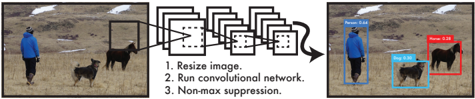
We present YOLO, a new approach to object detection. Prior work on object detection repurposes classifiers to perform detection. Instead, we frame object detection as a regression problem to spatially separated bounding boxes and associated class probabilities. A single neural network predicts bounding boxes and class probabilities directly from full images in one evaluation. Since the whole detection pipeline is a single network, it can be optimized end-to-end directly on detection performance. Our unified architecture is extremely fast. Our base YOLO model processes images in real-time at 45 frames per second. A smaller version of the network, Fast YOLO, processes an astounding 155 frames per second while still achieving double the mAP of other real-time detectors. Compared to state-of-the-art detection systems, YOLO makes more localization errors but is less likely to predict false positives on background. Finally, YOLO learns very general representations of objects. It outperforms other detection methods, including DPM and R-CNN, when generalizing from natural images to other domains like artwork.
Overview
CoChat Summary
TL;DR
YOLO reframes object detection as a single regression problem, using one convolutional network to predict bounding boxes and class probabilities directly from full images. It achieves real-time detection speeds while remaining competitive with, and complementary to, slower region-based detectors.
Key findings
- YOLO runs at 45 FPS on a Titan X GPU, and Fast YOLO runs at 155 FPS; Fast YOLO reaches 52.7% mAP on PASCAL VOC 2007, more than double prior real-time detectors, while YOLO reaches 63.4% mAP.
- On PASCAL VOC 2012, YOLO scores 57.9% mAP; combining Fast R-CNN with YOLO raises Fast R-CNN from 71.8% to 75.0% mAP on VOC 2007, a 3.2% gain.
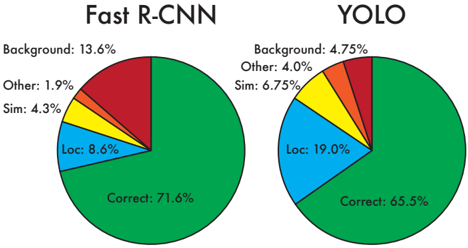
- YOLO makes fewer background false positives than Fast R-CNN: Fast R-CNN has 13.6% background false positives among top detections and is almost 3× more likely to predict background detections than YOLO.
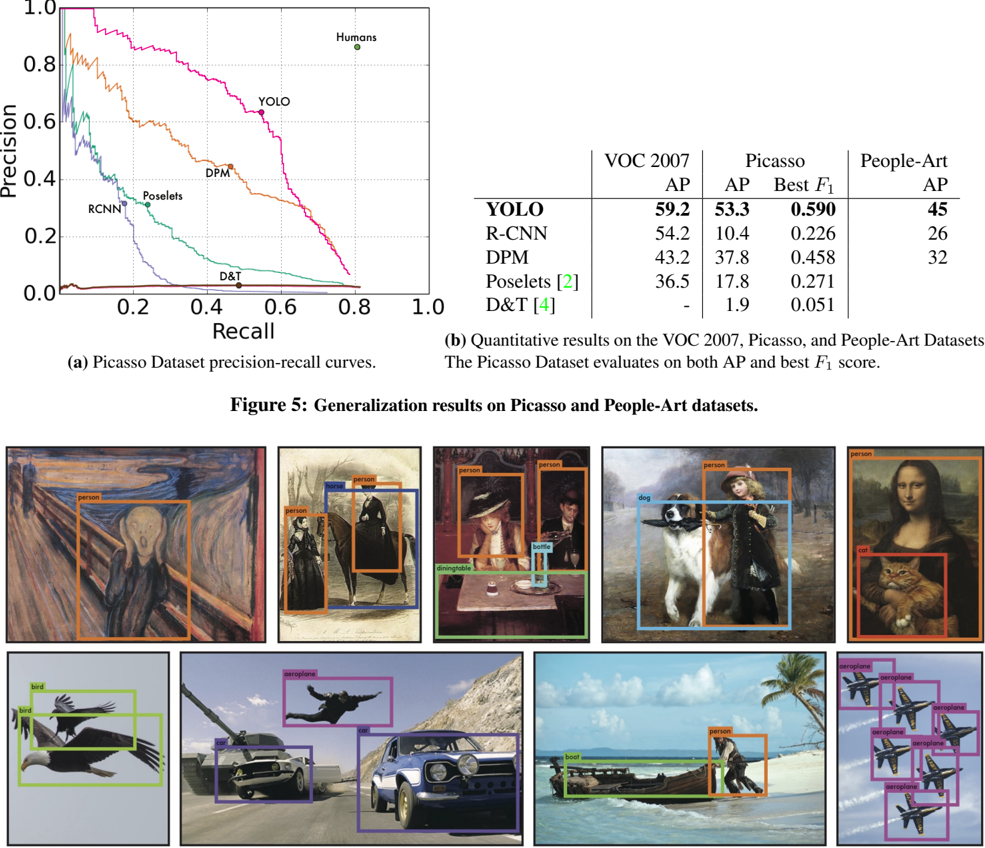
- YOLO generalizes better to artwork: on Picasso, YOLO gets 53.3 AP versus R-CNN’s 10.4 AP and DPM’s 37.8 AP; on People-Art, YOLO gets 45 AP versus R-CNN’s 26 AP and DPM’s 32 AP.
Methods
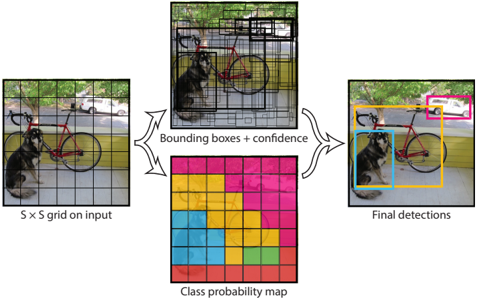
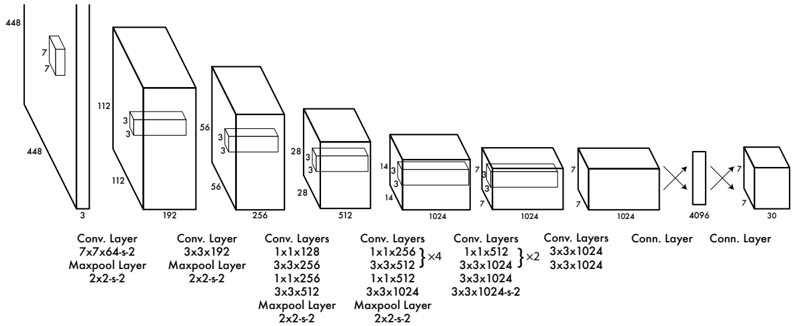
- Detection is modeled as a single CNN regression: the image is divided into an S×S grid; for PASCAL VOC, S=7, B=2, C=20, producing a 7×7×30 tensor of bounding boxes, confidence scores, and class probabilities.
- The base network has 24 convolutional layers followed by 2 fully connected layers; Fast YOLO uses 9 convolutional layers. Convolutional layers are pretrained on ImageNet at 224×224, then detection training uses 448×448 input.
- Training uses PASCAL VOC 2007 and 2012 for about 135 epochs, batch size 64, momentum 0.9, decay 0.0005, sum-squared error with λ_coord=5 and λ_noobj=0.5, dropout, and data augmentation.
Limitations
- The paper states YOLO imposes strong spatial constraints because each grid cell predicts only two boxes and one class, limiting nearby objects and struggling with small objects in groups such as flocks of birds.
- The paper states YOLO struggles to generalize to objects in new or unusual aspect ratios or configurations, uses relatively coarse features due to downsampling, and its loss treats small and large box errors equally; its main error source is incorrect localization.
- The paper states YOLO still lags state-of-the-art detection accuracy and struggles to precisely localize some objects, especially small ones.
Model-written summary. Check it against the paper before relying on it.
Integrity signals
Registry
Cites
Statistics
Figures
Verification
Claims the paper makes
6 Valid · 8 Not valid · 15 Not checked · 92 Own results and interpretations
The cited sources that could be checked couldn’t confirm or dispute this claim.
In the paper
“While it is much faster than R-CNN, it still falls short of real-time and takes a significant accuracy hit from not having good proposals.”
What the sources say
- Could not verifycites [20] [20] K. Lenc and A. Vedaldi. R-cnn minus r. arXiv preprint arXiv:1506.06981 , 2015. 5, 6 - sourceExperimental — accuracy not yet measured
The ConvNet-based Object Detection section identifies R-CNN minus R as a method that uses predefined regions instead of region proposals. It gives no runtime measurement or assessment of whether the method achieves real-time detection; searches for real-time performance and speed did not establish that claim. (LLM, conf=0.76)
plain- Asserted: passes — The authors put it forward as true.
- Checkable: passes — It can be checked against evidence.
- Load-bearing: passes — The paper’s conclusions depend on it.
- Based: passes — The paper gives a reason why it holds.
- Could not verify
The cited sources support only part of this claim — read each source’s verdict below.
In the paper
“To avoid overfitting we use dropout and extensive data augmentation.”
What the sources say
- Partly supportedcites [18] [18] G. E. Hinton, N. Srivastava, A. Krizhevsky, I. Sutskever, and R. R. Salakhutdinov. Improving neural networks by preventing co-adaptation of feature detectors. arXiv preprint arXiv:1207.0580 , 2012. 4 - sourceExperimental — accuracy not yet measured
The paper states that dropout reduces overfitting (p. 1) and describes using dropout with data augmentation for its ImageNet model (H Models for ImageNet, p. 18). It does not establish that YOLO uses either technique or describe YOLO’s augmentation as extensive. (LLM, conf=0.88)
plainstates a cause- Asserted: passes — The authors put it forward as true.
- Checkable: passes — It can be checked against evidence.
- Load-bearing: unclear — It is unclear whether the paper’s conclusions depend on it.
- Based: passes — The paper gives a reason why it holds.
- Partly supported
Every source the paper cites for this claim was checked and supports it.
In the paper
“However, only 30Hz DPM [31] actually runs in real-time.”
What the sources say
- Supportedcites [31] [31] M. A. Sadeghi and D. Forsyth. 30hz object detection with dpm v5. In Computer Vision-ECCV 2014 , pages 65-79. Springer, 2014. 5, 6 - source
The Introduction (p.1) states that 'except for certain objects including face, pedestrians and certain rigid objects, detectors do not currently run at video rate' and that the presented architecture detects the 20 PASCAL VOC categories simultaneously at 30Hz, i.e. at video/real-time rate. The Abstract (p.1) and Table 2 (Method) bound the comparison to other DPM speed-up efforts: reference DPM at 0.07Hz, the fastest GPU 'Vanilla DPM' at ~1Hz, FTVQ at 0.53s, and 'over an order of magnitude faster than the previous fastest DPM implementation', so none of the listed variants reaches real-time. Thus our copy supports both parts of the attribution: that this 30Hz DPM runs in real-time and that it is the only such DPM among the speed-up efforts compared. (LLM, conf=0.82)
plain- Asserted: passes — The authors put it forward as true.
- Checkable: passes — It can be checked against evidence.
- Load-bearing: unclear — It is unclear whether the paper’s conclusions depend on it.
- Based: passes — The paper gives a reason why it holds.
- Supported
The cited sources that could be checked couldn’t confirm or dispute this claim.
In the paper
“While it is much faster than R-CNN, it still falls short of real-time and takes a significant accuracy hit from not having good proposals.”
What the sources say
- Could not verifycites [20] [20] K. Lenc and A. Vedaldi. R-cnn minus r. arXiv preprint arXiv:1506.06981 , 2015. 5, 6 - sourceExperimental — accuracy not yet measured
The ConvNet-based Object Detection section identifies R-CNN minus R and says it uses predefined regions in an SPPnet system, but gives no speed comparison with R-CNN. A search for R-CNN minus R and speed found no passage in our copy establishing that it is much faster. (LLM, conf=0.73)
plainstates a cause- Asserted: passes — The authors put it forward as true.
- Checkable: passes — It can be checked against evidence.
- Load-bearing: unclear — It is unclear whether the paper’s conclusions depend on it.
- Based: passes — The paper gives a reason why it holds.
- Could not verify
The cited sources support only part of this claim — read each source’s verdict below.
In the paper
“While it is much faster than R-CNN, it still falls short of real-time and takes a significant accuracy hit from not having good proposals.”
What the sources say
- Partly supportedcites [20] [20] K. Lenc and A. Vedaldi. R-cnn minus r. arXiv preprint arXiv:1506.06981 , 2015. 5, 6 - sourceExperimental — accuracy not yet measured
The “ConvNet-based Object Detection” section (page unavailable) says R-CNN minus R uses predefined regions instead of region proposals. It does not say that this causes a significant accuracy loss; the paper’s discussion of low accuracy concerns a different system, naïve Faster R-CNN. (LLM, conf=0.83)
plainstates a cause- Asserted: passes — The authors put it forward as true.
- Checkable: passes — It can be checked against evidence.
- Load-bearing: unclear — It is unclear whether the paper’s conclusions depend on it.
- Based: passes — The paper gives a reason why it holds.
- Partly supported
84 more claims
Create a free account to see all 121 claims and to verify the 2 references still open.
- Probably not a substantial claim. 17
- It may state two separate claims as one. 15
Claims other papers make about this one
Each is checked against this paper’s own text: does it say what the citing paper says it does?
The source backs part of the claim, not all of it — or backs it for a different population, condition or comparison.
In the citing paper
“which was not thoroughly investigated in prevIoUs work such as YOLOv1 [20] and YOLOv2 [51] employing MSE/L2 loss (Mean Squared Error).”
From Object Detection in 20 Years: A Survey (2023) · cites this paper as [20]
Experimental — accuracy not yet measuredThe source backs part of the claim, not all of it — or backs it for a different population, condition or comparison.
In the citing paper
“the YOLO series models v2-v5 [144-147] are some of the most advanced object detection methods based on DNN, which have good performance in terms of speed and precision.”
From A survey of model compression strategies for object detection (2023) · cites this paper as [144]
Experimental — accuracy not yet measuredThe source backs part of the claim, not all of it — or backs it for a different population, condition or comparison.
In the citing paper
“As a typical and more widely used new form of applications [9], various deep learning-based intelligent services and applications have changed many aspects of people's lives due to the great advantages of Deep Learning (DL) in the fields of Computer Vision (CV) and Natural Language Processing (NLP) [10].”
From Convergence of Edge Computing and Deep Learning: A Comprehensive Survey (2020) · cites this paper as [9]
Experimental — accuracy not yet measuredThe cited source says what the claim attributes to it.
In the citing paper
“A convolutional neural network predicts the bounding boxes as well as class probabilities for all the objects depicted in an image.”
From Object detection using YOLO: challenges, architectural successors, datasets and applications (2023) · cites this paper as [56]
The cited source says what the claim attributes to it.
In the citing paper
“Authors of YOLO [56] have reframed the problem of object detection as a regression problem instead of classification problem.”
From Object detection using YOLO: challenges, architectural successors, datasets and applications (2023) · cites this paper as [56]
6 more claims about this paper
Create a free account to see every claim other papers make about this one.
Citations
Cites
Faster R-CNN: Towards Real-Time Object Detection with Region Proposal Networks
Ren, S., He, K., Girshick, R., & Sun, J. (2017) · IEEE Transactions on Pattern Analysis and Machine Intelligence · doi:10.1109/tpami.2016.2577031 · Cited by 73,472
Self-citationFaster R-CNN: Towards Real-Time Object Detection with Region Proposal Networks
Ren, S., He, K., Girshick, R., & Sun, J. (2015) · arXiv · doi:10.48550/arxiv.1506.01497 · Cited by 70,812
Self-citationGoing deeper with convolutions
Szegedy, C., Liu, W., Jia, Y., Sermanet, P., Reed, S., Anguelov, D., Erhan, D., Vanhoucke, V., & Rabinovich, A. (2015) · 2015 IEEE Conference on Computer Vision and Pattern Recognition (CVPR) · doi:10.1109/cvpr.2015.7298594 · Cited by 48,562
ImageNet Large Scale Visual Recognition Challenge
Russakovsky, O., Deng, J., Su, H., Krause, J., Satheesh, S., Ma, S., Huang, Z., Karpathy, A., Khosla, A., Bernstein, M., et al. (2015) · International Journal of Computer Vision · doi:10.1007/s11263-015-0816-y · Cited by 39,380 · cited 1×
“We pretrain our convolutional layers on the ImageNet 1000-class competition dataset [29].”
MethodHistograms of Oriented Gradients for Human Detection
Dalal, N., & Triggs, B. (2005) · 2005 IEEE Computer Society Conference on Computer Vision and Pattern Recognition (CVPR'05) · doi:10.1109/cvpr.2005.177 · Cited by 33,584 · cited 2×
“Detection pipelines generally start by extracting a set of robust features from input images (Haar [25], SIFT [23], HOG [4], convolutional features [6]).”
MethodRich Feature Hierarchies for Accurate Object Detection and Semantic Segmentation
Girshick, R., Donahue, J., Darrell, T., & Malik, J. (2014) · 2014 IEEE Conference on Computer Vision and Pattern Recognition · doi:10.1109/cvpr.2014.81 · Cited by 32,684 · cited 2×
“Then, classifiers [35, 21, 13, 10] or localizers [1, 31] are used to identify objects in the feature space.”
MethodSelf-citationGirshick, R. (2015) · 2015 IEEE International Conference on Computer Vision (ICCV) · doi:10.1109/iccv.2015.169 · Cited by 28,105
Self-citationDelving Deep into Rectifiers: Surpassing Human-Level Performance on ImageNet Classification
He, K., Zhang, X., Ren, S., & Sun, J. (2015) · 2015 IEEE International Conference on Computer Vision (ICCV) · doi:10.1109/iccv.2015.123 · Cited by 19,741 · cited 1×
“Convolutional neural networks (CNNs) achieve impressive performance on classification tasks at real-time speeds [13].”
Object recognition from local scale-invariant features
Lowe, D. G. (1999) · Proceedings of the Seventh IEEE International Conference on Computer Vision · doi:10.1109/iccv.1999.790410 · Cited by 16,472 · cited 1×
“Detection pipelines generally start by extracting a set of robust features from input images (Haar [25], SIFT [23], HOG [4], convolutional features [6]).”
MethodRobust Real-Time Face Detection
Viola, P., & Jones, M. J. (2004) · International Journal of Computer Vision · doi:10.1023/b:visi.0000013087.49260.fb · Cited by 14,097 · cited 1×
“Detectors for single classes like faces or people can be highly optimized since they have to deal with much less variation [36].”
Background
Cited by
Items 23,301–23,400 of 51,401
CDAD-Net: Bridging Domain Gaps in Generalized Category Discovery
Rongali, S. B., Mehrotra, S., Jha, A., C, M. H. N., Bose, S., Gupta, T., Singha, M., & Banerjee, B. (2024) · IEEE/CVF Conference on Computer Vision and Pattern Recognition Workshops (CVPRW) · doi:10.1109/cvprw63382.2024.00268 · Cited by 5
Automated Mineral Identification of Pozzolanic Materials Using XRD Patterns
Kim, H., & Yoon, J. (2024) · Journal of Materials in Civil Engineering · doi:10.1061/jmcee7.mteng-17973 · Cited by 6
Lightweight Tunnel Leakage Water Detection Algorithm Based on YOLOv8n
Wang, S., Mo, J., Xu, L., & Zheng, X. (2024) · IEEE China Conference on System Simulation Technology and its Applications (CCSSTA) · doi:10.1109/ccssta62096.2024.10691725 · Cited by 5
Feature diffusion reconstruction mechanism network for crop spike head detection
Ming, R., Gong, Q., Chen, Y., Luo, H., Song, C., & Zhou, Z. (2024) · Frontiers in Plant Science · doi:10.3389/fpls.2024.1459515 · Cited by 5
A new data label conversion algorithm for YOLO segmentation of medical images
Telçeken, M., Okuyar, M., Akgün, D., et al. (2024) · The European Physical Journal Special Topics · doi:10.1140/epjs/s11734-024-01338-5 · Cited by 5
MAP-ADAPT: Real-Time Quality-Adaptive Semantic 3D Maps
Zheng, J., Baráth, D., Pollefeys, M., & Armeni, I. (2024) · Lecture notes in computer science · doi:10.1007/978-3-031-72933-1_13 · Cited by 9
Design of defect detection system for process parts based on machine vision
Zhang, D., Li, W., Chen, G., Xie, W., Cui, F., Cui, C., Gan, Y., & Fang, W. (2024) · Journal of the Brazilian Society of Mechanical Sciences and Engineering · doi:10.1007/s40430-024-05205-1 · Cited by 5
Deep Learning Based Mobile Platform for Predicting Passenger Congestion in Public Transportation
Kavanoz, A., Kosak, H. I., Aksakalli, I. K., & Bayındır, L. (2024) · International Artificial Intelligence and Data Processing Symposium (IDAP) · doi:10.1109/idap64064.2024.10710788 · Cited by 5
An automatic workflow for the quantitative evaluation of bit wear based on computer vision
Yang, D., Song, X., Zhu, Z., Pan, T., Tian, L., & Zhu, L. (2024) · Petroleum Science · doi:10.1016/j.petsci.2024.10.005 · Cited by 7
Ishida, M., Ikematsu, K., & Igarashi, Y. (2024) · Proceedings of the ACM on Human-Computer Interaction · doi:10.1145/3698133 · Cited by 6
Deep Learning-Based Road Sign Detection: The Ultimate Road Technology
Singh, A. P., Rahi, P., Sahu, B., et al. (2024) · doi:10.1109/acet61898.2024.10730463 · Cited by 5
Hierarchical Mixed-Precision Post-Training Quantization for SAR Ship Detection Networks
Wei, H., Wang, Z., & Ni, Y. (2024) · Remote Sensing · doi:10.3390/rs16214042 · Cited by 7
Surface Defect Identification of Strip Steel Using ViT‐RepVGG
Wang, Z., Long, M., Sun, P., et al. (2024) · steel research international · doi:10.1002/srin.202400569 · Cited by 5
Small aircraft detection in infrared aerial imagery based on deep neural network
Zhang, K., Wang, X., Li, S., et al. (2024) · Infrared Physics & Technology · doi:10.1016/j.infrared.2024.105454 · Cited by 5
Nurmaini, S., Nova, R., Sapitri, A. I., Rachmatullah, M. N., Tutuko, B., Firdaus, F., Darmawahyuni, A., Islami, A., Mandala, S., Partan, R. U., et al. (2024) · Journal of Imaging · doi:10.3390/jimaging10110280 · Cited by 7
Acoustic Imaging Learning-Based Approaches for Marine Litter Detection and Classification
Guedes, P. A., Silva, H. M., Wang, S., Martins, A., Almeida, J. M., & Silva, E. (2024) · Journal of Marine Science and Engineering · doi:10.3390/jmse12111984 · Cited by 7
F1TENTH: Enhancing Autonomous Systems Education Through Hands-On Learning and Competition
Betz, J., Zheng, H., Jahncke, F., Zang, Z., Sauerbeck, F., Zheng, Y. R., Biswas, J., Krovi, V., & Mangharam, R. (2024) · IEEE Transactions on Intelligent Vehicles · doi:10.1109/tiv.2024.3495227 · Cited by 8
HaM3D: generalized XR-based multimodal HRI framework with haptic feedback for industry 4.0
Raj, S., Beri, N., Patel, D. S., Sinha, Y., Chakrabarti, A., & Biswas, P. (2024) · Journal on Multimodal User Interfaces · doi:10.1007/s12193-024-00443-y · Cited by 5
Optimizing computer vision algorithms with TVM on VLIW architecture based on RVV
Yu, M.-S., Chang, H., Wang, C.-T., Tien, Y.-W., Chen, T.-L., & Lee, J. (2024) · The Journal of Supercomputing · doi:10.1007/s11227-024-06530-x · Cited by 7
Gao, Y., Han, Z., & Wang, J. (2024) · IEEE Sensors Journal · doi:10.1109/jsen.2024.3494772 · Cited by 5
Xu, W., Fang, H., Yu, S., et al. (2024) · Applied Sciences · doi:10.3390/app142210732 · Cited by 5
Fang, G., Yan, W., Guo, Y., Han, J., Jiang, Z., Xu, H., Liao, S., & Liang, X. (2024) · Lecture notes in computer science · doi:10.1007/978-3-031-73411-3_12 · Cited by 30
Sun, X. L., Lu, X., Wang, Y., He, T., & Tian, Z. (2024) · Buildings · doi:10.3390/buildings14123728 · Cited by 7
YOLO-AES A Lightweight Model for Real-Time Underwater Object Detection
Zhang, Y., & Zhang, X. (2024) · International Conference on Big Data & Artificial Intelligence & Software Engineering (ICBASE) · doi:10.1109/icbase63199.2024.10762198 · Cited by 7
Huang, X., Yang, S., Xiong, A., & Yang, Y. (2024) · IEEE Access · doi:10.1109/access.2024.3505208 · Cited by 5
Fast arbitrary-oriented object detection for remote sensing images
Liu, J., Tang, J., Yang, F., & Zhao, Y. (2024) · European Journal of Remote Sensing · doi:10.1080/22797254.2024.2431006 · Cited by 5
Detection and Classification of Agave angustifolia Haw Using Deep Learning Models
Matadamas-Ortiz, I. C., Zamora, E., & Aquino-Bolaños, T. (2024) · Agriculture · doi:10.3390/agriculture14122199 · Cited by 5
Lightweight Barcode Positioning Algorithm Based on YOLO Model
Li, C., Zeng, Q., & Lu, L. (2024) · IEEE Access · doi:10.1109/access.2024.3511125 · Cited by 5
Zhu, Z., Wang, P., Diao, W., Yang, J., Kong, L., Wang, H., & Sun, X. (2024) · IEEE Transactions on Geoscience and Remote Sensing · doi:10.1109/tgrs.2024.3512865 · Cited by 7
Mystique: User-Level Adaptation for Real-Time Video Analytics in Edge Networks via Meta-RL
Shi, X., Zhang, S., Liu, M., Meng, L., Liu, W., Gu, Y., Liu, K., Cheng, H., Song, Y., Lei, T., et al. (2024) · IEEE Transactions on Mobile Computing · doi:10.1109/tmc.2024.3514088 · Cited by 8
“Though promising, facing the ever-increasing video quality, the cost of full-rate analytics, i.e., performing the real-time state-of-the-art DNN [19], [20], [21] inference with the raw resolution and frame rate, is often exorbitant even for the resourceful edge servers.”
PhySense: Defending Physically Realizable Attacks for Autonomous Systems via Consistency Reasoning
Yu, Z., Li, A., Wen, R., Chen, Y., & Zhang, N. (2024) · ACM SIGSAC Conference on Computer and Communications Security (CCS) · doi:10.1145/3658644.3690236 · Cited by 18
SANet: similarity aggregation and semantic fusion for few-shot semantic segmentation
Ye, M., & Zhang, T. (2024) · Applied Intelligence · doi:10.1007/s10489-024-05986-x · Cited by 5
Wu, D., & Gao, Q. (2024) · Alexandria Engineering Journal · doi:10.1016/j.aej.2024.11.064 · Cited by 7
CRE-YOLO: Efficient Jaboticaba Tree Detection on UAV Platforms
Huang, J., Luo, R., Tan, Y., & Wu, Z. (2024) · IEEE Access · doi:10.1109/access.2024.3520115 · Cited by 7
Single-Shot 6DoF Pose and 3D Size Estimation for Robotic Strawberry Harvesting
Li, L., & Kasaei, H. (2024) · IEEE/RSJ International Conference on Intelligent Robots and Systems (IROS) · doi:10.1109/iros58592.2024.10802107 · Cited by 16
Liu, Y., Hou, Z., & Fan, Q. (2024) · IEEE/RSJ International Conference on Intelligent Robots and Systems (IROS) · doi:10.1109/iros58592.2024.10801712 · Cited by 5
Cao, H., Li, Y., Liu, Y., Li, X., Chen, G., & Knoll, A. (2024) · IEEE/RSJ International Conference on Intelligent Robots and Systems (IROS) · doi:10.1109/iros58592.2024.10802087 · Cited by 6
Zhang, R., Li, Y., & Guan, Z. (2024) · Scientific Reports · doi:10.1038/s41598-024-81430-x · Cited by 6
Pi-Vision: Leveraging YOLO V8 for Real-Time Person Detection and Recognition on Raspberry Pi
Kumar, P., Choudhary, S. K., Pallerla, S., Sangani, S., Thota, A., & Matta, V. (2024) · International Conference on Data Intelligence and Cognitive Informatics (ICDICI) · doi:10.1109/icdici62993.2024.10810836 · Cited by 7
Liu, Z. “. (2025) · Springer eBooks · doi:10.1007/978-3-031-75953-6_4 · Cited by 5
Jing, J., Hu, J. F., Zhao, Z. P., & Liu, Y. (2025) · IET Image Processing · doi:10.1049/ipr2.13320 · Cited by 7
Tanapatpiboon, A., Kusakunniran, W., & Limroongreungrat, W. (2025) · Applied Computing and Informatics · doi:10.1108/aci-07-2024-0257 · Cited by 8
A density-point network for dense tiny stored grain pest counting
Qi, R., Li, R., Zhang, J., Xia, Y., Du, J., Sun, J., chen, L., Xie, C., Zhang, H., & Li, G. (2025) · Journal of Stored Products Research · doi:10.1016/j.jspr.2024.102536 · Cited by 6
Typhoon localization detection algorithm based on TGE-YOLO
He, L., Xiao, L., Yang, P., & Li, S. (2025) · Scientific Reports · doi:10.1038/s41598-025-87833-8 · Cited by 8
Sensing for Space Safety and Sustainability: A Deep Learning Approach with Vision Transformers
Zhang, W., & Hu, P. (2024) · IEEE International Conference on Wireless for Space and Extreme Environments (WiSEE) · doi:10.1109/wisee61249.2024.10850362 · Cited by 11
Infrared dim tiny-sized target detection based on feature fusion
Zhang, P., Jing, Y., Liu, Y., et al. (2025) · Scientific Reports · doi:10.1038/s41598-025-88956-8 · Cited by 5
Liu, C., Deng, Y., Zhang, Z., et al. (2025) · IEEE Journal of Selected Topics in Applied Earth Observations and Remote Sensing · doi:10.1109/jstars.2025.3540902 · Cited by 5
Surface Defect Detection Algorithm for PCB Based on Improved YOLOv8
Ai, Y., & Ye, T. S. (2024) · International Conference on Electrical, Mechanical and Computer Engineering (ICEMCE) · doi:10.1109/icemce64157.2024.10862076 · Cited by 5
ADH-YOLO: a small object detection based on improved YOLOv8 for airport scene images in hazy weather
Zhou, W., Cai, C., Srigrarom, S. S., Wang, P., Cui, Z., & Li, C. (2025) · The Journal of Supercomputing · doi:10.1007/s11227-025-06999-0 · Cited by 5
ML-based semantic segmentation for quantitative spray atomization description
Jose, B., Lammel, O., & Hampp, F. (2025) · International Journal of Multiphase Flow · doi:10.1016/j.ijmultiphaseflow.2025.105179 · Cited by 5
Cheng, X., Fang, Y., Feng, J., & Yin, H. (2025) · Signal Image and Video Processing · doi:10.1007/s11760-025-03877-3 · Cited by 5
Generalizable deep neural networks for image quality classification of cervical images
Ahmed, S. R., Befano, B., Egemen, D., Rodríguez, A. C., Desai, K. T., Jerónimo, J., Ajenifuja, K. O., Clark, C., Perkins, R. B., Campos, N. G., et al. (2025) · Scientific Reports · doi:10.1038/s41598-025-90024-0 · Cited by 10
Li, Y., Wang, Y., Sui, D., & Guo, M. (2025) · npj Heritage Science · doi:10.1038/s40494-025-01587-0 · Cited by 7
Ma, Y., Kong, F., Lu, D., et al. (2025) · Georisk Assessment and Management of Risk for Engineered Systems and Geohazards · doi:10.1080/17499518.2025.2471796 · Cited by 6
Yılmaz, A., Yurtay, Y., & Yurtay, N. (2025) · Applied Sciences · doi:10.3390/app15052718 · Cited by 10
Deep Learning and AI for Superior Colorectal Polyp Detection with YOLOv9 Variants
Haider, Z., Azar, A. T., Fati, S. M., & Ibraheem, I. K. (2025) · International Conference on Data Science and Machine Learning Applications (CDMA) · doi:10.1109/cdma61895.2025.00031 · Cited by 5
Shun, 成. C., Jianrong, 李. L., Zhiqian, 王. W., Shaojin, 刘. L., & Muyuan, 王. W. (2025) · Laser & Optoelectronics Progress · doi:10.3788/lop241313 · Cited by 6
Simplify-YOLOv5m: A Simplified High-Speed Insulator Detection Algorithm for UAV Images
Li, Y., Hu, B., Wei, S., Gao, D., & Shuang, F. (2025) · IEEE Transactions on Instrumentation and Measurement · doi:10.1109/tim.2025.3549909 · Cited by 6
HAF-YOLO: an efficient network for the detection of safety equipment for working at heights
Li, D., Liu, B., Gao, Q., Song, Y. C., Yu, X., & Li, X. (2025) · Signal Image and Video Processing · doi:10.1007/s11760-025-03967-2 · Cited by 5
RS-YOLO: A YOLO-Based Method for Small Object Detection in Remote Sensing
Ao, D., Zhao, W., Zhang, Y., & Lei, F. (2024) · International Conference on Machine Vision, Image Processing and Imaging Technology (MVIPIT) · doi:10.1109/mvipit65697.2024.00018 · Cited by 9
Deep learning for ultrafast X-ray scattering and imaging with intense X-ray FEL pulses
Hu, M., Fan, J., Tong, Y., Sun, Z., & Jiang, H. (2025) · Advanced Optical Technologies · doi:10.3389/aot.2025.1546386 · Cited by 5
An improved YOLOv8 model for prohibited item detection with deformable convolution and dynamic head
Guan, F., Zhang, H., & Wang, X. (2025) · Journal of Real-Time Image Processing · doi:10.1007/s11554-025-01665-3 · Cited by 9
Lightweight RT-DETR with Attentional Up-Downsampling Pyramid Network
Li, N., Han, X., Song, X., Fang, X., Wu, M., & Yu, Q. (2025) · Applied Sciences · doi:10.3390/app15063309 · Cited by 6
White Blood Cell Detection Based on FBDM-YOLOv8s
Sun, B., Fan, X., Meng, J., Wang, J., Chen, H., & Liu, L. (2025) · IEEE Access · doi:10.1109/access.2025.3553139 · Cited by 7
Rosenberger, J., Tlatlik, J., Rump, N., & Münstermann, S. (2025) · Engineering Failure Analysis · doi:10.1016/j.engfailanal.2025.109551 · Cited by 6
Cui, H., Zhao, X., & Luo, G. (2025) · IEEE Access · doi:10.1109/access.2025.3555156 · Cited by 5
Gupta, A. K., Mathur, P., Mishra, S., et al. (2024) · International Conference on Cyber Physical Systems, Power Electronics and Electric Vehicles (ICPEEV) · doi:10.1109/icpeev63032.2024.10932088 · Cited by 5
GDS‐YOLO: A Rice Diseases Identification Model With Enhanced Feature Extraction Capability
Huang, Y., Feng, X. Y., Han, T., Song, H., Liu, Y., & Bao, M. (2025) · IET Image Processing · doi:10.1049/ipr2.70034 · Cited by 5
Yan, C., & Li, H. (2025) · Multimedia Systems · doi:10.1007/s00530-025-01756-y · Cited by 7
Schueler, J., Araújo, H. M., Balashov, S., Borg, J., Brew, C., Brunbauer, F., Cazzaniga, C., Cottle, A., Frost, C. D., García, F., et al. (2025) · Physical review. D/Physical review. D. · doi:10.1103/physrevd.111.072004 · Cited by 9
Alajami, A. A., & Pous, R. (2025) · Sensors · doi:10.3390/s25082418 · Cited by 8
Target Detection of Safety Protective Gear Using the Improved YOLOv5
Liu, H., & Qin, X. (2024) · International Conference on Computers and Artificial Intelligence Technology (CAIT) · doi:10.1109/cait64506.2024.10962947 · Cited by 5
Jiang, X., Liu, T., Song, T., et al. (2025) · Information · doi:10.3390/info16040332 · Cited by 5
“This paper aims to improve the performance of YOLOv5 [9] in small object detection by addressing the maritime remote sensing small object detection problem.”
Advancing Open-Set Object Detection in Remote Sensing Using Multimodal Large Language Model
Saini, N., Dubey, A., Das, D., & Chattopadhyay, C. (2025) · IEEE/CVF Winter Conference on Applications of Computer Vision Workshops (WACVW) · doi:10.1109/wacvw65960.2025.00052 · Cited by 12
YOLO-EDGE: an object detection algorithm for traffic scenarios
Li, Y., Zheng, Q., Xu, S., Wang, P., Wang, Y., Song, Z., & Guo, M. (2025) · The Journal of Supercomputing · doi:10.1007/s11227-025-07275-x · Cited by 8
“In contrast, single-stage algorithms, such as You Only Look Once(YOLO) [7, 8] and SSD [9], predict both position and class in a single step.”
MF-YOLOv10: Research on the Improved YOLOv10 Intelligent Identification Algorithm for Goods
Wang, Q., Wang, X., Hou, J., Liu, X., Wen, H., & Ji, Z. (2025) · Sensors · doi:10.3390/s25102975 · Cited by 9
“These mainly include YOLO [4], SSD [5], RetinaNet [6], and CenterNet [7].”
YOLOv8-UW: innovative real-time algorithm for underwater object detection
Yang, L., & Noh, T. (2025) · Signal Image and Video Processing · doi:10.1007/s11760-025-04191-8 · Cited by 7
“The other category is the single-stage algorithm, such as SSD [ 14 ] and YOLO [ 15 ], which typically offer faster detection speeds and fewer model parameters.”
Yazdani, M., Bao, D., Zhou, J. W., Wang, A., & van Klinken, R. D. (2025) · Smart Agricultural Technology · doi:10.1016/j.atech.2025.101090 · Cited by 6
Flexi-YOLO: A lightweight method for road crack detection in complex environments
Yang, J., Tian, R., Zhou, Z., Tan, X., & He, P. (2025) · PLoS ONE · doi:10.1371/journal.pone.0325993 · Cited by 9
“The latter directly predicts classes and bounding boxes on the image without the need to generate candidate regions, with models such as You Only Look Once (YOLO) and Single Shot MultiBox Detector(SSD) being representative [29,30].”
Bai, Y., Zhou, X., & Hu, S. (2025) · Journal of Real-Time Image Processing · doi:10.1007/s11554-025-01721-y · Cited by 7
“Current algorithms at the forefront, including R-CNN [12], Mask R-CNN [13], SSD [14], and the YOLO series [15–18], have demonstrated outstanding performance in object detection; it has been applied to the research of target detection in underground coal mines by more and more scholars at home and…”
MLF-YOLO: a novel multiscale feature fusion network for remote sensing small target detection
Zhang, Y., Wu, C., & Fan, Y. (2025) · Journal of Real-Time Image Processing · doi:10.1007/s11554-025-01716-9 · Cited by 5
“In this regard, the YOLO (You Only Look Once) series has emerged as a leading solution for dense object detection tasks, thanks to its superior speed and accuracy [8].”
Beyond the Click: How YouTube Thumbnails Shape User Interaction and Algorithmic Recommendations
Poudel, D., Çakmak, M. C., & Agarwal, N. K. (2025) · Lecture notes in social networks · doi:10.1007/978-3-031-85240-4_15 · Cited by 10
Efficient OCT Image Reconstruction via Deep Compressed Sensing for Intelligent IoT Devices
Guo, X., Zhang, T., Song, K., Wang, P., Han, X., Yu, M., Yi, X., He, X., & Zhang, T. (2025) · IEEE Internet of Things Journal · doi:10.1109/jiot.2025.3588150 · Cited by 6
CNN filter sizes, effects, limitations, and challenges: An exploratory study
Aboukhair, M., Alsheref, F. K., Assiri, A., Koura, A., & Kayed, M. (2025) · Network Computation in Neural Systems · doi:10.1080/0954898x.2025.2533865 · Cited by 8
Damir, S. S., Probst, J., deMello, A. J., & Stavrakis, S. (2025) · Chemistry - Methods · doi:10.1002/cmtd.202500069 · Cited by 12
MaizeStar-YOLO: Precise Detection and Localization of Seedling-Stage Maize
Chu, T., Zha, H., Wang, Y., Yao, Z., Wang, X., Wu, C., & Liao, J. (2025) · Agronomy · doi:10.3390/agronomy15081788 · Cited by 5
High-Precision Circle Detection for Phase Recognition of Dual-Branch Helical Antenna Element
Chen, S., Shen, F., Guo, C. Q., Qiu, S., & Liu, Q. (2025) · IEEE Transactions on Instrumentation and Measurement · doi:10.1109/tim.2025.3604122 · Cited by 5
Object detection refinement using Markov random field based pruning and learning based rescoring
Inoue, N., Furuta, R., Yamasaki, T., & Aizawa, K. (2017) · IEEE International Conference on Acoustics Speech and Signal Processing · doi:10.1109/icassp.2017.7952437 · Cited by 5
Text-Edge-Box: An Object Proposal Approach for Scene Texts Localization
Nguyen, D. C., Lu, S., Ouarti, N., & Mokhtari, M. (2017) · IEEE Winter Conference on Applications of Computer Vision · doi:10.1109/wacv.2017.149 · Cited by 5
Learning discriminative action and context representations for action recognition in still images
Xin, M., Zhang, H., Yuan, D., et al. (2017) · IEEE International Conference on Multimedia and Expo (ICME) · doi:10.1109/icme.2017.8019399 · Cited by 5
Analysis of the Discriminative Generalized Hough Transform for Pedestrian Detection
Gabriel, E., Schramm, H., & Meyer, C. (2017) · Lecture notes in computer science · doi:10.1007/978-3-319-68548-9_10 · Cited by 5
Optimizing a neural network for detection of moving vehicles in video
Bouma, H., Fischer, N. M., & Kruithof, M. C. (2017) · Counterterrorism, Crime Fighting, Forensics, and Surveillance Technologies · doi:10.1117/12.2277974 · Cited by 5
Convolutional Gated Recurrent Units Fusion for Video Action Recognition
Huang, B., Huang, H., & Lu, H. (2017) · Lecture notes in computer science · doi:10.1007/978-3-319-70090-8_12 · Cited by 5
Evaluation of classroom teaching quality based on video processing technology
Guan, E., Zhang, Z., He, M., & Zhao, X. (2017) · Chinese Automation Congress · doi:10.1109/cac.2017.8243084 · Cited by 5
Rank selection of CP-decomposed convolutional layers with variational Bayesian matrix factorization
Astrid, M., Lee, S., & Seo, B.-S. (2018) · International Conference on Advanced Communication Technology · doi:10.23919/icact.2018.8323750 · Cited by 10
Performance evaluation of multiple sports player tracking system based on graph optimization
Nishikawa, Y., Sato, H., & Ozawa, J. (2017) · IEEE International Conference on Big Data (BigData) · doi:10.1109/bigdata.2017.8258259 · Cited by 6
A Real-Time Suspicious Stay Detection System Based on Face Detection and Tracking in Monitor Videos
Ren, Z., Zhang, X., & Yang, S. (2017) · International Symposium on Computational Intelligence and Design · doi:10.1109/iscid.2017.150 · Cited by 5
Feature Pyramid Based Scene Text Detector
En, M., Li, R., Li, J., & Liu, B. (2017) · IAPR International Conference on Document Analysis and Recognition (ICDAR) · doi:10.1109/icdar.2017.341 · Cited by 5
Anomaly Detection in a Crowd Using a Cascade of Deep Learning Networks
Qiu, P., Kim, S., Lee, J.-H., & Choi, J. (2018) · Advances in intelligent systems and computing · doi:10.1007/978-981-10-7512-4_59 · Cited by 5
Deep learning in low-power stereo vision accelerator for automotive
Maliţa, M., Nedescu, O., Negoita, A., & Gheorghe, Ș. (2018) · International Conference on Consumer Electronics · doi:10.1109/icce.2018.8326285 · Cited by 6
Metadata
- Authors
- Redmon, J., Divvala, S., Girshick, R., & Farhadi, A.
- Affiliations
- University of Washington (US)
- Meta (United States) (US)
- Venue
- 2016 IEEE Conference on Computer Vision and Pattern Recognition (CVPR)
- Publisher
- IEEE
- Published
- 2016-06
- Pages
- 779-788
- ISSN
- 1063-6919 (ISSN-L)
- OpenAlex
- W1483870316
- Cited by
- 53,803
- References
- 42
- Citations by year
- 2026: 5347 · 2025: 8912 · 2024: 8953 · 2023: 8264 · 2022: 6785 · 2021: 5741 · 2020: 4223 · 2019: 3286 · 2018: 1560 · 2017: 635 · 2016: 90
- FWCI
- 644.23
- Type
- conference paper
- Language
- en
- Open access
- green
- arxiv.org
- Locations
- IEEE Computer Society Conference on Computer Vision and Pattern Recognition/Proceedings - IEEE Computer Society Conference on Computer Vision and Pattern Recognition/Proceedings (publishedVersion)
- arXiv (Cornell University) (submittedVersion)
- arXiv (Cornell University)
- Zenodo (CERN European Organization for Nuclear Research) (cc-by)
- Funders
- National Science Foundation (1338054)
- Office of Naval Research (N00014-13-1-0720, N00014)
- Topics
- Physical Sciences › Computer Science › Computer Vision and Pattern Recognition › Advanced Neural Network Applications
- Physical Sciences › Computer Science › Computer Vision and Pattern Recognition › Advanced Image and Video Retrieval Techniques
- Physical Sciences › Computer Science › Computer Vision and Pattern Recognition › Visual Attention and Saliency Detection
- Keywords
- object detection, YOLO, real-time detection, bounding box regression, end-to-end learning, false positive reduction, domain generalization
About these checks
Registry, retraction, Cites and statistics results are computed, not judged, with one exception: a printed reference that no index lists is read once by a model before it counts as a citation error. Claims are extracted by a model and kept only when their quote appears verbatim in the text; each cited source is then checked, with a model’s help, for whether it says what the claim relies on. Those verdicts can be wrong — read the claim’s quote and the cited source before relying on one.
The claim verdicts this report counts are experimental: their accuracy is not yet measured.
A language model drew the claims from the paper on 2026-10-10, under version 3 of the claim definition (model deepseek-v4.1-flash, prompt extract-v3).
A second model labelled each claim on 2026-10-10 (model jev-1.13-20260917, definition revision gold-guideline-v0.2).
Cited sources are checked with a language model’s help (gpt-6-sol and qwen3.8-omni-flash).
Statistics and arithmetic are recomputed, not judged.
Confidence bands are shown only for fields calibrated on our annotated test set. None is calibrated yet, so no band is shown.
What counts as a claim ›How we measure confidence ›How we check this ›
Are you an author, or do you see a problem with this page? Request a review
Data sources
Bibliographic data: Semantic Scholar, OpenAlex, Crossref.
Contains information from the Semantic Scholar Academic Graph Datasets, made available under the ODC Attribution License (ODC-BY 1.0).
Semantic Scholar’s data is described in: Kinney, R., et al. (2023). The Semantic Scholar Open Data Platform. arXiv:2301.10140.
