

You Only Look Once: Unified, Real-Time Object Detection
Open accessThe DOI matches its Crossref record; 53 of the 53 references it cites were found in a registry or an index; 8 of the 25 sources its claims cite were checked for support.
Abstract
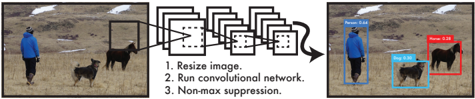
We present YOLO, a new approach to object detection. Prior work on object detection repurposes classifiers to perform detection. Instead, we frame object detection as a regression problem to spatially separated bounding boxes and associated class probabilities. A single neural network predicts bounding boxes and class probabilities directly from full images in one evaluation. Since the whole detection pipeline is a single network, it can be optimized end-to-end directly on detection performance. Our unified architecture is extremely fast. Our base YOLO model processes images in real-time at 45 frames per second. A smaller version of the network, Fast YOLO, processes an astounding 155 frames per second while still achieving double the mAP of other real-time detectors. Compared to state-of-the-art detection systems, YOLO makes more localization errors but is less likely to predict false positives on background. Finally, YOLO learns very general representations of objects. It outperforms other detection methods, including DPM and R-CNN, when generalizing from natural images to other domains like artwork.
Overview
CoChat Summary
TL;DR
YOLO reframes object detection as a single regression problem, using one convolutional network to predict bounding boxes and class probabilities directly from full images. It achieves real-time detection speeds while remaining competitive with, and complementary to, slower region-based detectors.
Key findings
- YOLO runs at 45 FPS on a Titan X GPU, and Fast YOLO runs at 155 FPS; Fast YOLO reaches 52.7% mAP on PASCAL VOC 2007, more than double prior real-time detectors, while YOLO reaches 63.4% mAP.
- On PASCAL VOC 2012, YOLO scores 57.9% mAP; combining Fast R-CNN with YOLO raises Fast R-CNN from 71.8% to 75.0% mAP on VOC 2007, a 3.2% gain.
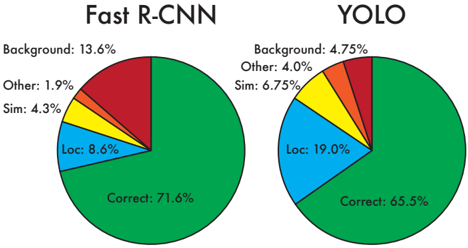
- YOLO makes fewer background false positives than Fast R-CNN: Fast R-CNN has 13.6% background false positives among top detections and is almost 3× more likely to predict background detections than YOLO.
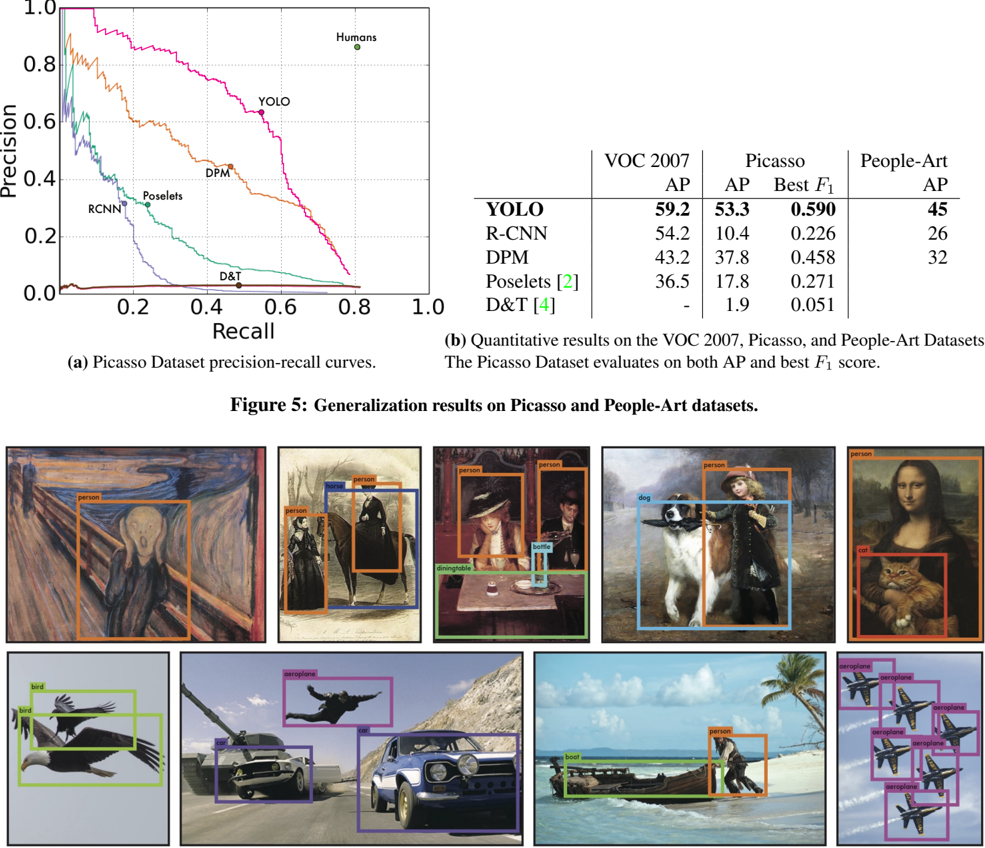
- YOLO generalizes better to artwork: on Picasso, YOLO gets 53.3 AP versus R-CNN’s 10.4 AP and DPM’s 37.8 AP; on People-Art, YOLO gets 45 AP versus R-CNN’s 26 AP and DPM’s 32 AP.
Methods
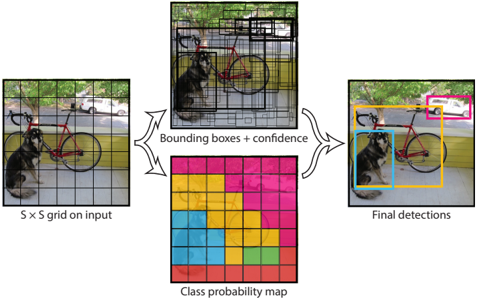
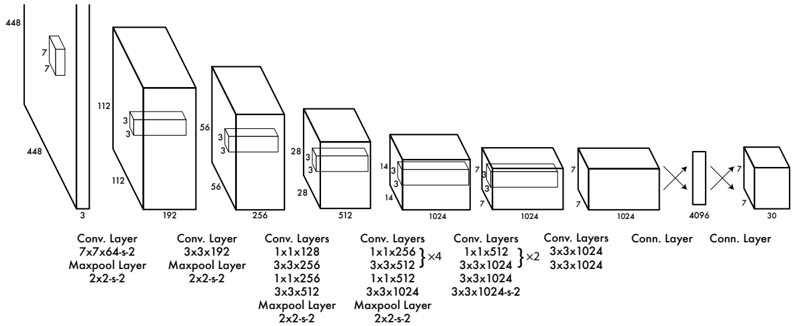
- Detection is modeled as a single CNN regression: the image is divided into an S×S grid; for PASCAL VOC, S=7, B=2, C=20, producing a 7×7×30 tensor of bounding boxes, confidence scores, and class probabilities.
- The base network has 24 convolutional layers followed by 2 fully connected layers; Fast YOLO uses 9 convolutional layers. Convolutional layers are pretrained on ImageNet at 224×224, then detection training uses 448×448 input.
- Training uses PASCAL VOC 2007 and 2012 for about 135 epochs, batch size 64, momentum 0.9, decay 0.0005, sum-squared error with λ_coord=5 and λ_noobj=0.5, dropout, and data augmentation.
Limitations
- The paper states YOLO imposes strong spatial constraints because each grid cell predicts only two boxes and one class, limiting nearby objects and struggling with small objects in groups such as flocks of birds.
- The paper states YOLO struggles to generalize to objects in new or unusual aspect ratios or configurations, uses relatively coarse features due to downsampling, and its loss treats small and large box errors equally; its main error source is incorrect localization.
- The paper states YOLO still lags state-of-the-art detection accuracy and struggles to precisely localize some objects, especially small ones.
Model-written summary. Check it against the paper before relying on it.
Integrity signals
Registry
Cites
Statistics
Figures
Verification
Claims the paper makes
6 Valid · 8 Not valid · 15 Not checked · 92 Own results and interpretations
The cited sources that could be checked couldn’t confirm or dispute this claim.
In the paper
“While it is much faster than R-CNN, it still falls short of real-time and takes a significant accuracy hit from not having good proposals.”
What the sources say
- Could not verifycites [20] [20] K. Lenc and A. Vedaldi. R-cnn minus r. arXiv preprint arXiv:1506.06981 , 2015. 5, 6 - sourceExperimental — accuracy not yet measured
The ConvNet-based Object Detection section identifies R-CNN minus R as a method that uses predefined regions instead of region proposals. It gives no runtime measurement or assessment of whether the method achieves real-time detection; searches for real-time performance and speed did not establish that claim. (LLM, conf=0.76)
plain- Asserted: passes — The authors put it forward as true.
- Checkable: passes — It can be checked against evidence.
- Load-bearing: passes — The paper’s conclusions depend on it.
- Based: passes — The paper gives a reason why it holds.
- Could not verify
The cited sources support only part of this claim — read each source’s verdict below.
In the paper
“To avoid overfitting we use dropout and extensive data augmentation.”
What the sources say
- Partly supportedcites [18] [18] G. E. Hinton, N. Srivastava, A. Krizhevsky, I. Sutskever, and R. R. Salakhutdinov. Improving neural networks by preventing co-adaptation of feature detectors. arXiv preprint arXiv:1207.0580 , 2012. 4 - sourceExperimental — accuracy not yet measured
The paper states that dropout reduces overfitting (p. 1) and describes using dropout with data augmentation for its ImageNet model (H Models for ImageNet, p. 18). It does not establish that YOLO uses either technique or describe YOLO’s augmentation as extensive. (LLM, conf=0.88)
plainstates a cause- Asserted: passes — The authors put it forward as true.
- Checkable: passes — It can be checked against evidence.
- Load-bearing: unclear — It is unclear whether the paper’s conclusions depend on it.
- Based: passes — The paper gives a reason why it holds.
- Partly supported
Every source the paper cites for this claim was checked and supports it.
In the paper
“However, only 30Hz DPM [31] actually runs in real-time.”
What the sources say
- Supportedcites [31] [31] M. A. Sadeghi and D. Forsyth. 30hz object detection with dpm v5. In Computer Vision-ECCV 2014 , pages 65-79. Springer, 2014. 5, 6 - source
The Introduction (p.1) states that 'except for certain objects including face, pedestrians and certain rigid objects, detectors do not currently run at video rate' and that the presented architecture detects the 20 PASCAL VOC categories simultaneously at 30Hz, i.e. at video/real-time rate. The Abstract (p.1) and Table 2 (Method) bound the comparison to other DPM speed-up efforts: reference DPM at 0.07Hz, the fastest GPU 'Vanilla DPM' at ~1Hz, FTVQ at 0.53s, and 'over an order of magnitude faster than the previous fastest DPM implementation', so none of the listed variants reaches real-time. Thus our copy supports both parts of the attribution: that this 30Hz DPM runs in real-time and that it is the only such DPM among the speed-up efforts compared. (LLM, conf=0.82)
plain- Asserted: passes — The authors put it forward as true.
- Checkable: passes — It can be checked against evidence.
- Load-bearing: unclear — It is unclear whether the paper’s conclusions depend on it.
- Based: passes — The paper gives a reason why it holds.
- Supported
The cited sources that could be checked couldn’t confirm or dispute this claim.
In the paper
“While it is much faster than R-CNN, it still falls short of real-time and takes a significant accuracy hit from not having good proposals.”
What the sources say
- Could not verifycites [20] [20] K. Lenc and A. Vedaldi. R-cnn minus r. arXiv preprint arXiv:1506.06981 , 2015. 5, 6 - sourceExperimental — accuracy not yet measured
The ConvNet-based Object Detection section identifies R-CNN minus R and says it uses predefined regions in an SPPnet system, but gives no speed comparison with R-CNN. A search for R-CNN minus R and speed found no passage in our copy establishing that it is much faster. (LLM, conf=0.73)
plainstates a cause- Asserted: passes — The authors put it forward as true.
- Checkable: passes — It can be checked against evidence.
- Load-bearing: unclear — It is unclear whether the paper’s conclusions depend on it.
- Based: passes — The paper gives a reason why it holds.
- Could not verify
The cited sources support only part of this claim — read each source’s verdict below.
In the paper
“While it is much faster than R-CNN, it still falls short of real-time and takes a significant accuracy hit from not having good proposals.”
What the sources say
- Partly supportedcites [20] [20] K. Lenc and A. Vedaldi. R-cnn minus r. arXiv preprint arXiv:1506.06981 , 2015. 5, 6 - sourceExperimental — accuracy not yet measured
The “ConvNet-based Object Detection” section (page unavailable) says R-CNN minus R uses predefined regions instead of region proposals. It does not say that this causes a significant accuracy loss; the paper’s discussion of low accuracy concerns a different system, naïve Faster R-CNN. (LLM, conf=0.83)
plainstates a cause- Asserted: passes — The authors put it forward as true.
- Checkable: passes — It can be checked against evidence.
- Load-bearing: unclear — It is unclear whether the paper’s conclusions depend on it.
- Based: passes — The paper gives a reason why it holds.
- Partly supported
84 more claims
Create a free account to see all 121 claims and to verify the 2 references still open.
- Probably not a substantial claim. 17
- It may state two separate claims as one. 15
Claims other papers make about this one
Each is checked against this paper’s own text: does it say what the citing paper says it does?
The source backs part of the claim, not all of it — or backs it for a different population, condition or comparison.
In the citing paper
“which was not thoroughly investigated in prevIoUs work such as YOLOv1 [20] and YOLOv2 [51] employing MSE/L2 loss (Mean Squared Error).”
From Object Detection in 20 Years: A Survey (2023) · cites this paper as [20]
Experimental — accuracy not yet measuredThe source backs part of the claim, not all of it — or backs it for a different population, condition or comparison.
In the citing paper
“the YOLO series models v2-v5 [144-147] are some of the most advanced object detection methods based on DNN, which have good performance in terms of speed and precision.”
From A survey of model compression strategies for object detection (2023) · cites this paper as [144]
Experimental — accuracy not yet measuredThe source backs part of the claim, not all of it — or backs it for a different population, condition or comparison.
In the citing paper
“As a typical and more widely used new form of applications [9], various deep learning-based intelligent services and applications have changed many aspects of people's lives due to the great advantages of Deep Learning (DL) in the fields of Computer Vision (CV) and Natural Language Processing (NLP) [10].”
From Convergence of Edge Computing and Deep Learning: A Comprehensive Survey (2020) · cites this paper as [9]
Experimental — accuracy not yet measuredThe cited source says what the claim attributes to it.
In the citing paper
“A convolutional neural network predicts the bounding boxes as well as class probabilities for all the objects depicted in an image.”
From Object detection using YOLO: challenges, architectural successors, datasets and applications (2023) · cites this paper as [56]
The cited source says what the claim attributes to it.
In the citing paper
“Authors of YOLO [56] have reframed the problem of object detection as a regression problem instead of classification problem.”
From Object detection using YOLO: challenges, architectural successors, datasets and applications (2023) · cites this paper as [56]
6 more claims about this paper
Create a free account to see every claim other papers make about this one.
Citations
Cites
Faster R-CNN: Towards Real-Time Object Detection with Region Proposal Networks
Ren, S., He, K., Girshick, R., & Sun, J. (2017) · IEEE Transactions on Pattern Analysis and Machine Intelligence · doi:10.1109/tpami.2016.2577031 · Cited by 73,472
Self-citationFaster R-CNN: Towards Real-Time Object Detection with Region Proposal Networks
Ren, S., He, K., Girshick, R., & Sun, J. (2015) · arXiv · doi:10.48550/arxiv.1506.01497 · Cited by 70,812
Self-citationGoing deeper with convolutions
Szegedy, C., Liu, W., Jia, Y., Sermanet, P., Reed, S., Anguelov, D., Erhan, D., Vanhoucke, V., & Rabinovich, A. (2015) · 2015 IEEE Conference on Computer Vision and Pattern Recognition (CVPR) · doi:10.1109/cvpr.2015.7298594 · Cited by 48,562
ImageNet Large Scale Visual Recognition Challenge
Russakovsky, O., Deng, J., Su, H., Krause, J., Satheesh, S., Ma, S., Huang, Z., Karpathy, A., Khosla, A., Bernstein, M., et al. (2015) · International Journal of Computer Vision · doi:10.1007/s11263-015-0816-y · Cited by 39,380 · cited 1×
“We pretrain our convolutional layers on the ImageNet 1000-class competition dataset [29].”
MethodHistograms of Oriented Gradients for Human Detection
Dalal, N., & Triggs, B. (2005) · 2005 IEEE Computer Society Conference on Computer Vision and Pattern Recognition (CVPR'05) · doi:10.1109/cvpr.2005.177 · Cited by 33,584 · cited 2×
“Detection pipelines generally start by extracting a set of robust features from input images (Haar [25], SIFT [23], HOG [4], convolutional features [6]).”
MethodRich Feature Hierarchies for Accurate Object Detection and Semantic Segmentation
Girshick, R., Donahue, J., Darrell, T., & Malik, J. (2014) · 2014 IEEE Conference on Computer Vision and Pattern Recognition · doi:10.1109/cvpr.2014.81 · Cited by 32,684 · cited 2×
“Then, classifiers [35, 21, 13, 10] or localizers [1, 31] are used to identify objects in the feature space.”
MethodSelf-citationGirshick, R. (2015) · 2015 IEEE International Conference on Computer Vision (ICCV) · doi:10.1109/iccv.2015.169 · Cited by 28,105
Self-citationDelving Deep into Rectifiers: Surpassing Human-Level Performance on ImageNet Classification
He, K., Zhang, X., Ren, S., & Sun, J. (2015) · 2015 IEEE International Conference on Computer Vision (ICCV) · doi:10.1109/iccv.2015.123 · Cited by 19,741 · cited 1×
“Convolutional neural networks (CNNs) achieve impressive performance on classification tasks at real-time speeds [13].”
Object recognition from local scale-invariant features
Lowe, D. G. (1999) · Proceedings of the Seventh IEEE International Conference on Computer Vision · doi:10.1109/iccv.1999.790410 · Cited by 16,472 · cited 1×
“Detection pipelines generally start by extracting a set of robust features from input images (Haar [25], SIFT [23], HOG [4], convolutional features [6]).”
MethodRobust Real-Time Face Detection
Viola, P., & Jones, M. J. (2004) · International Journal of Computer Vision · doi:10.1023/b:visi.0000013087.49260.fb · Cited by 14,097 · cited 1×
“Detectors for single classes like faces or people can be highly optimized since they have to deal with much less variation [36].”
Background
Cited by
Items 23,601–23,700 of 51,401
A Multi-Precision Bit-Serial Hardware Accelerator IP for Deep Learning Enabled Internet-of-Things
Capra, M., Conti, F., & Martina, M. (2021) · IEEE International Midwest Symposium on Circuits and Systems (MWSCAS) · doi:10.1109/mwscas47672.2021.9531722 · Cited by 7
A Review on Deep Learning Techniques Applied to Object Detection
Ying-jie, L., Cui, X., Xu, X., & Jiang, F. (2020) · International Conference on Information Science and Control Engineering · doi:10.1109/icisce50968.2020.00035 · Cited by 7
Infrared small target detection method based on multi-scale feature fusion
Wang, F., Li, C., Wu, B., et al. (2021) · Journal of Physics Conference Series · doi:10.1088/1742-6596/2024/1/012012 · Cited by 5
Analyse or Transmit: Utilising Correlation at the Edge with Deep Reinforcement Learning
Hribar, J., Shinkuma, R., Iosifidis, G., & Dusparić, I. (2021) · Globecom · doi:10.1109/globecom46510.2021.9685166 · Cited by 5
Improved lightweight peanut detection algorithm based on YOLO v3
Shen, Z., & Zhao, Z. (2021) · International Conference on Artificial Intelligence, Big Data and Algorithms (CAIBDA) · doi:10.1109/caibda53561.2021.00043 · Cited by 5
A deep neural network based toddler tracking system
Guney, H., Aydin, M., Taşkıran, M., & Kahraman, N. (2021) · Concurrency and Computation Practice and Experience · doi:10.1002/cpe.6636 · Cited by 5
ICDAR 2021 Competition on Components Segmentation Task of Document Photos
Lopes, C. A. M., das Neves, R. B., Bezerra, B. L. D., Toselli, A. H., & Impedovo, D. (2021) · Lecture notes in computer science · doi:10.1007/978-3-030-86337-1_45 · Cited by 8
SAR Target Detection Network Based on Saliency-Combined Single Shot Multi Box Detector
Li, L., Du, L., & Du, Y. (2021) · IEEE International Geoscience and Remote Sensing Symposium (IGARSS) · doi:10.1109/igarss47720.2021.9554004 · Cited by 5
Advanced Driver-Assistance System with Traffic Sign Recognition for Safe and Efficient Driving
Gunasekara, S., Gunarathna, D., & Dissanayake, M. B. (2021) · International Journal on Recent and Innovation Trends in Computing and Communication · doi:10.17762/ijritcc.v9i9.5488 · Cited by 5
Leveraging Motor Babbling for Efficient Robot Learning
Kase, K., Matsumoto, N., & Ogata, T. (2021) · Journal of Robotics and Mechatronics · doi:10.20965/jrm.2021.p1063 · Cited by 7
Student-Teacher Oneness: A Storage-efficient approach that improves facial expression recognition
Zheng, Z., Rasmussen, C. E., & Peng, X. (2021) · IEEE International Conference on Computer Vision Workshops · doi:10.1109/iccvw54120.2021.00453 · Cited by 6
Research on YOLOv3 pedestrian detection algorithm based on channel attention mechanism
Li, Y., Wang, Q., & Liu, R. (2021) · 2021 IEEE International Conference on Computer Science, Electronic Information Engineering and Intelligent Control Technology (CEI) · doi:10.1109/cei52496.2021.9574546 · Cited by 5
The Shrank YoloV3-tiny for spinal fracture lesions detection
Sha, G., Wu, J., & Yu, B. (2021) · Journal of Intelligent & Fuzzy Systems · doi:10.3233/jifs-212255 · Cited by 5
Efficient and Robust Indian Number Plate Recognition Through Modified and Tuned LPRNet
Dangi, R. S., Kuvelkar, A., Maity, S. K., & Wandhekar, S. (2021) · Lecture notes in electrical engineering · doi:10.1007/978-981-16-3690-5_12 · Cited by 5
Self-attention module and FPN-based remote sensing image target detection
Li, Z., Wang, H., Zhong, H., & Dai, Y. (2021) · Arabian Journal of Geosciences · doi:10.1007/s12517-021-08552-8 · Cited by 5
Optimal trajectory generation of a drone for wheelchair tracking using mixed-integer programming
Watanabe, S., & Mukai, M. (2021) · Artificial Life and Robotics · doi:10.1007/s10015-021-00710-1 · Cited by 5
Real-Time Traffic Sign Detection Based on Improved YOLO V3
Zeng, H. (2021) · Lecture notes in electrical engineering · doi:10.1007/978-981-16-6554-7_19 · Cited by 5
Fusion and Visualization Design of Violence Detection and Geographic Video
Liang, Q., Cheng, C., Li, Y., et al. (2021) · Communications in computer and information science · doi:10.1007/978-981-16-7443-3_3 · Cited by 5
A Novel 3D Convolutional Neural Network for Action Recognition in Infrared Videos
Nie, J., Yan, L., Wang, X., et al. (2021) · International Conference on Information Communication and Signal Processing (ICICSP) · doi:10.1109/icicsp54369.2021.9611896 · Cited by 5
Chang, Y.-B., Tsai, C., Lin, C. H., & Chen, P. (2021) · Sensors · doi:10.3390/s21238072 · Cited by 6
Research Progress of Loss Function in Object Detection
杨, 倩. (2021) · Computer Science and Application · doi:10.12677/csa.2021.1111288 · Cited by 5
Full Content-based Web Page Classification Methods by using Deep Neural Networks
Suleymanzade, S., & Abdullayeva, F. J. (2021) · Statistics Optimization & Information Computing · doi:10.19139/soic-2310-5070-1056 · Cited by 5
Hybrides Maschinelles Lernen im Kontext der Produktion
Gauger, I., Nagel, T., & Huber, M. F. (2021) · Springer eBooks · doi:10.1007/978-3-662-64408-9_6 · Cited by 7
Face Mask Detection: A Real-Time Android Application Based on Deep Learning Modeling
Sharma, H., Sewani, H., Garg, R., et al. (2021) · IEEE Annual Information Technology, Electronics and Mobile Communication Conference (IEMCON) · doi:10.1109/iemcon53756.2021.9623222 · Cited by 5
Collision-Line Counting Method Using DeepSORT to Count Pedestrian Flow Density and Hungary Algorithm
Pei, Y., Liu, H., & Bei, Q. (2021) · IEEE International Conference on Civil Aviation Safety and Information Technology (ICCASIT) · doi:10.1109/iccasit53235.2021.9633356 · Cited by 5
Capsule Network Based on Self-Attention Mechanism
Shang, Y., Xu, N., Jin, Z., & Yao, X. L. (2021) · International Conference on Wireless Communications and Signal Processing (WCSP) · doi:10.1109/wcsp52459.2021.9613717 · Cited by 6
An Efficient Deep Learning Framework for People Detection in Overhead Images
Peker, M., İnci, B., Musaoğlu, E., ÇOBANOĞLU, H. K., Kocakır, N., & Karademir, Ö. (2021) · Learning and analytics in intelligent systems · doi:10.1007/978-3-030-85383-9_1 · Cited by 5
A Real-Time Malaysian Traffic Sign Recognition Using YOLO Algorithm
Mangshor, N. N. A., Paudzi, N. P. A. M., Ibrahim, S., et al. (2021) · Lecture notes in electrical engineering · doi:10.1007/978-981-16-2406-3_22 · Cited by 5
Detección de peatones en el día y en la noche usando YOLO-v5
Montenegro, B., & Flores-Calero, M. J. (2021) · Ingenius · doi:10.17163/ings.n27.2022.08 · Cited by 5
Tomato Harvesting Robot System Based on Binocular Vision
Wu, Y., Qiu, C., Liu, S., et al. (2021) · IEEE International Conference on Unmanned Systems (ICUS) · doi:10.1109/icus52573.2021.9641260 · Cited by 6
Wu, J., Wu, C., Cen, W.-S., et al. (2021) · Australian & New Zealand Control Conference (ANZCC) · doi:10.1109/anzcc53563.2021.9628221 · Cited by 5
Visual Pollution Detection Using Google Street View and YOLO
Hossain, M. Y., Nijhum, I. R., Sadi, A. A., et al. (2021) · IEEE Annual Ubiquitous Computing, Electronics & Mobile Communication Conference (UEMCON) · doi:10.1109/uemcon53757.2021.9666654 · Cited by 5
An Improved Yolov3 Object Detection Algorithm for UAV Aerial Images
Zhang, Z., Gong, H., Wang, X., et al. (2021) · doi:10.1109/icaa53760.2021.00100 · Cited by 5
General-purpose Abandoned Object Detection Method without Background Modeling
Liu, W., Liu, P., Xiao, C., et al. (2021) · IEEE International Conference on Imaging Systems and Techniques (IST) · doi:10.1109/ist50367.2021.9651400 · Cited by 5
Fruits Detection and Distance Estimation using RGB-D camera for Harvesting Robot
Nguyen, A. Q., Nguyen, M. A., Nguyen, H. T., Luong, H. Q., & Dao, N. P. (2021) · International Conference on Science & Contemporary Technologies (ICSCT) · doi:10.1109/icsct53883.2021.9642700 · Cited by 7
Classifying Plastic Waste on River Surfaces utilising CNN and Tensorflow
McShane, J., Meehan, K., Furey, E., & McAfee, M. (2021) · IEEE Annual Ubiquitous Computing, Electronics & Mobile Communication Conference (UEMCON) · doi:10.1109/uemcon53757.2021.9666556 · Cited by 5
Crack Detection Method of Sleeper Based on Cascade Convolutional Neural Network
Li, L., Zheng, S., Wang, C., Zhao, S., Chai, X., Peng, L., Tong, Q., & Ji, W. (2022) · Journal of Advanced Transportation · doi:10.1155/2022/7851562 · Cited by 6
Vision based robot-to-robot object handover
Sileo, M., Nigro, M., Bloisi, D. D., et al. (2021) · International Conference on Advanced Robotics (ICAR) · doi:10.1109/icar53236.2021.9659446 · Cited by 5
Fast and Accurate Deep Learning Architecture on Vehicle Type Recognition
Surinta, O., & Boonsirisumpun, N. (2021) · Current Applied Science and Technology · doi:10.55003/cast.2022.01.22.001 · Cited by 5
Welding Defect Detection with Deep Learning Architectures
Tripicchio, P., & D’Avella, S. (2022) · IntechOpen eBooks · doi:10.5772/intechopen.101951 · Cited by 8
Lightweight real-time face detection method based on improved YOLOv4
Shi, M., & Gao, Y. (2021) · International Conference on Computer Information Science and Artificial Intelligence (CISAI) · doi:10.1109/cisai54367.2021.00058 · Cited by 5
Murtaza, M., Sharif, M. I., Yasmin, M., & Kadry, S. (2022) · Mathematical Methods in the Applied Sciences · doi:10.1002/mma.8197 · Cited by 8
Trajectory Prediction Using Video Generation in Autonomous Driving
Iancu, D.-T., Nan, M., Ghiță, A. Ș., & Florea, A. M. (2022) · Studies in Informatics and Control · doi:10.24846/v31i1y202204 · Cited by 5
Imaging Parameters-Considered Slender Target Detection in Optical Satellite Images
Huang, Z., Wang, F., You, H., & Hu, Y. (2022) · Remote Sensing · doi:10.3390/rs14061385 · Cited by 5
UTextNet: A UNet Based Arbitrary Shaped Scene Text Detector
Naosekpam, V., Aggarwal, S., & Sahu, N. (2022) · Lecture notes in networks and systems · doi:10.1007/978-3-030-96308-8_34 · Cited by 8
The Improved YOLO-V5 Based Automatic Non-parking Overloading Detection Method
Lu, G., & Wang, Y. (2022) · International Symposium on Autonomous Systems (ISAS) · doi:10.1109/isas55863.2022.9757325 · Cited by 5
Fourie, C. M., & Myburgh, H. C. (2022) · Sensors · doi:10.3390/s22083026 · Cited by 5
Golf Swing Sequencing Using Computer Vision
Marais, M., & Brown, D. (2022) · Lecture notes in computer science · doi:10.1007/978-3-031-04881-4_28 · Cited by 6
Path planning for assisting blind people in purposeful navigation
Toro, A. A. D., Mosquera-Ortega, P., Herrera-Silva, G., & Bastidas, S. E. C. (2022) · Indonesian Journal of Electrical Engineering and Computer Science · doi:10.11591/ijeecs.v26.i1.pp450-461 · Cited by 5
Zhang, Y., Qiu, C., Zhong, N., Su, X., Zhang, X., Huang, F., Wang, L., & Wang, L. (2021) · International Conference on Video and Image Processing (ICVIP) · doi:10.1145/3511176.3511196 · Cited by 6
Application of Deep Learning in Imaging diagnosis of Brain diseases
Liang, J., Wang, Z., & Ye, X. (2021) · International Conference on Machine Learning, Big Data and Business Intelligence (MLBDBI) · doi:10.1109/mlbdbi54094.2021.00040 · Cited by 6
Research Review of Object Detection Algorithms in Vehicle Detection
An, H., Liu, K., Liang, Z., Qin, M., Huang, Y., & Guo, Z. (2022) · IEEE International Conference on Electrical Engineering, Big Data and Algorithms (EEBDA) · doi:10.1109/eebda53927.2022.9744735 · Cited by 5
LCornerIoU: An Improved IoU-based Loss Function for Accurate Bounding Box Regression
Wang, Q., & Cheng, J. (2021) · International Conference on Intelligent Computing, Automation and Systems (ICICAS) · doi:10.1109/icicas53977.2021.00085 · Cited by 7
An intelligent hand-washing monitoring platform based on gesture recognition technology
Yue, Z., Wang, F., & Liu, Z. (2021) · China Automation Congress (CAC) · doi:10.1109/cac53003.2021.9728292 · Cited by 4
Interactive Regression and Classification for Dense Object Detector
Zhou, L., Chang, H., Ma, B., & Shan, S. (2022) · IEEE Transactions on Image Processing · doi:10.1109/tip.2022.3174391 · Cited by 7
Age Should Not Matter: Towards More Accurate Pedestrian Detection via Self-Training
Kogure, S., Watabe, K., Yamada, R., Aoki, Y., Nakamura, A., & Kataoka, H. (2022) · doi:10.3390/cmsf2022003011 · Cited by 7
TD-Sampler: Learning a Training Difficulty Based Sampling Strategy for Few-Shot Object Detection
Wu, C., Wang, B., Liu, S., Liu, X., & Wu, P. F. (2022) · International Conference on Cloud Computing and Big Data Analytics (ICCCBDA) · doi:10.1109/icccbda55098.2022.9778859 · Cited by 6
A single-shot model for traffic-related pedestrian detection
Sun, C., Ai, Y., Qi, X., Wang, S., & Zhang, W. (2022) · Pattern Analysis and Applications · doi:10.1007/s10044-022-01076-1 · Cited by 6
Quan, W., Feng, K., Lu, X., et al. (2022) · Neural Processing Letters · doi:10.1007/s11063-022-10874-x · Cited by 5
Quantitative Analysis of Visual Representation of Sign Elements in COVID-19 Context
Cano-Martínez, M. J., Carrasco, M., Sandoval, J., & González-Martín, C. (2022) · Empirical Studies of the Arts · doi:10.1177/02762374221104059 · Cited by 5
The Use of DCNN for Road Path Detection and Segmentation
Murad, N. M., Rejeb, L., & Saïd, L. B. (2022) · Iraqi Journal for Computer Science and Mathematics · doi:10.52866/ijcsm.2022.02.01.013 · Cited by 5
Pilot Feasibility Study of a Multi-View Vision Based Scoring Method for Cervical Dystonia
Ye, C., Xiao, Y., Li, R., et al. (2022) · Sensors · doi:10.3390/s22124642 · Cited by 5
Direct regression scene text detection with accuracy scoring
Cheng, P., Zhao, Y., Cai, Y., & Wang, W. (2022) · Neurocomputing · doi:10.1016/j.neucom.2022.06.057 · Cited by 5
A Wireless-Vision Dataset for Privacy Preserving Human Activity Recognition
Hao, Y., Shi, Z., & Liu, Y. (2020) · International Conference on Multimedia Computing, Networking and Applications (MCNA) · doi:10.1109/mcna50957.2020.9264288 · Cited by 9
An Intelligent Edge System for Face Mask Recognition Application
LeAnh, T., Nguyen-Van, B., & Le‐Trung, Q. (2022) · Lecture notes of the Institute for Computer Sciences, Social Informatics and Telecommunications Engineering · doi:10.1007/978-3-031-08878-0_8 · Cited by 5
Tan, C., Gu, G., Ruan, T., Wei, S., & Zhao, Y. (2022) · IEEE Transactions on Multimedia · doi:10.1109/tmm.2022.3184486 · Cited by 7
Team JSK at MBZIRC 2020: Interception of Fast Flying Target using Multilinked Aerial Robot
Zhao, M., Shi, F., Anzai, T., Nishio, T., Maki, T., Ito, K., Kuromiya, N., Okada, K., & Inaba, M. (2021) · Field Robotics · doi:10.55417/fr.2021003 · Cited by 6
Xavier, R. J., Viegas, C. F. O., Costa, B. C., et al. (2022) · Lecture notes in computer science · doi:10.1007/978-3-031-10522-7_42 · Cited by 5
Probabilistic Radio-Visual Active Sensing for Search and Tracking
Varotto, L., Cenedese, A., & Cavallaro, A. (2021) · European Control Conference (ECC) · doi:10.23919/ecc54610.2021.9655209 · Cited by 5
Lightweight PM-YOLO Network Model for Moving Object Recognition on the Distribution Network Side
Zhang, Y., Yuan, B., Zhang, J., Li, Z., Pang, C., & Dong, C. (2022) · Asia-Pacific Conference on Communications Technology and Computer Science (ACCTCS) · doi:10.1109/acctcs53867.2022.00109 · Cited by 7
Graphite Classification of Gray Cast Iron in Metallographic via a Deep Learning Approach
Huang, W. H. W., Huang, Z.-Y. S. W., Su, C.-S. W. Z.-Y., et al. (2022) · 網際網路技術學刊 · doi:10.53106/160792642022072304023 · Cited by 5
Multiple Detection Model Fusion Framework for Printed Circuit Board Defect Detection
Wu, X., Zhang, Q., Wang, J., Yao, J., & Guo, Y. (2022) · Journal of Shanghai Jiaotong University (Science) · doi:10.1007/s12204-022-2471-0 · Cited by 5
Neuromorphic computing for attitude estimation onboard quadrotors
Stroobants, S., Dupeyroux, J., & de Croon, G. (2022) · Neuromorphic Computing and Engineering · doi:10.1088/2634-4386/ac7ee0 · Cited by 9
CAPTION: Caption Analysis with Proposed Terms, Image of Objects, and Natural Language Processing
Ferreira, L. A., Meneghetti, D. D. R., Lopes, M., & Santos, P. E. (2022) · SN Computer Science · doi:10.1007/s42979-022-01322-7 · Cited by 5
Detection of Road Traffic Crashes based on Collision Estimation
Essam, M., Ghanem, N. M., & Ismail, M. A. (2022) · doi:10.5121/csit.2022.121213 · Cited by 5
A Novel Multi-Scale Transformer for Object Detection in Aerial Scenes
Lu, G., He, X., Wang, Q., Shao, F., Wang, H., & Wang, J. (2022) · Drones · doi:10.3390/drones6080188 · Cited by 6
RT-Net: replay-and-transfer network for class incremental object detection
Cui, B., Hu, G., & Yu, S. P. (2022) · Applied Intelligence · doi:10.1007/s10489-022-03509-0 · Cited by 6
One-Stage Arbitrary-Oriented Object Detection With Prediction Decoupling
Xiong, Z. (2022) · IEEE Access · doi:10.1109/access.2022.3197588 · Cited by 5
Image Recognition in Autonomous Driving Based on Improved Swin Transformer
Bie, Y., & Tan, H. X. (2022) · IEEE International Conference on Artificial Intelligence and Computer Applications (ICAICA) · doi:10.1109/icaica54878.2022.9844630 · Cited by 5
Multi-Vehicle Tracking Using Heterogeneous Neural Networks for Appearance And Motion Features
Abdallah, M. S., Han, D. S., & Kim, H. (2022) · International Journal of Intelligent Transportation Systems Research · doi:10.1007/s13177-022-00320-6 · Cited by 8
Concept Activation Vectors for Generating User-Defined 3D Shapes
Druc, S., Balu, A., Wooldridge, P., Krishnamurthy, A., & Sarkar, S. (2022) · IEEE/CVF Conference on Computer Vision and Pattern Recognition Workshops (CVPRW) · doi:10.1109/cvprw56347.2022.00338 · Cited by 9
Detecting Objects in Less Response Time for Processing Multimedia Events in Smart Cities
Aslam, A. (2022) · IEEE/CVF Conference on Computer Vision and Pattern Recognition Workshops (CVPRW) · doi:10.1109/cvprw56347.2022.00222 · Cited by 7
Lateral Feature Enhancement Network for Page Object Detection
Shi, C., Xu, C., Bi, H., Cheng, Y., Li, Y., & Zhang, H. (2022) · IEEE Transactions on Instrumentation and Measurement · doi:10.1109/tim.2022.3201546 · Cited by 6
High Accuracy Detection Strategy for EL Defects in PV Modules Based on Machine Learning
Chen, T., Ding, S., Chen, H., et al. (2022) · Asia-Pacific Conference on Intelligent Robot Systems (ACIRS) · doi:10.1109/acirs55390.2022.9845525 · Cited by 5
An Improved Target Detection General Framework Based on Yolov4
Liu, H., Zhang, L., & Xin, S. (2021) · IEEE International Conference on Robotics and Biomimetics (ROBIO) · doi:10.1109/robio54168.2021.9739530 · Cited by 5
Bortoloti, F. D., Tavares, J., Rauber, T. W., Ciarelli, P. M., & Botelho, R. C. G. (2022) · Machine Vision and Applications · doi:10.1007/s00138-022-01335-5 · Cited by 7
An Automatic Detection Approach for Wearing Safety Helmets on Construction Site based on YOLOv5
Ge, P., & Chen, Y. (2022) · IEEE Data Driven Control and Learning Systems Conference (DDCLS) · doi:10.1109/ddcls55054.2022.9858511 · Cited by 6
Rajput, S. K., & Patni, J. C. (2022) · Conference on Human System Interactions · doi:10.1109/hsi55341.2022.9869476 · Cited by 5
Training of Deep Learning Models Using Synthetic Datasets
Kowalczuk, Z., & Glinko, J. (2022) · Lecture notes in networks and systems · doi:10.1007/978-3-031-16159-9_12 · Cited by 6
An Anchor‐Free 3D Object Detection Approach Based on Hierarchical Pillars
Ren, X., & Li, S. (2022) · Wireless Communications and Mobile Computing · doi:10.1155/2022/3481517 · Cited by 5
Multispectral interaction convolutional neural network for pedestrian detection
Ryu, J., Kim, J., Kim, H., & Kim, S. (2022) · Computer Vision and Image Understanding · doi:10.1016/j.cviu.2022.103554 · Cited by 8
Automatic Object Detection of Construction Workers and Machinery Based on Improved YOLOv5
Xiang, Y., Zhao, J., Wu, W., et al. (2022) · Lecture notes in civil engineering · doi:10.1007/978-981-19-5217-3_74 · Cited by 5
Automatic Detection of Knives in Complex Scenes
Morán, M. B. H., Conci, A., & Sánchez, Á. (2022) · Intelligent systems reference library · doi:10.1007/978-3-031-06307-7_4 · Cited by 5
UMTSS: a unifocal motion tracking surveillance system for multi-object tracking in videos
Hazra, S., Mandal, S., Saha, B., & Khatua, S. (2022) · Multimedia Tools and Applications · doi:10.1007/s11042-022-13780-5 · Cited by 8
FA-SSD: A Small Object Detection Algorithm Based on Feature Alignment
Zheng, Y., Wang, Y., Li, F., et al. (2022) · International Conference on Pattern Recognition and Artificial Intelligence (PRAI) · doi:10.1109/prai55851.2022.9904188 · Cited by 5
Intelligent Identification of Landslide Based on Deep Semi-supervised Learning
Xie, D., Yang, R., Qiao, Y., et al. (2022) · International Conference on Pattern Recognition and Artificial Intelligence (PRAI) · doi:10.1109/prai55851.2022.9904223 · Cited by 5
Exploration of The Impact of Kernel Size for YOLOv5-based Object Detection on Quadcopter
Rahmania, R., Corputty, F., Wibowo, S. A., Saputra, D. E., & Istiqomah, A. (2022) · JOIV International Journal on Informatics Visualization · doi:10.30630/joiv.6.3.898 · Cited by 7
An Efficient Deep Learning Technique for Detecting and Classifying the Growth of Weeds on Fields
Almalky, A. M., Ahmed, K. R., Guzel, M., & Turan, B. (2022) · Lecture notes in networks and systems · doi:10.1007/978-3-031-18458-1_56 · Cited by 6
Path Planning and Landing for Unmanned Aerial Vehicles Using AI
Politi, E., Garyfallou, A., Panagiotopoulos, I. E., Varlamis, I., & Dimitrakopoulos, G. J. (2022) · Lecture notes in networks and systems · doi:10.1007/978-3-031-18461-1_23 · Cited by 7
A Practical Approach to the Analysis and Optimization of Neural Networks on Embedded Systems
Merone, M., Graziosi, A., Lapadula, V., Petrosino, L., d’Angelis, O., & Vollero, L. (2022) · Sensors · doi:10.3390/s22207807 · Cited by 10
Metadata
- Authors
- Redmon, J., Divvala, S., Girshick, R., & Farhadi, A.
- Affiliations
- University of Washington (US)
- Meta (United States) (US)
- Venue
- 2016 IEEE Conference on Computer Vision and Pattern Recognition (CVPR)
- Publisher
- IEEE
- Published
- 2016-06
- Pages
- 779-788
- ISSN
- 1063-6919 (ISSN-L)
- OpenAlex
- W1483870316
- Cited by
- 53,803
- References
- 42
- Citations by year
- 2026: 5347 · 2025: 8912 · 2024: 8953 · 2023: 8264 · 2022: 6785 · 2021: 5741 · 2020: 4223 · 2019: 3286 · 2018: 1560 · 2017: 635 · 2016: 90
- FWCI
- 644.23
- Type
- conference paper
- Language
- en
- Open access
- green
- arxiv.org
- Locations
- IEEE Computer Society Conference on Computer Vision and Pattern Recognition/Proceedings - IEEE Computer Society Conference on Computer Vision and Pattern Recognition/Proceedings (publishedVersion)
- arXiv (Cornell University) (submittedVersion)
- arXiv (Cornell University)
- Zenodo (CERN European Organization for Nuclear Research) (cc-by)
- Funders
- National Science Foundation (1338054)
- Office of Naval Research (N00014-13-1-0720, N00014)
- Topics
- Physical Sciences › Computer Science › Computer Vision and Pattern Recognition › Advanced Neural Network Applications
- Physical Sciences › Computer Science › Computer Vision and Pattern Recognition › Advanced Image and Video Retrieval Techniques
- Physical Sciences › Computer Science › Computer Vision and Pattern Recognition › Visual Attention and Saliency Detection
- Keywords
- object detection, YOLO, real-time detection, bounding box regression, end-to-end learning, false positive reduction, domain generalization
About these checks
Registry, retraction, Cites and statistics results are computed, not judged, with one exception: a printed reference that no index lists is read once by a model before it counts as a citation error. Claims are extracted by a model and kept only when their quote appears verbatim in the text; each cited source is then checked, with a model’s help, for whether it says what the claim relies on. Those verdicts can be wrong — read the claim’s quote and the cited source before relying on one.
The claim verdicts this report counts are experimental: their accuracy is not yet measured.
A language model drew the claims from the paper on 2026-10-10, under version 3 of the claim definition (model deepseek-v4.1-flash, prompt extract-v3).
A second model labelled each claim on 2026-10-10 (model jev-1.13-20260917, definition revision gold-guideline-v0.2).
Cited sources are checked with a language model’s help (gpt-6-sol and qwen3.8-omni-flash).
Statistics and arithmetic are recomputed, not judged.
Confidence bands are shown only for fields calibrated on our annotated test set. None is calibrated yet, so no band is shown.
What counts as a claim ›How we measure confidence ›How we check this ›
Are you an author, or do you see a problem with this page? Request a review
Data sources
Bibliographic data: Semantic Scholar, OpenAlex, Crossref.
Contains information from the Semantic Scholar Academic Graph Datasets, made available under the ODC Attribution License (ODC-BY 1.0).
Semantic Scholar’s data is described in: Kinney, R., et al. (2023). The Semantic Scholar Open Data Platform. arXiv:2301.10140.
