

Gradient descent-based programming of analog in-memory computing cores
Open accessThe DOI matches its Crossref record; 1 of the 1 references it cites were found in a registry or an index.
Abstract
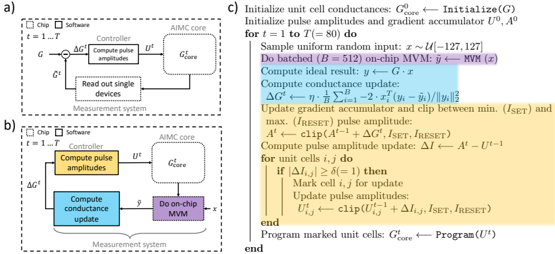
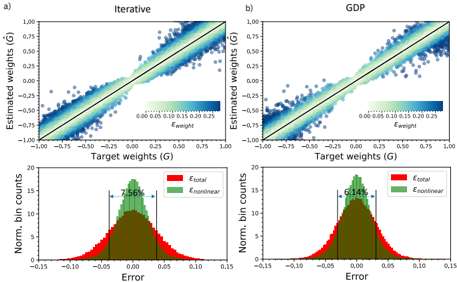
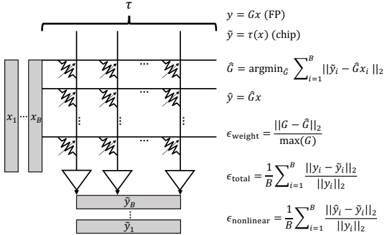
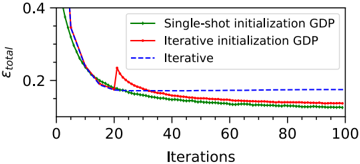
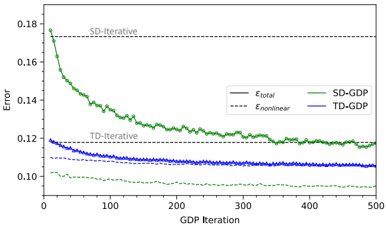
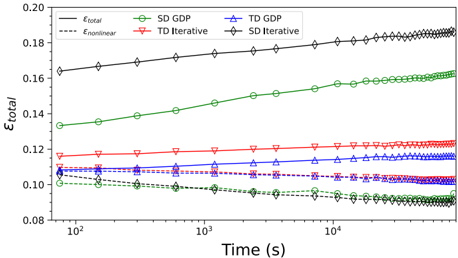
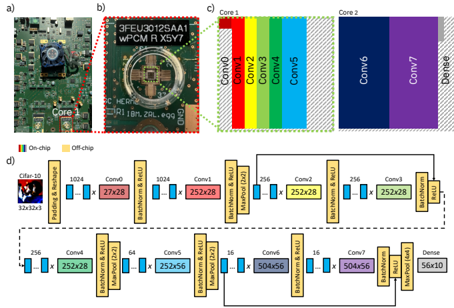
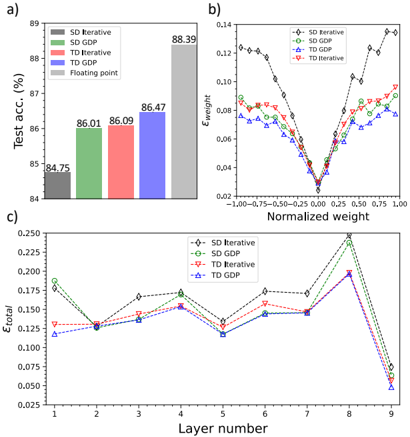
The precise programming of crossbar arrays of unit-cells is crucial for obtaining high matrix-vector-multiplication (MVM) accuracy in analog in-memory computing (AIMC) cores. We propose a radically different approach based on directly minimizing the MVM error using gradient descent with synthetic random input data. Our method significantly reduces the MVM error compared with conventional unit-cell by unit-cell iterative programming. It also eliminates the need for high-resolution analog-to-digital converters (ADCs) to read the small unit-cell conductance during programming. Our method improves the experimental inference accuracy of ResNet-9 implemented on two phase-change memory (PCM)-based AIMC cores by 1.26%.
Overview
The claims and statistics of this paper haven’t been checked yet.
Free: it reads the open-access text and checks the first 5 claims that cite a source we can check. Create a free account to check every claim.
Integrity signals
Registry
Cites
Statistics
Figures
Verification
Claims the paper makes
The claims and statistics of this paper haven’t been checked yet.
Free: it reads the open-access text and checks the first 5 claims that cite a source we can check. Create a free account to check every claim.
Claims other papers make about this one
Each is checked against this paper’s own text: does it say what the citing paper says it does?
The cited source says what the claim attributes to it.
In the citing paper
“a promising new approach has been recently proposed by Büchel et al.215, aiming to further optimize the Write-Verify method. In this variant, instead of updating each weight with the goal of reaching a given conductance target, the weights are updated in order to minimize the error of the VMM product. As such, the design requirements for the current measuring circuits are less exigent.”
From Hardware implementation of memristor-based artificial neural networks (2024) · cites this paper as [215]
Self-check
Percentages, sums and reported differences re-computed from the paper’s own numbers.
The self-check needs the paper’s full text.
Citations
Cites
(2019) · Nature Communications · doi:10.1038/41467.2041-1723 · Cited by 1,914
Research works printed but not linked: 7
- Lanza, 2022, Science, 376, 1066
- Yu, 2021, IEEE Circuits Syst. Mag, 21, 31
- Nandakumar, 2020, IEDM Tech. Dig., 29.4.1
- Papandreou, 2011, Proc. ISCAS, 329
- Yao, 2020, Nature, 577, 641
- Khaddam-Aljameh, 2022, JSSC, 57, 1027
- Gallo, 2022, Neuromorphic Comput. Eng, 2, 014009
Cited by
Hardware implementation of memristor-based artificial neural networks
Aguirre, F., Sebastian, A., Le Gallo, M., Song, W., Wang, T., Yang, J. J., Lu, W., Chang, M.-F., Ielmini, D., Yang, Y., et al. (2024) · Nature Communications · doi:10.1038/s41467-024-45670-9 · Cited by 564
“In this regard, a promising new approach has been recently proposed by Büchel et al. 215 , aiming to further optimize the Write-Verify method.”
Self-citationRecent Advances and Future Prospects for Memristive Materials, Devices, and Systems
Song, M.-K., Kang, J.-H., Zhang, X., Ji, W., Ascoli, A., Messaris, I., Demirkol, A. S., Dong, B., Aggarwal, S., Wan, W., et al. (2023) · ACS Nano · doi:10.1021/acsnano.3c03505 · Cited by 300
Self-citationRasch, M. J., Mackin, C., Le Gallo, M., Chen, A., Fasoli, A., Odermatt, F., Li, N., Nandakumar, S. R., Narayanan, P., Tsai, H., et al. (2023) · Nature Communications · doi:10.1038/s41467-023-40770-4 · Cited by 213
Self-citationFast and robust analog in-memory deep neural network training
Rasch, M. J., Carta, F., Fagbohungbe, O. I., & Gokmen, T. (2024) · Nature Communications · doi:10.1038/s41467-024-51221-z · Cited by 74
Efficient scaling of large language models with mixture of experts and 3D analog in-memory computing
Büchel, J., Vasilopoulos, A., Simon, W., Boybat, I., Tsai, H.-Y. S., Burr, G. W., Castro, H., Filipiak, B., Gallo, M. L., Rahimi, A., et al. (2025) · Nature Computational Science · doi:10.1038/s43588-024-00753-x · Cited by 71
Self-citation
Metadata
- Authors
- Büchel, J., Vasilopoulos, A., Kersting, B., Odermatt, F., Brew, K., Ok, I., Choi, S., Saraf, I., Chan, V., Philip, T., Saulnier, N., Narayanan, V., Gallo, M. L., & Sebastian, A.
- Affiliations
- IBM Research - Zurich (CH)
- IBM Research - Albany (US)
- IBM Research – Albany,NY,USA
- IBM (United States) (US)
- ORCID
- Venue
- 2022 International Electron Devices Meeting (IEDM)
- Publisher
- IEEE
- Published
- 2022-12-03
- Pages
- 33.1.1-33.1.4
- ISSN
- 0163-1918 (ISSN-L)
- OpenAlex
- W4317793291
- Cited by
- 18
- References
- 1
- Citations by year
- 2026: 3 · 2025: 3 · 2024: 7 · 2023: 5
- FWCI
- 6.07
- Type
- conference paper
- Language
- en
- Open access
- green
- arxiv.org
- Locations
- Technical digest - International Electron Devices Meeting/Technical digest (publishedVersion)
- arXiv (Cornell University) (submittedVersion, cc-by)
- arXiv (Cornell University) (cc-by)
- Zenodo (CERN European Organization for Nuclear Research) (cc-by)
- Funders
- Horizon Europe
- Topics
- Physical Sciences › Engineering › Electrical and Electronic Engineering › Advanced Memory and Neural Computing
- Physical Sciences › Engineering › Electrical and Electronic Engineering › Ferroelectric and Negative Capacitance Devices
- Physical Sciences › Engineering › Electrical and Electronic Engineering › Low-power high-performance VLSI design
- Keywords
- analog in-memory computing, crossbar arrays, matrix-vector multiplication, phase-change memory, inference accuracy, analog-to-digital converter resolution
About these checks
Registry, retraction, Cites and statistics results are computed, not judged, with one exception: a printed reference that no index lists is read once by a model before it counts as a citation error. Claims are extracted by a model and kept only when their quote appears verbatim in the text; each cited source is then checked, with a model’s help, for whether it says what the claim relies on. Those verdicts can be wrong — read the claim’s quote and the cited source before relying on one.
Statistics and arithmetic are recomputed, not judged.
Confidence bands are shown only for fields calibrated on our annotated test set. None is calibrated yet, so no band is shown.
What counts as a claim ›How we measure confidence ›How we check this ›
Are you an author, or do you see a problem with this page? Request a review
How to cite
Cite CoChat for the checks on this page, and the paper for its own findings.
- This page
- CoChat. (2026). Citation check: Gradient descent-based programming of analog in-memory computing cores. https://app.cochat.ai/papers/10.1109/iedm45625.2022.10019486
- The paper
- Büchel, J., Vasilopoulos, A., Kersting, B., Odermatt, F., Brew, K., Ok, I., Choi, S., Saraf, I., Chan, V., Philip, T., Saulnier, N., Narayanan, V., Gallo, M. L., & Sebastian, A. (2022). Gradient descent-based programming of analog in-memory computing cores. 2022 International Electron Devices Meeting (IEDM). https://doi.org/10.1109/iedm45625.2022.10019486
Data sources
Bibliographic data: Semantic Scholar, OpenAlex, Crossref.
Contains information from the Semantic Scholar Academic Graph Datasets, made available under the ODC Attribution License (ODC-BY 1.0).
Semantic Scholar’s data is described in: Kinney, R., et al. (2023). The Semantic Scholar Open Data Platform. arXiv:2301.10140.
