

The DOI matches its Crossref record; 83 of the 83 references it cites were found in a registry or an index; 15 of the 38 sources its claims cite were checked for support.
Hardware-aware training for large-scale and diverse deep learning inference workloads using in-memory computing-based accelerators
Open accessAbstract
Analog in-memory computing-a promising approach for energy-efficient acceleration of deep learning workloads-computes matrix-vector multiplications but only approximately, due to nonidealities that often are non-deterministic or nonlinear. This can adversely impact the achievable inference accuracy. Here, we develop an hardware-aware retraining approach to systematically examine the accuracy of analog in-memory computing across multiple network topologies, and investigate sensitivity and robustness to a broad set of nonidealities. By introducing a realistic crossbar model, we improve significantly on earlier retraining approaches. We show that many larger-scale deep neural networks-including convnets, recurrent networks, and transformers-can in fact be successfully retrained to show iso-accuracy with the floating point implementation. Our results further suggest that nonidealities that add noise to the inputs or outputs, not the weights, have the largest impact on accuracy, and that recurrent networks are particularly robust to all nonidealities.
Overview
CoChat Summary
TL;DR
The paper develops a hardware-aware retraining framework for analog in-memory computing (AIMC) and shows that many large DNNs, including CNNs, RNNs, and transformers, can be brought to iso-accuracy or near-iso-accuracy on a realistic PCM-based crossbar model. Across 11 benchmarks, five reached the paper’s 99% iso-accuracy target, and the average accuracy gap fell from 11.3% to 1.1% at 1 h after programming.
Key findings
- The benchmark covered 11 medium- to large-scale DNNs spanning image classification, speech-to-text, and NLP, with model sizes from 0.3M to 108M parameters, depths up to 121 layers, and crossbar utilization from 4% to 86%.
- With hardware-aware (HWA) retraining, the normalized accuracies at 1 h after programming were all above 97%, and 5/11 workloads reached the paper’s 99% iso-accuracy target.
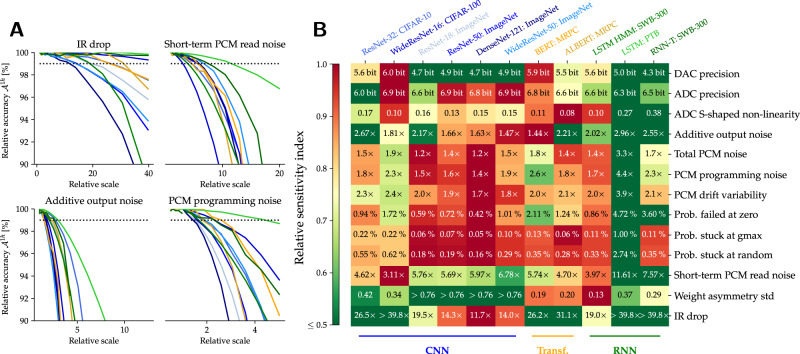
- Among the tested nonidealities, those that add noise to inputs or outputs had the largest impact on DNN accuracy, including ADC/DAC resolution, additive output noise, and S-shaped ADC nonlinearity.
- CNNs were the most sensitive topology and RNNs the least sensitive; some RNNs and transformers remained near iso-accuracy even after long-term PCM drift, while HWA-trained models for Speech-SWB300 and LSTM-PTB stayed iso-accurate out to 1 year.
Methods
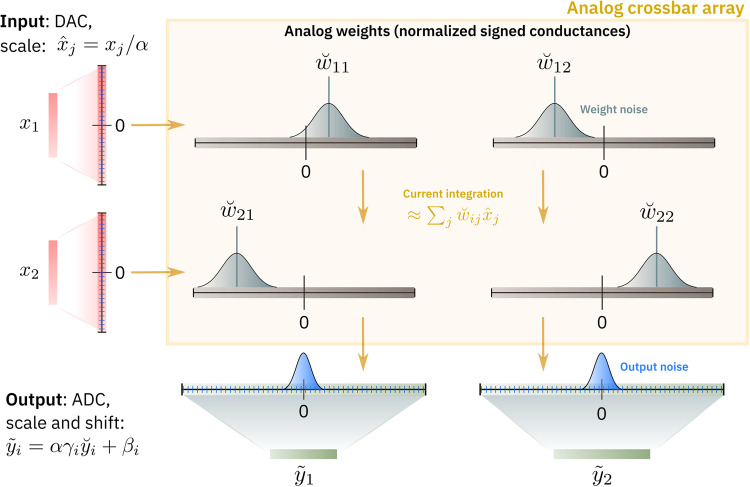
- The authors built a standardized AIMC crossbar simulation model for PCM-based hardware, incorporating dynamic-range limits, programming errors, drift, read noise, output noise, DAC/ADC quantization, and IR-drop; they used a 512 × 512 tile size and 8-bit quantization by default.
- They HWA-retrained 11 DNNs starting from FP-trained models, using SGD with noise injection and learned peripheral scaling factors for inputs and outputs; evaluation was done at delays of 1 s, 1 h, 1 day, and 1 year after programming.
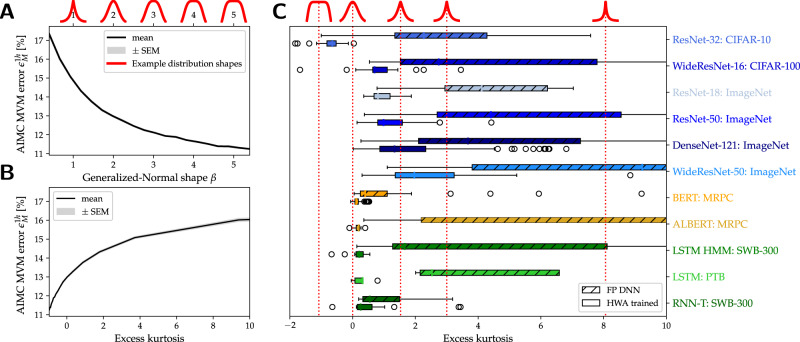
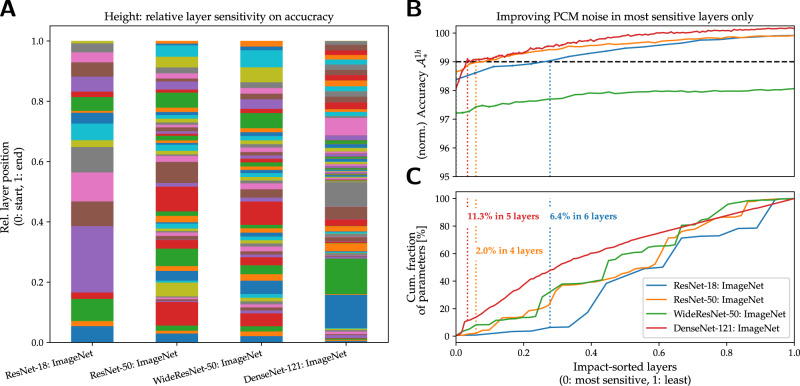
- They performed sensitivity analyses by stress-testing individual nonidealities, ranking layers by sensitivity in large CNNs, and measuring MVM error as relative deviation from ideal matrix-vector multiplication.
Limitations
- The authors state that the results are simulated and that the larger-scale DNN iso-accuracy results remain to be verified in hardware in future.
- They note that the model uses simplifications and abstractions, including Gaussian noise assumptions and an approximate IR-drop calculation, and therefore cannot replace ultimate hardware verification.
- Evidence from the text: some results depend on a PCM-specific calibration, so transferability to non-PCM devices is not direct, although the authors say the framework can be adapted.
Model-written summary. Check it against the paper before relying on it.
Integrity signals
Registry
Cites
Statistics
Figures



Verification
Claims the paper makes
10 Valid · 3 Not valid · 6 Not checked · 81 Own results and interpretations
The cited sources support only part of this claim — read each source’s verdict below.
In the paper
“Weight-quantization into as few as 2–4 bits can often be tolerated without significant accuracy reduction8,19,20.”
§ Hardware-aware training for large-scale and diverse deep learning inference workloads using in-memory computing-based accelerators > Introduction
What the sources say
- Supportedcites [8] Choi, J. et al. Pact: parameterized clipping activation for quantized neural networks. Preprint at https://arxiv.org/abs/1805.06085 (2018). source
The Abstract (p. 1) says 4-bit weights and activations achieved accuracy comparable to full precision across several models and datasets. The ResNet18 results in C.2 (p. 14) also show 2-bit weights with accuracy comparable to the full-precision baseline. The claim’s “can often” wording allows for variation across models. (LLM, conf=0.88)
- Partly supportedcites [19] Krishnamoorthi, R. Quantizing deep convolutional networks for efficient inference: a whitepaper. Preprint at https://arxiv.org/abs/1806.08342 (2018). sourceExperimental — accuracy not yet measured
Section 3.2.4 (p. 22) reports that, for most networks, fine-tuned 4-bit weights achieved accuracy within 5% of 8-bit quantization, with activations kept at 8 bits. This supports the 4-bit portion under those conditions, but the cited passages do not establish comparable accuracy for 2-bit weights. (LLM, conf=0.88)
- Partly supportedcites [20] Nagel, M. et al. A white paper on neural network quantization. Preprint at https://arxiv.org/abs/2106.08295 (2021). sourceExperimental — accuracy not yet measured
The Experiments (p. 24) show that 4-bit weight quantization can preserve accuracy closely for several models, including BERT-base, particularly with 8-bit activations or per-channel quantization. The cited passages do not establish the same result for weights as low as 2 bits, and they report larger accuracy drops for some models at 4 bits. (LLM, conf=0.86)
plain- Asserted: passes — The authors put it forward as true.
- Checkable: passes — It can be checked against evidence.
- Load-bearing: passes — The paper’s conclusions depend on it.
- Based: passes — The paper gives a reason why it holds.
- Supported
The sources with a verdict support this claim; the rest weren’t checked yet, have no full text we could read, or their verdicts aren’t rated yet.
In the paper
“In terms of AIMC workload execution latency and system mapping51, CNNs are already less well-suited for resistive crossbar arrays due to the uneven temporal reuse between layers and spatial under-utilization of the large analog tiles by the small kernel matrices (see Table 1), although some optimization and mapping tricks52 are available.”
§ Hardware-aware training for large-scale and diverse deep learning inference workloads using in-memory computing-based accelerators > Results > HWA training improves AIMC accuracy for all DNNs
What the sources say
- Not checked — no full text of the sourcecites [51] Jain, S. et al. A heterogeneous and programmable compute-in-memory accelerator architecture for analog-ai using dense 2-d mesh. IEEE Trans. Very Large Scale Integr. (VLSI) Syst. 31, 114–127 (2023). source
- Supportedcites [52] Rasch, M. J., Gokmen, T., Rigotti, M. & Haensch, W. RAPA-ConvNets: modified convolutional networks for accelerated training on architectures with analog arrays. Front. Neurosci. 13, 753 (2019). source
The Introduction says ConvNets do not map favorably onto analog-array hardware because convolution kernel matrices are typically small while the number of matrix-vector operations can be very large, especially in early layers. Its Figure 1 caption also shows that analog-array computing time varies across layers, supporting the claim about uneven temporal use. (LLM, conf=0.88)
plainstates a cause- Asserted: passes — The authors put it forward as true.
- Checkable: passes — It can be checked against evidence.
- Load-bearing: passes — The paper’s conclusions depend on it.
- Based: passes — The paper gives a reason why it holds.
The sources with a verdict support this claim; the rest weren’t checked yet, have no full text we could read, or their verdicts aren’t rated yet.
In the paper
“For evaluation times teval long after NVM programming, the conductance drift Eq. (8) can be compensated in the digital domain without any expensive re-programming36,73.”
§ Hardware-aware training for large-scale and diverse deep learning inference workloads using in-memory computing-based accelerators > Methods > AIMC standardized evaluation model
What the sources say
- Not checked — no full text of the sourcecites [36] Ambrogio, S. et al. Reducing the impact of phase-change memory conductance drift on the inference of large-scale hardware neural networks. in IEEE International Electron Devices Meeting, 1–4 (IEEE, 2019). source
- Supportedcites [73] Le Gallo, M., Sebastian, A., Cherubini, G., Giefers, H. & Eleftheriou, E. Compressed sensing with approximate message passing using in-memory computing. IEEE Trans. Electron. Devices 65, 4304–4312 (2018). source
The Physical Implementation section describes periodic calibration that compensates for a global conductance shift, with the correction performed in a control unit or digital circuitry. It also says the matrix is programmed only once; the Discussion explains that subsequent reconstruction uses read operations rather than reprogramming. The support is for this global-drift calibration, not necessarily every form of device drift. (LLM, conf=0.88)
plainstates a cause- Asserted: passes — The authors put it forward as true.
- Checkable: passes — It can be checked against evidence.
- Load-bearing: passes — The paper’s conclusions depend on it.
- Based: passes — The paper gives a reason why it holds.
Every source the paper cites for this claim was checked and supports it.
In the paper
“We have tried distilling with the FP model as a teacher (similar to ref. 71) and found some benefits when HWA training time is limited.”
§ Hardware-aware training for large-scale and diverse deep learning inference workloads using in-memory computing-based accelerators > Discussion
What the sources say
- Supportedcites [71] Zhou, C., Kadambi, P., Mattina, M. & Whatmough, P. N. Noisy machines: understanding noisy neural networks and enhancing robustness to analog hardware errors using distillation. Preprint at https://arxiv.org/pdf/2001.04974.pdf (2020). source
The citation is attached to the method the citing authors imitate — distillation with the full-precision model as teacher — and our copy states exactly that: Section 5.1 (p. 6) proposes 'a noise free clean model as the teacher to train a noisy student network', and Section 5.2 (p. 8) confirms 'In the distillation retraining runs, the full-precision clean model with an accuracy of 93.87% is used as the teacher'. The same section (5.2, p. 9-10; Discussion, p. 10) reports the benefit of that distillation for hardware-aware retraining under noise, and Section 5.1 (p. 7) notes the teacher-initialised student 'can be considered as a warm start to accelerate retraining', consistent with the citing sentence's limited-training-time framing. The 'found some benefits when HWA training time is limited' result itself is the citing authors' own experiment, not a claim about this source. (LLM, conf=0.88)
plainstates a possible cause- Asserted: passes — The authors put it forward as true.
- Checkable: passes — It can be checked against evidence.
- Load-bearing: unclear — It is unclear whether the paper’s conclusions depend on it.
- Based: passes — The paper gives a reason why it holds.
- Supported
Every source the paper cites for this claim was checked and supports it.
In the paper
“We verified the effectiveness of our HWA training approach on the very same DNNs used in a previous study38 and found, on average, a >10% decrease in AIMC test error for long teval times.”
§ Hardware-aware training for large-scale and diverse deep learning inference workloads using in-memory computing-based accelerators > Methods > AIMC hardware-aware DNN training
What the sources say
- Supportedcites [38] Joshi, V. et al. Accurate deep neural network inference using computational phase-change memory. Nat. Commun. 11, 1–13 (2020). source
Citation 38 identifies the previous study whose DNNs the citing authors reused; the >10% decrease is presented as the citing authors’ own finding, not as a result of this source. The source’s Results, “Problem statement” (page unavailable), identifies its DNNs as ResNet-32 on CIFAR-10 and ResNet-34 on ImageNet. (LLM, conf=0.90)
plainstates a cause- Asserted: passes — The authors put it forward as true.
- Checkable: passes — It can be checked against evidence.
- Load-bearing: passes — The paper’s conclusions depend on it.
- Based: passes — The paper gives a reason why it holds.
- Supported
64 more claims
Create a free account to see all 100 claims and to verify the 1 reference still open.
- Probably not a substantial claim. 15
- It may state two separate claims as one. 17
- The quote only partly states this claim. 1
Citations
Cites
ImageNet: A large-scale hierarchical image database
Deng, J., Dong, W., Socher, R., Li, L.-J., Li, K., & Fei-Fei, L. (2009) · 2009 IEEE Conference on Computer Vision and Pattern Recognition · doi:10.1109/cvpr.2009.5206848 · Cited by 65,333
PyTorch: An Imperative Style, High-Performance Deep Learning Library
Paszke, A., Gross, S., Massa, F., Lerer, A., Bradbury, J., Chanan, G., Killeen, T., Lin, Z., Gimelshein, N., Antiga, L., et al. (2019) · arXiv · doi:10.48550/arxiv.1912.01703 · Cited by 31,473
Learning Multiple Layers of Features from Tiny Images
Krizhevsky, A. (2024) · doi:10.57702/zp44cu3g · Cited by 23,395
Advances in neural information processing systems 7
Cios, K., & Shields, M. (1997) · Neurocomputing · doi:10.1016/s0925-2312(97)90018-7 · Cited by 22,059
Distilling the Knowledge in a Neural Network
Hinton, G., Vinyals, O., & Dean, J. (2015) · arXiv · doi:10.48550/arxiv.1503.02531 · Cited by 14,204
Han, S., Mao, H., & Dally, W. J. (2015) · arXiv · doi:10.48550/arxiv.1510.00149 · Cited by 4,662
XNOR-Net: ImageNet Classification Using Binary Convolutional Neural Networks
Rastegari, M., Ordonez, V., Redmon, J., & Farhadi, A. (2016) · Lecture Notes in Computer Science · doi:10.1007/978-3-319-46493-0_32 · Cited by 4,408 · cited 1×
“…DNN training and/or inference 2 – 4 , by approximating matrix-vector multiplications (MVMs) and other arithmetic with custom fl oating-point representations such as b fl oat16 5 or DLFloat 6 , or with reduced-precision fi xed-point arithmetic to quantize synaptic weights and activations 7 – 10 .”
BackgroundGLUE: A Multi-Task Benchmark and Analysis Platform for Natural Language Understanding
Wang, A., Singh, A., Michael, J., Hill, F., Levy, O., & Bowman, S. (2018) · Proceedings of the 2018 EMNLP Workshop BlackboxNLP: Analyzing and Interpreting Neural Networks for NLP · doi:10.18653/v1/w18-5446 · Cited by 4,222
Efficient Processing of Deep Neural Networks: A Tutorial and Survey
Sze, V., Chen, Y.-H., Yang, T.-J., & Emer, J. S. (2017) · Proceedings of the IEEE · doi:10.1109/jproc.2017.2761740 · Cited by 4,215 · cited 1×
“Numerous hardware concepts have been introduced to accelerate DNN training and/or inference 2 – 4 , by approximating matrix-vector multiplications (MVMs) and other arithmetic with custom fl oating-point representations such as b fl oat16 5 or DLFloat 6 , or with reduced-precision fi xed-point…”
BackgroundMemory devices and applications for in-memory computing
Sebastian, A., Le Gallo, M., Khaddam-Aljameh, R., & Eleftheriou, E. (2020) · Nature Nanotechnology · doi:10.1038/s41565-020-0655-z · Cited by 2,289 · cited 1×
“(7)–(14) in “Methods”) assumes that each array or “tile” approximates MVM ey≈Wx, where digital inputs are converted with a digital-”
MethodSelf-citation
Research works printed but not linked: 8
- Hubara, I., Courbariaux, M., Soudry, D., El-Yaniv, R. & Bengio, Y. Quantized neural networks: Training neural networks with low precision weights and activations. The Journal of Machine Learning Research 1, 6869–6898 (2017).
- Srivastava, N., Hinton, G., Krizhevsky, A., Sutskever, I. & Salakhutdinov, R. Dropout: a simple way to prevent neural networks from overfitting. J. Mach. Learn. Res. 15, 1929–1958 (2014).
- Goodfellow, I., Warde-Farley, D., Mirza, M., Courville, A. & Bengio, Y. Maxout networks. In International conference on machine learning 1319–1327 (PMLR, 2013).
- Noh, H., You, T., Mun, J. & Han, B. Regularizing deep neural networks by noise: its interpretation and optimization. in Proceedings of the 31st International Conference on Neural Information Processing Systems, NIPS’17, (Red Hook, NY, USA) 5115–5124 (Curran Associates Inc., 2017).
- Rakin, A. S., He, Z. & Fan, D. Parametric noise injection: trainable randomness to improve deep neural network robustness against adversarial attack. in Proceedings of the IEEE/CVF Conference on Computer Vision and Pattern Recognition 588–597 (IEEE, 2018).
- Wan, L., Zeiler, M., Zhang, S., Le Cun, Y. & Fergus, R. Regularization of neural networks using drop connect. in Proceedings of the 30th International Conference on Machine Learning (eds Dasgupta, S. & McAllester, D.) Vol. 28 of Proceedings of Machine Learning Research, 1058–1066 (PMLR, 2013).
- Glorot, X. & Bengio, Y. Understanding the difficulty of training deep feedforward neural networks. in Proceedings of the Thirteenth International Conference on Artificial Intelligence and Statistics 249–256 (JMLR Workshop and Conference Proceedings, 2010).
- Godfrey, J. J. & Holliman, E. Switchboard-1 release 2 ldc97s62. 926, 927 (1997).
Cited by
Hardware implementation of memristor-based artificial neural networks
Aguirre, F., Sebastian, A., Le Gallo, M., Song, W., Wang, T., Yang, J. J., Lu, W., Chang, M.-F., Ielmini, D., Yang, Y., et al. (2024) · Nature Communications · doi:10.1038/s41467-024-45670-9 · Cited by 564
“To avoid this loss of accuracy, hardware-aware training methods, in which device non-idealities are incorporated during training have been proposed in the literature 189,190 .”
Self-citationLe Gallo, M., Khaddam-Aljameh, R., Stanisavljevic, M., Vasilopoulos, A., Kersting, B., Dazzi, M., Karunaratne, G., Brändli, M., Singh, A., Müller, S. M., et al. (2023) · Nature Electronics · doi:10.1038/s41928-023-01010-1 · Cited by 310
Self-citationMemristor-based hardware accelerators for artificial intelligence
Huang, Y., Ando, T., Sebastian, A., Chang, M., Yang, J. J., & Xia, Q. (2024) · Nature Reviews Electrical Engineering · doi:10.1038/s44287-024-00037-6 · Cited by 191
“The multicore chip has demonstrated an inference accuracy nearly equivalent to software-based implementations with two widely employed ANN models, residual neural networks (ResNet) and LSTM. Combining the concepts of multicore within a chip and multichip setups, an RNN with over 45 million weights has been deployed ac…”
InfluentialSelf-citationUsing the IBM analog in-memory hardware acceleration kit for neural network training and inference
Gallo, M. L., Lammie, C., Büchel, J., Carta, F., Fagbohungbe, O. I., Mackin, C., Tsai, H.-Y. S., Narayanan, V., Sebastian, A., Maghraoui, K. E., et al. (2023) · APL Machine Learning · doi:10.1063/5.0168089 · Cited by 86
Self-citationPhase-Change Memory for In-Memory Computing
Syed, G. S., Gallo, M. L., & Sebastian, A. (2025) · Chemical Reviews · doi:10.1021/acs.chemrev.4c00670 · Cited by 97
Self-citation
Metadata
- Authors
- Rasch, M. J., Mackin, C., Le Gallo, M., Chen, A., Fasoli, A., Odermatt, F., Li, N., Nandakumar, S. R., Narayanan, P., Tsai, H., Burr, G. W., Sebastian, A., & Narayanan, V.
- Affiliations
- IBM (United States) (US)
- IBM Research - Almaden (US)
- IBM Research - Zurich (CH)
- Corresponding author
- Rasch, Malte J.
- ORCID
- Venue
- Nature Communications
- Published
- 2023-08-30
- Volume
- 14
- Issue
- 1
- Pages
- 5282-5282
- ISSN
- 2041-1723 (ISSN-L)
- PMC
- PMC10469175
- OpenAlex
- W4386293192
- Cited by
- 213
- References
- 81
- Citations by year
- 2026: 83 · 2025: 70 · 2024: 46 · 2023: 14
- FWCI
- 15.35
- Type
- journal article
- Language
- en
- Open access
- gold
- doi.org
- Licence
- cc-by
- creativecommons.org/licenses/by/4.0 (tdm)
- creativecommons.org/licenses/by/4.0 (vor)
- Locations
- Nature Communications (publishedVersion, cc-by)
- PubMed Central (publishedVersion, cc-by)
- PubMed (publishedVersion)
- arXiv (Cornell University) (submittedVersion, cc-by)
- RePEc: Research Papers in Economics (submittedVersion)
- DOAJ (DOAJ: Directory of Open Access Journals) (submittedVersion, cc-by-sa)
- arXiv (Cornell University) (cc-by)
- Funders
- Rensselaer Polytechnic Institute
- Topics
- Physical Sciences › Engineering › Electrical and Electronic Engineering › Advanced Memory and Neural Computing
- Physical Sciences › Computer Science › Computer Vision and Pattern Recognition › Advanced Neural Network Applications
- Physical Sciences › Computer Science › Hardware and Architecture › Parallel Computing and Optimization Techniques
- Keywords
- analog in-memory computing, deep learning inference, non-idealities, inference accuracy, energy-efficient accelerators, recurrent neural networks, transformer models, convolutional neural networks, matrix-vector multiplication
About these checks
Registry, retraction, Cites and statistics results are computed, not judged, with one exception: a printed reference that no index lists is read once by a model before it counts as a citation error. Claims are extracted by a model and kept only when their quote appears verbatim in the text; each cited source is then checked, with a model’s help, for whether it says what the claim relies on. Those verdicts can be wrong — read the claim’s quote and the cited source before relying on one.
The claim verdicts this report counts are experimental: their accuracy is not yet measured.
A language model drew the claims from the paper on 2026-10-10, under version 3 of the claim definition (model deepseek-v4.1-flash, prompt extract-v3).
A second model labelled each claim on 2026-10-10 (model jev-1.13-20260917, definition revision gold-guideline-v0.2).
Cited sources are checked with a language model’s help (gpt-6-sol and qwen3.8-omni-flash).
Statistics and arithmetic are recomputed, not judged.
Confidence bands are shown only for fields calibrated on our annotated test set. None is calibrated yet, so no band is shown.
What counts as a claim ›How we measure confidence ›How we check this ›
Are you an author, or do you see a problem with this page? Request a review
How to cite
Cite CoChat for the checks on this page, and the paper for its own findings.
- This page
- CoChat. (2026). Citation check: Hardware-aware training for large-scale and diverse deep learning inference workloads using in-memory computing-based accelerators. https://app.cochat.ai/papers/10.1038/s41467-023-40770-4
- The paper
- Rasch, M. J., Mackin, C., Le Gallo, M., Chen, A., Fasoli, A., Odermatt, F., Li, N., Nandakumar, S. R., Narayanan, P., Tsai, H., Burr, G. W., Sebastian, A., & Narayanan, V. (2023). Hardware-aware training for large-scale and diverse deep learning inference workloads using in-memory computing-based accelerators. Nature Communications. https://doi.org/10.1038/s41467-023-40770-4
Data sources
Bibliographic data: Semantic Scholar, OpenAlex, Crossref.
Contains information from the Semantic Scholar Academic Graph Datasets, made available under the ODC Attribution License (ODC-BY 1.0).
Semantic Scholar’s data is described in: Kinney, R., et al. (2023). The Semantic Scholar Open Data Platform. arXiv:2301.10140.
