

Robust Network Intrusion Detection Through Explainable Artificial Intelligence (XAI)
Open accessPublished version of a preprint
The DOI matches its Crossref record; 18 of the 18 references it cites were found in a registry or an index.
Abstract
In this letter, we present a two-stage pipeline for robust network intrusion detection. First, we implement an extreme gradient boosting (XGBoost) model to perform supervised intrusion detection, and leverage the SHapley Additive exPlanation (SHAP) framework to devise explanations of our model. In the second stage, we use these explanations to train an auto-encoder to distinguish between previously seen and unseen attacks. Experiments conducted on the NSL-KDD dataset show that our solution is able to accurately detect new attacks encountered during testing, while its overall performance is comparable to numerous state-of-the-art works from the cybersecurity literature.
Overview
The claims and statistics of this paper haven’t been checked yet.
Free: it reads the open-access text and checks the first 5 claims that cite a source we can check. Create a free account to check every claim.
Integrity signals
Registry
Cites
Statistics
Figures
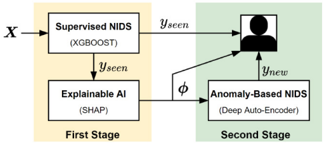
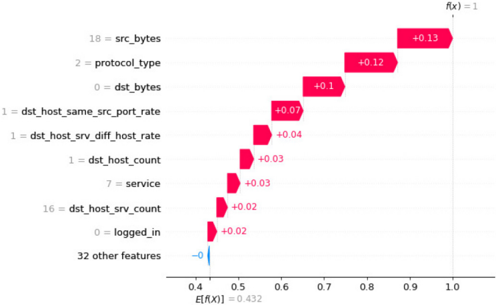
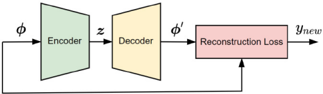
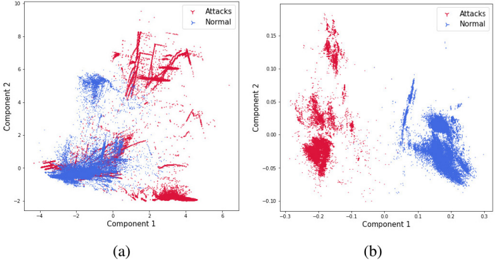
Verification
Claims the paper makes
The claims and statistics of this paper haven’t been checked yet.
Free: it reads the open-access text and checks the first 5 claims that cite a source we can check. Create a free account to check every claim.
Claims other papers make about this one
Each is checked against this paper’s own text: does it say what the citing paper says it does?
The source backs part of the claim, not all of it — or backs it for a different population, condition or comparison.
In the citing paper
“First, SHAP solutions satisfy three essential properties for any additive feature attribution model: local accuracy, missingness, and consistency [21].”
From Explainable AI-Aided Feature Selection and Model Reduction for DRL-Based V2X Resource Allocation (2025) · cites this paper as [21]
Experimental — accuracy not yet measuredIn the citing paper
“These insights helped determine how particular behaviors were associated with normal or malicious activity.”
From A Comprehensive Survey of Explainable Artificial Intelligence Techniques for Malicious Insider Threat Detection (2025) · cites this paper as [50]
In the citing paper
“SHAP improved the interpretability and trustworthiness of XGBoost in ITD by clarifying the contribution of individual features.”
From A Comprehensive Survey of Explainable Artificial Intelligence Techniques for Malicious Insider Threat Detection (2025) · cites this paper as [50]
In the citing paper
“The study demonstrated how SHAP provided insights into the importance of features such as login frequency and data access patterns.”
From A Comprehensive Survey of Explainable Artificial Intelligence Techniques for Malicious Insider Threat Detection (2025) · cites this paper as [50]
In the citing paper
“This demonstrates that SHAP can support interpretability across both simple and complex models in the context of insider threat analysis.”
From A Comprehensive Survey of Explainable Artificial Intelligence Techniques for Malicious Insider Threat Detection (2025) · cites this paper as [50]
3 more claims about this paper
Create a free account to see every claim other papers make about this one.
Self-check
Percentages, sums and reported differences re-computed from the paper’s own numbers.
The self-check needs the paper’s full text.
Citations
Cites
Scikit-learn: Machine Learning in Python
Pedregosa, F., Varoquaux, G., Gramfort, A., Michel, V., Thirion, B., Grisel, O., Blondel, M., Müller, A., Nothman, J., Louppe, G., et al. (2012) · arXiv · doi:10.48550/arxiv.1201.0490 · Cited by 71,016 · cited 1×
“To ensure this requirement is met during the training and testing of our solution, we apply label encoding to all non-numerical features passed to our model using the ‘LabelEncoder’ method from the Scikit-Learn [14] library for Python.”
MethodFrom local explanations to global understanding with explainable AI for trees
Lundberg, S. M., Erion, G., Chen, H., DeGrave, A., Prutkin, J. M., Nair, B., Katz, R., Himmelfarb, J., Bansal, N., & Lee, S.-I. (2020) · Nature Machine Intelligence · doi:10.1038/s42256-019-0138-9 · Cited by 10,551 · cited 4×
“Finally, we use an open-source implementation of SHAP [11] to compute explanations our model.”
BackgroundMethodResultInfluentialA detailed analysis of the KDD CUP 99 data set
Tavallaee, M., Bagheri, E., Lu, W., & Ghorbani, A. A. (2009) · 2009 IEEE Symposium on Computational Intelligence for Security and Defense Applications · doi:10.1109/cisda.2009.5356528 · Cited by 5,396 · cited 2×
“Moreover, numerical evaluations conducted on the NSL-KDD intrusion dataset [12] show that our solution is able to outperform various state-of-the-art works in terms of its overall accuracy, recall and precision.”
MethodToward Generating a New Intrusion Detection Dataset and Intrusion Traffic Characterization
Sharafaldin, I., Habibi Lashkari, A., & Ghorbani, A. A. (2018) · Proceedings of the 4th International Conference on Information Systems Security and Privacy · doi:10.5220/0006639801080116 · Cited by 5,318 · cited 1×
“…as the effectiveness of the ‘explanation domain’ in separating clusters of attacks from normal traffic, as well as to optimise the various stages our pipeline and to extend its ability to support multiclass classification across additional intrusion datasets, such as the more recent CIC-IDS2017 [18].”
BackgroundA Survey of Data Mining and Machine Learning Methods for Cyber Security Intrusion Detection
Buczak, A. L., & Guven, E. (2016) · IEEE Communications Surveys & Tutorials · doi:10.1109/comst.2015.2494502 · Cited by 3,332
A Deep Learning Approach to Network Intrusion Detection
Shone, N., Ngoc, T. N., Phai, V. D., & Shi, Q. (2018) · IEEE Transactions on Emerging Topics in Computational Intelligence · doi:10.1109/tetci.2017.2772792 · Cited by 1,819 · cited 1×
“On the other hand, recent works adopting deep learning solutions for anomaly-based NIDS, such as deep autoencoders [4]–[6], have demonstrated promising results against detecting new attacks.”
BackgroundInvestigating Ad Transparency Mechanisms in Social Media: A Case Study of Facebook's Explanations
Andreou, A., Venkatadri, G., Goga, O., Gummadi, K. P., Loiseau, P., & Mislove, A. (2018) · Proceedings 2018 Network and Distributed System Security Symposium · doi:10.14722/ndss.2018.23191 · Cited by 1,477
A Deep Learning Approach for Network Intrusion Detection System
Javaid, A., Niyaz, Q., Sun, W., & Alam, M. (2016) · Proceedings of the 9th EAI International Conference on Bio-inspired Information and Communications Technologies (formerly BIONETICS) · doi:10.4108/eai.3-12-2015.2262516 · Cited by 1,274 · cited 1×
“To benchmark our work, we also compare our results against those reported in various state-of-the-art works which also incorporate the NSL-KDD dataset in their evaluations [6], [17], as well as any other works which offer explainability in their solutions [8], [10].”
ResultMachine Learning and Deep Learning Methods for Cybersecurity
Xin, Y., Kong, L., Liu, Z., Chen, Y., Li, Y., Zhu, H., Gao, M., Hou, H., & Wang, C. (2018) · IEEE Access · doi:10.1109/access.2018.2836950 · Cited by 1,228 · cited 1×
“At the forefront of today’s state-of-the-art, machine learning (ML), and in particular deep learning methods for NIDSs, have allowed experts to achieve high detection accuracy on a wide host of simulated and real-world intrusion datasets [1].”
BackgroundDeep learning approach for Network Intrusion Detection in Software Defined Networking
Tang, T. A., Mhamdi, L., McLernon, D., Zaidi, S. A. R., & Ghogho, M. (2016) · 2016 International Conference on Wireless Networks and Mobile Communications (WINCOM) · doi:10.1109/wincom.2016.7777224 · Cited by 806 · cited 1×
“In the cybersecurity literature, two main approaches dominate the design of a NIDS [2].”
Background
Research works printed but not linked: 1
- 15. M. Abadi et al.. "TensorFlow: Large-Scale Machine Learning on Heterogeneous Systems." 2015. [Online]. Available: https://www.tensorflow.org/
Cited by
Items 101–145 of 145
Network Intrusion Detection and Defense System Based on Deep Learning
Zhang, Y. (2025) · International Conference on Intelligent Algorithms for Computational Intelligence Systems (IACIS) · doi:10.1109/iacis65746.2025.11211034
“Barnard et al. [15] introduced explainable artificial intelligence (XAI) technology into the field of network intrusion detection and proposed a network intrusion detection method based on XAI.”
Tasnim, A., Mehda, R., Rahman, M. S., & Akhter, N. (2025) · Lecture notes in networks and systems · doi:10.1007/978-981-95-1069-6_36
From Insight to Action: XAI-Enhanced Detection of DDoS Attacks in Software Defined Networks
Senevirathna, T., Paltun, B. G., Fuladi, R., Wang, S., & Liyanage, M. (2025) · IEEE International Symposium on Personal, Indoor and Mobile Radio Communications (PIMRC) · doi:10.1109/pimrc62392.2025.11274964
“[14] introduces a two-stage NIDS pipeline combining XGBoost with an auto-encoder trained on SHAP explanations to improve accuracy and explainability.”
Toward Secure 5G/6G Networks: Comparing Multimodal Fusion Methods for Attack Detection
Ilias, L., Doukas, G., Ntanos, C., & Askounis, D. (2025) · IEEE Networking Letters · doi:10.1109/lnet.2025.3616521
“The study in [10] performs a two-stage experiment on the NSL-KDD dataset.”
Enhancing Explainability in X-IDS Through Counterfactuals
Li, Q., & Li, Y. (2026) · Lecture notes in computer science · doi:10.1007/978-981-95-6203-9_13
E-XAI: Evaluating Black-Box Explainable AI Frameworks for Network Intrusion Detection
Kumar, A., Sikdar, R., Trisha, U., Negi, R. S., Yogesh, K. M., & Bhandari, V. (2026) · Lecture notes in networks and systems · doi:10.1007/978-3-032-15407-1_29
Leela, V., Roshini, P., S, S. C., K, P. M., & Thanvanthri, S. (2025) · Global Conference on Information Technology and Communication Networks (GITCON) · doi:10.1109/gitcon65266.2025.11377743
“…(ML), Deep Learning (DL), and XAI with the new systems, are complemented by better data quality to largely improve the reliability, scalability, and explainability of the cyber threat detection techniques, including cyber threat detection in real-time which has relevance to HS-RAN [1, 2, 3].”
A Comprehensive Review on Explainable AI: Where It Was, Is and Will
Wangkhem, K. (2026) · Lecture notes in networks and systems · doi:10.1007/978-981-96-9935-3_1
Enhanced Network Intrusion Detection Framework Using Deep Convolutional Neural Networks
Mazid, A., Kirmani, S., & Abid, M. (2025) · Automatic Control and Computer Sciences · doi:10.3103/s0146411625701317 · Cited by 1
“Furthermore, [19] presents a two-phase robust network intrusion detection approach.”
Explainable and Privacy-Preserving Multi-Class Network Intrusion Detection Using SHAP and LightGBM
Dudi, K., Singh, M., Kumar, D., Kumar, N., & Sharmila, A. (2025) · International Conference on Advancement in Electronics & Communication Engineering (AECE) · doi:10.1109/aece67531.2025.11386640 · Cited by 2
Generative AI-based approach for player behavior analysis and gray area identification
Vinay, K., & Sankaran, S. (2026) · Frontiers in Artificial Intelligence · doi:10.3389/frai.2026.1730018
Trustable machine learning for intrusion detection systems
Duraz, R. (2024) · theses.fr (ABES) · doi:10.70675/e2fe5f32z19e5z41caz9b55z7b33b874c3c0 · Cited by 2
Optimized Self-adaptive Intrusion Detection System (SPIDS) for Enhanced Network Security
Karthikeyan, R., Ramkumar, J., Priyadharshini, S. P., & Narasimhan, B. (2026) · Communications in computer and information science · doi:10.1007/978-3-032-17843-5_3
Jhawar, V., Grover, K., Samanta, P. K., Darshana, S., Mishra, S., & Bakshi, A. (2026) · International Conference on Computing, Electronics & Communications Engineering (iCCECE) · doi:10.1109/iccece69715.2026.11493103
XAI for Network Security: A Case Study on Trust Ranking in 6G Wireless Networks
Alnoman, A. A., Abudaqqa, S., Habte, B., Tanveer, L., Para, H., Mohammed, H., Alshamsi, M. S., Gemeda, R., & Omari, M. (2026) · International Conference on Electrical/Electronics, Robotics, Artificial Intelligence, and Informatics (ICERAI) · doi:10.1109/icerai69511.2026.11494590
“In [8], the authors introduced a two-phase intrusion detection framework enhanced with XAI techniques.”
Evaluating the Explainability of Deep Learning-Based Network Intrusion Detection Systems
Kumar, A., & Thing, V. L. L. (2026) · Lecture notes in computer science · doi:10.1007/978-3-032-16092-8_14
“…NIDSs, our work fills an important gap due to the following reasons: • Existing works that evaluate XAI methods on ML/DL-based NIDSs ([9, 10, 11, 12, 38, 40]): (1) do not com-12 pare the explainability of those NIDSs with that of state-of-the-art DL-based NIDSs and (2) do not include the…”
Liu, J. (2026) · Lecture notes in electrical engineering · doi:10.1007/978-981-95-6199-5_4
Tabular or Image Input? Transformers for NIDS: A Comparative Study
Mahmoud, L., Hussain, A., & Gangopadhyay, S. (2026) · Lecture notes in computer science · doi:10.1007/978-981-95-8034-7_2
Explainable AI-Informed Misclassification Identification for ML-Driven Anomaly Detection
Wright, S., Fragkos, G., & Oentung, T. (2026) · IEEE Texas Power and Energy Conference (TPEC) · doi:10.1109/tpec67884.2026.11513182
“In [18], SHAP is again used for explanations of XGBoost, but an autoencoder is trained to distinguish trustworthy and untrustworthy explanations, increasing complexity with the addition of another black box.”
Resilient and Explainable AI for Reliable Systems
Cirillo, E., Moccardi, A., Pelosi, M., & Amato, F. (2026) · Lecture notes on data engineering and communications technologies · doi:10.1007/978-3-032-23335-6_18
A hybrid explainable intrusion detection system for fair and trustworthy cybersecurity
Chinu, & Urvashi (2026) · Computers & Electrical Engineering · doi:10.1016/j.compeleceng.2026.111218
DeepGuardXAI: Human-Centric and explainable AI for enhancement in cybersecurity decision-making
Barik, K., Misra, S., Konar, K., & López-Baldominos, I. (2026) · Results in Engineering · doi:10.1016/j.rineng.2026.111282 · Cited by 2
XAID framework: defending against adversarial attacks on IDSs using eXplainable AI
den Camp, F. O., Kunstmann, T., & Tundis, A. (2026) · IEEE Conference on Artificial Intelligence (CAI) · doi:10.1109/cai68641.2026.11536493
“Similarly, [27] employed SHAP values from an XGBoost IDS to train an auto-decoder that detected unseen attacks based on shifts in explanation patterns, while [28] employed LIME to identify adversarial samples through mismatched explanations.”
Rewaskar, V. D., & Chandre, P. R. (2026) · International Conference on Recent Trends in Computer Science and Technology (ICRTCST) · doi:10.1109/icrtcst68392.2026.11545448
Jayalakshmi, R., Pavanathil, R. J., Chowdary, S., Janardhanan, J., Hari, P., & Srinivasan, R. (2026) · ASU International Conference in Emerging Technologies for Sustainability and Intelligent Systems (ICETSIS) · doi:10.1109/icetsis68266.2026.11548832
“Detecting systems powered by artificial intelligence are the new focal point in the paradigm of recognizing aberrant behavior, predicting attack vectors, and supporting response mechanisms [9].”
XAI in cybersecurity: A survey on techniques, challenges, and future directions
Sani, S. D., Olapojoye, R., Salman, T., & Teixeira, M. A. (2026) · Journal of Information Security and Applications · doi:10.1016/j.jisa.2026.104563 · Cited by 5
Explainable AI-Driven Intrusion Detection for Trustworthy Cybersecurity in IoT–Cloud EnvironmentsPreprint
Oise, G. P., Uloko, F. O., OBRORINDO, I. C., & OSHASHA, R. L. (2026) · SSRN Electronic Journal · doi:10.2139/ssrn.7069193
Explainable AI-Driven Intrusion Detection for Trustworthy Cybersecurity in IoT–Cloud EnvironmentsPreprint
Oise, G. P., Uloko, F. O., OBRORINDO, I. C., & OSHASHA, R. L. (2026) · SSRN Electronic Journal · doi:10.2139/ssrn.7079426
A Multi-Layer Intrusion Detection Architecture for Cloud Environments Using DL and LLMs
Shirdi, W., & Dasepalli, D. P. (2026) · International Conference on Computational Intelligence and Communication Networks (CICN) · doi:10.1109/cicn70047.2026.11594139
Nayak, S. (2026) · Cognitive Models and Artificial Intelligence Conference (AICCONF) · doi:10.1109/aicconf69182.2026.11600642
“In addition, security teams increasingly require explanations for alerts to support triage and reduce investigation time, motivating reliable explainable IDS designs that connect model decisions to traffic evidence [2].”
Pacheco, E. J., & Pedroso, C. M. (2026) · IEEE Open Journal of the Communications Society · doi:10.1109/ojcoms.2026.3717518
“Explainability has been added on top of these detectors [17], [18], [19], [20], where the attribution serves as a post-hoc report and does not change what the network measures.”
InfluentialManivannan, D. (2026) · High-Confidence Computing · doi:10.1016/j.hcc.2026.100423 · Cited by 6
Omkar, K., Anantula, J., Shailaja, K., & Murthy, G. V. (2026) · International Conference on Inventive Computation and Information Technologies (ICICIT) · doi:10.1109/icicit69063.2026.11633918
“Additionally, Barnard et al. demonstrated that adding explainability capabilities to IDS helps analysts identify the parts of the network that are responsible for each prediction and improves model reliability and operational trustworthiness [16].”
Yashu Pradha, N., H, Z. T. K., I, H. K., Aruna Priya, D., Ramesh, S., & Jeeva, S. (2026) · International Conference on Data Science and Business Systems (ICDSBS) · doi:10.1109/icdsbs69077.2026.11634922
“Le et al. [13] showed a major role in detection, such as failed login attempts, connection duration, etc. Barnard et al. [28] showed that using explainable AI increases the security trust because they understand why a system flagged an attack.”
Upendra, Tripathi, R., Sahu, T. P., & Kumar, R. (2026) · IEEE Guwahati Subsection Conference (GCON) · doi:10.1109/gcon69192.2026.11648935
“Bidirectional Long Short-Term Memory (Bi-LSTM) networks possess high potential to detect time-based connections within network traffic patterns and current deep learning advancements achieve high success rates toward detecting network intrusions according to research [10].”
Moudgil, A., Rani, S., & Khan, F. (2026) · PLoS ONE · doi:10.1371/journal.pone.0354977
“Recent studies have deployed Explainable Artificial Intelligence (XAI) methods into vehicular and edge computing systems to deal with the interpretability challenge [24].”
HybridML CyberShield for explainable proactive intrusion detection in enterprise and IoT networks
Sripada, R. N. S. V. S. C., Bhavani, A. D., Malagi, K. B., Veena, M., Radha, M., & Kavitha, J. (2026) · Discover Computing · doi:10.1007/s10791-026-10455-9
Alhammadi, A. S. A., Moghram, A. A. A. A., Noman, B. A. A., Awn, A. N. M., Al.Sohipi, G. A. A., Almaliki, M. M. A., & Murshed, O. A. Q. (2026) · International Conference on Digital Transformation, Innovation & Sustainable Development (DTISD) · doi:10.1109/dtisd69661.2026.11668386
“Yet, many of these models continue to produce large false-positive rates and frequently fail to explain why a borderline session was classified as suspicious [1], [2], [5].”
Manai, E., Salhab, W., Mejri, M., & Fattahi, J. (2026) · IEEE Access · doi:10.1109/access.2026.3733220
ElMongy, N. S., Saraya, M. S., & Ayyad, S. M. (2026) · Journal of King Saud University - Computer and Information Sciences · doi:10.1007/s44443-026-01020-x
Abdullah, J. S., Alharbi, R., Ahmed, C. M., Shah, T., & Ranjan, R. K. (2026) · ACM Workshop on CPS&IoT Security and Privacy (CPSIoTSec) · doi:10.1145/3847353.3847506
Explainable AI in Emerging Cybersecurity Domains
Ansari, S. K., Ahmad, Y., Shajahan, N., Husain, S., Appukuttan, A., & Shahzad, A. (2026) · Advances in computational intelligence and robotics book series · doi:10.4018/979-8-2600-1970-2.ch008
Jha, A. C., & Kushwaha, D. (2026) · International Conference on Computational Intelligence Systems and Devices (ICCISD) · doi:10.1109/iccisd69924.2026.11731918
“Real-time explainable operation: Many XAI methods [6] are computationally heavy, challenging real-time deployment in latency-sensitive environments such as protection relays or in-vehicle networks.”
SinkhorNET: A Graph-Augmented Sinkhorn Optimal Transport Architecture for Malicious IP Detection
Tejada, M. A. M., & Gerardo, B. D. (2026) · International Conference on Advanced Machine Learning and Data Science (AMLDS) · doi:10.1109/amlds69611.2026.11724323
SinkNet: A Differentiable Sinkhorn Assignment Architecture for Malicious IP Detection
Tejada, M. A. M., & Gerardo, B. D. (2026) · International Conference on Advanced Machine Learning and Data Science (AMLDS) · doi:10.1109/amlds69611.2026.11723905
“Therefore, the non-deep baseline method that produced the highest value for predictive accuracy were the methods based upon gradient boosting as has been shown previously by other IDS researchers [22].”
Metadata
- Authors
- Barnard, P., Marchetti, N., & DaSilva, L. A.
- Affiliations
- Trinity College Dublin (IE)
- Virginia Tech (US)
- Venue
- IEEE Networking Letters
- Published
- 2022-09
- Volume
- 4
- Issue
- 3
- Pages
- 167-171
- ISSN
- 2576-3156 (ISSN-L)
- OpenAlex
- W4285248859
- Cited by
- 145
- References
- 18
- Citations by year
- 2026: 45 · 2025: 46 · 2024: 39 · 2023: 13 · 2022: 2
- FWCI
- 11.09
- Type
- journal article
- Language
- en
- Open access
- hybrid
- doi.org
- Locations
- IEEE Networking Letters (publishedVersion, cc-by)
- VTechWorks (Virginia Tech) (submittedVersion, public-domain)
- Figshare (submittedVersion, cc-by)
- Funders
- Science Foundation Ireland (18/CRT/6222, 13/RC/2077_P2)
- Commonwealth Cyber Initiative
- Topics
- Physical Sciences › Computer Science › Computer Networks and Communications › Network Security and Intrusion Detection
- Physical Sciences › Computer Science › Hardware and Architecture › Network Packet Processing and Optimization
- Physical Sciences › Computer Science › Artificial Intelligence › Adversarial Robustness in Machine Learning
- Keywords
- network intrusion detection, explainable AI, SHAP, XGBoost, autoencoder, anomaly detection, unknown attack detection, robustness, NSL-KDD dataset
About these checks
Registry, retraction, Cites and statistics results are computed, not judged, with one exception: a printed reference that no index lists is read once by a model before it counts as a citation error. Claims are extracted by a model and kept only when their quote appears verbatim in the text; each cited source is then checked, with a model’s help, for whether it says what the claim relies on. Those verdicts can be wrong — read the claim’s quote and the cited source before relying on one.
Statistics and arithmetic are recomputed, not judged.
Confidence bands are shown only for fields calibrated on our annotated test set. None is calibrated yet, so no band is shown.
What counts as a claim ›How we measure confidence ›How we check this ›
Are you an author, or do you see a problem with this page? Request a review
Data sources
Bibliographic data: Semantic Scholar, OpenAlex, Crossref.
Contains information from the Semantic Scholar Academic Graph Datasets, made available under the ODC Attribution License (ODC-BY 1.0).
Semantic Scholar’s data is described in: Kinney, R., et al. (2023). The Semantic Scholar Open Data Platform. arXiv:2301.10140.
