

The DOI matches its Crossref record; 36 of the 36 references it cites were found in a registry or an index.
Walking Faster and Farther With a Soft Robotic Exosuit: Implications for Post-Stroke Gait Assistance and Rehabilitation
Open accessAbstract
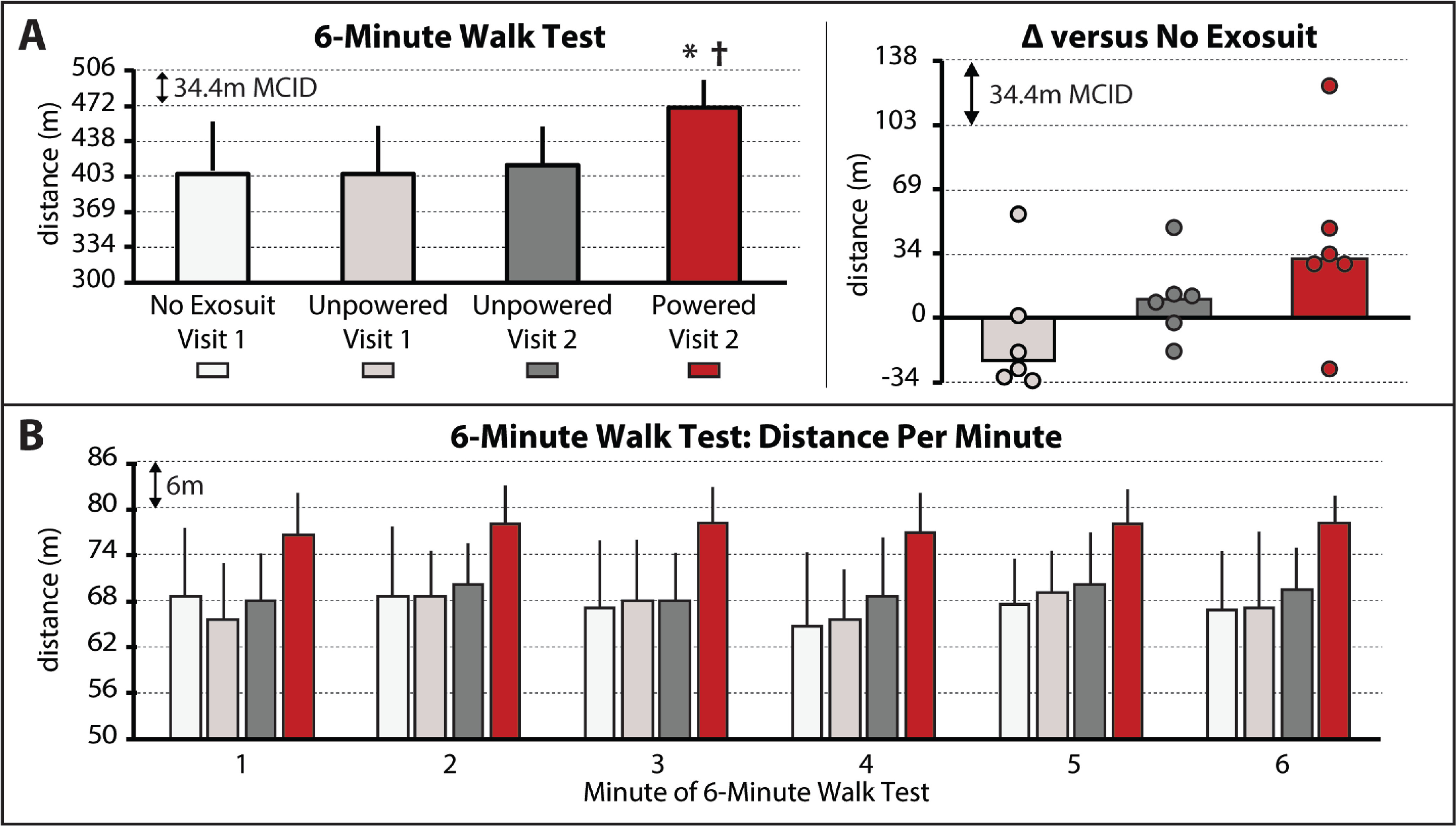
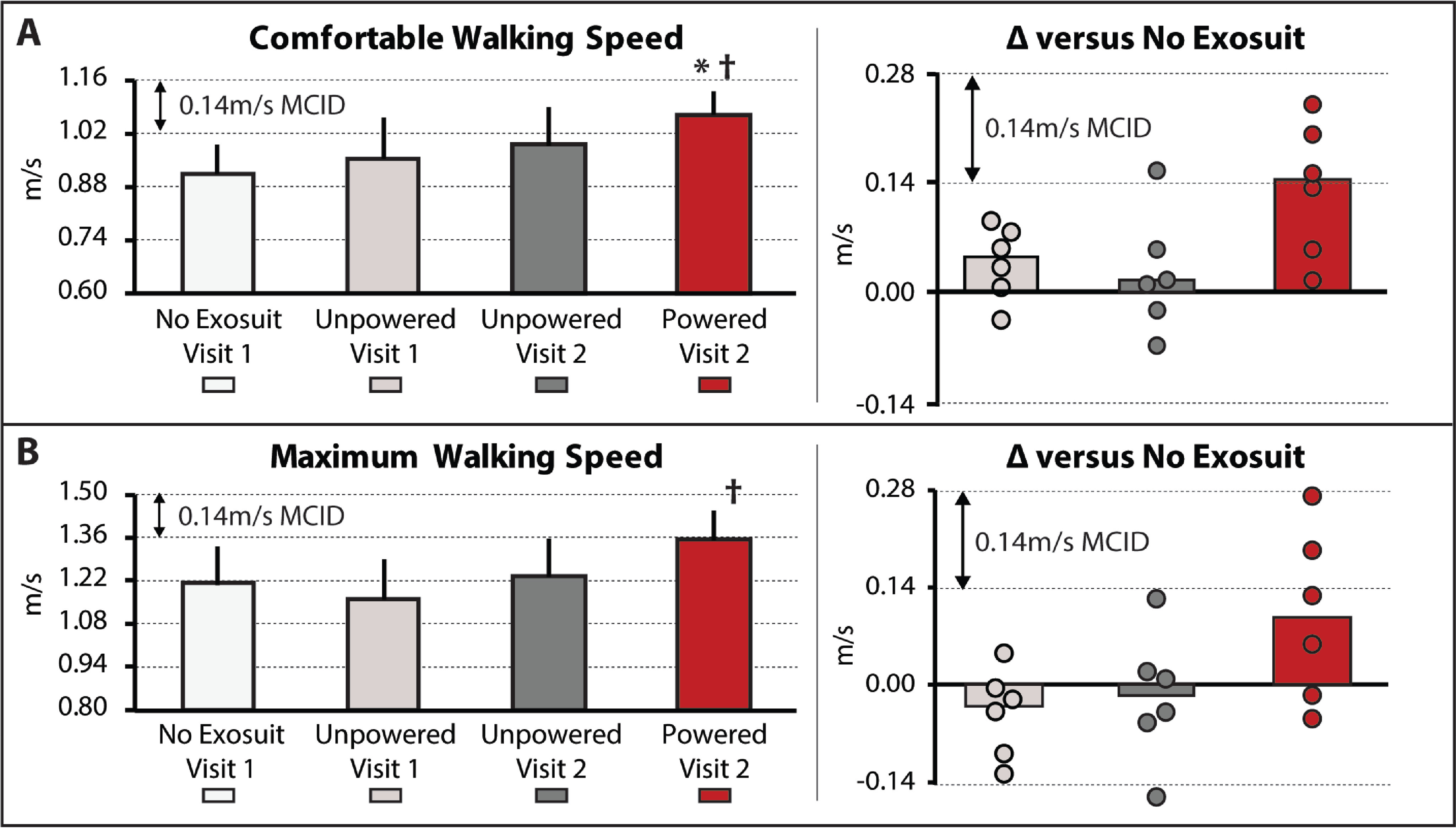
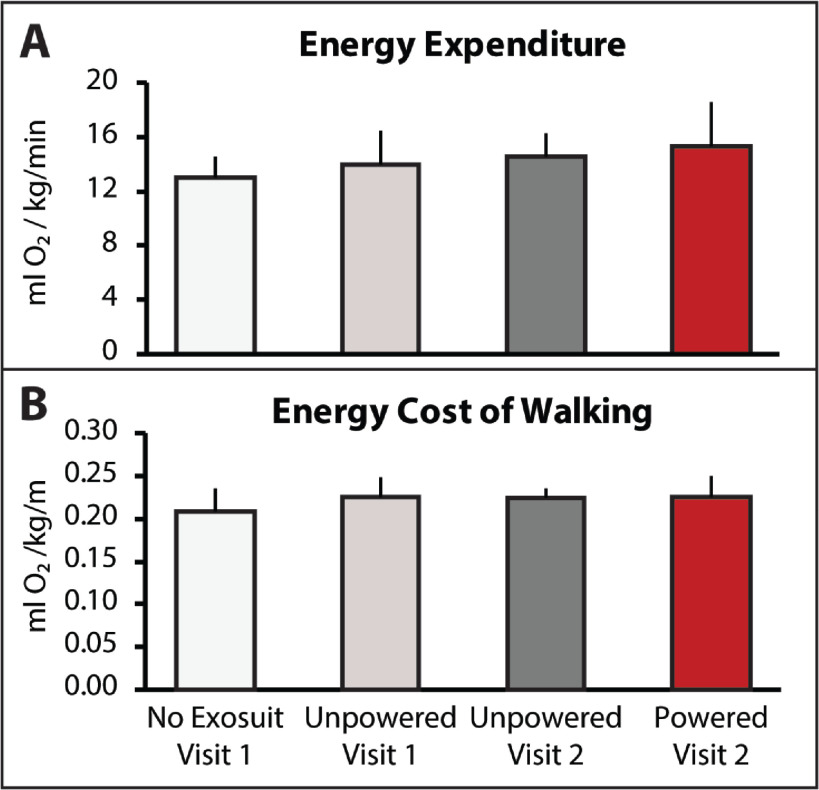
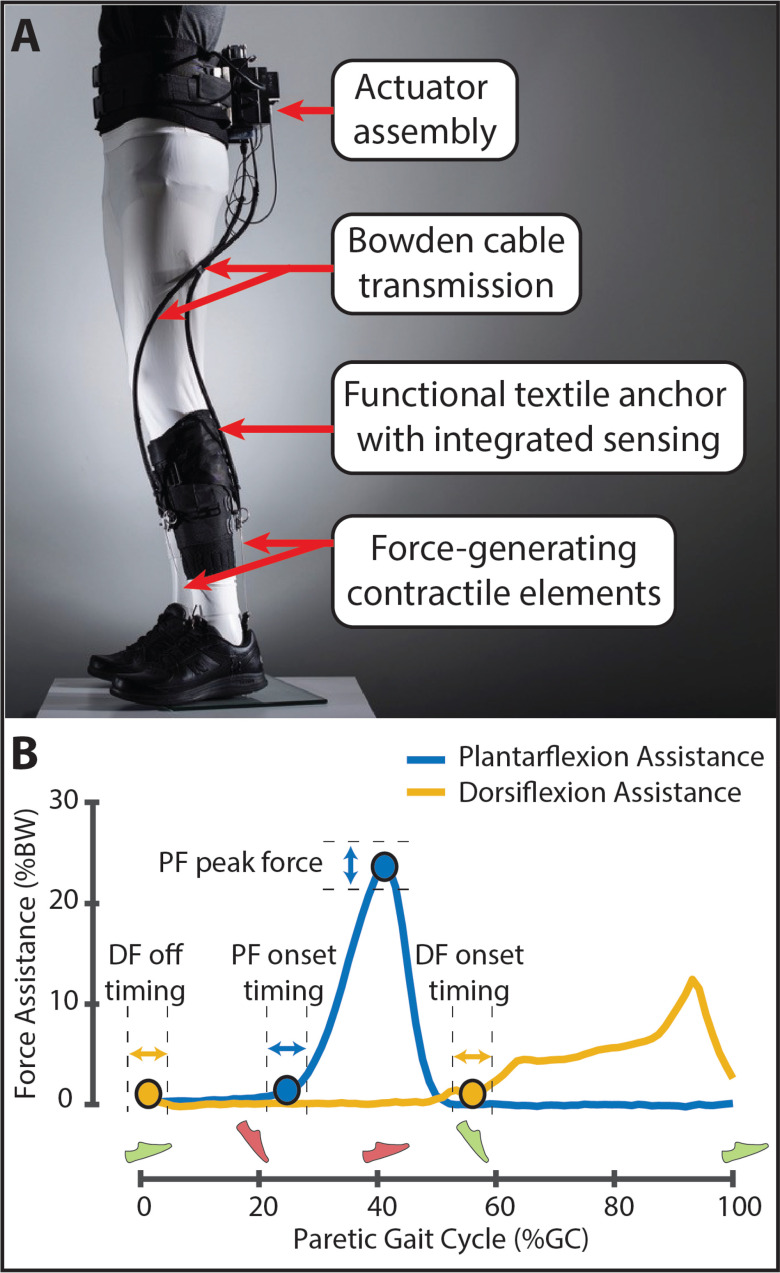
OBJECTIVE: Soft robotic exosuits can improve the mechanics and energetics of walking after stroke. Building on this prior work, we evaluated the effects of the first prototype of a portable soft robotic exosuit. METHODS: Exosuit-induced changes in the overground walking speed, distance, and energy expenditure of individuals post-stroke were evaluated statistically with alpha set to 0.05 and compared to minimal clinically important difference scores. RESULTS: 5kg exosuit did not substantially modify walking speed, distance, or energy expenditure when worn unpowered. In contrast, when the exosuit was powered on to provide an average 22.87±0.58 %bodyweight of plantarflexor force assistance during the paretic limb's stance phase and assist the paretic dorsiflexors during swing phase to reduce drop-foot, study participants walked a median 0.14±0.06 m/s faster during the 10-meter walk test and traveled 32±8 m farther during the six minute walk test. CONCLUSIONS: Individuals post-stroke can leverage the paretic plantarflexor and dorsiflexor assistance provided by soft robotic exosuits to achieve clinically-meaningful increases in speed and distance.
Overview
The claims and statistics of this paper haven’t been checked yet.
Run the check — free, no account needed. It reads the open-access text and checks the sources it cites.
Integrity signals
Registry
Cites
Statistics
Figures
Verification
Claims the paper makes
The claims and statistics of this paper haven’t been checked yet.
Run the check — free, no account needed. It reads the open-access text and checks the sources it cites.
Claims other papers make about this one
Each is checked against this paper’s own text: does it say what the citing paper says it does?
In the citing paper
“The incorporation of plantarflexor and dorsiflexor assistance within the soft exosuit exhibited promising outcomes in terms of enhancing walking speed and distance for post-stroke patients.”
From Artificial intelligence enhanced sensors - enabling technologies to next-generation healthcare and biomedical platform (2023) · cites this paper as Awad et al. 2020
Self-check
Percentages, sums and reported differences re-computed from the paper’s own numbers.
The self-check needs the paper’s full text.
Citations
Cites
1 retracted
Jayaraman, A., O’Brien, M. K., Madhavan, S., Oikawa, K., Endo, Y., Kantak, S. S., Stinear, J. W., Hornby, T. G., & Rymer, W. Z. (2019) · Archives of Physical Medicine and Rehabilitation · doi:10.1016/j.apmr.2019.08.473 · Cited by 5
RetractedMeaningful change and responsiveness in common physical performance measures in older adults.
Perera, S., Mody, S. H., Woodman, R. C., & Studenski, S. A. (2006) · Journal of the American Geriatrics Society · doi:10.1111/j.1532-5415.2006.00701.x · Cited by 2,513
Motor recovery after stroke: A systematic review of the literature
Hendricks, H. T., van Limbeek, J., Geurts, A. C. H., & Zwarts, M. J. (2002) · Archives of Physical Medicine and Rehabilitation · doi:10.1053/apmr.2002.35473 · Cited by 782
A soft robotic exosuit improves walking in patients after stroke
Awad, L. N., Bae, J., O’Donnell, K., De Rossi, S. M. M., Hendron, K., Sloot, L. H., Kudzia, P., Allen, S., Holt, K. G., Ellis, T. D., et al. (2017) · Science Translational Medicine · doi:10.1126/scitranslmed.aai9084 · Cited by 672
Self-citationMulticenter Randomized Clinical Trial Evaluating the Effectiveness of the Lokomat in Subacute Stroke
Hidler, J., Nichols, D., Pelliccio, M., Brady, K., Campbell, D. D., Kahn, J. H., & Hornby, T. G. (2009) · Neurorehabilitation and Neural Repair · doi:10.1177/1545968308326632 · Cited by 652
Tilson, J. K., Sullivan, K. J., Cen, S., Rose, D. K., Koradia, C. H., Azen, S. P., Duncan, P. W., & for the Locomotor Experience Applied Post Stroke (LEAPS) Investigative Team (2009) · Physical Therapy · doi:10.2522/ptj.20090079 · Cited by 501
Hornby, T. G., Reisman, D. S., Ward, I., Scheets, P. L., Miller, A. E., Haddad, D., Fox, E. J., Fritz, N. E., Hawkins, K. A., Henderson, C. E., et al. (2019) · Neurology Report · doi:10.1097/npt.0000000000000303 · Cited by 416
Powered robotic exoskeletons in post-stroke rehabilitation of gait: a scoping review
Louie, D. R., & Eng, J. J. (2016) · Journal of NeuroEngineering and Rehabilitation · doi:10.1186/s12984-016-0162-5 · Cited by 352
Predicting Home and Community Walking Activity Poststroke
Fulk, G. D., He, Y., Boyne, P., & Dunning, K. K. (2017) · Stroke · doi:10.1161/strokeaha.116.015309 · Cited by 308
Hornby, T. G., Straube, D., Kinnaird, C. R., Holleran, C. L., Echauz, A. J., Rodriguez, K. S., Wagner, E. J., & Narducci, E. (2011) · Topics in Stroke Rehabilitation · doi:10.1310/tsr1804-293 · Cited by 209
Schmidt, K., Duarte, J. E., Grimmer, M., Sancho-Puchades, A., Wei, H., Easthope, C. A., & Riener, R. (2017) · Frontiers in Neurorobotics · doi:10.3389/fnbot.2017.00057 · Cited by 205
Predicting Home and Community Walking Activity in People With Stroke
Fulk, G. D., Reynolds, C., Mondal, S., & Deutsch, J. E. (2010) · Archives of Physical Medicine and Rehabilitation · doi:10.1016/j.apmr.2010.07.005 · Cited by 181
Esquenazi, A., Talaty, M. C., & Jayaraman, A. (2016) · PM&R · doi:10.1016/j.pmrj.2016.07.534 · Cited by 179
Veale, A. J., & Xie, S. Q. (2016) · Medical Engineering & Physics · doi:10.1016/j.medengphy.2016.01.010 · Cited by 167
Effect of a Foot-Drop Stimulator and Ankle–Foot Orthosis on Walking Performance After Stroke
Everaert, D. G., Stein, R. B., Abrams, G., Dromerick, A. W., Francisco, G. E., Hafner, B. J., Huskey, T. N., Munin, M. C., Nolan, K. J., & Kufta, C. V. (2013) · Neurorehabilitation and neural repair · doi:10.1177/1545968313481278 · Cited by 155
Bae, J., Siviy, C., Rouleau, M., Menard, N., O’Donnell, K., Geliana, I., Athanassiu, M., Ryan, D. L., Bibeau, C., Sloot, L. H., et al. (2018) · Proceedings - IEEE International Conference on Robotics and Automation/Proceedings · doi:10.1109/icra.2018.8461046 · Cited by 153
Self-citationRelationship Between Perceived and Measured Changes in Walking After Stroke
Tang, A., Eng, J. J., & Rand, D. (2012) · Neurology Report · doi:10.1097/npt.0b013e318262dbd0 · Cited by 128
Béthoux, F., Rogers, H. L., Nolan, K. J., Abrams, G., Annaswamy, T. M., Brandstater, M. E., Browne, B. J., Burnfield, J. M., Feng, W., Freed, M. J., et al. (2014) · Neurorehabilitation and neural repair · doi:10.1177/1545968314521007 · Cited by 127
Slacking by the human motor system: Computational models and implications for robotic orthoses
Reinkensmeyer, D. J., Akoner, O. M., Ferris, D. P., & Gordon, K. E. (2009) · Annual International Conference of the IEEE Engineering in Medicine and Biology Society (EMBC) · doi:10.1109/iembs.2009.5333978 · Cited by 122
Contributions of Stepping Intensity and Variability to Mobility in Individuals Poststroke
Hornby, T. G., Henderson, C. E., Plawecki, A., Lucas, E., Lotter, J., Holthus, M. E., Brazg, G., Fahey, M., Woodward, J. L., Ardestani, M. M., et al. (2019) · Stroke · doi:10.1161/strokeaha.119.026254 · Cited by 111
A soft exosuit for patients with stroke: Feasibility study with a mobile off-board actuation unit
Bae, J., Rossi, S., O’Donnell, K., Hendron, K. L., Awad, L. N., Santos, T. R. T., Araújo, V. L., Ding, Y., Holt, K. G., Ellis, T. D., et al. (2015) · International Conference on Rehabilitation Robotics · doi:10.1109/icorr.2015.7281188 · Cited by 104
Self-citationLeech, K. A., & Hornby, T. G. (2016) · Journal of Neurotrauma · doi:10.1089/neu.2016.4532 · Cited by 96
Wearable Ankle Robots in Post-stroke Rehabilitation of Gait: A Systematic Review
Shi, B., Chen, X., Yue, Z., Yin, S., Weng, Q., Zhang, X., Wang, J., & Wen, W. (2019) · Frontiers in Neurorobotics · doi:10.3389/fnbot.2019.00063 · Cited by 94
Reducing the energy cost of walking in older adults using a passive hip flexion device
Panizzolo, F. A., Bolgiani, C., Liddo, L. D., Annese, E., & Marcolin, G. (2019) · Journal of NeuroEngineering and Rehabilitation · doi:10.1186/s12984-019-0599-4 · Cited by 88
A Soft-Inflatable Exosuit for Knee Rehabilitation: Assisting Swing Phase During Walking
Sridar, S., Qiao, Z., Muthukrishnan, N., Zhang, W., & Polygerinos, P. (2018) · Frontiers in Robotics and AI · doi:10.3389/frobt.2018.00044 · Cited by 84
Awad, L. N., Bae, J., Kudzia, P., Long, A., Hendron, K. L., Holt, K. G., O’Donnell, K., Ellis, T. D., & Walsh, C. J. (2017) · American Journal of Physical Medicine & Rehabilitation · doi:10.1097/phm.0000000000000800 · Cited by 80
Self-citationBarthuly, A. M., Bohannon, R. W., & Gorack, W. (2012) · Gait & Posture · doi:10.1016/j.gaitpost.2012.01.002 · Cited by 78
Is walking faster or walking farther more important to persons with chronic stroke?
Combs, S. A., Puymbroeck, M. V., Altenburger, P., Miller, K. K., Dierks, T. A., & Schmid, A. A. (2012) · Disability and Rehabilitation · doi:10.3109/09638288.2012.717575 · Cited by 78
Leech, K. A., Kinnaird, C. R., Holleran, C. L., Kahn, J. H., & Hornby, T. G. (2016) · Physical Therapy · doi:10.2522/ptj.20150646 · Cited by 73
Brazg, G., Fahey, M., Holleran, C. L., Connolly, M., Woodward, J. L., Hennessy, P. W., Schmit, B. D., & Hornby, T. G. (2017) · Neurorehabilitation and neural repair · doi:10.1177/1545968317731538 · Cited by 57
Biomechanical mechanisms underlying exosuit-induced improvements in walking economy after stroke
Bae, J., Awad, L. N., Long, A., O’Donnell, K., Hendron, K., Holt, K. G., Ellis, T. D., & Walsh, C. J. (2018) · Journal of Experimental Biology · doi:10.1242/jeb.168815 · Cited by 56
Self-citationReinkensmeyer, D. J., Wolbrecht, E. T., & Bobrow, J. E. (2007) · Conference proceedings · doi:10.1109/iembs.2007.4353215 · Cited by 46
Graham, S. A., Roth, E. J., & Brown, D. A. (2018) · Journal of NeuroEngineering and Rehabilitation · doi:10.1186/s12984-018-0442-3 · Cited by 22
Distance-Induced Changes in Walking Speed After Stroke: Relationship to Community Walking Activity
Awad, L. N., Reisman, D. S., & Binder‐Macleod, S. A. (2019) · Neurology Report · doi:10.1097/npt.0000000000000293 · Cited by 17
Self-citationImmediate Adaptations to Post-Stroke Walking Performance Using a Wearable Robotic Exoskeleton
Jayaraman, A., O’Brien, M. K., Madhavan, S., Oikawa, K., Endo, Y., Kantak, S. S., Stinear, J. W., Hornby, T. G., & Rymer, W. Z. (2019) · Publisher · Cited by 2
Kleim (n.d.) · doi:10.1044/1092-4388(2008/018
Research works printed but not linked: 1
- mcdonald, 2014, Multiple Comparisons - Handbook of Biological Statistics
Cited by
Sorted by citations
Personalizing exoskeleton assistance while walking in the real world
Slade, P., Kochenderfer, M. J., Delp, S. L., & Collins, S. H. (2022) · Nature · doi:10.1038/s41586-022-05191-1 · Cited by 339
Wang, C., He, T., Zhou, H., Zhang, Z., & Lee, C. (2023) · Bioelectronic Medicine · doi:10.1186/s42234-023-00118-1 · Cited by 295
How adaptation, training, and customization contribute to benefits from exoskeleton assistance
Poggensee, K. L., & Collins, S. H. (2021) · Science Robotics · doi:10.1126/scirobotics.abf1078 · Cited by 230
Awad, L. N., Esquenazi, A., Francisco, G. E., Nolan, K. J., & Jayaraman, A. (2020) · Journal of NeuroEngineering and Rehabilitation · doi:10.1186/s12984-020-00702-5 · Cited by 160
Self-citationOptimizing Exoskeleton Assistance for Faster Self-Selected Walking
Song, S., & Collins, S. H. (2021) · IEEE Transactions on Neural Systems and Rehabilitation Engineering · doi:10.1109/tnsre.2021.3074154 · Cited by 112
Metadata
- Authors
- Awad, L. N., Kudzia, P., Revi, D. A., Ellis, T. D., & Walsh, C. J.
- Affiliations
- Boston University (US)
- Harvard University (US)
- Corresponding author
- Awad, Louis N.
- Walsh, Conor J.
- Venue
- IEEE Open Journal of Engineering in Medicine and Biology
- Published
- 2020
- Volume
- 1
- Pages
- 108-115
- ISSN
- 2644-1276 (ISSN-L)
- PMC
- PMC7971412
- OpenAlex
- W3014201768
- Cited by
- 111
- References
- 36
- Citations by year
- 2026: 9 · 2025: 19 · 2024: 17 · 2023: 19 · 2022: 23 · 2021: 18 · 2020: 6
- FWCI
- 5.18
- Type
- journal article
- Language
- en
- Open access
- gold
- doi.org
- Licence
- Locations
- IEEE Open Journal of Engineering in Medicine and Biology (publishedVersion, cc-by)
- PubMed Central (publishedVersion, cc-by)
- PubMed (publishedVersion)
- DOAJ (DOAJ: Directory of Open Access Journals) (submittedVersion, cc-by-sa)
- Funders
- National Institutes of Health (R01HD088619)
- American Heart Association (18TPA34170171)
- Wyss Institute at Harvard University
- Topics
- Physical Sciences › Engineering › Biomedical Engineering › Prosthetics and Rehabilitation Robotics
- Health Sciences › Medicine › Rehabilitation › Stroke Rehabilitation and Recovery
- Physical Sciences › Engineering › Biomedical Engineering › Soft Robotics and Applications
- Keywords
- stroke rehabilitation, gait assistance, walking speed, walking distance, energy expenditure, foot drop, paretic limb, powered exoskeleton, overground walking
About these checks
Registry, retraction, Cites and statistics results are computed, not judged, with one exception: a printed reference that no index lists is read once by a model before it counts as a citation error. Claims are extracted by a model and kept only when their quote appears verbatim in the text; each cited source is then checked, with a model’s help, for whether it says what the claim relies on. Those verdicts can be wrong — read the claim’s quote and the cited source before relying on one.
Statistics and arithmetic are recomputed, not judged.
Confidence bands are shown only for fields calibrated on our annotated test set. None is calibrated yet, so no band is shown.
What counts as a claim ›How we measure confidence ›How we check this ›
Are you an author, or do you see a problem with this page? Request a review
