

Faster R-CNN: Towards Real-Time Object Detection with Region Proposal Networks
Open accessThe DOI matches its Crossref record; 56 of the 60 references it cites were found in a registry or an index; 15 of the 27 sources its claims cite were checked for support.
Abstract
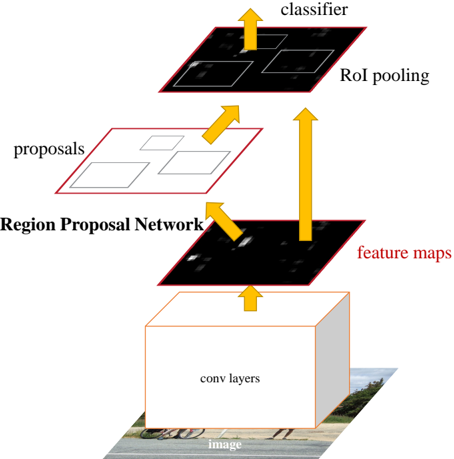
State-of-the-art object detection networks depend on region proposal algorithms to hypothesize object locations. Advances like SPPnet [1] and Fast R-CNN [2] have reduced the running time of these detection networks, exposing region proposal computation as a bottleneck. In this work, we introduce a Region Proposal Network (RPN) that shares full-image convolutional features with the detection network, thus enabling nearly cost-free region proposals. An RPN is a fully convolutional network that simultaneously predicts object bounds and objectness scores at each position. The RPN is trained end-to-end to generate high-quality region proposals, which are used by Fast R-CNN for detection. We further merge RPN and Fast R-CNN into a single network by sharing their convolutional features-using the recently popular terminology of neural networks with 'attention' mechanisms, the RPN component tells the unified network where to look. For the very deep VGG-16 model [3] , our detection system has a frame rate of 5 fps (including all steps) on a GPU, while achieving state-of-the-art object detection accuracy on PASCAL VOC 2007, 2012, and MS COCO datasets with only 300 proposals per image. In ILSVRC and COCO 2015 competitions, Faster R-CNN and RPN are the foundations of the 1st-place winning entries in several tracks. Code has been made publicly available.
Overview
CoChat Summary
TL;DR
Faster R-CNN introduces a Region Proposal Network (RPN) that shares convolutional features with Fast R-CNN, making region proposals nearly cost-free and enabling a unified object detection system. It achieves near real-time detection with state-of-the-art accuracy on PASCAL VOC and MS COCO.
Key findings
- With VGG-16 and shared features, Faster R-CNN reaches 69.9% mAP on PASCAL VOC 2007 test using 300 proposals, 73.2% with VOC07+12 training, 70.4% on VOC 2012 with 07++12, and 78.8% on VOC 2007 with COCO+07+12.
- Runtime: VGG-16 RPN + Fast R-CNN takes 198 ms total (5 fps), with RPN proposals costing 10 ms; ZF runs at 59 ms total (17 fps), versus SS + Fast R-CNN at 1830 ms (0.5 fps).
- Ablations: sharing features improves ZF mAP from 58.7% (unshared) to 59.9%; removing the reg layer drops mAP to 52.1%, and removing cls with 100 proposals drops it to 44.6%.
- On MS COCO test-dev, Faster R-CNN with VGG-16 and COCO train reaches 42.1% mAP@0.5 and 21.5% mAP@[.5,.95]; with COCO trainval it reaches 42.7% and 21.9%.
Methods
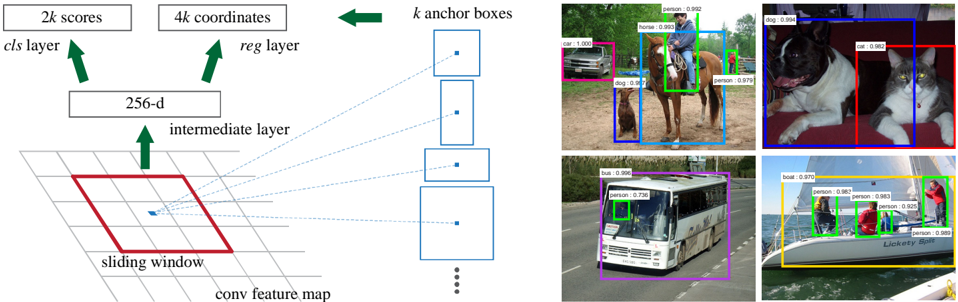
- The RPN is a fully convolutional network that slides a 3×3 window over shared conv features and predicts objectness scores and box regressions relative to anchors; default anchors use 3 scales (128², 256², 512²) and 3 aspect ratios (1:1, 1:2, 2:1), giving k = 9 anchors per position.
- Training uses a 4-step alternating scheme with ImageNet-pretrained ZF or VGG-16, SGD, single-scale images (shorter side s = 600), NMS at IoU 0.7, and 300 proposals at test time; evaluation is on PASCAL VOC 2007/2012 and MS COCO.
- Main metrics are detection mAP on PASCAL VOC and mAP@0.5 / mAP@[.5,.95] on MS COCO, with timing measured on a K40 GPU.
Limitations
- Stated in the paper: non-approximate joint training would require a differentiable RoI pooling/warping layer and is beyond the paper’s scope; the approximate joint training ignores gradients with respect to proposal box coordinates.
- Stated in the paper: cross-boundary anchors are ignored during training, and multi-scale feature extraction may improve accuracy but does not offer a good speed-accuracy trade-off.
- Evident from the text: the main experiments focus on PASCAL VOC and MS COCO with ZF/VGG-16 backbones, so generalization to other datasets, backbones, or detection regimes is not extensively characterized.
Model-written summary. Check it against the paper before relying on it.
Integrity signals
Registry
Cites
Statistics
Figures


Verification
Claims the paper makes
12 Valid · 5 Not valid · 8 Not checked · 83 Own results and interpretations
Every source the paper cites for this claim was checked and supports it.
In the paper
“Only by replacing VGG-16 with a 101layer residual net (ResNet-101) [18], the Faster R-CNN system increases the mAP from 41.5%/21.2% (VGG16) to 48.4%/27.2% (ResNet-101) on the COCO val set.”
What the sources say
- Supportedcites [18] [18] K. He, X. Zhang, S. Ren, and J. Sun, 'Deep residual learning for image recognition,' arXiv:1512.03385 , 2015. - source
Table 8 (p. 8) reports the exact COCO validation-set mAP values for baseline Faster R-CNN with VGG-16 and ResNet-101. Section 4.3 (p. 8) says the detection implementation was the same for both models and attributes the gain to replacing VGG-16 with ResNet-101. (LLM, conf=0.95)
plainstates a cause- Asserted: passes — The authors put it forward as true.
- Checkable: passes — It can be checked against evidence.
- Load-bearing: passes — The paper’s conclusions depend on it.
- Based: passes — The paper gives a reason why it holds.
- Supported
Every source the paper cites for this claim was checked and supports it.
In the paper
“This observation is still valid even when one increases the depth substantially to over 100 layers [18].”
What the sources say
- Supportedcites [18] [18] K. He, X. Zhang, S. Ren, and J. Sun, 'Deep residual learning for image recognition,' arXiv:1512.03385 , 2015. - source
In ImageNet Classification (p. 7), the paper reports that 101- and 152-layer ResNets outperform the 34-layer model, with no observed degradation. Its CIFAR-10 analysis (p. 7) also reports that a 110-layer ResNet converges well. These results support the stated extension to over 100 layers, although the isolated sentence does not specify what “this observation” refers to. (LLM, conf=0.87)
plain- Asserted: passes — The authors put it forward as true.
- Checkable: passes — It can be checked against evidence.
- Load-bearing: unclear — It is unclear whether the paper’s conclusions depend on it.
- Based: passes — The paper gives a reason why it holds.
- Supported
The cited sources support only part of this claim — read each source’s verdict below.
In the paper
“In ILSVRC and COCO 2015 competitions, Faster R-CNN and RPN are the basis of several 1st-place entries [18] in the tracks of ImageNet detection, ImageNet localization, COCO detection, and COCO segmentation.”
What the sources say
- Partly supportedcites [18] [18] K. He, X. Zhang, S. Ren, and J. Sun, 'Deep residual learning for image recognition,' arXiv:1512.03385 , 2015. - sourceExperimental — accuracy not yet measured
Section 4.3 (p. 8) lists first-place finishes in all four tracks, and the Object Detection Baselines (p. 10) describe a Faster R-CNN system using an RPN. The ImageNet Localization section (p. 12) also identifies its RPN-based method. But the copy attributes the entries collectively to deep residual nets; it does not establish that Faster R-CNN and RPN underpinned the COCO segmentation entry. (LLM, conf=0.86)
plainstates a cause- Asserted: passes — The authors put it forward as true.
- Checkable: passes — It can be checked against evidence.
- Load-bearing: unclear — It is unclear whether the paper’s conclusions depend on it.
- Based: passes — The paper gives a reason why it holds.
- Partly supported
The cited sources that could be checked couldn’t confirm or dispute this claim.
In the paper
“Yet when compared to efficient detection networks [2], Selective Search is an order of magnitude slower, at 2 seconds per image in a CPU implementation.”
What the sources say
- Could not verifycites [4] [4] J. R. Uijlings, K. E. van de Sande, T. Gevers, and A. W. Smeulders, 'Selective search for object recognition,' International Journal of Computer Vision (IJCV) , 2013. - sourceExperimental — accuracy not yet measured
The computational discussion in §5.3 (pp. 12–13) gives timings for complete object-recognition pipelines, not a two-second CPU runtime for Selective Search. The comparisons in §5.2.1 (p. 11) concern other object-location methods, not efficient detection networks. Searches for a two-second per-image runtime and a network comparison found neither claim in our copy. (LLM, conf=0.73)
- Not checked — no full text of the sourcecites [2] [2] R. Girshick, 'Fast R-CNN,' in IEEE International Conference on Computer Vision (ICCV) , 2015. - source
plainstates an association- Asserted: passes — The authors put it forward as true.
- Checkable: passes — It can be checked against evidence.
- Load-bearing: passes — The paper’s conclusions depend on it.
- Based: passes — The paper gives a reason why it holds.
- Could not verify
Every source the paper cites for this claim was checked and supports it.
In the paper
“We comprehensively evaluate our method on the PASCAL VOC detection benchmarks [11] where RPNs with Fast R-CNNs produce detection accuracy better than the strong baseline of Selective Search with Fast R-CNNs.”
What the sources say
- Supportedcites [11] [11] M. Everingham, L. Van Gool, C. K. I. Williams, J. Winn, and A. Zisserman, 'The PASCAL Visual Object Classes Challenge 2007 (VOC2007) Results,' 2007. - source
The citation is attached to “PASCAL VOC detection benchmarks,” not to the citing authors’ comparison of RPNs and Selective Search. Sections 5.2 and 6.2 describe the VOC detection task, its submitted methods, and its results, confirming the benchmark identification. (LLM, conf=0.92)
plainstates a cause- Asserted: passes — The authors put it forward as true.
- Checkable: passes — It can be checked against evidence.
- Load-bearing: passes — The paper’s conclusions depend on it.
- Based: passes — The paper gives a reason why it holds.
- Rests on an assumption not shown here.
- Supported
56 more claims
Create a free account to see all 108 claims and to verify the 2 references still open.
- Probably not a substantial claim. 11
- It may state two separate claims as one. 40
- The quote only partly states this claim. 1
Claims other papers make about this one
Each is checked against this paper’s own text: does it say what the citing paper says it does?
The source backs part of the claim, not all of it — or backs it for a different population, condition or comparison.
In the citing paper
“Unlike the original paper [19] that adopted stage-wise training regarding RPN, we use an improved implementation with end-to-end joint training similar to [37], which leads to higher baselines than [19].”
From Non-local Neural Networks (2018) · cites this paper as [37]
Experimental — accuracy not yet measuredThe source backs part of the claim, not all of it — or backs it for a different population, condition or comparison.
In the citing paper
“Faster RCNN is the first near-realtime deep learning detector (COCO mAP@.5=42.7%, VOC07 mAP=73.2%, 17fps with ZF-Net [48]).”
From Object Detection in 20 Years: A Survey (2023) · cites this paper as [19]
Experimental — accuracy not yet measuredThe source backs part of the claim, not all of it — or backs it for a different population, condition or comparison.
In the citing paper
“Faster RCNN is the first near-realtime deep learning detector (COCO mAP@.5=42.7%, VOC07 mAP=73.2%, 17fps with ZF-Net [48]).”
From Object Detection in 20 Years: A Survey (2023) · cites this paper as [47]
Experimental — accuracy not yet measuredThe source backs part of the claim, not all of it — or backs it for a different population, condition or comparison.
In the citing paper
“In the deep learning era, due to the increase of computing power, bootstrap was shortly discarded in object detection during 2014-2016 [16-20].”
From Object Detection in 20 Years: A Survey (2023) · cites this paper as [19]
Experimental — accuracy not yet measuredThe source backs part of the claim, not all of it — or backs it for a different population, condition or comparison.
In the citing paper
“The most commonly used idea to reduce the feature computational redundancy is to compute the feature map of the whole image only once [18, 19, 124], which have achieved tens or even hundreds of times of acceleration.”
From Object Detection in 20 Years: A Survey (2023) · cites this paper as [19]
Experimental — accuracy not yet measured
21 more claims about this paper
Create a free account to see every claim other papers make about this one.
Citations
Cites
Deep Residual Learning for Image Recognition
He, K., Zhang, X., Ren, S., & Sun, J. (2016) · 2016 IEEE Conference on Computer Vision and Pattern Recognition (CVPR) · doi:10.1109/cvpr.2016.90 · Cited by 235,474 · cited 7×
“to propose regions from data, and thus can easily benefit from deeper and more expressive features (such as the 101layer residual nets adopted in [18]).”
BackgroundInfluentialSelf-citationVery Deep Convolutional Networks for Large-Scale Image Recognition
Simonyan, K., & Zisserman, A. (2014) · arXiv · doi:10.48550/arxiv.1409.1556 · Cited by 114,148
ImageNet classification with deep convolutional neural networks
Krizhevsky, A., Sutskever, I., & Hinton, G. E. (2017) · Communications of the ACM · doi:10.1145/3065386 · Cited by 112,155 · cited 1×
“For the regression loss, we use L where R is the robust loss function (smooth L 1 ) defined in [5].”
MethodGoing deeper with convolutions
Szegedy, C., Liu, W., Jia, Y., Sermanet, P., Reed, S., Anguelov, D., Erhan, D., Vanhoucke, V., & Rabinovich, A. (2015) · 2015 IEEE Conference on Computer Vision and Pattern Recognition (CVPR) · doi:10.1109/cvpr.2015.7298594 · Cited by 48,562 · cited 1×
“1× 10(6) parameters (1536 × (4 + 1) × 800 for GoogleNet [34] in MultiBox [27]).”
Microsoft COCO: Common Objects in Context
Lin, T.-Y., Maire, M., Belongie, S., Hays, J., Perona, P., Ramanan, D., Dollár, P., & Zitnick, C. L. (2014) · Lecture Notes in Computer Science · doi:10.1007/978-3-319-10602-1_48 · Cited by 45,460 · cited 1×
“Region proposal methods typically rely on inexpensive features and economical inference schemes.”
MethodImageNet Large Scale Visual Recognition Challenge
Russakovsky, O., Deng, J., Su, H., Krause, J., Satheesh, S., Ma, S., Huang, Z., Karpathy, A., Khosla, A., Bernstein, M., et al. (2015) · International Journal of Computer Vision · doi:10.1007/s11263-015-0816-y · Cited by 39,380 · cited 1×
“, the shared convolutional layers) are initialized by pre-training a model for ImageNet classification [36], as is standard practice [5].”
MethodFully convolutional networks for semantic segmentation
Long, J., Shelhamer, E., & Darrell, T. (2015) · 2015 IEEE Conference on Computer Vision and Pattern Recognition (CVPR) · doi:10.1109/cvpr.2015.7298965 · Cited by 38,834 · cited 5×
“Our RPNs are thus a kind of fully-convolutional network (FCN) [14] and they can be trained end-to-end specifically for the task for generating detection proposals.”
BackgroundMethodInfluentialRich Feature Hierarchies for Accurate Object Detection and Semantic Segmentation
Girshick, R., Donahue, J., Darrell, T., & Malik, J. (2014) · 2014 IEEE Conference on Computer Vision and Pattern Recognition · doi:10.1109/cvpr.2014.81 · Cited by 32,684 · cited 7×
“, Selective Search [4] object detectors, RCNN [5], and Fast R-CNN [2]).”
BackgroundMethodInfluentialSelf-citationGirshick, R. (2015) · 2015 IEEE International Conference on Computer Vision (ICCV) · doi:10.1109/iccv.2015.169 · Cited by 28,105
Self-citationThe pascal visual object classes (VOC) challenge
Everingham, M., Van Gool, L., Williams, C. K. I., Winn, J., & Zisserman, A. (2010) · International Journal of Computer Vision · doi:10.1007/s11263-009-0275-4 · Cited by 19,599
Research works printed but not linked: 1
- [10] S. Ren, K. He, R. Girshick, and J. Sun, 'Faster R-CNN: Towards real-time object detection with region proposal networks,' in Neural Information Processing Systems (NIPS) , 2015. -
Cited by
Items 52,601–52,700 of 56,407
Lightweight Temporal Consistency for Grid-Based Obstacle Detection in Edge Devices
Kurkutlu, O., & Roohi, A. (2025) · IEEE International Conference on Autonomic Computing and Self-Organizing Systems Companion (ACSOS-C) · doi:10.1109/acsos-c66519.2025.00047
“Traditional object detection methods, such as Faster R-CNN [14], SSD [15], and YOLO [16], have demonstrated strong performance on general-purpose GPUs and CPUs.”
Dai, L., Yan, X., Xiong, J., Zhang, S., & Zhai, X. (2025) · Communications in computer and information science · doi:10.1007/978-981-95-3736-5_16 · Cited by 1
Jia, P., Gong, J., Nie, L., Ju, Z., Zhang, R., Tian, L., & Qin, T. (2025) · IEEE Transactions on Consumer Electronics · doi:10.1109/tce.2025.3631894 · Cited by 1
“For the auxiliary task loss L aux and the joint prediction loss L reg , we use a smooth L 1 loss [31] to quantify the error between the predicted trajectories and the GT trajectories across different modalities.”
Hu, Z., Wang, X., Peng, L., Xiong, L., & Huang, S. (2025) · Communications in computer and information science · doi:10.1007/978-981-95-3736-5_18
Edge Feature-Enhanced Swin Transformer for Insect Image Classification
Li, Y., Zhang, L., & Sun, L. (2025) · Communications in computer and information science · doi:10.1007/978-981-95-3736-5_20 · Cited by 1
Brain tumor image object detection based on improved RT-DETR
Liao, G., & Zhou, K. (2025) · International Conference on Electronic Information Technology (EIT) · doi:10.1109/eit67313.2025.11232048
“Models like Faster R-CNN[3], YOLO[4], and RetinaNet[5] have been applied to brain tumor detection, achieving progress in automatic lesion localization and bounding box prediction.”
Lightweight Underwater Sonar Target Detection Algorithm Based on Context Feature Fusion
Zhou, W., Wei, N., & Jiang, L. (2025) · International Joint Conference on Neural Networks (IJCNN) · doi:10.1109/ijcnn64981.2025.11228534
LDFC-YOLO: A Detector for Electron Microscope Images of Cashmere and Wool
Xu, H., Ji, Y., Ren, Q.-D.-E.-J., & Lu, M. (2025) · International Joint Conference on Neural Networks (IJCNN) · doi:10.1109/ijcnn64981.2025.11228413
“Two-stage detectors include the RCNN series such as Faster-RCNN [8], Mask-RCNN [9], and Cascade R-CNN [10].”
Detecting and Removing Adversarial Patches using Frequency Signatures
Simon, D., Walker, C., Jha, S., & Ewetz, R. (2025) · International Joint Conference on Neural Networks (IJCNN) · doi:10.1109/ijcnn64981.2025.11227422
“For classifying images on Imagenet, we use the PyTorch [28] implementation of Resnet50 [29], for detecting objects on Xview we use the Armory [30] implementation of Faster RCNN [31], and for INRIA Person we use the Darknet [32] implementation of Yolov4-tiny [33].”
Research on obstacle detection for unmanned surface vehicles based on an enhanced YOLOv5 algorithm
Liu, M., Chen, Y., Zhao, X., et al. (2025) · AIP Advances · doi:10.1063/5.0294581
CGMSF-SAR:Context-Guided and Multi-Scale Fusion Lightweight SAR Ship Detection Model
Chen, M., Zhang, S.-X., Zhu, G.-L., et al. (2025) · IEEE International Joint Conference on Neural Network · doi:10.1109/ijcnn64981.2025.11229188
“Existing deep learning methods are mainly classified into three categories: two-stage methods (e.g., Faster R-CNN [12] and Cascade R-CNN [13]), single-stage methods (e.g., YOLO [14]–[17] series and RetinaNet [18]), and an-chorless methods (e.g., CenterNet [19] and FCOS [20]).”
DRM-Yolov8 Pedestrian Detection Method for Nighttime Complex Scenarios
Yao, R., Wu, G., Wang, D., Wang, Y., & Lu, Y. (2025) · International Joint Conference on Neural Networks (IJCNN) · doi:10.1109/ijcnn64981.2025.11227574
Dyadic Human-Robot Interaction: Emerging Technologies, Challenges, and Opportunities
Adebayo, S., Dessing, J. C., & McLoone, S. (2025) · Transactions on computer systems and networks · doi:10.1007/978-981-96-9471-6_1 · Cited by 1
Huang, F., Wang, W., Liu, Q., Fan, W., Su, W., Jia, W., Wang, T., & Cao, J. (2025) · IEEE Transactions on Mobile Computing · doi:10.1109/tmc.2025.3633699 · Cited by 3
Indoor Obstacle Object Detection Algorithm Based on Improved YOLOv8n
Song, Z., & Lu, J. (2025) · International Symposium on Artificial Intelligence and Intelligent Manufacturing (AIIM) · doi:10.1109/aiim67611.2025.11232846
“The Faster R-CNN algorithm proposed by Ren et al [6]. later innovatively introduced a Region Proposal Network (RPN), enabling end-to-end candidate region generation and feature extraction, achieving an average precision (mAP) of 73.2% on the PASCAL VOC dataset, but the algorithm is still not ideal…”
InfluentialDing, J., Wu, X., Yang, X., et al. (2025) · International Symposium on Artificial Intelligence and Intelligent Manufacturing (AIIM) · doi:10.1109/aiim67611.2025.11233100
“Two-stage frameworks (e.g., Faster R-CNN) and single-stage models (e.g., YOLO) [4-5] employ feature pyramids and anchor-ratio tuning to improve recall on elongated targets, yet still struggle to localize ultra-narrow continuous structures with high precision.”
ArborNet: Featherweight Representation Learning for Real-Time Cashew Nut Quality Classification
Duc, Q.-A. N., Kim, D.-T., Nguyen, M.-A., et al. (2025) · International Symposium on Communications and Information Technologies · doi:10.1109/iscit67082.2025.11231447
“High-performance deep learning models, such as the YOLO family [6], Faster R-CNN [7], and EfficientDet [8], typically demand high-wattage GPUs and significant computational resources, which are often un-available in SME environments.”
SMFNet: Streaming Multi-modal Audio-Visual Source Separation via Gated Fusion
Sun, S., Zhu, M., & Yu, Y. (2025) · Lecture notes in electrical engineering · doi:10.1007/978-981-95-4045-7_25
Deep Learning-Based Rapid 3D Reconstruction and Spatial Localization of Leakage in Shield Tunnels
Qian, J., Wu, S., Xue, F., Xiao, K., & Wang, T. (2025) · Journal of Computing in Civil Engineering · doi:10.1061/jccee5.cpeng-7105
Gao, P., Shi, F., Yin, Y., Cheng, X., Wang, M., Zhao, M., & Chen, S. (2025) · IEEE Journal of Selected Topics in Applied Earth Observations and Remote Sensing · doi:10.1109/jstars.2025.3635416 · Cited by 2
Wang, X., Li, Y., Zhou, X., et al. (2025) · SSRN Electronic Journal · doi:10.2139/ssrn.5799975
Saeaifisppf: Squeeze Aggregation Excitation Intrascale Feature Interaction Spatial Pyramid Pooling
Guo, C., & Ren, K. (2025) · IEEE International Geoscience and Remote Sensing Symposium (IGARSS) · doi:10.1109/igarss55030.2025.11243981
“Two-stage object detection has one more stage of generating candidate boxes than one-stage, represented by the Region-based Convolutional Neural Network (R-CNN) series [15–17].”
Barros, T., Figueiredo, T., Gamboa, P., & Santos, B. (2025) · SSRN Electronic Journal · doi:10.2139/ssrn.5817138
PADY-YOLOv8: A Dense Pedestrian Detection Algorithm Based on YOLOv8
Yan, Z., Shi, L., & Zhang, D. (2025) · IEEE International Symposium on Parallel and Distributed Processing with Applications (ISPA) · doi:10.1109/ispa67752.2025.00138
“However, pedestrian targets in crowded scenes are often accompanied by severe occlusions, large variations in scale, and close spacing between individuals, which leads to high false detection and missed detection rates in existing object detection methods [1].”
Li, J., Li, J., Li, K., et al. (2025) · Engineering Structures · doi:10.1016/j.engstruct.2025.121771
Li, Z., Yang, Y., Xie, M., et al. (2025) · Journal of Computing in Civil Engineering · doi:10.1061/jccee5.cpeng-7321
Information Bottleneck for Attribution Applied to Object Detection
Coelho, B. F. O., & Cardoso, J. S. (2025) · IEEE Transactions on Artificial Intelligence · doi:10.1109/tai.2025.3639344
“We experiment with the faster R-CNN [19], RetinaNET [12], and YOLOv11n [9] models.”
Fine-grained reinforcement learning for natural language-based vehicle video clip retrieval
Peng, Y., Dai, T., Wang, H., Ma, S., Sun, D. J., & Zhao, X. (2025) · Expert Systems with Applications · doi:10.1016/j.eswa.2025.130655
Aerial-MangoYOLOv8: An Optimized Mango Detection System for UAV-Based Yield Estimation
Pichhika, H. C., Subudhi, P., & Yerra, R. V. P. (2025) · IEEE Transactions on AgriFood Electronics · doi:10.1109/tafe.2025.3631839 · Cited by 1
SMCI-YOLO: A Low-Light Detector Based on Synergistic Multi-Component InteractionPreprint
Hu, J., Wang, H., Zeng, M., Liu, S., Huang, H., & Xie, X. (2025) · SSRN Electronic Journal · doi:10.2139/ssrn.5861654
Optimizing Human Detection in Natural Disaster Environments Through YOLO and Image Processing
Muradkhanli, L. (2025) · IEEE International Conference on Application of Information and Communication Technologies (AICT) · doi:10.1109/aict67988.2025.11268634
“Nonetheless, the extensive computations required by the model frequently restricted its applicability for real-time responses [2].”
Appearance-semantic graphical model for human-object interaction detection
Ye, Q., Yang, T., Wang, X., & Zhang, Y. (2025) · Engineering Applications of Artificial Intelligence · doi:10.1016/j.engappai.2025.113406
Artificial Intelligence-Based Mold Defect Detection SystemPreprint
xie, C., Xie, C.-F., Chen, C.-Y., et al. (2025) · SSRN Electronic Journal · doi:10.2139/ssrn.5886013
Pu, Y., Zhang, R., & Zhang, Z. (2025) · doi:10.1145/3772128.3772168
“Two-stage detection includes detectors such as Region-based Convolutional Neural Networks (R-CNN) [ 4 ] and Faster R-CNN [ 5 ] .”
Enhanced sodium rod detection and distribution using a YOLOv5s-SNet2-CBAM lightweight network
Song, H., Wang, J., Li, Z., et al. (2025) · The Visual Computer · doi:10.1007/s00371-025-04274-0
Measurement of Secondary Dendrite Arm Spacing Using Deep LearningPreprint
Fujiwara, S., Ode, M., Kojima, Y., & Muramatsu, M. (2025) · SSRN Electronic Journal · doi:10.2139/ssrn.5892596
Enhancing the Security of Large Character Set CAPTCHAs Using Transferable Adversarial Examples
Sun, G., Fu, Y., Yang, H., Huang, J., Zhang, R., & Wang, H. (2025) · IEEE Transactions on Dependable and Secure Computing · doi:10.1109/tdsc.2025.3641953 · Cited by 1
Zhang, S., Huang, H., & Li, N. (2025) · doi:10.1145/3761668.3761687
AHS-YOLOv11: Identification of Oilseed Flax PestsPreprint
lin, Z., & Li, Y. (2025) · SSRN Electronic Journal · doi:10.2139/ssrn.5896225
Guo, Y., Jin, J., Sun, G., & Liu, Y. (2025) · doi:10.1145/3761668.3761683
Zhao, Z., Zhang, F., Yang, L., et al. (2025) · SSRN Electronic Journal · doi:10.2139/ssrn.5896229
An incremental out-of-distribution learning framework for robust open-world object detection
Iqbal, M. A., Gil, J.-M., & Kim, S. K. (2025) · Computers & Electrical Engineering · doi:10.1016/j.compeleceng.2025.110904
An Improved YOLOv8 Algorithm Based on BiFPN Architecture for Detection of Aerospace Connector Pins
Wang, C., Liu, S., Ni, Z., et al. (2025) · International Symposium on Aerospace Engineering and Systems (ISAES) · doi:10.1109/isaes66870.2025.11274381
“The two-stage object detection algorithm represented by Fast R-CNN [6] , follow a coarse-to-fine strategy that first generates region proposals and then uses region classifiers to accurately determine the category and optimize the position.”
Nunes, G., & Rodrigues, P. S. (2025) · doi:10.5753/sibgrapi.est.2025.38275
“Combined with the object class information, this forms a data structure (class + centroid) for each object, which is then passed as input to a Graph Attention Network (GAT) [30] (Figure 3, step 4).”
EMSH-DETR: an efficient multi-scale and hybrid DETR for floating garbage detection
Liu, C.-H., Li, J.-Y., Ke, Z., Yang, X., Hu, C., & Zou, T. (2025) · Measurement science and technology · doi:10.1088/1361-6501/ae2b2c · Cited by 2
Semantic-integrated multi-model fitting for real-time VSLAM in highly dynamic environments
Zhang, T., Li, N., Gong, G., & Lin, X. (2025) · The Visual Computer · doi:10.1007/s00371-025-04235-7 · Cited by 1
“This technique is pluggable, as it is compatible with various off-the-shelf detectors (whether one-stage [26], two-stage [27], or anchor-free [28]), and is zero cost in terms of additional training.”
Galván-Hernández, A., Arana-Pulido, V., Cabrera-Almeida, F., & Quintana-Morales, P. (2025) · IEEE Transactions on Geoscience and Remote Sensing · doi:10.1109/tgrs.2025.3644384 · Cited by 2
Detection of Explicit Sexual Content in Videos for Digital Forensic Application
Giguet, E., Charrier, C., & Rosenberger, C. (2025) · Proceedings - International Conference on Tools with Artificial Intelligence, TAI · doi:10.1109/ictai66417.2025.00033
“Open NSFW + SVM [21] 85.76% 22.7 NPDI-2k ShallowCNN(AlexNet) [21] 84.56 % - NPDI-2k Open NSFW + MaskR-CNN [22] [23] 90.4% 182.4 NPDI-2k Video YOLOv4 [24] 87.75% 246 LSPD SSD [25] 83.28% 100 LSPD Cascade Mask R-CNN [20] 86 Another point is the use of other modalities for our classification, for…”
InfluentialDCGF-YOLOv8: a lightweight and multi-scale model for wind turbine blade surface defect detection
Wang, Y., Zheng, Y., Cao, Y., Liu, Y., & Cui, T. (2025) · Engineering Research Express · doi:10.1088/2631-8695/ae2ce5
LSL-ISTD: A local saliency-aware learning framework for infrared small target detection
Xi, Y., Liu, D., Liu, Z., Kou, R., Wu, Y., & Zhang, J. (2025) · Infrared Physics & Technology · doi:10.1016/j.infrared.2025.106322 · Cited by 5
He, Y., Wang, Y., Feng, S., Yuan, H., & Lou, A. G. (2025) · Journal of Culinary Science & Technology · doi:10.1080/15428052.2025.2603491
“For Faster R-CNN and its backbone networks, we used the Adam optimizer with a momentum of 0.9 and employed the cosine annealing schedule to adjust the learning rate.”
InfluentialContext-assisted astrous deformable convolution for robust goat face detection and identification
Han, G., Zhang, L., Bai, Z., Zhang, X., Han, R., Tang, C., & Tang, J. (2025) · The Visual Computer · doi:10.1007/s00371-025-04298-6
“Here, we employ ResNet50 [14] as the backbone of the faster R-CNN [37].”
InfluentialYOLO-SAD: Enhancing Small Arthropod Target Detection for Autonomous Port Inspection Robots
Song, B., Zi, P., Pei, J., et al. (2025) · IEEE Sensors Journal · doi:10.1109/jsen.2025.3643408
“In recent years, compared with two-stage approaches such as the R-CNN family of approaches [7], [8], [9], single-stage detection algorithms, such as SSD [10] and the YOLO series [11], [12], [13], [14], [15], [16], [17], [18], [19], have demonstrated superior speed and efficiency in dynamic object…”
YSBE-Based Target Detection via Multibeam Sonar on Velocity-Constrained AUVs: Toward Port Inspection
Yang, X., Yu, S., Zhu, J., et al. (2025) · IEEE Transactions on Industrial Informatics · doi:10.1109/tii.2025.3609203
“Recent years have witnessed substantial improvements in deep learning-based detection frameworks [10], [11], [12], [13], [14], with the you only look once (YOLO) architecture emerging as a dominant paradigm due to its exceptional balance of detection speed and precision.”
Computer Vision for Autonomous Driving
Suguna, A. (2025) · International Journal of Innovative Research in Information Security · doi:10.26562/ijiris.2025.v1112.03
Hass, M., & Memari, A. (2025) · ACM SIGEnergy Energy Informatics Review · doi:10.1145/3777518.3777541
“For evaluation on the DTU dataset, the mask head was removed, resulting in a Faster R-CNN [41], since only bounding box annotations were available.”
A Deep Learning‐Based Method for Particle Size Distribution Analysis From TBM Rock Muck Images
Wang, Z., Liu, Y., Zhang, W., Chen, S., Zhou, J., Li, H., Yang, Y.-C., Yang, Y., & Liu, Y. (2025) · Advances in Civil Engineering · doi:10.1155/adce/5542242 · Cited by 3
Optimizing Direct Convolutions on High-Performance Multi-Core DSPs
Wang, P., Chen, X., Fang, J., Zhang, P., Che, Y., Huang, C. L., & Ren, J. (2025) · Proceedings of the International Conference on Parallel Processing · doi:10.1145/3754598.3754619
AN ENHANCED YOLOV11-BASED FRAMEWORK FOR REAL-TIME UNDERWATER OBJECT DETECTION
Ye, R., & Zhu, C. (2025) · International Conference on Electronic Information Technology and Computer Engineering (EITCE) · doi:10.1145/3766671.3766682
Real-Time DEtection TRansformer Enhanced by WaveFormer and WS-GD Neck
Kang, L., Liu, C., Fan, H., et al. (2025) · IEEE Geoscience and Remote Sensing Letters · doi:10.1109/lgrs.2025.3646494
Dong, H., Xu, Y., Wang, X., Ji, X., & Ding, Z. (2025) · Proceedings of the International Conference on Parallel Processing · doi:10.1145/3754598.3754634
Scene Graph-Based Spatial Reasoning with VLM for High-Level Robotic Tasks
Guran, N. B., Ren, H., Yang, Y., & Xie, X. (2025) · International Conference on Advanced Robotics and Mechatronics (ICARM) · doi:10.1109/icarm65671.2025.11293747
“Instead of relying on conventional object detection methods like Faster R-CNN [17] or DEtection TRansformer (DETR) [18], the proposed approach adopts a detector-free method inspired by prior work [19] and employs a pre-trained VLM, specifically Bootstrapped Language-Image Pre-training (BLIP) [20].”
A Vision-Based Scheme for Autonomous Charging Port Alignment
Yang, Y., Zeng, C., Zhan, H. L., et al. (2025) · International Conference on Advanced Robotics and Mechatronics (ICARM) · doi:10.1109/icarm65671.2025.11293705
“To address this challenge, this paper employs Mask R-CNN [11], constructed as an augmented framework enhanced from Faster R-CNN [12].”
Improved YOLOv8-based crack detection model for road bridges
Li, X., Chen, L., Zhang, H., et al. (2025) · doi:10.1109/isemc68048.2025.11291860
“…into two categories, one is a two-stage algorithm based on regional convolutional neural networks, which generates target candidate regions through a regional network, carries out the classification of cracks and bounding box regression, and outputs the category and exact location of cracks [4].”
ParkTrack AI: Hybrid Vision System for Real-Time Parking Space Detection
Kurakula, V., Kharthik, B., & Minchula, V. K. (2025) · International Conference on Cyber Physical Systems, Power Electronics and Electric Vehicles (ICPEEV) · doi:10.1109/icpeev67897.2025.11291447
“Simultaneously, object detection frameworks such as Faster R-CNN [4], SSD [5], and YOLO [6] facilitated real-time vehicle detection.”
DBSD: a Fast Visual Detection Algorithm for Maritime Distressed Personnel
Yan, D., & Li, X. (2025) · International Conference on Advanced Robotics and Mechatronics (ICARM) · doi:10.1109/icarm65671.2025.11293535
“A representative example of the two-stage methods is Faster R-CNN [10], whereas among one-stage detectors, the YOLO series [11], [12] has become particularly prominent for its balance between accuracy and inference speed.”
Determining the Origin of Multi Socket Fires Using YOLO Image Detection
Lee, H.-G., Pham, T.-N., Nguyen, V.-H., Kwon, K., Huh, J.-H., Lee, J.-H., & Liu, Y. (2025) · Electronics · doi:10.3390/electronics15010022
Efficient Mid-To-Long-Range Human Detection Based on Improved NanoDet-Plus
Li, G., Wang, Y., Guo, X., & Yang, Z. (2025) · International Conference on Advanced Robotics and Mechatronics (ICARM) · doi:10.1109/icarm65671.2025.11293640
“Historically, detection methods have been categorized into two main groups: two-stage methods reliant on region proposals (e.g., Faster R-CNN [6]) and one-stage, regression-based methods (e.g., YOLO and SSD [7], [8]).”
Dynamic context learning using multiple visual scanpaths for action classification in still images
Verma, A., Satuley, D., & Sen, D. (2025) · Applied Soft Computing · doi:10.1016/j.asoc.2025.114521
EfficientMOTR: An End-To-End Framework for Efficient and Accurate Multi-Object Tracking
Fu, W., Wang, X., Zhou, Z., Zhang, X., & Yu, X. (2025) · IEEE International Conference on Unmanned Systems (ICUS) · doi:10.1109/icus66297.2025.11294731
“The advent of deep learning, particularly with powerful object detectors like Faster R-CNN [25] and YOLO [26], has dramatically advanced MOT performance.”
Quasi-Circular Cell Detection via Frequency-Enhanced and Shape-Aware Features
Xu, Q., & Zheng, X. (2025) · IEEE International Conference on Unmanned Systems (ICUS) · doi:10.1109/icus66297.2025.11294108
“For comprehensive comparison, we include a set of representative object detection frameworks, covering two-stage detectors (Faster R-CNN[17]), one-stage detectors (RetinaNet[8], SSD[9], YOLOv11[10]), and Transformer-based detectors (DETR[18], D-FINE[19], and RT-DETR).”
Sun, M., Yuan, H., Luan, T., Zhang, Q., & Zhang, Y. (2025) · SSRN Electronic Journal · doi:10.2139/ssrn.5956895
Liu, Y., Wang, H., Wen, T., Tan, Y., Liu, L., & Zhang, A. (2025) · International Conference on Power System Technology (POWERCON) · doi:10.1109/powercon66300.2025.11294047
Zhang, Y., Hei, Y., Duan, X., Zhang, W., Lin, C., & Zhou, J. (2025) · IEEE International Conference on Unmanned Systems (ICUS) · doi:10.1109/icus66297.2025.11295715
“The introduction of the R-CNN family, pioneered by R.Girshick et al. between 2014 and 2015, marked a turning point for adopting deep learning in object detection tasks [2]– [4].”
Biouki, M. A., Soheili, F., Delfan, N., Masoudifar, N., Mohaghegh, N., Ebrahimi, S., Daneshvar, S. M. M. H., Tahernezhad, Y., Sun, C., Glogauer, M., et al. (2025) · IEEE Journal of Biomedical and Health Informatics · doi:10.1109/jbhi.2025.3647413
An enhanced cow-teat-detection model for automatic teat-cup-attachment devices
Li, M., Wang, J., Li, N., et al. (2025) · Biosystems Engineering · doi:10.1016/j.biosystemseng.2025.104374
SHNet: A Lightweight Network Focusing on Shallow High-ResolutionFeatures for PCB Defect DetectionPreprint
Liu, Y., Fang, C., Wu, D., et al. (2025) · SSRN Electronic Journal · doi:10.2139/ssrn.5956898
Plug-and-Play Global and Local Collaborative Fusion for Weakly Supervised Object DetectionPreprint
Liang, Q., & Zhang, Y. (2025) · SSRN Electronic Journal · doi:10.2139/ssrn.5959469
A Bayesian Neural Network Approach for Spatial Relations Learning in Human-Robot Collaboration
McCarthy, M., Dao, M., & Yan, F. (2025) · Lecture notes in computer science · doi:10.1007/978-981-95-2379-5_23
Research on Traffic Sign Detection Algorithm Based on Improved YOLO11n
Feng, H., Meng, J., Guo, Z., Zhao, P., Zhang, W., Cao, Y., & Liang, C. (2025) · Technologies · doi:10.3390/technologies14010004 · Cited by 2
Zhang, R., Wei, C. L., Li, L., et al. (2025) · IEEE International Conference on Unmanned Systems (ICUS) · doi:10.1109/icus66297.2025.11294720
“Although multi-object tracking (MOT) techniques have made significant progress in recent years, challenges such as appearance variations, occlusion, identity switches, and tracking drift remain particularly prominent in complex and dynamic road environments [2, 3].”
An Intelligent Framework for Micro-LED Defect Detection With Deep Learning
Wang, J., Xie, Z., & Chen, M. (2025) · IEEE Sensors Journal · doi:10.1109/jsen.2025.3645818
Duda, M. L. D. F., & Cabral, L. (2025) · Holos · doi:10.15628/holos.2025.17940
“…metastáticos com a ajuda da classificação de imagens (Jiao et al. , 2020); sistemas de monitoramento de segurança que identificam objetos em imagens em tempo real (Ren et al. , 2017); monitoramento de danos ambientais como desmatamento, poluição e queimadas (Ronneberger; Fischer; Brox, 2015).”
Mamba-Driven Comprehensive Context Learning for Zero-Shot HOI Detection
Liu, J., Xu, Y., Tao, S., Qi, Y., & Zha, Z.-J. (2025) · International Journal of Computer Vision · doi:10.1007/s11263-025-02616-y
“In contrast, two-stage methods typically rely on a pre-trained object detector ( e.g. , Faster R-CNN (Ren et al, 2016), DETR (Carion et al, 2020)) to localize humans and objects independently, followed by pairing the detected instances and predicting their interaction types.”
Fang, J., Shen, Y., Sun, Y., Jiang, C., Jiang, Y. H., Pan, H., Yiu, S., & Jiang, Z. L. (2025) · Neural Networks · doi:10.1016/j.neunet.2025.108497 · Cited by 1
Lightweight Object Detection for Remote Sensing Imagery on Resource-Constrained Edge Devices
Ge, W., Yu, Y. Y., & Shao, Y. (2025) · doi:10.1109/aipip66876.2025.11299157
“Contemporary object detection algorithms can be broadly categorized into two paradigms: two-stage methods, such as Fast R-CNN [1] and Faster R-CNN [2], which offer superior detection accuracy at the expense of high computational cost; and one-stage methods, exemplified by the YOLO series, which…”
Field-Oriented Rice Pest Detection: Dataset Construction and Performance Analysis
Mo, B., Zhang, Z., Li, C. X., Zhang, Q., & Chen, C. (2025) · Agronomy · doi:10.3390/agronomy16010053 · Cited by 5
Optimization of the YOLOv4 Algorithm with MFNMS for Defect Detection in Arabica Coffee Beans
Kasman, M. F., & Mokobombang, N. R. A. N. (2025) · IEEE Information Technology International Seminar (ITIS) · doi:10.1109/itis67966.2025.11309041
“Without NMS, the detection system may generate multiple predictions for a single object, thereby reducing accuracy and producing confusing results [4].”
Visual dialog with semantic consistency: An external knowledge-driven approach
Du, S., & Wang, H. (2025) · Neural Networks · doi:10.1016/j.neunet.2025.108523
Engel, L., Bergmann, M., Kammel, C., Ullmann, I., Eskofier, B. M., & Vossiek, M. (2025) · IEEE Journal of Microwaves · doi:10.1109/jmw.2025.3642570 · Cited by 1
“Owing to the rich visual information in RGB images, modern computer vision techniques — particularly deep neural networks — have shown strong performance in object recognition and scene understanding tasks [41], [42], [43].”
Faster R-CNN and U-Net Based Image Recognition to Classify Rice Plants Health
Firdaus, D. B., Winarno, P. M., & Widjaja, M. (2025) · doi:10.1109/icon-sonics67145.2025.11309267
“Faster R-CNN was selected for its strong detection accuracy on small datasets and suitability for offline [18] [19], non-real-time processing, while U-Net was chosen due to its proven performance in segmentation tasks with limited training samples [20] [21].”
Multi-Scale Attention Fusion-Based Smoke and Fire Detection for Power Transmission LinesPreprint
Zhang, T., Du, Q., Liu, J., et al. (2025) · SSRN Electronic Journal · doi:10.2139/ssrn.5971816
CDA-Net: Cross dimensional attention network for wetland bird detection
Lv, J., Zhang, C., Xie, J., & Zhang, J. (2025) · Avian Research · doi:10.1016/j.avrs.2025.100334 · Cited by 1
Samu, J., Yang, C., Huang, C., et al. (2025) · SSRN Electronic Journal · doi:10.2139/ssrn.5970903
Wang, E., Zou, R., & Su, C. (2025) · Sensors · doi:10.3390/s26010137
“Deep learning-based methods (e.g., the YOLO [12] and Faster R-CNN [13] series) perform well in target detection of industrial components, enabling rapid identification of target regions.”
Kee, E., Chong, J. J., Choong, Z. J., & Lau, M. W. S. (2025) · SSRN Electronic Journal · doi:10.2139/ssrn.5974795
Video Surveillance Based on Moving Vehicle Detection Using Adaptive Gaussian and Otsu Thresholding
Ukey, E., & Varma, S. L. (2025) · Lecture notes in networks and systems · doi:10.1007/978-981-95-0684-2_2
Du, W., Xu, L., Tie, X., Zhou, Y., & Li, A. (2025) · Transportation Research Record Journal of the Transportation Research Board · doi:10.1177/03611981251398755
“Current mainstream approaches are divided into two categories: two-stage detectors (e.g., region-based convolutional neural network [R-CNN] [ 7 ], Faster R-CNN [ 8 ]) and single-stage detectors (SSD) (e.g., YOLO [ 9 ], SSD [ 10 ]).”
I2D-SGG: scene graph generation via joint modeling of intra- and inter-relationship dependencies
Lei, J., Tian, J., You, X., & He, Z. (2025) · Complex & Intelligent Systems · doi:10.1007/s40747-025-02208-w
“Traditional two-stage paradigms typically employ object detectors (e.g., Faster R-CNN [12]) to identify candidate entities, followed by relationship classifiers that infer predicates between these entities.”
Metadata
- Authors
- Ren, S., He, K., Girshick, R., & Sun, J.
- Affiliations
- University of Science and Technology of China (CN)
- Visual Computing Group, Microsoft Research, Beijing, China
- Meta (United States) (US)
- ORCID
- Venue
- IEEE Transactions on Pattern Analysis and Machine Intelligence
- Published
- 2017-06-01
- Volume
- 39
- Issue
- 6
- Pages
- 1137-1149
- ISSN
- 0162-8828 (ISSN-L)
- 2160-9292
- 1939-3539
- OpenAlex
- W639708223
- Cited by
- 73,472
- References
- 60
- Citations by year
- 2026: 5632 · 2025: 9233 · 2024: 9699 · 2023: 9795 · 2022: 9251 · 2021: 9857 · 2020: 7617 · 2019: 6376 · 2018: 3729 · 2017: 1740
- FWCI
- 2215.09
- Type
- journal article
- Language
- en
- Open access
- green
- arxiv.org
- Licence
- Locations
- IEEE Transactions on Pattern Analysis and Machine Intelligence (publishedVersion)
- PubMed (publishedVersion)
- arXiv (Cornell University) (submittedVersion)
- arXiv (Cornell University)
- neural information processing systems
- Funders
- Microsoft Research
- Topics
- Physical Sciences › Computer Science › Computer Vision and Pattern Recognition › Advanced Neural Network Applications
- Physical Sciences › Computer Science › Computer Vision and Pattern Recognition › Visual Attention and Saliency Detection
- Physical Sciences › Computer Science › Computer Vision and Pattern Recognition › Advanced Image and Video Retrieval Techniques
- Keywords
- Faster R-CNN, region proposal network, real-time object detection, Fast R-CNN, bounding box regression, VGG16, attention mechanism, end-to-end learning, Pascal VOC, MS COCO
About these checks
Registry, retraction, Cites and statistics results are computed, not judged, with one exception: a printed reference that no index lists is read once by a model before it counts as a citation error. Claims are extracted by a model and kept only when their quote appears verbatim in the text; each cited source is then checked, with a model’s help, for whether it says what the claim relies on. Those verdicts can be wrong — read the claim’s quote and the cited source before relying on one.
The claim verdicts this report counts are experimental: their accuracy is not yet measured.
A language model drew the claims from the paper on 2026-10-10, under version 3 of the claim definition (model deepseek-v4.1-flash, prompt extract-v3).
A second model labelled each claim on 2026-10-10 (model jev-1.13-20260917, definition revision gold-guideline-v0.2).
Cited sources are checked with a language model’s help (gpt-6-sol).
Statistics and arithmetic are recomputed, not judged.
Confidence bands are shown only for fields calibrated on our annotated test set. None is calibrated yet, so no band is shown.
What counts as a claim ›How we measure confidence ›How we check this ›
Are you an author, or do you see a problem with this page? Request a review
Data sources
Bibliographic data: Semantic Scholar, OpenAlex, Crossref.
Contains information from the Semantic Scholar Academic Graph Datasets, made available under the ODC Attribution License (ODC-BY 1.0).
Semantic Scholar’s data is described in: Kinney, R., et al. (2023). The Semantic Scholar Open Data Platform. arXiv:2301.10140.
