

Faster R-CNN: Towards Real-Time Object Detection with Region Proposal Networks
Open accessThe DOI matches its Crossref record; 56 of the 60 references it cites were found in a registry or an index; 15 of the 27 sources its claims cite were checked for support.
Abstract
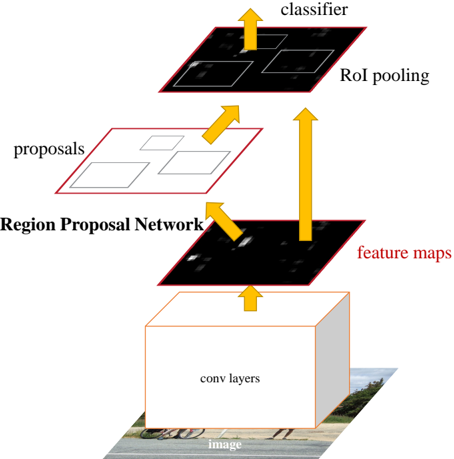
State-of-the-art object detection networks depend on region proposal algorithms to hypothesize object locations. Advances like SPPnet [1] and Fast R-CNN [2] have reduced the running time of these detection networks, exposing region proposal computation as a bottleneck. In this work, we introduce a Region Proposal Network (RPN) that shares full-image convolutional features with the detection network, thus enabling nearly cost-free region proposals. An RPN is a fully convolutional network that simultaneously predicts object bounds and objectness scores at each position. The RPN is trained end-to-end to generate high-quality region proposals, which are used by Fast R-CNN for detection. We further merge RPN and Fast R-CNN into a single network by sharing their convolutional features-using the recently popular terminology of neural networks with 'attention' mechanisms, the RPN component tells the unified network where to look. For the very deep VGG-16 model [3] , our detection system has a frame rate of 5 fps (including all steps) on a GPU, while achieving state-of-the-art object detection accuracy on PASCAL VOC 2007, 2012, and MS COCO datasets with only 300 proposals per image. In ILSVRC and COCO 2015 competitions, Faster R-CNN and RPN are the foundations of the 1st-place winning entries in several tracks. Code has been made publicly available.
Overview
CoChat Summary
TL;DR
Faster R-CNN introduces a Region Proposal Network (RPN) that shares convolutional features with Fast R-CNN, making region proposals nearly cost-free and enabling a unified object detection system. It achieves near real-time detection with state-of-the-art accuracy on PASCAL VOC and MS COCO.
Key findings
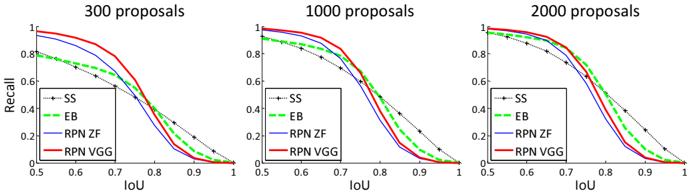
- With VGG-16 and shared features, Faster R-CNN reaches 69.9% mAP on PASCAL VOC 2007 test using 300 proposals, 73.2% with VOC07+12 training, 70.4% on VOC 2012 with 07++12, and 78.8% on VOC 2007 with COCO+07+12.
- Runtime: VGG-16 RPN + Fast R-CNN takes 198 ms total (5 fps), with RPN proposals costing 10 ms; ZF runs at 59 ms total (17 fps), versus SS + Fast R-CNN at 1830 ms (0.5 fps).
- Ablations: sharing features improves ZF mAP from 58.7% (unshared) to 59.9%; removing the reg layer drops mAP to 52.1%, and removing cls with 100 proposals drops it to 44.6%.
- On MS COCO test-dev, Faster R-CNN with VGG-16 and COCO train reaches 42.1% mAP@0.5 and 21.5% mAP@[.5,.95]; with COCO trainval it reaches 42.7% and 21.9%.
Methods
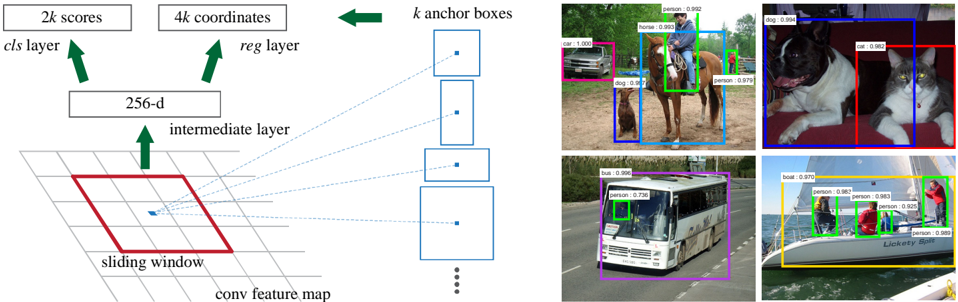
- The RPN is a fully convolutional network that slides a 3×3 window over shared conv features and predicts objectness scores and box regressions relative to anchors; default anchors use 3 scales (128², 256², 512²) and 3 aspect ratios (1:1, 1:2, 2:1), giving k = 9 anchors per position.
- Training uses a 4-step alternating scheme with ImageNet-pretrained ZF or VGG-16, SGD, single-scale images (shorter side s = 600), NMS at IoU 0.7, and 300 proposals at test time; evaluation is on PASCAL VOC 2007/2012 and MS COCO.
- Main metrics are detection mAP on PASCAL VOC and mAP@0.5 / mAP@[.5,.95] on MS COCO, with timing measured on a K40 GPU.
Limitations
- Stated in the paper: non-approximate joint training would require a differentiable RoI pooling/warping layer and is beyond the paper’s scope; the approximate joint training ignores gradients with respect to proposal box coordinates.
- Stated in the paper: cross-boundary anchors are ignored during training, and multi-scale feature extraction may improve accuracy but does not offer a good speed-accuracy trade-off.
- Evident from the text: the main experiments focus on PASCAL VOC and MS COCO with ZF/VGG-16 backbones, so generalization to other datasets, backbones, or detection regimes is not extensively characterized.
Model-written summary. Check it against the paper before relying on it.
Integrity signals
Registry
Cites
Statistics
Figures


Verification
Claims the paper makes
12 Valid · 5 Not valid · 8 Not checked · 83 Own results and interpretations
Every source the paper cites for this claim was checked and supports it.
In the paper
“Only by replacing VGG-16 with a 101layer residual net (ResNet-101) [18], the Faster R-CNN system increases the mAP from 41.5%/21.2% (VGG16) to 48.4%/27.2% (ResNet-101) on the COCO val set.”
What the sources say
- Supportedcites [18] [18] K. He, X. Zhang, S. Ren, and J. Sun, 'Deep residual learning for image recognition,' arXiv:1512.03385 , 2015. - source
Table 8 (p. 8) reports the exact COCO validation-set mAP values for baseline Faster R-CNN with VGG-16 and ResNet-101. Section 4.3 (p. 8) says the detection implementation was the same for both models and attributes the gain to replacing VGG-16 with ResNet-101. (LLM, conf=0.95)
plainstates a cause- Asserted: passes — The authors put it forward as true.
- Checkable: passes — It can be checked against evidence.
- Load-bearing: passes — The paper’s conclusions depend on it.
- Based: passes — The paper gives a reason why it holds.
- Supported
Every source the paper cites for this claim was checked and supports it.
In the paper
“This observation is still valid even when one increases the depth substantially to over 100 layers [18].”
What the sources say
- Supportedcites [18] [18] K. He, X. Zhang, S. Ren, and J. Sun, 'Deep residual learning for image recognition,' arXiv:1512.03385 , 2015. - source
In ImageNet Classification (p. 7), the paper reports that 101- and 152-layer ResNets outperform the 34-layer model, with no observed degradation. Its CIFAR-10 analysis (p. 7) also reports that a 110-layer ResNet converges well. These results support the stated extension to over 100 layers, although the isolated sentence does not specify what “this observation” refers to. (LLM, conf=0.87)
plain- Asserted: passes — The authors put it forward as true.
- Checkable: passes — It can be checked against evidence.
- Load-bearing: unclear — It is unclear whether the paper’s conclusions depend on it.
- Based: passes — The paper gives a reason why it holds.
- Supported
The cited sources support only part of this claim — read each source’s verdict below.
In the paper
“In ILSVRC and COCO 2015 competitions, Faster R-CNN and RPN are the basis of several 1st-place entries [18] in the tracks of ImageNet detection, ImageNet localization, COCO detection, and COCO segmentation.”
What the sources say
- Partly supportedcites [18] [18] K. He, X. Zhang, S. Ren, and J. Sun, 'Deep residual learning for image recognition,' arXiv:1512.03385 , 2015. - sourceExperimental — accuracy not yet measured
Section 4.3 (p. 8) lists first-place finishes in all four tracks, and the Object Detection Baselines (p. 10) describe a Faster R-CNN system using an RPN. The ImageNet Localization section (p. 12) also identifies its RPN-based method. But the copy attributes the entries collectively to deep residual nets; it does not establish that Faster R-CNN and RPN underpinned the COCO segmentation entry. (LLM, conf=0.86)
plainstates a cause- Asserted: passes — The authors put it forward as true.
- Checkable: passes — It can be checked against evidence.
- Load-bearing: unclear — It is unclear whether the paper’s conclusions depend on it.
- Based: passes — The paper gives a reason why it holds.
- Partly supported
The cited sources that could be checked couldn’t confirm or dispute this claim.
In the paper
“Yet when compared to efficient detection networks [2], Selective Search is an order of magnitude slower, at 2 seconds per image in a CPU implementation.”
What the sources say
- Could not verifycites [4] [4] J. R. Uijlings, K. E. van de Sande, T. Gevers, and A. W. Smeulders, 'Selective search for object recognition,' International Journal of Computer Vision (IJCV) , 2013. - sourceExperimental — accuracy not yet measured
The computational discussion in §5.3 (pp. 12–13) gives timings for complete object-recognition pipelines, not a two-second CPU runtime for Selective Search. The comparisons in §5.2.1 (p. 11) concern other object-location methods, not efficient detection networks. Searches for a two-second per-image runtime and a network comparison found neither claim in our copy. (LLM, conf=0.73)
- Not checked — no full text of the sourcecites [2] [2] R. Girshick, 'Fast R-CNN,' in IEEE International Conference on Computer Vision (ICCV) , 2015. - source
plainstates an association- Asserted: passes — The authors put it forward as true.
- Checkable: passes — It can be checked against evidence.
- Load-bearing: passes — The paper’s conclusions depend on it.
- Based: passes — The paper gives a reason why it holds.
- Could not verify
Every source the paper cites for this claim was checked and supports it.
In the paper
“We comprehensively evaluate our method on the PASCAL VOC detection benchmarks [11] where RPNs with Fast R-CNNs produce detection accuracy better than the strong baseline of Selective Search with Fast R-CNNs.”
What the sources say
- Supportedcites [11] [11] M. Everingham, L. Van Gool, C. K. I. Williams, J. Winn, and A. Zisserman, 'The PASCAL Visual Object Classes Challenge 2007 (VOC2007) Results,' 2007. - source
The citation is attached to “PASCAL VOC detection benchmarks,” not to the citing authors’ comparison of RPNs and Selective Search. Sections 5.2 and 6.2 describe the VOC detection task, its submitted methods, and its results, confirming the benchmark identification. (LLM, conf=0.92)
plainstates a cause- Asserted: passes — The authors put it forward as true.
- Checkable: passes — It can be checked against evidence.
- Load-bearing: passes — The paper’s conclusions depend on it.
- Based: passes — The paper gives a reason why it holds.
- Rests on an assumption not shown here.
- Supported
56 more claims
Create a free account to see all 108 claims and to verify the 2 references still open.
- Probably not a substantial claim. 11
- It may state two separate claims as one. 40
- The quote only partly states this claim. 1
Claims other papers make about this one
Each is checked against this paper’s own text: does it say what the citing paper says it does?
The source backs part of the claim, not all of it — or backs it for a different population, condition or comparison.
In the citing paper
“Unlike the original paper [19] that adopted stage-wise training regarding RPN, we use an improved implementation with end-to-end joint training similar to [37], which leads to higher baselines than [19].”
From Non-local Neural Networks (2018) · cites this paper as [37]
Experimental — accuracy not yet measuredThe source backs part of the claim, not all of it — or backs it for a different population, condition or comparison.
In the citing paper
“Faster RCNN is the first near-realtime deep learning detector (COCO mAP@.5=42.7%, VOC07 mAP=73.2%, 17fps with ZF-Net [48]).”
From Object Detection in 20 Years: A Survey (2023) · cites this paper as [19]
Experimental — accuracy not yet measuredThe source backs part of the claim, not all of it — or backs it for a different population, condition or comparison.
In the citing paper
“Faster RCNN is the first near-realtime deep learning detector (COCO mAP@.5=42.7%, VOC07 mAP=73.2%, 17fps with ZF-Net [48]).”
From Object Detection in 20 Years: A Survey (2023) · cites this paper as [47]
Experimental — accuracy not yet measuredThe source backs part of the claim, not all of it — or backs it for a different population, condition or comparison.
In the citing paper
“In the deep learning era, due to the increase of computing power, bootstrap was shortly discarded in object detection during 2014-2016 [16-20].”
From Object Detection in 20 Years: A Survey (2023) · cites this paper as [19]
Experimental — accuracy not yet measuredThe source backs part of the claim, not all of it — or backs it for a different population, condition or comparison.
In the citing paper
“The most commonly used idea to reduce the feature computational redundancy is to compute the feature map of the whole image only once [18, 19, 124], which have achieved tens or even hundreds of times of acceleration.”
From Object Detection in 20 Years: A Survey (2023) · cites this paper as [19]
Experimental — accuracy not yet measured
21 more claims about this paper
Create a free account to see every claim other papers make about this one.
Citations
Cites
Deep Residual Learning for Image Recognition
He, K., Zhang, X., Ren, S., & Sun, J. (2016) · 2016 IEEE Conference on Computer Vision and Pattern Recognition (CVPR) · doi:10.1109/cvpr.2016.90 · Cited by 235,474 · cited 7×
“to propose regions from data, and thus can easily benefit from deeper and more expressive features (such as the 101layer residual nets adopted in [18]).”
BackgroundInfluentialSelf-citationVery Deep Convolutional Networks for Large-Scale Image Recognition
Simonyan, K., & Zisserman, A. (2014) · arXiv · doi:10.48550/arxiv.1409.1556 · Cited by 114,148
ImageNet classification with deep convolutional neural networks
Krizhevsky, A., Sutskever, I., & Hinton, G. E. (2017) · Communications of the ACM · doi:10.1145/3065386 · Cited by 112,155 · cited 1×
“For the regression loss, we use L where R is the robust loss function (smooth L 1 ) defined in [5].”
MethodGoing deeper with convolutions
Szegedy, C., Liu, W., Jia, Y., Sermanet, P., Reed, S., Anguelov, D., Erhan, D., Vanhoucke, V., & Rabinovich, A. (2015) · 2015 IEEE Conference on Computer Vision and Pattern Recognition (CVPR) · doi:10.1109/cvpr.2015.7298594 · Cited by 48,562 · cited 1×
“1× 10(6) parameters (1536 × (4 + 1) × 800 for GoogleNet [34] in MultiBox [27]).”
Microsoft COCO: Common Objects in Context
Lin, T.-Y., Maire, M., Belongie, S., Hays, J., Perona, P., Ramanan, D., Dollár, P., & Zitnick, C. L. (2014) · Lecture Notes in Computer Science · doi:10.1007/978-3-319-10602-1_48 · Cited by 45,460 · cited 1×
“Region proposal methods typically rely on inexpensive features and economical inference schemes.”
MethodImageNet Large Scale Visual Recognition Challenge
Russakovsky, O., Deng, J., Su, H., Krause, J., Satheesh, S., Ma, S., Huang, Z., Karpathy, A., Khosla, A., Bernstein, M., et al. (2015) · International Journal of Computer Vision · doi:10.1007/s11263-015-0816-y · Cited by 39,380 · cited 1×
“, the shared convolutional layers) are initialized by pre-training a model for ImageNet classification [36], as is standard practice [5].”
MethodFully convolutional networks for semantic segmentation
Long, J., Shelhamer, E., & Darrell, T. (2015) · 2015 IEEE Conference on Computer Vision and Pattern Recognition (CVPR) · doi:10.1109/cvpr.2015.7298965 · Cited by 38,834 · cited 5×
“Our RPNs are thus a kind of fully-convolutional network (FCN) [14] and they can be trained end-to-end specifically for the task for generating detection proposals.”
BackgroundMethodInfluentialRich Feature Hierarchies for Accurate Object Detection and Semantic Segmentation
Girshick, R., Donahue, J., Darrell, T., & Malik, J. (2014) · 2014 IEEE Conference on Computer Vision and Pattern Recognition · doi:10.1109/cvpr.2014.81 · Cited by 32,684 · cited 7×
“, Selective Search [4] object detectors, RCNN [5], and Fast R-CNN [2]).”
BackgroundMethodInfluentialSelf-citationGirshick, R. (2015) · 2015 IEEE International Conference on Computer Vision (ICCV) · doi:10.1109/iccv.2015.169 · Cited by 28,105
Self-citationThe pascal visual object classes (VOC) challenge
Everingham, M., Van Gool, L., Williams, C. K. I., Winn, J., & Zisserman, A. (2010) · International Journal of Computer Vision · doi:10.1007/s11263-009-0275-4 · Cited by 19,599
Research works printed but not linked: 1
- [10] S. Ren, K. He, R. Girshick, and J. Sun, 'Faster R-CNN: Towards real-time object detection with region proposal networks,' in Neural Information Processing Systems (NIPS) , 2015. -
Cited by
Items 55,501–55,600 of 56,405
Pei, R., Ma, P., Qian, J., et al. (2026) · PLoS ONE · doi:10.1371/journal.pone.0354466
Self-citationLTE-DETR: Long-Tail Scenes Object Detection via Enhanced Feature Representation
Xu, F., Zhang, H., Zhang, Z., et al. (2026) · Communications in computer and information science · doi:10.1007/978-981-95-8447-5_13
A Review of AI-Enabled UAV-Based Systems for Defense Applications
Michailidis, E. T., & Karanasiou, I. S. (2026) · Drones · doi:10.3390/drones10080602
Jing, L., Xiao, X., Li, Z., et al. (2026) · Materials Evaluation · doi:10.32548/2026.me-04571
Cai, H., Li, X., Li, Y.-Y., et al. (2026) · Neurocomputing · doi:10.1016/j.neucom.2026.134687
SFEDet: edge-guided spatial-frequency fusion network for steel surface defect detection
Chen, W., Wei, J., Guo, X., & Chen, B. (2026) · Scientific Reports · doi:10.1038/s41598-026-64588-4
Fang, J., Sun, H., & Li, H. (2026) · Remote Sensing · doi:10.3390/rs18152627
“Main-stream deep learning detectors fall into two categories: two-stage frameworks represented by Faster R-CNN [15] and one-stage frameworks, including RetinaNet and the YOLO series [16].”
Yang, Q., Hong, Q., Xiao, D., Xiao, F., & Yang, Z. (2026) · Smart Agricultural Technology · doi:10.1016/j.atech.2026.102459
Bi, P., Ding, Y., Du, X., & Gabbouj, M. (2026) · IEEE Transactions on Instrumentation and Measurement · doi:10.1109/tim.2026.3720869
Tang, X., Wang, Y., Wang, C., Han, Y., & Materukhin, A. (2026) · Science of Remote Sensing · doi:10.1016/j.srs.2026.100484
Onboard Vehicle Detection for Autonomous UAV Reconnaissance under Degraded Visual Conditions
Pham, T. D., & Тарлаковский, Д. В. (2026) · Lecture notes in computer science · doi:10.1007/978-3-032-34384-0_28
SAC-YOLO: a lightweight pest detection algorithm based on progressive feature fusion
Lv, M., Zhou, H., Wang, X., Wen, W., & Xue, Y. (2026) · Engineering Research Express · doi:10.1088/2631-8695/ae8f0a
“Among these, two-stage algorithms include region-based convolutional neural networks [2], fast region-based convolutional neural network [3], faster region-based convolutional neural network [4], and mask region-based convolutional neural network [5].”
Wavelet-Guided Context Modeling and Aggregation Network for Anti-UAV Detection
Liu, J.-Q., Zhang, S.-X., Sun, Z.-Y., et al. (2026) · IEEE Internet of Things Journal · doi:10.1109/jiot.2026.3721211
“These results indicate that WCMA-UAV achieves competitive AP performance among the compared higher-capacity generic detectors under this setting, including DINO [40], RT-DETR [43], Faster R-CNN [41], Cascade R-CNN [42], and TOOD [38].”
Hacıefendioğlu, K., Günaydın, M., Bostan, A., & Altunışık, A. C. (2026) · Sensors · doi:10.3390/s26154977
“Although two-stage object detection methods such as R-CNN and its derivatives [22,24] are known for their high accuracy, single-stage architectures have become increasingly popular in real-time applications due to their faster inference speed [23].”
Han, P., Huang, H., & Chen, D. (2026) · Buildings · doi:10.3390/buildings16153120
“Among these, Faster R-CNN utilizes a Region Proposal Network (RPN) to directly generate candidate damage regions from an image [83] and has been widely applied in post-disaster damage assessment.”
Chang, Y. L., Zhao, X., Li, Y., et al. (2026) · Concurrency and Computation Practice and Experience · doi:10.1002/cpe.70893
“Typical representatives of this class of detectors include region-based convolutional neural networks R-CNN [ 12], Fast R-CNN [ 13], Faster R-CNN [ 14], and Mask R-CNN [ 15].”
OpenAqua: A Large-Scale Fine-Grained Dataset and Benchmark for Open Underwater Visual Perception
Luo, L., Mu, P., & Bai, C. (2026) · ACM SIGKDD Conference on Knowledge Discovery and Data Mining (KDD) · doi:10.1145/3770855.3817535
“Our comparative benchmark includes general detectors, such as the two-stage Faster R-CNN [42], the Transformer-based DINO [54], and the one-stage YOLO11m.”
A track obstacle detection algorithm for underground coal mines based on SGF-DETR
Bai, Y., Hu, S., Sun, J., et al. (2026) · Pattern Analysis and Applications · doi:10.1007/s10044-026-01747-3
“The initial target detection methods were represented by two-stage algorithms such as RCNN [6], Fast-RCNN [7], and Faster-RCNN [8], which achieved high positioning accuracy through the candidate region mechanism.”
Self-citationLEIPL: A novel fault diagnosis method for high-speed train axle box bearings under noisy labels
Jiacheng, L., Zhang, K., Guo, Z., Xia, Y., Guan, Y., Zheng, Q. S., & Zhao, C. (2026) · ISA Transactions · doi:10.1016/j.isatra.2026.07.021
Ma, W., Liu, L., Wang, B., et al. (2026) · Electric Power Systems Research · doi:10.1016/j.epsr.2026.113938
Kong, Q.-Y., Yang, C., Tsai, C.-H., & Lee, M.-Y. (2026) · Journal of Hydrology · doi:10.1016/j.jhydrol.2026.136183
Dong, X., Shen, J., Li, C., & Zhang, T. (2026) · Journal of Real-Time Image Processing · doi:10.1007/s11554-026-01955-4
“The RCNN [24] series serves as a representative algorithm for two-stage detection.”
Dan, D., Hu, J., Dan, Q., Ge, L., Bao, Y., & Sadhu, A. (2026) · Engineering Structures · doi:10.1016/j.engstruct.2026.123514 · Cited by 1
Chong, I. K., Zhao, Z., Yu, Q., Zhang, Q., Xu, J., Xu, Z., & Zou, Y. (2026) · Biomedical Signal Processing and Control · doi:10.1016/j.bspc.2026.111178
ALSDet: a global context-enhanced network for detecting small-target diseases on apple leaves
Gong, X., Xu, P., Ren, R., Gong, F., & Zhang, S. (2026) · Frontiers in Plant Science · doi:10.3389/fpls.2026.1883033
FUSEP: A Multi-Center Benchmark for Diverse Tasks in Fetal Ultrasound Screening Early Pregnancy
Pu, B., Yang, J., Wang, L., Tan, Y., He, G., Dong, X., Lin, Q., Guo, J., Yang, L., Liu, Z., et al. (2026) · ACM SIGKDD Conference on Knowledge Discovery and Data Mining (KDD) · doi:10.1145/3770855.3817453 · Cited by 1
“In this section, we evaluate existing advanced methods [5, 26, 29, 35, 40, 58, 66, 78, 83–85] on our proposed FUSEP for multi-center medical multi-object detection task across multiple medical centers.”
Yoon, J.-H., Lim, W.-J., Kim, W., et al. (2026) · Sensors · doi:10.3390/s26154997
Wang, H., He, S., Ding, K., Zhao, Y., Wang, W., Wang, Y., & Zhang, X. (2026) · Foods · doi:10.3390/foods15162775
“The detection of small targets largely depends on the ability to capture detailed features [19].”
Yang, F., Chen, J., Wan, D., et al. (2026) · Ocean Engineering · doi:10.1016/j.oceaneng.2026.127219
PFE-Det: Progressive Feature Evolution for Small Object Detection in UAV Aerial Images
Fang, A., zhang, Y., Dong, X., Gu, L., Li, S. G., Zhu, D., & Xiao, X. (2026) · Sensors · doi:10.3390/s26155003 · Cited by 1
“Comparison models cover classical two-stage networks (Faster R-CNN [6], Cascade R-CNN [42]), mainstream single-stage and anchor-free networks (RetinaNet [43], TOOD [44], GFL [45], RTMDet [46], YOLOX [47], RT-DETR [9]), the latest YOLO series variants (YOLOv5, YOLOv8, YOLOv10, and YOLO11–YOLO13…”
Zhang, H., Liu, J., & Li, J. (2026) · Research Square · doi:10.21203/rs.3.rs-10037779/v1
Small object detection for aerial images based on adaptive context enhancement and feature guidance
Ma, J., Ma, X., Zhao, Y., Wang, C., & Xu, S. (2026) · Engineering Applications of Artificial Intelligence · doi:10.1016/j.engappai.2026.115879
Anomaly Detection System Design Based on Deep Learning for Tobacco Production Line
Song, M., Shi, Y., Zhu, L., et al. (2026) · doi:10.1109/iehns68708.2026.11606679
“The popular models include R-CNN [4], SSD [5], DETR [6], and YOLO [7].”
Hybrid Object Detection and Semantic Segmentation for Offline Handwritten Diagram Understanding
Costa, D. S., & Mello, C. A. B. (2026) · IEEE Access · doi:10.1109/access.2026.3721793
Belabbas, I., & Su, Z. (2026) · Sustainability · doi:10.3390/su18168073
Huang, Z., Guan, W., Zhou, J., Hong, W., & Su, H. (2026) · Remote Sensing · doi:10.3390/rs18162649 · Cited by 1
Unsupervised Few-Shot Industrial Defect Detection via Hierarchical Gating and Dynamic Fusion
Hu, S., Chan, S., Piao, X., Wang, L., Wen, H., & Chen, J. (2026) · International Conference on Artificial Intelligence and Computing (AIC) · doi:10.1109/aic65131.2026.11633758
Kiran, K., & Kumar, T. S. (2026) · doi:10.1109/gseact68539.2026.11620006
“Two-stage detectors built around the Region Proposal Network (RPN) and region-based convolutional networks, notably Faster R-CNN [1] and Fast R-CNN [2], have defined the canonical architecture for high-accuracy detection.”
Zhao, P., Chen, W., & An, J. (2026) · Journal of Real-Time Image Processing · doi:10.1007/s11554-026-01936-7
“Representative models such as R-CNN [9], FasterR-CNN[10],andMaskR-CNN[11]havebeenapplied to helmet detection, reaching 90.1–98.4% accuracy [12] and 92% accuracy [13].”
InfluentialA Hybrid Human Pose Recognition System for Complex Rescue Scenarios
Qu, D., Cao, S., Fan, M., & Ma, L. (2026) · IEEE International Conference on Computer Vision and Deep Learning (DLCV) · doi:10.1109/dlcv69906.2026.11635668
“Therefore, network branches for single-person pose estimation were introduced, leading to the development of multi-person pose detection algorithms such as Faster R-CNN [15] and Mask R-CNN [9].”
SMN: Signal Modulation Network for Tiny Object Detection in Remote Sensing Imagery
Zhang, T., Ren, L., Gao, L., Sun, X., & Zhang, B. (2026) · IEEE Transactions on Image Processing · doi:10.1109/tip.2026.3719467
Improved Real-Time Object Detection Using a YOLOv8-Based Ensemble Framework
Vashistha, P., Kayal, M., & Das, B. (2026) · IEEE Global Symposium on Emerging and Communication Technologies (GSEACT) · doi:10.1109/gseact68539.2026.11620141
“Early deep learning methods such as Region-based Convolu-tional Neural Networks (R-CNN) combined region proposals with accuracy [1], while Faster R-CNN further enhanced efficiency by integrating a region proposal [2].”
Vision Transformers-Integrated Construction Site Monitoring System for Project Accuracy
Alshikhe, R. R., Manikanda Prasath, K., Mallika, G. R., Siddharthan, P., Dhivya, S., & Malani, S. R. (2026) · IEEE Global Symposium on Emerging and Communication Technologies (GSEACT) · doi:10.1109/gseact68539.2026.11619990
“The head for classifying consists of 2 layer MLP with GELU activation for refining feature before final predicted results [12].”
Chen, X., & Cheng, K. (2026) · International Journal of Computer Integrated Manufacturing · doi:10.1080/0951192x.2026.2714117 · Cited by 3
From Filtering to Repairing: An Organic Triage Framework for Domain Adaptive Object Detection
Hou, Z., Liu, J., & Dong, L. (2026) · IEEE Access · doi:10.1109/access.2026.3721511
Advanced YOLO-Based Banknote Detection
Mirindi, F., Sinkhonde, D., & Mirindi, D. (2026) · IEEE International Conference on Computer Vision and Deep Learning (DLCV) · doi:10.1109/dlcv69906.2026.11635378
“For Faster Region-based Convolutional Neural Network (Faster R-CNN), Ren et al. explain that “a Region Proposal Network is a fully convolutional network that simultaneously predicts object bounds and objectness scores” [6, p. 1137].”
Improving Solar Panel Defect Detection in Thermal Imagery Through Temperature Data Integration
Patton, D. J. C., García, F., Viani, L., et al. (2026) · Applied Sciences · doi:10.3390/app16167874
A Lightweight In-Cabin Driver Object Detection Method Based on Improved YOLOv12
Han, K., Cheng, X., Li, D., et al. (2026) · doi:10.1109/dlcv69906.2026.11635544
“Representative two-stage detectors, such as Faster R-CNN [8], usually achieve strong detection accuracy, but their multi-step processing pipelines often result in higher complexity and lower inference efficiency, which limits their suitability for real-time in-vehicle applications.”
Multi-Camera Real-Time Accident Detection and Emergency Alert System for Traffic Control Rooms
Kumar, J. B., Sainath, B. V. S., Mageswari, R. U., et al. (2026) · doi:10.1109/gseact68539.2026.11620246
Frustumpillar-Fusion: Gated 4D Radar-Camera Fusion for USVs
Zheng, H., Li, H., Song, H., Huang, H., Chen, Y., Ding, W., Ma, X., & Zhou, X. (2026) · MTS/IEEE OCEANS Conference (OCEANS) · doi:10.1109/oceans66983.2026.11617087
Reddy, K. N., Swarna, B., Sathwik, G., Manikanth, B., Madhuri, G., & Gobbilla, U. R. (2026) · IEEE Global Symposium on Emerging and Communication Technologies (GSEACT) · doi:10.1109/gseact68539.2026.11620115
“Feature fusion has received considerable attention because it balances semantic richness and computational practicality [2], [8].”
Consistencydet: few-step self-consistent box denoising for efficient object detection
Jiang, L., Wang, Z., Wang, C., Li, M., & Leng, J. (2026) · The Visual Computer · doi:10.1007/s00371-026-04674-w
“Early detectors relied on sliding windows or region proposals [7, 8]; anchor-based methods improved scale and aspect-ratio coverage [9, 10]; and recent query/proposal-based detectors, including DETR and Sparse R-CNN, recast detection as set prediction with learnable queries or proposals [11, 12].”
A Cloud-Edge Collaborative Framework for Personnel Identification via Wearable Smart Glasses
Chen, H., Chen, W., Zhang, L., Ye, F., & Fu, M. (2026) · Lecture notes in computer science · doi:10.1007/978-3-032-34387-1_2
Wang, R., Tang, Q., Zhang, M., et al. (2026) · doi:10.1109/oceans66983.2026.11617048
“Among deep learning methods, two-stage detectors such as Faster R-CNN [8] first generate region proposals and then perform classification and regression, offering high detection accuracy but slower speed.”
Yang, D., 关传弢, Zu, A., Chen, Z., Li, P., Chen, H., Luo, D., & Fan, X. (2026) · Biomedical Signal Processing and Control · doi:10.1016/j.bspc.2026.111224
Mask R-CNN Based Attention Guided CNN Ordinal Regression for Automated Car Damage Severity Detection
Biswas, S., Basak, D., Das, S., Saha, S., & Banerjee, S. (2026) · IEEE Global Symposium on Emerging and Communication Technologies (GSEACT) · doi:10.1109/gseact68539.2026.11620498
“Two-stage detection frameworks were popularized by Faster R-CNN [4], and instance segmentation was significantly advanced by Mask R-CNN, which augments detection with a mask prediction branch [5].”
Zhao, Z., Tian, B., Miao, S., et al. (2026) · Electric Power Systems Research · doi:10.1016/j.epsr.2026.113919
Boosting YOLOv5 Model Performance Without Architectural Modifications: A Systematic Approach
Nguyen, Q. H., Tran, D. M. P., Luong, P. T. A., Trinh, L. H., La, H. G., & Ha, A. D. (2026) · Lecture notes in networks and systems · doi:10.1007/978-3-032-23317-2_10
Liu, M., Lou, T., Yin, Y., Wang, C., & Wang, J. (2026) · Biotechnology Advances · doi:10.1016/j.biotechadv.2026.109006
PestBoost: a novel Bayesian augmented domain neural network for robust strawberry disease detection
Kim, Y., Lee, H., Lee, W. S., Chae, Y. T., & Lee, D. (2026) · Information Processing in Agriculture · doi:10.1016/j.inpa.2026.08.002
Han, X.-J., Qu, Z., Xia, S., et al. (2026) · IET Image Processing · doi:10.1049/ipr2.70448
YOLOv11-ASE: fabric defect detection algorithm based on improved YOLOv11
Wang, J., Wang, M., Xing, Y., Xia, Q., & Wu, G. (2026) · Journal of the Textile Institute · doi:10.1080/00405000.2026.2713315 · Cited by 1
A lightweight deep learning network for accurate defect detection in photovoltaic cells
Gao, Y., Li, Z., Zhang, K., Jiang, Y., & Zhu, Z. (2026) · Applied Soft Computing · doi:10.1016/j.asoc.2026.116169
Real-Time Vehicle Detection and License Plate Recognition for Smart Traffic Management
Kour, S. K., Konduri, G. K., Sreeja, S., Konduri, M., Manda, V. K., & Adilakshmi, T. (2026) · Lecture notes in networks and systems · doi:10.1007/978-3-032-27669-8_11
Wang, X., Zhu, M., Zou, Y., Liu, S., Zhang, H., Wan, M., & Lin, M. (2026) · Ultrasound in Medicine & Biology · doi:10.1016/j.ultrasmedbio.2026.07.002
LDMFNet: A Lightweight Dual-Modal Fusion Network for Accurate Multispectral Object DetectionPreprint
Cao, D., & Li, G. (2026) · Research Square · doi:10.21203/rs.3.rs-7808714/v1
Attention-driven YOLOv11n–DeiT model for enhanced detection of tomato leaf diseases
Alsakar, Y. M., Sakr, N. A., & Elmogy, M. M. (2026) · Scientific Reports · doi:10.1038/s41598-026-64897-8
Huang, S., Zhang, Y., Wang, Y., et al. (2026) · Multimedia Systems · doi:10.1007/s00530-026-02599-x
MicroPPE-Guard: an efficient model for accurate personal protective equipment
Le, X., Pham, P., Le, K.-T., Bui, L., & Huynh, B. (2026) · Measurement · doi:10.1016/j.measurement.2026.122842
Abdelaziz, A., Abdelwahab, H., & Ali, E. (2026) · Innovative Infrastructure Solutions · doi:10.1007/s41062-026-02873-x
“The main detector types utilized in this field include Faster R-CNN, R-FCN, YOLO, and SSD. Region-based models are often associated with high detection accuracy; however, their high computational requirements may limit real-time implementation [3, 14].”
Bearing-TFUNet: A Triple-Fusion Segmentation Model for Bearing Defect Detection
Shi, H., & Hua, C. (2026) · Applied Sciences · doi:10.3390/app16167907
Detector-Guided Multi-View Visual Monitoring of Bolt Loosening in Hydropower Generator Rotors
Lyu, J., Guo, J., Yuan, F., Ran, Y., Gong, H., Wu, T., & Zhang, T. (2026) · Applied Sciences · doi:10.3390/app16167930
FAFA: A frequency-aware adversarial robust fairness algorithm
Li, J., Yan, C., & Zheng, S. (2026) · Neural Networks · doi:10.1016/j.neunet.2026.109496
Real Time Automated Surface Defect Detection in Food Products
Yazhini, M. C., & Mahalakshmi, M. (2026) · International Conference on Data Science and Business Systems (ICDSBS) · doi:10.1109/icdsbs69077.2026.11634642
Hyperspectral Object Detection via Spectral Prototype Mining and Spatial-Spectral Mamba Fusion
Wang, J., Li, Z., Wang, Y., Fu, G., Xing, C., & Xue, J. (2026) · IEEE Journal of Selected Topics in Applied Earth Observations and Remote Sensing · doi:10.1109/jstars.2026.3722059
Bolt-YOLO: A Cascaded Framework for Fine-Grained Status Detection of Transmission Line Bolts
Zhu, D., Huang, Q., & Gao, F. (2026) · International Conference on Electronic Information Technology and Computer Engineering (EITCE) · doi:10.1109/eitce70137.2026.11634631
SmoC-Track: Smoothing Observation Noise and Feature Degradation for Robust Multi-Object Tracking
Xie, L., Wu, P., Xu, R., Zhang, X., & Zhang, Y. (2026) · IEEE Access · doi:10.1109/access.2026.3722072
Pedestrian Behavior Prediction for Autonomous Vehicles using Deep Learning
Prathipa, K., & Arthy, M. (2026) · International Conference on Data Science and Business Systems (ICDSBS) · doi:10.1109/icdsbs69077.2026.11634987
“The proposed architecture does not treat each frame equally while being processed as opposed to conventional RNNs, but rather employs additive attention to eliminate irrelevant frames containing no action [13].”
Tang, Y., Sun, H., Zhong, Z., et al. (2026) · Research Square · doi:10.21203/rs.3.rs-10506597/v1
Shen, Y., Ma, L., Wang, H., et al. (2026) · Expert Systems with Applications · doi:10.1016/j.eswa.2026.133936
Transmission Line Equipment Defect Detection Based on an Improved RT-DETR
Wu, Z., Qin, L., Bian, H., et al. (2026) · International Symposium on Advances in Electrical, Electronics and Computer Engineering (ISAEECE) · doi:10.1109/isaeece70502.2026.11635259
“Two-stage detectors, such as Fast Region-based Convolutional Neural Networks (Fast R-CNN), generally achieve high detection accuracy, but their inference speed is relatively low [6].”
Campus Personnel Abnormal Behavior Detection Based on an Improved YOLOv10
Hao, Y., Pan, Y., Gu, Y., et al. (2026) · International Symposium on Advances in Electrical, Electronics and Computer Engineering (ISAEECE) · doi:10.1109/isaeece70502.2026.11635547
“Faster R-CNN further used a region proposal network to jointly optimize candidate-box generation, classification, and regression, improving the performance of two-stage detection [3].”
Dai, Y., Luo, Q., Qiang, Z., & Wang, X. (2026) · doi:10.1109/icbdse70225.2026.11635253 · Cited by 1
“…; YOLOv3 adopted the Darknet-53 feature pyramid architecture and multi-scale prediction mechanism to improve small object detection capabilities [10] ; YOLOv4 achieved performance leaps in single-GPU environments through technologies like CSPNet, Mosaic data augmentation, and PANet path…”
AOPQ-Net Acoustic–Optical Proposal Query Network for Underwater Multimodal Object Detection
Lu, Y., Zhang, Z., Ding, S., et al. (2026) · Remote Sensing · doi:10.3390/rs18162703
Exploring high-frequency spatial guidance for enhanced small remote sensing object detection
Sun, J., Chen, F., Xu, M., Cao, F., Li, C., Zhao, Y., Sun, Z., & Li, J. (2026) · Computing · doi:10.1007/s00607-026-01726-w
“And These models include YOLOv5, YOLOv4 [39], Faster-RCNN [17], YOLOx [40 ], SSD [ 41], YOLOv3, YOLOv7 [18 ], YOLOv8, EfficientDet [ 42], RetinaNet [43], CenterNet [44] and SOD-YOLOv10 [ 45].”
Self-citationA Lightweight Multi-Scale Road Defect Detection Method Based on an Improved YOLO11n
Li, Z., Ma, X., Liang, J., & Wang, H. (2026) · IEEE China Conference on System Simulation Technology and its Applications (CCSSTA) · doi:10.1109/ccssta69471.2026.11635258
“Two-stage algorithms, such as Faster R-CNN [2] and Mask R-CNN [3], achieve high accuracy but suffer from slow inference speed, while one-stage algorithms, represented by SSD [4] and the YOLO series [5], have gained widespread adoption, with YOLO being particularly favored for its strong real-time…”
Li, Z., Chen, Z., Chen, L., Yang, S., Li, F., Li, F., Xu, T., Shi, J., & Chen, N. (2026) · Geo-spatial Information Science · doi:10.1080/10095020.2026.2710946
Lightweight Embedded Model for Real-Time Object Detection in Autonomous Driving
Ahn, G., Choi, J., Bong, E.-J., et al. (2026) · Transactions of Korean Society of Automotive Engineers · doi:10.7467/ksae.2026.34.8.947
Geroprotective drug discovery with an AI-enabled assay for heat resistancePreprint
Hodder, T. J., Nunes, A., Martinez, B., Opperman, K. J., Robbins, P. D., Myers, C. L., & Gill, M. S. (2026) · bioRxiv (Cold Spring Harbor Laboratory) · doi:10.64898/2026.08.10.743574
Edge-Aware Transformer Encoder for UAV-Based Power Grid Defect Detection
Kong, X., Zhou, J., Zhao, J., et al. (2026) · doi:10.1109/ccssta69471.2026.11635326
Huang, C., Wang, W., & Zhu, J. (2026) · IEEE China Conference on System Simulation Technology and its Applications (CCSSTA) · doi:10.1109/ccssta69471.2026.11635436
“Faster R-CNN [3] introduces the region proposal network to generate candidate regions for subsequent RoI prediction.”
A Transformer-Based Framework with Multi-Scale Feature Reconstruction for UAV Power Inspection
Zhang, B., Sun, M., Meng, H., & Yang, L. (2026) · Mathematics · doi:10.3390/math14162901
Liao, J., Luo, L., Hu, L., Chen, Q., & Peng, S. (2026) · Proceedings of the Institution of Mechanical Engineers Part D Journal of Automobile Engineering · doi:10.1177/09544070261469918
Weng, Z., Su, H., & Zheng, Z. (2026) · Concurrency and Computation Practice and Experience · doi:10.1002/cpe.70903
“…performance of LLSA-YOLO under conventional day-and-night conditions, this study compares it with classical object detection models and several rep - resentative modern detectors, including Faster R-CNN [ 23], RetinaNet [ 24], RT-DETR-L [ 25], SSDlite320 [ 26], and various YOLO-based models.”
Zhang, J., & Shang, J. (2026) · Algorithms · doi:10.3390/a19080670
Wavelet-Enhanced Cross-Strip Network for Remote Sensing Object Detection
Yang, C., Wu, Z., Hu, S., & Yang, Y. (2026) · Applied Sciences · doi:10.3390/app16168011
Afford-X: Generalizable and Slim Affordance Reasoning for Task-Oriented Manipulation
Zhu, X., Li, Y., Cui, L., Li, P., Gao, H.-A., Zhu, Y., & Zhao, H. (2026) · IEEE Transactions on Pattern Analysis and Machine Intelligence · doi:10.1109/tpami.2026.3722040 · Cited by 7
Zhou, Z., Ren, W., Zhao, X., et al. (2026) · Expert Systems with Applications · doi:10.1016/j.eswa.2026.133869
YOPOv2-Tracker: An End-to-End Agile Tracking and Navigation Framework
Lu, J., Hui, Y., Zhang, X., et al. (2026) · IEEE Transactions on Robotics · doi:10.1109/tro.2026.3721689
Metadata
- Authors
- Ren, S., He, K., Girshick, R., & Sun, J.
- Affiliations
- University of Science and Technology of China (CN)
- Visual Computing Group, Microsoft Research, Beijing, China
- Meta (United States) (US)
- ORCID
- Venue
- IEEE Transactions on Pattern Analysis and Machine Intelligence
- Published
- 2017-06-01
- Volume
- 39
- Issue
- 6
- Pages
- 1137-1149
- ISSN
- 0162-8828 (ISSN-L)
- 2160-9292
- 1939-3539
- OpenAlex
- W639708223
- Cited by
- 73,472
- References
- 60
- Citations by year
- 2026: 5632 · 2025: 9233 · 2024: 9699 · 2023: 9795 · 2022: 9251 · 2021: 9857 · 2020: 7617 · 2019: 6376 · 2018: 3729 · 2017: 1740
- FWCI
- 2215.09
- Type
- journal article
- Language
- en
- Open access
- green
- arxiv.org
- Licence
- Locations
- IEEE Transactions on Pattern Analysis and Machine Intelligence (publishedVersion)
- PubMed (publishedVersion)
- arXiv (Cornell University) (submittedVersion)
- arXiv (Cornell University)
- neural information processing systems
- Funders
- Microsoft Research
- Topics
- Physical Sciences › Computer Science › Computer Vision and Pattern Recognition › Advanced Neural Network Applications
- Physical Sciences › Computer Science › Computer Vision and Pattern Recognition › Visual Attention and Saliency Detection
- Physical Sciences › Computer Science › Computer Vision and Pattern Recognition › Advanced Image and Video Retrieval Techniques
- Keywords
- Faster R-CNN, region proposal network, real-time object detection, Fast R-CNN, bounding box regression, VGG16, attention mechanism, end-to-end learning, Pascal VOC, MS COCO
About these checks
Registry, retraction, Cites and statistics results are computed, not judged, with one exception: a printed reference that no index lists is read once by a model before it counts as a citation error. Claims are extracted by a model and kept only when their quote appears verbatim in the text; each cited source is then checked, with a model’s help, for whether it says what the claim relies on. Those verdicts can be wrong — read the claim’s quote and the cited source before relying on one.
The claim verdicts this report counts are experimental: their accuracy is not yet measured.
A language model drew the claims from the paper on 2026-10-10, under version 3 of the claim definition (model deepseek-v4.1-flash, prompt extract-v3).
A second model labelled each claim on 2026-10-10 (model jev-1.13-20260917, definition revision gold-guideline-v0.2).
Cited sources are checked with a language model’s help (gpt-6-sol).
Statistics and arithmetic are recomputed, not judged.
Confidence bands are shown only for fields calibrated on our annotated test set. None is calibrated yet, so no band is shown.
What counts as a claim ›How we measure confidence ›How we check this ›
Are you an author, or do you see a problem with this page? Request a review
Data sources
Bibliographic data: Semantic Scholar, OpenAlex, Crossref.
Contains information from the Semantic Scholar Academic Graph Datasets, made available under the ODC Attribution License (ODC-BY 1.0).
Semantic Scholar’s data is described in: Kinney, R., et al. (2023). The Semantic Scholar Open Data Platform. arXiv:2301.10140.
