

Faster R-CNN: Towards Real-Time Object Detection with Region Proposal Networks
Open accessThe DOI matches its Crossref record; 56 of the 60 references it cites were found in a registry or an index; 15 of the 27 sources its claims cite were checked for support.
Abstract
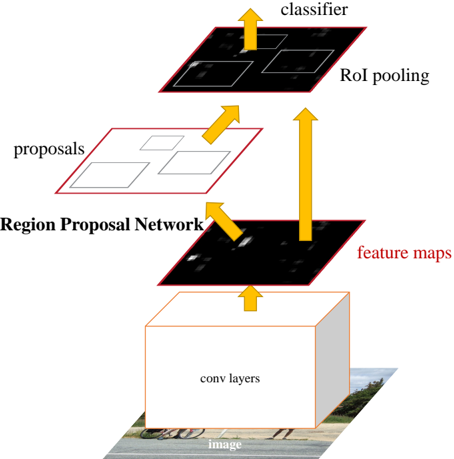
State-of-the-art object detection networks depend on region proposal algorithms to hypothesize object locations. Advances like SPPnet [1] and Fast R-CNN [2] have reduced the running time of these detection networks, exposing region proposal computation as a bottleneck. In this work, we introduce a Region Proposal Network (RPN) that shares full-image convolutional features with the detection network, thus enabling nearly cost-free region proposals. An RPN is a fully convolutional network that simultaneously predicts object bounds and objectness scores at each position. The RPN is trained end-to-end to generate high-quality region proposals, which are used by Fast R-CNN for detection. We further merge RPN and Fast R-CNN into a single network by sharing their convolutional features-using the recently popular terminology of neural networks with 'attention' mechanisms, the RPN component tells the unified network where to look. For the very deep VGG-16 model [3] , our detection system has a frame rate of 5 fps (including all steps) on a GPU, while achieving state-of-the-art object detection accuracy on PASCAL VOC 2007, 2012, and MS COCO datasets with only 300 proposals per image. In ILSVRC and COCO 2015 competitions, Faster R-CNN and RPN are the foundations of the 1st-place winning entries in several tracks. Code has been made publicly available.
Overview
CoChat Summary
TL;DR
Faster R-CNN introduces a Region Proposal Network (RPN) that shares convolutional features with Fast R-CNN, making region proposals nearly cost-free and enabling a unified object detection system. It achieves near real-time detection with state-of-the-art accuracy on PASCAL VOC and MS COCO.
Key findings
- With VGG-16 and shared features, Faster R-CNN reaches 69.9% mAP on PASCAL VOC 2007 test using 300 proposals, 73.2% with VOC07+12 training, 70.4% on VOC 2012 with 07++12, and 78.8% on VOC 2007 with COCO+07+12.
- Runtime: VGG-16 RPN + Fast R-CNN takes 198 ms total (5 fps), with RPN proposals costing 10 ms; ZF runs at 59 ms total (17 fps), versus SS + Fast R-CNN at 1830 ms (0.5 fps).
- Ablations: sharing features improves ZF mAP from 58.7% (unshared) to 59.9%; removing the reg layer drops mAP to 52.1%, and removing cls with 100 proposals drops it to 44.6%.
- On MS COCO test-dev, Faster R-CNN with VGG-16 and COCO train reaches 42.1% mAP@0.5 and 21.5% mAP@[.5,.95]; with COCO trainval it reaches 42.7% and 21.9%.
Methods
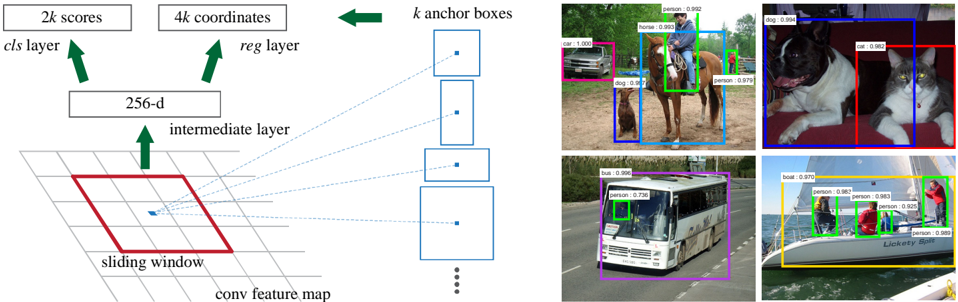
- The RPN is a fully convolutional network that slides a 3×3 window over shared conv features and predicts objectness scores and box regressions relative to anchors; default anchors use 3 scales (128², 256², 512²) and 3 aspect ratios (1:1, 1:2, 2:1), giving k = 9 anchors per position.
- Training uses a 4-step alternating scheme with ImageNet-pretrained ZF or VGG-16, SGD, single-scale images (shorter side s = 600), NMS at IoU 0.7, and 300 proposals at test time; evaluation is on PASCAL VOC 2007/2012 and MS COCO.
- Main metrics are detection mAP on PASCAL VOC and mAP@0.5 / mAP@[.5,.95] on MS COCO, with timing measured on a K40 GPU.
Limitations
- Stated in the paper: non-approximate joint training would require a differentiable RoI pooling/warping layer and is beyond the paper’s scope; the approximate joint training ignores gradients with respect to proposal box coordinates.
- Stated in the paper: cross-boundary anchors are ignored during training, and multi-scale feature extraction may improve accuracy but does not offer a good speed-accuracy trade-off.
- Evident from the text: the main experiments focus on PASCAL VOC and MS COCO with ZF/VGG-16 backbones, so generalization to other datasets, backbones, or detection regimes is not extensively characterized.
Model-written summary. Check it against the paper before relying on it.
Integrity signals
Registry
Cites
Statistics
Figures


Verification
Claims the paper makes
12 Valid · 5 Not valid · 8 Not checked · 83 Own results and interpretations
Every source the paper cites for this claim was checked and supports it.
In the paper
“Only by replacing VGG-16 with a 101layer residual net (ResNet-101) [18], the Faster R-CNN system increases the mAP from 41.5%/21.2% (VGG16) to 48.4%/27.2% (ResNet-101) on the COCO val set.”
What the sources say
- Supportedcites [18] [18] K. He, X. Zhang, S. Ren, and J. Sun, 'Deep residual learning for image recognition,' arXiv:1512.03385 , 2015. - source
Table 8 (p. 8) reports the exact COCO validation-set mAP values for baseline Faster R-CNN with VGG-16 and ResNet-101. Section 4.3 (p. 8) says the detection implementation was the same for both models and attributes the gain to replacing VGG-16 with ResNet-101. (LLM, conf=0.95)
plainstates a cause- Asserted: passes — The authors put it forward as true.
- Checkable: passes — It can be checked against evidence.
- Load-bearing: passes — The paper’s conclusions depend on it.
- Based: passes — The paper gives a reason why it holds.
- Supported
Every source the paper cites for this claim was checked and supports it.
In the paper
“This observation is still valid even when one increases the depth substantially to over 100 layers [18].”
What the sources say
- Supportedcites [18] [18] K. He, X. Zhang, S. Ren, and J. Sun, 'Deep residual learning for image recognition,' arXiv:1512.03385 , 2015. - source
In ImageNet Classification (p. 7), the paper reports that 101- and 152-layer ResNets outperform the 34-layer model, with no observed degradation. Its CIFAR-10 analysis (p. 7) also reports that a 110-layer ResNet converges well. These results support the stated extension to over 100 layers, although the isolated sentence does not specify what “this observation” refers to. (LLM, conf=0.87)
plain- Asserted: passes — The authors put it forward as true.
- Checkable: passes — It can be checked against evidence.
- Load-bearing: unclear — It is unclear whether the paper’s conclusions depend on it.
- Based: passes — The paper gives a reason why it holds.
- Supported
The cited sources support only part of this claim — read each source’s verdict below.
In the paper
“In ILSVRC and COCO 2015 competitions, Faster R-CNN and RPN are the basis of several 1st-place entries [18] in the tracks of ImageNet detection, ImageNet localization, COCO detection, and COCO segmentation.”
What the sources say
- Partly supportedcites [18] [18] K. He, X. Zhang, S. Ren, and J. Sun, 'Deep residual learning for image recognition,' arXiv:1512.03385 , 2015. - sourceExperimental — accuracy not yet measured
Section 4.3 (p. 8) lists first-place finishes in all four tracks, and the Object Detection Baselines (p. 10) describe a Faster R-CNN system using an RPN. The ImageNet Localization section (p. 12) also identifies its RPN-based method. But the copy attributes the entries collectively to deep residual nets; it does not establish that Faster R-CNN and RPN underpinned the COCO segmentation entry. (LLM, conf=0.86)
plainstates a cause- Asserted: passes — The authors put it forward as true.
- Checkable: passes — It can be checked against evidence.
- Load-bearing: unclear — It is unclear whether the paper’s conclusions depend on it.
- Based: passes — The paper gives a reason why it holds.
- Partly supported
The cited sources that could be checked couldn’t confirm or dispute this claim.
In the paper
“Yet when compared to efficient detection networks [2], Selective Search is an order of magnitude slower, at 2 seconds per image in a CPU implementation.”
What the sources say
- Could not verifycites [4] [4] J. R. Uijlings, K. E. van de Sande, T. Gevers, and A. W. Smeulders, 'Selective search for object recognition,' International Journal of Computer Vision (IJCV) , 2013. - sourceExperimental — accuracy not yet measured
The computational discussion in §5.3 (pp. 12–13) gives timings for complete object-recognition pipelines, not a two-second CPU runtime for Selective Search. The comparisons in §5.2.1 (p. 11) concern other object-location methods, not efficient detection networks. Searches for a two-second per-image runtime and a network comparison found neither claim in our copy. (LLM, conf=0.73)
- Not checked — no full text of the sourcecites [2] [2] R. Girshick, 'Fast R-CNN,' in IEEE International Conference on Computer Vision (ICCV) , 2015. - source
plainstates an association- Asserted: passes — The authors put it forward as true.
- Checkable: passes — It can be checked against evidence.
- Load-bearing: passes — The paper’s conclusions depend on it.
- Based: passes — The paper gives a reason why it holds.
- Could not verify
Every source the paper cites for this claim was checked and supports it.
In the paper
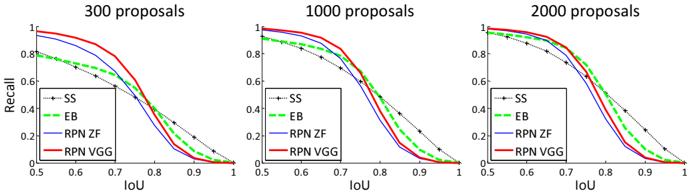
“We comprehensively evaluate our method on the PASCAL VOC detection benchmarks [11] where RPNs with Fast R-CNNs produce detection accuracy better than the strong baseline of Selective Search with Fast R-CNNs.”
What the sources say
- Supportedcites [11] [11] M. Everingham, L. Van Gool, C. K. I. Williams, J. Winn, and A. Zisserman, 'The PASCAL Visual Object Classes Challenge 2007 (VOC2007) Results,' 2007. - source
The citation is attached to “PASCAL VOC detection benchmarks,” not to the citing authors’ comparison of RPNs and Selective Search. Sections 5.2 and 6.2 describe the VOC detection task, its submitted methods, and its results, confirming the benchmark identification. (LLM, conf=0.92)
plainstates a cause- Asserted: passes — The authors put it forward as true.
- Checkable: passes — It can be checked against evidence.
- Load-bearing: passes — The paper’s conclusions depend on it.
- Based: passes — The paper gives a reason why it holds.
- Rests on an assumption not shown here.
- Supported
56 more claims
Create a free account to see all 108 claims and to verify the 2 references still open.
- Probably not a substantial claim. 11
- It may state two separate claims as one. 40
- The quote only partly states this claim. 1
Claims other papers make about this one
Each is checked against this paper’s own text: does it say what the citing paper says it does?
The source backs part of the claim, not all of it — or backs it for a different population, condition or comparison.
In the citing paper
“Unlike the original paper [19] that adopted stage-wise training regarding RPN, we use an improved implementation with end-to-end joint training similar to [37], which leads to higher baselines than [19].”
From Non-local Neural Networks (2018) · cites this paper as [37]
Experimental — accuracy not yet measuredThe source backs part of the claim, not all of it — or backs it for a different population, condition or comparison.
In the citing paper
“Faster RCNN is the first near-realtime deep learning detector (COCO mAP@.5=42.7%, VOC07 mAP=73.2%, 17fps with ZF-Net [48]).”
From Object Detection in 20 Years: A Survey (2023) · cites this paper as [19]
Experimental — accuracy not yet measuredThe source backs part of the claim, not all of it — or backs it for a different population, condition or comparison.
In the citing paper
“Faster RCNN is the first near-realtime deep learning detector (COCO mAP@.5=42.7%, VOC07 mAP=73.2%, 17fps with ZF-Net [48]).”
From Object Detection in 20 Years: A Survey (2023) · cites this paper as [47]
Experimental — accuracy not yet measuredThe source backs part of the claim, not all of it — or backs it for a different population, condition or comparison.
In the citing paper
“In the deep learning era, due to the increase of computing power, bootstrap was shortly discarded in object detection during 2014-2016 [16-20].”
From Object Detection in 20 Years: A Survey (2023) · cites this paper as [19]
Experimental — accuracy not yet measuredThe source backs part of the claim, not all of it — or backs it for a different population, condition or comparison.
In the citing paper
“The most commonly used idea to reduce the feature computational redundancy is to compute the feature map of the whole image only once [18, 19, 124], which have achieved tens or even hundreds of times of acceleration.”
From Object Detection in 20 Years: A Survey (2023) · cites this paper as [19]
Experimental — accuracy not yet measured
21 more claims about this paper
Create a free account to see every claim other papers make about this one.
Citations
Cites
Deep Residual Learning for Image Recognition
He, K., Zhang, X., Ren, S., & Sun, J. (2016) · 2016 IEEE Conference on Computer Vision and Pattern Recognition (CVPR) · doi:10.1109/cvpr.2016.90 · Cited by 235,474 · cited 7×
“to propose regions from data, and thus can easily benefit from deeper and more expressive features (such as the 101layer residual nets adopted in [18]).”
BackgroundInfluentialSelf-citationVery Deep Convolutional Networks for Large-Scale Image Recognition
Simonyan, K., & Zisserman, A. (2014) · arXiv · doi:10.48550/arxiv.1409.1556 · Cited by 114,148
ImageNet classification with deep convolutional neural networks
Krizhevsky, A., Sutskever, I., & Hinton, G. E. (2017) · Communications of the ACM · doi:10.1145/3065386 · Cited by 112,155 · cited 1×
“For the regression loss, we use L where R is the robust loss function (smooth L 1 ) defined in [5].”
MethodGoing deeper with convolutions
Szegedy, C., Liu, W., Jia, Y., Sermanet, P., Reed, S., Anguelov, D., Erhan, D., Vanhoucke, V., & Rabinovich, A. (2015) · 2015 IEEE Conference on Computer Vision and Pattern Recognition (CVPR) · doi:10.1109/cvpr.2015.7298594 · Cited by 48,562 · cited 1×
“1× 10(6) parameters (1536 × (4 + 1) × 800 for GoogleNet [34] in MultiBox [27]).”
Microsoft COCO: Common Objects in Context
Lin, T.-Y., Maire, M., Belongie, S., Hays, J., Perona, P., Ramanan, D., Dollár, P., & Zitnick, C. L. (2014) · Lecture Notes in Computer Science · doi:10.1007/978-3-319-10602-1_48 · Cited by 45,460 · cited 1×
“Region proposal methods typically rely on inexpensive features and economical inference schemes.”
MethodImageNet Large Scale Visual Recognition Challenge
Russakovsky, O., Deng, J., Su, H., Krause, J., Satheesh, S., Ma, S., Huang, Z., Karpathy, A., Khosla, A., Bernstein, M., et al. (2015) · International Journal of Computer Vision · doi:10.1007/s11263-015-0816-y · Cited by 39,380 · cited 1×
“, the shared convolutional layers) are initialized by pre-training a model for ImageNet classification [36], as is standard practice [5].”
MethodFully convolutional networks for semantic segmentation
Long, J., Shelhamer, E., & Darrell, T. (2015) · 2015 IEEE Conference on Computer Vision and Pattern Recognition (CVPR) · doi:10.1109/cvpr.2015.7298965 · Cited by 38,834 · cited 5×
“Our RPNs are thus a kind of fully-convolutional network (FCN) [14] and they can be trained end-to-end specifically for the task for generating detection proposals.”
BackgroundMethodInfluentialRich Feature Hierarchies for Accurate Object Detection and Semantic Segmentation
Girshick, R., Donahue, J., Darrell, T., & Malik, J. (2014) · 2014 IEEE Conference on Computer Vision and Pattern Recognition · doi:10.1109/cvpr.2014.81 · Cited by 32,684 · cited 7×
“, Selective Search [4] object detectors, RCNN [5], and Fast R-CNN [2]).”
BackgroundMethodInfluentialSelf-citationGirshick, R. (2015) · 2015 IEEE International Conference on Computer Vision (ICCV) · doi:10.1109/iccv.2015.169 · Cited by 28,105
Self-citationThe pascal visual object classes (VOC) challenge
Everingham, M., Van Gool, L., Williams, C. K. I., Winn, J., & Zisserman, A. (2010) · International Journal of Computer Vision · doi:10.1007/s11263-009-0275-4 · Cited by 19,599
Research works printed but not linked: 1
- [10] S. Ren, K. He, R. Girshick, and J. Sun, 'Faster R-CNN: Towards real-time object detection with region proposal networks,' in Neural Information Processing Systems (NIPS) , 2015. -
Cited by
Items 55,901–56,000 of 56,405
DAC-Net: Dual-Attention Collaborative Network for Robust Shui Script Detection
Li, M., Song, J., 蒋尚慧, Jing, Y., Qiao, W., Pu, Q., & Han, L. (2026) · Mathematics · doi:10.3390/math14173098
“Early detection methods based on two-stage detectors, such as Faster R-CNN [10], can only handle limited character categories and relatively clean scenarios, showing poor adaptability to real-world Shui manuscripts.”
A comprehensive review of AI-based UAV navigation techniques in GPS-denied environments
Kalaimani, N., Saran, R., & Vignesh, G. (2026) · International Journal of Intelligent Unmanned Systems · doi:10.1108/ijius-03-2026-0077
IoT-Based Real-Time Foreign Particle Detection System for Tea Manufacturing Using Deep Learning
Silva, B. N., Liyanage, S. N., De Silva, P. S., et al. (2026) · International Conference on Electronics Representation and Algorithm (ICERA) · doi:10.1109/icera72709.2026.11666647
“The Faster R-CNN architecture [5][6] established the twostage detection paradigm, combining a Region Proposal Network with a classification head to achieve high localization precision.”
Pan, P., Guo, W., LI, M., Yu, G., Li, H., Yan, H., Li, Q., Zhihao, G., Yu, G., Li, M., et al. (2026) · Smart Agricultural Technology · doi:10.1016/j.atech.2026.102528
Yu, H., Li, Y.-G., Cao, Z., et al. (2026) · Pattern Recognition Letters · doi:10.1016/j.patrec.2026.08.031
Shi, H., Wang, Y., Yao, J., & Yu, W. (2026) · IEEE Transactions on Instrumentation and Measurement · doi:10.1109/tim.2026.3729008
Deng, H., Wang, S., Wang, Y., et al. (2026) · International Conference on Applied Mathematics, Modelling and Intelligent Computing (CAMMIC) · doi:10.1145/3817124.3817197
“In the field of ship detection, researchers have proposed various methods, such as applying Faster R-CNN[3] on the Sea-Ships dataset[4] and designing multi-scale feature fusion networks.”
DMASNet: A Defect Detection Network for PCBs via Multi-Scale Feature Collaborative OptimizationPreprint
Zhang, Y., Zhao, Y., Wang, T., Gao, Y., & Chen, Z. (2026) · Research Square · doi:10.21203/rs.3.rs-10024488/v1
Hendry, A. B., Purnama, B., & Ferdian, E. (2026) · International Conference on Electronics Representation and Algorithm (ICERA) · doi:10.1109/icera72709.2026.11666764
“Faster R-CNN [5] is the canonical two-stage detector and a long-standing accuracy baseline.”
Deb, R., Bhowmik, M., Singh, S., et al. (2026) · doi:10.1109/insect68872.2026.11663949
“Models such as YOLO, Faster R-CNN [7], and SSD [8] have demonstrated high accuracy in detecting persons, vehicles, and objects from video streams [2], [3].”
AI-Enabled Learning Behavior Analysis in Smart Classrooms Based on DINOv3
Song, W., & Li, Y.-H. (2026) · 2026 International Conference on Distance Education and Learning (ICDEL) · doi:10.1109/icdel70250.2026.11663975
Ren, Q., He, Y., Li, Y., & Li, Q. (2026) · Applied Sciences · doi:10.3390/app16178624
MD-YOLO: An Improved YOLO26-Based Model for Small-Object Detection in UAV Aerial Imagery
Zhang, T., Zou, W., Yu, M., Song, S., Wu, Q., Chen, J., Fan, Z., & Ding, Q. (2026) · Algorithms · doi:10.3390/a19090737 · Cited by 1
Huang, S., Lv, J., Wang, B., & Shen, B. (2026) · AgriEngineering · doi:10.3390/agriengineering8090363
A Survey on Millimeter-Wave Radar and Vision Fusion Perception in Autonomous Driving
Han, Y., Wang, S., Feng, D., Guo, Y., & Ma, L. (2026) · Electronics · doi:10.3390/electronics15173919
Fan, L., Li, Z., Dong, F., et al. (2026) · Infrared Physics & Technology · doi:10.1016/j.infrared.2026.106886
Research on Fabric Defect Detection Method Based on Improved YOLOv8
Hou, X., Yan, Q., & Zhang, M. (2026) · International Conference on Computer Information and Big Data Applications (CIBDA) · doi:10.1145/3813822.3813993
“…defect detection: it cannot well adapt to four typical defects (irregular defects, thick weft, holes, oil stains), lacks sufficient representation for low-contrast/complex-shaped targets, and has limited bounding box regression accuracy, leading to missed detections and localization errors [4].”
An Improved YOLOv8-Based Method for Distinguishing Between Unmanned Aerial Vehicles and Bird Targets
Li, D., & Wang, Y. (2026) · International Symposium on Aerospace Engineering and Systems (ISAES) · doi:10.1109/isaes70982.2026.11669273
From Generation to Optimization: Improving Pseudo Labels for Semi-Supervised Object Detection
Yang, X., Li, P., & Wang, N. (2026) · IEEE Transactions on Image Processing · doi:10.1109/tip.2026.3727903
“We follow the experimental setup of Soft Teacher [23] and adopt Faster R-CNN [4] with FPN [8], RoIAlign [7], and a ResNet-50 [5] backbone as the default object detector.”
CAR-YOLO: A Lightweight Improved YOLOv11 Model for Pavement Defect Detection
Wang, X., & Lu, Y. (2026) · Applied Sciences · doi:10.3390/app16178621
High-Frequency Guided Feature Aggregation for Strip Steel Surface Defect Detection
Sun, Y., Xu, C., Guo, H., Zhang, L., Feng, Y., Zhang, W., & Tang, Y. (2026) · IEEE Transactions on Automation Science and Engineering · doi:10.1109/tase.2026.3728911
Classroom Behavior Detection and Evaluation Method Based on Deep Learning Algorithms
Cui, L., Chen, S. Y., Han, X., et al. (2026) · Applied Sciences · doi:10.3390/app16178660
Sugiura, H., Fukazawa, Y., & Ogawa, M. (2026) · IEEE Access · doi:10.1109/access.2026.3729255
Insulator Defect Detection by Fusing Fine-Grained Features and Contextual Information
Zhang, D., Xiao, Q., Idrus, Z., & Liu, S. (2026) · IEEE Access · doi:10.1109/access.2026.3729323
Oh, J., Gugliotta, M., Leluschko, C., Tholen, C., & Randazzo, G. (2026) · SSRN Electronic Journal · doi:10.2139/ssrn.7391513
A lightweight RPB-YOLO11-based detector improves mobile phenotyping of rice panicle blast
Yang, X., Zhao, X., Xu, C., Hu, J., Xu, L., Chi, J., Zhang, N., Wang, X., Liu, L., Liu, B., et al. (2026) · Frontiers in Plant Science · doi:10.3389/fpls.2026.1925522
Mamba-RSDETR: Vision Mamba-enhanced lightweight RT-DETR for remote sensing object detection
Zi, L., Guo, J., Cong, X., Li, K., Bai, Y., & Zha, Y. (2026) · Neurocomputing · doi:10.1016/j.neucom.2026.135007
Group-size adaptive kernel extension for feature upsampling
Xin, J., Wu, C., Xue, G., & Liu, G. (2026) · Image and Vision Computing · doi:10.1016/j.imavis.2026.106183
Dual-Branch Multi-Scale Wavelet Enhancement Method for Tea Bud Detection
Gui, J., Li, Y., & Xia, Z. (2026) · Applied Sciences · doi:10.3390/app16178686
Paddy parcel detection method using drone images based on YOLO-Seg model and tiling movement
Jeon, J., Kim, S., & Kim, T. (2026) · Paddy and Water Environment · doi:10.1007/s10333-026-01092-5
Chen, D., Zou, J., Fan, T., et al. (2026) · Infrastructures · doi:10.3390/infrastructures11090308
“Regarding the transfer of general object detectors, Xu et al. [5] systematically compared the accuracy– speed trade-off between Faster R-CNN [36] and Mask R-CNN on the crack detection task; the results indicated that two-stage methods are marginally superior in accuracy but their inference speed…”
The DFD-YOLO Algorithm for Detecting Small-Scale Surface Damage on Mining Steel Ropes
Wang, H., Jiang, L., Zhang, L., Zhao, Q., & Zhang, S. (2026) · Applied Sciences · doi:10.3390/app16178568
GQ-DETR: grouped query transformer for multi-UAV object detection
Feng, Y., Wu, Y., Lyu, R., Yao, L., & Cai, Y. (2026) · Aerospace Systems · doi:10.1007/s42401-026-00525-7
Ma, H., Cheng, W., Shao, L., et al. (2026) · Signal Image and Video Processing · doi:10.1007/s11760-026-05675-x
An enhanced end-to-end low-light ship detection framework for UAV-based maritime surveillance
Zheng, Y., Ao, X., Xie, W., Xiao, H., Gao, Z., & Chen, L. (2026) · Ocean Engineering · doi:10.1016/j.oceaneng.2026.127916 · Cited by 1
Enhancing target identification and query discrimination for visual grounding
Bu, X., Liu, Y., Yu, J., & Xu, K. (2026) · Multimedia Systems · doi:10.1007/s00530-026-02620-3
Deep Learning-Based Steel Surface Defect Detection: A Survey
Wen, X., Yu, Z., He, Y., Wang, Z., Chen, X., & Song, K. (2026) · Coatings · doi:10.3390/coatings16091040 · Cited by 2
Huang, W., Zhou, Q., Gao, L., Sun, L., & Niu, J. (2026) · Remote Sensing · doi:10.3390/rs18172965
Lee, M.-S., & Han, S.-Y. (2026) · Sensors · doi:10.3390/s26175573
“Standard architectures include ResNet [29] and Inception [30] classifiers; SSD [31], Faster R-CNN [32], and focal-loss-based dense detectors [33]; transformer-based detectors such as DETR [34] and RT-DETR [35]; and the YOLO family, from the original YOLO [1] to YOLOv7 [2], YOLOv9 [36], YOLOv10…”
Wang, B., Lv, J., Huang, S., & Bai, Y. (2026) · Journal of Imaging · doi:10.3390/jimaging12090413
Khan, A., Farooq, M. A., Bai, X.-F., et al. (2026) · IEEE Access · doi:10.1109/access.2026.3729812
Collaborative Context-Affine Perception Network for Remote Sensing Small Object Detection
He, W. P., Xu, Y., Qi, Q., Zhang, G., & Tu, B. (2026) · IEEE Transactions on Geoscience and Remote Sensing · doi:10.1109/tgrs.2026.3729695
Robust weak object detection via information compensation and feature filtering for UAV images
Li, X., Deng, X., Zhou, Q., Geng, J., & Jiang, W. (2026) · Expert Systems with Applications · doi:10.1016/j.eswa.2026.134212
Lei, Y., Sun, W., Li, Q., et al. (2026) · Neurocomputing · doi:10.1016/j.neucom.2026.134999
Seeing Through Threats: Adversarial Detection Through Explainability (ADEx)
Sarkar, S., Joseph, N., George, S. N., Ameer, P. M., & Raja, K. B. (2026) · IEEE Transactions on Image Processing · doi:10.1109/tip.2026.3727133
“D EEP learning (DL) models have helped make tremendous progress in various domains, including computer vision [1], natural language processing [2], and medical image analysis [3].”
Hong, J., Yang, T., Liu, Y., et al. (2026) · SSRN Electronic Journal · doi:10.2139/ssrn.7397585
Precise small unmanned aerial vehicle target detection model ATU-Net
Yang, J., Guo, T., Han, J., et al. (2026) · Journal of Real-Time Image Processing · doi:10.1007/s11554-026-01976-z
“Results for HSP-YOLOv8 [11], CNIFE [12], DCR-YOLO [17], Faster R-CNN [31], SSD [32], FCOS [33], RetinaNet [34], and RT-DETR [35] The components are also complementary when combined.”
Typical Defect Detection Algorithm for OCS Based on Multi-scale Cascade and Adaptive Feature Fusion
Zhang, J., Han, S., Miao, B., et al. (2026) · Lecture notes in electrical engineering · doi:10.1007/978-981-92-2250-6_45
Feng, Z., Guo, Y., Liu, B., et al. (2026) · Lecture notes in electrical engineering · doi:10.1007/978-981-92-2254-4_18
High-precision detection model of wear debris in aero-engine oil based on MPN-YOLOv11n
Wang, S., Jiang, X., Xia, L., et al. (2026) · Gas Turbine Experiment and Research · doi:10.3724/j.gter.20260043
Yameng, N., Shengliang, H., Liu, Y., et al. (2026) · IET Image Processing · doi:10.1049/ipr2.70468
LSO-YOLO: a lightweight real-time object detection network for UAV small-object detection
Dai, P., Chen, L., Lian, Y., & Xie, L. (2026) · Journal of Real-Time Image Processing · doi:10.1007/s11554-026-01977-y
“Two-stage approaches, exemplified by the R-CNN family [8, 9], first generate region proposals and then perform classification and bounding box refinement.”
DAQ-YOLO:a high precision counting model for maize seedlings in dense scenes
He, X., Wang, H., Ma, Z., Li, K., Zhou, T., Liu, Y., Zhou, Y., & Zhang, X. (2026) · Frontiers in Plant Science · doi:10.3389/fpls.2026.1879331
“With the rapid development of deep learning technology, two-stage detectors, typi fi ed by Faster RCNN (Khan et al., 2025; Ren et al., 2017) and one-stage frameworks, such as SSD (Liu et al., 2016) and the YOLO series (Redmon et al., 2016; Kang et al., 2025; Wang et al., 2023, 2024a), have…”
Student Behavior Recognition in the Classroom Based on Hyper-YOLO
Sun, J., Wang, J., & Ming, Y. (2026) · Sensors · doi:10.3390/s26175601
“Early studies mostly relied on two-stage detectors (e.g., Faster R-CNN) [9].”
Self-citationChen, Y., & Wang, X. (2026) · Frontiers in Oncology · doi:10.3389/fonc.2026.1888077
“Two-stage anchor-based approaches, exempli fi ed by Faster R-CNN (7), leverage region proposal networks to extract regions of interest with high precision, yet their inference speed is inherently constrained.”
InfluentialZhang, Y., Chai, L., & Lai, J. (2026) · Applied Soft Computing · doi:10.1016/j.asoc.2026.116306
Method for recognition and positioning of composite three-way pipe fittings based on machine vision
Yang, H., Sheng, Z. Y., Xu, J., & Bo, W. Z. (2026) · Proceedings of the Institution of Mechanical Engineers Part C Journal of Mechanical Engineering Science · doi:10.1177/09544062261479003
Aziz, B. A., Rushdi, M. A., Yoshida, S., Dief, T. N., Shaban, I. A., & Kamra, M. M. (2026) · Applied Sciences · doi:10.3390/app16178774 · Cited by 1
SFD-KD: Structured Feature Decoupling Knowledge Distillation for Fracture Detection
Yu, X., Longjun, D., Xin, W., Liang, M., Cai, H., & Zheng, J. (2026) · ACM Transactions on Computing for Healthcare · doi:10.1145/3845807
“Healthcare 2 Related Work 2.1 Fracture Detection Two-stage detectors (e.g., Faster R-CNN [1]) leverage region proposal networks for precise localization, demonstrating strong performance for complex fracture patterns.”
InfluentialShinan, 蒋. J., Guie, 矫. J., & Yimin, 陈. C. (2026) · Laser & Optoelectronics Progress · doi:10.3788/lop260716
Using semi-supervised learning to detect beluga whales from aerial image sequences
Al-Jassani, M. G., Bang, C., O'Corry-Crowe, G., Watt, C. A., Gillespie, M., & Zhuang, H. (2026) · Frontiers in Marine Science · doi:10.3389/fmars.2026.1913328
Zhang, W., Huang, H., Sun, Y., Zhang, J., & Qu, F. (2026) · Artificial Intelligence in Agriculture · doi:10.1016/j.aiia.2026.08.013
基于改进Mask R-CNN的荧光动力学图像叶片实例分割与几何参数提取方法(特邀)
Liang, 梅. M., Zhang, H., Yinxi, 韩. H., Rongguang, 潘. P., Demidchik, V. V., & Shuqing, 杨. Y. (2026) · Acta Optica Sinica (Online) · doi:10.3788/aosol260507
Liandong, 戴. D., Wei, 钟. Z., Jihan, 魏. W., et al. (2026) · Laser & Optoelectronics Progress · doi:10.3788/lop252667
From Pixel Modification to Generative Synthesis: A Survey of Deep Learning for Image Data Hiding
Janok, M., Forgáč, R., & Hluchý, L. (2026) · Journal of Imaging · doi:10.3390/jimaging12090417 · Cited by 1
Wang, L., Liu, Z., Fang, L., et al. (2026) · doi:10.1145/3820915.3820916
“The visible pixels of small contraband items (e.g., knives, 100ml liquid sprays) often account for less than 0.1% of the total image area, which mathematically constitutes a highly ill-posed inverse detection problem [11].”
InfluentialCai, X., Zhang, Y., Zhao, S., Zhang, D., & Tang, X. (2026) · Pattern Recognition Letters · doi:10.1016/j.patrec.2026.09.001
A lightweight and efficient carton detection model for intelligent warehouse environments
Chen, H., Xue, B., & Zong, G. (2026) · Transactions of the Institute of Measurement and Control · doi:10.1177/01423312261480552
Aricibasi, H., Bode, J., Bergeron, R., & Tulpan, D. (2026) · Frontiers in Bioinformatics · doi:10.3389/fbinf.2026.1869902
Visual Food Object Detection via Open‐Vocabulary Learning
liu, S., Sheng, G., zhou, S., Yang, B., Min, W., & Jiang, S. (2026) · Journal of Food Science · doi:10.1111/1750-3841.71414
Wan, Y., Li, J., Lin, L., Lv, Z., Zhang, Z., Yuan, Q., & Shen, H. (2026) · ISPRS Journal of Photogrammetry and Remote Sensing · doi:10.1016/j.isprsjprs.2026.08.041
Zero-Harm Feature Calibration and Adaptive Boundary Query for Tiny Object DetectionPreprint
Zhai, Y., He, C., Wang, Z., Feng, Z., Wang, B., & Yang, X. (2026) · Research Square · doi:10.21203/rs.3.rs-10475931/v1
Yingbo, 王. W., & Zhongao, 英. Y. (2026) · Laser & Optoelectronics Progress · doi:10.3788/lop260472
Dy-YOLO for Wheat Head Counting via Content-Aware Dynamic Upsampling
He, C., Dong, C., Zhao, Y., et al. (2026) · doi:10.1145/3820915.3820963
“However, mainstream detection frameworks such as Faster R-CNN and EfficientDet still showed obvious missed detections in real field scenes with high target density and severe occlusion [1, 2].”
Yingbo, 刘. L., Shuaiqi, 马. M., & Huan, 程. C. (2026) · Laser & Optoelectronics Progress · doi:10.3788/lop260548
Islam, N. U., Raja, D., Khan, E. M., Shah, S. H., & Mughal, M. R. (2026) · IEEE Access · doi:10.1109/access.2026.3731049
CADSpotting: Robust Panoptic Symbol Spotting on Large-Scale CAD Drawings
Yang, F., Mu, J., Zhang, M., Zhang, Y., Zhang, J., Xu, L., & Zhang, Y. (2026) · Computational Visual Media · doi:10.26599/cvm.2026.9450573 · Cited by 18
Wei, Q., Zhao, P., Zhang, H., Yang, Z., Mu, X., Wang, Y., & Cheng, X. (2026) · Corrosion Science · doi:10.1016/j.corsci.2026.114239
LECF-DETR: layer-enhanced collaborative fusion DETR for multispectral object detection
Chen, H., Tao, J., Yao, Y., Chan, S., Zhou, X., & Li, C. (2026) · Multimedia Systems · doi:10.1007/s00530-026-02638-7
“Early methods are largely based on single-modality detectors ( e.g. , Faster R-CNN [8], YOLO [9]) and rely on simple fusion strategies, such as feature concatenation or cascaded processing.”
LMC-DETR: A lightweight detection model for foreign object detection on power lines
Zhu, C., Wang, F., Wang, S., et al. (2026) · Electric Power Systems Research · doi:10.1016/j.epsr.2026.114121
elkasas, A. E. A., Şeker, M., & Özerdem, M. S. (2026) · SSRN Electronic Journal · doi:10.2139/ssrn.7422537
Xu, C., Liu, F., Fan, J., Yin, H., & Tan, R. (2026) · The Visual Computer · doi:10.1007/s00371-026-04726-1
“Faster R-CNN uses a two-stage detection pipeline and achieves strong representation capability, but its region-proposal process can limit deployment efficiency [10].”
A ROS 2-Based Robotic Platform for Mobile Occupant Sensing and Edge Perception in Buildings
Wu, M., Wang, H., Wang, W., et al. (2026) · Buildings · doi:10.3390/buildings16173551
Tang, T., Jiang, X., He, B., Zhou, D., Li, R., Lin, K., & Cai, Y. (2026) · Fire · doi:10.3390/fire9090386 · Cited by 1
Wang, X., He, H., Zhang, J., & Song, M. (2026) · Fire · doi:10.3390/fire9090385
“Initial advancements significantly improved detection precision using region-based frameworks, as demonstrated by R-CNN [18], generalized CNN approaches [19], Fast R-CNN [20], Faster R-CNN [21], and Mask R-CNN [22].”
Wang, K., Feng, C., Yu, J., Wang, B., Li, J., Zhu, W., & Dong, Z. (2026) · Engineering Research Express · doi:10.1088/2631-8695/aea3a6
“Representative two-stage detectors include the R-CNN series [15–17], whereas typical one-stage detectors include the YOLO series [18] and SSD [19].”
Quantifying Cross-Illumination Domain Shift in YOLO-Based Camera-Trap Wildlife Detection
Saraboji, K., & Mitra, D. (2026) · IEEE International Conference on Electro Information Technology · doi:10.1109/eit68936.2026.11670345
“Modern object detection frameworks include two-stage detectors such as Faster R-CNN [10] and single-stage detectors such as YOLO [3]-[6].”
Wang, C., Wang, X., Wang, Y., Li, D., Wang, S., & Song, Y. (2026) · Computers · doi:10.3390/computers15090587
Kang, J., Kim, Y., Chaurasia, A., et al. (2026) · Journal of Periodontal & Implant Science · doi:10.5051/jpis.2601900095
YOLO-RCHA: a gear defect detection method based on robust context-aware hybrid attention mechanism
Zhou, S., Zhang, T., Zhang, Y., Ji, K., Li, W., Zhou, X., & Ren, Z. (2026) · Nondestructive Testing And Evaluation · doi:10.1080/10589759.2026.2729838
YOLO-Based Object Localization and Classification in UAV Images Compressed by JPEG
Tsekhmystro, R., Лукин, В. В., & Kritskiy, D. (2026) · Computation · doi:10.3390/computation14090206
Wang, J., Lin, Q., Ding, Y., Liu, J., & Qi, B. (2026) · Sensors · doi:10.3390/s26175677
“Faster R-CNN was used as a conventional two-stage object-detection baseline [27].”
Zhou, Y., Ji, C., Wang, H., Zhao, L., Yang, P., & Zhang, C. (2026) · Sensors · doi:10.3390/s26175648
“…line vibration damper detection task, several representative object detection algorithms were selected for comparison, including YOLOv8, YOLOv11, YOLOv12 [33], Mamba-YOLO [34], SSD [35], Faster R-CNN [36], CenterNet [37], EfficientDet [38], RetinaNet [39], Hyper-YOLO-T [40], and RT-DETR-R18 [41].”
Duan, T., Yang, B., Li, X., Hou, D., Hu, P., Li, X., Cong, W., & Wang, F. (2026) · Smart Agricultural Technology · doi:10.1016/j.atech.2026.102552
Yu, H., Zhao, Y., Yang, M., & Wang, P. (2026) · Optoelectronics Letters · doi:10.1007/s11801-026-5051-y
“The two-stage detection algorithms are represented by region-based convolutional neural network (R-CNN) [3] and Fast R-CNN [4] .”
A Study on Lightweight Defect Detection in Solar Cells Based on Multi-Scale Rapid Feature FusionPreprint
Han, W., Jia, Z., Wang, Y., et al. (2026) · SSRN Electronic Journal · doi:10.2139/ssrn.7428736
Wu, G., Liu, L., Gao, T., et al. (2026) · IEEE Transactions on Geoscience and Remote Sensing · doi:10.1109/tgrs.2026.3731184
Metadata
- Authors
- Ren, S., He, K., Girshick, R., & Sun, J.
- Affiliations
- University of Science and Technology of China (CN)
- Visual Computing Group, Microsoft Research, Beijing, China
- Meta (United States) (US)
- ORCID
- Venue
- IEEE Transactions on Pattern Analysis and Machine Intelligence
- Published
- 2017-06-01
- Volume
- 39
- Issue
- 6
- Pages
- 1137-1149
- ISSN
- 0162-8828 (ISSN-L)
- 2160-9292
- 1939-3539
- OpenAlex
- W639708223
- Cited by
- 73,472
- References
- 60
- Citations by year
- 2026: 5632 · 2025: 9233 · 2024: 9699 · 2023: 9795 · 2022: 9251 · 2021: 9857 · 2020: 7617 · 2019: 6376 · 2018: 3729 · 2017: 1740
- FWCI
- 2215.09
- Type
- journal article
- Language
- en
- Open access
- green
- arxiv.org
- Licence
- Locations
- IEEE Transactions on Pattern Analysis and Machine Intelligence (publishedVersion)
- PubMed (publishedVersion)
- arXiv (Cornell University) (submittedVersion)
- arXiv (Cornell University)
- neural information processing systems
- Funders
- Microsoft Research
- Topics
- Physical Sciences › Computer Science › Computer Vision and Pattern Recognition › Advanced Neural Network Applications
- Physical Sciences › Computer Science › Computer Vision and Pattern Recognition › Visual Attention and Saliency Detection
- Physical Sciences › Computer Science › Computer Vision and Pattern Recognition › Advanced Image and Video Retrieval Techniques
- Keywords
- Faster R-CNN, region proposal network, real-time object detection, Fast R-CNN, bounding box regression, VGG16, attention mechanism, end-to-end learning, Pascal VOC, MS COCO
About these checks
Registry, retraction, Cites and statistics results are computed, not judged, with one exception: a printed reference that no index lists is read once by a model before it counts as a citation error. Claims are extracted by a model and kept only when their quote appears verbatim in the text; each cited source is then checked, with a model’s help, for whether it says what the claim relies on. Those verdicts can be wrong — read the claim’s quote and the cited source before relying on one.
The claim verdicts this report counts are experimental: their accuracy is not yet measured.
A language model drew the claims from the paper on 2026-10-10, under version 3 of the claim definition (model deepseek-v4.1-flash, prompt extract-v3).
A second model labelled each claim on 2026-10-10 (model jev-1.13-20260917, definition revision gold-guideline-v0.2).
Cited sources are checked with a language model’s help (gpt-6-sol).
Statistics and arithmetic are recomputed, not judged.
Confidence bands are shown only for fields calibrated on our annotated test set. None is calibrated yet, so no band is shown.
What counts as a claim ›How we measure confidence ›How we check this ›
Are you an author, or do you see a problem with this page? Request a review
Data sources
Bibliographic data: Semantic Scholar, OpenAlex, Crossref.
Contains information from the Semantic Scholar Academic Graph Datasets, made available under the ODC Attribution License (ODC-BY 1.0).
Semantic Scholar’s data is described in: Kinney, R., et al. (2023). The Semantic Scholar Open Data Platform. arXiv:2301.10140.
