

Self-Supervised Learning for Time Series Analysis: Taxonomy, Progress, and Prospects
Open accessThe DOI matches its Crossref record; 222 of the 232 references it cites were found in a registry or an index, and 2 are not checked yet; 86 of the 189 sources its claims cite were checked for support.
Abstract
A comprehensive survey of current state-of-the-art SSL methods for time series data, proposing a taxonomy categorizing methods into generative-based, contrastive-based, and adversarial-based across ten subcategories, along with benchmark datasets for forecasting, classification, anomaly detection, and clustering.
Verified 2026-11-22 · 2 references not checked yet
Overview
CoChat Summary
TL;DR
This survey reviews self-supervised learning (SSL) for time series, proposing a taxonomy of generative-based, contrastive-based, and adversarial-based methods divided into ten subcategories. It summarizes applications/datasets and future directions, and compiles quantitative comparisons showing no single SSL method dominates across tasks.
Key findings
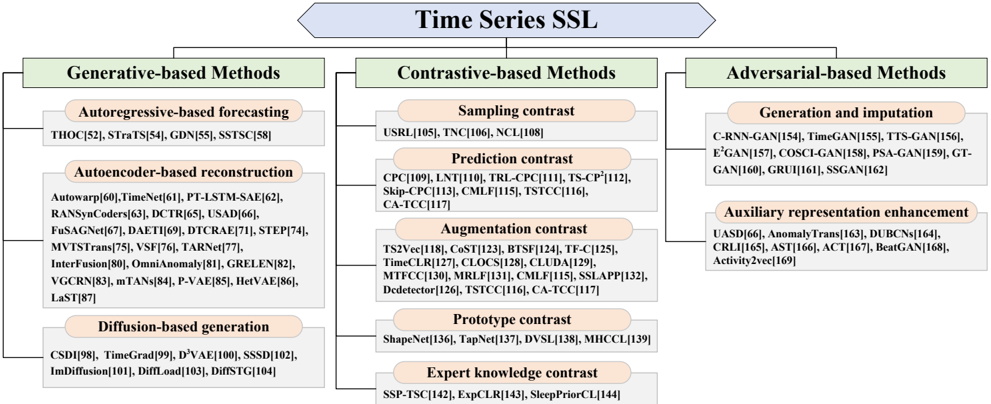
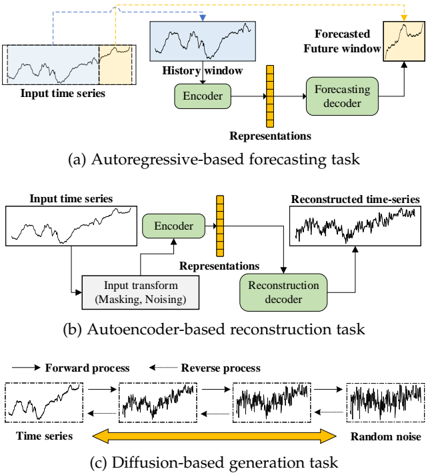
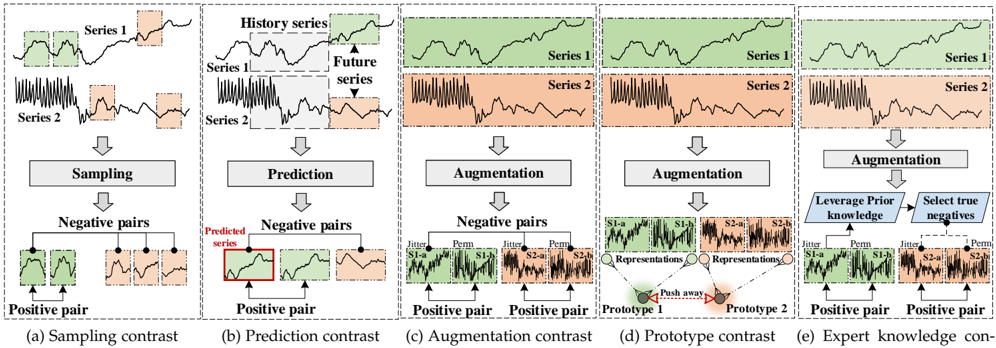
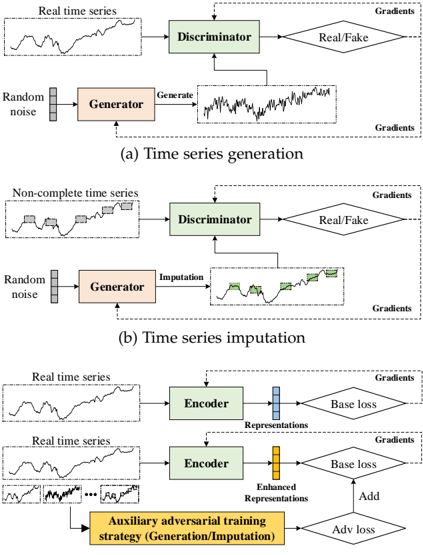
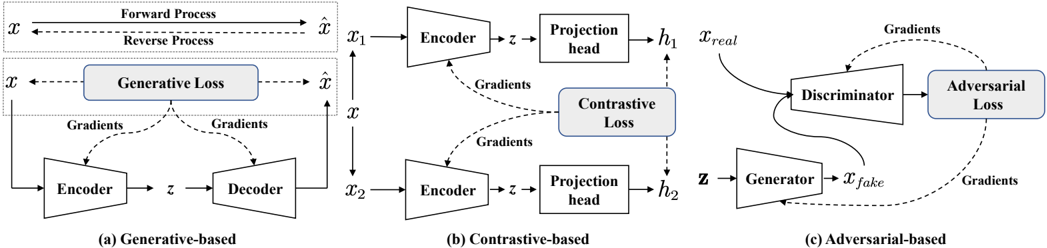
- The paper proposes a taxonomy with three broad SSL paradigms and ten subcategories: autoregressive-based forecasting, autoencoder-based reconstruction, diffusion-based generation; sampling contrast, prediction contrast, augmentation contrast, prototype contrast, expert knowledge contrast; generation/imputation and auxiliary representation enhancement.
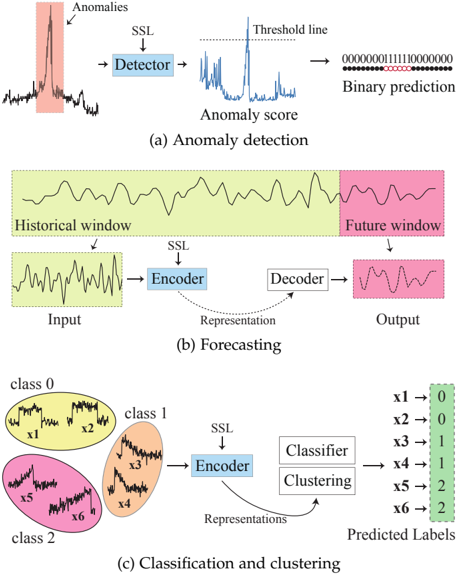
- For anomaly detection, contrastive methods such as Skip-CPC and Dcdetector are reported as achieving the best performance on four datasets; Dcdetector reaches F1 scores of 97.94 on PSM, 96.60 on MSL, 97.02 on SMAP, and 96.33 on SWaT, while Skip-CPC reaches F1 98.55 on PSM, 94.46 on SMD, and 92.75 on MSL.
- For forecasting, LaST and CoST show significant advantages; LaST reports ETTh H=24 MSE/MAE of 0.324/0.368, ETTm 0.218/0.289, Electricity 0.125/0.222, and Weather 0.105/0.134.
- For classification and clustering, results on 30 datasets from HAR, UCR, and UEA show that no single method achieves the best performance on all datasets, and most methods are based on self-supervised contrastive learning.
Methods
- Design: a comprehensive literature survey that reviews existing SSL and time series surveys, then organizes time series SSL methods by learning paradigm and by how positive/negative samples or pretext tasks are constructed.
- Data/resources: summarizes commonly used datasets for anomaly detection, forecasting, classification, and clustering, including PSM, SMD, MSL, SMAP, SWaT, WADI, ETTh, ETTm, Electricity, Weather, HAR, UCR 128, and UEA 30.
- Analysis: qualitative review of frameworks, mathematical formulations, advantages/disadvantages, plus compiled quantitative comparisons from prior work on anomaly detection (five datasets), forecasting (four datasets), and classification/clustering (30 datasets); no new experiments are reported.
Limitations
- The paper states that prior time series SSL surveys only discuss a small part of self-supervised contrastive learning, lack benchmark dataset summaries, and have scarce future directions; it positions itself as filling that gap.
- It also summarizes method-family limitations: generative-based methods are sensitive to rare instances and lack high-level semantic information; contrastive-based methods face sampling bias and augmentation uncertainty; adversarial-based methods suffer unstable training and are rarely used for feature extraction.
- Evident from the text: as a survey, it does not run a unified benchmark; the quantitative tables are collected from prior papers and contain missing entries (“-”), so comparisons are incomplete, and the paper itself calls for reliable benchmark evaluation as a future direction.
Model-written summary. Check it against the paper before relying on it.
Integrity signals
Registry
Cites
Statistics
Figures
Verification
Claims the paper makes
66 Valid · 26 Not valid · 63 Not checked · 80 Own results and interpretations
The cited sources support only part of this claim — read each source’s verdict below.
In the paper
“Methods for constructing multiple contrastive views based on multi-granularity or multi-scale augmentations also include MRLF [131], CMLF [115], and SSLAPP [132].”
What the sources say
- Not checked — no full text of the sourcecites [131] [131] M. Hou, C. Xu, Z. Li, Y. Liu, W. Liu, E. Chen, and J. Bian, 'Multigranularity residual learning with confidence estimation for time series prediction,' in Proceedings of the ACM Web Conference 2022 , ser. WWW '22, 2022, p. 112-121. - source
- Not checked — no full text of the sourcecites [115] [115] M. Hou, C. Xu, Y. Liu, W. Liu, J. Bian, L. Wu, Z. Li, E. Chen, and T.-Y. Liu, 'Stock trend prediction with multi-granularity data: A contrastive learning approach with adaptive fusion,' Proceedings of the 30th ACM International Conference on Information & Knowledge Management , p. 700-709, 2021. - source
- Partly supportedcites [132] [132] H. Lee, E. Seong, and D.-K. Chae, 'Self-supervised learning with attention-based latent signal augmentation for sleep staging with limited labeled data,' in Proceedings of the Thirty-First International Joint Conference on Artificial Intelligence, IJCAI-22 , 7 2022, pp. 38683876, main Track. - sourceExperimental — accuracy not yet measured
Sections 3.2 and 3.3 describe SSLAPP constructing two augmented views as a positive pair and learning from global and local features. But Section 3.2 explicitly says SSLAPP uses pairwise representation learning instead of contrastive learning; the global and local distinction applies to its loss terms, not to multi-scale augmentations. The citation identifies SSLAPP correctly but mischaracterizes its method. (LLM, conf=0.88)
plain- Asserted: passes — The authors put it forward as true.
- Checkable: passes — It can be checked against evidence.
- Load-bearing: unclear — It is unclear whether the paper’s conclusions depend on it.
- Based: passes — The paper gives a reason why it holds.
Every source the paper cites for this claim was checked and supports it.
In the paper
“However, introducing reasonable inductive bias or prior is helpful for many deep neural networks-based modeling tasks [140], [196], [197].”
What the sources say
- Supportedcites [140] [140] X. Wu, L. Xiao, Y. Sun, J. Zhang, T. Ma, and L. He, 'A survey of human-in-the-loop for machine learning,' Future Generation Computer Systems , vol. 135, pp. 364-381, 2022. - source
The Introduction (§1.1; page not provided) says integrating prior knowledge into a learning framework is effective for sparse data and describes its use across several applications. This supports the broad claim that suitable priors can help deep-learning modeling tasks. (LLM, conf=0.85)
- Supportedcites [196] [196] C. Deng, X. Ji, C. Rainey, J. Zhang, and W. Lu, 'Integrating machine learning with human knowledge,' iScience , vol. 23, no. 11, p. 101656, 2020. - source
The Network Architecture section says that adding domain-specific components to neural networks can boost performance and that task-targeted architectures can generalize better. It gives examples for different data and tasks, supporting the broad claim that appropriate inductive biases are helpful in neural-network modeling. (LLM, conf=0.91)
- Supportedcites [197] [197] Y. Chen and D. Zhang, 'Integration of knowledge and data in machine learning,' 2022. - source
The Introduction (page not available in our copy) says that embedding domain knowledge can improve model accuracy and robustness, and that it can improve machine-learning performance. Section 3.1 describes several ways to incorporate prior knowledge into neural networks across different applications, supporting the citing sentence’s broad, qualified claim. (LLM, conf=0.91)
plainstates a cause- Asserted: passes — The authors put it forward as true.
- Checkable: passes — It can be checked against evidence.
- Load-bearing: passes — The paper’s conclusions depend on it.
- Based: passes — The paper gives a reason why it holds.
- Rests on 2 assumptions not shown here.
- Supported
Every source the paper cites for this claim was checked and supports it.
In the paper
“Unlike previous frameworks, SSGAN's classification network makes full use of label information, which helps the model achieve more accurate imputations.”
What the sources say
- Supportedcites [162] [162] X. Miao, Y. Wu, J. Wang, Y. Gao, X. Mao, and J. Yin, 'Generative semi-supervised learning for multivariate time series imputation,' Proceedings of the AAAI Conference on Artificial Intelligence , vol. 35, no. 10, pp. 8983-8991, May 2021. - source
The Classifier Network passage says SSGAN’s classifier uses self-training to make full use of label information in partially labeled time series and guides the generator during imputation. The Ablation Study reports that removing the classifier reduces imputation accuracy by an average of 1.36%, supporting its contribution to more accurate imputations. (LLM, conf=0.94)
plainstates a cause- Asserted: passes — The authors put it forward as true.
- Checkable: passes — It can be checked against evidence.
- Load-bearing: unclear — It is unclear whether the paper’s conclusions depend on it.
- Based: passes — The paper gives a reason why it holds.
- Supported
The cited sources support only part of this claim — read each source’s verdict below.
In the paper
“It is beneficial to introduce an adversarial-based SSL, which can further amplify the difference between normal and anomalous data, such as USAD [66] and DAEMON [184].”
What the sources say
- Partly supportedcites [66] [66] J. Audibert, P. Michiardi, F. Guyard, S. Marti, and M. A. Zuluaga, 'USAD: Unsupervised anomaly detection on multivariate time series,' in Proceedings of the 26th ACM SIGKDD International Conference on Knowledge Discovery & Data Mining , ser. KDD '20, 2020, p. 3395-3404. - sourceExperimental — accuracy not yet measured
Section 5.4 (Ablation Study; page unavailable) reports that adversarial training improves USAD’s F1 score and helps detect anomalies close to normal data. Section 3.2 describes USAD as an unsupervised autoencoder method with adversarial training, but the copy does not identify it as self-supervised learning (SSL). (LLM, conf=0.82)
- Partly supportedcites [184] [184] X. Chen, L. Deng, Y. Zhao, and K. Zheng, 'Adversarial autoencoder for unsupervised time series anomaly detection and interpretation,' in Proceedings of the Sixteenth ACM International Conference on Web Search and Data Mining , ser. WSDM '23, New York, NY, USA, 2023, p. 267-275. - sourceExperimental — accuracy not yet measured
The Abstract and §2.2 identify DAEMON as an unsupervised anomaly detector that uses adversarial training to learn normal time-series patterns; the model-variant results in §4.5.2 report a benefit from adversarial regularization. The paper does not describe DAEMON as self-supervised learning (SSL) or establish that adversarial training amplifies the difference between normal and anomalous data. The cited paper is DAEMON, so this verdict does not assess USAD. (LLM, conf=0.84)
plainstates a cause- Asserted: passes — The authors put it forward as true.
- Checkable: passes — It can be checked against evidence.
- Load-bearing: unclear — It is unclear whether the paper’s conclusions depend on it.
- Based: passes — The paper gives a reason why it holds.
- Partly supported
The cited sources support only part of this claim — read each source’s verdict below.
In the paper
“In recent years, many scholars have also explored the potential of generative representation learning in time series generation and imputation, such as C-RNN-GAN [154], TimeGAN [155], TTS-GAN [156], and E 2 GAN[157].”
What the sources say
- Partly supportedcites [154] [154] O. Mogren, 'C-RNN-GAN: continuous recurrent neural networks with adversarial training,' CoRR , vol. abs/1611.09904, 2016. - sourceExperimental — accuracy not yet measured
The Introduction (p. 1) identifies C-RNN-GAN as an adversarial model that generates continuous sequences, demonstrated with classical music. This supports citing it as an example of sequence generation, but the paper does not describe time-series imputation or establish it as an imputation method. (LLM, conf=0.84)
- Not matchedcites [155] [155] J. Yoon, D. Jarrett, and M. van der Schaar, Time-Series Generative Adversarial Networks , Red Hook, NY, USA, 2019. -
Its entry has no title and year that we can search by.
- Supportedcites [156] [156] X. Li, V. Metsis, H. Wang, and A. H. H. Ngu, 'TTS-GAN: A transformer-based time-series generative adversarial network,' in Artificial Intelligence in Medicine: 20th International Conference on Artificial Intelligence in Medicine, AIME 2022, Halifax, NS, Canada, June 14-17, 2022, Proceedings , Berlin, Heidelberg, 2022, p. 133-143. - sourceExperimental — accuracy not yet measured
The TTS-GAN paper identifies itself as a transformer-based GAN for generating synthetic time-series data (title and abstract, p. 1). Citation [156] is attached to TTS-GAN as an example in the list; the paper supports its role as a time-series generation method. (LLM, conf=0.93)
plain- Asserted: passes — The authors put it forward as true.
- Checkable: passes — It can be checked against evidence.
- Load-bearing: unclear — It is unclear whether the paper’s conclusions depend on it.
- Based: passes — The paper gives a reason why it holds.
- Partly supported
44 more claims · 15 with their cited sources checked
Create a free account to see all 235 claims and to verify the 13 references still open.
- Probably not a substantial claim. 158
- It may state two separate claims as one. 79
Self-check
Percentages, sums and reported differences re-computed from the paper’s own numbers.
Each contradiction between two passages listed here was confirmed by an independent check.
Rated minor: it would not touch a result — a value no result rests on, a p-value that stays on the same side of the significance level, or a conflict that is clerical, resolved elsewhere in the paper, or outside its own findings.
In the paper
§ I.2 Correlation analysis between methods and tasks · p. 26
“| Method | 15 UCR Datasets | 15 UCR Datasets | 15 UCR Datasets | 15 UCR Datasets |”
§ I.2 Correlation analysis between methods and tasks · p. 26
“| | Beef | ChCo | Coffee | CricketX | DiPOA | DiPOC | ECG200 | ECGF | Car | Ham | Herring | Wine | Meat | MiPOA | Wafer | Yoga |”
Rated minor: it would not touch a result — a value no result rests on, a p-value that stays on the same side of the significance level, or a conflict that is clerical, resolved elsewhere in the paper, or outside its own findings.
In the paper
§ I.1 Quantitative performance comparisons · p. 25
“| RANSynCoder [63] | 99 | 96 | 93 | 90 | 85 | 83 |”
§ H.1 Anomaly detection · p. 23
“F1-score is the harmonic mean of precision and recall, i.e.,”
Rated minor: it would not touch a result — a value no result rests on, a p-value that stays on the same side of the significance level, or a conflict that is clerical, resolved elsewhere in the paper, or outside its own findings.
In the paper
§ I.1 Quantitative performance comparisons · p. 25
“| ImDiffusion [101] | 98.11 | 97.53 | 97.81 | 95.2 | 95.09 | 94.88 |”
§ H.1 Anomaly detection · p. 23
“F1-score is the harmonic mean of precision and recall, i.e.,”
Citations
Cites
BERT: Pre-training of Deep Bidirectional Transformers for Language Understanding
Devlin, J., Chang, M.-W., Lee, K., & Toutanova, K. (2018) · arXiv · doi:10.48550/arxiv.1810.04805 · Cited by 73,173 · cited 2×
“With the help of well-designed pretext tasks, SSL has recently achieved great success in the domains of Computer Vision (CV) [7], [8], [9], [10] and Natural Language Processing (NLP) [11], [12].”
BackgroundMethodUnpaired image-to-image translation using cycle-consistent adversarial networks
Zhu, J.-Y., Park, T., Isola, P., & Efros, A. A. (2017) · 2017 IEEE International Conference on Computer Vision (ICCV) · doi:10.1109/iccv.2017.244 · Cited by 23,602
Image-to-Image Translation with Conditional Adversarial Networks
Isola, P., Zhu, J.-Y., Zhou, T., & Efros, A. A. (2017) · 2017 IEEE Conference on Computer Vision and Pattern Recognition (CVPR) · doi:10.1109/cvpr.2017.632 · Cited by 22,930 · cited 1×
“The generator in the GAN can generate synthetic data close to the real data, so adversarial representation learning has a wide range of applications in the data generation field [141], especially in image generation [142]–[145].”
BackgroundAuto-Encoding Variational Bayes
Kingma, D. P., & Welling, M. (2013) · arXiv · doi:10.48550/arxiv.1312.6114 · Cited by 20,067
Momentum Contrast for Unsupervised Visual Representation Learning
He, K., Fan, H., Wu, Y., Xie, S., & Girshick, R. (2020) · 2020 IEEE/CVF Conference on Computer Vision and Pattern Recognition (CVPR) · doi:10.1109/cvpr42600.2020.00975 · Cited by 13,347 · cited 1×
“The major categories include end-to-end [16], memory bank [34], momentum encoder [35], and clustering [36].”
BackgroundRepresentation Learning: A Review and New Perspectives
Bengio, Y., Courville, A., & Vincent, P. (2013) · IEEE Transactions on Pattern Analysis and Machine Intelligence · doi:10.1109/tpami.2013.50 · Cited by 13,001 · cited 1×
“Using the learning paradigm as a taxonomy is arguably the most popular among the existing SSL surveys, including [20], [22], [23], [24], [25], [26], [27].”
MethodKirillov, A., Mintun, E., Ravi, N., Mao, H., Rolland, C., Gustafson, L., Xiao, T., Whitehead, S., Berg, A. C., Lo, W.-Y., et al. (2023) · 2023 IEEE/CVF International Conference on Computer Vision (ICCV) · doi:10.1109/iccv51070.2023.00371 · Cited by 11,953 · cited 1×
“A similar phenomenon also appears in computational vision [203].”
BackgroundA Style-Based Generator Architecture for Generative Adversarial Networks
Karras, T., Laine, S., & Aila, T. (2019) · 2019 IEEE/CVF Conference on Computer Vision and Pattern Recognition (CVPR) · doi:10.1109/cvpr.2019.00453 · Cited by 11,714 · cited 1×
“The generator in the GAN can generate synthetic data close to the real data, so adversarial representation learning has a wide range of applications in the data generation field [149], especially in image generation [150], [151], [152], [153].”
BackgroundA simple framework for contrastive learning of visual representations
Chen, T., Kornblith, S., Norouzi, M., & Hinton, G. (2020) · arXiv · doi:10.48550/arxiv.2002.05709 · Cited by 10,857
Explaining and Harnessing Adversarial Examples
Goodfellow, I. J., Shlens, J., & Szegedy, C. (2014) · arXiv · doi:10.48550/arxiv.1412.6572 · Cited by 10,381 · cited 1×
“…various recent and typical adversarial attack and defense methods for fault classifiers in data-driven fault detection and classificationsystems,includingwhite-boxattack(FGSM[209], IGSM[210],C & W attack [211], DeepFool [212]) and gray-box and black-box attack (UAP [213], SPSA [214], Random noise).”
Background
Research works printed but not linked: 9
- [13] R. B. Cleveland, W. S. Cleveland, J. E. McRae, and I. Terpenning, 'STL: A seasonal-trend decomposition,' J. Off. Stat , vol. 6, no. 1, pp. 3-73, 1990. -
- [83] W. Chen, L. Tian, B. Chen, L. Dai, Z. Duan, and M. Zhou, 'Deep variational graph convolutional recurrent network for multivariate time series anomaly detection,' in Proceedings of the 19. 39th International Conference on Machine Learning , ser. Proceedings of Machine Learning Research, vol. 162, 17-23 Jul 2022, pp. 36213633. -
- [95] Y. Song and S. Ermon, 'Improved techniques for training scorebased generative models,' Advances in neural information processing systems , vol. 33, pp. 12 438-12 448, 2020. -
- [113] K. Zhang, Q. Wen, C. Zhang, L. Sun, and Y. Liu, 'Time series anomaly detection using skip-step contrastive predictive coding,' in NeurIPS 2022 Workshop: Self-Supervised Learning - Theory and Practice , 2022. -
- [148] I. Goodfellow, J. Pouget-Abadie, M. Mirza, B. Xu, D. WardeFarley, S. Ozair, A. Courville, and Y. Bengio, 'Generative adversarial nets,' in Advances in Neural Information Processing Systems , vol. 27, 2014. - · doi:10.5555/2969033.2969125
- [165] Q. Ma, C. Chen, S. Li, and G. W. Cottrell, 'Learning representations for incomplete time series clustering,' Proceedings of the AAAI Conference on Artificial Intelligence , vol. 35, no. 10, pp. 88378846, May 2021. - · DOI · Paper page
- [189] Y. Zhang and J. Yan, 'Crossformer: Transformer utilizing crossdimension dependency for multivariate time series forecasting,' in The Eleventh International Conference on Learning Representations , 2023. -
- [191] H. Wang, J. Peng, F. Huang, J. Wang, J. Chen, and Y. Xiao, 'MICN: Multi-scale local and global context modeling for long-term series forecasting,' in The Eleventh International Conference on Learning Representations , 2023. -
- [215] J. Li, L. Lyu, D. Iso, C. Chakrabarti, and M. Spranger, 'MocoSFL: enabling cross-client collaborative self-supervised learning,' in The Eleventh International Conference on Learning Representations , 2023. -
Cited by
Jin, M., Koh, H. Y., Wen, Q., Zambon, D., Alippi, C., Webb, G. I., King, I., & Pan, S. (2024) · IEEE Transactions on Pattern Analysis and Machine Intelligence · doi:10.1109/tpami.2024.3443141 · Cited by 567
Self-citationKim, J., Kim, H., Kim, H., Lee, D., & Yoon, S. (2025) · Artificial Intelligence Review · doi:10.1007/s10462-025-11223-9 · Cited by 263
Data-driven stock forecasting models based on neural networks: A review
Bao, W., Cao, Y., Yang, Y., Che, H., Huang, J., & Wen, S. (2024) · Information Fusion · doi:10.1016/j.inffus.2024.102616 · Cited by 217
Correlation-Aware Spatial–Temporal Graph Learning for Multivariate Time-Series Anomaly Detection
Zheng, Y., Koh, H. Y., Jin, M., Chi, L., Phan, K. T., Pan, S., Chen, Y. P., & Xiang, W. (2023) · IEEE Transactions on Neural Networks and Learning Systems · doi:10.1109/tnnls.2023.3325667 · Cited by 158
“Due to the capacity of modeling interrelationship of different entities in various domains, GNNs have been widely used in domains and applications including traffic [35], [42], recommender systems [43], drug discovery [44], [45], and anomaly detection [46], [47].”
BackgroundMethodSelf-citationA Survey on Time-Series Pre-Trained Models
Ma, Q., Liu, Z., Zheng, Z., Huang, Z., Zhu, S., Yu, Z., & Kwok, J. T.-Y. (2024) · IEEE Transactions on Knowledge and Data Engineering · doi:10.1109/tkde.2024.3475809 · Cited by 182
DiagLLM: multimodal reasoning with large language model for explainable bearing fault diagnosis
Wang, J., Li, T., Yang, Y., Chen, S., & Zhai, W. (2025) · Science China Information Sciences · doi:10.1007/s11432-024-4333-7 · Cited by 138
Lu, Z., Ozek, B., & Kamarthi, S. V. (2023) · Frontiers in Physiology · doi:10.3389/fphys.2023.1294577 · Cited by 75
Generalizable and explainable deep learning for medical image computing: An overview
Chaddad, A., Hu, Y., Wu, Y., Wen, B., & Kateb, R. (2024) · Current Opinion in Biomedical Engineering · doi:10.1016/j.cobme.2024.100567 · Cited by 83
“Despite the approaches in previous studies, there are many other strategies such as self-supervised learning [36], semi-supervised learning [37] to further enhance the generalizability in medical image analysis.”
Zhang, L., Lin, Y., Yang, X., Chen, T., Cheng, X., & Cheng, W. (2024) · IEEE Access · doi:10.1109/access.2024.3444483 · Cited by 58
“Self-Supervised Learning encompasses a variety of tasks, including but not limited to image rotation prediction [40], image colorization [41], and time series forecasting [42].”
BackgroundTransformer encoder based self-supervised learning for HVAC fault detection with unlabeled data
Abdollah, M. A. F., Scoccia, R., & Aprile, M. (2024) · Building and Environment · doi:10.1016/j.buildenv.2024.111568 · Cited by 53
Label-Efficient Time Series Representation Learning: A Review
Eldele, E., Ragab, M., Chen, Z., Wu, M., Kwoh, C. K., & Li, X. (2024) · IEEE Transactions on Artificial Intelligence · doi:10.1109/tai.2024.3430236 · Cited by 69
“Furthermore, Zhang et al. [10] presented an exhaustive review of state-of-the-art self-supervised learning techniques specifically tailored for time series data.”
Cao, B., Liu, K., Wu, G., He, Z., Xin, D., Chen, K., & Gao, G. (2025) · IEEE Transactions on Industrial Informatics · doi:10.1109/tii.2025.3598442 · Cited by 58
“Graph contrastive learning learns the general features of graph data by mining the similarities and differences between graph data without data labels [19].”
AGFNet: Adaptive Gated Fusion Network for RGB-T Semantic Segmentation
Zhou, X., Wu, X., Bao, L., Yin, H., Jiang, Q., & Zhang, J. (2025) · IEEE Transactions on Intelligent Transportation Systems · doi:10.1109/tits.2025.3528064 · Cited by 56
“These methods, as well as [46], [47], [48], provide valuable insights into handling scale variations, textures, and complex scenes in semantic segmentation.”
Self-citationA Survey on Deep Learning based Time Series Analysis with Frequency Transformation
Yi, K., Zhang, Q., Fan, W., Cao, L., Wang, S., He, H., Long, G., Hu, L., Wen, Q., & Xiong, H. (2025) · ACM SIGKDD Conference on Knowledge Discovery and Data Mining (KDD) · doi:10.1145/3711896.3736571 · Cited by 144
Self-citationTimeMAE: Self-Supervised Representations of Time Series with Decoupled Masked Autoencoders
Cheng, M., Tao, X., Liu, Z., Liu, Q., Zhang, H., Zhang, R., & Chen, E. (2026) · ACM International Conference on Web Search and Data Mining (WSDM) · doi:10.1145/3773966.3778007 · Cited by 131
Graph Anomaly Detection in Time Series: A Survey
Ho, T. K. K., Karami, A., & Armanfard, N. (2025) · IEEE Transactions on Pattern Analysis and Machine Intelligence · doi:10.1109/tpami.2025.3566620 · Cited by 91
“This is because there are always fresh persons who enroll in the community network every day/month/year, hence, the relationship between individuals is changing over-time.”
Saravana, M. K., Roopa, M. S., Arunalatha, J. S., & Venugopal, K. R. (2026) · IEEE Access · doi:10.1109/access.2026.3654408 · Cited by 52
Wang, S. (2026) · Energy and Buildings · doi:10.1016/j.enbuild.2026.117233 · Cited by 40
Liu, C., Zhu, Z., Hao, W., & Sun, G. (2025) · Expert Systems with Applications · doi:10.1016/j.eswa.2025.126435 · Cited by 39
Wang, S. (2026) · Building and Environment · doi:10.1016/j.buildenv.2026.114300 · Cited by 35
Rethinking self-supervised learning for time series forecasting: A temporal perspective
Zhao, S., Zhou, X., Jin, M., Hou, Z., Yang, C., Li, Z., Wen, Q., Wang, Y., Wen, Y., & Yuan, X. (2024) · Knowledge-Based Systems · doi:10.1016/j.knosys.2024.112652 · Cited by 26
Self-citationProspective Role of Foundation Models in Advancing Autonomous Vehicles
Wu, J., Gao, B., Gao, J., Yu, J., Chu, H., Yu, Q., Gong, X., Chang, Y. M., Tseng, H. E., Chen, H., et al. (2024) · Research · doi:10.34133/research.0399 · Cited by 38
“The generator is responsible for generating fake samples, while the discriminator is adapted to distinguishing between these fake samples and real samples [25], and a typical example is generative adversarial network [28].”
BackgroundTimeDRL: Disentangled Representation Learning for Multivariate Time-Series
Chang, C., Chan, C.-T., Wang, W., Peng, W.-C., & Chen, T.-F. (2024) · IEEE International Conference on Data Engineering (ICDE) · doi:10.1109/icde60146.2024.00054 · Cited by 56
“However, these two types of embeddings serve distinct purposes: timestamp-level embeddings are effective for forecasting and anomaly detection, whereas instance-level embeddings are suited for classification and clustering tasks [17].”
BackgroundDPEM: Dual-Perspective Enhanced Mamba for multivariate time series forecasting
Hou, R. L., Liu, Q., He, P., Liu, Y., Huang, Y., Xie, J., Xie, Y., & Dai, T. (2025) · Information Fusion · doi:10.1016/j.inffus.2025.103250 · Cited by 28
Self-citationZhao, R., Li, W., Xu, J., et al. (2025) · Analytical Methods · doi:10.1039/d4ay01970a · Cited by 19
Unraveling the ‘Anomaly’ in Time Series Anomaly Detection: A Self-supervised Tri-domain Solution
Sun, Y., Pang, G., Ye, G., Chen, T., Hu, X., & Yin, H. (2024) · IEEE International Conference on Data Engineering (ICDE) · doi:10.1109/icde60146.2024.00080 · Cited by 48
“However, the challenges of choosing the best augmentation strategies that preserve temporal dependencies and defining the respective positive and negative pairs still require further exploration [71], [72].”
BackgroundSelf-citationA survey on recent trends in robotics and artificial intelligence in the furniture industry
Brunello, A., Fabris, G., Gasparetto, A., Montanari, A., Saccomanno, N., & Scalera, L. (2024) · Robotics and Computer-Integrated Manufacturing · doi:10.1016/j.rcim.2024.102920 · Cited by 27
Chen, L., Xu, Y., Li, M., Hu, B., Guo, H., & Liu, Z. (2025) · IEEE Transactions on Industrial Informatics · doi:10.1109/tii.2025.3538127 · Cited by 26
Zhang, Z., Yang, H. S., Chen, J., & Yin, Z. (2023) · Journal of Manufacturing Systems · doi:10.1016/j.jmsy.2023.10.004 · Cited by 17
Self-supervised representation learning for geospatial objects: A survey
Chen, Y., Huang, W., Zhao, K., Jiang, Y., & Cong, G. (2025) · Information Fusion · doi:10.1016/j.inffus.2025.103265 · Cited by 34
“Related Surveys and Our Distinction: Several recent surveys have discussed the application of SSL, mainly focusing on other domains, such as general SSL [11], SSL for computer vision [13], graphs [17, 18], time series [19], and recommender systems [22].”
Wang, Y., Lei, Y., Li, N., Li, X., & Yang, B. (2024) · IEEE Transactions on Neural Networks and Learning Systems · doi:10.1109/tnnls.2024.3453604 · Cited by 20
“The MCRL part is designed in a self-supervised fashion [26].”
General pre-trained inertial signal feature extraction based on temporal memory fusion
Wang, Y., & Zhao, Y. (2025) · Information Fusion · doi:10.1016/j.inffus.2025.103274 · Cited by 22
Sarkar, M. R., Anavatti, S. G., Ferdaus, M. M., et al. (2025) · Expert Systems with Applications · doi:10.1016/j.eswa.2025.129171 · Cited by 11
WAVAE: A Weakly Augmented Variational Autoencoder for Time Series Anomaly Detection
Wu, Z., Zhang, Q., Zhou, J., Chen, H., & Liu, Y. F. (2025) · Information Fusion · doi:10.1016/j.inffus.2025.103462 · Cited by 34
Self-citationA self-supervised contrastive change point detection method for industrial time series
Bao, X., Chen, L., Zhong, J., Wu, D., & Zheng, Y. (2024) · Engineering Applications of Artificial Intelligence · doi:10.1016/j.engappai.2024.108217 · Cited by 17
Mamba-attention: A self-supervised framework for efficient remaining useful life prediction
Han, J., Kwon, Y., & Yoon, H. (2025) · Reliability Engineering & System Safety · doi:10.1016/j.ress.2025.111492 · Cited by 26
Song, P., Wang, J., Zhao, C., & Huang, B. (2024) · IEEE/CAA Journal of Automatica Sinica · doi:10.1109/jas.2024.124902 · Cited by 10
A robust machine learning framework for stock market classification
Alghamdi, H., & Alqithami, S. (2025) · Expert Systems with Applications · doi:10.1016/j.eswa.2025.128573 · Cited by 10
Wu, H., Zhong, S., Zhao, M., Fu, X., Zhang, Y., & Fu, S. (2025) · Advanced Engineering Informatics · doi:10.1016/j.aei.2025.103297 · Cited by 13
Kaur, P., Kaur, G., Bansal, J., Singh, A., Bhatia, B., & Akhai, S. (2024) · International Conference on Communication, Computing and Energy Efficient Technologies (I3CEET) · doi:10.1109/i3ceet61722.2024.10993874 · Cited by 11
“These are gathered or noted at predetermined periods of time [20].”
MSNet: Multi-task self-supervised network for time series classification
Huang, D., Lv, X., & Zhang, Y. (2025) · Pattern Recognition Letters · doi:10.1016/j.patrec.2025.03.008 · Cited by 10
Chu, S., & Bao, W. (2025) · International Journal of Cognitive Computing in Engineering · doi:10.1016/j.ijcce.2025.04.002 · Cited by 17
Li, J., Luo, J., Wang, Y., Jiang, Y., Chen, X., & Quan, Y. (2024) · International Conference on Bioinformatics and Biomedical Science (ICBBS) · doi:10.1145/3704198.3704212 · Cited by 16
Zhang, Z., Lu, H., Ma, S., Peng, J., Lin, C., Li, N., & Dong, B. (2024) · Biomedical Signal Processing and Control · doi:10.1016/j.bspc.2024.106788 · Cited by 18
Annotating neurophysiologic data at scale with optimized human input
Xu, Z., Scheid, B. H., Conrad, E. C., Davis, K. A., Ganguly, T. M., Gelfand, M. A., Gugger, J. J., Jiang, X., LaRocque, J. J., Ojemann, W. K. S., et al. (2025) · Journal of Neural Engineering · doi:10.1088/1741-2552/ade402 · Cited by 7
Feature Extraction Method Using Lag Operation for Sub-Grouped Multidimensional Time Series Data
Okadome, Y., & Nakamura, Y. (2024) · IEEE Access · doi:10.1109/access.2024.3429529 · Cited by 10
“Self-supervised learning is a widely used method, which employs a pair of sampled time series data for pretraining [6].”
BackgroundMethodReconciling Attribute and Structural Anomalies for Improved Graph Anomaly Detection
Xiao, C., Lu, J., Xu, X., Zhou, F., Xie, T., Lu, W., & Xu, L. (2025) · IEEE Transactions on Neural Networks and Learning Systems · doi:10.1109/tnnls.2025.3561172 · Cited by 12
“In economic systems, financial fraud harms businesses, investors, and consumers [5], [6].”
EMIT - Event-Based Masked Auto Encoding for Irregular Time Series
Patel, H., Qiu, R., Irwin, A., Sadiq, S. W., & Wang, S. (2024) · Proceedings · doi:10.1109/icdm59182.2024.00044 · Cited by 12
“TimeNET [31] leverages a masked autoencoder to learn dense vector representations from time series of varying lengths.”
Pan, J., Yu, Y., Li, M., Wei, W., Chen, S., Zheng, H., He, Y., & Li, Y. (2024) · IEEE Journal of Biomedical and Health Informatics · doi:10.1109/jbhi.2024.3487657 · Cited by 11
Qian, L., Zuo, Q., Liu, H., & Zhu, H. (2024) · Applied Intelligence · doi:10.1007/s10489-024-06014-8 · Cited by 11
Wang, P., Zheng, H., Dai, S., Wang, Y., Gu, X., Wu, Y., & Wang, X. (2024) · Chinese journal of information fusion. · doi:10.62762/cjif.2024.876830 · Cited by 13
“Zhang et al.[159] categorized existing self-supervised learning-based time series analysis methods into three types: generative, contrastive, and adversarial, and discussed their key intuitions and main frameworks in detail.”
Learning Disentangled Representation for Multi-Modal Time-Series Sensing Signals
Cai, R., Jiang, Z., Zheng, K., Li, Z., Chen, W., XueXin, C., Shen, Y., Chen, G., Hao, Z., & Zhang, K. (2025) · International World Wide Web Conference (WWW) · doi:10.1145/3696410.3714931 · Cited by 23
Self-citationStatioCL : Contrastive Learning for Time Series via Non-Stationary and Temporal Contrast
Wu, Y. Y., Dang, T., Spathis, D., Jia, H., & Mascolo, C. (2024) · ACM International Conference on Information and Knowledge Management (CIKM) · doi:10.1145/3627673.3679732 · Cited by 11
DiffAT: Effective data augmentation with diffusion models for time series forecasting
Yu, Y., Ma, R., Gu, W., & Ma, Z. (2025) · Engineering Applications of Artificial Intelligence · doi:10.1016/j.engappai.2025.112091 · Cited by 14
Audio–visual self-supervised representation learning: A survey
Alsuwat, M. S., Al-Shareef, S., & Alghamdi, M. (2025) · Neurocomputing · doi:10.1016/j.neucom.2025.129750 · Cited by 11
Lu, Z., Ozek, B., & Kamarthi, S. V. (2023) · PubMed · doi:10.48550/arxiv.2303.06845 · Cited by 5
A self-supervised graph network with time-varying functional connectivity for seizure prediction
Wei, B., Xu, L., & Zhang, J. (2024) · Biomedical Signal Processing and Control · doi:10.1016/j.bspc.2024.107375 · Cited by 7
Self-citationA self-supervised assisted label-efficient method for online remaining useful life prediction
Li, Y., Bai, X., Liu, C., Chu, J., & Tan, J. (2024) · Measurement · doi:10.1016/j.measurement.2024.115902 · Cited by 14
Huang, X., Li, G., Chen, C., Yang, K., & Liu, S. (2025) · Engineering Applications of Artificial Intelligence · doi:10.1016/j.engappai.2025.111826 · Cited by 6
Towards a general-purpose foundation model for functional MRI analysis
Wang, C., Jiang, Y., Peng, Z., Li, C., Bang, C., Zhao, L., Fu, W., Lv, J., Sepulcre, J., Yang, C., et al. (2026) · Nature Biomedical Engineering · doi:10.1038/s41551-026-01666-y · Cited by 24
A Double-Hurdle Quantification Model for Freezing of Gait of Parkinson's Patients
Xu, N., Wang, C., Peng, L., Zhou, X.-H., Chen, J., Cheng, Z., & Hou, Z. (2024) · IEEE Transactions on Biomedical Engineering · doi:10.1109/tbme.2024.3402677 · Cited by 6
“F REEZING of gait (FOG) refers to a sudden and brief episode where Parkinson’s disease (PD) patients have dif-ficulty initiating or continuing their normal walking pattern, generally occurring at the advanced stage of PD [1].”
BackgroundRank Supervised Contrastive Learning for Time Series Classification
Ren, Q., Luo, D., & Song, D. (2024) · Proceedings · doi:10.1109/icdm59182.2024.00102 · Cited by 10
“More recently, deep learning based time series classification algorithms, e.g. , InceptionTime [6], are becoming more popular as they have shown promising performance and can obtain more effective representations.”
Self-citationSuhas, M., Abisset‐Chavanne, E., & Rey, P.-A. (2025) · Expert Systems with Applications · doi:10.1016/j.eswa.2025.127513 · Cited by 6
Hao, Q., Liang, R., Gao, Y., Dong, H., Fan, W., Jiang, L., & Wang, P. (2025) · IEEE Transactions on Knowledge and Data Engineering · doi:10.1109/tkde.2025.3594032 · Cited by 7
Chakraborty, S., Delibaşoğlu, İ., & Heintz, F. (2026) · Artificial Intelligence Review · doi:10.1007/s10462-025-11481-7 · Cited by 12
“Time series can be classified as either univariate or multivariate, describing one or more variables that change over time, respectively [44].”
Wang, R., Pang, J., Xu, D., Han, X., Yang, Y., Liu, Z., Wang, Y., Xiang, M., & Ning, X. (2025) · Expert Systems with Applications · doi:10.1016/j.eswa.2025.129500 · Cited by 5
ECG Adaptive Synthesis With Multigranular Fuzzy EASNN: Enhancing Wearable Cardiac Monitoring
Fu, F., Liu, J., He, B., Chen, W., Zhou, T., Zhai, J., Lu, J., Lu, H., & Ding, W. (2025) · IEEE Transactions on Fuzzy Systems · doi:10.1109/tfuzz.2025.3573405 · Cited by 4
Yang, J., & Zhao, C. (2025) · Reliability Engineering & System Safety · doi:10.1016/j.ress.2025.111369 · Cited by 7
SPPMFN: Efficient Multimodal Financial Time-Series Prediction Network With Self-Supervised Learning
Li, N., Chao, G., Zou, J., & Jiang, G. (2025) · IEEE Access · doi:10.1109/access.2025.3593851 · Cited by 5
“Zhang et al. [23] introduced self-supervised learning to generate supervisory information from the data itself, significantly reducing the reliance on labeled datasets.”
RicciFlowRec: A Geometric Root Cause Recommender Using Ricci Curvature on Financial Graphs
Sun, Z., & Harit, A. (2025) · ACM Conference on Recommender Systems (RecSys) · doi:10.1145/3705328.3759312 · Cited by 3
Lee, J., Ham, I., Kim, Y., & Ko, H. (2024) · Sensors · doi:10.3390/s24247932 · Cited by 6
“This technique enables models to learn useful representations without extensive labeled data, allowing for more effective feature extraction and enhancing performance in downstream tasks [19].”
Wang, P., Wu, X., Song, Y., Tian, D., & Wang, X. (2026) · Computer Science Review · doi:10.1016/j.cosrev.2026.100953 · Cited by 5
Accounting data anomaly detection and prediction based on self-supervised learning
Zhang, Y., & Duan, B. (2025) · Frontiers in Applied Mathematics and Statistics · doi:10.3389/fams.2025.1628652 · Cited by 10
LearnMat: Semantic-Aware Self-Supervision Fine-Grained Visual Recognition
Li, S., Cai, Q., Zhang, F. W., Shu, Y., Li, G., Dong, J., Liu, L., & Zhang, D. D. (2026) · IEEE Transactions on Image Processing · doi:10.1109/tip.2026.3671661 · Cited by 5
“In light of this, SSL has been increasingly applied to FGVR tasks [30], [31], [32], [33], [34], [35], [36] and achieved promising results.”
A unified adaptive graph structure generation method for spatio-temporal graph forecasting
Wang, X., Lai, N., Liu, P., Wang, Z., & Gao, M. (2024) · Knowledge-Based Systems · doi:10.1016/j.knosys.2024.112811 · Cited by 5
Chen, L., Xu, Y., Fan, C., Li, Y., Li, M., Lu, Z., & Xie, X. (2025) · Knowledge-Based Systems · doi:10.1016/j.knosys.2025.113137 · Cited by 3
Zhang, C., Cheng, M., Li, X., et al. (2025) · Journal of environmental chemical engineering · doi:10.1016/j.jece.2025.118366 · Cited by 3
Self-citationLi, Y., He, J., Liew, B. X. W., Hollinger, D. S., Mei, Q., Gholami, B., Fasli, M., McDonald-Maier, K. D., & Zhai, X. (2025) · Frontiers in Bioengineering and Biotechnology · doi:10.3389/fbioe.2025.1633513 · Cited by 3
Corponi, F., Li, B. M., Anmella, G., Valenzuela‐Pascual, C., Mas, A., Pacchiarotti, I., Valentí, M., Grande, I., Benabarre, A., Garriga, M., et al. (2024) · JMIR mhealth and uhealth · doi:10.2196/55094 · Cited by 6
“Indeed, although MP is a general-purpose strategy inspired by the great success of BERT [38] in NLP, the literature on SSL [40] suggests that domain knowledge may help tailor the pretext task to the specific use case.”
Self-Supervised Transformer for Trajectory Prediction Using Noise Imputed Past Trajectory
Bharilya, V., Arora, A., & Kumar, N. (2025) · IEEE Transactions on Intelligent Transportation Systems · doi:10.1109/tits.2025.3550711 · Cited by 7
“However, state-of-the-art study, the following research gaps have been identified, RG1: Although self-supervised learning has been explored in various domains, its application in trajectory forecasting, especially for handling noisy data, is still underdeveloped [18], [19].”
Mir, M. N. H., Biswas, A. K., Bhuiyan, M. S. A., Abir, M. G. R., Mridha, M. F., & Hossen, M. J. (2025) · IEEE Open Journal of the Computer Society · doi:10.1109/ojcs.2025.3579522 · Cited by 4
Fuzzy cluster-aware contrastive clustering for time series
Wang, C., Du, M., Jiang, X., & Dong, Y. (2025) · Pattern Recognition · doi:10.1016/j.patcog.2025.112899 · Cited by 7
Sumiya, K., & Arima, S. (2024) · IEEE International Symposium on Semiconductor Manufacturing conference proceedings · doi:10.1109/issm64832.2024.10875023 · Cited by 3
A process pretrained transformer model for cross-unit fault prognosis in chemical process
Yang, B., Bai, Y., Lv, F., Zheng, J., Qin, S., & Zhao, J. (2026) · Process Safety and Environmental Protection · doi:10.1016/j.psep.2025.108203 · Cited by 6
Refining Automation in Power Dispatching Systems: A Cloud Optimization Investigation
Chi, Z., Zeng, C., & Weiwei, Z. (2024) · International Conference on Inventive Computation Technologies (ICICT) · doi:10.1109/icict60155.2024.10544445 · Cited by 3
“For the proposed model, the time series analysis [18]-[20] is applied for the prediction model.”
MethodA Survey of Generative Techniques for Spatial-Temporal Data Mining
Zhang, Q., Wang, H., Wen, H., Long, C., Su, L., He, X., Wu, T., Jensen, C. S., Yiu, S., & Yin, H. (2026) · Data Science and Engineering · doi:10.1007/s41019-026-00346-w · Cited by 27
Bian, S., Liu, M., Ray, L. S. S., Zhou, B., Guo, B., Yu, Z., Plötz, T., Lukowicz, P., Yuan, S., & Rey, V. F. (2026) · Proceedings of the ACM on Interactive Mobile Wearable and Ubiquitous Technologies · doi:10.1145/3810230 · Cited by 17
EEGcMamba: EEG Clustering via State Space Model
Chen, J., Pi, D., Jiang, X., Gao, F., Yang, Q., & Chen, Y. (2025) · IEEE Transactions on Artificial Intelligence · doi:10.1109/tai.2025.3614230 · Cited by 4
“For time-series contrastive learning, the augmentation view can be generated using a series of operations, including jitter, scaling, rotation, permutation, and warping [60].”
Self-supervised learning reduces label noise in sharp wave ripple classification
Saber, G. R. A. F., Meyrand, P., Herry, C., Bem, T., & Tsai, F.-S. (2025) · Scientific Reports · doi:10.1038/s41598-025-90380-x · Cited by 2
Yu, Z., Wang, B., Hong, H., et al. (2025) · Expert Systems with Applications · doi:10.1016/j.eswa.2025.128384 · Cited by 2
Adversarial Multimodal Contrastive Learning for Robust Industrial Fault Diagnosis
Cai, R., Zhang, K., Tai, H., Zhou, Y., Ding, Y., Zhou, C., & Liu, Y. (2025) · IEEE Transactions on Instrumentation and Measurement · doi:10.1109/tim.2025.3608323 · Cited by 6
“Current SSCL-based FD research primarily focuses on developing intricate similarity architectures [7], [8], [9], [10], [11] and mining (MIN) multigranularity representations [12], [13], [14].”
Self-citationiBACon: imBalance-Aware Contrastive Learning for Time Series Forecasting
Zhang, J., Dai, Q., & Ye, R. (2025) · IEEE Transactions on Knowledge and Data Engineering · doi:10.1109/tkde.2025.3589693 · Cited by 4
Self-citationData-Driven Cross-Lingual Anomaly Detection via Self-Supervised Representation Learning
Wang, M., Wang, N., Mei, L., Li, Y., Liu, X., Hua, S., & Li, M. (2026) · Electronics · doi:10.3390/electronics15010212 · Cited by 3
Time Series Classification Based on Supervised Contrastive Learning and Homoscedastic Uncertainty
Zhang, T., Li, K., & Wang, S. (2025) · IEEE Transactions on Neural Networks and Learning Systems · doi:10.1109/tnnls.2025.3607901 · Cited by 5
“Contrastive learning (CL) can learn invariant representations by comparing di ff erent views of input samples, thereby reducing reliance on high-quality labels and mitigating overfitting induced by noisy labels [21].”
Unsupervised Domain Adaptive Medical Segmentation Network Based on Contrastive Learning
Wang, S., Wu, H., Yu, X., & Wu, C. (2025) · International Journal of Imaging Systems and Technology · doi:10.1002/ima.70210 · Cited by 2
Self-Supervised Anomaly Detection Using Outliers for Multivariate Time Series
Hong, J., & Hur, Y. (2024) · IEEE Access · doi:10.1109/access.2024.3522325 · Cited by 3
Liu, R., Shen, J., Gu, Y., Chen, Y., Zhang, J., Wu, Q., Xu, C., & Fan, F. (2025) · IEEE Journal of Biomedical and Health Informatics · doi:10.1109/jbhi.2025.3554495 · Cited by 4
Self-citationSkip-Step Contrastive Predictive Coding for Time Series Anomaly Detection
Zhang, K., Wen, Q., Zhang, C., Sun, L., & Liu, Y. (2024) · IEEE International Conference on Acoustics Speech and Signal Processing · doi:10.1109/icassp48485.2024.10447104 · Cited by 5
“The key idea behind CL is to minimize the distance between similar samples and maximize the distance between dissimilar samples, and it has also been adopted in time series analysis [8].”
BackgroundSelf-citationTime-Series Clustering With Dynamic Feature Mining in the Framework of Belief Function Theory
Shi, Y., Gong, C., & Su, Z. (2025) · IEEE Transactions on Systems Man and Cybernetics Systems · doi:10.1109/tsmc.2025.3577606 · Cited by 2
“Through a nonlinear contracting of the time axes, shaped-based algorithms match the shapes of any two time-series as well as possible [14].”
MGTC: Multi-Granularity Temporal Aware Time Series Classification
Xi, L., Wei, W., Liu, H., & Pan, J. (2025) · IEEE Transactions on Automation Science and Engineering · doi:10.1109/tase.2025.3574034 · Cited by 3
“Consequently, many time series representation learning methods follow this learning paradigm [12].”
Metadata
- Authors
- Zhang, K., Wen, Q., Zhang, C., Cai, R., Jin, M., Liu, Y., Zhang, J. Y., Liang, Y., Pang, G., Song, D., & Pan, S.
- Affiliations
- Zhejiang University (CN)
- Alibaba Group (China) (CN)
- Zhejiang Normal University (CN)
- Monash University (AU)
- Ant Group (China) (CN)
- Hong Kong University of Science and Technology (HK)
- Singapore Management University (SG)
- University of Connecticut (US)
- Griffith University (AU)
- ORCID
- Venue
- IEEE Transactions on Pattern Analysis and Machine Intelligence
- Published
- 2024-10
- Volume
- 46
- Issue
- 10
- Pages
- 6775-6794
- ISSN
- 0162-8828 (ISSN-L)
- 2160-9292
- 1939-3539
- OpenAlex
- W4394699135
- Cited by
- 295
- References
- 232
- Citations by year
- 2026: 124 · 2025: 115 · 2024: 51
- FWCI
- 51.74
- Type
- journal article
- Language
- en
- Open access
- green
- arxiv.org
- Licence
- Locations
- IEEE Transactions on Pattern Analysis and Machine Intelligence (publishedVersion)
- PubMed (publishedVersion)
- arXiv (Cornell University) (submittedVersion, public-domain)
- Singapore Management University Institutional Knowledge (InK) (Singapore Management University) (submittedVersion, cc-by-nc-nd)
- Rare & Special e-Zone (The Hong Kong University of Science and Technology) (submittedVersion)
- Griffith Research Online (submittedVersion)
- arXiv (Cornell University)
- Funders
- Key R&D Project of Zhejiang Province (2024C01172)
- National Key R&D Program of China (2021YFB2012300)
- Topics
- Physical Sciences › Computer Science › Signal Processing › Time Series Analysis and Forecasting
- Physical Sciences › Computer Science › Artificial Intelligence › Domain Adaptation and Few-Shot Learning
- Social Sciences › Decision Sciences › Management Science and Operations Research › Stock Market Forecasting Methods
- Keywords
- self-supervised learning, time series analysis, contrastive learning, adversarial learning, pre-training and fine-tuning, time series forecasting, time series classification, time series anomaly detection, time series clustering, benchmark dataset
About these checks
Registry, retraction, Cites and statistics results are computed, not judged, with one exception: a printed reference that no index lists is read once by a model before it counts as a citation error. Claims are extracted by a model and kept only when their quote appears verbatim in the text; each cited source is then checked, with a model’s help, for whether it says what the claim relies on. Those verdicts can be wrong — read the claim’s quote and the cited source before relying on one.
The claim verdicts this report counts are experimental: their accuracy is not yet measured.
A language model drew the claims from the paper on 2026-10-10, under version 3 of the claim definition (model deepseek-v4.1-flash, prompt extract-v3).
A second model labelled each claim on 2026-10-10 (model jev-1.13-20260917, definition revision gold-guideline-v0.2).
Cited sources are checked with a language model’s help (gpt-6-sol).
Statistics and arithmetic are recomputed, not judged.
Confidence bands are shown only for fields calibrated on our annotated test set. None is calibrated yet, so no band is shown.
What counts as a claim ›How we measure confidence ›How we check this ›
Are you an author, or do you see a problem with this page? Request a review
Data sources
Bibliographic data: Semantic Scholar, OpenAlex, Crossref.
Contains information from the Semantic Scholar Academic Graph Datasets, made available under the ODC Attribution License (ODC-BY 1.0).
Semantic Scholar’s data is described in: Kinney, R., et al. (2023). The Semantic Scholar Open Data Platform. arXiv:2301.10140.
