

Self-Supervised Learning for Time Series Analysis: Taxonomy, Progress, and Prospects
Open accessThe DOI matches its Crossref record; 222 of the 232 references it cites were found in a registry or an index, and 2 are not checked yet; 86 of the 189 sources its claims cite were checked for support.
Abstract
A comprehensive survey of current state-of-the-art SSL methods for time series data, proposing a taxonomy categorizing methods into generative-based, contrastive-based, and adversarial-based across ten subcategories, along with benchmark datasets for forecasting, classification, anomaly detection, and clustering.
Verified 2026-11-22 · 2 references not checked yet
Overview
CoChat Summary
TL;DR
This survey reviews self-supervised learning (SSL) for time series, proposing a taxonomy of generative-based, contrastive-based, and adversarial-based methods divided into ten subcategories. It summarizes applications/datasets and future directions, and compiles quantitative comparisons showing no single SSL method dominates across tasks.
Key findings
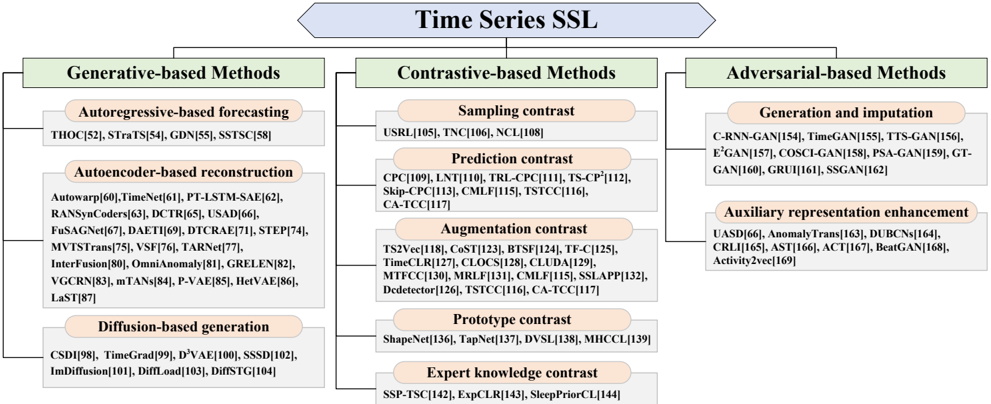
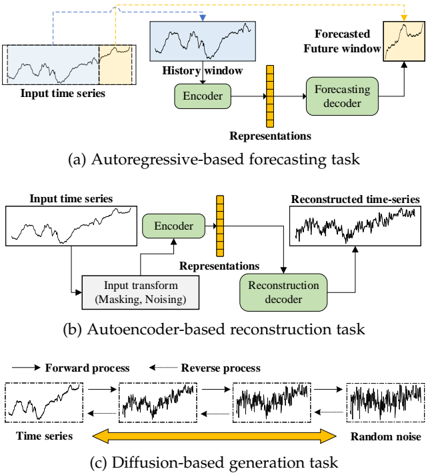
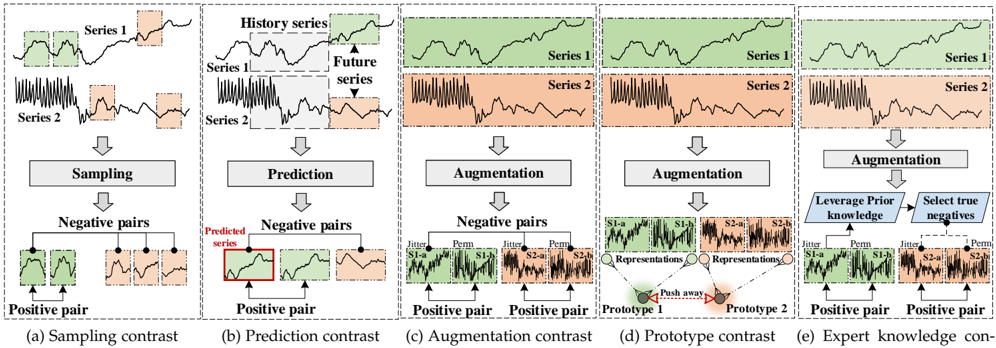
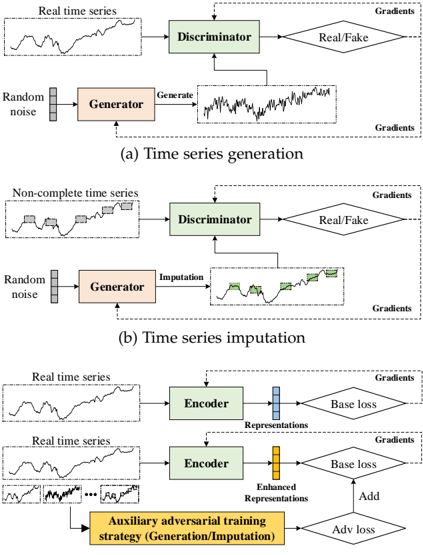
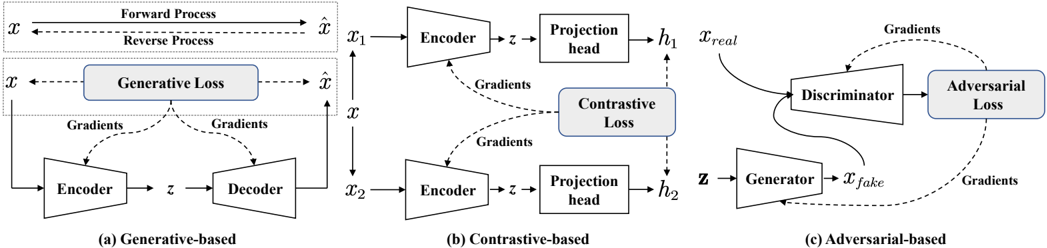
- The paper proposes a taxonomy with three broad SSL paradigms and ten subcategories: autoregressive-based forecasting, autoencoder-based reconstruction, diffusion-based generation; sampling contrast, prediction contrast, augmentation contrast, prototype contrast, expert knowledge contrast; generation/imputation and auxiliary representation enhancement.
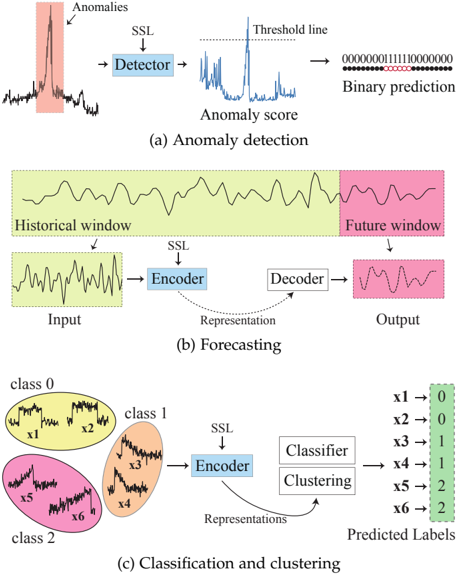
- For anomaly detection, contrastive methods such as Skip-CPC and Dcdetector are reported as achieving the best performance on four datasets; Dcdetector reaches F1 scores of 97.94 on PSM, 96.60 on MSL, 97.02 on SMAP, and 96.33 on SWaT, while Skip-CPC reaches F1 98.55 on PSM, 94.46 on SMD, and 92.75 on MSL.
- For forecasting, LaST and CoST show significant advantages; LaST reports ETTh H=24 MSE/MAE of 0.324/0.368, ETTm 0.218/0.289, Electricity 0.125/0.222, and Weather 0.105/0.134.
- For classification and clustering, results on 30 datasets from HAR, UCR, and UEA show that no single method achieves the best performance on all datasets, and most methods are based on self-supervised contrastive learning.
Methods
- Design: a comprehensive literature survey that reviews existing SSL and time series surveys, then organizes time series SSL methods by learning paradigm and by how positive/negative samples or pretext tasks are constructed.
- Data/resources: summarizes commonly used datasets for anomaly detection, forecasting, classification, and clustering, including PSM, SMD, MSL, SMAP, SWaT, WADI, ETTh, ETTm, Electricity, Weather, HAR, UCR 128, and UEA 30.
- Analysis: qualitative review of frameworks, mathematical formulations, advantages/disadvantages, plus compiled quantitative comparisons from prior work on anomaly detection (five datasets), forecasting (four datasets), and classification/clustering (30 datasets); no new experiments are reported.
Limitations
- The paper states that prior time series SSL surveys only discuss a small part of self-supervised contrastive learning, lack benchmark dataset summaries, and have scarce future directions; it positions itself as filling that gap.
- It also summarizes method-family limitations: generative-based methods are sensitive to rare instances and lack high-level semantic information; contrastive-based methods face sampling bias and augmentation uncertainty; adversarial-based methods suffer unstable training and are rarely used for feature extraction.
- Evident from the text: as a survey, it does not run a unified benchmark; the quantitative tables are collected from prior papers and contain missing entries (“-”), so comparisons are incomplete, and the paper itself calls for reliable benchmark evaluation as a future direction.
Model-written summary. Check it against the paper before relying on it.
Integrity signals
Registry
Cites
Statistics
Figures
Verification
Claims the paper makes
66 Valid · 26 Not valid · 63 Not checked · 80 Own results and interpretations
The cited sources support only part of this claim — read each source’s verdict below.
In the paper
“Methods for constructing multiple contrastive views based on multi-granularity or multi-scale augmentations also include MRLF [131], CMLF [115], and SSLAPP [132].”
What the sources say
- Not checked — no full text of the sourcecites [131] [131] M. Hou, C. Xu, Z. Li, Y. Liu, W. Liu, E. Chen, and J. Bian, 'Multigranularity residual learning with confidence estimation for time series prediction,' in Proceedings of the ACM Web Conference 2022 , ser. WWW '22, 2022, p. 112-121. - source
- Not checked — no full text of the sourcecites [115] [115] M. Hou, C. Xu, Y. Liu, W. Liu, J. Bian, L. Wu, Z. Li, E. Chen, and T.-Y. Liu, 'Stock trend prediction with multi-granularity data: A contrastive learning approach with adaptive fusion,' Proceedings of the 30th ACM International Conference on Information & Knowledge Management , p. 700-709, 2021. - source
- Partly supportedcites [132] [132] H. Lee, E. Seong, and D.-K. Chae, 'Self-supervised learning with attention-based latent signal augmentation for sleep staging with limited labeled data,' in Proceedings of the Thirty-First International Joint Conference on Artificial Intelligence, IJCAI-22 , 7 2022, pp. 38683876, main Track. - sourceExperimental — accuracy not yet measured
Sections 3.2 and 3.3 describe SSLAPP constructing two augmented views as a positive pair and learning from global and local features. But Section 3.2 explicitly says SSLAPP uses pairwise representation learning instead of contrastive learning; the global and local distinction applies to its loss terms, not to multi-scale augmentations. The citation identifies SSLAPP correctly but mischaracterizes its method. (LLM, conf=0.88)
plain- Asserted: passes — The authors put it forward as true.
- Checkable: passes — It can be checked against evidence.
- Load-bearing: unclear — It is unclear whether the paper’s conclusions depend on it.
- Based: passes — The paper gives a reason why it holds.
Every source the paper cites for this claim was checked and supports it.
In the paper
“However, introducing reasonable inductive bias or prior is helpful for many deep neural networks-based modeling tasks [140], [196], [197].”
What the sources say
- Supportedcites [140] [140] X. Wu, L. Xiao, Y. Sun, J. Zhang, T. Ma, and L. He, 'A survey of human-in-the-loop for machine learning,' Future Generation Computer Systems , vol. 135, pp. 364-381, 2022. - source
The Introduction (§1.1; page not provided) says integrating prior knowledge into a learning framework is effective for sparse data and describes its use across several applications. This supports the broad claim that suitable priors can help deep-learning modeling tasks. (LLM, conf=0.85)
- Supportedcites [196] [196] C. Deng, X. Ji, C. Rainey, J. Zhang, and W. Lu, 'Integrating machine learning with human knowledge,' iScience , vol. 23, no. 11, p. 101656, 2020. - source
The Network Architecture section says that adding domain-specific components to neural networks can boost performance and that task-targeted architectures can generalize better. It gives examples for different data and tasks, supporting the broad claim that appropriate inductive biases are helpful in neural-network modeling. (LLM, conf=0.91)
- Supportedcites [197] [197] Y. Chen and D. Zhang, 'Integration of knowledge and data in machine learning,' 2022. - source
The Introduction (page not available in our copy) says that embedding domain knowledge can improve model accuracy and robustness, and that it can improve machine-learning performance. Section 3.1 describes several ways to incorporate prior knowledge into neural networks across different applications, supporting the citing sentence’s broad, qualified claim. (LLM, conf=0.91)
plainstates a cause- Asserted: passes — The authors put it forward as true.
- Checkable: passes — It can be checked against evidence.
- Load-bearing: passes — The paper’s conclusions depend on it.
- Based: passes — The paper gives a reason why it holds.
- Rests on 2 assumptions not shown here.
- Supported
Every source the paper cites for this claim was checked and supports it.
In the paper
“Unlike previous frameworks, SSGAN's classification network makes full use of label information, which helps the model achieve more accurate imputations.”
What the sources say
- Supportedcites [162] [162] X. Miao, Y. Wu, J. Wang, Y. Gao, X. Mao, and J. Yin, 'Generative semi-supervised learning for multivariate time series imputation,' Proceedings of the AAAI Conference on Artificial Intelligence , vol. 35, no. 10, pp. 8983-8991, May 2021. - source
The Classifier Network passage says SSGAN’s classifier uses self-training to make full use of label information in partially labeled time series and guides the generator during imputation. The Ablation Study reports that removing the classifier reduces imputation accuracy by an average of 1.36%, supporting its contribution to more accurate imputations. (LLM, conf=0.94)
plainstates a cause- Asserted: passes — The authors put it forward as true.
- Checkable: passes — It can be checked against evidence.
- Load-bearing: unclear — It is unclear whether the paper’s conclusions depend on it.
- Based: passes — The paper gives a reason why it holds.
- Supported
The cited sources support only part of this claim — read each source’s verdict below.
In the paper
“It is beneficial to introduce an adversarial-based SSL, which can further amplify the difference between normal and anomalous data, such as USAD [66] and DAEMON [184].”
What the sources say
- Partly supportedcites [66] [66] J. Audibert, P. Michiardi, F. Guyard, S. Marti, and M. A. Zuluaga, 'USAD: Unsupervised anomaly detection on multivariate time series,' in Proceedings of the 26th ACM SIGKDD International Conference on Knowledge Discovery & Data Mining , ser. KDD '20, 2020, p. 3395-3404. - sourceExperimental — accuracy not yet measured
Section 5.4 (Ablation Study; page unavailable) reports that adversarial training improves USAD’s F1 score and helps detect anomalies close to normal data. Section 3.2 describes USAD as an unsupervised autoencoder method with adversarial training, but the copy does not identify it as self-supervised learning (SSL). (LLM, conf=0.82)
- Partly supportedcites [184] [184] X. Chen, L. Deng, Y. Zhao, and K. Zheng, 'Adversarial autoencoder for unsupervised time series anomaly detection and interpretation,' in Proceedings of the Sixteenth ACM International Conference on Web Search and Data Mining , ser. WSDM '23, New York, NY, USA, 2023, p. 267-275. - sourceExperimental — accuracy not yet measured
The Abstract and §2.2 identify DAEMON as an unsupervised anomaly detector that uses adversarial training to learn normal time-series patterns; the model-variant results in §4.5.2 report a benefit from adversarial regularization. The paper does not describe DAEMON as self-supervised learning (SSL) or establish that adversarial training amplifies the difference between normal and anomalous data. The cited paper is DAEMON, so this verdict does not assess USAD. (LLM, conf=0.84)
plainstates a cause- Asserted: passes — The authors put it forward as true.
- Checkable: passes — It can be checked against evidence.
- Load-bearing: unclear — It is unclear whether the paper’s conclusions depend on it.
- Based: passes — The paper gives a reason why it holds.
- Partly supported
The cited sources support only part of this claim — read each source’s verdict below.
In the paper
“In recent years, many scholars have also explored the potential of generative representation learning in time series generation and imputation, such as C-RNN-GAN [154], TimeGAN [155], TTS-GAN [156], and E 2 GAN[157].”
What the sources say
- Partly supportedcites [154] [154] O. Mogren, 'C-RNN-GAN: continuous recurrent neural networks with adversarial training,' CoRR , vol. abs/1611.09904, 2016. - sourceExperimental — accuracy not yet measured
The Introduction (p. 1) identifies C-RNN-GAN as an adversarial model that generates continuous sequences, demonstrated with classical music. This supports citing it as an example of sequence generation, but the paper does not describe time-series imputation or establish it as an imputation method. (LLM, conf=0.84)
- Not matchedcites [155] [155] J. Yoon, D. Jarrett, and M. van der Schaar, Time-Series Generative Adversarial Networks , Red Hook, NY, USA, 2019. -
Its entry has no title and year that we can search by.
- Supportedcites [156] [156] X. Li, V. Metsis, H. Wang, and A. H. H. Ngu, 'TTS-GAN: A transformer-based time-series generative adversarial network,' in Artificial Intelligence in Medicine: 20th International Conference on Artificial Intelligence in Medicine, AIME 2022, Halifax, NS, Canada, June 14-17, 2022, Proceedings , Berlin, Heidelberg, 2022, p. 133-143. - sourceExperimental — accuracy not yet measured
The TTS-GAN paper identifies itself as a transformer-based GAN for generating synthetic time-series data (title and abstract, p. 1). Citation [156] is attached to TTS-GAN as an example in the list; the paper supports its role as a time-series generation method. (LLM, conf=0.93)
plain- Asserted: passes — The authors put it forward as true.
- Checkable: passes — It can be checked against evidence.
- Load-bearing: unclear — It is unclear whether the paper’s conclusions depend on it.
- Based: passes — The paper gives a reason why it holds.
- Partly supported
44 more claims · 15 with their cited sources checked
Create a free account to see all 235 claims and to verify the 13 references still open.
- Probably not a substantial claim. 158
- It may state two separate claims as one. 79
Self-check
Percentages, sums and reported differences re-computed from the paper’s own numbers.
Each contradiction between two passages listed here was confirmed by an independent check.
Rated minor: it would not touch a result — a value no result rests on, a p-value that stays on the same side of the significance level, or a conflict that is clerical, resolved elsewhere in the paper, or outside its own findings.
In the paper
§ I.2 Correlation analysis between methods and tasks · p. 26
“| Method | 15 UCR Datasets | 15 UCR Datasets | 15 UCR Datasets | 15 UCR Datasets |”
§ I.2 Correlation analysis between methods and tasks · p. 26
“| | Beef | ChCo | Coffee | CricketX | DiPOA | DiPOC | ECG200 | ECGF | Car | Ham | Herring | Wine | Meat | MiPOA | Wafer | Yoga |”
Rated minor: it would not touch a result — a value no result rests on, a p-value that stays on the same side of the significance level, or a conflict that is clerical, resolved elsewhere in the paper, or outside its own findings.
In the paper
§ I.1 Quantitative performance comparisons · p. 25
“| RANSynCoder [63] | 99 | 96 | 93 | 90 | 85 | 83 |”
§ H.1 Anomaly detection · p. 23
“F1-score is the harmonic mean of precision and recall, i.e.,”
Rated minor: it would not touch a result — a value no result rests on, a p-value that stays on the same side of the significance level, or a conflict that is clerical, resolved elsewhere in the paper, or outside its own findings.
In the paper
§ I.1 Quantitative performance comparisons · p. 25
“| ImDiffusion [101] | 98.11 | 97.53 | 97.81 | 95.2 | 95.09 | 94.88 |”
§ H.1 Anomaly detection · p. 23
“F1-score is the harmonic mean of precision and recall, i.e.,”
Citations
Cites
BERT: Pre-training of Deep Bidirectional Transformers for Language Understanding
Devlin, J., Chang, M.-W., Lee, K., & Toutanova, K. (2018) · arXiv · doi:10.48550/arxiv.1810.04805 · Cited by 73,173 · cited 2×
“With the help of well-designed pretext tasks, SSL has recently achieved great success in the domains of Computer Vision (CV) [7], [8], [9], [10] and Natural Language Processing (NLP) [11], [12].”
BackgroundMethodUnpaired image-to-image translation using cycle-consistent adversarial networks
Zhu, J.-Y., Park, T., Isola, P., & Efros, A. A. (2017) · 2017 IEEE International Conference on Computer Vision (ICCV) · doi:10.1109/iccv.2017.244 · Cited by 23,602
Image-to-Image Translation with Conditional Adversarial Networks
Isola, P., Zhu, J.-Y., Zhou, T., & Efros, A. A. (2017) · 2017 IEEE Conference on Computer Vision and Pattern Recognition (CVPR) · doi:10.1109/cvpr.2017.632 · Cited by 22,930 · cited 1×
“The generator in the GAN can generate synthetic data close to the real data, so adversarial representation learning has a wide range of applications in the data generation field [141], especially in image generation [142]–[145].”
BackgroundAuto-Encoding Variational Bayes
Kingma, D. P., & Welling, M. (2013) · arXiv · doi:10.48550/arxiv.1312.6114 · Cited by 20,067
Momentum Contrast for Unsupervised Visual Representation Learning
He, K., Fan, H., Wu, Y., Xie, S., & Girshick, R. (2020) · 2020 IEEE/CVF Conference on Computer Vision and Pattern Recognition (CVPR) · doi:10.1109/cvpr42600.2020.00975 · Cited by 13,347 · cited 1×
“The major categories include end-to-end [16], memory bank [34], momentum encoder [35], and clustering [36].”
BackgroundRepresentation Learning: A Review and New Perspectives
Bengio, Y., Courville, A., & Vincent, P. (2013) · IEEE Transactions on Pattern Analysis and Machine Intelligence · doi:10.1109/tpami.2013.50 · Cited by 13,001 · cited 1×
“Using the learning paradigm as a taxonomy is arguably the most popular among the existing SSL surveys, including [20], [22], [23], [24], [25], [26], [27].”
MethodKirillov, A., Mintun, E., Ravi, N., Mao, H., Rolland, C., Gustafson, L., Xiao, T., Whitehead, S., Berg, A. C., Lo, W.-Y., et al. (2023) · 2023 IEEE/CVF International Conference on Computer Vision (ICCV) · doi:10.1109/iccv51070.2023.00371 · Cited by 11,953 · cited 1×
“A similar phenomenon also appears in computational vision [203].”
BackgroundA Style-Based Generator Architecture for Generative Adversarial Networks
Karras, T., Laine, S., & Aila, T. (2019) · 2019 IEEE/CVF Conference on Computer Vision and Pattern Recognition (CVPR) · doi:10.1109/cvpr.2019.00453 · Cited by 11,714 · cited 1×
“The generator in the GAN can generate synthetic data close to the real data, so adversarial representation learning has a wide range of applications in the data generation field [149], especially in image generation [150], [151], [152], [153].”
BackgroundA simple framework for contrastive learning of visual representations
Chen, T., Kornblith, S., Norouzi, M., & Hinton, G. (2020) · arXiv · doi:10.48550/arxiv.2002.05709 · Cited by 10,857
Explaining and Harnessing Adversarial Examples
Goodfellow, I. J., Shlens, J., & Szegedy, C. (2014) · arXiv · doi:10.48550/arxiv.1412.6572 · Cited by 10,381 · cited 1×
“…various recent and typical adversarial attack and defense methods for fault classifiers in data-driven fault detection and classificationsystems,includingwhite-boxattack(FGSM[209], IGSM[210],C & W attack [211], DeepFool [212]) and gray-box and black-box attack (UAP [213], SPSA [214], Random noise).”
Background
Research works printed but not linked: 9
- [13] R. B. Cleveland, W. S. Cleveland, J. E. McRae, and I. Terpenning, 'STL: A seasonal-trend decomposition,' J. Off. Stat , vol. 6, no. 1, pp. 3-73, 1990. -
- [83] W. Chen, L. Tian, B. Chen, L. Dai, Z. Duan, and M. Zhou, 'Deep variational graph convolutional recurrent network for multivariate time series anomaly detection,' in Proceedings of the 19. 39th International Conference on Machine Learning , ser. Proceedings of Machine Learning Research, vol. 162, 17-23 Jul 2022, pp. 36213633. -
- [95] Y. Song and S. Ermon, 'Improved techniques for training scorebased generative models,' Advances in neural information processing systems , vol. 33, pp. 12 438-12 448, 2020. -
- [113] K. Zhang, Q. Wen, C. Zhang, L. Sun, and Y. Liu, 'Time series anomaly detection using skip-step contrastive predictive coding,' in NeurIPS 2022 Workshop: Self-Supervised Learning - Theory and Practice , 2022. -
- [148] I. Goodfellow, J. Pouget-Abadie, M. Mirza, B. Xu, D. WardeFarley, S. Ozair, A. Courville, and Y. Bengio, 'Generative adversarial nets,' in Advances in Neural Information Processing Systems , vol. 27, 2014. - · doi:10.5555/2969033.2969125
- [165] Q. Ma, C. Chen, S. Li, and G. W. Cottrell, 'Learning representations for incomplete time series clustering,' Proceedings of the AAAI Conference on Artificial Intelligence , vol. 35, no. 10, pp. 88378846, May 2021. - · DOI · Paper page
- [189] Y. Zhang and J. Yan, 'Crossformer: Transformer utilizing crossdimension dependency for multivariate time series forecasting,' in The Eleventh International Conference on Learning Representations , 2023. -
- [191] H. Wang, J. Peng, F. Huang, J. Wang, J. Chen, and Y. Xiao, 'MICN: Multi-scale local and global context modeling for long-term series forecasting,' in The Eleventh International Conference on Learning Representations , 2023. -
- [215] J. Li, L. Lyu, D. Iso, C. Chakrabarti, and M. Spranger, 'MocoSFL: enabling cross-client collaborative self-supervised learning,' in The Eleventh International Conference on Learning Representations , 2023. -
Cited by
Items 201–276 of 276
A Fluctuation Correlation Analysis Model for Time Series Data in the Fresh Food Field
Zhang, X., & Wang, Y. (2025) · International Conference on Natural Computation, Fuzzy Systems and Knowledge Discovery (ICNC-FSKD) · doi:10.1109/icnc-fskd67701.2025.11198039
“Time series data is a collection of research data whose process of change is precipitated by the passage of time [1] 。 Fresh food market prices have complex characteristics such as random volatility and seasonality.”
Online Irregular Multivariate Time Series Forecasting via Uncertainty-Driven Dual-Expert Calibration
Wen, H., Chen, H., & Feng, S. (2026) · ACM SIGKDD Conference on Knowledge Discovery and Data Mining (KDD) · doi:10.1145/3770855.3817729
Self-supervised multi-scale cloud workload prediction with time series data augmentation
Jiang, C., Wu, W., & Qiaoping, Z. (2026) · Neural Networks · doi:10.1016/j.neunet.2026.109034
Interpretable multi-scale trajectory-to-quality prediction for optical film deposition
Li, J., Lei, H., Ma, W., Li, H., Wei, Y., Cheng, J. P., Huang, X., Zhang, F., Luo, Z., Zhao, L., et al. (2026) · International Journal of Mechanical Sciences · doi:10.1016/j.ijmecsci.2026.112030
TRIAD: Ternary Information Routing for Multimodal Time-Series Sensing Signals
Liu, Y., Ma, S., Lu, H. C., Cheng, X., Liu, X., & Huo, H. (2026) · ACM SIGKDD Conference on Knowledge Discovery and Data Mining (KDD) · doi:10.1145/3770855.3818194
Self-citationSemi-Supervised Approach to Detect Human Discontent from Real-Life Behaviour Data
Vildjiounaite, E., Finland, O., Kyllönen, V., Kallio, J., & Räsänen, P. (2025) · International Workshop on Content-Based Multimedia Indexing (CBMI) · doi:10.1109/cbmi66578.2025.11339272
“Self-supervised learning methods for sparse, irregular time series are also only emerging now; most of them use interpolation [10], but this fails when missing segments are long, as is often the case with real-life human behaviour data.”
Bais, P. K., & Londhe, N. D. (2026) · Computers & Electrical Engineering · doi:10.1016/j.compeleceng.2026.111500
Tong, Z., Abuhaija, B., & Gao, Z. (2026) · Multidimensional Signal Processing Workshop · doi:10.1109/ivmsp68335.2026.11618781
“A. Self-Supervised Learning for Time Series Self-supervised learning (SSL) has become an important paradigm for time-series representation learning, especially when labeled annotations are limited or expensive to obtain [10].”
Li, X., Huang, Y., Fang, Q., Yang, Y., Zhao, C., & Cai, K. (2026) · ACM SIGKDD Conference on Knowledge Discovery and Data Mining (KDD) · doi:10.1145/3770855.3817822
Looking Around You: External Information Enhances Representations for Event Sequences
Sokerin, P., Kovaleva, M., Boyarina, E., Tikhomirov, P., Vorobiyov, D., & Zaytsev, A. A. (2026) · IEEE Access · doi:10.1109/access.2026.3695159
“Contrastive learning also enables the generation of meaningful representations for time-series and event-sequence data [24].”
Latent-consistency-constrained self-supervised representation stabilisation
Wang, C. (2026) · Cyber-Physical Systems · doi:10.1080/23335777.2026.2696420
Spectral-adaptive masking and hierarchical contrastive learning for time series clustering
Wang, Z., Xu, X., Xu, S. L., Guo, N., Bian, X., Yao, S., Zhou, T., & Shen, Y. (2026) · Intelligent Data Analysis · doi:10.1177/1088467x251413367
Enhancing Contrastive Learning in Sequence Classification via Data Augmentation
Huang, H., Tang, C.-Y., & Pao, H.-K. (2025) · Communications in computer and information science · doi:10.1007/978-981-96-6291-3_20
Adaptive Extraction of Variable-Length Subsequence Patterns in Noisy Time Series
Zhang, K., Duan, J., Yang, T., Wang, H., & Lv, C. (2025) · Lecture notes in computer science · doi:10.1007/978-981-96-8295-9_30
Self-citationNiu, Y., Ye, J., Zhao, S., Hou, Z., Yang, C., Li, Z., Wen, Y., & Yuan, X. (2025) · IEEE International Conference on Acoustics Speech and Signal Processing · doi:10.1109/icassp49660.2025.10889264
“Existing methods can be categorized into five approaches based on how they construct positive and negative samples [13]: sampling contrast, prediction contrast, augmentation contrast, prototype contrast, and expert knowledge contrast.”
Ayyob, F., Javaid, S., Li, S., Khan, M. A., Barb, G., & Silaghi, A.-M. (2026) · IEEE Access · doi:10.1109/access.2026.3732057
“These pretrained representations can subsequently be transferred to downstream tasks such as fault classification, enabling effective fine-tuning with only a small amount of labeled data [133], [134].”
Li, X., Sun, S., Wang, Y., et al. (2026) · Earth Science Informatics · doi:10.1007/s12145-026-02178-8
“Contrastive learning, as an important paradigm of representation learning, aims to pull semantically similar positive pairs together and push semantically dissimilar negative pairs apart in a latent space (Huang et al. 2025; Zhang et al. 2024 ).”
Double masked sub-representations for contrastive learning withsmall-batch trainingPreprint
Leng, Q., Yuan, G., Yi, G., Fan, X., & Wang, C. (2025) · SSRN Electronic Journal · doi:10.2139/ssrn.5987338
Foundation Models for Time Series Analysis: Concepts, Methodologies, and Applications
Liang, Y., Wen, H., Jiang, Y., Jin, M., Song, D., Wu, M., Pan, S., & Wen, Q. (2026) · ACM SIGKDD Conference on Knowledge Discovery and Data Mining (KDD) · doi:10.1145/3770855.3816446
Self-citationLi, K., Wang, Q., Liu, H., Wang, M., Zhu, S., Wang, X., & Qin, J. (2025) · Engineering Applications of Artificial Intelligence · doi:10.1016/j.engappai.2025.112216
An, F., Ma, X., Shen, N., He, Y., Hao, Y., Jiang, L., & Duan, J. (2026) · IEEE Sensors Journal · doi:10.1109/jsen.2026.3720358
“Masked autoencoding [19], [20], contrastive pretraining [21], [22], [23], [24], and, more recently, general-purpose time-series representation models [24], [25], [26], [27], [28], [29] have demonstrated strong transferability in natural-image, natural-language, and generic time-series settings.”
Real‐Positive‐Neighbours Guide Contrastive Graph Clustering Network
Yang, J., Xiang, C., Xu, W., Zhao, Z., Zhang, J., & Wu, H. (2025) · Expert Systems · doi:10.1111/exsy.70125 · Cited by 1
“These methods leverage Contrastive Learning (Yang, Wang, et al. 2025; Liu et al. 2021; Zhang et al. 2024) to pull positive sample pairs closer while pushing negative pairs apart, often relying on graph augmentation techniques.”
Self-citationChi, C. (2026) · International Conference on Distributed Computing and Electrical Circuits and Electronics (ICDCECE) · doi:10.1109/icdcece68961.2026.11646003
“Zhang and others have put forward a taxonomy of self-supervised time-series analysis and demonstrated that reconstruction, contrastive and predictive objectives can be used together under label scarcity [10].”
Wang, G., Li, Q., Wang, Q., Alsolai, H., & Jiang, X. (2025) · IEEE Transactions on Consumer Electronics · doi:10.1109/tce.2025.3608449
“This leads to high false alarm rates or missed detections when the system enters new operational states or experiences gradual drift [20].”
Helicopter Flight Action Recognition Based on the Rocket Algorithm
Jie, Y., Liu, Y., Shen, R., et al. (2025) · International Joint Conference on Information and Communication Engineering (JCICE) · doi:10.1109/jcice66205.2025.11182073
Self-citationWang, P., Wu, X., Song, Y., Wu, X., & Wang, X. (2026) · Journal Of Big Data · doi:10.1186/s40537-026-01455-z
Learning Satellite Pattern-of-Life Identification: A Diffusion-Based Approach
Ye, Y., Zhu, X., Shen, X., Chen, X., Qin, S. J., & Li, L. (2025) · IEEE Transactions on Aerospace and Electronic Systems · doi:10.1109/taes.2025.3624708 · Cited by 1
“Satellite PoL identification can be viewed as a specific instance of the broader problem of time-series segmentation, which involves dividing a sequence of data points over time into meaningful and distinct segments for subsequent analysis [21].”
Cross-Modal Self-supervised Learning with Smartphone Records for Early Parkinson’s Disease Detection
He, T., Du, J., & Chen, J. (2026) · Communications in computer and information science · doi:10.1007/978-981-92-3994-8_10
Peng, D., Shu, Z., & Yu, Z. (2026) · Measurement · doi:10.1016/j.measurement.2026.122068
Ziogas, I., Hadjileontiadis, L. J., Khandoker, A. H., & Shehhi, A. A. (2025) · IEEE International Conference on Acoustics Speech and Signal Processing · doi:10.1109/icassp49660.2025.10888648 · Cited by 2
“Computer vision-inspired augmentations have been applied to time series [5], [6], yet they do not possess the capacity to model temporal dependencies, temporal ordering and the high-dimensional nature of univariate and multivariate signals [7].”
Sanjalawe, Y. K., Fraihat, S., Al-E’mari, S., & Makhadmeh, S. N. (2025) · Annals of Data Science · doi:10.1007/s40745-025-00665-1 · Cited by 1
THE POINT OF OBLIVION THEOREMPreprint
Datt, S. (2024) · doi:10.14293/pr2199.000921.v1
Pettine, W. W., & Christenson, M. P. (2024) · doi:10.2196/preprints.68679
Subhan, R. M., Lee, Y.-D., & Koo, I. (2026) · IEEE Access · doi:10.1109/access.2026.3706281
“Because anomaly labels are often scarce in WSN and related multivariate sensing problems, self-supervised and representation-learning approaches have become increasingly important [12], [13], [14].”
Dynamic Transfer Learning Switching Approach Using Resource Benchmark in Edge Intelligence
Nkenyereye, L., Rajkumar, C., Lee, B. G., & Chung, W. (2025) · IEEE Internet of Things Journal · doi:10.1109/jiot.2025.3557408 · Cited by 4
“When employing ML techniques, particularly UL techniques [51], the input dataset is crucial as it establishes the knowledge foundation from which the algorithms learn.”
FastTWE: Making TWE-based time-series similarity search faster via random convolutional kernels
Zhang, H., He, X., Jing, L., Li, J., & Yao, Q. (2025) · Applied Soft Computing · doi:10.1016/j.asoc.2025.114256
Huang, Z., Xu, Z., Wang, Y., Yao, T., Li, K., Yin, R., Yang, Z., Mei, W., & Bing, S. (2026) · Engineering Applications of Artificial Intelligence · doi:10.1016/j.engappai.2026.116143
LG-Fast-ACDTW: a fast adaptive dynamic time warping algorithm
Cao, D., Cui, H., Liu, D., Lin, Z., & Yang, L. (2026) · Knowledge and Information Systems · doi:10.1007/s10115-026-02822-1
Multitimeframe Drummond Patches and JEPA Pretraining for Short-Term Retail OHLC Series Forecasting
Sizov, A. S., Khalin, Y. A., & Belykh, A. A. (2026) · Automatic Documentation and Mathematical Linguistics · doi:10.3103/s0005105526700238
“…• SeasonalNaive: naive forecast with weekly sea-sonality; • Ridge/LightGBM: linear model and gradient boosting on table features, which underlie modern ensemble solutions [11]; • N-BEATS/N-HiTS: modern neural network models for time series forecasting [4, 5]; • TFT: Temporal Fusion Transformer [6].”
Grace, J. P. S., Ezhilarasi, P., & Kannan, S. R. (2025) · Journal of Electrical Engineering and Technology · doi:10.1007/s42835-025-02410-3
“The significance of self-supervised learning is its ability to enable machines to extract knowledge from large volumes of unmarked data, thereby enhancing their capacity to adapt to novel tasks and fields [ 29, 30].”
Explicit Temporal and Spatial Modeling for Multivariate Time Series Anomaly Detection: A Survey
Xu, Y., Liu, Y., Ding, Y., & Yang, S. (2026) · International Symposium on Machine Learning and Media Computing (MLMC) · doi:10.1109/mlmc69743.2026.11686790
“Other surveys adopt specific modeling perspectives, such as self-supervised learning [17], [18], frequency-domain analysis [19], or graph-based dependency modeling [20], [21].”
Self-citationZhang, Z., Li, Y., Lai, D., et al. (2026) · AIP Advances · doi:10.1063/5.0313786
Extracting brain states and quantifying the dynamical transitions between states using VQ-VAE
Lin, S., Qiu, Z., Chen, H., et al. (2025) · Journal of Physics Conference Series · doi:10.1088/1742-6596/3147/1/012004
“Zhang et al [2] . proposed an EEG representation framework based on self-supervised learning, enhancing the model's ability to capture temporal patterns through Contrastive Learning, achieving a 12% improvement in accuracy for emotion recognition tasks.”
Forecasting extreme temperature events by Hankel-augmented contrastive learning
Qin, C., Ding, Y., Tao, P., & Chen, L. (2026) · National Science Review · doi:10.1093/nsr/nwag456 · Cited by 1
“Applications to time-series analysis show promise [56 ,57 ], with works like TS2Vec [58 ], CoST [59 ], TF-C [60 ], SimMTM [61 ] and TNC [62 ] demonstrating improved representations.”
Ilyin, E. V., & Sidorkina, I. (2026) · Computational nanotechnology · doi:10.33693/2313-223x-2026-13-2-162-175
CoGenT: A Unified Contrastive-Generative Framework for Time Series Classification
Liu, Z., Alavi, A., Li, M., & Zhang, X. (2025) · IEEE Transactions on Artificial Intelligence · doi:10.1109/tai.2025.3637168
“The prominent SSL approaches in time series contain autoregressive, contrastive, and generative (reconstructive) methods [2].”
Dynamic-Segment-Masking Pre-training for Multivariate Time-Series Classification
Zhang, L., Ding, Y., Hu, T., Li, J., & Sato, H. (2026) · Lecture notes in computer science · doi:10.1007/978-981-95-7084-3_43
Graph-enhanced Multi-scale Mamba Network with Whale Optimization for Air Quality Forecasting
Cheng, M., Fan, K., & Zhang, C. (2026) · International Conference on Computer Vision and Data Mining (ICCVDM) · doi:10.1109/iccvdm71812.2026.11709328
“The proposed WOA-GMamba is compared with five single models (RNN, GRU, LSTM, TCN[3], Mamba[10]) and four hybrid models (STCN[2], AirFormer[7], MICN[4],WOA-STMamba[8]).”
Self-citationLiu, T., Hu, M., Song, Y., & Wu, D. C. (2026) · Knowledge-Based Systems · doi:10.1016/j.knosys.2026.117105
Time Series Foundation Models for Process Model Forecasting
Yu, Y., Peeperkorn, J., Smedt, J. D., & Weerdt, J. D. (2026) · Lecture notes in computer science · doi:10.1007/978-3-032-28110-4_5 · Cited by 3
REFINE: Trajectory Representation Learning via Closed-Loop Transcription
Yang, B., Sun, Y., Hu, J., Xu, Z., Torp, K., Lu, H. C., Yang, B., & Jensen, C. S. (2026) · ACM SIGKDD Conference on Knowledge Discovery and Data Mining (KDD) · doi:10.1145/3770855.3817866 · Cited by 5
Self supervised intrusion detection algorithm based on dynamic spatiotemporal graph
Bai, H., Chen, L., & Dai, Q. (2026) · Applied Intelligence · doi:10.1007/s10489-026-07371-2 · Cited by 2
T-SSCL: A Temporal Self-supervised Framework for Enhanced Land Cover Classification
Yadav, A., Bhatnagar, V., & Jain, A. (2026) · Lecture notes in networks and systems · doi:10.1007/978-3-032-28379-5_41
AI-Driven Soft Sensors: Applications, Validation, and Metrological Challenges
Nzakuna, P. S., Lasaba, M. E., Basemenane, V., Mutelezi, E., Paciello, V., & Lusala, A. K. (2026) · IEEE International Symposium on Artificial Intelligence for Instrumentation and Measurement (AI4IM) · doi:10.1109/ai4im69129.2026.11558210
“Self-supervised learning (SSL) provides a route to exploit large volumes of unlabeled sensor data to learn representations that can be fine-tuned with few labels [34].”
Peng, S., Han, Y., Liu, L., Li, J., Li, R., Gu, Z., Liu, J., & Chu, X. (2026) · IEEE Transactions on Automation Science and Engineering · doi:10.1109/tase.2026.3683936 · Cited by 1
“…this tight cyber–physical integration also significantly enlarges the attack surface: sophisticated cyber intrusions, stealthy signal manipulations, and cross-layer disturbances may propagate across both cyber and physical domains, giving rise to subtle yet safety-critical anomalies [5], [6], [7].”
Ma, Z., An, W., & Huang, Y. (2026) · IEEE Transactions on Aerospace and Electronic Systems · doi:10.1109/taes.2026.3676433
“Moreover, they are generally designed for pattern discrimination tasks with two to six classes, comparable to our five-class scenario, and are widely acknowledged as benchmark datasets [23], [24], [37], [38], [39], [40].”
Lightweight multi-period universal representation learning for multivariate time series
Chen, L., Hu, B., Zou, Y. Y., et al. (2026) · Information Sciences · doi:10.1016/j.ins.2026.124115
Learning Cardiac Features: ECG Biometrics Across Time and Exercise
Thiebaud, L., Chauchat, P., Ouladsine, M., & Delliaux, S. (2026) · Lecture notes in computer science · doi:10.1007/978-3-032-35387-0_7
“To overcome the reliance on labeled data, recent work has turned to self-supervised learning (SSL) based approaches, enabling pre-training large architectures without the need for large amounts of annotated data [32].”
Ghanadian, F., Zollanvari, A., Nurmanova, V., & Bagheri, M. (2026) · International Transactions on Electrical Energy Systems · doi:10.1155/etep/7093491
Enseñar, aprender e investigar la Planificación Territorial
Rocco, R., Bracken, G., Newton, C., et al. (2025) · doi:10.59490/mg.123
Wensheng, Y., Ke, G., & Chen, J. (2026) · WSEAS TRANSACTIONS ON BUSINESS AND ECONOMICS · doi:10.37394/23207.2026.23.97
Li, D. C. (2026) · SSRN Electronic Journal · doi:10.2139/ssrn.6960522
He, T., He, Q., Mou, J., & Chen, J. (2026) · IEEE Transactions on Instrumentation and Measurement · doi:10.1109/tim.2026.3729007
“The main reasons are the di ffi culty of data augmentation, the complex dynamic patterns, and poor transferability [10], [18].”
Zhou, J., Du, X., Lei, X., Wu, Y., Li, J., & Liu, Z. (2025) · IEEE Conference on Energy Internet and Energy System Integration (EI2) · doi:10.1109/ei268505.2025.11425457
“In the speech and acoustic domains, typical approaches include temporal prediction [20], masked reconstruction [21], [22] (e.g., restoring masked time-frequency patches), and contrastive learning [23].”
Research Progress and Prospects of Pre-Training Technology for Electromagnetic Signal Analysis
Lu, X., Li, Q., Long, H., Wang, L., Liang, X., Chen, W., Zhang, X. “., Zeng, X., & Liu, Y. (2025) · IEEE Access · doi:10.1109/access.2025.3553739
“Representation learning in time series has shown its advantages in self-supervised contrastive learning [10] because it is able to learn invariant representations of features.”
Self-citationSelf-Supervised Spatial-Frequency Domain Learning for Time Series Forecasting
Qian, Y., Wang, C., & Ding, Y. (2025) · China Automation Congress (CAC) · doi:10.1109/cac67268.2025.11487124
Multimodal Learning for Spatio-Temporal Data Mining
Zhong, S., Hao, X., Miao, H., Zhao, Y. L., Wen, Q., Zimmermann, R., & Liang, Y. (2025) · ACM International Conference on Multimedia (ACM MM) · doi:10.1145/3746027.3759204 · Cited by 2
Self-citationSkaf, W., Baratchi, M., & Hoos, H. H. (2025) · Machine Learning · doi:10.1007/s10994-025-06895-x · Cited by 1
Zhang, B., Wang, Z., Wang, S. T., Qin, C., Xia, P., & Liu, C. (2026) · Advanced Engineering Informatics · doi:10.1016/j.aei.2026.105140
Chang, A., Rani, S., Kim, B., Gong, J., Qin, Z., Li, K., & Lv, J. (2026) · Applied Soft Computing · doi:10.1016/j.asoc.2026.116377
“We follow the standard few-shot learning notation established in [25,26] and adopt the N-way K-shot episodic framework.”
Torshin, I., M'Zough, W., López-García, T. B., & Sidqi, Y. (2026) · International Conference on the European Energy Market (EEM) · doi:10.1109/eem68581.2026.11589668
“Recent advances in machine learning have shown that representation learning can improve generalization in time-series problems by extracting latent temporal structure before task-specific supervision [7].”
Yuan, H., Zhang, L., Bao, R., Si, J., Wang, S., & Niu, T. (2025) · IEEE/RSJ International Conference on Intelligent Robots and Systems (IROS) · doi:10.1109/iros60139.2025.11247613
“Additionally, studies emphasizing multi-scale and local-global feature aggregation [24], [25], [26] have provided valuable insights into the advancement of semantic segmentation.”
Source-free time series domain adaptation with class-aware temporal imputation
Zhong, Y., Zhou, W., & Tao, L. (2026) · Information Processing & Management · doi:10.1016/j.ipm.2026.104658 · Cited by 1
Tian, H., zhao, J., He, X., Wu, B., Chen, Y., Liu, S., Lu, X., Gao, Z., & Yang, W. (2026) · SSRN Electronic Journal · doi:10.2139/ssrn.6124333
Multi-Granularity Graph Contrastive Learning Framework via Granular Ball on Heterogeneous Graphs
Wang, G., Xia, S., Tan, C., Chao, H., Zhao, S., Liu, Y., Wang, Y., Wang, W., Wang, G., & Gao, X. (2026) · IEEE Transactions on Pattern Analysis and Machine Intelligence · doi:10.1109/tpami.2026.3720194
Self-citationZhang, T., Hui, L., Zhang, J., Bai, L., & Li, Y. (2026) · Pattern Recognition · doi:10.1016/j.patcog.2026.115051
Self-citation
Metadata
- Authors
- Zhang, K., Wen, Q., Zhang, C., Cai, R., Jin, M., Liu, Y., Zhang, J. Y., Liang, Y., Pang, G., Song, D., & Pan, S.
- Affiliations
- Zhejiang University (CN)
- Alibaba Group (China) (CN)
- Zhejiang Normal University (CN)
- Monash University (AU)
- Ant Group (China) (CN)
- Hong Kong University of Science and Technology (HK)
- Singapore Management University (SG)
- University of Connecticut (US)
- Griffith University (AU)
- ORCID
- Venue
- IEEE Transactions on Pattern Analysis and Machine Intelligence
- Published
- 2024-10
- Volume
- 46
- Issue
- 10
- Pages
- 6775-6794
- ISSN
- 0162-8828 (ISSN-L)
- 2160-9292
- 1939-3539
- OpenAlex
- W4394699135
- Cited by
- 295
- References
- 232
- Citations by year
- 2026: 124 · 2025: 115 · 2024: 51
- FWCI
- 51.74
- Type
- journal article
- Language
- en
- Open access
- green
- arxiv.org
- Licence
- Locations
- IEEE Transactions on Pattern Analysis and Machine Intelligence (publishedVersion)
- PubMed (publishedVersion)
- arXiv (Cornell University) (submittedVersion, public-domain)
- Singapore Management University Institutional Knowledge (InK) (Singapore Management University) (submittedVersion, cc-by-nc-nd)
- Rare & Special e-Zone (The Hong Kong University of Science and Technology) (submittedVersion)
- Griffith Research Online (submittedVersion)
- arXiv (Cornell University)
- Funders
- Key R&D Project of Zhejiang Province (2024C01172)
- National Key R&D Program of China (2021YFB2012300)
- Topics
- Physical Sciences › Computer Science › Signal Processing › Time Series Analysis and Forecasting
- Physical Sciences › Computer Science › Artificial Intelligence › Domain Adaptation and Few-Shot Learning
- Social Sciences › Decision Sciences › Management Science and Operations Research › Stock Market Forecasting Methods
- Keywords
- self-supervised learning, time series analysis, contrastive learning, adversarial learning, pre-training and fine-tuning, time series forecasting, time series classification, time series anomaly detection, time series clustering, benchmark dataset
About these checks
Registry, retraction, Cites and statistics results are computed, not judged, with one exception: a printed reference that no index lists is read once by a model before it counts as a citation error. Claims are extracted by a model and kept only when their quote appears verbatim in the text; each cited source is then checked, with a model’s help, for whether it says what the claim relies on. Those verdicts can be wrong — read the claim’s quote and the cited source before relying on one.
The claim verdicts this report counts are experimental: their accuracy is not yet measured.
A language model drew the claims from the paper on 2026-10-10, under version 3 of the claim definition (model deepseek-v4.1-flash, prompt extract-v3).
A second model labelled each claim on 2026-10-10 (model jev-1.13-20260917, definition revision gold-guideline-v0.2).
Cited sources are checked with a language model’s help (gpt-6-sol).
Statistics and arithmetic are recomputed, not judged.
Confidence bands are shown only for fields calibrated on our annotated test set. None is calibrated yet, so no band is shown.
What counts as a claim ›How we measure confidence ›How we check this ›
Are you an author, or do you see a problem with this page? Request a review
Data sources
Bibliographic data: Semantic Scholar, OpenAlex, Crossref.
Contains information from the Semantic Scholar Academic Graph Datasets, made available under the ODC Attribution License (ODC-BY 1.0).
Semantic Scholar’s data is described in: Kinney, R., et al. (2023). The Semantic Scholar Open Data Platform. arXiv:2301.10140.
