

Self-Supervised Learning for Time Series Analysis: Taxonomy, Progress, and Prospects
Open accessThe DOI matches its Crossref record; 222 of the 232 references it cites were found in a registry or an index, and 2 are not checked yet; 86 of the 189 sources its claims cite were checked for support.
Abstract
A comprehensive survey of current state-of-the-art SSL methods for time series data, proposing a taxonomy categorizing methods into generative-based, contrastive-based, and adversarial-based across ten subcategories, along with benchmark datasets for forecasting, classification, anomaly detection, and clustering.
Verified 2026-11-22 · 2 references not checked yet
Overview
CoChat Summary
TL;DR
This survey reviews self-supervised learning (SSL) for time series, proposing a taxonomy of generative-based, contrastive-based, and adversarial-based methods divided into ten subcategories. It summarizes applications/datasets and future directions, and compiles quantitative comparisons showing no single SSL method dominates across tasks.
Key findings
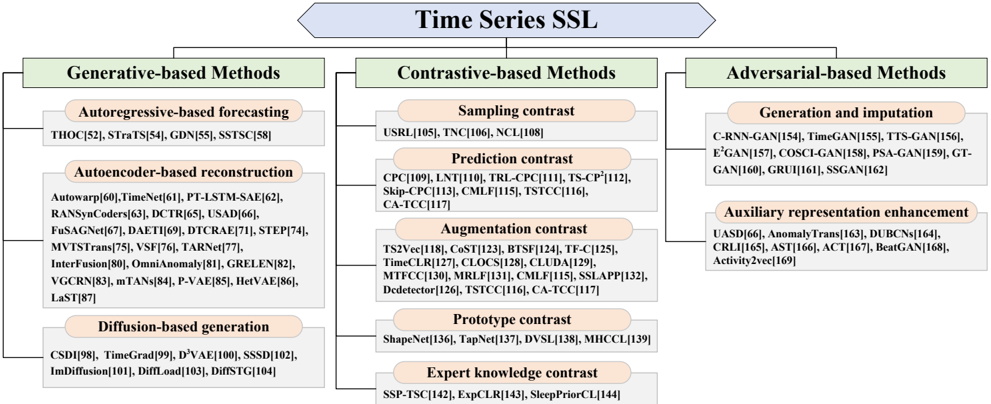
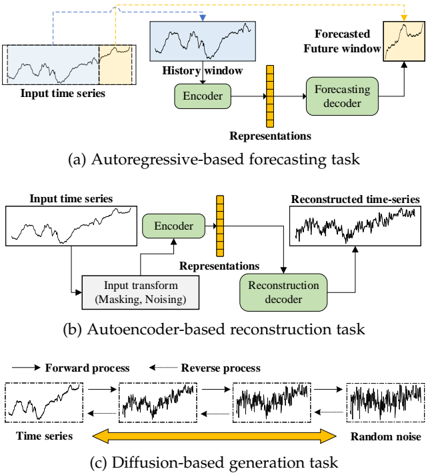
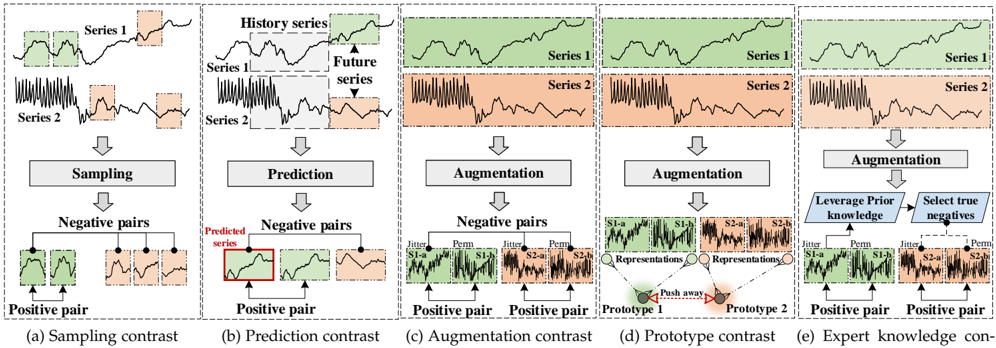
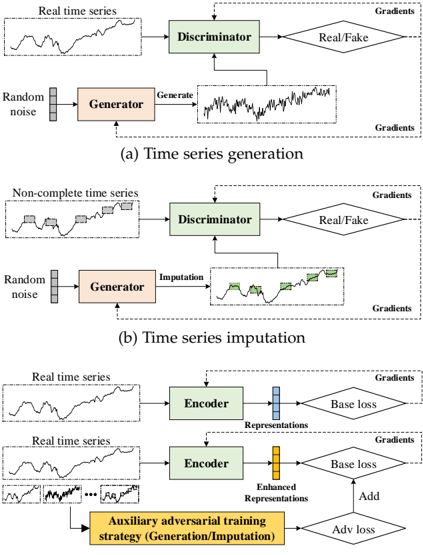
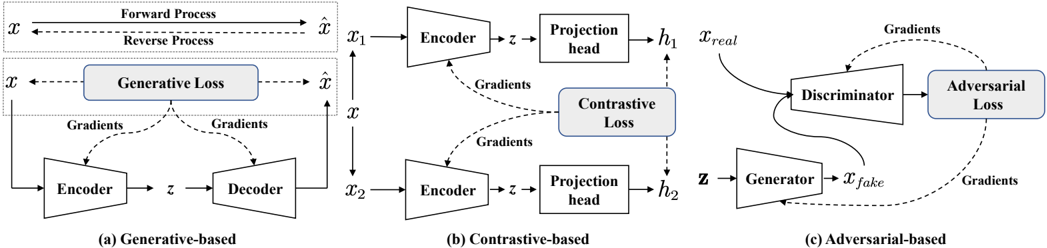
- The paper proposes a taxonomy with three broad SSL paradigms and ten subcategories: autoregressive-based forecasting, autoencoder-based reconstruction, diffusion-based generation; sampling contrast, prediction contrast, augmentation contrast, prototype contrast, expert knowledge contrast; generation/imputation and auxiliary representation enhancement.
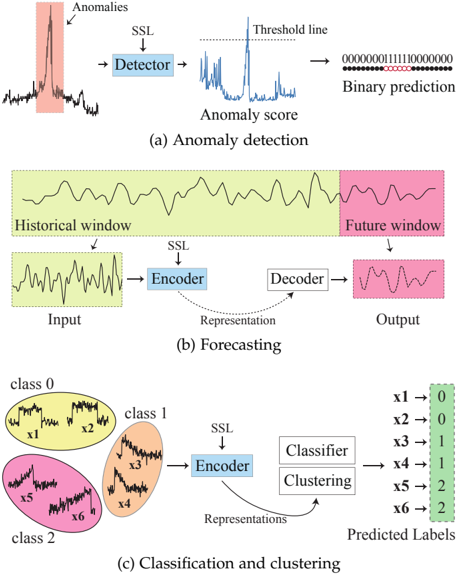
- For anomaly detection, contrastive methods such as Skip-CPC and Dcdetector are reported as achieving the best performance on four datasets; Dcdetector reaches F1 scores of 97.94 on PSM, 96.60 on MSL, 97.02 on SMAP, and 96.33 on SWaT, while Skip-CPC reaches F1 98.55 on PSM, 94.46 on SMD, and 92.75 on MSL.
- For forecasting, LaST and CoST show significant advantages; LaST reports ETTh H=24 MSE/MAE of 0.324/0.368, ETTm 0.218/0.289, Electricity 0.125/0.222, and Weather 0.105/0.134.
- For classification and clustering, results on 30 datasets from HAR, UCR, and UEA show that no single method achieves the best performance on all datasets, and most methods are based on self-supervised contrastive learning.
Methods
- Design: a comprehensive literature survey that reviews existing SSL and time series surveys, then organizes time series SSL methods by learning paradigm and by how positive/negative samples or pretext tasks are constructed.
- Data/resources: summarizes commonly used datasets for anomaly detection, forecasting, classification, and clustering, including PSM, SMD, MSL, SMAP, SWaT, WADI, ETTh, ETTm, Electricity, Weather, HAR, UCR 128, and UEA 30.
- Analysis: qualitative review of frameworks, mathematical formulations, advantages/disadvantages, plus compiled quantitative comparisons from prior work on anomaly detection (five datasets), forecasting (four datasets), and classification/clustering (30 datasets); no new experiments are reported.
Limitations
- The paper states that prior time series SSL surveys only discuss a small part of self-supervised contrastive learning, lack benchmark dataset summaries, and have scarce future directions; it positions itself as filling that gap.
- It also summarizes method-family limitations: generative-based methods are sensitive to rare instances and lack high-level semantic information; contrastive-based methods face sampling bias and augmentation uncertainty; adversarial-based methods suffer unstable training and are rarely used for feature extraction.
- Evident from the text: as a survey, it does not run a unified benchmark; the quantitative tables are collected from prior papers and contain missing entries (“-”), so comparisons are incomplete, and the paper itself calls for reliable benchmark evaluation as a future direction.
Model-written summary. Check it against the paper before relying on it.
Integrity signals
Registry
Cites
Statistics
Figures
Verification
Claims the paper makes
66 Valid · 26 Not valid · 63 Not checked · 80 Own results and interpretations
The cited sources support only part of this claim — read each source’s verdict below.
In the paper
“Methods for constructing multiple contrastive views based on multi-granularity or multi-scale augmentations also include MRLF [131], CMLF [115], and SSLAPP [132].”
What the sources say
- Not checked — no full text of the sourcecites [131] [131] M. Hou, C. Xu, Z. Li, Y. Liu, W. Liu, E. Chen, and J. Bian, 'Multigranularity residual learning with confidence estimation for time series prediction,' in Proceedings of the ACM Web Conference 2022 , ser. WWW '22, 2022, p. 112-121. - source
- Not checked — no full text of the sourcecites [115] [115] M. Hou, C. Xu, Y. Liu, W. Liu, J. Bian, L. Wu, Z. Li, E. Chen, and T.-Y. Liu, 'Stock trend prediction with multi-granularity data: A contrastive learning approach with adaptive fusion,' Proceedings of the 30th ACM International Conference on Information & Knowledge Management , p. 700-709, 2021. - source
- Partly supportedcites [132] [132] H. Lee, E. Seong, and D.-K. Chae, 'Self-supervised learning with attention-based latent signal augmentation for sleep staging with limited labeled data,' in Proceedings of the Thirty-First International Joint Conference on Artificial Intelligence, IJCAI-22 , 7 2022, pp. 38683876, main Track. - sourceExperimental — accuracy not yet measured
Sections 3.2 and 3.3 describe SSLAPP constructing two augmented views as a positive pair and learning from global and local features. But Section 3.2 explicitly says SSLAPP uses pairwise representation learning instead of contrastive learning; the global and local distinction applies to its loss terms, not to multi-scale augmentations. The citation identifies SSLAPP correctly but mischaracterizes its method. (LLM, conf=0.88)
plain- Asserted: passes — The authors put it forward as true.
- Checkable: passes — It can be checked against evidence.
- Load-bearing: unclear — It is unclear whether the paper’s conclusions depend on it.
- Based: passes — The paper gives a reason why it holds.
Every source the paper cites for this claim was checked and supports it.
In the paper
“However, introducing reasonable inductive bias or prior is helpful for many deep neural networks-based modeling tasks [140], [196], [197].”
What the sources say
- Supportedcites [140] [140] X. Wu, L. Xiao, Y. Sun, J. Zhang, T. Ma, and L. He, 'A survey of human-in-the-loop for machine learning,' Future Generation Computer Systems , vol. 135, pp. 364-381, 2022. - source
The Introduction (§1.1; page not provided) says integrating prior knowledge into a learning framework is effective for sparse data and describes its use across several applications. This supports the broad claim that suitable priors can help deep-learning modeling tasks. (LLM, conf=0.85)
- Supportedcites [196] [196] C. Deng, X. Ji, C. Rainey, J. Zhang, and W. Lu, 'Integrating machine learning with human knowledge,' iScience , vol. 23, no. 11, p. 101656, 2020. - source
The Network Architecture section says that adding domain-specific components to neural networks can boost performance and that task-targeted architectures can generalize better. It gives examples for different data and tasks, supporting the broad claim that appropriate inductive biases are helpful in neural-network modeling. (LLM, conf=0.91)
- Supportedcites [197] [197] Y. Chen and D. Zhang, 'Integration of knowledge and data in machine learning,' 2022. - source
The Introduction (page not available in our copy) says that embedding domain knowledge can improve model accuracy and robustness, and that it can improve machine-learning performance. Section 3.1 describes several ways to incorporate prior knowledge into neural networks across different applications, supporting the citing sentence’s broad, qualified claim. (LLM, conf=0.91)
plainstates a cause- Asserted: passes — The authors put it forward as true.
- Checkable: passes — It can be checked against evidence.
- Load-bearing: passes — The paper’s conclusions depend on it.
- Based: passes — The paper gives a reason why it holds.
- Rests on 2 assumptions not shown here.
- Supported
Every source the paper cites for this claim was checked and supports it.
In the paper
“Unlike previous frameworks, SSGAN's classification network makes full use of label information, which helps the model achieve more accurate imputations.”
What the sources say
- Supportedcites [162] [162] X. Miao, Y. Wu, J. Wang, Y. Gao, X. Mao, and J. Yin, 'Generative semi-supervised learning for multivariate time series imputation,' Proceedings of the AAAI Conference on Artificial Intelligence , vol. 35, no. 10, pp. 8983-8991, May 2021. - source
The Classifier Network passage says SSGAN’s classifier uses self-training to make full use of label information in partially labeled time series and guides the generator during imputation. The Ablation Study reports that removing the classifier reduces imputation accuracy by an average of 1.36%, supporting its contribution to more accurate imputations. (LLM, conf=0.94)
plainstates a cause- Asserted: passes — The authors put it forward as true.
- Checkable: passes — It can be checked against evidence.
- Load-bearing: unclear — It is unclear whether the paper’s conclusions depend on it.
- Based: passes — The paper gives a reason why it holds.
- Supported
The cited sources support only part of this claim — read each source’s verdict below.
In the paper
“It is beneficial to introduce an adversarial-based SSL, which can further amplify the difference between normal and anomalous data, such as USAD [66] and DAEMON [184].”
What the sources say
- Partly supportedcites [66] [66] J. Audibert, P. Michiardi, F. Guyard, S. Marti, and M. A. Zuluaga, 'USAD: Unsupervised anomaly detection on multivariate time series,' in Proceedings of the 26th ACM SIGKDD International Conference on Knowledge Discovery & Data Mining , ser. KDD '20, 2020, p. 3395-3404. - sourceExperimental — accuracy not yet measured
Section 5.4 (Ablation Study; page unavailable) reports that adversarial training improves USAD’s F1 score and helps detect anomalies close to normal data. Section 3.2 describes USAD as an unsupervised autoencoder method with adversarial training, but the copy does not identify it as self-supervised learning (SSL). (LLM, conf=0.82)
- Partly supportedcites [184] [184] X. Chen, L. Deng, Y. Zhao, and K. Zheng, 'Adversarial autoencoder for unsupervised time series anomaly detection and interpretation,' in Proceedings of the Sixteenth ACM International Conference on Web Search and Data Mining , ser. WSDM '23, New York, NY, USA, 2023, p. 267-275. - sourceExperimental — accuracy not yet measured
The Abstract and §2.2 identify DAEMON as an unsupervised anomaly detector that uses adversarial training to learn normal time-series patterns; the model-variant results in §4.5.2 report a benefit from adversarial regularization. The paper does not describe DAEMON as self-supervised learning (SSL) or establish that adversarial training amplifies the difference between normal and anomalous data. The cited paper is DAEMON, so this verdict does not assess USAD. (LLM, conf=0.84)
plainstates a cause- Asserted: passes — The authors put it forward as true.
- Checkable: passes — It can be checked against evidence.
- Load-bearing: unclear — It is unclear whether the paper’s conclusions depend on it.
- Based: passes — The paper gives a reason why it holds.
- Partly supported
The cited sources support only part of this claim — read each source’s verdict below.
In the paper
“In recent years, many scholars have also explored the potential of generative representation learning in time series generation and imputation, such as C-RNN-GAN [154], TimeGAN [155], TTS-GAN [156], and E 2 GAN[157].”
What the sources say
- Partly supportedcites [154] [154] O. Mogren, 'C-RNN-GAN: continuous recurrent neural networks with adversarial training,' CoRR , vol. abs/1611.09904, 2016. - sourceExperimental — accuracy not yet measured
The Introduction (p. 1) identifies C-RNN-GAN as an adversarial model that generates continuous sequences, demonstrated with classical music. This supports citing it as an example of sequence generation, but the paper does not describe time-series imputation or establish it as an imputation method. (LLM, conf=0.84)
- Not matchedcites [155] [155] J. Yoon, D. Jarrett, and M. van der Schaar, Time-Series Generative Adversarial Networks , Red Hook, NY, USA, 2019. -
Its entry has no title and year that we can search by.
- Supportedcites [156] [156] X. Li, V. Metsis, H. Wang, and A. H. H. Ngu, 'TTS-GAN: A transformer-based time-series generative adversarial network,' in Artificial Intelligence in Medicine: 20th International Conference on Artificial Intelligence in Medicine, AIME 2022, Halifax, NS, Canada, June 14-17, 2022, Proceedings , Berlin, Heidelberg, 2022, p. 133-143. - sourceExperimental — accuracy not yet measured
The TTS-GAN paper identifies itself as a transformer-based GAN for generating synthetic time-series data (title and abstract, p. 1). Citation [156] is attached to TTS-GAN as an example in the list; the paper supports its role as a time-series generation method. (LLM, conf=0.93)
plain- Asserted: passes — The authors put it forward as true.
- Checkable: passes — It can be checked against evidence.
- Load-bearing: unclear — It is unclear whether the paper’s conclusions depend on it.
- Based: passes — The paper gives a reason why it holds.
- Partly supported
44 more claims · 15 with their cited sources checked
Create a free account to see all 235 claims and to verify the 13 references still open.
- Probably not a substantial claim. 158
- It may state two separate claims as one. 79
Self-check
Percentages, sums and reported differences re-computed from the paper’s own numbers.
Each contradiction between two passages listed here was confirmed by an independent check.
Rated minor: it would not touch a result — a value no result rests on, a p-value that stays on the same side of the significance level, or a conflict that is clerical, resolved elsewhere in the paper, or outside its own findings.
In the paper
§ I.2 Correlation analysis between methods and tasks · p. 26
“| Method | 15 UCR Datasets | 15 UCR Datasets | 15 UCR Datasets | 15 UCR Datasets |”
§ I.2 Correlation analysis between methods and tasks · p. 26
“| | Beef | ChCo | Coffee | CricketX | DiPOA | DiPOC | ECG200 | ECGF | Car | Ham | Herring | Wine | Meat | MiPOA | Wafer | Yoga |”
Rated minor: it would not touch a result — a value no result rests on, a p-value that stays on the same side of the significance level, or a conflict that is clerical, resolved elsewhere in the paper, or outside its own findings.
In the paper
§ I.1 Quantitative performance comparisons · p. 25
“| RANSynCoder [63] | 99 | 96 | 93 | 90 | 85 | 83 |”
§ H.1 Anomaly detection · p. 23
“F1-score is the harmonic mean of precision and recall, i.e.,”
Rated minor: it would not touch a result — a value no result rests on, a p-value that stays on the same side of the significance level, or a conflict that is clerical, resolved elsewhere in the paper, or outside its own findings.
In the paper
§ I.1 Quantitative performance comparisons · p. 25
“| ImDiffusion [101] | 98.11 | 97.53 | 97.81 | 95.2 | 95.09 | 94.88 |”
§ H.1 Anomaly detection · p. 23
“F1-score is the harmonic mean of precision and recall, i.e.,”
Citations
Cites
BERT: Pre-training of Deep Bidirectional Transformers for Language Understanding
Devlin, J., Chang, M.-W., Lee, K., & Toutanova, K. (2018) · arXiv · doi:10.48550/arxiv.1810.04805 · Cited by 73,173 · cited 2×
“With the help of well-designed pretext tasks, SSL has recently achieved great success in the domains of Computer Vision (CV) [7], [8], [9], [10] and Natural Language Processing (NLP) [11], [12].”
BackgroundMethodUnpaired image-to-image translation using cycle-consistent adversarial networks
Zhu, J.-Y., Park, T., Isola, P., & Efros, A. A. (2017) · 2017 IEEE International Conference on Computer Vision (ICCV) · doi:10.1109/iccv.2017.244 · Cited by 23,602
Image-to-Image Translation with Conditional Adversarial Networks
Isola, P., Zhu, J.-Y., Zhou, T., & Efros, A. A. (2017) · 2017 IEEE Conference on Computer Vision and Pattern Recognition (CVPR) · doi:10.1109/cvpr.2017.632 · Cited by 22,930 · cited 1×
“The generator in the GAN can generate synthetic data close to the real data, so adversarial representation learning has a wide range of applications in the data generation field [141], especially in image generation [142]–[145].”
BackgroundAuto-Encoding Variational Bayes
Kingma, D. P., & Welling, M. (2013) · arXiv · doi:10.48550/arxiv.1312.6114 · Cited by 20,067
Momentum Contrast for Unsupervised Visual Representation Learning
He, K., Fan, H., Wu, Y., Xie, S., & Girshick, R. (2020) · 2020 IEEE/CVF Conference on Computer Vision and Pattern Recognition (CVPR) · doi:10.1109/cvpr42600.2020.00975 · Cited by 13,347 · cited 1×
“The major categories include end-to-end [16], memory bank [34], momentum encoder [35], and clustering [36].”
BackgroundRepresentation Learning: A Review and New Perspectives
Bengio, Y., Courville, A., & Vincent, P. (2013) · IEEE Transactions on Pattern Analysis and Machine Intelligence · doi:10.1109/tpami.2013.50 · Cited by 13,001 · cited 1×
“Using the learning paradigm as a taxonomy is arguably the most popular among the existing SSL surveys, including [20], [22], [23], [24], [25], [26], [27].”
MethodKirillov, A., Mintun, E., Ravi, N., Mao, H., Rolland, C., Gustafson, L., Xiao, T., Whitehead, S., Berg, A. C., Lo, W.-Y., et al. (2023) · 2023 IEEE/CVF International Conference on Computer Vision (ICCV) · doi:10.1109/iccv51070.2023.00371 · Cited by 11,953 · cited 1×
“A similar phenomenon also appears in computational vision [203].”
BackgroundA Style-Based Generator Architecture for Generative Adversarial Networks
Karras, T., Laine, S., & Aila, T. (2019) · 2019 IEEE/CVF Conference on Computer Vision and Pattern Recognition (CVPR) · doi:10.1109/cvpr.2019.00453 · Cited by 11,714 · cited 1×
“The generator in the GAN can generate synthetic data close to the real data, so adversarial representation learning has a wide range of applications in the data generation field [149], especially in image generation [150], [151], [152], [153].”
BackgroundA simple framework for contrastive learning of visual representations
Chen, T., Kornblith, S., Norouzi, M., & Hinton, G. (2020) · arXiv · doi:10.48550/arxiv.2002.05709 · Cited by 10,857
Explaining and Harnessing Adversarial Examples
Goodfellow, I. J., Shlens, J., & Szegedy, C. (2014) · arXiv · doi:10.48550/arxiv.1412.6572 · Cited by 10,381 · cited 1×
“…various recent and typical adversarial attack and defense methods for fault classifiers in data-driven fault detection and classificationsystems,includingwhite-boxattack(FGSM[209], IGSM[210],C & W attack [211], DeepFool [212]) and gray-box and black-box attack (UAP [213], SPSA [214], Random noise).”
Background
Research works printed but not linked: 9
- [13] R. B. Cleveland, W. S. Cleveland, J. E. McRae, and I. Terpenning, 'STL: A seasonal-trend decomposition,' J. Off. Stat , vol. 6, no. 1, pp. 3-73, 1990. -
- [83] W. Chen, L. Tian, B. Chen, L. Dai, Z. Duan, and M. Zhou, 'Deep variational graph convolutional recurrent network for multivariate time series anomaly detection,' in Proceedings of the 19. 39th International Conference on Machine Learning , ser. Proceedings of Machine Learning Research, vol. 162, 17-23 Jul 2022, pp. 36213633. -
- [95] Y. Song and S. Ermon, 'Improved techniques for training scorebased generative models,' Advances in neural information processing systems , vol. 33, pp. 12 438-12 448, 2020. -
- [113] K. Zhang, Q. Wen, C. Zhang, L. Sun, and Y. Liu, 'Time series anomaly detection using skip-step contrastive predictive coding,' in NeurIPS 2022 Workshop: Self-Supervised Learning - Theory and Practice , 2022. -
- [148] I. Goodfellow, J. Pouget-Abadie, M. Mirza, B. Xu, D. WardeFarley, S. Ozair, A. Courville, and Y. Bengio, 'Generative adversarial nets,' in Advances in Neural Information Processing Systems , vol. 27, 2014. - · doi:10.5555/2969033.2969125
- [165] Q. Ma, C. Chen, S. Li, and G. W. Cottrell, 'Learning representations for incomplete time series clustering,' Proceedings of the AAAI Conference on Artificial Intelligence , vol. 35, no. 10, pp. 88378846, May 2021. - · DOI · Paper page
- [189] Y. Zhang and J. Yan, 'Crossformer: Transformer utilizing crossdimension dependency for multivariate time series forecasting,' in The Eleventh International Conference on Learning Representations , 2023. -
- [191] H. Wang, J. Peng, F. Huang, J. Wang, J. Chen, and Y. Xiao, 'MICN: Multi-scale local and global context modeling for long-term series forecasting,' in The Eleventh International Conference on Learning Representations , 2023. -
- [215] J. Li, L. Lyu, D. Iso, C. Chakrabarti, and M. Spranger, 'MocoSFL: enabling cross-client collaborative self-supervised learning,' in The Eleventh International Conference on Learning Representations , 2023. -
Cited by
Items 101–200 of 276
Zhao, X., Ghassemi-Armaki, H., Carlson, B. E., & Wang, P. E. (2025) · Journal of Manufacturing Systems · doi:10.1016/j.jmsy.2025.10.001 · Cited by 3
Tsuchiya, Y., & Sonobe, R. (2025) · Geocarto International · doi:10.1080/10106049.2025.2596969 · Cited by 3
A scale-adaptive spatio-temporal modeling approach for multivariate time-series anomaly detection
Chen, L., Wang, C., Lin, H., Chen, L., Jiang, J., & Lai, X. (2026) · Applied Intelligence · doi:10.1007/s10489-026-07120-5 · Cited by 2
Li, Q., Zhang, Z., Zhang, Y., Zhang, Z., Zhu, L., Hua, X., Yu, R., Fan, X., Lei, Z., & Feng, J. (2025) · Neural Networks · doi:10.1016/j.neunet.2025.107922 · Cited by 2
Li, Z., Zhu, Z., Li, Q., & Wu, X. (2025) · Pattern Recognition · doi:10.1016/j.patcog.2025.112006 · Cited by 3
Zhang, Z., Su, N., Deng, C., Zhao, Y., Liu, W., & Han, Q. (2025) · Avian Research · doi:10.1016/j.avrs.2025.100320 · Cited by 3
Preference Guided Meta-Learning for Cross Domain Time Series Forecasting
Li, X., Teng, F., Li, T., & Duan, Q. (2026) · IEEE Transactions on Knowledge and Data Engineering · doi:10.1109/tkde.2026.3658637 · Cited by 3
Yang, Z., Lin, C., Qin, Y., Huang, R., Chen, Y., & Qin, J. (2025) · Information Fusion · doi:10.1016/j.inffus.2025.103258 · Cited by 2
Wang, L., Chen, F., Hu, Y., Zheng, Z., & Zhang, K. (2024) · Algorithms · doi:10.3390/a17120595 · Cited by 1
Self-citationYang, Z., Dong, H., Zhang, H., & Wang, R. (2025) · IEEE Transactions on Instrumentation and Measurement · doi:10.1109/tim.2025.3587364 · Cited by 1
“The training process of SSRL is typically divided into two phases: pretraining and fine-tuning [12].”
Shen, Z., Yang, C., Cheng, L., Kong, X., Liu, Z., & Su, K. (2026) · Scientific Reports · doi:10.1038/s41598-026-38417-7 · Cited by 3
Knowledge-enhanced AI models for domain-specific application: a survey
Li, X.-Y., Wang, Y., Liang, J., Wang, X., Zhou, P., Zhao, Q., Zhang, Y., & Song, Q. (2026) · Science China Information Sciences · doi:10.1007/s11432-025-4635-0 · Cited by 1
Atienza, A., Manimaran, G., Puthusserypady, S. K., Domínguez, H., Jacobsen, P. K., & Bardram, J. E. (2025) · Annual International Conference of the IEEE Engineering in Medicine and Biology Society (EMBC) · doi:10.1109/embc58623.2025.11253612 · Cited by 1
“It has been successfully applied to all data domains, i.e., Natural Language Processing [5], Computer Vision [6] and Time Series [7].”
AI-driven pathology in esophageal cancer: from early screening to precision prognostics
Bian, Y., Li, J., Cao, J., Wang, S., & Ma, C. (2026) · Frontiers in Oncology · doi:10.3389/fonc.2026.1733548 · Cited by 1
“…fusion training to incorporate multi-dimensional data and using self-supervised learning (SSL) strategies to optimize the training process, these models achieve more complex functions, such as in-depth therapeutic ef fi cacy analysis, prognostic prediction, and even survival assessment (29, 30).”
Liu, B., Wu, L., Li, J., & Wang, X. (2025) · International Conference on Neural Networks, Information and Communication Engineering (NNICE) · doi:10.1109/nnice64954.2025.11063892 · Cited by 1
“By maximizing the similarity of positive sample pairs and minimizing it of negative pairs, contrastive learning helps models learn discriminative feature representations, significantly enhancing generalization and robustness while reducing reliance on labeled data [4,9,10,12,13].”
Transient Stability Assessment Model and Its Updating Based on Dual-Tower Transformer
Li, N., Dong, J., Tao, L., et al. (2025) · Energy Engineering · doi:10.32604/ee.2025.062667 · Cited by 1
“.1 Stage 1: Regression Prediction Based on Self-Supervised Learning Self-supervised learning [26], as an important branch of unsupervised learning [27], possesses the ability to autonomously mine and extract the intrinsic representation characteristics of unlabeled data.”
Liu, Z., Zeng, K., Ma, Q., & Kwok, J. T.-Y. (2025) · IEEE Transactions on Pattern Analysis and Machine Intelligence · doi:10.1109/tpami.2025.3644603 · Cited by 7
Tackling Low-Resource ECG Classification with Self-supervised Learning
da Silva, R. B. P., & Silva, D. F. (2025) · Lecture notes in computer science · doi:10.1007/978-3-031-79038-6_17 · Cited by 2
An Analysis of Time-Frequency Consistency in Human Activity Recognition
Hecker, N., Napoli, O. O., Delgado, J., Rocha, A. R., Boccato, L., & Borin, E. (2025) · Lecture notes in computer science · doi:10.1007/978-3-031-79035-5_5 · Cited by 4
Kovalenko, D., & Marček, D. (2024) · IEEE International Scientific Conference on Informatics (Informatics) · doi:10.1109/informatics62280.2024.10900841 · Cited by 1
“The usefulness of data augmentation was spotlighted in [9], with an emphasis on how the generation of new time series helps models improve their performance in cases of data scarcity.”
Chen, S., Du, X., & Wang, J. (2024) · IEEE Transactions on Neural Networks and Learning Systems · doi:10.1109/tnnls.2024.3477320 · Cited by 3
“Self-supervised learning is explored to leverage rich information underlying the unlabeled data, with success in time series [42], videos [43], and static graphs [33], [44].”
Feature-based clustering of global sea level anomaly time series
Sun, Q., Wan, J., & Liu, S. (2025) · Scientific Reports · doi:10.1038/s41598-025-19269-z · Cited by 1
Kibrete, F., Woldemichael, D. E., Gebremedhen, H. S., Çakar, O., & Çelik, E. (2026) · Journal of Engineering · doi:10.1155/je/6113740 · Cited by 1
Yang, J., Yuan, J., & Li, W. (2026) · Engineering Applications of Artificial Intelligence · doi:10.1016/j.engappai.2026.114765 · Cited by 1
Learning from small datasets—review of workshop 6 of the 10th International BCI Meeting 2023
Tangermann, M., Chevallier, S., Dold, M., Guetschel, P., Kobler, R. J., Papadopoulo, T., & Thielen, J. (2025) · Journal of Neural Engineering · doi:10.1088/1741-2552/addf80 · Cited by 2
Ensemble Self-Learning for Pseudo-Labeling
AKDİŞ, M., & Elbır, A. (2025) · Signal Image and Video Processing · doi:10.1007/s11760-025-04618-2 · Cited by 1
“They propose a comprehensive taxonomy of state-of-the-art SSL methods [21].”
Liu, Y., Si, H., Boateng, G. O., Guo, X., Qian, B., & Ansari, N. (2026) · IEEE Transactions on Network Science and Engineering · doi:10.1109/tnse.2026.3667788 · Cited by 6
Self-citationLaiadi, O., Remadna, I., Laiadi, M. E.-A., Hadoune, O., Drai, R., & Noureddine Zerhouni, A. (2026) · Mechanical Systems and Signal Processing · doi:10.1016/j.ymssp.2026.114292 · Cited by 2
Wang, H., Chen, L., Hao, K., & Wei, B. (2025) · Journal of Manufacturing Systems · doi:10.1016/j.jmsy.2025.11.013 · Cited by 1
MorsEar: Toward Generalizable Low-Resource Covert Messaging via Earable based Inertial Sensing
Chugh, G., Ghosh, I., Roy, N., Chakraborty, S., & Chakraborty, S. (2026) · CHI Conference on Human Factors in Computing Systems · doi:10.1145/3772318.3791436 · Cited by 1
Receptive Field Aware Contrastive Learning for Multivariate Time Series Classification
Lin, F., Gao, Y., Chen, Y., Huo, J., & Hui, Y. (2025) · International Joint Conference on Neural Networks (IJCNN) · doi:10.1109/ijcnn64981.2025.11228102 · Cited by 1
“As a self-supervised learning paradigm, CL has gained popularity due to its ability to learn effective features from unlabeled samples by bringing positive pairs closer while pushing negative pairs apart [19], [20], [21].”
Lin, H., Yang, G., & Luo, T.-J. (2025) · Neurocomputing · doi:10.1016/j.neucom.2025.131981 · Cited by 1
Feng, X., Jiang, Y., Sha, H., Zou, W., Chen, C., Chen, T., Chen, X., & Zhang, Y. (2025) · Journal of Physics Photonics · doi:10.1088/2515-7647/add978 · Cited by 2
RF-HeartSSL: Self-Supervised Learning for RF-Based Cardiac Sensing
Cai, X., Chen, J., Xu, G., Wang, H., Yuan, Y., Sun, Q., & Chen, Y. (2026) · Proceedings of the ACM on Interactive Mobile Wearable and Ubiquitous Technologies · doi:10.1145/3810229 · Cited by 3
A Temporally Disentangled Contrastive Diffusion Model for Spatiotemporal Imputation
Chen, Y., Shi, K., Wu, Z., Chen, J., WANG, X., McAuley, J., Xu, G., & Yu, S. L. (2026) · CAAI Transactions on Intelligence Technology · doi:10.1049/cit2.70085 · Cited by 8
Large Language Models Meet Time Series
Chen, P., & Liu, S. (2025) · Springer eBooks · doi:10.1007/978-3-031-76770-8_8 · Cited by 1
Trend-Error Decomposition for Self-Supervised Time Series Learning in Multivariate Forecasting Task
Pederzoli, S., Buono, F. D., Vincini, M., & Guerra, F. (2026) · IEEE Access · doi:10.1109/access.2026.3653488 · Cited by 3
“According to the taxonomy presented in [9], SSL approaches can be categorized based on their learning paradigm into three main types: generative-based, contrastive-based, and adversarial-based.”
Augmentation-Free Longitudinal Modeling Through Structuring Whitened Embeddings
Fonteyn, K., Bontinck, L., Dhaene, T., & Deschrijver, D. (2025) · IEEE Access · doi:10.1109/access.2025.3608901 · Cited by 2
“While contrastive methods are widely applied to time series data such as ECGs [17], [18], [19], their effectiveness is often constrained by the temporal dependencies inherent in such data and their sensitivity to distortions introduced by augmentations [20].”
Battery Safety: Mechanisms, Monitoring, and Machine Intelligence
Jing, H., Ou, S. S., Lv, Z., Guo, H., Burke, A. F., & Zhao, J. (2026) · Advanced Energy Materials · doi:10.1002/aenm.71093 · Cited by 3
Deep learning methods for image recognition and classification in smart environmental systems
Rishi, N., Kumar, A., & Kumari, R. (2025) · Elsevier eBooks · doi:10.1016/b978-0-443-34254-7.00004-0 · Cited by 3
Wen, Z., Zhai, Z., Wang, Y., Li, Q., Zhang, W., & Shao, H. (2025) · IEEE Transactions on Mobile Computing · doi:10.1109/tmc.2025.3633287 · Cited by 2
Anomaly synthesis and detection in accounting data via a generative adversarial network
Zhang, S., Zhang, L., Mi, W., Chen, Z. J., & Guo, W. (2026) · PeerJ Computer Science · doi:10.7717/peerj-cs.3550 · Cited by 1
Mantouka, E. G., Fafoutellis, P., & Vlahogianni, E. I. (2025) · Physica A Statistical Mechanics and its Applications · doi:10.1016/j.physa.2025.131151 · Cited by 1
Source-Free Time-Series Domain Adaptation With Prior Evaluation of Model Salience
Cai, R., Jin, M., Wen, Q., Zhang, K., & Liu, Y. (2025) · IEEE Transactions on Neural Networks and Learning Systems · doi:10.1109/tnnls.2025.3641830 · Cited by 3
“Compounding this challenge is the heavy reliance of DL methods on large-scale labeled data, which is often prohibitively expensive or time-consuming to acquire in target domains [8], [11].”
Self-citationXu, J., Lyu, F., & Yuen, P. C. (2025) · ACM SIGKDD Conference on Knowledge Discovery and Data Mining (KDD) · doi:10.1145/3711896.3737151 · Cited by 1
Causality-Preserving Domain Generalization via Adaptive Fourier Mixup for RUL Prediction
Zhu, Y., Chen, W., Cheng, Z., Zhang, F., & Ye, Z. (2026) · IEEE Transactions on Pattern Analysis and Machine Intelligence · doi:10.1109/tpami.2026.3688520 · Cited by 3
Liu, Z., Michiels, S., & Hughes, D. (2025) · doi:10.1145/3737901.3768364 · Cited by 2
Toward Accessible AI Research for Complex Batch Biochemical Processes
Chen, S., Zhou, Y., Tu, P., Chen, L., He, Q., Qiao, S., Zhang, H., & Liu, X. (2026) · IEEE Transactions on Instrumentation and Measurement · doi:10.1109/tim.2026.3655901 · Cited by 3
“Beyond semi-supervised and active learning strategies, self-supervised time-series pretraining [5] and di ff usion-based data augmentation are increasingly adopted to enhance cross-batch generalization.”
He, T., Lin, C., He, Q., Wu, Y., & Chen, J. (2026) · IEEE Transactions on Mobile Computing · doi:10.1109/tmc.2026.3676474 · Cited by 1
da Luz, G. P. C. P., Napoli, O. O., Delgado, J. V., Rocha, A. R., Boccato, L., & Borin, E. (2025) · Lecture notes in computer science · doi:10.1007/978-3-031-79035-5_6 · Cited by 2
Ghorbani, V., Ghorbani, A., & Yoo, C. (2025) · Building and Environment · doi:10.1016/j.buildenv.2025.113713 · Cited by 4
Chitla, V. S., & Kalluri, H. K. (2024) · OITS International Conference on Information Technology (OCIT) · doi:10.1109/ocit65031.2024.00056 · Cited by 1
Low-Complexity Environmental Sound Classification via Cyclic Adaptive Curriculum Learning
Chen, X., & Xie, W. (2026) · International Conference on Artificial Intelligence and Big Data (ICAIBD) · doi:10.1109/icaibd69640.2026.11637175
“In standard supervised learning [38], [39] for ESC, given a dataset D = { ( x i , y i ) } Ni =1 , y i ∈ { 1 , . . . , K } , let z i ∈ R K be the logits for sample ( x i , y i ) .”
A Domain Adaptation Segmentation Network Based on Pyramid Prototypes and Contrastive Learning
Siqi, W., Hao, W., Chengdong, W., Yu, X., & Meiyu, Y. (2025) · IEEE International Conference on Smart Internet of Things (SmartIoT) · doi:10.1109/smartiot66867.2025.00027
“In recent years, deep neural networks have achieved significant advancements across various domains, including computer vision [1], [2], scene understanding [3], [4], and speech This work was supported in part by the National Natural Science Foundation of China under Grant nos.”
Self-Supervised Vibration Analytics for Predictive Maintenance of Multistage Compressors
Rajagopal, M., Shashank, R., & Shreeshanth, R. (2026) · Journal of Vibration Engineering & Technologies · doi:10.1007/s42417-026-02455-2
Learning neural representation for time series
Naour, É. L. (2024) · theses.fr (ABES) · doi:10.70675/26f2fe87z93ccz4840za636z5cf51c0db90a
Multi-scale self-distillation underwater acoustic signal recognition via saliency masking modeling
Wang, X., Liu, Z., & Guo, Z. X. (2025) · The Journal of the Acoustical Society of America · doi:10.1121/10.0041851 · Cited by 1
hu, Q. (2026) · SSRN Electronic Journal · doi:10.2139/ssrn.7315139
Liu, Y., Jiang, C., Li, Y., et al. (2026) · Measurement · doi:10.1016/j.measurement.2026.122619
Self-citationMa, L., Guo, C., Zhe, W., et al. (2025) · SSRN Electronic Journal · doi:10.2139/ssrn.5967764
EntroTS: Entropy-guided representation learning for time series classification
Lin, G., Shen, C., & Wan, L. (2026) · Chaos Solitons & Fractals · doi:10.1016/j.chaos.2026.119042
Qian, W., & Su, W. (2026) · Measurement Science and Technology · doi:10.1088/1361-6501/ae5409
Exploring Data-Oriented Strategies for Training ECG Self-supervised Models
Silva, R. D. C., Medronha, A., & Silva, D. F. (2026) · Lecture notes in computer science · doi:10.1007/978-3-032-15990-8_15
Generalizable fault detection and diagnosis of bearings via time–frequency embedded pre-training
Ding, Y., Miao, Q., Zheng, L., Ren, L., Hu, C., & Lee, C.-G. (2026) · Transportation Safety and Environment · doi:10.1093/tse/tdag011
A large language model-empowered approach to trajectory prediction for edge deployment on ships
Zuo, Y., Zhao, L., & Sun, Z. (2026) · Transportation Research Part E Logistics and Transportation Review · doi:10.1016/j.tre.2026.105274
Latent-to-Observable Score Correction for Probabilistic Time Series Imputation
Liang, G., Su, Z., Abiri, N., Nowaczyk, S., Byttner, S., Lundström, J., & Tiwari, P. (2026) · Lecture notes in computer science · doi:10.1007/978-3-032-37676-3_25
Xu, X., Chang, P., Liu, G., Feng, J., Wen, J., Chen, X., & Zhang, G. (2026) · Biomedical Signal Processing and Control · doi:10.1016/j.bspc.2026.109471
Zhang, C., Zhang, M., Kan, Z., et al. (2026) · Microelectronics Journal · doi:10.1016/j.mejo.2026.107377
Self-citationCALAD: Channel-Aware Contrastive Learning for Multivariate Time Series Anomaly Detection
Hong, J., & Hur, Y. (2026) · Lecture notes in computer science · doi:10.1007/978-3-032-31404-8_38
Li, K., Pitts, T., Liang, B., Huang, C., & Lu, Y. (2026) · SSRN Electronic Journal · doi:10.2139/ssrn.6033215
Das, D. (2026) · SSRN Electronic Journal · doi:10.2139/ssrn.7422310
Lang, K., & Li, Y. (2026) · IEEE Transactions on Automation Science and Engineering · doi:10.1109/tase.2026.3722651
“Second, we extend the downstream predictor from LSTM to TCN and Transformer, so as to examine whether the usefulness of rule-guided synthetic data is robust across recurrent, convolutional and attention forecasting architectures [27], [28], [29].”
Zhu, L., Kong, X., Li, M., Qin, T., Chen, Y.-B., Chang, J., & Chen, X. (2024) · International Conference on Frontiers of Intelligent Manufacturing and Automation · doi:10.1145/3704558.3707079
“Forecasting Accuracy CNN [27] 77.30% GRU [28] 79.04% LSTM [29] 79.54% GCN [30] 85.33% DTSSDGN 91.02% implemented distribution graph guided feature extraction module took in the tobacco pest time series data and generated features that encapsulated the internal and external patterns of pest…”
InfluentialTjondronegoro, D., Yuwono, E. I., & Costa, F. D. S. (2026) · BMC Medical Informatics and Decision Making · doi:10.1186/s12911-026-03651-6
Li, C., Ran, T., Wang, J., He, L., Du, Y., & Yuan, L. (2026) · Measurement Science and Technology · doi:10.1088/1361-6501/ae9da8
Time-series clustering algorithm based on common tightest neighbors and local embedding
Gao, L., Tian, T., & Wen, L. (2026) · Digital Signal Processing · doi:10.1016/j.dsp.2026.105895
You, J., Lei, C., & Li, X. (2026) · International Conference on Electronic Engineering and Informatics (EEI) · doi:10.1109/eei70303.2026.11640498
“Similar ideas have subsequently been extended to representation learning for time series, radar signals, and I/Q signals [13, 14].”
Xue, H., Li, A., Ma, Y., Yu, J., & 秦焕然 (2026) · International Conference on Artificial Intelligence, Internet of Things and Cloud Computing Technology (AIoTC) · doi:10.1109/aiotc71250.2026.11688798
A Review of Machine Learning-Based Time-Series Anomaly Detection in the Water Domain
Liu, Z., Wang, Z., Ding, C., Luo, J., Luo, X., Tan, R., Li, Y., Gan, Y., & Cui, Y. (2026) · Water · doi:10.3390/w18172209 · Cited by 1
Self-Supervised Recurrent Hashing for Efficient Time Series Similarity Search
Ghadekar, P. P., Bhagat, H., More, P., More, V., Saraf, C., & Khare, S. (2024) · IEEE Global Conference for Advancement in Technology (GCAT) · doi:10.1109/gcat62922.2024.10923920
“The survey offers insights into applications and commonly used time series datasets [1].”
Li, Y., Shao, H., Zhang, Y., Shi, L., & Zhu, L. (2026) · SSRN Electronic Journal · doi:10.2139/ssrn.6031938
Solution-Guided Machine Learning for Physical Field Prediction in Complex Geometries
Du, Y., Wang, R., Ying, T., Deng, Y., Wu, J.-Z., Wang, B., & Chang, T. (2026) · Journal of Computing and Information Science in Engineering · doi:10.1115/1.4072215
Rafi, M. A., Rodrigues, G. N., Mir, M. N. H., Bhuiyan, M., Eva, A. A., Nahar, A., & Nur, K. M. (2024) · IEEE International Conference on Robotics, Automation, Artificial-Intelligence and Internet-of-Things (RAAICON) · doi:10.1109/raaicon64172.2024.10928582 · Cited by 4
“Once the model has learned these representations, it can be fine-tuned on a smaller set of labeled data, making it highly effective for fraud detection in environments with limited labeled fraud cases [9].”
YOLOv8-DTW-based pose recognition and training evaluation for free climbing actions
Cai, K. (2026) · Discover Artificial Intelligence · doi:10.1007/s44163-026-01527-2
“In the field of sports action analysis, deep learning-based posture detection and time series analysis technologies are widely applied in scenarios such as action recognition and skill evaluation due to their powerful feature modeling and dynamic correlation capture capabilities [12, 13].”
Guo, Y., Xia, P., Ni, Y., & Li, J. (2025) · IEEE/CIC International Conference on Communications in China (ICCC) · doi:10.1109/iccc65529.2025.11148816
“TSPFMs possess a multilayer network structure and neuronal connections with a large number of parameter counts [17], leverage massive labeled data during pre-training through supervised learning, unsupervised learning, or self-supervised learning [18] to learn appropriate representations.”
How Effective Are Generative Adversarial Networks for Time Series Representation Learning?
Garcia, V. M., Rocha, A. D. R., Boccato, L., & Borin, E. (2026) · Lecture notes in computer science · doi:10.1007/978-3-032-39892-5_8
He, X., Zhao, C., Li, S., et al. (2026) · Journal of Vibration and Control · doi:10.1177/10775463261485856
Biomechanics-Informed Masked Autoencoder With Anchor Alignment for Robust Human Activity Recognition
Guo, T., Hou, F., Pang, Y., & Wang, Z. (2026) · IEEE Access · doi:10.1109/access.2026.3713236
“Key design choices under active investigation include masking granularity (point-level vs. patch-level vs. sensor-level), the optimal masking ratio, and the trade-off between Transformer and CNN backbones for downstream human activity recognition (HAR) and cross-placement transfer [41], [45].”
Decoding the brain via multi-view brain topology contrastive learning
Li, Z., Zhu, Z., Li, Q., & Wu, X. (2025) · Pattern Recognition · doi:10.1016/j.patcog.2025.112445 · Cited by 6
Guo, K., Wang, J., Lin, J., Chen, N., Chen, H., Zhou, Z., & Li, M. (2026) · Sensors · doi:10.3390/s26123851
“The latest advances in time-series self-supervised learning were reviewed by Zhang et al. (2024) [16].”
Ran, Z., Yao, Y., Shan, Y., Bo, H., Li, A., Zhou, X., Yang, W., Xu, C., & Chang, Y. (2026) · International Journal of Machine Learning and Cybernetics · doi:10.1007/s13042-026-03163-9
Xin, G., Yao, H., Qiao, J., Yao, H., Li, S., Liu, L., Zhang, J., Qin, K., & Shu, L. (2026) · JMIR mhealth and uhealth · doi:10.2196/101026
“Within each development split, this transform was pretrained using only non-ROA windows from the corresponding training subset in a self-supervised one-step-ahead prediction task, consistent with predictive representation learning for sequential data [26,27].”
Self-citationImpacto do Aprendizado de Máquina Adversário contra Detectores de Anomalias em Séries Temporais
Tomazeli, F. D., Junior, G. F., & Zarpel�ão, B. B. (2024) · Anais do XXIV Simpósio Brasileiro de Segurança da Informação e de Sistemas Computacionais (SBSeg 2024) · doi:10.5753/sbseg.2024.241416
Awwad, F. R., Hassan, M., & Hasan, O. (2025) · Journal of Circuits Systems and Computers · doi:10.1142/s0218126626300035
Self-supervised pretraining for PV power forecasting: Toward enhanced interpretability
Ta, H., Yan, X., Wang, K., & Wang, B. (2026) · Journal of Renewable and Sustainable Energy · doi:10.1063/5.0300730
EQAnomalyNet: Unsupervised Seismic Phase Picking via Transformer Autoencoder
Wang, H., Ma, Q., Wang, J., Tao, D., Xie, Q., & Zhu, H. (2026) · IEEE Transactions on Geoscience and Remote Sensing · doi:10.1109/tgrs.2026.3677697
“Traditional supervised methods [38], [39], [40] attempt to learn a direct mapping f : x ( t ) (cid:55)→ Y .”
Sheoran, U., Rizwan, M., & Nangia, U. (2026) · Electric Power Systems Research · doi:10.1016/j.epsr.2026.114216
Latent Multi-Branch Diffusion Model for Addressing Class Imbalance in Medical Signal Classification
Wu, Z., Huang, T., Liu, C., Wang, Y., Xiong, S., & Chen, H. (2026) · International Conference on Communication Networks and Machine Learning (CNML) · doi:10.1109/cnml68938.2026.11453198
“Consequently, numerous semi-supervised frameworks, including contrastive learning approaches such as self-supervised learning [7], [8], [9], and [10], have been proposed for time series analysis.”
Meng, X., ZHANG, J., & LIU, J. (2025) · Journal of Mechanics in Medicine and Biology · doi:10.1142/s0219519425400275
Self-citationA Mixed Augmentations Method for Multivariate Time Series Contrastive Learning
Huo, W., Wang, Y., & Ye, L. (2024) · IEEE International Symposium on Parallel and Distributed Processing with Applications (ISPA) · doi:10.1109/ispa63168.2024.00243
“In recent years, some researchers have increasingly focused on time series contrastive learning [6, 7].”
Metadata
- Authors
- Zhang, K., Wen, Q., Zhang, C., Cai, R., Jin, M., Liu, Y., Zhang, J. Y., Liang, Y., Pang, G., Song, D., & Pan, S.
- Affiliations
- Zhejiang University (CN)
- Alibaba Group (China) (CN)
- Zhejiang Normal University (CN)
- Monash University (AU)
- Ant Group (China) (CN)
- Hong Kong University of Science and Technology (HK)
- Singapore Management University (SG)
- University of Connecticut (US)
- Griffith University (AU)
- ORCID
- Venue
- IEEE Transactions on Pattern Analysis and Machine Intelligence
- Published
- 2024-10
- Volume
- 46
- Issue
- 10
- Pages
- 6775-6794
- ISSN
- 0162-8828 (ISSN-L)
- 2160-9292
- 1939-3539
- OpenAlex
- W4394699135
- Cited by
- 295
- References
- 232
- Citations by year
- 2026: 124 · 2025: 115 · 2024: 51
- FWCI
- 51.74
- Type
- journal article
- Language
- en
- Open access
- green
- arxiv.org
- Licence
- Locations
- IEEE Transactions on Pattern Analysis and Machine Intelligence (publishedVersion)
- PubMed (publishedVersion)
- arXiv (Cornell University) (submittedVersion, public-domain)
- Singapore Management University Institutional Knowledge (InK) (Singapore Management University) (submittedVersion, cc-by-nc-nd)
- Rare & Special e-Zone (The Hong Kong University of Science and Technology) (submittedVersion)
- Griffith Research Online (submittedVersion)
- arXiv (Cornell University)
- Funders
- Key R&D Project of Zhejiang Province (2024C01172)
- National Key R&D Program of China (2021YFB2012300)
- Topics
- Physical Sciences › Computer Science › Signal Processing › Time Series Analysis and Forecasting
- Physical Sciences › Computer Science › Artificial Intelligence › Domain Adaptation and Few-Shot Learning
- Social Sciences › Decision Sciences › Management Science and Operations Research › Stock Market Forecasting Methods
- Keywords
- self-supervised learning, time series analysis, contrastive learning, adversarial learning, pre-training and fine-tuning, time series forecasting, time series classification, time series anomaly detection, time series clustering, benchmark dataset
About these checks
Registry, retraction, Cites and statistics results are computed, not judged, with one exception: a printed reference that no index lists is read once by a model before it counts as a citation error. Claims are extracted by a model and kept only when their quote appears verbatim in the text; each cited source is then checked, with a model’s help, for whether it says what the claim relies on. Those verdicts can be wrong — read the claim’s quote and the cited source before relying on one.
The claim verdicts this report counts are experimental: their accuracy is not yet measured.
A language model drew the claims from the paper on 2026-10-10, under version 3 of the claim definition (model deepseek-v4.1-flash, prompt extract-v3).
A second model labelled each claim on 2026-10-10 (model jev-1.13-20260917, definition revision gold-guideline-v0.2).
Cited sources are checked with a language model’s help (gpt-6-sol).
Statistics and arithmetic are recomputed, not judged.
Confidence bands are shown only for fields calibrated on our annotated test set. None is calibrated yet, so no band is shown.
What counts as a claim ›How we measure confidence ›How we check this ›
Are you an author, or do you see a problem with this page? Request a review
Data sources
Bibliographic data: Semantic Scholar, OpenAlex, Crossref.
Contains information from the Semantic Scholar Academic Graph Datasets, made available under the ODC Attribution License (ODC-BY 1.0).
Semantic Scholar’s data is described in: Kinney, R., et al. (2023). The Semantic Scholar Open Data Platform. arXiv:2301.10140.
