

Likelihood of Questioning AI-Based Recommendations Due to Perceived Racial/Gender Bias
Open accessThe DOI matches its Crossref record; 17 of the 17 references it cites were found in a registry or an index.
Abstract
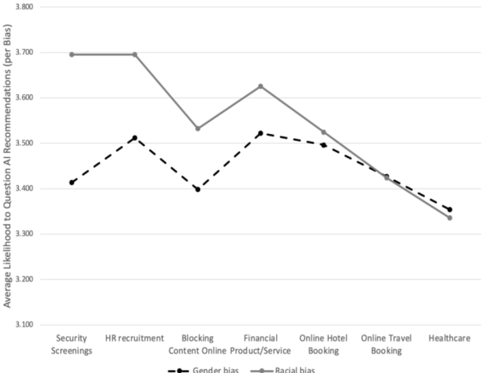
Advances in artificial intelligence (AI) are giving rise to a multitude of AI-embedded technologies that are increasingly impacting all aspects of modern society. Yet, there is a paucity of rigorous research that advances understanding of when, and which type of, individuals are more likely to question AI-based recommendations due to perceived racial and gender bias. This study, which is part of a larger research stream contributes to knowledge by using a scenario-based survey that was issued to a sample of 387 U.S. participants. The findings suggest that considering perceived racial and gender bias, human resource (HR) recruitment and financial product/service procurement scenarios exhibit a higher questioning likelihood. Meanwhile, the healthcare scenario presents the lowest questioning likelihood. Furthermore, in the context of this study, U.S. participants tend to be more susceptible to questioning AI-based recommendations due to perceived racial bias rather than gender bias.
Overview
The claims and statistics of this paper haven’t been checked yet.
Free: it reads the open-access text and checks the first 5 claims that cite a source we can check. Create a free account to check every claim.
Integrity signals
Registry
Cites
Statistics
Figures
Verification
Claims the paper makes
The claims and statistics of this paper haven’t been checked yet.
Free: it reads the open-access text and checks the first 5 claims that cite a source we can check. Create a free account to check every claim.
Claims other papers make about this one
Each is checked against this paper’s own text: does it say what the citing paper says it does?
The source backs part of the claim, not all of it — or backs it for a different population, condition or comparison.
In the citing paper
“The questionnaire-based healthcare app suffered from racial inequalities as it suggested different diagnoses for different race of people keeping all other parameters identical [101,108].”
From Artificial intelligence bias in medical system designs: a systematic review (2023) · cites this paper as [108]
Experimental — accuracy not yet measured
Self-check
Percentages, sums and reported differences re-computed from the paper’s own numbers.
The self-check needs the paper’s full text.
Citations
Cites
Dissecting racial bias in an algorithm used to manage the health of populations
Obermeyer, Z., Powers, B., Vogeli, C., & Mullainathan, S. (2019) · Science · doi:10.1126/science.aax2342 · Cited by 7,137 · cited 1×
“In the context of healthcare, an algorithm used to predict healthcare needs was found to exhibit significant racial discrimination as it considered health expenses and costs as a proxy for healthcare needs, without having first controlled for evident inequalities in access to healthcare services [9].”
MethodRunning experiments on Amazon Mechanical Turk
Paolacci, G., Chandler, J., & Ipeirotis, P. G. (2010) · Judgment and Decision Making · doi:10.1017/s1930297500002205 · Cited by 3,767 · cited 1×
“Mturk was chosen because it has been proven to be an effective data collection tool in many fields, producing results equivalent to studies performed in laboratory settings [17].”
ResultAmazon Scraps Secret AI Recruiting Tool that Showed Bias against Women *
Dastin, J. (2022) · Ethics of Data and Analytics · doi:10.1201/9781003278290-44 · Cited by 1,165
Di Vaio, A., Palladino, R., Hassan, R., & Escobar, O. (2020) · Journal of Business Research · doi:10.1016/j.jbusres.2020.08.019 · Cited by 1,096
Does a different view create something new? The effect of employee diversity on innovation
Østergaard, C. R., Timmermans, B., & Kristinsson, K. (2011) · Research Policy · doi:10.1016/j.respol.2010.11.004 · Cited by 1,016 · cited 1×
“It is widely accepted that inclusive policies aimed at promoting and advancing diversity are important catalyzers of innovation and economic development [5].”
BackgroundPredictably Unequal? The Effects of Machine Learning on Credit Markets
FUSTER, A., GOLDSMITH‐PINKHAM, P., RAMADORAI, T., & WALTHER, A. (2022) · The Journal of Finance · doi:10.1111/jofi.13090 · Cited by 872
Lambrecht, A., & Tucker, C. (2019) · Management Science · doi:10.1287/mnsc.2018.3093 · Cited by 854
Predictably Unequal? The Effects of Machine Learning on Credit Markets
Fuster, A., Goldsmith-Pinkham, P. S., Ramadorai, T., & Walther, A. (2017) · doi:10.2139/ssrn.3072038 · Cited by 769
Measuring price discrimination and steering on e-commerce web sites
Hannak, A., Soeller, G., Lazer, D., Mislove, A., & Wilson, C. (2014) · Proceedings of the 2014 Conference on Internet Measurement Conference · doi:10.1145/2663716.2663744 · Cited by 405
My Anger Is Your Gain, My Contempt Your Loss: Explaining Consumer Responses to Corporate Wrongdoing
Romani, S., Grappi, S., & Bagozzi, R. P. (2013) · Psychology & Marketing · doi:10.1002/mar.20664 · Cited by 140 · cited 1×
“Such situations could be perceived as corporate infractions that could in turn initiate negative word-of-mouth transmission chains as well as associated protests against the organizations in question, and reputational damage [28].”
Background
Research works printed but not linked: 7
- E. Hamilton, AI Perpetuating Human Bias in the Lending Space, Tech Times, New York, NY, USA, 2019. [Online]. Available: https://www.techtimes.com/articles/240769/20190402/ai-perpetuating- human-bias-in-the-lending-space.htm
- The Future of Jobs Report 2018, World Econ. Forum, Geneva, Switzerland, 2018.
- S. Bogle and S. Sankaranarayanan, "Job search system in android environment-Application of intelligent agents," Int. J. Inf. Sci. Techn., vol. 2, no. 3, pp. 1-17, 2021.
- E. Brynjolfsson and A. Mcafee, The Business of Artificial Intelligence, What it Can-And Cannot-Do for an Organization, Harvard Bus. Rev., Brighton, MA, USA, 2017.
- J. Manyika, J. Silberg, and S. Presten, What Do We Do About the Biases in AI? vol. 25, Harvard Bus. Rev., Brighton, MA, USA, 2019.
- J. Angwin, J. Larson, S. Mattu, and L. Kirchner, Machine Bias, ProPublica, New York, NY, USA, May 2016. Accessed: Apr. 20, 2019. [Online]. Available: https://www.propublica.org/article/machine- bias-risk-assessments-in-criminal-sentencing
- Worldwide Semiannual Artificial Intelligence Tracker, Int. Data Corp. (IDC), Needham, MA, USA, Feb 2021.
Cited by
Fake news on Social Media: the Impact on Society
Olan, F., Jayawickrama, U., Arakpogun, E. O., Suklan, J., & Liu, S. (2024) · Information Systems Frontiers · doi:10.1007/s10796-022-10242-z · Cited by 303
“…business activities and strategies used in positioning new products and brands, also leading to mis-information in the society (Modgil et al., 2021; Parra et al., 2021; Piccialli et al., 2021), also analyzed the SM platforms as the environment for business and social transactions focusing on…”
An evaluation of the critical success factors impacting artificial intelligence implementation
Merhi, M. I. (2022) · International Journal of Information Management · doi:10.1016/j.ijinfomgt.2022.102545 · Cited by 242
A Confirmation Bias View on Social Media Induced Polarisation During Covid-19
Modgil, S., Singh, R. K., Gupta, S., & Dennehy, D. (2024) · Information Systems Frontiers · doi:10.1007/s10796-021-10222-9 · Cited by 168
“The research provides further evidence to support supply chain practitioners and members of online communities to reflect and reassess their pre-existing biases (Parra et al., 2021) and how their choice of social medial platforms can positively or negatively reinforce this deep-seated belief system.”
Self-citationSecurity of Blockchain and AI-Empowered Smart Healthcare: Application-Based Analysis
Alabdulatif, A., Khalil, I., & Saidur Rahman, M. (2022) · Applied Sciences · doi:10.3390/app122111039 · Cited by 117
“Then, Parra et al. in [31] studied the application of AI algorithms for sustainable development.”
BackgroundA Systematic Literature Review on AI-Based Recommendation Systems and Their Ethical Considerations
Masciari, E., Umair, A., & Ullah, M. H. (2024) · IEEE Access · doi:10.1109/access.2024.3451054 · Cited by 75
Innovative applications of artificial intelligence in zoonotic disease management
Guo, W., Lv, C., Guo, M., Zhao, Q. C., Yin, X., & Zhang, L. (2023) · Science in One Health · doi:10.1016/j.soh.2023.100045 · Cited by 79
“Furthermore, AI systems may unintentionally perpetuate or introduce biases based on factors such as gender, ethnicity, socioeconomic status, and geographic location [109,124].”
BackgroundArtificial intelligence bias in medical system designs: a systematic review
Kumar, A., Aelgani, V., Vohra, R., Gupta, S. K., Bhagawati, M., Paul, S., Saba, L., Suri, N., Khanna, N. N., Laird, J. R., et al. (2023) · Multimedia Tools and Applications · doi:10.1007/s11042-023-16029-x · Cited by 65
An Assessment of the Barriers Impacting Responsible Artificial Intelligence
Merhi, M. I. (2022) · Information Systems Frontiers · doi:10.1007/s10796-022-10276-3 · Cited by 70
“These systems depend on data provided to them and the algorithms/models entered into these machines are created by humans who might have a bias towards one aspect (Parra et al., 2021).”
BackgroundChuan, C., Sun, R., Tian, S., & Tsai, W. S. (2024) · Telematics and Informatics · doi:10.1016/j.tele.2024.102135 · Cited by 63
Kekez, I., Lauwaert, L., & Ređep, N. B. (2025) · Technology in Society · doi:10.1016/j.techsoc.2025.102818 · Cited by 55
Kim, K., & Kwon, K. (2024) · Journal of Educational Computing Research · doi:10.1177/07356331241271059 · Cited by 35
Samala, A. D., & Rawas, S. (2025) · IAES International Journal of Artificial Intelligence · doi:10.11591/ijai.v14.i1.pp32-43 · Cited by 37
“Our analysis revealed that gender bias in AI algorithms often reflects and perpetuates societal inequalities based on gender identity or expression [10].”
Kartal, E. (2022) · International Journal of Intelligent Information Technologies · doi:10.4018/ijiit.309582 · Cited by 36
Algorithmic gender bias: investigating perceptions of discrimination in automated decision-making
Kim, S., Oh, P., & Lee, J. (2024) · Behaviour and Information Technology · doi:10.1080/0144929x.2024.2306484 · Cited by 30
“Past studies have reported that these scenarios have actually occurred in the real world (Acikgoz et al. 2020; Binns et al. 2018; Miller and Hosanagar 2019; Parra, Gupta, and Dennehy 2021).”
Petzel, Z. W., & Sowerby, L. (2025) · Computers in Human Behavior · doi:10.1016/j.chb.2025.108563 · Cited by 24
Kim, S. (2024) · International Journal of Human-Computer Studies · doi:10.1016/j.ijhcs.2024.103387 · Cited by 23
“All scenarios were presented in the same narrative format tested by Parra et al. (2021).”
MethodInfluencer is the New Recommender: insights for Theorising Social Recommender Systems
Bawack, R. E., & Bonhoure, É. (2022) · Information Systems Frontiers · doi:10.1007/s10796-022-10262-9 · Cited by 25
“Thus, it presents practitioners with additional behavioural factors to consider when designing SRSs to improve the quality of recommendations made by SRS (Guy, 2015; Parra et al., 2021; Shokeen & Rana, 2020).”
BackgroundIn-Group Bias in Deep Learning-Based Face Recognition Models Due to Ethnicity and Age
Nagpal, S., Singh, M., Singh, R., Vatsa, M., & Ratha, N. (2023) · IEEE Transactions on Technology and Society · doi:10.1109/tts.2023.3241010 · Cited by 20
“This effect has been observed across various spectra ranging from hiring, healthcare, financial markets, to elections [12], [13], [14], [67].”
BackgroundVindigni, G. (2025) · European Journal of Applied Science Engineering and Technology · doi:10.59324/ejaset.2025.3(3).06 · Cited by 22
“…the integration of culturally sensitive concepts into AI design, the implementation of culturally aware data curation practices, and interdisciplinary collaboration structures in accordance with DIN EN ISO 9241 are indispensable for constituting inclusive digital interaction spaces [6,14,53-56].”
Cross-Cultural Implications of Large Language Models: An Extended Comparative Analysis
Shan, X., Xu, Y., Wang, Y., Lin, Y.-S., & Bao, Y. (2024) · Lecture notes in computer science · doi:10.1007/978-3-031-76806-4_8 · Cited by 28
A Survey of Bias and Fairness in Healthcare AI
Mienye, I. D., Obaido, G., Emmanuel, I. D., & Ajani, A. A. (2024) · IEEE International Conference on Healthcare Informatics (ICHI) · doi:10.1109/ichi61247.2024.00103 · Cited by 11
“For example, Parra et al. [11] and Cirillo et al. [12] studied racial and gender biases in diagnostic algorithms and their impact on patient care.”
BackgroundRisk-Informed and AI-Based Bias Detection on Gender, Race, and Income Using Gen-Z Survey Data
Low, B., Lavin, D., Du, C. R., & Fang, C. (2023) · IEEE Access · doi:10.1109/access.2023.3305636 · Cited by 9
Questioning AI: How Racial Identity Shapes the Perceptions of Algorithmic BiasPreprint
Kim, S., Lee, J., & Oh, P. (2023) · PsyArXiv (OSF Preprints) · doi:10.31234/osf.io/afcdn · Cited by 6
Model-Agnostic Dual-Side Online Fairness Learning for Dynamic Recommendation
Tang, H., Wu, S., Cui, Z., Li, Y., Xu, G., & Li, Q. (2025) · IEEE Transactions on Knowledge and Data Engineering · doi:10.1109/tkde.2025.3544510 · Cited by 8
“In general, it is challenging to achieve significant improvements in both fairness and recommendation simultaneously [16], [29], as the superior performance of the recommendation system naturally depends on those advantaged groups who may cause unfairness to disadvantaged groups [6], [30], [31].”
Utilization of Blockchain Technology in Artificial Intelligence–Based Healthcare Security
Shah, P., Mishra, S., & Adrian, A. M. (2024) · Signals and communication technology · doi:10.1007/978-3-031-49593-9_2 · Cited by 6
Jo, J. I. (2025) · Asian Women · doi:10.64446/aw.2025.9.41.3.145 · Cited by 4
Bias mitigation in text classification through cGAN and LLMs
Kumar, G., & Singh, J. P. (2024) · Proceedings of the Indian National Science Academy · doi:10.1007/s43538-024-00371-1 · Cited by 3
“Parra et al. (2021) enrich our understanding of biases that exist in different areas by employing a scenario-based survey distributed to 387 participants in the United States.”
Assessing and Mitigating the Privacy Implications of Eye Tracking on Handheld Mobile Devices
Alsakar, N., Alotaibi, N., Khamis, M., & Stumpf, S. (2025) · ACM Transactions on Privacy and Security · doi:10.1145/3746452 · Cited by 3
“For example, such information could be exploited for discriminatory practices, such as biased hiring decisions or personalized advertising campaigns [24, 81].”
AI and Gender Equality: One Step Forward or Two Steps Back?
Guedes, M. J., Rodrigues, R., & Macedo, D. (2025) · International Conference on Gender Research · doi:10.34190/icgr.8.1.3483 · Cited by 1
“Identifying and addressing these biases is essential to ensure that AI promotes, rather than hinders, gender equity (Domnich & Anbarjafari, 2021; Gupta et al., 2022; Newstead et al., 2023; Parra et al., 2021).”
Examining media coverage of ethical dimensions of advanced algorithmic technology
Vilchez, A., Bera, S., Lewenstein, B. V., & Hilgartner, S. (2026) · Public Understanding of Science · doi:10.1177/09636625261419755 · Cited by 1
“Unlike issues such as algorithmic bias, mass surveillance, autonomous vehicle safety, and data privacy (Hall and Ellis, 2023; Lupo, 2022; Parra et al., 2021; Sham et al., 2023; Stahl and Wright, 2018; Zhang and Dafoe, 2020; Zhang et al., 2021; Zou and Schiebinger, 2018), matters related to jobs,…”
Mapping Discrimination in LLM-Driven HR Systems
Jalilzade, E., Kalameyets, M., Malviya, S., Owens, R., Katsigiannis, S., Farrand, B. M., & Shi, L. (2025) · IEEE International Conference on Big Data (BigData) · doi:10.1109/bigdata66926.2025.11401029 · Cited by 1
“While existing frameworks for bias detection and mitigation [10], [19] are valuable, they often overlook intersectional demographic attributes [8], [9].”
Hameed, D., Ahmed, K., Hassan, M. U., & Khan, K. I. A. (2026) · International Journal of Construction Management · doi:10.1080/15623599.2026.2643738 · Cited by 2
AI and Social Determinants of Health in Health Care: A Personal Perspective
Krishnamurthy, A. K., Zègre‐Hemsey, J. K., Kitzmiller, R. R., & Farlow, B. (2024) · North Carolina Medical Journal · doi:10.18043/001c.120568 · Cited by 1
“For example, one algorithm used to predict health care needs “consid-ered health expenses and costs as a proxy for healthcare needs, without having first controlled for evident inequalities in access to healthcare services” [6].”
2022 Index IEEE Transactions on Technology and Society Vol. 3
(2022) · IEEE Transactions on Technology and Society · doi:10.1109/tts.2022.3230198
Chuan, C., Sun, R., Tian, S., & Tsai, W. S. (2023) · SSRN Electronic Journal · doi:10.2139/ssrn.4624907
Promoting Reliable Artificial Intelligence by Means of an Ethical Foundation for Trust Evaluation
Tewari, D., Abdullah, F. H., Jabbar, I., Al‐Farouni, M., Abdtawfeeq, T. H., & Alwan, A. S. (2024) · International Conference on Advance Computing and Innovative Technologies in Engineering (ICACITE) · doi:10.1109/icacite60783.2024.10616529
“[3] A review of the literature revealed, in support of this justification, that there are few studies examining how an ethical framework could facilitate the excellent calibration of employees' trust in real-world situations.”
BackgroundDevelopment of Structure For Reliability Kind of Assessment Through Artificial Intelligence
Kadiri, P., Brahmareddy, A., Narayanasamy, S., Aggarwal, A., Fakher, A. J., & Al-Hilali, A. A. (2024) · International Conference on Advance Computing and Innovative Technologies in Engineering (ICACITE) · doi:10.1109/icacite60783.2024.10617063
“[3] Based on this justification, a review of the literature found that there aren't many research looking at how an ethical framework might help workers' excellent trust calibration in real-world situations.”
BackgroundSignificance of Artificial Intelligence in Animal Disease Recognition
Kumar, R., Sharma, T., & Veer, K. (2025) · Current Signal Transduction Therapy · doi:10.2174/0115743624362164250630194443
Analysis of AI-Bias in Modern Healthcare Systems
Kumar, A., & Singh, D. (2025) · Transactions on computer systems and networks · doi:10.1007/978-981-96-6703-1_14 · Cited by 1
RETRACTED CHAPTER: Engineering Secure AI Solutions for Protecting Medical Data
Singh, R. P., Ghazaly, N. M., Singh, S., Dunka, V. K., Devarajan, H. R., Kondapaka, K. K., Thuniki, P., & Gajrani, J. (2025) · Algorithms for intelligent systems · doi:10.1007/978-981-96-7473-2_10
RetractedExploring the Potential of ChatGPT: The AI Revolution in Human and Technology Interaction
Atikah, C., Hendrawan, W., & Haryadi, R. (2025) · AL-ISHLAH Jurnal Pendidikan · doi:10.35445/alishlah.v17i3.7028
Evaldsson, J., & Crona, C. (2024) · DiVA (Linnaeus University)
Artificiell Intelligens inom företagsförvärv
Mohammadi, M., & Hasani, F. (2024) · DiVA (Digitala Vetenskapliga Arkivet)
Kim, S., Lee, J., & Oh, P. (2023) · International journal of communication · Cited by 1
Unfolding the Ethical and Philosophical Implications of AI in Shaping Human-Centered Fields
Nisha, A. R., Subramani, A. K., & Harini, S. (2026) · Advances in computational intelligence and robotics book series · doi:10.4018/979-8-3373-3436-3.ch018
The Role of Computer Vision in AI-Based Product Recommendation Systems
Avinash, S., Ram, S. S., Sam, J. J., Venkatesan, R., Thulasimani, K., & Kumaran, S. (2025) · International Conference on Advances in Computation, Communication and Information Technology (ICAICCIT) · doi:10.1109/icaiccit68829.2025.11434131
“Parra, Gupta, and Dennehy [20] investigated user perceptions of bias in AI-based recommendation systems, focusing on racial and gender implications.”
Muchowe, R. M., & Chingwaro, L. (2026) · Advances in computational intelligence and robotics book series · doi:10.4018/406026
Yeh, G. Y.-H., Chiu, C., & Hsu, J. S. (2026) · SSRN Electronic Journal · doi:10.2139/ssrn.6675166
Inclusive and Equitable AI in Diverse Learning Environments
Oyenuga, M. O. (2026) · Advances in computational intelligence and robotics book series · doi:10.4018/979-8-2600-3663-1.ch011
Gender Bias Detection and Mitigation in Income Prediction Using Machine Learning
Gupta, S., Singh, S., Abhiraj, H., Varshini, U. S. S., & Reddy, G. P. (2026) · International Conference on Circuit, Power and Computing Technologies · doi:10.1109/iccpct70290.2026.11654878
Freitas, E. S. L. (2026) · Encyclopedia · doi:10.3390/encyclopedia6090191
Kavya Priya, R., Jothika, S., Mohan Babu, M., & Suganthi, N. (2026) · International Conference on Natural Language Processing and Computer Vision (ICNPCV) · doi:10.1109/icnpcv69434.2026.11708801
“…mentioned during the webinar include work by Parra et al. that investigated how users respond to perceived bias in AI-driven product recommendations [4] and work by Hamilton who discussed broader ethics of AI including fairness in recommendations and the need for more transparent systems [15].”
Metadata
- Authors
- Parra, C. M., Gupta, M., & Dennehy, D.
- Affiliations
- Florida International University (US)
- Ollscoil na Gaillimhe – University of Galway (IE)
- Venue
- IEEE Transactions on Technology and Society
- Published
- 2022-03
- Volume
- 3
- Issue
- 1
- Pages
- 41-45
- ISSN
- 2637-6415 (ISSN-L)
- OpenAlex
- W3205332925
- Cited by
- 48
- References
- 16
- Citations by year
- 2026: 9 · 2025: 11 · 2024: 14 · 2023: 6 · 2022: 7
- FWCI
- 8.76
- Type
- journal article
- Language
- en
- Open access
- hybrid
- doi.org
- Locations
- IEEE Transactions on Technology and Society (publishedVersion, cc-by)
- Topics
- Physical Sciences › Computer Science › Artificial Intelligence › Ethics and Social Impacts of AI
- Social Sciences › Business, Management and Accounting › Organizational Behavior and Human Resource Management › AI and HR Technologies
- Physical Sciences › Computer Science › Artificial Intelligence › Explainable Artificial Intelligence (XAI)
- Keywords
- AI-based recommendation, algorithmic fairness, trust in AI, personnel selection, health care, scenario-based survey
About these checks
Registry, retraction, Cites and statistics results are computed, not judged, with one exception: a printed reference that no index lists is read once by a model before it counts as a citation error. Claims are extracted by a model and kept only when their quote appears verbatim in the text; each cited source is then checked, with a model’s help, for whether it says what the claim relies on. Those verdicts can be wrong — read the claim’s quote and the cited source before relying on one.
Statistics and arithmetic are recomputed, not judged.
Confidence bands are shown only for fields calibrated on our annotated test set. None is calibrated yet, so no band is shown.
What counts as a claim ›How we measure confidence ›How we check this ›
Are you an author, or do you see a problem with this page? Request a review
Data sources
Bibliographic data: Semantic Scholar, OpenAlex, Crossref.
Contains information from the Semantic Scholar Academic Graph Datasets, made available under the ODC Attribution License (ODC-BY 1.0).
Semantic Scholar’s data is described in: Kinney, R., et al. (2023). The Semantic Scholar Open Data Platform. arXiv:2301.10140.
