

Likelihood of Questioning AI-Based Recommendations Due to Perceived Racial/Gender Bias
Open accessThe DOI matches its Crossref record; 17 of the 17 references it cites were found in a registry or an index.
Abstract
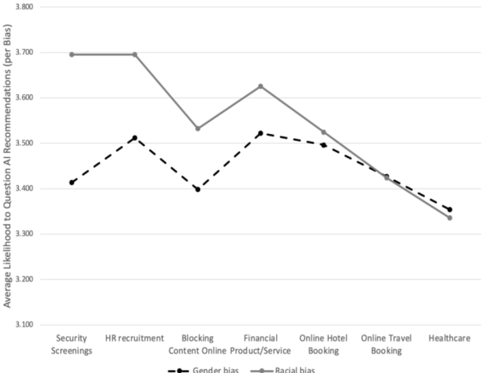
Advances in artificial intelligence (AI) are giving rise to a multitude of AI-embedded technologies that are increasingly impacting all aspects of modern society. Yet, there is a paucity of rigorous research that advances understanding of when, and which type of, individuals are more likely to question AI-based recommendations due to perceived racial and gender bias. This study, which is part of a larger research stream contributes to knowledge by using a scenario-based survey that was issued to a sample of 387 U.S. participants. The findings suggest that considering perceived racial and gender bias, human resource (HR) recruitment and financial product/service procurement scenarios exhibit a higher questioning likelihood. Meanwhile, the healthcare scenario presents the lowest questioning likelihood. Furthermore, in the context of this study, U.S. participants tend to be more susceptible to questioning AI-based recommendations due to perceived racial bias rather than gender bias.
Overview
The claims and statistics of this paper haven’t been checked yet.
Free: it reads the open-access text and checks the first 5 claims that cite a source we can check. Create a free account to check every claim.
Integrity signals
Registry
Cites
Statistics
Figures
Verification
Claims the paper makes
The claims and statistics of this paper haven’t been checked yet.
Free: it reads the open-access text and checks the first 5 claims that cite a source we can check. Create a free account to check every claim.
Claims other papers make about this one
Each is checked against this paper’s own text: does it say what the citing paper says it does?
The source backs part of the claim, not all of it — or backs it for a different population, condition or comparison.
In the citing paper
“The questionnaire-based healthcare app suffered from racial inequalities as it suggested different diagnoses for different race of people keeping all other parameters identical [101,108].”
From Artificial intelligence bias in medical system designs: a systematic review (2023) · cites this paper as [108]
Experimental — accuracy not yet measured
Self-check
Percentages, sums and reported differences re-computed from the paper’s own numbers.
The self-check needs the paper’s full text.
Citations
Cites
Dissecting racial bias in an algorithm used to manage the health of populations
Obermeyer, Z., Powers, B., Vogeli, C., & Mullainathan, S. (2019) · Science · doi:10.1126/science.aax2342 · Cited by 7,137 · cited 1×
“In the context of healthcare, an algorithm used to predict healthcare needs was found to exhibit significant racial discrimination as it considered health expenses and costs as a proxy for healthcare needs, without having first controlled for evident inequalities in access to healthcare services [9].”
MethodRunning experiments on Amazon Mechanical Turk
Paolacci, G., Chandler, J., & Ipeirotis, P. G. (2010) · Judgment and Decision Making · doi:10.1017/s1930297500002205 · Cited by 3,767 · cited 1×
“Mturk was chosen because it has been proven to be an effective data collection tool in many fields, producing results equivalent to studies performed in laboratory settings [17].”
ResultAmazon Scraps Secret AI Recruiting Tool that Showed Bias against Women *
Dastin, J. (2022) · Ethics of Data and Analytics · doi:10.1201/9781003278290-44 · Cited by 1,165
Di Vaio, A., Palladino, R., Hassan, R., & Escobar, O. (2020) · Journal of Business Research · doi:10.1016/j.jbusres.2020.08.019 · Cited by 1,096
Does a different view create something new? The effect of employee diversity on innovation
Østergaard, C. R., Timmermans, B., & Kristinsson, K. (2011) · Research Policy · doi:10.1016/j.respol.2010.11.004 · Cited by 1,016 · cited 1×
“It is widely accepted that inclusive policies aimed at promoting and advancing diversity are important catalyzers of innovation and economic development [5].”
BackgroundPredictably Unequal? The Effects of Machine Learning on Credit Markets
FUSTER, A., GOLDSMITH‐PINKHAM, P., RAMADORAI, T., & WALTHER, A. (2022) · The Journal of Finance · doi:10.1111/jofi.13090 · Cited by 872
Lambrecht, A., & Tucker, C. (2019) · Management Science · doi:10.1287/mnsc.2018.3093 · Cited by 854
Predictably Unequal? The Effects of Machine Learning on Credit Markets
Fuster, A., Goldsmith-Pinkham, P. S., Ramadorai, T., & Walther, A. (2017) · doi:10.2139/ssrn.3072038 · Cited by 769
Measuring price discrimination and steering on e-commerce web sites
Hannak, A., Soeller, G., Lazer, D., Mislove, A., & Wilson, C. (2014) · Proceedings of the 2014 Conference on Internet Measurement Conference · doi:10.1145/2663716.2663744 · Cited by 405
My Anger Is Your Gain, My Contempt Your Loss: Explaining Consumer Responses to Corporate Wrongdoing
Romani, S., Grappi, S., & Bagozzi, R. P. (2013) · Psychology & Marketing · doi:10.1002/mar.20664 · Cited by 140 · cited 1×
“Such situations could be perceived as corporate infractions that could in turn initiate negative word-of-mouth transmission chains as well as associated protests against the organizations in question, and reputational damage [28].”
BackgroundGupta, M., Parra, C. M., & Dennehy, D. (2022) · Information Systems Frontiers · doi:10.1007/s10796-021-10156-2 · Cited by 129 · cited 5×
“…them to question AI-based recommendations when perceived as exhibiting racial or gender biases and reported that individuals who espouse national cultural values associated with collectivism, masculinity, and uncertainty avoidance are more likely to question biased AI-based recommendations [10].”
BackgroundMethodInfluentialSelf-citationDissecting Racial Bias in an Algorithm that Guides Health Decisions for 70 Million People
Obermeyer, Z., & Mullainathan, S. (2019) · Proceedings of the Conference on Fairness, Accountability, and Transparency · doi:10.1145/3287560.3287593 · Cited by 124
Parra, C. M., Gupta, M., & Mikalef, P. (2021) · International Journal of Information Management · doi:10.1016/j.ijinfomgt.2020.102271 · Cited by 54 · cited 1×
“All of which, may lead to associated worldview gaps that strain social ties [15].”
BackgroundSelf-citationBarker, A., Crawford, A., Booth, N., & Churchill, D. (2019) · International Journal of Law in Context · doi:10.1017/s1744552319000387 · Cited by 40 · cited 1×
“In addition, automated decision making, by minimizing human involvement, encounters, and interactions, limit the sense of otherness, and of common humanity, essential to strengthening the social fabric of communities [14].”
BackgroundGrinblat, Y., Gilichinsky, M., & Benenson, I. (2016) · Annals of the American Association of Geographers · doi:10.1080/24694452.2016.1213154 · Cited by 32 · cited 1×
“For instance, geog-raphers have expressed doubts about the adequacy of land use/land cover classification models [11].”
BackgroundA Comprehensive Study of Artificial Intelligence-based Medical Diagnosis
Jain, A., Khanna, B., Dubey, R., & Agarwal, S. (2020) · International Conference for Innovation in Technology (INOCON) · doi:10.1109/inocon50539.2020.9298194 · Cited by 3 · cited 1×
“Similarly, doctors have raised concerns about the accuracy of AI-based diagnostic tools [12].”
BackgroundHartzog, W. (2017) · eYLS (Yale Law School) · Cited by 2
Research works printed but not linked: 7
- E. Hamilton, AI Perpetuating Human Bias in the Lending Space, Tech Times, New York, NY, USA, 2019. [Online]. Available: https://www.techtimes.com/articles/240769/20190402/ai-perpetuating- human-bias-in-the-lending-space.htm
- The Future of Jobs Report 2018, World Econ. Forum, Geneva, Switzerland, 2018.
- S. Bogle and S. Sankaranarayanan, "Job search system in android environment-Application of intelligent agents," Int. J. Inf. Sci. Techn., vol. 2, no. 3, pp. 1-17, 2021.
- E. Brynjolfsson and A. Mcafee, The Business of Artificial Intelligence, What it Can-And Cannot-Do for an Organization, Harvard Bus. Rev., Brighton, MA, USA, 2017.
- J. Manyika, J. Silberg, and S. Presten, What Do We Do About the Biases in AI? vol. 25, Harvard Bus. Rev., Brighton, MA, USA, 2019.
- J. Angwin, J. Larson, S. Mattu, and L. Kirchner, Machine Bias, ProPublica, New York, NY, USA, May 2016. Accessed: Apr. 20, 2019. [Online]. Available: https://www.propublica.org/article/machine- bias-risk-assessments-in-criminal-sentencing
- Worldwide Semiannual Artificial Intelligence Tracker, Int. Data Corp. (IDC), Needham, MA, USA, Feb 2021.
Cited by
Fake news on Social Media: the Impact on Society
Olan, F., Jayawickrama, U., Arakpogun, E. O., Suklan, J., & Liu, S. (2024) · Information Systems Frontiers · doi:10.1007/s10796-022-10242-z · Cited by 303
“…business activities and strategies used in positioning new products and brands, also leading to mis-information in the society (Modgil et al., 2021; Parra et al., 2021; Piccialli et al., 2021), also analyzed the SM platforms as the environment for business and social transactions focusing on…”
An evaluation of the critical success factors impacting artificial intelligence implementation
Merhi, M. I. (2022) · International Journal of Information Management · doi:10.1016/j.ijinfomgt.2022.102545 · Cited by 242
A Confirmation Bias View on Social Media Induced Polarisation During Covid-19
Modgil, S., Singh, R. K., Gupta, S., & Dennehy, D. (2024) · Information Systems Frontiers · doi:10.1007/s10796-021-10222-9 · Cited by 168
“The research provides further evidence to support supply chain practitioners and members of online communities to reflect and reassess their pre-existing biases (Parra et al., 2021) and how their choice of social medial platforms can positively or negatively reinforce this deep-seated belief system.”
Self-citationSecurity of Blockchain and AI-Empowered Smart Healthcare: Application-Based Analysis
Alabdulatif, A., Khalil, I., & Saidur Rahman, M. (2022) · Applied Sciences · doi:10.3390/app122111039 · Cited by 117
“Then, Parra et al. in [31] studied the application of AI algorithms for sustainable development.”
BackgroundA Systematic Literature Review on AI-Based Recommendation Systems and Their Ethical Considerations
Masciari, E., Umair, A., & Ullah, M. H. (2024) · IEEE Access · doi:10.1109/access.2024.3451054 · Cited by 75
Metadata
- Authors
- Parra, C. M., Gupta, M., & Dennehy, D.
- Affiliations
- Florida International University (US)
- Ollscoil na Gaillimhe – University of Galway (IE)
- Venue
- IEEE Transactions on Technology and Society
- Published
- 2022-03
- Volume
- 3
- Issue
- 1
- Pages
- 41-45
- ISSN
- 2637-6415 (ISSN-L)
- OpenAlex
- W3205332925
- Cited by
- 48
- References
- 16
- Citations by year
- 2026: 9 · 2025: 11 · 2024: 14 · 2023: 6 · 2022: 7
- FWCI
- 8.76
- Type
- journal article
- Language
- en
- Open access
- hybrid
- doi.org
- Locations
- IEEE Transactions on Technology and Society (publishedVersion, cc-by)
- Topics
- Physical Sciences › Computer Science › Artificial Intelligence › Ethics and Social Impacts of AI
- Social Sciences › Business, Management and Accounting › Organizational Behavior and Human Resource Management › AI and HR Technologies
- Physical Sciences › Computer Science › Artificial Intelligence › Explainable Artificial Intelligence (XAI)
- Keywords
- AI-based recommendation, algorithmic fairness, trust in AI, personnel selection, health care, scenario-based survey
About these checks
Registry, retraction, Cites and statistics results are computed, not judged, with one exception: a printed reference that no index lists is read once by a model before it counts as a citation error. Claims are extracted by a model and kept only when their quote appears verbatim in the text; each cited source is then checked, with a model’s help, for whether it says what the claim relies on. Those verdicts can be wrong — read the claim’s quote and the cited source before relying on one.
Statistics and arithmetic are recomputed, not judged.
Confidence bands are shown only for fields calibrated on our annotated test set. None is calibrated yet, so no band is shown.
What counts as a claim ›How we measure confidence ›How we check this ›
Are you an author, or do you see a problem with this page? Request a review
Data sources
Bibliographic data: Semantic Scholar, OpenAlex, Crossref.
Contains information from the Semantic Scholar Academic Graph Datasets, made available under the ODC Attribution License (ODC-BY 1.0).
Semantic Scholar’s data is described in: Kinney, R., et al. (2023). The Semantic Scholar Open Data Platform. arXiv:2301.10140.
