

Dynamic Capabilities in Acquisitions: When Acquirer and Target Employees Face Contradictory and Complementary Human Resource Signals
Open accessThe DOI matches its Crossref record; 123 of the 123 references it cites were found in a registry or an index; none of the 189 sources its claims cite is checked for support yet.
Abstract
Dynamic capabilities are crucial for firm survival and success, but to survive and succeed firms must manage multiple higher‐ and lower‐order dynamic capabilities that can be complementary, but also conflicting. Utilizing human resource (HR) signalling theory, we provide new theoretical insights into the conditions, mechanisms and reasons why merger and acquisition (M&A) capabilities (a lower‐order dynamic capability) and organizational agility (a higher‐order dynamic capability) are sometimes complementary and at other times contradictory during acquisition integration. Our theory disentangles the interaction between these capabilities and explains how they act as a double‐edged sword. We test our theory development using survey data from 91 acquisitions taking place in Germany, Austria, Switzerland and Lichtenstein. Our results show that conflicting HR signals from M&A capabilities and organizational agility cause acquirer–target conflict, complicating post‐merger integration and hindering knowledge transfer, while complementary signals enhance knowledge transfer. The findings provide important implications for the M&A, HR management and dynamic capabilities literature, as well as valuable insights for M&A practitioners.
Overview
CoChat Summary
TL;DR
Using HR signalling theory, this paper examines how lower-order M&A capabilities and higher-order organizational agility send complementary or contradictory signals during acquisition integration, affecting acquirer-target conflict and knowledge transfer. Survey evidence from 91 acquisitions in Germany, Austria, Switzerland and Lichtenstein shows that agility and M&A capability interact as a double-edged sword: high agility makes M&A capability increase conflict and only then increase knowledge transfer, while low agility lets M&A capability reduce conflict but not significantly increase knowledge transfer.
Key findings
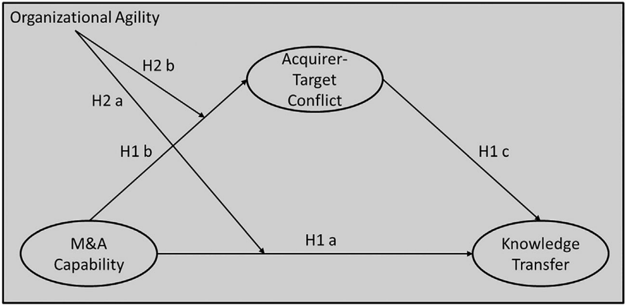
- M&A capability had a positive direct effect on knowledge transfer in Model 2 (β = 0.27, p = 0.01) but became insignificant when moderator and mediator variables were included in Model 5, so H1a was not supported; M&A capability had no significant direct effect on acquirer-target conflict, so H1b was not supported.
- Acquirer-target conflict significantly reduced knowledge transfer (β = -0.29, p = 0.00), supporting H1c; organizational agility had a significant negative direct effect on conflict (β = -0.24, p = 0.05) and a significant positive direct effect on knowledge transfer (β = 0.26, p = 0.01).
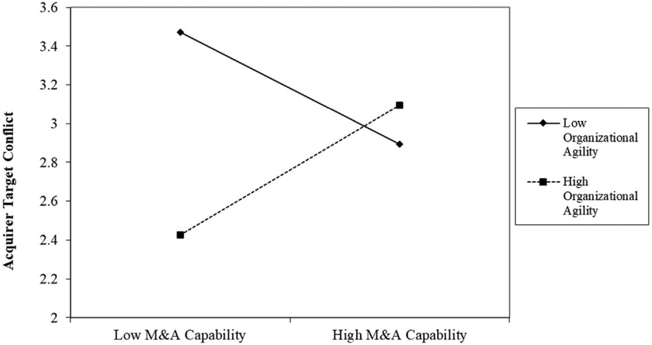
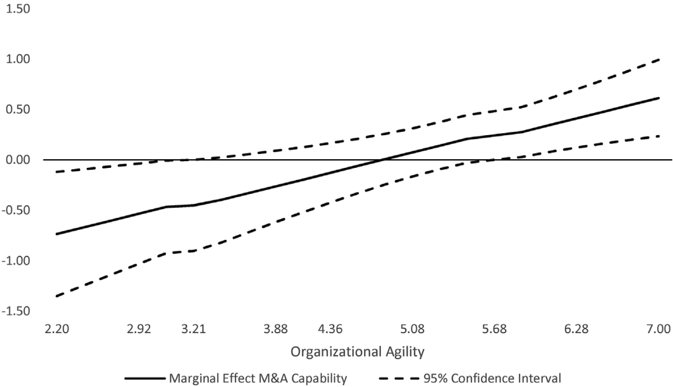
- The M&A capability × organizational agility interaction was positive for conflict (β = 0.28, p = 0.00), supporting H2b: under low agility (ratings below 3.21) M&A capability reduced conflict, while under high agility (ratings above 5.68) it increased conflict.
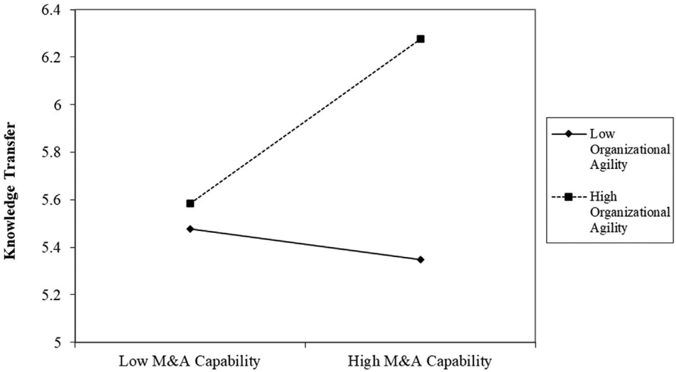
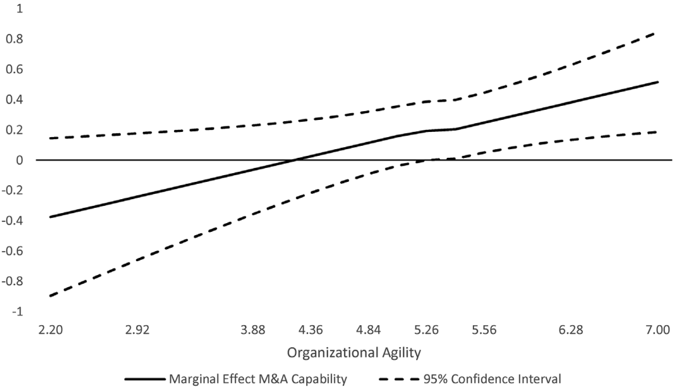
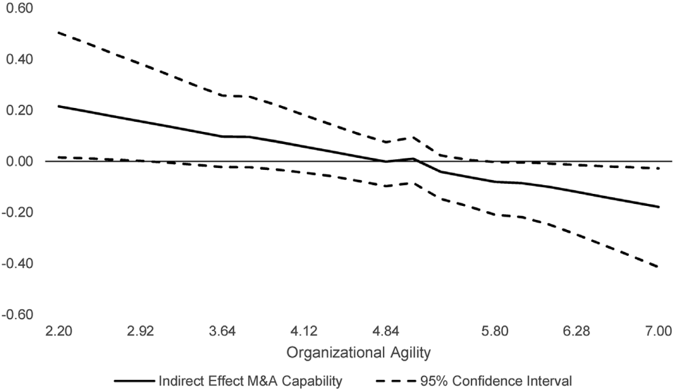
- The interaction was also positive for knowledge transfer (β = 0.19, p = 0.02), supporting H2a: below agility 5.26 M&A capability did not significantly influence knowledge transfer, while above 5.26 it significantly increased it; the moderated mediation index was -0.08 (95% CI -0.18 to -0.01), supporting H2c, with M&A capability increasing knowledge transfer via reduced conflict under very low agility (<2.92) and decreasing it via increased conflict under very high agility (>5.80).
Methods
- Survey design targeting senior executives (CEOs, CFOs and M&A managers) deeply involved in M&A; data collected in 2019 using the WIRE database of the Bayer Institute; sample limited to acquisitions by acquirers in Germany, Austria, Switzerland and Lichtenstein, in long-established industries, with transactions from 2014–2016; final sample was 780 transactions, 144 questionnaires returned, 91 fully completed, response rate 11.66%.
- Measures used pre-validated seven-point scales: knowledge transfer adapted from Capron et al. (1998) (10 items); acquirer-target conflict adapted from Jehn et al. (2008) (task, process and relationship conflict); M&A capability adapted from Trichterborn et al. (2016) (articulation, codification, internalization and sharing); organizational agility adapted from Lu and Ramamurthy (2011) (6 items); controls included relative size, industry growth, acquisition experience, human integration and years since acquisition.
- Analysis used EFA in SPSS and CFA in Amos; hierarchical OLS regressions and moderated mediation using Hayes’ (2013) Process macro Model 8; variables were mean-centred; VIFs were below 1.79; robustness checks included instrumental variable analysis, ITCV/RIR, a trimmed measurement model and alternative models.
Limitations
- The paper states that the retrospective key-informant design cannot completely rule out potential biases; the cross-sectional survey design limits the ability to establish causality; and the focus on specific regions and types of acquirers limits generalizability.
- Text-evident: the sample is small (91 fully completed) and the CFA showed moderate fit (χ²/df = 1.54; TLI = 0.79; CFI = 0.81; RMSEA = 0.08); common method variance cannot be entirely ruled out despite Harman’s test and a single-factor CFA; endogeneity sensitivity analysis indicated the organizational agility → acquirer-target conflict effect could not exclude omitted-variable bias (ITCV), while other significant relationships were judged unlikely to be biased.
- Text-evident: some robustness and alternative models were not fully consistent: the interaction on the second knowledge-transfer factor (management and marketing knowledge transfer) was not significant (β = 0.09, p = 0.37); moderated mediation was significant only for task conflict; when all three conflict dimensions were included simultaneously, process conflict was not significant (β = 0.13, p = 0.37) and all moderated mediation indexes were insignificant, with multicollinearity concerns (VIFs 6.22 for task and 5.96 for process conflict).
Model-written summary. Check it against the paper before relying on it.
Integrity signals
Registry
Cites
Statistics
Figures
Verification
Claims the paper makes
0 Valid · 0 Not valid · 109 Not checked · 105 Own results and interpretations
A result the paper reports from its own data — it cites no other source for it, so there is none to check. The quote shows it is in the paper.
In the paper
“Our results show that conflicting HR signals from M&A capabilities and organizational agility cause acquirer-target conflict, complicating post-merger integration and hindering knowledge transfer, while complementary signals enhance knowledge transfer.”
§ Dynamic Capabilities in Acquisitions: When Acquirer and Target Employees Face Contradictory and Complementary Human Resource Signals > Abstract
plainstates a cause- Asserted: passes — The authors put it forward as true.
- Checkable: passes — It can be checked against evidence.
- Load-bearing: passes — The paper’s conclusions depend on it.
- Based: passes — The paper gives a reason why it holds.
A result the paper states — it cites no source for it, so there is none to check. The quote shows it is in the paper.
In the paper
“However, we also show that strong signals improve knowledge transfer.”
§ Dynamic Capabilities in Acquisitions: When Acquirer and Target Employees Face Contradictory and Complementary Human Resource Signals > Introduction
plainstates a cause- Asserted: passes — The authors put it forward as true.
- Checkable: passes — It can be checked against evidence.
- Load-bearing: passes — The paper’s conclusions depend on it.
- Based: passes — The paper gives a reason why it holds.
A result the paper reports from its own data — it cites no other source for it, so there is none to check. The quote shows it is in the paper.
In the paper
“The subsequent two-stage least-squares regression confirms the effect of acquirer-target conflict (β = -0.26*;p-value = 0.08).”
§ Dynamic Capabilities in Acquisitions: When Acquirer and Target Employees Face Contradictory and Complementary Human Resource Signals > Robustness checks.
plainstates a cause- Asserted: passes — The authors put it forward as true.
- Checkable: passes — It can be checked against evidence.
- Load-bearing: unclear — It is unclear whether the paper’s conclusions depend on it.
- Based: passes — The paper gives a reason why it holds.
A result the paper reports from its own data — it cites no other source for it, so there is none to check. The quote shows it is in the paper.
In the paper
“Under very high levels of organizational agility (ratings exceeding 5.80), an M&A capability decreases knowledge transfer due to increased acquirer-target conflict.”
§ Dynamic Capabilities in Acquisitions: When Acquirer and Target Employees Face Contradictory and Complementary Human Resource Signals > Hypothesis testing.
plainstates a cause- Asserted: passes — The authors put it forward as true.
- Checkable: passes — It can be checked against evidence.
- Load-bearing: passes — The paper’s conclusions depend on it.
- Based: passes — The paper gives a reason why it holds.
A result the paper reports from its own data — it cites no other source for it, so there is none to check. The quote shows it is in the paper.
In the paper
“For all other significant relationships, it is unlikely that endogeneity is a major concern, since the covariates' impact values are consistently lower that employees of the target company had to take on tasks without receiving the necessary resources (material, time, budget, etc.).compared to ITCV values.”
§ Dynamic Capabilities in Acquisitions: When Acquirer and Target Employees Face Contradictory and Complementary Human Resource Signals > Dynamic Capabilities in Acquisitions
hedged- Asserted: passes — The authors put it forward as true.
- Checkable: passes — It can be checked against evidence.
- Load-bearing: passes — The paper’s conclusions depend on it.
- Based: passes — The paper gives a reason why it holds.
97 more claims
Create a free account to see all 214 claims and to verify the 145 references still open.
- It may state two separate claims as one. 73
- Probably not a substantial claim. 57
Self-check
Percentages, sums and reported differences re-computed from the paper’s own numbers.
Each contradiction between two passages listed here was confirmed by an independent check.
Rated minor: it would not touch a result — a value no result rests on, a p-value that stays on the same side of the significance level, or a conflict that is clerical, resolved elsewhere in the paper, or outside its own findings.
In the paper
§ Dynamic Capabilities in Acquisitions: When Acquirer and Target Employees Face Contradictory and Complementary Human Resource Signals > Dynamic Capabilities in Acquisitions
“Years since acquisition (9) 2.93 1.84”
§ Dynamic Capabilities in Acquisitions: When Acquirer and Target Employees Face Contradictory and Complementary Human Resource Signals > Methods
“Thus, we focused on transactions made between 2014 and 2016 and obtained a final sample consisting of 780 transactions.”
Citations
Cites
Evaluating structural equation models with unobservable variables and measurement error
Fornell, C., & Larcker, D. F. (1981) · Journal of Marketing Research · doi:10.1177/002224378101800104 · Cited by 109,190
(2013) · Cited by 44,563
Multiple regression: testing and interpreting interactions
(1992) · Choice Reviews Online · doi:10.5860/choice.29-3352 · Cited by 36,654
A Dynamic Theory of Organizational Knowledge Creation
Nonaka, I. (1994) · Organization Science · doi:10.1287/orsc.5.1.14 · Cited by 17,809
Self-Reports in Organizational Research: Problems and Prospects
Podsakoff, P. M., & Organ, D. W. (1986) · Journal of Management · doi:10.1177/014920638601200408 · Cited by 17,102
Teece, D. J. (2007) · Strategic Management Journal · doi:10.1002/smj.640 · Cited by 16,825
Sources of method bias in social science research and recommendations on how to control it
Podsakoff, P. M., MacKenzie, S. B., & Podsakoff, N. P. (2012) · Annual Review of Psychology · doi:10.1146/annurev-psych-120710-100452 · Cited by 15,744
A Caution Regarding Rules of Thumb for Variance Inflation Factors
O’brien, R. M. (2007) · Quality & Quantity · doi:10.1007/s11135-006-9018-6 · Cited by 11,217
Absorptive Capacity: A Review, Reconceptualization, and Extension
Zahra, S. A., & George, G. (2002) · The Academy of Management Review · doi:10.5465/amr.2002.6587995 · Cited by 10,758
Structural inertia and organizational change
Hannan, M. T., & Freeman, J. (1984) · American Sociological Review · doi:10.2307/2095567 · Cited by 7,244
Research works printed but not linked: 1
- 10.2307/20159537 · doi:10.2307/20159537
Cited by
Acquirer Strategic Orientations, Integration Decisions, and Performance
Bauer, F., King, D. R., Covin, J. G., Schriber, S., Brueller, N. N., & Weng, Q. D. (2026) · Journal of Management Studies · doi:10.1111/joms.70082 · Cited by 3
Self-citationWhen does acquisition experience recency matter?
Barwinski, R., King, D. R., Chaturvedi, T., & Bauer, F. (2025) · Journal of Business Research · doi:10.1016/j.jbusres.2025.115708 · Cited by 3
Self-citationPolicy uncertainty: patent acquisition strategies
Ye, Y., Hao, Z., & Quan, R. (2026) · Management Decision · doi:10.1108/md-04-2025-0888 · Cited by 2
The dual nature of humor: Leader humor style, psychological safety, and employee innovative behavior
Lin, C., Li, J., Li, X., & Ji, P. (2025) · European Management Journal · doi:10.1016/j.emj.2025.10.010 · Cited by 2
Machayo, S. K., Wekesa, E. N., & Eboi, A. A. (2025) · African Multidisciplinary Journal of Research · doi:10.71064/spu.amjr.2.3.2025.467 · Cited by 1
Metadata
- Authors
- Strobl, A., Bauer, F., Shepherd, N. G., Lou, B., Tarba, S. Y., & Dao, M. A.
- Affiliations
- Department of Entrepreneurship & Strategy Lancaster University Management School Bailrigg Lancaster LA1 4YX UK
- University of Bristol (GB)
- Lancaster University (GB)
- University of Birmingham (GB)
- MADiscover GmbH Innsbruck 6020 Austria
- Venue
- British Journal of Management
- Publisher
- Wiley
- Published
- 2024-12-20
- Volume
- 36
- Issue
- 3
- Pages
- 1146-1164
- ISSN
- 1045-3172 (ISSN-L)
- 1467-8551
- OpenAlex
- W4405648267
- Semantic Scholar
- 441f4775c9fa052d97e4ff25d1f12b92ef0ade76
- Cited by
- 21
- References
- 122
- Citations by year
- 2026: 16 · 2025: 5
- FWCI
- 3.54
- Type
- journal article
- Language
- en
- Open access
- hybrid
- doi.org
- Licence
- Locations
- British Journal of Management (publishedVersion, cc-by)
- Explore Bristol Research (publishedVersion, cc-by)
- Bristol Research (University of Bristol) (publishedVersion, cc-by)
- Lancaster EPrints (Lancaster University) (submittedVersion, cc-by)
- White Rose Research Online (University of Leeds, The University of Sheffield, University of York) (submittedVersion, cc-by)
- University of Birmingham Research Portal (University of Birmingham) (submittedVersion, other-oa)
- Topics
- Social Sciences › Business, Management and Accounting › Strategy and Management › Innovation and Knowledge Management
- Social Sciences › Economics, Econometrics and Finance › Finance › Corporate Finance and Governance
- Social Sciences › Business, Management and Accounting › Organizational Behavior and Human Resource Management › Human Resource and Talent Management
- Keywords
- dynamic capabilities, mergers and acquisitions, organizational agility, post-merger integration, knowledge transfer
About these checks
Registry, retraction, Cites and statistics results are computed, not judged, with one exception: a printed reference that no index lists is read once by a model before it counts as a citation error. Claims are extracted by a model and kept only when their quote appears verbatim in the text; each cited source is then checked, with a model’s help, for whether it says what the claim relies on. Those verdicts can be wrong — read the claim’s quote and the cited source before relying on one.
A language model drew the claims from the paper on 2026-11-23, under version 3 of the claim definition (model deepseek-v4.1-flash, prompt extract-v3).
A second model labelled each claim on 2026-11-23 (model jev-1.13-20260917, definition revision gold-guideline-v0.2).
Statistics and arithmetic are recomputed, not judged.
Confidence bands are shown only for fields calibrated on our annotated test set. None is calibrated yet, so no band is shown.
What counts as a claim ›How we measure confidence ›How we check this ›
Are you an author, or do you see a problem with this page? Request a review
How to cite
Cite CoChat for the checks on this page, and the paper for its own findings.
- This page
- CoChat. (2026). Citation check: Dynamic Capabilities in Acquisitions: When Acquirer and Target Employees Face Contradictory and Complementary Human Resource Signals. https://app.cochat.ai/papers/10.1111/1467-8551.12889
- The paper
- Strobl, A., Bauer, F., Shepherd, N. G., Lou, B., Tarba, S. Y., & Dao, M. A. (2025). Dynamic Capabilities in Acquisitions: When Acquirer and Target Employees Face Contradictory and Complementary Human Resource Signals. British Journal of Management. https://doi.org/10.1111/1467-8551.12889
Data sources
Bibliographic data: Semantic Scholar, OpenAlex, Crossref.
Contains information from the Semantic Scholar Academic Graph Datasets, made available under the ODC Attribution License (ODC-BY 1.0).
Semantic Scholar’s data is described in: Kinney, R., et al. (2023). The Semantic Scholar Open Data Platform. arXiv:2301.10140.
