

Dynamic Capabilities in Acquisitions: When Acquirer and Target Employees Face Contradictory and Complementary Human Resource Signals
Open accessThe DOI matches its Crossref record; 123 of the 123 references it cites were found in a registry or an index; none of the 189 sources its claims cite is checked for support yet.
Abstract
Dynamic capabilities are crucial for firm survival and success, but to survive and succeed firms must manage multiple higher‐ and lower‐order dynamic capabilities that can be complementary, but also conflicting. Utilizing human resource (HR) signalling theory, we provide new theoretical insights into the conditions, mechanisms and reasons why merger and acquisition (M&A) capabilities (a lower‐order dynamic capability) and organizational agility (a higher‐order dynamic capability) are sometimes complementary and at other times contradictory during acquisition integration. Our theory disentangles the interaction between these capabilities and explains how they act as a double‐edged sword. We test our theory development using survey data from 91 acquisitions taking place in Germany, Austria, Switzerland and Lichtenstein. Our results show that conflicting HR signals from M&A capabilities and organizational agility cause acquirer–target conflict, complicating post‐merger integration and hindering knowledge transfer, while complementary signals enhance knowledge transfer. The findings provide important implications for the M&A, HR management and dynamic capabilities literature, as well as valuable insights for M&A practitioners.
Overview
CoChat Summary
TL;DR
Using HR signalling theory, this paper examines how lower-order M&A capabilities and higher-order organizational agility send complementary or contradictory signals during acquisition integration, affecting acquirer-target conflict and knowledge transfer. Survey evidence from 91 acquisitions in Germany, Austria, Switzerland and Lichtenstein shows that agility and M&A capability interact as a double-edged sword: high agility makes M&A capability increase conflict and only then increase knowledge transfer, while low agility lets M&A capability reduce conflict but not significantly increase knowledge transfer.
Key findings
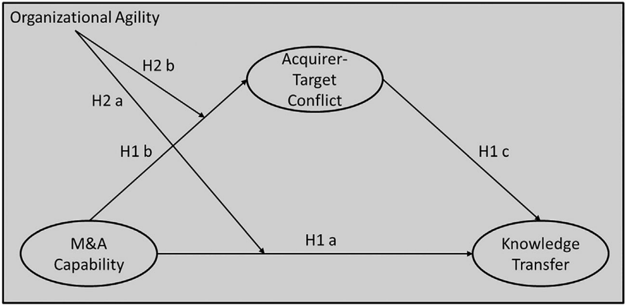
- M&A capability had a positive direct effect on knowledge transfer in Model 2 (β = 0.27, p = 0.01) but became insignificant when moderator and mediator variables were included in Model 5, so H1a was not supported; M&A capability had no significant direct effect on acquirer-target conflict, so H1b was not supported.
- Acquirer-target conflict significantly reduced knowledge transfer (β = -0.29, p = 0.00), supporting H1c; organizational agility had a significant negative direct effect on conflict (β = -0.24, p = 0.05) and a significant positive direct effect on knowledge transfer (β = 0.26, p = 0.01).
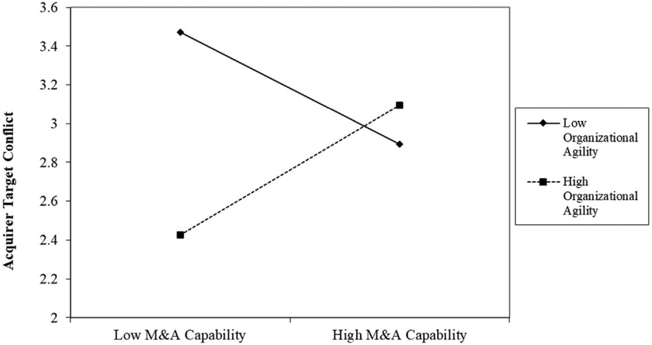
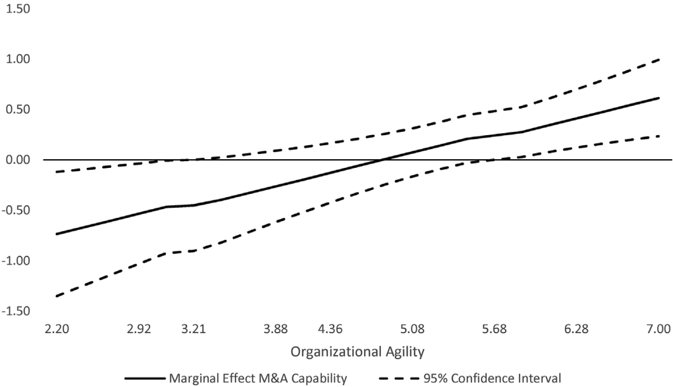
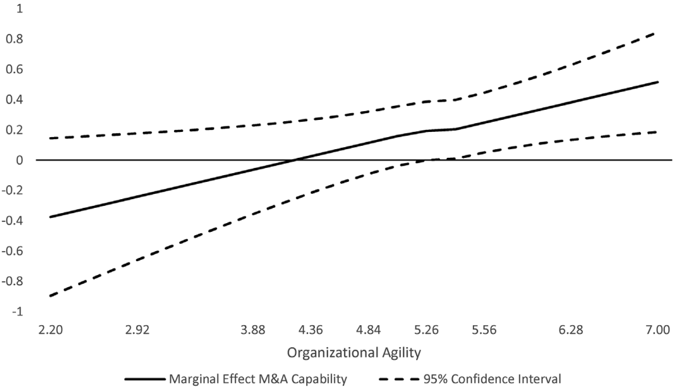
- The M&A capability × organizational agility interaction was positive for conflict (β = 0.28, p = 0.00), supporting H2b: under low agility (ratings below 3.21) M&A capability reduced conflict, while under high agility (ratings above 5.68) it increased conflict.
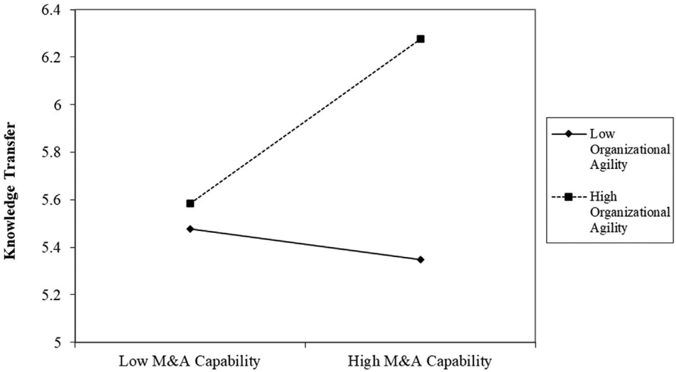
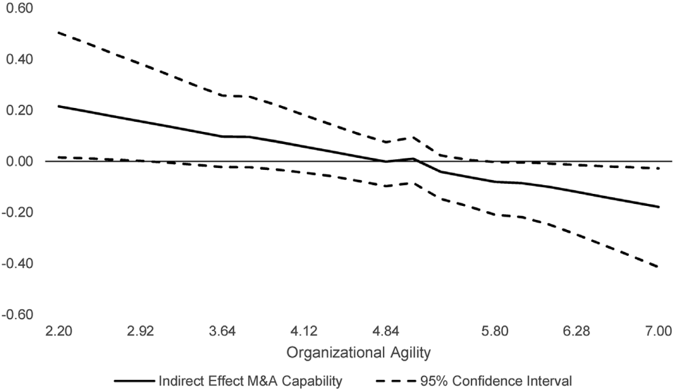
- The interaction was also positive for knowledge transfer (β = 0.19, p = 0.02), supporting H2a: below agility 5.26 M&A capability did not significantly influence knowledge transfer, while above 5.26 it significantly increased it; the moderated mediation index was -0.08 (95% CI -0.18 to -0.01), supporting H2c, with M&A capability increasing knowledge transfer via reduced conflict under very low agility (<2.92) and decreasing it via increased conflict under very high agility (>5.80).
Methods
- Survey design targeting senior executives (CEOs, CFOs and M&A managers) deeply involved in M&A; data collected in 2019 using the WIRE database of the Bayer Institute; sample limited to acquisitions by acquirers in Germany, Austria, Switzerland and Lichtenstein, in long-established industries, with transactions from 2014–2016; final sample was 780 transactions, 144 questionnaires returned, 91 fully completed, response rate 11.66%.
- Measures used pre-validated seven-point scales: knowledge transfer adapted from Capron et al. (1998) (10 items); acquirer-target conflict adapted from Jehn et al. (2008) (task, process and relationship conflict); M&A capability adapted from Trichterborn et al. (2016) (articulation, codification, internalization and sharing); organizational agility adapted from Lu and Ramamurthy (2011) (6 items); controls included relative size, industry growth, acquisition experience, human integration and years since acquisition.
- Analysis used EFA in SPSS and CFA in Amos; hierarchical OLS regressions and moderated mediation using Hayes’ (2013) Process macro Model 8; variables were mean-centred; VIFs were below 1.79; robustness checks included instrumental variable analysis, ITCV/RIR, a trimmed measurement model and alternative models.
Limitations
- The paper states that the retrospective key-informant design cannot completely rule out potential biases; the cross-sectional survey design limits the ability to establish causality; and the focus on specific regions and types of acquirers limits generalizability.
- Text-evident: the sample is small (91 fully completed) and the CFA showed moderate fit (χ²/df = 1.54; TLI = 0.79; CFI = 0.81; RMSEA = 0.08); common method variance cannot be entirely ruled out despite Harman’s test and a single-factor CFA; endogeneity sensitivity analysis indicated the organizational agility → acquirer-target conflict effect could not exclude omitted-variable bias (ITCV), while other significant relationships were judged unlikely to be biased.
- Text-evident: some robustness and alternative models were not fully consistent: the interaction on the second knowledge-transfer factor (management and marketing knowledge transfer) was not significant (β = 0.09, p = 0.37); moderated mediation was significant only for task conflict; when all three conflict dimensions were included simultaneously, process conflict was not significant (β = 0.13, p = 0.37) and all moderated mediation indexes were insignificant, with multicollinearity concerns (VIFs 6.22 for task and 5.96 for process conflict).
Model-written summary. Check it against the paper before relying on it.
Integrity signals
Registry
Cites
Statistics
Figures
Verification
Claims the paper makes
0 Valid · 0 Not valid · 109 Not checked · 105 Own results and interpretations
A result the paper reports from its own data — it cites no other source for it, so there is none to check. The quote shows it is in the paper.
In the paper
“Our results show that conflicting HR signals from M&A capabilities and organizational agility cause acquirer-target conflict, complicating post-merger integration and hindering knowledge transfer, while complementary signals enhance knowledge transfer.”
§ Dynamic Capabilities in Acquisitions: When Acquirer and Target Employees Face Contradictory and Complementary Human Resource Signals > Abstract
plainstates a cause- Asserted: passes — The authors put it forward as true.
- Checkable: passes — It can be checked against evidence.
- Load-bearing: passes — The paper’s conclusions depend on it.
- Based: passes — The paper gives a reason why it holds.
A result the paper states — it cites no source for it, so there is none to check. The quote shows it is in the paper.
In the paper
“However, we also show that strong signals improve knowledge transfer.”
§ Dynamic Capabilities in Acquisitions: When Acquirer and Target Employees Face Contradictory and Complementary Human Resource Signals > Introduction
plainstates a cause- Asserted: passes — The authors put it forward as true.
- Checkable: passes — It can be checked against evidence.
- Load-bearing: passes — The paper’s conclusions depend on it.
- Based: passes — The paper gives a reason why it holds.
A result the paper reports from its own data — it cites no other source for it, so there is none to check. The quote shows it is in the paper.
In the paper
“The subsequent two-stage least-squares regression confirms the effect of acquirer-target conflict (β = -0.26*;p-value = 0.08).”
§ Dynamic Capabilities in Acquisitions: When Acquirer and Target Employees Face Contradictory and Complementary Human Resource Signals > Robustness checks.
plainstates a cause- Asserted: passes — The authors put it forward as true.
- Checkable: passes — It can be checked against evidence.
- Load-bearing: unclear — It is unclear whether the paper’s conclusions depend on it.
- Based: passes — The paper gives a reason why it holds.
A result the paper reports from its own data — it cites no other source for it, so there is none to check. The quote shows it is in the paper.
In the paper
“Under very high levels of organizational agility (ratings exceeding 5.80), an M&A capability decreases knowledge transfer due to increased acquirer-target conflict.”
§ Dynamic Capabilities in Acquisitions: When Acquirer and Target Employees Face Contradictory and Complementary Human Resource Signals > Hypothesis testing.
plainstates a cause- Asserted: passes — The authors put it forward as true.
- Checkable: passes — It can be checked against evidence.
- Load-bearing: passes — The paper’s conclusions depend on it.
- Based: passes — The paper gives a reason why it holds.
A result the paper reports from its own data — it cites no other source for it, so there is none to check. The quote shows it is in the paper.
In the paper
“For all other significant relationships, it is unlikely that endogeneity is a major concern, since the covariates' impact values are consistently lower that employees of the target company had to take on tasks without receiving the necessary resources (material, time, budget, etc.).compared to ITCV values.”
§ Dynamic Capabilities in Acquisitions: When Acquirer and Target Employees Face Contradictory and Complementary Human Resource Signals > Dynamic Capabilities in Acquisitions
hedged- Asserted: passes — The authors put it forward as true.
- Checkable: passes — It can be checked against evidence.
- Load-bearing: passes — The paper’s conclusions depend on it.
- Based: passes — The paper gives a reason why it holds.
97 more claims
Create a free account to see all 214 claims and to verify the 145 references still open.
- It may state two separate claims as one. 73
- Probably not a substantial claim. 57
Self-check
Percentages, sums and reported differences re-computed from the paper’s own numbers.
Each contradiction between two passages listed here was confirmed by an independent check.
Rated minor: it would not touch a result — a value no result rests on, a p-value that stays on the same side of the significance level, or a conflict that is clerical, resolved elsewhere in the paper, or outside its own findings.
In the paper
§ Dynamic Capabilities in Acquisitions: When Acquirer and Target Employees Face Contradictory and Complementary Human Resource Signals > Dynamic Capabilities in Acquisitions
“Years since acquisition (9) 2.93 1.84”
§ Dynamic Capabilities in Acquisitions: When Acquirer and Target Employees Face Contradictory and Complementary Human Resource Signals > Methods
“Thus, we focused on transactions made between 2014 and 2016 and obtained a final sample consisting of 780 transactions.”
Citations
Cites
Evaluating structural equation models with unobservable variables and measurement error
Fornell, C., & Larcker, D. F. (1981) · Journal of Marketing Research · doi:10.1177/002224378101800104 · Cited by 109,190
(2013) · Cited by 44,563
Multiple regression: testing and interpreting interactions
(1992) · Choice Reviews Online · doi:10.5860/choice.29-3352 · Cited by 36,654
A Dynamic Theory of Organizational Knowledge Creation
Nonaka, I. (1994) · Organization Science · doi:10.1287/orsc.5.1.14 · Cited by 17,809
Self-Reports in Organizational Research: Problems and Prospects
Podsakoff, P. M., & Organ, D. W. (1986) · Journal of Management · doi:10.1177/014920638601200408 · Cited by 17,102
Teece, D. J. (2007) · Strategic Management Journal · doi:10.1002/smj.640 · Cited by 16,825
Sources of method bias in social science research and recommendations on how to control it
Podsakoff, P. M., MacKenzie, S. B., & Podsakoff, N. P. (2012) · Annual Review of Psychology · doi:10.1146/annurev-psych-120710-100452 · Cited by 15,744
A Caution Regarding Rules of Thumb for Variance Inflation Factors
O’brien, R. M. (2007) · Quality & Quantity · doi:10.1007/s11135-006-9018-6 · Cited by 11,217
Absorptive Capacity: A Review, Reconceptualization, and Extension
Zahra, S. A., & George, G. (2002) · The Academy of Management Review · doi:10.5465/amr.2002.6587995 · Cited by 10,758
Structural inertia and organizational change
Hannan, M. T., & Freeman, J. (1984) · American Sociological Review · doi:10.2307/2095567 · Cited by 7,244
Testing for Weak Instruments in Linear IV Regression
Stock, J. H., & Yogo, M. (2005) · Identification and Inference for Econometric Models · doi:10.1017/cbo9780511614491.006 · Cited by 7,211
(1991) · Cited by 7,187
Deliberate learning and the evolution of dynamic capabilities
Zollo, M., & Winter, S. G. (2002) · Organization Science · doi:10.1287/orsc.13.3.339.2780 · Cited by 6,963
Estimation and Inference in Econometrics.
Chambers, M. J., Davidson, R., & MacKinnon, J. G. (1994) · The Economic Journal · doi:10.2307/2234656 · Cited by 5,413
Understanding dynamic capabilities
Winter, S. G. (2003) · Strategic Management Journal · doi:10.1002/smj.318 · Cited by 5,315
Building dynamic capabilities for digital transformation: An ongoing process of strategic renewal
Warner, K. S. R., & Wäger, M. (2019) · Long Range Planning · doi:10.1016/j.lrp.2018.12.001 · Cited by 3,445
Sambamurthy, V., Bharadwaj, A., & Grover, V. (2003) · MIS Quarterly · doi:10.2307/30036530 · Cited by 3,228
Understanding HRM–Firm Performance Linkages: The Role of the “Strength” of the HRM System
Bowen, D. E., & Ostroff, C. (2004) · Academy of Management Review · doi:10.5465/amr.2004.12736076 · Cited by 2,996
Work group diversity and group performance: an integrative model and research agenda.
van Knippenberg, D., De Dreu, C. K. W., & Homan, A. C. (2004) · Journal of Applied Psychology · doi:10.1037/0021-9010.89.6.1008 · Cited by 2,911
THE DYNAMIC NATURE OF CONFLICT: A LONGITUDINAL STUDY OF INTRAGROUP CONFLICT AND GROUP PERFORMANCE.
Jehn, K. A., & Mannix, E. A. (2001) · Academy of Management Journal · doi:10.2307/3069453 · Cited by 2,487 · cited 2×
“When conflict is affective, it most commonly undermines interpersonal relations and trust and leads to animosity (Jehn and Mannix, 2001).”
CONDUCTING INTERORGANIZATIONAL RESEARCH USING KEY INFORMANTS.
KUMAR, N., STERN, L. W., & ANDERSON, J. C. (1993) · Academy of Management Journal · doi:10.2307/256824 · Cited by 2,467
Dynamic Capabilities: A Review of Past Research and an Agenda for the Future
Barreto, I. (2010) · Journal of Management · doi:10.1177/0149206309350776 · Cited by 1,948 · cited 1×
“Research typically assumes that higher-and lower-order dynamic capabilities complement each other and enhance performance (Barreto, 2010; Heimeriks, Schi-jven and Gates, 2012), promoting the idea that ‘more is better’.”
Managing acquisitions: Creating value through corporate renewal
(1991) · Long Range Planning · doi:10.1016/0024-6301(91)90291-u · Cited by 1,499
Untangling dynamic and operational capabilities: Strategy for the (N) ever - changing world
Helfat, C. E., & Winter, S. G. (2011) · Strategic Management Journal · doi:10.1002/smj.955 · Cited by 1,439
Meta‐analyses of post‐acquisition performance: indications of unidentified moderators
King, D. R., Dalton, D. R., Daily, C. M., & Covin, J. G. (2004) · Strategic Management Journal · doi:10.1002/smj.371 · Cited by 1,363
Lu, Y., & Ramamurthy, K. (. (2011) · MIS Quarterly · doi:10.2307/41409967 · Cited by 1,309 · cited 4×
“Organizational agility was adapted from Lu and Ramamurthy (2011) and captures operational and market-based agility with six items.”
InfluentialDoz, Y. L., & Kosonen, M. (2010) · Long Range Planning · doi:10.1016/j.lrp.2009.07.006 · Cited by 1,245
Schilke, O., Hu, S., & Helfat, C. E. (2018) · Academy of Management Annals · doi:10.5465/annals.2016.0014 · Cited by 1,226 · cited 7×
“This represents an important contribution to HR research on dynamic capabilities, as it unravels the complexities and pitfalls of dynamic capability hierarchies (Apascaritei and Elvira, 2022; Peteraf, Di Stefano and Verona, 2013; Schilke, Hu and Helfat, 2018).”
InfluentialControlling for endogeneity with instrumental variables in strategic management research
Bascle, G. (2008) · Strategic Organization · doi:10.1177/1476127008094339 · Cited by 1,133
Zollo, M., & Singh, H. (2004) · Strategic Management Journal · doi:10.1002/smj.426 · Cited by 1,106
Knowledge Transfer in International Acquisitions
Bresman, H., Birkinshaw, J., & Nobel, R. (1999) · Journal of International Business Studies · doi:10.1057/palgrave.jibs.8490078 · Cited by 1,071
Kale, P., & Singh, H. (2007) · Strategic Management Journal · doi:10.1002/smj.616 · Cited by 1,070
CONTINUOUS "MORPHING": COMPETING THROUGH DYNAMIC CAPABILITIES, FORM, AND FUNCTION.
Rindova, V. P., & Kotha, S. (2001) · Academy of Management Journal · doi:10.2307/3069400 · Cited by 899
INTRAGROUP CONFLICT IN ORGANIZATIONS: A CONTINGENCY PERSPECTIVE ON THE CONFLICT-OUTCOME RELATIONSHIP
Jehn, K. A., & Bendersky, C. (2003) · Research in Organizational Behavior · doi:10.1016/s0191-3085(03)25005-x · Cited by 881
When do firms learn from their acquisition experience? Evidence from 1990 to 1995
Hayward, M. L. A. (2002) · Strategic Management Journal · doi:10.1002/smj.207 · Cited by 797
Acquiring New Technologies and Capabilities: A Grounded Model of Acquisition Implementation
Ranft, A. L., & Lord, M. D. (2002) · Organization Science · doi:10.1287/orsc.13.4.420.2952 · Cited by 787
The elephant in the room of dynamic capabilities: Bringing two diverging conversations together
Peteraf, M., Di Stefano, G., & Verona, G. (2013) · Strategic Management Journal · doi:10.1002/smj.2078 · Cited by 702
Dynamic Capabilities: Current Debates and Future Directions
Easterby‐Smith, M., Lyles, M. A., & Peteraf, M. A. (2009) · British Journal of Management · doi:10.1111/j.1467-8551.2008.00609.x · Cited by 695
Fundamental issues in strategy: a research agenda
(1994) · Choice Reviews Online · doi:10.5860/choice.32-1614 · Cited by 669
Resource redeployment following horizontal acquisitions in Europe and North America, 1988-1992
Capron, L., Dussauge, P., & Mitchell, W. (1998) · Strategic Management Journal · doi:10.1002/(sici)1097-0266(199807)19:7<631::aid-smj963>3.0.co;2-9 · Cited by 645
The Process of Postmerger Integration: A Review and Agenda for Future Research
Graebner, M. E., Heimeriks, K. H., Huy, Q. N., & Vaara, E. (2017) · Academy of Management Annals · doi:10.5465/annals.2014.0078 · Cited by 615
Fundamental issues in strategy a research agenda
Rumelt, R. P. (1994) · Cited by 592
Digital transformation of industrial businesses: A dynamic capability approach
Ghosh, S., Hughes, M., Hodgkinson, I., & Hughes, P. (2022) · Technovation · doi:10.1016/j.technovation.2021.102414 · Cited by 572
Birkinshaw, J., Bresman, H., & Håkanson, L. (2000) · Journal of Management Studies · doi:10.1111/1467-6486.00186 · Cited by 572
DETERMINANTS OF ACQUISITION INTEGRATION LEVEL: A DECISION-MAKING PERSPECTIVE.
PABLO, A. L. (1994) · Academy of Management Journal · doi:10.2307/256601 · Cited by 543
Bauer, F., & Matzler, K. (2014) · Strategic Management Journal · doi:10.1002/smj.2091 · Cited by 498
Self-citationNot all M&As are alike--and that matters.
Bower, J. (2001) · Harvard Business Review · doi:10.4324/9780203708071-10 · Cited by 493
Effects of Time and Memory Factors on Response in Surveys
Sudman, S., & Bradburn, N. M. (1973) · Journal of the American Statistical Association · doi:10.1080/01621459.1973.10481428 · Cited by 471 · cited 1×
“Despite implementing several countermeasures, we cannot completely rule out potential biases (Kumar, Stern and Anderson, 1993; Sudman and Bradburn, 1973).”
Busenbark, J. R., Yoon, H. (., Gamache, D. L., & Withers, M. C. (2022) · Journal of Management · doi:10.1177/01492063211006458 · Cited by 457
The double-edged sword of cultural distance in international acquisitions
Reus, T. H., & Lamont, B. T. (2009) · Journal of International Business Studies · doi:10.1057/jibs.2009.25 · Cited by 451
Empson, L. (2001) · Human Relations · doi:10.1177/0018726701547003 · Cited by 447
Context, Cognition, and Common Method Variance: Psychometric and Verbal Protocol Evidence
Harrison, D. A., McLaughlin, M. E., & Coalter, T. M. (1996) · Organizational Behavior and Human Decision Processes · doi:10.1006/obhd.1996.0103 · Cited by 429
How organizational learning affects a firm's flexibility, competitive strategy, and performance
Santos-Vijande, M. L., López-Sánchez, J. Á., & Trespalacios, J. A. (2012) · Journal of Business Research · doi:10.1016/j.jbusres.2011.09.002 · Cited by 415
Frank, K. A., Maroulis, S. J., Duong, M. Q., & Kelcey, B. M. (2013) · Educational Evaluation and Policy Analysis · doi:10.3102/0162373713493129 · Cited by 406 · cited 1×
“RIR provides insights into biases stemming from any source of endogeneity (Busen-bark et al. , 2022; Frank et al. , 2013).”
The Effects of Conflict Types, Dimensions, and Emergent States on Group Outcomes
Jehn, K. A., Greer, L., Levine, S., & Szulanski, G. (2008) · Group Decision and Negotiation · doi:10.1007/s10726-008-9107-0 · Cited by 405
Strategic Agility: A State of the Art Introduction to the Special Section on Strategic Agility
Weber, Y., & Tarba, S. Y. (2014) · California Management Review · doi:10.1525/cmr.2014.56.3.5 · Cited by 403
Self-citationOlson, B. J., Parayitam, S., & Bao, Y. (2007) · Journal of Management · doi:10.1177/0149206306298657 · Cited by 396
Handbook of Organizational Learning and Knowledge Management
(2012) · Wiley eBooks · doi:10.1002/9781119207245 · Cited by 355
Homburg, C., & Bucerius, M. (2006) · Strategic Management Journal · doi:10.1002/smj.520 · Cited by 350
Paruchuri, S., Nerkar, A., & Hambrick, D. C. (2006) · Organization Science · doi:10.1287/orsc.1060.0207 · Cited by 347
Sarala, R. M., & Vaara, E. (2010) · Journal of International Business Studies · doi:10.1057/jibs.2009.89 · Cited by 315
CORDING, M., CHRISTMANN, P., & KING, D. R. (2008) · Academy of Management Journal · doi:10.5465/amj.2008.33665279 · Cited by 313
KRISHNAN, H. A., MILLER, A., & JUDGE, W. Q. (1997) · Strategic Management Journal · doi:10.1002/(sici)1097-0266(199705)18:5<361::aid-smj866>3.0.co;2-l · Cited by 307
Understanding the Human Side of Merger and Acquisition: An Integrative Framework
Seo, M.-G., & Hill, N. S. (2005) · The Journal of Applied Behavioral Science · doi:10.1177/0021886305281902 · Cited by 270
Vaara, E., Sarala, R., Stahl, G. K., & Björkman, I. (2012) · Journal of Management Studies · doi:10.1111/j.1467-6486.2010.00975.x · Cited by 260
Second-Order Dynamic Capabilities: How Do They Matter?
Schilke, O. (2014) · Academy of Management Perspectives · doi:10.5465/amp.2013.0093 · Cited by 253
A Sociocultural Perspective on Knowledge Transfer in Mergers and Acquisitions
Sarala, R. M., Junni, P., Cooper, C. L., & Tarba, S. Y. (2016) · Journal of Management · doi:10.1177/0149206314530167 · Cited by 242
Self-citationA framework for the human resources role in managing culture in mergers and acquisitions
Marks, M. L., & Mirvis, P. H. (2011) · Human Resource Management · doi:10.1002/hrm.20445 · Cited by 230
Heimeriks, K. H., Schijven, M., & Gates, S. (2012) · Academy of Management Journal · doi:10.5465/amj.2009.0572 · Cited by 222
Dynamizing human resources: An integrative review of SHRM and dynamic capabilities research
Apascaritei, P., & Elvira, M. M. (2021) · Human Resource Management Review · doi:10.1016/j.hrmr.2021.100878 · Cited by 217
HRM in turbulent times: how to achieve organizational agility?
Nijssen, M., & Paauwe, J. (2012) · The International Journal of Human Resource Management · doi:10.1080/09585192.2012.689160 · Cited by 202
Cheng, C., Zhong, H., & Cao, L. (2020) · Journal of Business Research · doi:10.1016/j.jbusres.2020.01.003 · Cited by 198
The Role of Strategic Agility in Acquisitions
Junni, P., Sarala, R. M., Tarba, S. Y., & Weber, Y. (2015) · British Journal of Management · doi:10.1111/1467-8551.12115 · Cited by 194
Self-citationMaking mergers and acquisitions work: Strategic and psychological preparation
Marks, M. L., & Mirvis, P. H. (2001) · Academy of Management Perspectives · doi:10.5465/ame.2001.4614947 · Cited by 186
Liu, Y., & Meyer, K. E. (2020) · Journal of World Business · doi:10.1016/j.jwb.2018.07.007 · Cited by 184
Trichterborn, A., Zu Knyphausen‐Aufseß, D., & Schweizer, L. (2016) · Strategic Management Journal · doi:10.1002/smj.2364 · Cited by 182
Strategic agility and human resource management
Ahammad, M. F., Glaister, K. W., & Gomes, E. (2020) · Human Resource Management Review · doi:10.1016/j.hrmr.2019.100700 · Cited by 171
Brueller, N. N., Carmeli, A., & Markman, G. D. (2018) · Journal of Management · doi:10.1177/0149206315626270 · Cited by 169
Linking HRM and knowledge transfer via individual‐level mechanisms
Minbaeva, D. B., Mäkelä, K., & Rabbiosi, L. (2012) · Human Resource Management · doi:10.1002/hrm.21478 · Cited by 169
The impact of cultural differences and acculturation factors on post-acquisition conflict
Sarala, R. M. (2009) · Scandinavian Journal of Management · doi:10.1016/j.scaman.2009.07.001 · Cited by 145
Recasting the dynamics of post-acquisition integration: An embeddedness perspective
Rouziès, A., Colman, H. L., & Angwin, D. (2018) · Long Range Planning · doi:10.1016/j.lrp.2018.03.003 · Cited by 125
Human resource practices and performance of mergers and acquisitions in Israel
Weber, Y., & Tarba, S. Y. (2010) · Human Resource Management Review · doi:10.1016/j.hrmr.2009.08.007 · Cited by 119
Self-citationStröbl, A., Bauer, F., & Matzler, K. (2018) · Journal of World Business · doi:10.1016/j.jwb.2018.03.002 · Cited by 103
Self-citationThe SAGE Handbook of Human Resource Management
Wilkinson, A. J., Bacon, N., Redman, T., & Snell, S. A. (2010) · SAGE Publications Ltd eBooks · doi:10.4135/9780857021496 · Cited by 100
Human integration following M&A: Synthesizing different M&A research streams
Dao, M. A., & Bauer, F. (2020) · Human Resource Management Review · doi:10.1016/j.hrmr.2020.100746 · Cited by 96
Self-citationBauer, F., Ströbl, A., Dao, M. A., Matzler, K., & Rudolf, N. (2016) · Long Range Planning · doi:10.1016/j.lrp.2016.07.002 · Cited by 95
Self-citationOrganizational Identification and Serendipitous Value Creation in Post-Acquisition Integration
Colman, H. L., & Lunnan, R. (2011) · Journal of Management · doi:10.1177/0149206309354645 · Cited by 95
Mixed signals in HRM: the HRM role of hospital line managers1
Townsend, K., Wilkinson, A., Allan, C., & Bamber, G. (2012) · Human Resource Management Journal · doi:10.1111/j.1748-8583.2011.00166.x · Cited by 94
HR practices during post-merger conflict and merger performance
Weber, Y., Rachman-Moore, D., & Tarba, S. Y. (2012) · International Journal of Cross Cultural Management · doi:10.1177/1470595811413111 · Cited by 93
Self-citationRogan, M. (2014) · Organization Science · doi:10.1287/orsc.2013.0833 · Cited by 89
Haggerty, J. J., & Wright, P. M. (2010) · SAGE Publications Ltd eBooks · doi:10.4135/9780857021496.n7 · Cited by 67
Experiential learning, M&A performance, and post-acquisition integration strategy: A meta-analysis
Schweizer, L., Wang, L., Koscher, E. M. K., & Michaelis, B. (2022) · Long Range Planning · doi:10.1016/j.lrp.2022.102212 · Cited by 58
Addressing Competitive Responses to Acquisitions
King, D. R., & Schriber, S. (2016) · California Management Review · doi:10.1525/cmr.2016.58.3.109 · Cited by 58
Integration capacity and knowledge‐based acquisition performance
Lamont, B. T., King, D. R., Maslach, D. J., Schwerdtfeger, M. T., & Tienari, J. (2018) · R and D Management · doi:10.1111/radm.12336 · Cited by 54
Klok, Y., Kroon, D. P., & Khapova, S. N. (2022) · International Journal of Management Reviews · doi:10.1111/ijmr.12322 · Cited by 53
Meier‐Barthold, M., Biemann, T., & Alfes, K. (2022) · Human Resource Management · doi:10.1002/hrm.22146 · Cited by 50
Political behavior does not (always) undermine strategic decision making: Theory and evidence
Shepherd, N. G., Hodgkinson, G. P., Mooi, E., Elbanna, S., & Rudd, J. M. (2019) · Long Range Planning · doi:10.1016/j.lrp.2019.101943 · Cited by 46
Self-citationFast and high‐quality decision‐making: The role of behavioral integration
Shepherd, N. G., Mooi, E., Elbanna, S., & Lou, B. (2023) · European Management Review · doi:10.1111/emre.12573 · Cited by 46
Self-citationIs A Counterattack The Best Defense? Competitive Dynamics Through Acquisitions
Keil, T., Laamanen, T., & McGrath, R. G. (2013) · Long Range Planning · doi:10.1016/j.lrp.2013.03.002 · Cited by 46
Tian, A. Y., Ahammad, M. F., Tarba, S. Y., Pereira, V., Arslan, A., & Khan, Z. (2021) · Human Resource Management · doi:10.1002/hrm.22058 · Cited by 45
Self-citationColman, H. L. (2019) · Journal of Business Research · doi:10.1016/j.jbusres.2019.09.063 · Cited by 40
Knowledge preservation and transfer during post-acquisition integration
Ranft, A. L. (2006) · Advances in Mergers & Acquisitions · doi:10.1016/s1479-361x(06)05003-4 · Cited by 37
Absorptive capacity and post-acquisition inventor productivity
Hussinger, K. (2010) · The Journal of Technology Transfer · doi:10.1007/s10961-010-9199-y · Cited by 33
Dao, M. A., & Ströbl, A. (2018) · R and D Management · doi:10.1111/radm.12314 · Cited by 31
Self-citationTriggering Innovation Through Mergers and Acquisitions: The Role of Shared Mental Models
Dao, M. A., Strobl, A., Bauer, F., & Tarba, S. Y. (2017) · Group & Organization Management · doi:10.1177/1059601117696573 · Cited by 29
Self-citationBusenbark, J. R., Frank, K. A., Maroulis, S. J., Xu, R., & Lin, Q. (2021) · Emerald Group Publishing Limited eBooks · doi:10.1108/s1479-838720210000013010 · Cited by 29
The Human Side of Dynamic Capabilities: A Holistic Learning Model
Verona, G., & Zollo, M. (2012) · Wiley eBooks · doi:10.1002/9781119207245.ch24 · Cited by 27
Ströbl, A., Bauer, F., & Degischer, D. (2021) · Journal of Business Research · doi:10.1016/j.jbusres.2021.09.043 · Cited by 25
Self-citationSchriber, S., Bauer, F., & King, D. R. (2019) · Applied Psychology · doi:10.1111/apps.12199 · Cited by 23
Self-citationSchriber, S., King, D. R., & Bauer, F. (2021) · British Journal of Management · doi:10.1111/1467-8551.12480 · Cited by 23
Self-citationLou, B., Bauer, F., Samba, C., & Shepherd, N. (2024) · Journal of Management Studies · doi:10.1111/joms.13074 · Cited by 22
Self-citationFelker, Y., Bauer, F., Friesl, M., & King, D. R. (2023) · British Journal of Management · doi:10.1111/1467-8551.12734 · Cited by 20
Self-citationDao, M. A., Bauer, F., Strobl, A., Matzler, K., & Eulerich, M. (2016) · The International Journal of Human Resource Management · doi:10.1080/09585192.2016.1173084 · Cited by 17
Self-citationZhang, M., Zhou, J., Chen, M., & Liu, H. (2023) · IEEE Transactions on Engineering Management · doi:10.1109/tem.2023.3241922 · Cited by 16
Acquisition Integration Capabilities and Organizational Design
Bauer, F., King, D. R., Friesl, M., Schriber, S., & Weng, Q. (2024) · Long Range Planning · doi:10.1016/j.lrp.2024.102479 · Cited by 11
Self-citationNavigating challenging contexts: Costs and benefits of codified acquisition experience
Bauer, F., King, D. R., Schriber, S., & Kruckenhauser, C. (2021) · Long Range Planning · doi:10.1016/j.lrp.2021.102088 · Cited by 7
Self-citationLou, B., Shepherd, N., Strobl, A., & Bauer, F. (2024) · British Journal of Management · doi:10.1111/1467-8551.12831 · Cited by 7
Self-citationThe European M&A Industry: A Market in the Process of Construction
Moschieri, C., & Campa, J. M. (2009) · Academy of Management Perspectives · doi:10.5465/amp.23.4.71 · Cited by 3
Dynamic capabilities and strategic management
Teece, D. J., Pisano, G., & Shuen, A. (1997) · Strategic Management Journal · doi:10.1002/(sici)1097-0266(199708)18:7<509::aid-smj882>3.0.co;2-z · cited 4×
“However, organizational agility focuses on continuous renewal, emphasizing flexibility and change, breaking path dependencies and reliance on historic routines (Doz and Koso-nen, 2010; Teece, Pisano and Shuen, 1997).”
Influential(2001) · PubMed
(1993) · RePEc: Research Papers in Economics
(2007) · PubMed
(2012)
Research works printed but not linked: 1
- 10.2307/20159537 · doi:10.2307/20159537
Cited by
Acquirer Strategic Orientations, Integration Decisions, and Performance
Bauer, F., King, D. R., Covin, J. G., Schriber, S., Brueller, N. N., & Weng, Q. D. (2026) · Journal of Management Studies · doi:10.1111/joms.70082 · Cited by 3
Self-citationWhen does acquisition experience recency matter?
Barwinski, R., King, D. R., Chaturvedi, T., & Bauer, F. (2025) · Journal of Business Research · doi:10.1016/j.jbusres.2025.115708 · Cited by 3
Self-citationPolicy uncertainty: patent acquisition strategies
Ye, Y., Hao, Z., & Quan, R. (2026) · Management Decision · doi:10.1108/md-04-2025-0888 · Cited by 2
The dual nature of humor: Leader humor style, psychological safety, and employee innovative behavior
Lin, C., Li, J., Li, X., & Ji, P. (2025) · European Management Journal · doi:10.1016/j.emj.2025.10.010 · Cited by 2
Machayo, S. K., Wekesa, E. N., & Eboi, A. A. (2025) · African Multidisciplinary Journal of Research · doi:10.71064/spu.amjr.2.3.2025.467 · Cited by 1
Metadata
- Authors
- Strobl, A., Bauer, F., Shepherd, N. G., Lou, B., Tarba, S. Y., & Dao, M. A.
- Affiliations
- Department of Entrepreneurship & Strategy Lancaster University Management School Bailrigg Lancaster LA1 4YX UK
- University of Bristol (GB)
- Lancaster University (GB)
- University of Birmingham (GB)
- MADiscover GmbH Innsbruck 6020 Austria
- Venue
- British Journal of Management
- Publisher
- Wiley
- Published
- 2024-12-20
- Volume
- 36
- Issue
- 3
- Pages
- 1146-1164
- ISSN
- 1045-3172 (ISSN-L)
- 1467-8551
- OpenAlex
- W4405648267
- Semantic Scholar
- 441f4775c9fa052d97e4ff25d1f12b92ef0ade76
- Cited by
- 21
- References
- 122
- Citations by year
- 2026: 16 · 2025: 5
- FWCI
- 3.54
- Type
- journal article
- Language
- en
- Open access
- hybrid
- doi.org
- Licence
- Locations
- British Journal of Management (publishedVersion, cc-by)
- Explore Bristol Research (publishedVersion, cc-by)
- Bristol Research (University of Bristol) (publishedVersion, cc-by)
- Lancaster EPrints (Lancaster University) (submittedVersion, cc-by)
- White Rose Research Online (University of Leeds, The University of Sheffield, University of York) (submittedVersion, cc-by)
- University of Birmingham Research Portal (University of Birmingham) (submittedVersion, other-oa)
- Topics
- Social Sciences › Business, Management and Accounting › Strategy and Management › Innovation and Knowledge Management
- Social Sciences › Economics, Econometrics and Finance › Finance › Corporate Finance and Governance
- Social Sciences › Business, Management and Accounting › Organizational Behavior and Human Resource Management › Human Resource and Talent Management
- Keywords
- dynamic capabilities, mergers and acquisitions, organizational agility, post-merger integration, knowledge transfer
About these checks
Registry, retraction, Cites and statistics results are computed, not judged, with one exception: a printed reference that no index lists is read once by a model before it counts as a citation error. Claims are extracted by a model and kept only when their quote appears verbatim in the text; each cited source is then checked, with a model’s help, for whether it says what the claim relies on. Those verdicts can be wrong — read the claim’s quote and the cited source before relying on one.
A language model drew the claims from the paper on 2026-11-23, under version 3 of the claim definition (model deepseek-v4.1-flash, prompt extract-v3).
A second model labelled each claim on 2026-11-23 (model jev-1.13-20260917, definition revision gold-guideline-v0.2).
Statistics and arithmetic are recomputed, not judged.
Confidence bands are shown only for fields calibrated on our annotated test set. None is calibrated yet, so no band is shown.
What counts as a claim ›How we measure confidence ›How we check this ›
Are you an author, or do you see a problem with this page? Request a review
Data sources
Bibliographic data: Semantic Scholar, OpenAlex, Crossref.
Contains information from the Semantic Scholar Academic Graph Datasets, made available under the ODC Attribution License (ODC-BY 1.0).
Semantic Scholar’s data is described in: Kinney, R., et al. (2023). The Semantic Scholar Open Data Platform. arXiv:2301.10140.
