

The DOI matches its Crossref record, with a small difference in title or year; 52 of the 52 references it cites were found in a registry or an index.
Art‐omics: multi‐omics meet archaeology and art conservation
Abstract
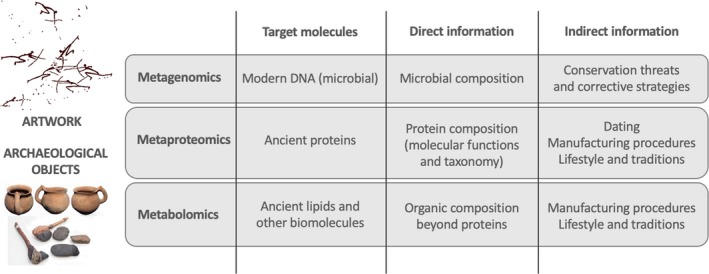
Summary: Multi‐omics can informally be described as the combined use of high‐throughput techniques allowing the characterization of complete microbial communities by the sequencing/identification of total pools of biomolecules including DNA , proteins or metabolites. These techniques have allowed an unprecedented level of knowledge on complex microbial ecosystems, which is having key implications in land and marine ecology, industrial biotechnology or biomedicine. Multi‐omics have recently been applied to artistic or archaeological objects, with the goal of either contributing to shedding light on the original context of the pieces and/or to inform conservation approaches. In this minireview, we discuss the application of ‐omic techniques to the study of prehistoric artworks and ancient man‐made objects in three main technical blocks: metagenomics, proteomics and metabolomics. In particular, we will focus on how proteomics and metabolomics can provide paradigm‐breaking results by unambiguously identifying peptides associated with a given, palaeo‐cultural context; and we will discuss how metagenomics can be central for the identification of the microbial keyplayers on artworks surfaces, whose conservation can then be approached by a range of techniques, including using selected microorganisms as ‘probiotics’ because of their direct or indirect effect in the stabilization and preservation of valuable art objects.
Overview
The claims and statistics of this paper haven’t been checked yet.
Run the check — free, no account needed. It reads the open-access text and checks the sources it cites.
Integrity signals
Registry
Cites
Statistics
Figures
Verification
Claims the paper makes
The claims and statistics of this paper haven’t been checked yet.
Run the check — free, no account needed. It reads the open-access text and checks the sources it cites.
Claims other papers make about this one
Each is checked against this paper’s own text: does it say what the citing paper says it does?
The cited source says what the claim attributes to it.
In the citing paper
“Indeed, mass spectrometry-based proteomics has already been used in a multi-omics approach to analyze artifacts [17], archaeological clay matrices [18], and ancient food [19-21].”
From Metaproteomic analysis of King Ghezo tomb wall (Abomey, Benin) confirms 19th century voodoo sacrifices (2024) · cites this paper as [17]
Self-check
Percentages, sums and reported differences re-computed from the paper’s own numbers.
The self-check needs the paper’s full text.
Citations
Cites
Evershed, R. P., Heron, C., & Goad, L. J. (1990) · The Analyst · doi:10.1039/an9901501339 · Cited by 316
Chemistry of Archaeological Animal Fats
Evershed, R. P., Dudd, S. N., Copley, M. S., Berstan, R., Stott, A. W., Mottram, H., Buckley, S. A., & Crossman, Z. (2002) · Accounts of Chemical Research · doi:10.1021/ar000200f · Cited by 303
Earliest evidence for the use of pottery
Craig, O. E., Saul, H., Lucquin, A., Nishida, Y., Taché, K., Clarke, L., Thompson, A., Altoft, D. T., Uchiyama, J., Ajimoto, M., et al. (2013) · Nature · doi:10.1038/nature12109 · Cited by 302
Cappellini, E., Jensen, L. J., Szklarczyk, D., Ginolhac, A., da Fonseca, R. R., Stafford, T. W., Holen, S. R., Collins, M. J., Orlando, L., Willerslev, E., et al. (2011) · Journal of Proteome Research · doi:10.1021/pr200721u · Cited by 243
Andreotti, A., Bonaduce, I., Colombini, M. P., Gautier, G., Modugno, F., & Ribechini, E. (2006) · Analytical Chemistry · doi:10.1021/ac0519615 · Cited by 198
Evidence of cacao use in the Prehispanic American Southwest
Crown, P. L., & Hurst, W. J. (2009) · Proceedings of the National Academy of Sciences · doi:10.1073/pnas.0812817106 · Cited by 170
A multi-omic future for microbiome studies
Jansson, J. K., & Baker, E. S. (2016) · Nature Microbiology · doi:10.1038/nmicrobiol.2016.49 · Cited by 170
Ancient proteins from ceramic vessels at Çatalhöyük West reveal the hidden cuisine of early farmers
Hendy, J., Colonese, A. C., Franz, I., Fernandes, R., Fischer, R., Orton, D., Lucquin, A., Spindler, L., Anvari, J., Stroud, E., et al. (2018) · Nature Communications · doi:10.1038/s41467-018-06335-6 · Cited by 159
Altamira cave Paleolithic paintings harbor partly unknown bacterial communities
Schabereiter‐Gurtner, C., Sáiz‐Jiménez, C., Piñar, G., Lubitz, W., & Rölleke, S. (2002) · FEMS Microbiology Letters · doi:10.1016/s0378-1097(02)00668-7 · Cited by 153
Discovering Childhood: Using Fingerprints to Find Children in the Archaeological Record
Kamp, K. A., Timmerman, N., Lind, G., et al. (1999) · American Antiquity · doi:10.2307/2694281 · Cited by 150
Lucquin, A., Gibbs, K., Uchiyama, J., Saul, H., Ajimoto, M., Eley, Y., Radini, A., Heron, C. P., Shoda, S., Nishida, Y., et al. (2016) · Proceedings of the National Academy of Sciences · doi:10.1073/pnas.1522908113 · Cited by 130
Assessing the Extent of Bone Degradation Using Glutamine Deamidation in Collagen
Wilson, J., van Doorn, N. L., & Collins, M. J. (2012) · Analytical Chemistry · doi:10.1021/ac301333t · Cited by 126
Glutamine deamidation: an indicator of antiquity, or preservational quality?
Schroeter, E. R., & Cleland, T. P. (2016) · Rapid Communications in Mass Spectrometry · doi:10.1002/rcm.7445 · Cited by 118
Portillo, M. C., Grau, J. M. G., & Sáiz‐Jiménez, C. (2007) · Journal of Applied Microbiology · doi:10.1111/j.1365-2672.2007.03594.x · Cited by 113
A Milk and Ochre Paint Mixture Used 49,000 Years Ago at Sibudu, South Africa
Villa, P., Pollarolo, L., Degano, I., Birolo, L., Pasero, M., Biagioni, C., Douka, K., Vinciguerra, R., Łucejko, J. J., & Wadley, L. (2015) · PLoS ONE · doi:10.1371/journal.pone.0131273 · Cited by 103
Isolation of five Rubrobacter strains from biodeteriorated monuments
Trobajo, L. L., Miller, A. Z., Jurado, V., Akatova, E. V., Moral, S. S., Grau, J. M. G., Dionísio, A., Macedo, M. F., & Sáiz‐Jiménez, C. (2008) · Die Naturwissenschaften · doi:10.1007/s00114-008-0452-2 · Cited by 102
Prehistoric Children Working and Playing: A Southwestern Case Study in Learning Ceramics
Kamp, K. A. (2001) · Journal of Anthropological Research · doi:10.1086/jar.57.4.3631354 · Cited by 99
Theory, Sampling, and Analytical Techniques in the Archaeological Study of Prehistoric Ceramics
Neff, H. (1993) · American Antiquity · doi:10.1017/s0002731600056079 · Cited by 90
Brandt, L. Ø., Schmidt, A. L., Mannering, U., Sarret, M., Kelstrup, C. D., Olsen, J. V., & Cappellini, E. (2014) · PLoS ONE · doi:10.1371/journal.pone.0106875 · Cited by 89
Detection of palm fruit lipids in archaeological pottery from Qasr Ibrim, Egyptian Nubia
Copley, M. S., Rose, P. J., Clapham, A., Edwards, D. N., Horton, M. C., & Evershed, R. P. (2001) · Proceedings of the Royal Society of London. Series B: Biological Sciences · doi:10.1098/rspb.2000.1394 · Cited by 82
Vilanova, C., & Porcar, M. (2016) · Nature Microbiology · doi:10.1038/nmicrobiol.2016.101 · Cited by 82
Self-citationSix novel Arthrobacter species isolated from deteriorated mural paintings
Heyrman, J., Verbeeren, J., Schümann, P., Swings, J., & Vos, P. D. (2005) · INTERNATIONAL JOURNAL OF SYSTEMATIC AND EVOLUTIONARY MICROBIOLOGY · doi:10.1099/ijs.0.63358-0 · Cited by 81
The Actinobacterial Colonization of Etruscan Paintings
Diaz-Herraiz, M., Jurado, V., Cuezva, S., Laiz, L., Pallecchi, P., Tiano, P., Moral, S. S., & Sáiz‐Jiménez, C. (2013) · Scientific Reports · doi:10.1038/srep01440 · Cited by 80
Malainey, M. E., Przybylski, R., & Sherriff, B. L. (1999) · Journal of Archaeological Science · doi:10.1006/jasc.1998.0306 · Cited by 79
Biomolecular Evidence of Silk from 8,500 Years Ago
Gong, Y., Li, L., Gong, D., Yin, H., & Zhang, J. (2016) · PLOS ONE · doi:10.1371/journal.pone.0168042 · Cited by 75
The earliest directly dated rock paintings from southern Africa: new AMS radiocarbon dates
Bonneau, A., Pearce, D. G., Mitchell, P. J., Staff, R. A., Arthur, C. K., Mallen, L., Brock, F., & Higham, T. (2017) · Antiquity · doi:10.15184/aqy.2016.271 · Cited by 72
Caselli, E., Pancaldi, S., Baldisserotto, C., Petrucci, F. C., Impallaria, A., Volpe, L., D’Accolti, M., Soffritti, I., Coccagna, M., Sassu, G., et al. (2018) · PLoS ONE · doi:10.1371/journal.pone.0207630 · Cited by 64
How old are Australia's pictographs? A review of rock art dating
David, B., Geneste, J., Petchey, F., Delannoy, J., Barker, B., & Eccleston, M. (2012) · Journal of Archaeological Science · doi:10.1016/j.jas.2012.08.019 · Cited by 58
GC/MS ANALYSIS OF FATTY ACIDS FROM ANCIENT HEARTH RESIDUES AT THE SWAN POINT ARCHAEOLOGICAL SITE*
Kedrowski, B. L., Crass, B. A., Behm, J. A., LUETKE, J. C., NICHOLS, A. L., MORECK, A. M., & Holmes, C. E. (2008) · Archaeometry · doi:10.1111/j.1475-4754.2008.00384.x · Cited by 57
Identification of Milk Component in Ancient Food Residue by Proteomics
Hong, C., Jiang, H., Lü, E., Wu, Y., Guo, L., Xie, Y., Wang, C., & Yang, Y. (2012) · PLoS ONE · doi:10.1371/journal.pone.0037053 · Cited by 54
The microbial community characteristics of ancient painted sculptures in Maijishan Grottoes, China
Duan, Y., Wu, F., Wang, W., He, D., Gu, J., Feng, H., Chen, T., Liu, G., & An, L. (2017) · PLoS ONE · doi:10.1371/journal.pone.0179718 · Cited by 50
Modeling Deamidation in Sheep α-Keratin Peptides and Application to Archeological Wool Textiles
Solazzo, C., Wilson, J., Dyer, J. M., Clerens, S., Plowman, J. E., von Holstein, I., Walton Rogers, P., Peacock, E. E., & Collins, M. J. (2014) · Analytical Chemistry · doi:10.1021/ac4026362 · Cited by 49
Olasz, J., Seidenberg, V., Hummel, S., Szentirmay, Z., Szabados, G., Melegh, B., & Kásler, M. (2018) · Archaeological and Anthropological Sciences · doi:10.1007/s12520-018-0609-7 · Cited by 49
Solazzo, C., Courel, B., Connan, J., van Dongen, B. E., Barden, H. E., Penkman, K. E. H., Taylor, S. M., Demarchi, B., Adam, P., Schaeffer, P., et al. (2016) · Scientific Reports · doi:10.1038/srep31053 · Cited by 47
Lluveras‐Tenorio, A., Vinciguerra, R., Galano, E., Blaensdorf, C., Emmerling, E., Colombini, M. P., Birolo, L., & Bonaduce, I. (2017) · PLoS ONE · doi:10.1371/journal.pone.0172990 · Cited by 40
Pepe, O., Palomba, S., Sannino, L., Blaiotta, G., Ventorino, V., Moschetti, G., & Villani, F. (2011) · PubMed · Cited by 36
Proteomic and metagenomic insights into prehistoric Spanish Levantine Rock Art
García, C. R., Murcia‐Mascarós, S., López-Montalvo, E., Vilanova, C., & Porcar, M. (2018) · Scientific Reports · doi:10.1038/s41598-018-28121-6 · Cited by 35
Self-citationReiche, I., Müller, K., Staude, A., Goebbels, J., & Riesemeier, H. (2011) · Journal of Analytical Atomic Spectrometry · doi:10.1039/c0ja00246a · Cited by 32
Liu, M., Xie, J., Zheng, H., Zhou, Y., Wang, B., & Hu, Z. (2015) · Analytical Sciences · doi:10.2116/analsci.31.1317 · Cited by 29
Immunological Detection of Albumin in Ancient Human Cremations using ELISA and Monoclonal Antibodies
Cattaneo, C., Gelsthorpe, K., Sokol, R. J., & Phillips, P. (1994) · Journal of Archaeological Science · doi:10.1006/jasc.1994.1055 · Cited by 27
Connecting phenome to genome in Pseudomonas stutzeri 5190: an artwork biocleaning bacterium
Bosch-Roig, P., Decorosi, F., Giovannetti, L., Ranalli, G., & Viti, C. (2016) · Research in Microbiology · doi:10.1016/j.resmic.2016.09.003 · Cited by 26
Polyphasic insights into the microbiomes of the Takamatsuzuka Tumulus and Kitora Tumulus
Sugiyama, J., Kiyuna, T., Nishijima, M., An, K.-D., Nagatsuka, Y., Tazato, N., Handa, Y., Hata-Tomita, J., Sato, Y., Kigawa, R., et al. (2017) · The Journal of General and Applied Microbiology · doi:10.2323/jgam.2017.01.007 · Cited by 26
Handa, Y., Tazato, N., Nagatsuka, Y., Koide, T., Kigawa, R., Sano, C., & Sugiyama, J. (2015) · INTERNATIONAL JOURNAL OF SYSTEMATIC AND EVOLUTIONARY MICROBIOLOGY · doi:10.1099/ijsem.0.000843 · Cited by 24
Soil proteomics: An assessment of its potential for archaeological site interpretation
Oonk, S., Cappellini, E., & Collins, M. J. (2012) · Organic Geochemistry · doi:10.1016/j.orggeochem.2012.06.012 · Cited by 23
Shevchenko, A., Schuhmann, A., Thomas, H., & Wetzel, G. (2018) · PLoS ONE · doi:10.1371/journal.pone.0206483 · Cited by 23
ElHagrassy, A. (2018) · Microbiological Research · doi:10.1016/j.micres.2018.08.005 · Cited by 22
Paenibacillus sepulcri sp. nov., isolated from biodeteriorated mural paintings in the Servilia tomb
Šmerda, J., Sedláček, I., Páčová, Z., Krejčí, E., & Havel, L. (2006) · INTERNATIONAL JOURNAL OF SYSTEMATIC AND EVOLUTIONARY MICROBIOLOGY · doi:10.1099/ijs.0.64280-0 · Cited by 15
Myroides guanonis sp. nov., isolated from prehistoric paintings
Tomova, I., Tomova, I., Vasileva−Tonkova, E., Lazarkevich, I., Stoilova-Disheva, M. M., Lyutskanova, D., & Kambourova, M. S. (2013) · INTERNATIONAL JOURNAL OF SYSTEMATIC AND EVOLUTIONARY MICROBIOLOGY · doi:10.1099/ijs.0.050831-0 · Cited by 13
STR-typing of ancient skeletal remains: which multiplex-PCR kit is the best?
Harder, M., Renneberg, R., Meyer, P., Krause‐Kyora, B., & von Wurmb‐Schwark, N. (2012) · Croatian Medical Journal · doi:10.3325/cmj.2012.53.416 · Cited by 13
Wang, B., Gu, J., Chen, B., Xu, C., Zheng, H., Peng, Z., Zhou, Y., & Hu, Z. (2018) · Journal of Analytical Methods in Chemistry · doi:10.1155/2018/2641624 · Cited by 10
In Search of Lost Time. Dating Methods for Prehistoric Art: the Example of Aurignacian Sites
Sauvet, G. (2015) · Palethnologie · doi:10.4000/palethnologie.823 · Cited by 4
Cited by
Warinner, C., Korzow Richter, K., & Collins, M. J. (2022) · Chemical Reviews · doi:10.1021/acs.chemrev.1c00703 · Cited by 178
Charlier, P., Bourdin, V., N'Dah, D., Kielbasa, M., Pible, O., & Armengaud, J. (2024) · PROTEOMICS · doi:10.1002/pmic.202400048 · Cited by 8
Metadata
- Authors
- Vilanova, C., & Porcar, M.
- Affiliations
- Darwin Bioprospecting Excellence SL Catedrático Agustín Escardino, 9 46980 Paterna Spain
- ORCID
- Porcar, Manuel
- Venue
- Microbial Biotechnology
- Publisher
- Wiley
- Published
- 2019-08-27
- Volume
- 13
- Issue
- 2
- Pages
- 435-441
- ISSN
- 1751-7915
- PMC
- PMC7017809
- Cited by
- 17
- References
- 52
- Language
- en
About these checks
Registry, retraction, Cites and statistics results are computed, not judged, with one exception: a printed reference that no index lists is read once by a model before it counts as a citation error. Claims are extracted by a model and kept only when their quote appears verbatim in the text; each cited source is then checked, with a model’s help, for whether it says what the claim relies on. Those verdicts can be wrong — read the claim’s quote and the cited source before relying on one.
Statistics and arithmetic are recomputed, not judged.
Confidence bands are shown only for fields calibrated on our annotated test set. None is calibrated yet, so no band is shown.
What counts as a claim ›How we measure confidence ›How we check this ›
Are you an author, or do you see a problem with this page? Request a review
Data sources
Bibliographic data: Semantic Scholar, OpenAlex, Crossref.
Contains information from the Semantic Scholar Academic Graph Datasets, made available under the ODC Attribution License (ODC-BY 1.0).
Semantic Scholar’s data is described in: Kinney, R., et al. (2023). The Semantic Scholar Open Data Platform. arXiv:2301.10140.
