

Prenatal daily musical exposure is associated with enhanced neural representation of speech fundamental frequency: Evidence from neonatal frequency‐following responses
Open accessThe DOI matches its Crossref record; 112 of the 112 references it cites were found in a registry or an index; none of the 80 sources its claims cite is checked for support yet.
Abstract
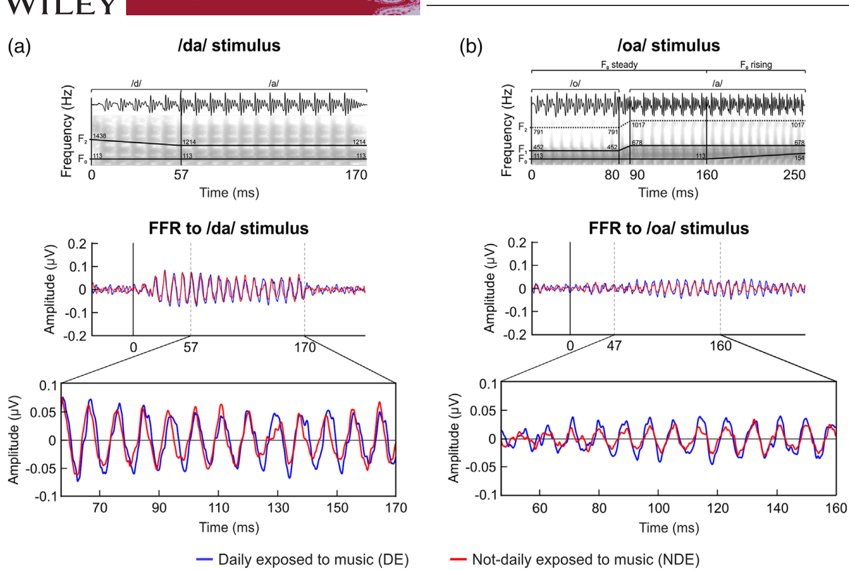
Fetal hearing experiences shape the linguistic and musical preferences of neonates. From the very first moment after birth, newborns prefer their native language, recognize their mother's voice, and show a greater responsiveness to lullabies presented during pregnancy. Yet, the neural underpinnings of this experience inducing plasticity have remained elusive. Here we recorded the frequency‐following response (FFR), an auditory evoked potential elicited to periodic complex sounds, to show that prenatal music exposure is associated to enhanced neural encoding of speech stimuli periodicity, which relates to the perceptual experience of pitch. FFRs were recorded in a sample of 60 healthy neonates born at term and aged 12–72 hours. The sample was divided into two groups according to their prenatal musical exposure (29 daily musically exposed; 31 not‐daily musically exposed). Prenatal exposure was assessed retrospectively by a questionnaire in which mothers reported how often they sang or listened to music through loudspeakers during the last trimester of pregnancy. The FFR was recorded to either a /da/ or an /oa/ speech‐syllable stimulus. Analyses were centered on stimuli sections of identical duration (113 ms) and fundamental frequency (F 0 = 113 Hz). Neural encoding of stimuli periodicity was quantified as the FFR spectral amplitude at the stimulus F 0 . Data revealed that newborns exposed daily to music exhibit larger spectral amplitudes at F 0 as compared to not‐daily musically‐exposed newborns, regardless of the eliciting stimulus. Our results suggest that prenatal music exposure facilitates the tuning to human speech fundamental frequency, which may support early language processing and acquisition. Research Highlights: Frequency‐following responses to speech were collected from a sample of neonates prenatally exposed to music daily and compared to neonates not‐daily exposed to music. Neonates who experienced daily prenatal music exposure exhibit enhanced frequency‐following responses to the periodicity of speech sounds. Prenatal music exposure is associated with a fine‐tuned encoding of human speech fundamental frequency, which may facilitate early language processing and acquisition.
Overview
CoChat Summary
TL;DR
In 60 healthy term neonates, daily prenatal music exposure was associated with larger frequency-following response (FFR) spectral amplitude at the speech fundamental frequency (113 Hz) than not-daily exposure. This suggests prenatal music may tune neural encoding of speech pitch, though causal and exposure-specific mechanisms remain unresolved.
Key findings
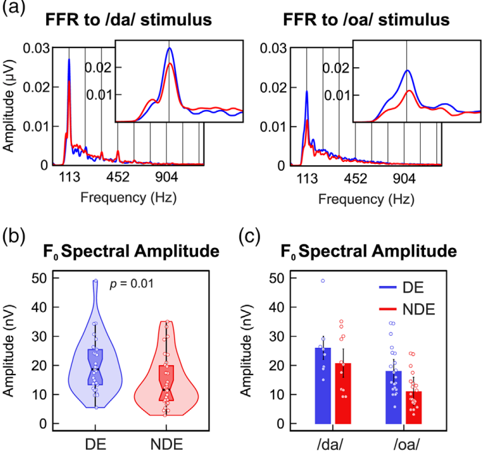
- Newborns exposed daily to music during the last trimester (n = 29) showed larger F0 spectral amplitude than not-daily exposed newborns (n = 31): U = 275.000, p = 0.010, Cohen’s d = 0.707; ANOVA Group effect F = 6.750, p = 0.012, η²p = 0.108.
- The group effect held regardless of eliciting speech stimulus (/da/ vs. /oa/): no Group × Stimulus interaction (F = 0.132, p = 0.718, η²p = 0.002), although /da/ elicited larger F0 amplitudes than /oa/ overall (F = 14.152, p < 0.001, η²p = 0.202).
- No significant group differences were found in auditory transmission or background measures: ABR wave V latency (U = 347.000, p = 0.129, d = 0.400), wave V amplitude (U = 329.000, p = 0.075, d = 0.473), FFR neural lag (t(58) = 0.459, p = 0.648, d = 0.119), or pre-stimulus RMS (U = 356.000, p = 0.167, d = 0.363).
- After excluding one DE outlier, the parametric ANOVA Group effect became marginal (F = 3.919, p = 0.053, η²p = 0.067), while the non-parametric Group effect remained significant (U = 275.000, p = 0.016, d = 0.587).
Methods
- Cross-sectional group comparison of 60 healthy term neonates aged 12–72 hours, recruited at SJD Barcelona Children’s Hospital; 29 were classified as daily musically exposed (DE) and 31 as not-daily exposed (NDE) based on a maternal retrospective questionnaire about singing or listening to music through loudspeakers during the last trimester.
- FFRs were recorded while newborns slept, elicited by either a /da/ or /oa/ speech syllable; analyses focused on 113-ms sections with identical fundamental frequency (F0 = 113 Hz), with the primary measure being FFR spectral amplitude at F0. ABR wave V, neural lag, and pre-stimulus RMS were also computed.
- Group comparisons used two-tailed independent-samples t-tests or Mann–Whitney U tests, plus a univariate ANOVA with Group as a fixed factor and Stimulus as a random factor; significance was set at p < 0.05.
Limitations
- The paper states that prenatal musical exposure was assessed retrospectively at delivery via a short questionnaire using closed categories (daily, weekly, etc.) rather than continuous reporting; it did not capture exact daily amount or intensity of music reaching the womb, nor speech exposure or whether speech was directed to the fetus. The small sample also precluded analysis of musical genre, and the cross-sectional design cannot establish causality.
- The paper states alternative explanations: reduced maternal/fetal stress from music could induce neuroplastic changes, and heritable musical abilities could partly explain the findings.
- Evident from the text: group assignment relied on maternal report with no randomized or controlled exposure, the sample came from a single hospital, and the parametric Group effect became marginal after excluding one DE outlier, so the result should be interpreted cautiously.
Model-written summary. Check it against the paper before relying on it.
Integrity signals
Registry
Cites
Statistics
Figures

Verification
Claims the paper makes
0 Valid · 0 Not valid · 41 Not checked · 34 Own results and interpretations
A result the paper reports from its own data — it cites no other source for it, so there is none to check. The quote shows it is in the paper.
In the paper
“Moreover, no significant differences between groups were found in auditory neural transmission time measures, such as wave V latency or neural lag.”
- Also stated in: § 4 DISCUSSION · plain
“auditory neural transmission time measures did not differ across groups, as evidenced by ABR wave V latencies and the FFR neural lag.”
§ Prenatal daily musical exposure is associated with enhanced neural representation of speech fundamental frequency: Evidence from neonatal frequency-following responses > 4 DISCUSSION
plain- Asserted: passes — The authors put it forward as true.
- Checkable: passes — It can be checked against evidence.
- Load-bearing: passes — The paper’s conclusions depend on it.
- Based: passes — The paper gives a reason why it holds.
- Also stated in: § 4 DISCUSSION · plain
A result the paper reports from its own data — it cites no other source for it, so there is none to check. The quote shows it is in the paper.
In the paper
“Data revealed that newborns exposed daily to music exhibit larger spectral amplitudes at F 0 as compared to not-daily musically-exposed newborns, regardless of the eliciting stimulus.”
§ Prenatal daily musical exposure is associated with enhanced neural representation of speech fundamental frequency: Evidence from neonatal frequency-following responses > Abstract
plainstates an association- Asserted: passes — The authors put it forward as true.
- Checkable: passes — It can be checked against evidence.
- Load-bearing: passes — The paper’s conclusions depend on it.
- Based: passes — The paper gives a reason why it holds.
- Rests on 3 assumptions not shown here.
A result the paper reports from its own data — it cites no other source for it, so there is none to check. The quote shows it is in the paper.
In the paper
“A significant main effect of Stimulus was also observed, caused by a larger spectral amplitude to the /da/ stimulus as compared to the /oa/ (F = 14.152, p < 0.001, η 2 p = 0.202).”
- Also stated in: § 5 CONCLUSION · plain
“Albeit FFR spectral amplitudes were different across stimuli, with the /da/ stimulus yielding overall higher spectral amplitudes at F 0 than the /oa/ stimulus”
§ Prenatal daily musical exposure is associated with enhanced neural representation of speech fundamental frequency: Evidence from neonatal frequency-following responses > Spectral amplitude at F 0 . Spectral representation of the neonatal FFR
plainstates an association- Asserted: passes — The authors put it forward as true.
- Checkable: passes — It can be checked against evidence.
- Load-bearing: unclear — It is unclear whether the paper’s conclusions depend on it.
- Based: passes — The paper gives a reason why it holds.
- Also stated in: § 5 CONCLUSION · plain
A result the paper reports from its own data — it cites no other source for it, so there is none to check. The quote shows it is in the paper.
In the paper
“we found no differences across groups segregated by musical exposure in background neural activity, as measured by pre-stimulus RMS amplitudes.”
§ Prenatal daily musical exposure is associated with enhanced neural representation of speech fundamental frequency: Evidence from neonatal frequency-following responses > 4 DISCUSSION
plain- Asserted: passes — The authors put it forward as true.
- Checkable: passes — It can be checked against evidence.
- Load-bearing: passes — The paper’s conclusions depend on it.
- Based: passes — The paper gives a reason why it holds.
A result the paper reports from its own data — it cites no other source for it, so there is none to check. The quote shows it is in the paper.
In the paper
“newborns exposed daily to music during the last trimester of pregnancy exhibited a larger spectral amplitude at the stimulus F 0 as compared to the less exposed group (U = 275.000,p = 0.010, Cohen's d = 0.707).”
- Also stated in: § Spectral amplitude at F 0 . Spectral representation of the neonatal FFR · plain
“A main effect of Group revealed significantly greater spectral amplitudes at stimulus F 0 for the DE newborns (F = 6.750, p = 0.012, η 2 p = 0.108).”
- Also stated in: § Spectral amplitude at F 0 . Spectral representation of the neonatal FFR · plain
“our data reveals that newborns exposed to music on a daily basis during the last trimester of pregnancy show a greater magnitude of neural phase-locking to speech stimuli F 0 than not-daily exposed neonates.”
§ Prenatal daily musical exposure is associated with enhanced neural representation of speech fundamental frequency: Evidence from neonatal frequency-following responses > Spectral amplitude at F 0 . Spectral representation of the neonatal FFR
plainstates an association- Asserted: passes — The authors put it forward as true.
- Checkable: passes — It can be checked against evidence.
- Load-bearing: passes — The paper’s conclusions depend on it.
- Based: passes — The paper gives a reason why it holds.
- Rests on an assumption not shown here.
- Also stated in: § Spectral amplitude at F 0 . Spectral representation of the neonatal FFR · plain
21 more claims
Create a free account to see all 75 claims and to verify the 65 references still open.
- It may state two separate claims as one. 23
- Probably not a substantial claim. 40
Statistics recomputed
Every reported test result, recomputed from its test statistic and degrees of freedom. A result shows as not adding up only once an independent check has confirmed it.
- Consistentt(58) = -0.307reported p = .76 · recomputed p = .760
“t (58) = -0.307,p = .760”
- Consistentt(58) = -0.525reported p = .602 · recomputed p = .602
“t (58) = -0.525,p = .602”
- Consistentχ²(2) = 0.229reported p = .892 · recomputed p = .892
“χ 2 (2) = 0.229, p = .892”
- Consistentχ²(2) = 2.092reported p = .351 · recomputed p = .351
“χ 2 (2) = 2.092, p = .351”
- Consistentt(58) = 0.459reported p = .648 · recomputed p = .648
“t (58) = 0.459, p = .648”
Self-check
Percentages, sums and reported differences re-computed from the paper’s own numbers.
Each contradiction between two passages listed here was confirmed by an independent check.
Rated minor: it would not touch a result — a value no result rests on, a p-value that stays on the same side of the significance level, or a conflict that is clerical, resolved elsewhere in the paper, or outside its own findings.
In the paper
§ Prenatal daily musical exposure is associated with enhanced neural representation of speech fundamental frequency: Evidence from neonatal frequency-following responses > 5 CONCLUSION
“/a/ rising section = 160-250 ms, F 0 = 113-154 ms, F 1 = 678 Hz”
§ Prenatal daily musical exposure is associated with enhanced neural representation of speech fundamental frequency: Evidence from neonatal frequency-following responses > 5 CONCLUSION
“F 0 was kept steady at 113 Hz during the first part of the stimulus (0-160 ms) and increased linearly until 154 Hz (160-250 ms).”
Citations
Cites
An algorithm for the machine calculation of complex Fourier series
Cooley, J. W., & Tukey, J. W. (1965) · Mathematics of Computation · doi:10.1090/s0025-5718-1965-0178586-1 · Cited by 13,154
Of Human Bonding: Newborns Prefer Their Mothers' Voices
DeCasper, A. J., & Fifer, W. P. (1980) · Science · doi:10.1126/science.7375928 · Cited by 2,317
Software for a cascade/parallel formant synthesizer
Klatt, D. H. (1980) · The Journal of the Acoustical Society of America · doi:10.1121/1.383940 · Cited by 1,583
Joint Committee on Infant Hearing, American Academy of Audiology, American Academy of Pediatrics, American Speech-Language-Hearing Association, & Agencies, D. O. S. A. H. P. I. S. H. A. W. (2000) · Pediatrics · doi:10.1542/peds.106.4.798 · Cited by 1,282
Music training for the development of auditory skills
Kraus, N., & Chandrasekaran, B. (2010) · Nature Reviews Neuroscience · doi:10.1038/nrn2882 · Cited by 1,115
Prenatal maternal speech influences newborns' perception of speech sounds
DeCasper, A. J., & Spence, M. J. (1986) · Infant Behavior and Development · doi:10.1016/0163-6383(86)90025-1 · Cited by 1,094
Imaging structural and functional brain development in early childhood
Gilmore, J. H., Knickmeyer, R. C., & Gao, W. (2018) · Nature Reviews Neuroscience · doi:10.1038/nrn.2018.1 · Cited by 1,013
Musical experience shapes human brainstem encoding of linguistic pitch patterns
Wong, P. C. M., Skoe, E., Russo, N. M., Dees, T., & Kraus, N. (2007) · Nature Neuroscience · doi:10.1038/nn1872 · Cited by 954
Acoustic determinants of infant preference for motherese speech
Fernald, A., & Kuhl, P. (1987) · Infant Behavior and Development · doi:10.1016/0163-6383(87)90017-8 · Cited by 818
Auditory Brain Stem Response to Complex Sounds: A Tutorial
Skoe, E., & Kraus, N. (2010) · Ear & Hearing · doi:10.1097/aud.0b013e3181cdb272 · Cited by 775
Research works printed but not linked: 1
- Schön, D., Magne, C., & Besson, M. (2004). The music of speech: Music training facilitates pitch processing in both music and language. Psy- chophysiology, 41, 341-349. https://doi.org/10.1111/1469-8986.00172. · doi:10.1111/1469-8986.00172
Cited by
The neuroscience of music – towards ecological validity
Tervaniemi, M. H. (2023) · Trends in Neurosciences · doi:10.1016/j.tins.2023.03.001 · Cited by 55
Prerequisites of language acquisition in the newborn brain
Kujala, T., Partanen, E., Virtala, P., & Winkler, I. (2023) · Trends in Neurosciences · doi:10.1016/j.tins.2023.05.011 · Cited by 48
Saadatmehr, B., Edalati, M., Wallois, F., Ghostine, G., Kongolo, G., Flaten, E., Tillmann, B., Trainor, L. J., & Moghimi, S. (2024) · Journal of Neuroscience · doi:10.1523/jneurosci.0398-24.2024 · Cited by 31
Papatzikis, E., Agapaki, M., Selvan, R. N., Hanson-Abromeit, D., Gold, C., Epstein, S., Lok, U. W. V., Barda, E., & Pandey, V. (2024) · BMC Pediatrics · doi:10.1186/s12887-024-05275-z · Cited by 16
“Studies on passive music listening have shown improvements in physiological responses and sleep [6, 11, 26, 37], while research on active music engagement has demonstrated benefits in cognitive, motor, and social-emotional development [3, 5, 13, 43, 14, 21].”
Arenillas‐Alcón, S., Gorina-Careta, N., Puertollano, M., Mondéjar‐Segovia, A., Ijjou-Kadiri, S., Costa‐Faidella, J., Gómez‐Roig, M. D., & Escera, C. (2024) · Frontiers in Human Neuroscience · doi:10.3389/fnhum.2024.1379660 · Cited by 14
Self-citation
Metadata
- Authors
- Arenillas‐Alcón, S., Ribas‐Prats, T., Puertollano, M., Mondéjar‐Segovia, A., Gómez‐Roig, M. D., Costa‐Faidella, J., & Escera, C.
- Affiliations
- Institut de Recerca Sant Joan de Déu (ES)
- Universitat de Barcelona (ES)
- Hospital Sant Joan de Déu Barcelona (ES)
- Corresponding author
- Costa‐Faidella, Jordi
- Escera, Carles
- ORCID
- Venue
- Developmental Science
- Publisher
- Wiley
- Published
- 2023-01-05
- Volume
- 26
- Issue
- 5
- Pages
- e13362-e13362
- ISSN
- 1363-755X (ISSN-L)
- 1467-7687
- OpenAlex
- W4312113623
- Cited by
- 40
- References
- 112
- Citations by year
- 2026: 12 · 2025: 10 · 2024: 13 · 2023: 5
- FWCI
- 4.03
- Type
- journal article
- Language
- en
- Open access
- hybrid
- doi.org
- Licence
- Locations
- Developmental Science (publishedVersion, cc-by-nc-nd)
- PubMed (publishedVersion)
- Dipòsit Digital de la Universitat de Barcelona (Universitat de Barcelona) (publishedVersion, cc-by-nc-nd)
- RECERCAT (Consorci de Serveis Universitaris de Catalunya) (publishedVersion, cc-by-nc-nd)
- Funders
- Ministerio de Ciencia e Innovación (PGC2018‐094765‐B‐I00, MCIN/AEI/10.13039/501100011033/FEDER “UnamaneradehacerEuropa”)
- Topics
- Life Sciences › Neuroscience › Cognitive Neuroscience › Neuroscience and Music Perception
- Life Sciences › Neuroscience › Sensory Systems › Hearing, Cochlea, Tinnitus, Genetics
- Social Sciences › Psychology › Experimental and Cognitive Psychology › Phonetics and Phonology Research
- Keywords
- prenatal music exposure, fetal hearing, auditory plasticity, neonates
- MeSH terms
- Acoustic Stimulation, Auditory Perception, Humans, Infant, Newborn, Music, Retrospective Studies, Speech, Speech Perception
About these checks
Registry, retraction, Cites and statistics results are computed, not judged, with one exception: a printed reference that no index lists is read once by a model before it counts as a citation error. Claims are extracted by a model and kept only when their quote appears verbatim in the text; each cited source is then checked, with a model’s help, for whether it says what the claim relies on. Those verdicts can be wrong — read the claim’s quote and the cited source before relying on one.
A language model drew the claims from the paper on 2026-11-27, under version 3 of the claim definition (model deepseek-v4.1-flash, prompt extract-v3).
A second model labelled each claim on 2026-11-27 (model jev-1.13-20260917, definition revision gold-guideline-v0.2).
Statistics and arithmetic are recomputed, not judged.
Confidence bands are shown only for fields calibrated on our annotated test set. None is calibrated yet, so no band is shown.
What counts as a claim ›How we measure confidence ›How we check this ›
Are you an author, or do you see a problem with this page? Request a review
How to cite
Cite CoChat for the checks on this page, and the paper for its own findings.
- This page
- CoChat. (2026). Citation check: Prenatal daily musical exposure is associated with enhanced neural representation of speech fundamental frequency: Evidence from neonatal frequency‐following responses. https://app.cochat.ai/papers/10.1111/desc.13362
- The paper
- Arenillas‐Alcón, S., Ribas‐Prats, T., Puertollano, M., Mondéjar‐Segovia, A., Gómez‐Roig, M. D., Costa‐Faidella, J., & Escera, C. (2023). Prenatal daily musical exposure is associated with enhanced neural representation of speech fundamental frequency: Evidence from neonatal frequency‐following responses. Developmental Science. https://doi.org/10.1111/desc.13362
Data sources
Bibliographic data: Semantic Scholar, OpenAlex, Crossref.
Contains information from the Semantic Scholar Academic Graph Datasets, made available under the ODC Attribution License (ODC-BY 1.0).
Semantic Scholar’s data is described in: Kinney, R., et al. (2023). The Semantic Scholar Open Data Platform. arXiv:2301.10140.
