

Prenatal daily musical exposure is associated with enhanced neural representation of speech fundamental frequency: Evidence from neonatal frequency‐following responses
Open accessThe DOI matches its Crossref record; 112 of the 112 references it cites were found in a registry or an index; none of the 80 sources its claims cite is checked for support yet.
Abstract
Fetal hearing experiences shape the linguistic and musical preferences of neonates. From the very first moment after birth, newborns prefer their native language, recognize their mother's voice, and show a greater responsiveness to lullabies presented during pregnancy. Yet, the neural underpinnings of this experience inducing plasticity have remained elusive. Here we recorded the frequency‐following response (FFR), an auditory evoked potential elicited to periodic complex sounds, to show that prenatal music exposure is associated to enhanced neural encoding of speech stimuli periodicity, which relates to the perceptual experience of pitch. FFRs were recorded in a sample of 60 healthy neonates born at term and aged 12–72 hours. The sample was divided into two groups according to their prenatal musical exposure (29 daily musically exposed; 31 not‐daily musically exposed). Prenatal exposure was assessed retrospectively by a questionnaire in which mothers reported how often they sang or listened to music through loudspeakers during the last trimester of pregnancy. The FFR was recorded to either a /da/ or an /oa/ speech‐syllable stimulus. Analyses were centered on stimuli sections of identical duration (113 ms) and fundamental frequency (F 0 = 113 Hz). Neural encoding of stimuli periodicity was quantified as the FFR spectral amplitude at the stimulus F 0 . Data revealed that newborns exposed daily to music exhibit larger spectral amplitudes at F 0 as compared to not‐daily musically‐exposed newborns, regardless of the eliciting stimulus. Our results suggest that prenatal music exposure facilitates the tuning to human speech fundamental frequency, which may support early language processing and acquisition. Research Highlights: Frequency‐following responses to speech were collected from a sample of neonates prenatally exposed to music daily and compared to neonates not‐daily exposed to music. Neonates who experienced daily prenatal music exposure exhibit enhanced frequency‐following responses to the periodicity of speech sounds. Prenatal music exposure is associated with a fine‐tuned encoding of human speech fundamental frequency, which may facilitate early language processing and acquisition.
Overview
CoChat Summary
TL;DR
In 60 healthy term neonates, daily prenatal music exposure was associated with larger frequency-following response (FFR) spectral amplitude at the speech fundamental frequency (113 Hz) than not-daily exposure. This suggests prenatal music may tune neural encoding of speech pitch, though causal and exposure-specific mechanisms remain unresolved.
Key findings
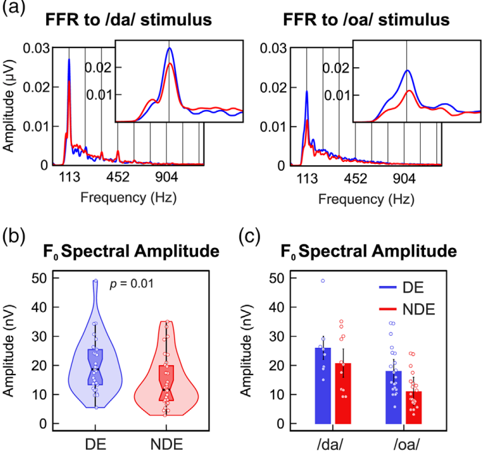
- Newborns exposed daily to music during the last trimester (n = 29) showed larger F0 spectral amplitude than not-daily exposed newborns (n = 31): U = 275.000, p = 0.010, Cohen’s d = 0.707; ANOVA Group effect F = 6.750, p = 0.012, η²p = 0.108.
- The group effect held regardless of eliciting speech stimulus (/da/ vs. /oa/): no Group × Stimulus interaction (F = 0.132, p = 0.718, η²p = 0.002), although /da/ elicited larger F0 amplitudes than /oa/ overall (F = 14.152, p < 0.001, η²p = 0.202).
- No significant group differences were found in auditory transmission or background measures: ABR wave V latency (U = 347.000, p = 0.129, d = 0.400), wave V amplitude (U = 329.000, p = 0.075, d = 0.473), FFR neural lag (t(58) = 0.459, p = 0.648, d = 0.119), or pre-stimulus RMS (U = 356.000, p = 0.167, d = 0.363).
- After excluding one DE outlier, the parametric ANOVA Group effect became marginal (F = 3.919, p = 0.053, η²p = 0.067), while the non-parametric Group effect remained significant (U = 275.000, p = 0.016, d = 0.587).
Methods
- Cross-sectional group comparison of 60 healthy term neonates aged 12–72 hours, recruited at SJD Barcelona Children’s Hospital; 29 were classified as daily musically exposed (DE) and 31 as not-daily exposed (NDE) based on a maternal retrospective questionnaire about singing or listening to music through loudspeakers during the last trimester.
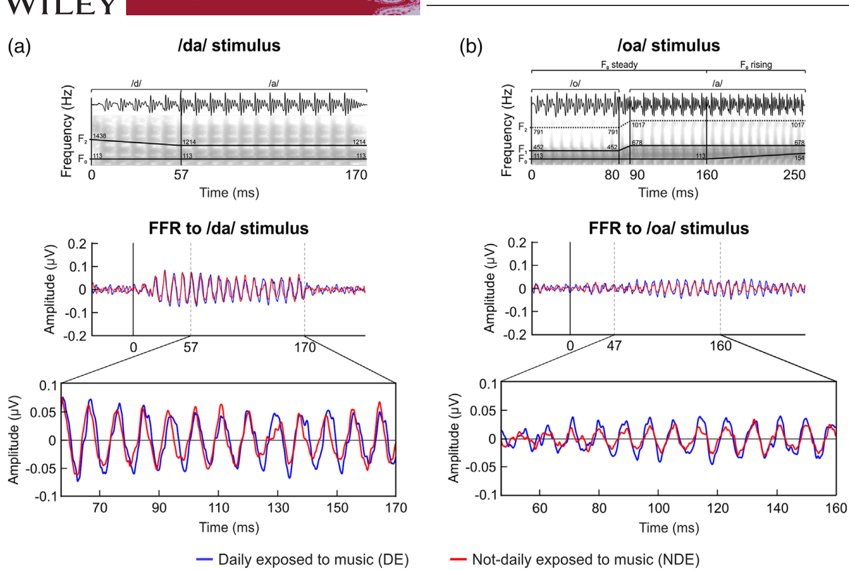
- FFRs were recorded while newborns slept, elicited by either a /da/ or /oa/ speech syllable; analyses focused on 113-ms sections with identical fundamental frequency (F0 = 113 Hz), with the primary measure being FFR spectral amplitude at F0. ABR wave V, neural lag, and pre-stimulus RMS were also computed.
- Group comparisons used two-tailed independent-samples t-tests or Mann–Whitney U tests, plus a univariate ANOVA with Group as a fixed factor and Stimulus as a random factor; significance was set at p < 0.05.
Limitations
- The paper states that prenatal musical exposure was assessed retrospectively at delivery via a short questionnaire using closed categories (daily, weekly, etc.) rather than continuous reporting; it did not capture exact daily amount or intensity of music reaching the womb, nor speech exposure or whether speech was directed to the fetus. The small sample also precluded analysis of musical genre, and the cross-sectional design cannot establish causality.
- The paper states alternative explanations: reduced maternal/fetal stress from music could induce neuroplastic changes, and heritable musical abilities could partly explain the findings.
- Evident from the text: group assignment relied on maternal report with no randomized or controlled exposure, the sample came from a single hospital, and the parametric Group effect became marginal after excluding one DE outlier, so the result should be interpreted cautiously.
Model-written summary. Check it against the paper before relying on it.
Integrity signals
Registry
Cites
Statistics
Figures

Verification
Claims the paper makes
0 Valid · 0 Not valid · 41 Not checked · 34 Own results and interpretations
A result the paper reports from its own data — it cites no other source for it, so there is none to check. The quote shows it is in the paper.
In the paper
“Moreover, no significant differences between groups were found in auditory neural transmission time measures, such as wave V latency or neural lag.”
- Also stated in: § 4 DISCUSSION · plain
“auditory neural transmission time measures did not differ across groups, as evidenced by ABR wave V latencies and the FFR neural lag.”
§ Prenatal daily musical exposure is associated with enhanced neural representation of speech fundamental frequency: Evidence from neonatal frequency-following responses > 4 DISCUSSION
plain- Asserted: passes — The authors put it forward as true.
- Checkable: passes — It can be checked against evidence.
- Load-bearing: passes — The paper’s conclusions depend on it.
- Based: passes — The paper gives a reason why it holds.
- Also stated in: § 4 DISCUSSION · plain
A result the paper reports from its own data — it cites no other source for it, so there is none to check. The quote shows it is in the paper.
In the paper
“Data revealed that newborns exposed daily to music exhibit larger spectral amplitudes at F 0 as compared to not-daily musically-exposed newborns, regardless of the eliciting stimulus.”
§ Prenatal daily musical exposure is associated with enhanced neural representation of speech fundamental frequency: Evidence from neonatal frequency-following responses > Abstract
plainstates an association- Asserted: passes — The authors put it forward as true.
- Checkable: passes — It can be checked against evidence.
- Load-bearing: passes — The paper’s conclusions depend on it.
- Based: passes — The paper gives a reason why it holds.
- Rests on 3 assumptions not shown here.
A result the paper reports from its own data — it cites no other source for it, so there is none to check. The quote shows it is in the paper.
In the paper
“A significant main effect of Stimulus was also observed, caused by a larger spectral amplitude to the /da/ stimulus as compared to the /oa/ (F = 14.152, p < 0.001, η 2 p = 0.202).”
- Also stated in: § 5 CONCLUSION · plain
“Albeit FFR spectral amplitudes were different across stimuli, with the /da/ stimulus yielding overall higher spectral amplitudes at F 0 than the /oa/ stimulus”
§ Prenatal daily musical exposure is associated with enhanced neural representation of speech fundamental frequency: Evidence from neonatal frequency-following responses > Spectral amplitude at F 0 . Spectral representation of the neonatal FFR
plainstates an association- Asserted: passes — The authors put it forward as true.
- Checkable: passes — It can be checked against evidence.
- Load-bearing: unclear — It is unclear whether the paper’s conclusions depend on it.
- Based: passes — The paper gives a reason why it holds.
- Also stated in: § 5 CONCLUSION · plain
A result the paper reports from its own data — it cites no other source for it, so there is none to check. The quote shows it is in the paper.
In the paper
“we found no differences across groups segregated by musical exposure in background neural activity, as measured by pre-stimulus RMS amplitudes.”
§ Prenatal daily musical exposure is associated with enhanced neural representation of speech fundamental frequency: Evidence from neonatal frequency-following responses > 4 DISCUSSION
plain- Asserted: passes — The authors put it forward as true.
- Checkable: passes — It can be checked against evidence.
- Load-bearing: passes — The paper’s conclusions depend on it.
- Based: passes — The paper gives a reason why it holds.
A result the paper reports from its own data — it cites no other source for it, so there is none to check. The quote shows it is in the paper.
In the paper
“newborns exposed daily to music during the last trimester of pregnancy exhibited a larger spectral amplitude at the stimulus F 0 as compared to the less exposed group (U = 275.000,p = 0.010, Cohen's d = 0.707).”
- Also stated in: § Spectral amplitude at F 0 . Spectral representation of the neonatal FFR · plain
“A main effect of Group revealed significantly greater spectral amplitudes at stimulus F 0 for the DE newborns (F = 6.750, p = 0.012, η 2 p = 0.108).”
- Also stated in: § Spectral amplitude at F 0 . Spectral representation of the neonatal FFR · plain
“our data reveals that newborns exposed to music on a daily basis during the last trimester of pregnancy show a greater magnitude of neural phase-locking to speech stimuli F 0 than not-daily exposed neonates.”
§ Prenatal daily musical exposure is associated with enhanced neural representation of speech fundamental frequency: Evidence from neonatal frequency-following responses > Spectral amplitude at F 0 . Spectral representation of the neonatal FFR
plainstates an association- Asserted: passes — The authors put it forward as true.
- Checkable: passes — It can be checked against evidence.
- Load-bearing: passes — The paper’s conclusions depend on it.
- Based: passes — The paper gives a reason why it holds.
- Rests on an assumption not shown here.
- Also stated in: § Spectral amplitude at F 0 . Spectral representation of the neonatal FFR · plain
21 more claims
Create a free account to see all 75 claims and to verify the 65 references still open.
- It may state two separate claims as one. 23
- Probably not a substantial claim. 40
Statistics recomputed
Every reported test result, recomputed from its test statistic and degrees of freedom. A result shows as not adding up only once an independent check has confirmed it.
- Consistentt(58) = -0.307reported p = .76 · recomputed p = .760
“t (58) = -0.307,p = .760”
- Consistentt(58) = -0.525reported p = .602 · recomputed p = .602
“t (58) = -0.525,p = .602”
- Consistentχ²(2) = 0.229reported p = .892 · recomputed p = .892
“χ 2 (2) = 0.229, p = .892”
- Consistentχ²(2) = 2.092reported p = .351 · recomputed p = .351
“χ 2 (2) = 2.092, p = .351”
- Consistentt(58) = 0.459reported p = .648 · recomputed p = .648
“t (58) = 0.459, p = .648”
Self-check
Percentages, sums and reported differences re-computed from the paper’s own numbers.
Each contradiction between two passages listed here was confirmed by an independent check.
Rated minor: it would not touch a result — a value no result rests on, a p-value that stays on the same side of the significance level, or a conflict that is clerical, resolved elsewhere in the paper, or outside its own findings.
In the paper
§ Prenatal daily musical exposure is associated with enhanced neural representation of speech fundamental frequency: Evidence from neonatal frequency-following responses > 5 CONCLUSION
“/a/ rising section = 160-250 ms, F 0 = 113-154 ms, F 1 = 678 Hz”
§ Prenatal daily musical exposure is associated with enhanced neural representation of speech fundamental frequency: Evidence from neonatal frequency-following responses > 5 CONCLUSION
“F 0 was kept steady at 113 Hz during the first part of the stimulus (0-160 ms) and increased linearly until 154 Hz (160-250 ms).”
Citations
Cites
An algorithm for the machine calculation of complex Fourier series
Cooley, J. W., & Tukey, J. W. (1965) · Mathematics of Computation · doi:10.1090/s0025-5718-1965-0178586-1 · Cited by 13,154
Of Human Bonding: Newborns Prefer Their Mothers' Voices
DeCasper, A. J., & Fifer, W. P. (1980) · Science · doi:10.1126/science.7375928 · Cited by 2,317
Software for a cascade/parallel formant synthesizer
Klatt, D. H. (1980) · The Journal of the Acoustical Society of America · doi:10.1121/1.383940 · Cited by 1,583
Joint Committee on Infant Hearing, American Academy of Audiology, American Academy of Pediatrics, American Speech-Language-Hearing Association, & Agencies, D. O. S. A. H. P. I. S. H. A. W. (2000) · Pediatrics · doi:10.1542/peds.106.4.798 · Cited by 1,282
Music training for the development of auditory skills
Kraus, N., & Chandrasekaran, B. (2010) · Nature Reviews Neuroscience · doi:10.1038/nrn2882 · Cited by 1,115
Prenatal maternal speech influences newborns' perception of speech sounds
DeCasper, A. J., & Spence, M. J. (1986) · Infant Behavior and Development · doi:10.1016/0163-6383(86)90025-1 · Cited by 1,094
Imaging structural and functional brain development in early childhood
Gilmore, J. H., Knickmeyer, R. C., & Gao, W. (2018) · Nature Reviews Neuroscience · doi:10.1038/nrn.2018.1 · Cited by 1,013
Musical experience shapes human brainstem encoding of linguistic pitch patterns
Wong, P. C. M., Skoe, E., Russo, N. M., Dees, T., & Kraus, N. (2007) · Nature Neuroscience · doi:10.1038/nn1872 · Cited by 954
Acoustic determinants of infant preference for motherese speech
Fernald, A., & Kuhl, P. (1987) · Infant Behavior and Development · doi:10.1016/0163-6383(87)90017-8 · Cited by 818
Auditory Brain Stem Response to Complex Sounds: A Tutorial
Skoe, E., & Kraus, N. (2010) · Ear & Hearing · doi:10.1097/aud.0b013e3181cdb272 · Cited by 775
Two-day-olds prefer their native language
Moon, C., Cooper, R. P., & Fifer, W. P. (1993) · Infant Behavior and Development · doi:10.1016/0163-6383(93)80007-u · Cited by 773
Musicians have enhanced subcortical auditory and audiovisual processing of speech and music
Musacchia, G., Sams, M., Skoe, E., & Kraus, N. (2007) · Proceedings of the National Academy of Sciences · doi:10.1073/pnas.0701498104 · Cited by 678
The music of speech: Music training facilitates pitch processing in both music and language
Schön, D., Magne, C., & Besson, M. (2004) · Psychophysiology · doi:10.1111/1469-8986.00172.x · Cited by 581
Melamed, N., Baschat, A., Yinon, Y., Athanasiadis, A., Mecacci, F., Figueras, F., Berghella, V., Nazareth, A., Tahlak, M., McIntyre, H. D., et al. (2021) · International Journal of Gynecology & Obstetrics · doi:10.1002/ijgo.13522 · Cited by 570
Encoding of pitch in the human brainstem is sensitive to language experience
Krishnan, A., Xu, Y., Gandour, J., & Cariani, P. (2005) · Cognitive Brain Research · doi:10.1016/j.cogbrainres.2005.05.004 · Cited by 472
The human auditory system: A timeline of development
Moore, J. K., & Linthicum, F. H. (2007) · International Journal of Audiology · doi:10.1080/14992020701383019 · Cited by 436
Magne, C., Schön, D., & Besson, M. (2006) · Journal of Cognitive Neuroscience · doi:10.1162/089892906775783660 · Cited by 404
Cortical contributions to the auditory frequency-following response revealed by MEG
Coffey, E. B. J., Herholz, S. C., Chepesiuk, A. M. P., Baillet, S., & Zatorre, R. J. (2016) · Nature Communications · doi:10.1038/ncomms11070 · Cited by 389
Language experienced in utero affects vowel perception after birth: a two‐country study
Moon, C., Lagercrantz, H., & Kuhl, P. K. (2013) · Acta Paediatrica · doi:10.1111/apa.12098 · Cited by 388
Envelope and spectral frequency-following responses to vowel sounds
Aiken, S. J., & Picton, T. W. (2008) · Hearing Research · doi:10.1016/j.heares.2008.08.004 · Cited by 356
Bidelman, G. M., Gandour, J. T., & Krishnan, A. (2011) · Journal of Cognitive Neuroscience · doi:10.1162/jocn.2009.21362 · Cited by 349
Flaugnacco, E., Lopez, L., Terribili, C., Montico, M., Zoia, S., & Schön, D. (2015) · PLOS ONE · doi:10.1371/journal.pone.0138715 · Cited by 336
Prenatal Music Exposure Induces Long-Term Neural Effects
Partanen, E., Kujala, T., Tervaniemi, M., & Huotilainen, M. (2013) · PLoS ONE · doi:10.1371/journal.pone.0078946 · Cited by 329
Auditory training improves neural timing in the human brainstem
Russo, N. M., Nicol, T. G., Zecker, S. G., Hayes, E. A., & Kraus, N. (2005) · Behavioural Brain Research · doi:10.1016/j.bbr.2004.05.012 · Cited by 306
Plasticity in the Adult Human Auditory Brainstem following Short-term Linguistic Training
Song, J. H., Skoe, E., Wong, P. C. M., & Kraus, N. (2008) · Journal of Cognitive Neuroscience · doi:10.1162/jocn.2008.20131 · Cited by 300
Word Learning in Infant- and Adult-Directed Speech
Ma, W., Golinkoff, R. M., Houston, D. M., & Hirsh-Pasek, K. (2011) · Language Learning and Development · doi:10.1080/15475441.2011.579839 · Cited by 297
Law, L. N. C., & Zentner, M. (2012) · PLoS ONE · doi:10.1371/journal.pone.0052508 · Cited by 285
Learning-induced neural plasticity of speech processing before birth
Partanen, E., Kujala, T., Näätänen, R., Liitola, A., Sambeth, A., & Huotilainen, M. (2013) · Proceedings of the National Academy of Sciences · doi:10.1073/pnas.1302159110 · Cited by 276
Reading and Subcortical Auditory Function
Banai, K., Hornickel, J., Skoe, E., Nicol, T., Zecker, S., & Kraus, N. (2009) · Cerebral Cortex · doi:10.1093/cercor/bhp024 · Cited by 266
Webb, A. R., Heller, H. T., Benson, C. B., & Lahav, A. (2015) · Proceedings of the National Academy of Sciences · doi:10.1073/pnas.1414924112 · Cited by 265
Chandrasekaran, B., Hornickel, J., Skoe, E., Nicol, T., & Kraus, N. (2009) · Neuron · doi:10.1016/j.neuron.2009.10.006 · Cited by 262
Origins of music in credible signaling
Mehr, S. A., Krasnow, M. M., Bryant, G. A., & Hagen, E. H. (2021) · Behavioral and Brain Sciences · doi:10.1017/s0140525x20000345 · Cited by 252
Perception of rhythmic grouping depends on auditory experience
Iversen, J. R., Patel, A. D., & Ohgushi, K. (2008) · The Journal of the Acoustical Society of America · doi:10.1121/1.2973189 · Cited by 235
Pitch characteristics of infant-directed speech affect infants’ ability to discriminate vowels
Trainor, L. J., & Desjardins, R. N. (2002) · Psychonomic Bulletin & Review · doi:10.3758/bf03196290 · Cited by 224
Music Therapy Research in the NICU: An Updated Meta-Analysis
Standley, J. (2012) · Neonatal Network · doi:10.1891/0730-0832.31.5.311 · Cited by 223
Musical training during early childhood enhances the neural encoding of speech in noise
Strait, D. L., Parbery-Clark, A., Hittner, E., & Kraus, N. (2012) · Brain and Language · doi:10.1016/j.bandl.2012.09.001 · Cited by 222
Deficits in auditory brainstem pathway encoding of speech sounds in children with learning problems
King, C., Warrier, C. M., Hayes, E., & Kraus, N. (2002) · Neuroscience Letters · doi:10.1016/s0304-3940(01)02556-3 · Cited by 215
Evolving perspectives on the sources of the frequency-following response
Coffey, E. B. J., Nicol, T., White-Schwoch, T., Chandrasekaran, B., Krizman, J., Skoe, E., Zatorre, R. J., & Kraus, N. (2019) · Nature Communications · doi:10.1038/s41467-019-13003-w · Cited by 207
May, L., Byers-Heinlein, K., Gervain, J., & Werker, J. F. (2011) · Frontiers in Psychology · doi:10.3389/fpsyg.2011.00222 · Cited by 205
Fetal Exposures to Sound and Vibroacoustic Stimulation
Gerhardt, K. J., & Abrams, R. M. (2000) · Journal of Perinatology · doi:10.1038/sj.jp.7200446 · Cited by 201
The frequency range of the voice fundamental in the speech of male and female adults
Traunmüller, H., & Eriksson, A. (1993) · Cited by 183
Subcortical Plasticity Following Perceptual Learning in a Pitch Discrimination Task
Carcagno, S., & Plack, C. J. (2011) · Journal of the Association for Research in Otolaryngology · doi:10.1007/s10162-010-0236-1 · Cited by 170
Rhythm perception and production predict reading abilities in developmental dyslexia
Flaugnacco, E., Lopez, L., Terribili, C., Zoia, S., Buda, S., Tilli, S., Monasta, L., Montico, M., Sila, A., Ronfani, L., et al. (2014) · Frontiers in Human Neuroscience · doi:10.3389/fnhum.2014.00392 · Cited by 169
Acoustic regularities in infant-directed speech and song across cultures
Hilton, C. B., Moser, C. J., Bertolo, M., Lee-Rubin, H., Amir, D., Bainbridge, C. M., Simson, J., Knox, D., Glowacki, L., Alemu, E., et al. (2022) · Nature Human Behaviour · doi:10.1038/s41562-022-01410-x · Cited by 165
Familiar songs reduce infant distress.
Cirelli, L. K., & Trehub, S. E. (2020) · Developmental Psychology · doi:10.1037/dev0000917 · Cited by 153
The genetic basis of music ability
Tan, Y. T., McPherson, G. E., Peretz, I., Berkovic, S. F., & Wilson, S. J. (2014) · Frontiers in Psychology · doi:10.3389/fpsyg.2014.00658 · Cited by 148
Inherent auditory skills rather than formal music training shape the neural encoding of speech
Mankel, K., & Bidelman, G. M. (2018) · Proceedings of the National Academy of Sciences · doi:10.1073/pnas.1811793115 · Cited by 141
Intrauterine growth restriction
Maršál, K. (2002) · Current Opinion in Obstetrics and Gynecology · doi:10.1097/00001703-200204000-00005 · Cited by 134
Cortical Correlates of the Auditory Frequency-Following and Onset Responses: EEG and fMRI Evidence
Coffey, E. B. J., Musacchia, G., & Zatorre, R. J. (2016) · Journal of Neuroscience · doi:10.1523/jneurosci.1265-16.2016 · Cited by 129
Infants relax in response to unfamiliar foreign lullabies
Bainbridge, C. M., Bertolo, M., Youngers, J., Atwood, S., Yurdum, L., Simson, J., Lopez, K. L., Xing, F., Martin, A., & Mehr, S. A. (2020) · Nature Human Behaviour · doi:10.1038/s41562-020-00963-z · Cited by 122
Brainstem correlates of temporal auditory processing in children with specific language impairment
Basu, M., Krishnan, A., & Weber‐Fox, C. (2010) · Developmental Science · doi:10.1111/j.1467-7687.2009.00849.x · Cited by 121
Enhanced Syllable Discrimination Thresholds in Musicians
Zuk, J., Ozernov-Palchik, O., Kim, H., Lakshminarayanan, K., Gabrieli, J. D. E., Tallal, P., & Gaab, N. (2013) · PLoS ONE · doi:10.1371/journal.pone.0080546 · Cited by 111
Language acquisition and speech rhythm patterns: an auditory neuroscience perspective
Goswami, U. (2022) · Royal Society Open Science · doi:10.1098/rsos.211855 · Cited by 109
Newborn’s brain activity signals the origin of word memories
Benavides-Varela, S., Hochmann, J.-R., Macagno, F., Nespor, M., & Mehler, J. (2012) · Proceedings of the National Academy of Sciences · doi:10.1073/pnas.1205413109 · Cited by 108
The Impoverished Brain: Disparities in Maternal Education Affect the Neural Response to Sound
Skoe, E., Krizman, J., & Kraus, N. (2013) · The Journal of Neuroscience · doi:10.1523/jneurosci.2102-13.2013 · Cited by 107
Linking prenatal experience to the emerging musical mind
Ullal, S., der Nederlanden, C. M. V. B., Tichko, P., Lahav, A., & Hannon, E. E. (2013) · Frontiers in Systems Neuroscience · doi:10.3389/fnsys.2013.00048 · Cited by 105
Near‐term fetuses process temporal features of speech
Granier‐Deferre, C., Ribeiro, A., Jacquet, A., & Bassereau, S. (2011) · Developmental Science · doi:10.1111/j.1467-7687.2010.00978.x · Cited by 104
Lordier, L., Loukas, S., Grouiller, F., Vollenweider, A., Vasung, L., Meskaldij, D., Lejeune, F., Pittet, M. P., Borradori-Tolsa, C., Lazeyras, F., et al. (2018) · NeuroImage · doi:10.1016/j.neuroimage.2018.03.078 · Cited by 99
Children with autism spectrum disorder have unstable neural responses to sound
Otto‐Meyer, S., Krizman, J., White‐Schwoch, T., & Kraus, N. (2018) · Experimental Brain Research · doi:10.1007/s00221-017-5164-4 · Cited by 95
Perceiving Prosody in Speech: Effects of Music Lessons
Thompson, W. F., Schellenberg, E. G., & Husain, G. (2003) · Annals of the New York Academy of Sciences · doi:10.1196/annals.1284.067 · Cited by 92
Gordon, R. L., Jacobs, M. S., Schuele, C. M., & McAuley, J. D. (2015) · Annals of the New York Academy of Sciences · doi:10.1111/nyas.12683 · Cited by 90
Vannasing, P., Florea, O., González-Frankenberger, B., Tremblay, J., Paquette, N., Safi, D., Wallois, F., Lepore, F., Béland, R., Lassonde, M., et al. (2016) · Neuropsychologia · doi:10.1016/j.neuropsychologia.2016.01.038 · Cited by 88
Pitch coding and pitch processing in the human brain
Plack, C. J., Barker, D., & Hall, D. A. (2013) · Hearing Research · doi:10.1016/j.heares.2013.07.020 · Cited by 84
Jeng, F.-C., Hu, J., Dickman, B., Montgomery-Reagan, K., Tong, M., Wu, G., & Lin, C.-D. (2011) · Ear & Hearing · doi:10.1097/aud.0b013e31821cc0df · Cited by 83
Gorina-Careta, N., Kurkela, J. L. O., Hämäläinen, J. A., Astikainen, P., & Escera, C. (2021) · NeuroImage · doi:10.1016/j.neuroimage.2021.117866 · Cited by 82
Self-citationSpeech perception at birth: The brain encodes fast and slow temporal information
Cabrera, L., & Gervain, J. (2020) · Science Advances · doi:10.1126/sciadv.aba7830 · Cited by 76
Subcortical representation of speech fine structure relates to reading ability
Hornickel, J., Anderson, S., Skoe, E., Yi, H., & Kraus, N. (2011) · Neuroreport · doi:10.1097/wnr.0b013e32834d2ffd · Cited by 69
Liu, F., Maggu, A. R., Lau, J. C. Y., & Wong, P. C. M. (2015) · Frontiers in Human Neuroscience · doi:10.3389/fnhum.2014.01029 · Cited by 68
Early Maturation of Frequency-Following Responses to Voice Pitch in Infants with Normal Hearing
Jeng, F.-C., Schnabel, E. A., Dickman, B., Hu, J., Li, X., Lin, C.-D., & Chung, H.-K. (2010) · Perceptual and Motor Skills · doi:10.2466/10.22.24.pms.111.6.765-784 · Cited by 65
Chorna, O., Filippa, M., De Almeida, J. S., Lordier, L., Monaci, M. G., Hüppi, P., Grandjean, D., & Guzzetta, A. (2019) · Neural Plasticity · doi:10.1155/2019/3972918 · Cited by 64
A description of externally recorded womb sounds in human subjects during gestation
Parga-Belinkie, J., Daland, R., Kesavan, K., Macey, P. M., Zeltzer, L. K., & Harper, R. M. (2018) · PLoS ONE · doi:10.1371/journal.pone.0197045 · Cited by 60
Mendoza, J. K., & Fausey, C. M. (2021) · Developmental Science · doi:10.1111/desc.13122 · Cited by 59
García‐González, J., Ventura‐Miranda, M. I., García, F. M., Ruiz, T. I. P., Gascón, M., Requena, M., Alarcón, R., & Carreño, T. P. (2017) · Complementary Therapies in Clinical Practice · doi:10.1016/j.ctcp.2017.03.004 · Cited by 58
The role of prenatal experience in language development
Gervain, J. (2018) · Current Opinion in Behavioral Sciences · doi:10.1016/j.cobeha.2018.02.004 · Cited by 58
Sex differences in subcortical auditory processing emerge across development
Krizman, J., Bonacina, S., & Kraus, N. (2019) · Hearing Research · doi:10.1016/j.heares.2019.07.002 · Cited by 57
Auditory-neurophysiological responses to speech during early childhood: Effects of background noise
White‐Schwoch, T., Davies, E. C., Thompson, E. C., Carr, K. W., Nicol, T. G., Bradlow, A. R., & Kraus, N. (2015) · Hearing Research · doi:10.1016/j.heares.2015.06.009 · Cited by 53
The frequency-following response (FFR) to speech stimuli: A normative dataset in healthy newborns
Ribas‐Prats, T., Almeida-Toledano, L., Costa‐Faidella, J., Plana, M., Corral, M. J., Gómez‐Roig, M. D., & Escera, C. (2018) · Hearing Research · doi:10.1016/j.heares.2018.11.001 · Cited by 51
Self-citationScalp-Recorded Frequency-Following Responses in Neonates
Gardi, J. N., Salamy, A., & Mendelson, T. (1979) · International Journal of Audiology · doi:10.3109/00206097909072640 · Cited by 49
Font-Alaminos, M., Cornella, M., Costa-Faidella, J., Hervás, A., Leung, S., Rueda, I., & Escera, C. (2020) · Biological Psychology · doi:10.1016/j.biopsycho.2019.107807 · Cited by 47
Self-citationPoćwierz-Marciniak, I., & Harciarek, M. (2021) · International Journal of Environmental Research and Public Health · doi:10.3390/ijerph18168467 · Cited by 47
Tsang, C. D., & Conrad, N. J. (2009) · Infant Behavior and Development · doi:10.1016/j.infbeh.2009.11.006 · Cited by 42
Deguchi, C., Boureux, M., Sarlo, M., Besson, M., Grassi, M., Schön, D., & Colombo, L. (2012) · Brain Research · doi:10.1016/j.brainres.2012.03.034 · Cited by 39
A Comparative Analysis of the Universal Elements of Music and the Fetal Environment
Teie, D. (2016) · Frontiers in Psychology · doi:10.3389/fpsyg.2016.01158 · Cited by 37
Palazzi, A., Filippa, M., Meschini, R., & Piccinini, C. A. (2021) · Infant Behavior and Development · doi:10.1016/j.infbeh.2021.101596 · Cited by 36
Stuart, A., Ey, Y., & Wb, G. (1994) · PubMed · Cited by 35
Arenillas‐Alcón, S., Costa‐Faidella, J., Ribas‐Prats, T., Gómez‐Roig, M. D., & Escera, C. (2021) · Scientific Reports · doi:10.1038/s41598-021-85799-x · Cited by 34
Self-citationÇatalgöl, Ş., & Turfan, E. Ç. (2021) · Health Care For Women International · doi:10.1080/07399332.2021.1944150 · Cited by 33
Across demographics and recent history, most parents sing to their infants and toddlers daily
Yan, R., Jessani, G., Spelke, E. S., de Villiers, P., de Villiers, J., & Mehr, S. A. (2021) · Philosophical Transactions of the Royal Society B · doi:10.1098/rstb.2021.0089 · Cited by 33
Olischar, M., Shoemark, H., Holton, T., Weninger, M., & Hunt, R. W. (2011) · Acta Paediatrica · doi:10.1111/j.1651-2227.2011.02171.x · Cited by 32
Neural stability: A reflection of automaticity in reading
Lam, S. S.-Y., White‐Schwoch, T., Zecker, S. G., Hornickel, J., & Kraus, N. (2017) · Neuropsychologia · doi:10.1016/j.neuropsychologia.2017.07.023 · Cited by 27
Auditory Processing of the Brain Is Enhanced by Parental Singing for Preterm Infants
Partanen, E., Mårtensson, G., Hugoson, P., Huotilainen, M., Fellman, V., & Ådén, U. (2022) · Frontiers in Neuroscience · doi:10.3389/fnins.2022.772008 · Cited by 27
He, H., Huang, J., Zhao, X., & Li, Z. (2021) · Complementary Therapies in Medicine · doi:10.1016/j.ctim.2021.102756 · Cited by 24
Deficient neural encoding of speech sounds in term neonates born after fetal growth restriction
Ribas‐Prats, T., Arenillas‐Alcón, S., Lip‐Sosa, D. L., Costa‐Faidella, J., Mazarico, E., Gómez‐Roig, M. D., & Escera, C. (2021) · Developmental Science · doi:10.1111/desc.13189 · Cited by 24
Self-citationSubcortical neural representation to Mandarin pitch contours in American and Chinese newborns
Jeng, F.-C., Lin, C., & Wang, T.-C. (2016) · The Journal of the Acoustical Society of America · doi:10.1121/1.4953998 · Cited by 24
Neonatal Frequency-Following Responses: A Methodological Framework for Clinical Applications
Gorina-Careta, N., Ribas‐Prats, T., Arenillas‐Alcón, S., Puertollano, M., Gómez‐Roig, M. D., & Escera, C. (2022) · Seminars in Hearing · doi:10.1055/s-0042-1756162 · Cited by 24
Self-citationD. Chorna, O., L. Hamm, E., Shrivastava, H., & Maitre, N. L. (2018) · Developmental Neuropsychology · doi:10.1080/87565641.2018.1433671 · Cited by 23
Frequency-Following Response in Newborns and Infants: A Systematic Review of Acquisition Parameters
Lemos, F. A., Nunes, A. D. D. S., Evangelista, C. K. D. S., Escera, C., Taveira, K. V. M., & Balen, S. A. (2021) · Journal of Speech Language and Hearing Research · doi:10.1044/2021_jslhr-20-00639 · Cited by 22
Self-citationRuben, R. J. (1995) · International Journal of Pediatric Otorhinolaryngology · doi:10.1016/0165-5876(94)01159-u · Cited by 22
Physiological Influences of Music in Perception and Action
Wright, S. E., Bégel, V., & Palmer, C. (2022) · doi:10.1017/9781009043359 · Cited by 21
The effect of prenatal exposure to music on fetal movements and fetal heart rate: a pilot study
Brillo, E., Tosto, V., Ceccagnoli, A., Nikolova, N., Pinzaglia, V., Bordoni, F., Spano, F., Bini, V., Giardina, I., & Renzo, G. C. D. (2019) · The Journal of Maternal-Fetal & Neonatal Medicine · doi:10.1080/14767058.2019.1663817 · Cited by 19
Understanding Auditory Processing Disorder Through the FFR
Schochat, E., Rocha-Muniz, C. N., & Filippini, R. (2017) · Springer handbook of auditory research · doi:10.1007/978-3-319-47944-6_9 · Cited by 18
The Role of the Auditory Brainstem in Regularity Encoding and Deviance Detection
Escera, C. (2017) · Springer handbook of auditory research · doi:10.1007/978-3-319-47944-6_5 · Cited by 15
Self-citationDevelopment of neural perceptual vowel spaces during the first year of life
McCarthy, K. M., Skoruppa, K., & Iverson, P. (2019) · Scientific Reports · doi:10.1038/s41598-019-55085-y · Cited by 15
Richard, C., Neel, M. L., Jeanvoine, A., Connell, S. M., Gehred, A. P., & Maitre, N. L. (2020) · Journal of Speech Language and Hearing Research · doi:10.1044/2020_jslhr-19-00322 · Cited by 12
A systematic review of the voice-tagging hypothesis of speech-in-noise perception
Rosenthal, M. (2019) · Neuropsychologia · doi:10.1016/j.neuropsychologia.2019.107256 · Cited by 8
Short-Term Learning and Memory: Training and Perceptual Learning
Carcagno, S., & Plack, C. J. (2017) · Springer Handbook of Auditory Research · doi:10.1007/978-3-319-47944-6_4 · Cited by 5
Non-stimulus-evoked activity as a measure of neural noise in the frequency-following response
Krizman, J., Bonacina, S., Otto-Meyer, R., & Kraus, N. (2021) · Journal of Neuroscience Methods · doi:10.1016/j.jneumeth.2021.109290 · Cited by 5
Early Development of the Human Auditory System
Anbuhl, K. L., Uhler, K. M., Werner, L. A., & Tollin, D. J. (2017) · Fetal and Neonatal Physiology · doi:10.1016/b978-0-323-35214-7.00138-4 · Cited by 4
Auditory Frequency-Following Responses
Gorina-Careta, N., Ribas-Prats, T., Costa-Faidella, J., & Escera, C. (2019) · Encyclopedia of Computational Neuroscience · doi:10.1007/978-1-4614-7320-6_100689-1 · Cited by 4
Self-citationCrovetto, F., Crispi, F., & Gratacós, E. (2022) · JAMA · doi:10.1001/jama.2022.2167 · Cited by 4
Infant and Childhood Development: Intersections Between Development and Language Experience
Jeng, F.-C. (2017) · Springer Handbook of Auditory Research · doi:10.1007/978-3-319-47944-6_2 · Cited by 3
Neural Encoding of Vocalic Sounds in Newborns
Arenillas‐Alcón, S., Costa‐Faidella, J., Ribas‐Prats, T., Gómez‐Roig, M. D., & Escera, C. (2021) · The Hearing Journal · doi:10.1097/01.hj.0000766224.58441.86 · Cited by 1
Self-citation
Research works printed but not linked: 1
- Schön, D., Magne, C., & Besson, M. (2004). The music of speech: Music training facilitates pitch processing in both music and language. Psy- chophysiology, 41, 341-349. https://doi.org/10.1111/1469-8986.00172. · doi:10.1111/1469-8986.00172
Cited by
The neuroscience of music – towards ecological validity
Tervaniemi, M. H. (2023) · Trends in Neurosciences · doi:10.1016/j.tins.2023.03.001 · Cited by 55
Prerequisites of language acquisition in the newborn brain
Kujala, T., Partanen, E., Virtala, P., & Winkler, I. (2023) · Trends in Neurosciences · doi:10.1016/j.tins.2023.05.011 · Cited by 48
Saadatmehr, B., Edalati, M., Wallois, F., Ghostine, G., Kongolo, G., Flaten, E., Tillmann, B., Trainor, L. J., & Moghimi, S. (2024) · Journal of Neuroscience · doi:10.1523/jneurosci.0398-24.2024 · Cited by 31
Papatzikis, E., Agapaki, M., Selvan, R. N., Hanson-Abromeit, D., Gold, C., Epstein, S., Lok, U. W. V., Barda, E., & Pandey, V. (2024) · BMC Pediatrics · doi:10.1186/s12887-024-05275-z · Cited by 16
“Studies on passive music listening have shown improvements in physiological responses and sleep [6, 11, 26, 37], while research on active music engagement has demonstrated benefits in cognitive, motor, and social-emotional development [3, 5, 13, 43, 14, 21].”
Arenillas‐Alcón, S., Gorina-Careta, N., Puertollano, M., Mondéjar‐Segovia, A., Ijjou-Kadiri, S., Costa‐Faidella, J., Gómez‐Roig, M. D., & Escera, C. (2024) · Frontiers in Human Neuroscience · doi:10.3389/fnhum.2024.1379660 · Cited by 14
Self-citation
Metadata
- Authors
- Arenillas‐Alcón, S., Ribas‐Prats, T., Puertollano, M., Mondéjar‐Segovia, A., Gómez‐Roig, M. D., Costa‐Faidella, J., & Escera, C.
- Affiliations
- Institut de Recerca Sant Joan de Déu (ES)
- Universitat de Barcelona (ES)
- Hospital Sant Joan de Déu Barcelona (ES)
- Corresponding author
- Costa‐Faidella, Jordi
- Escera, Carles
- ORCID
- Venue
- Developmental Science
- Publisher
- Wiley
- Published
- 2023-01-05
- Volume
- 26
- Issue
- 5
- Pages
- e13362-e13362
- ISSN
- 1363-755X (ISSN-L)
- 1467-7687
- OpenAlex
- W4312113623
- Cited by
- 40
- References
- 112
- Citations by year
- 2026: 12 · 2025: 10 · 2024: 13 · 2023: 5
- FWCI
- 4.03
- Type
- journal article
- Language
- en
- Open access
- hybrid
- doi.org
- Licence
- Locations
- Developmental Science (publishedVersion, cc-by-nc-nd)
- PubMed (publishedVersion)
- Dipòsit Digital de la Universitat de Barcelona (Universitat de Barcelona) (publishedVersion, cc-by-nc-nd)
- RECERCAT (Consorci de Serveis Universitaris de Catalunya) (publishedVersion, cc-by-nc-nd)
- Funders
- Ministerio de Ciencia e Innovación (PGC2018‐094765‐B‐I00, MCIN/AEI/10.13039/501100011033/FEDER “UnamaneradehacerEuropa”)
- Topics
- Life Sciences › Neuroscience › Cognitive Neuroscience › Neuroscience and Music Perception
- Life Sciences › Neuroscience › Sensory Systems › Hearing, Cochlea, Tinnitus, Genetics
- Social Sciences › Psychology › Experimental and Cognitive Psychology › Phonetics and Phonology Research
- Keywords
- prenatal music exposure, fetal hearing, auditory plasticity, neonates
- MeSH terms
- Acoustic Stimulation, Auditory Perception, Humans, Infant, Newborn, Music, Retrospective Studies, Speech, Speech Perception
About these checks
Registry, retraction, Cites and statistics results are computed, not judged, with one exception: a printed reference that no index lists is read once by a model before it counts as a citation error. Claims are extracted by a model and kept only when their quote appears verbatim in the text; each cited source is then checked, with a model’s help, for whether it says what the claim relies on. Those verdicts can be wrong — read the claim’s quote and the cited source before relying on one.
A language model drew the claims from the paper on 2026-11-27, under version 3 of the claim definition (model deepseek-v4.1-flash, prompt extract-v3).
A second model labelled each claim on 2026-11-27 (model jev-1.13-20260917, definition revision gold-guideline-v0.2).
Statistics and arithmetic are recomputed, not judged.
Confidence bands are shown only for fields calibrated on our annotated test set. None is calibrated yet, so no band is shown.
What counts as a claim ›How we measure confidence ›How we check this ›
Are you an author, or do you see a problem with this page? Request a review
Data sources
Bibliographic data: Semantic Scholar, OpenAlex, Crossref.
Contains information from the Semantic Scholar Academic Graph Datasets, made available under the ODC Attribution License (ODC-BY 1.0).
Semantic Scholar’s data is described in: Kinney, R., et al. (2023). The Semantic Scholar Open Data Platform. arXiv:2301.10140.
