

The DOI matches its Crossref record; 11 of the 11 references it cites were found in a registry or an index.
Effect of exenatide twice daily and dapagliflozin, alone and in combination, on markers of kidney function in obese patients with type 2 diabetes: A prespecified secondary analysis of a randomized controlled clinical trial
Abstract
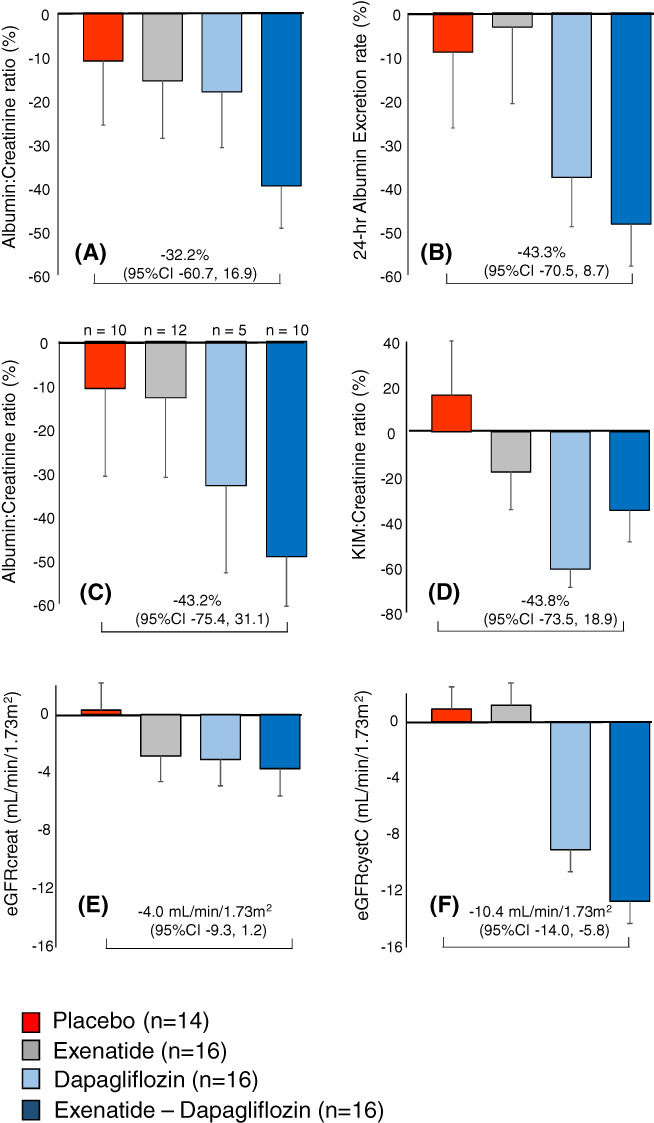
Aims: To evaluate the effects of separate and combined use of the sodium‐glucose cotransporter‐2 (SGLT2) inhibitor dapagliflozin and the glucagon‐like peptide‐1 receptor agonist (GLP‐1RA) exenatide on measures of kidney function. Methods: In this prespecified secondary analysis of the DECREASE trial, we enrolled 66 obese patients with type 2 diabetes in a 16‐week randomized double‐blind placebo‐controlled clinical trial to investigate the effects of dapagliflozin and exenatide twice daily, alone or in combination, versus placebo on 24‐hour urinary albumin:creatinine ratio (UACR), creatinine and cystatin C‐estimated glomerular filtration rate (GFR) and kidney injury molecule‐1:creatinine ratio (KIM‐1:Cr). Results: At week 16, the mean UACR change from baseline was −39.6% (95% confidence interval [CI] −58.6, −11.9; P = 0.001) in the combined exenatide‐dapagliflozin group, −18.1% (95% CI −43.1, 18.0; P = 0.278) in the dapagliflozin group, −15.6% (95% CI −41.4, 21.6; P = 0.357) in the exenatide group and − 11.0% (95% CI −39.8, 31.5; P = 0.552) in the placebo group. Compared to placebo, UACR difference at week 16 in the exenatide‐dapagliflozin group was −32.2% (95% CI −60.7, 16.9; P = 0.159). Effects were similar in 37 participants who were using angiotensin‐converting enzyme inhibitors or angiotensin receptor blockers at baseline. Compared to placebo, in the exenatide‐dapagliflozin group, an acute dip in estimated GFR was observed with creatinine‐estimated GFR (−4.0 mL/min/1.73 m 2 [95% CI −9.3, 1.2]; P = 0.129) and cystatin C‐estimated GFR (−10.4 mL/min/1.73 m 2 [95% CI −14.9, −5.8]; P < 0.001). The mean KIM‐1:Cr difference in the combined treatment arm versus placebo was −43.8% (95% CI −73.5, 18.9; P = 0.129). Conclusion: This prespecified secondary analysis suggests that combined therapy with exenatide and dapagliflozin may have synergistic effects on markers of kidney function compared to either therapy alone or placebo in obese patients with type 2 diabetes.
Overview
The claims and statistics of this paper haven’t been checked yet.
Run the check — free, no account needed. It reads the open-access text and checks the sources it cites.
Integrity signals
Registry
Cites
Statistics
Figures
Verification
Claims the paper makes
The claims and statistics of this paper haven’t been checked yet.
Run the check — free, no account needed. It reads the open-access text and checks the sources it cites.
Claims other papers make about this one
Each is checked against this paper’s own text: does it say what the citing paper says it does?
The source backs part of the claim, not all of it — or backs it for a different population, condition or comparison.
In the citing paper
“In patients with diabetes, GLP-1 receptor agonists have been reported to diminish eGFR during short-term treatment, but to improve glomerular function during long-term treatment,34,87,88 a biphasic effect that is similar to that observed with mineralocorticoid receptor antagonists and SGLT2 inhibitors.79,86”
From Interplay of Chronic Kidney Disease and the Effects of Tirzepatide in Patients With Heart Failure, Preserved Ejection Fraction, and Obesity (2025) · cites this paper as [87]
Experimental — accuracy not yet measured
Self-check
Percentages, sums and reported differences re-computed from the paper’s own numbers.
The self-check needs the paper’s full text.
Citations
Cites
Canagliflozin and Renal Outcomes in Type 2 Diabetes and Nephropathy
Perkovic, V., Jardine, M. J., Neal, B., Bompoint, S., Heerspink, H. J. L., Charytan, D. M., Edwards, R., Agarwal, R., Bakris, G., Bull, S., et al. (2019) · New England Journal of Medicine · doi:10.1056/nejmoa1811744 · Cited by 6,189
Self-citationEstimating glomerular filtration rate from serum creatinine and cystatin C
Inker, L. A., Schmid, C. H., Tighiouart, H., Eckfeldt, J. H., Feldman, H. I., Greene, T., Kusek, J. W., Manzi, J., Van Lente, F., Zhang, Y. L., et al. (2012) · New England Journal of Medicine · doi:10.1056/nejmoa1114248 · Cited by 4,102
Zelniker, T. A., Wiviott, S. D., Raz, I., Im, K., Goodrich, E. L., Bonaca, M. P., Mosenzon, O., Kato, E. T., Cahn, A., Furtado, R. H. M., et al. (2019) · The Lancet · doi:10.1016/s0140-6736(18)32590-x · Cited by 2,845 · cited 1×
“Secondary analyses from cardiovascular outcome trials in patients with type 2 diabetes have shown that GLP-1RAs also slow progression of kidney function decline in patients with type 2 diabetes.(1,2)”
MethodKristensen, S. L., Rørth, R., Jhund, P. S., Docherty, K. F., Sattar, N., Preiss, D., Køber, L., Petrie, M. C., & McMurray, J. J. V. (2019) · The Lancet Diabetes & Endocrinology · doi:10.1016/s2213-8587(19)30249-9 · Cited by 1,663 · cited 1×
“Secondary analyses from cardiovascular outcome trials in patients with type 2 diabetes have shown that GLP-1RAs also slow progression of kidney function decline in patients with type 2 diabetes.(1,2)”
MethodDapagliflozin a glucose-regulating drug with diuretic properties in subjects with type 2 diabetes
Lambers Heerspink, H. J., de Zeeuw, D., Wie, L., Leslie, B., & List, J. (2013) · Diabetes, Obesity and Metabolism · doi:10.1111/dom.12127 · Cited by 837
Perkovic, V., de Zeeuw, D., Mahaffey, K. W., Fulcher, G., Erondu, N., Shaw, W., Barrett, T. D., Weidner-Wells, M., Deng, H., Matthews, D. R., et al. (2018) · The Lancet Diabetes & Endocrinology · doi:10.1016/s2213-8587(18)30141-4 · Cited by 637
Cherney, D. Z. I., Zinman, B., Inzucchi, S. E., Koitka-Weber, A., Mattheus, M., von Eynatten, M., & Wanner, C. (2017) · The Lancet Diabetes & Endocrinology · doi:10.1016/s2213-8587(17)30182-1 · Cited by 383
Zinman, B., Bhosekar, V., Busch, R., Holst, I., Ludvik, B., Thielke, D., Thrasher, J., Woo, V., & Philis-Tsimikas, A. (2019) · The Lancet Diabetes & Endocrinology · doi:10.1016/s2213-8587(19)30066-x · Cited by 376
Ludvik, B., Frías, J. P., Tinahones, F. J., Wainstein, J., Jiang, H., Robertson, K. E., García-Pérez, L.-E., Woodward, D. B., & Milicevic, Z. (2018) · The Lancet Diabetes & Endocrinology · doi:10.1016/s2213-8587(18)30023-8 · Cited by 266
Muskiet, M. H. A., Tonneijck, L., Huang, Y., Liu, M., Saremi, A., Heerspink, H. J. L., & van Raalte, D. H. (2018) · The Lancet Diabetes & Endocrinology · doi:10.1016/s2213-8587(18)30268-7 · Cited by 259 · cited 1×
“reductions were 2% in patients with normoalbuminuria and 39% in patients with macroalbuminuria.(12) This may explain why in the present study, in which the majority of participants had normoalbuminuria, the albuminuria-lowering effect of exenatide was modest.”
ResultSelf-citation
Research works printed but not linked: 15
- 10.1161/CIRCULATIONAHA.116.021887 · DOI · Paper page
- 10.2337/dc18-0588 · DOI
- 10.1016/S2213-8587(16)30267-4 · DOI
- 10.1038/s41598-019-55524-w · DOI
- 10.7326/0003-4819-150-9-200905050-00006 · DOI · Paper page
- 10.1016/S2213-8587(18)30104-9 · DOI · Paper page
- 10.1111/dom.12936 · DOI
- 10.1111/dom.12654 · DOI
- 10.1056/NEJMoa1515920 · DOI · Paper page
- 10.1001/jama.2015.0602 · DOI
- 10.1038/nrneph.2017.123 · DOI · Paper page
- 10.1038/nrneph.2016.159 · DOI
- 10.2215/CJN.11220720 · DOI
- 10.1111/dom.12954 · DOI · Paper page
- 10.1016/S2213-8587(19)30086-5 · DOI · Paper page
Cited by
Sorted by citations
Neuen, B. L., Fletcher, R. A., Heath, L., Perkovic, A., Vaduganathan, M., Badve, S. V., Tuttle, K. R., Pratley, R., Gerstein, H. C., Perkovic, V., et al. (2024) · Circulation · doi:10.1161/circulationaha.124.071689 · Cited by 168
Self-citationCombination therapy for kidney disease in people with diabetes mellitus
van Raalte, D. H., Bjornstad, P., Cherney, D. Z. I., de Boer, I. H., Fioretto, P., Gordin, D., Persson, F., Rosas, S. E., Rossing, P., Schaub, J. A., et al. (2024) · Nature Reviews Nephrology · doi:10.1038/s41581-024-00827-z · Cited by 127
Self-citationPacker, M., Zile, M. R., Kramer, C. M., Murakami, M., Ou, Y., & Borlaug, B. A. (2025) · Journal of the American College of Cardiology · doi:10.1016/j.jacc.2025.03.009 · Cited by 49
Sivalingam, S., Wasehuus, V. S., Rotbain Curovic, V., Blond, M. B., Hansen, T. W., Persson, F., & Rossing, P. (2024) · Diabetes, Obesity and Metabolism · doi:10.1111/dom.15287 · Cited by 34
Metadata
- Authors
- van Ruiten, C. C., van der Aart‐van der Beek, A. B., IJzerman, R. G., Nieuwdorp, M., Hoogenberg, K., van Raalte, D. H., & Heerspink, H. J. L.
- Affiliations
- Diabetes Centre, Department of Internal Medicine Amsterdam UMC, Location VUMC Amsterdam The Netherlands
- Clinical Pharmacy and Pharmacology University of Groningen Groningen The Netherlands
- Department of Internal Medicine Martini Hospital Groningen The Netherlands
- ORCID
- Venue
- Diabetes, Obesity and Metabolism
- Publisher
- Wiley
- Published
- 2021-05-14
- Volume
- 23
- Issue
- 8
- Pages
- 1851-1858
- ISSN
- 1462-8902
- 1463-1326
- PMC
- PMC8360098
- Cited by
- 53
- References
- 11
- Language
- en
About these checks
Registry, retraction, Cites and statistics results are computed, not judged, with one exception: a printed reference that no index lists is read once by a model before it counts as a citation error. Claims are extracted by a model and kept only when their quote appears verbatim in the text; each cited source is then checked, with a model’s help, for whether it says what the claim relies on. Those verdicts can be wrong — read the claim’s quote and the cited source before relying on one.
Statistics and arithmetic are recomputed, not judged.
Confidence bands are shown only for fields calibrated on our annotated test set. None is calibrated yet, so no band is shown.
What counts as a claim ›How we measure confidence ›How we check this ›
Are you an author, or do you see a problem with this page? Request a review
