

The DOI matches its Crossref record; 8 of the 8 references it cites were found in a registry or an index.
Regulatory T‐cells in helminth infection: induction, function and therapeutic potential
Abstract
Summary: Helminth parasites infect an alarmingly large proportion of the world's population, primarily within tropical regions, and their ability to down‐modulate host immunity is key to their persistence. Helminths have developed multiple mechanisms that induce a state of hyporesponsiveness or immune suppression within the host; of particular interest are mechanisms that drive the induction of regulatory T‐cells (Tregs). Helminths actively induce Tregs either directly by secreting factors, such as the TGF‐β mimic Hp‐ TGM, or indirectly by interacting with bystander cell types such as dendritic cells and macrophages that then induce Tregs. Expansion of Tregs not only enhances parasite survival but, in cases such as filarial infection, Tregs also play a role in preventing parasite‐associated pathologies. Furthermore, Tregs generated during helminth infection have been associated with suppression of bystander immunopathologies in a range of inflammatory conditions such as allergy and autoimmune disease. In this review, we discuss evidence from natural and experimental infections that point to the pathways and molecules involved in helminth Treg induction, and postulate how parasite‐derived molecules and/or Tregs might be applied as anti‐inflammatory therapies in the future.
Overview
The claims and statistics of this paper haven’t been checked yet.
Run the check — free, no account needed. It reads the open-access text and checks the sources it cites.
Integrity signals
Registry
Cites
Statistics
Figures
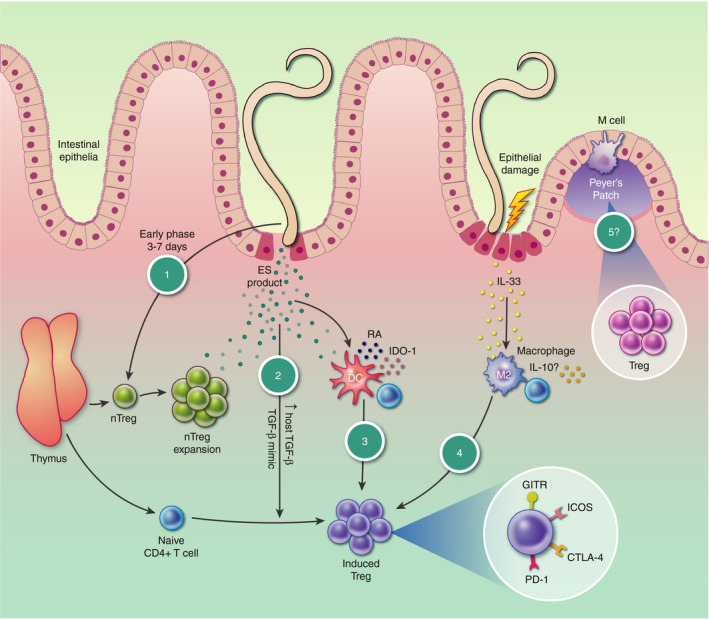
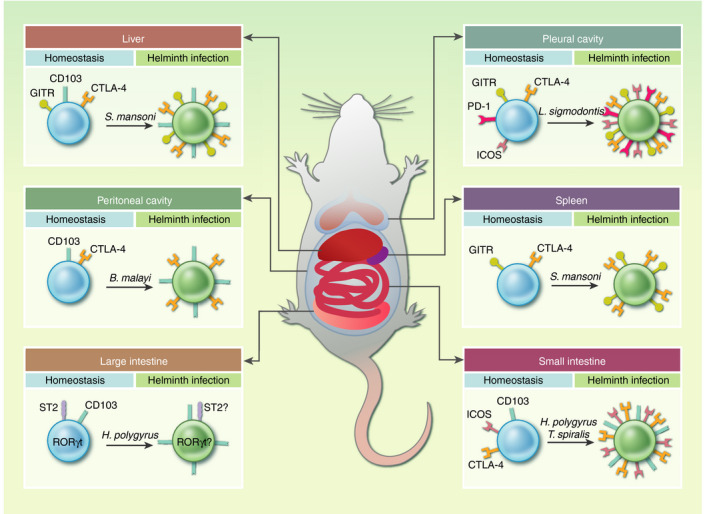
Verification
Claims the paper makes
The claims and statistics of this paper haven’t been checked yet.
Run the check — free, no account needed. It reads the open-access text and checks the sources it cites.
Claims other papers make about this one
Each is checked against this paper’s own text: does it say what the citing paper says it does?
In the citing paper
“This approach may lead to the development. of new, more effective, and safer methods for treating not only allergic diseases but also other immunological disorders”
From Parasites and allergies: a complex bidirectional relationship from evolutionary origins to modern therapeutics (2026) · cites this paper as White et al. 2020
Self-check
Percentages, sums and reported differences re-computed from the paper’s own numbers.
The self-check needs the paper’s full text.
Citations
Cites
The microbiota regulates type 2 immunity through RORγt + T cells
Ohnmacht, C., Park, J.-H., Cording, S., Wing, J. B., Atarashi, K., Obata, Y., Gaboriau-Routhiau, V., Marques, R., Dulauroy, S., Fedoseeva, M., et al. (2015) · Science · doi:10.1126/science.aac4263 · Cited by 863
Grainger, J. R., Smith, K. A., Hewitson, J. P., McSorley, H. J., Harcus, Y., Filbey, K. J., Finney, C. A. M., Greenwood, E. J. D., Knox, D. P., Wilson, M. S., et al. (2010) · Journal of Experimental Medicine · doi:10.1084/jem.20101074 · Cited by 469
Self-citationModulation of Host Immunity by Helminths: The Expanding Repertoire of Parasite Effector Molecules
Maizels, R. M., Smits, H. H., & McSorley, H. J. (2018) · Immunity · doi:10.1016/j.immuni.2018.10.016 · Cited by 435
Self-citationManoury, B., Gregory, W. F., Maizels, R. M., & Watts, C. (2001) · Current Biology · doi:10.1016/s0960-9822(01)00118-x · Cited by 223
Self-citationCoakley, G., McCaskill, J. L., Borger, J. G., Simbari, F., Robertson, E., Millar, M., Harcus, Y., McSorley, H. J., Maizels, R. M., & Buck, A. H. (2017) · Cell Reports · doi:10.1016/j.celrep.2017.05.001 · Cited by 219
Self-citationHookworm recombinant protein promotes regulatory T cell responses that suppress experimental asthma
Navarro, S., Pickering, D. A., Ferreira, I. B., Jones, L., Ryan, S., Troy, S., Leech, A., Hotez, P. J., Zhan, B., Laha, T., et al. (2016) · Science Translational Medicine · doi:10.1126/scitranslmed.aaf8807 · Cited by 139
TGF-β mimic proteins form an extended gene family in the murine parasite Heligmosomoides polygyrus
Smyth, D. J., Harcus, Y., White, M. P. J., Gregory, W. F., Nahler, J., Stephens, I., Toke-Bjolgerud, E., Hewitson, J. P., Ivens, A., McSorley, H. J., et al. (2018) · International Journal for Parasitology · doi:10.1016/j.ijpara.2017.12.004 · Cited by 66
Self-citationSulaiman, A. A., Zolnierczyk, K., Japa, O., Owen, J. P., Maddison, B. C., Emes, R. D., Hodgkinson, J. E., Gough, K. C., & Flynn, R. J. (2016) · PLOS Pathogens · doi:10.1371/journal.ppat.1005991 · Cited by 60
Research works printed but not linked: 128
- 10.1016/S0140-6736(18)32279-7 · DOI · Paper page
- 10.1186/1756-3305-7-37 · DOI
- 10.1111/pim.12193 · DOI
- 10.1111/cei.12353 · DOI
- 10.1016/j.jaci.2006.03.003 · DOI
- 10.1177/1757913916650225 · DOI
- 10.1016/j.ijpara.2012.11.011 · DOI
- 10.1146/annurev-immunol-042718-041717 · DOI
- 10.1016/j.immuni.2013.03.002 · DOI
- 10.1111/j.1600-065X.2011.01017.x · DOI
- 10.4269/ajtmh.2007.77.676 · DOI
- 10.4049/jimmunol.0904067 · DOI
- 10.1371/journal.pntd.0001655 · DOI
- 10.1371/journal.pntd.0000420 · DOI
- 10.1371/journal.pntd.0003414 · DOI
- 10.1126/scitranslmed.aaw3703 · DOI
- 10.1002/eji.200838193 · DOI
- 10.1126/science.1144603 · DOI
- 10.1016/j.micinf.2005.03.036 · DOI
- 10.1093/infdis/173.5.1242 · DOI
- 10.1093/infdis/172.6.1567 · DOI
- 10.1016/j.vaccine.2008.04.083 · DOI
- 10.1002/eji.200939699 · DOI
- 10.1002/eji.201545843 · DOI
- 10.1002/eji.200636751 · DOI
- 10.4049/jimmunol.181.9.6456 · DOI
- 10.1128/IAI.01233-07 · DOI
- 10.1002/eji.200838727 · DOI
- 10.4049/jimmunol.1001920 · DOI
- 10.1038/mi.2015.73 · DOI
- 10.1128/IAI.73.7.4034-4042.2005 · DOI
- 10.4049/jimmunol.174.8.4924 · DOI · Paper page
- 10.1007/s00436-010-2089-2 · DOI
- 10.1002/eji.200737063 · DOI
- 10.4049/jimmunol.178.2.1039 · DOI
- 10.4049/jimmunol.0802767 · DOI
- 10.1016/j.exppara.2013.11.001 · DOI
- 10.4049/jimmunol.179.7.4626 · DOI
- 10.1002/eji.200939644 · DOI
- 10.1371/journal.ppat.1003913 · DOI
- 10.4049/jimmunol.1202502 · DOI · Paper page
- 10.1371/journal.pone.0125495 · DOI
- 10.1371/journal.pone.0125945 · DOI
- 10.1371/journal.ppat.1003675 · DOI
- 10.1002/eji.200939721 · DOI
- 10.1002/eji.201242794 · DOI
- 10.1128/IAI.00266-15 · DOI
- 10.1016/j.jprot.2011.06.002 · DOI
- 10.1038/s41467-017-01886-6 · DOI · Paper page
- 10.1002/eji.200838871 · DOI
- 10.1186/2045-3701-1-20 · DOI
- 10.1002/eji.201141429 · DOI
- 10.3389/fimmu.2018.00011 · DOI
- 10.1002/eji.200636553 · DOI
- 10.1016/j.coi.2014.09.004 · DOI
- 10.1038/ni.1852 · DOI
- 10.1038/ncomms14919 · DOI
- 10.1371/journal.ppat.1006649 · DOI
- 10.1111/j.1365-3024.2007.00947.x · DOI
- 10.4049/jimmunol.176.9.5374 · DOI
- 10.4049/jimmunol.172.5.3157 · DOI
- 10.3347/kjp.2016.54.2.163 · DOI
- 10.4049/jimmunol.1100834 · DOI
- 10.1038/ni.2683 · DOI
- 10.1038/s41590-019-0351-z · DOI
- 10.1038/nature13577 · DOI
- 10.1111/j.1365-2249.2010.04139.x · DOI
- 10.1016/j.coi.2005.09.001 · DOI
- 10.1159/000332949 · DOI · Paper page
- 10.1016/S0140-6736(00)03206-2 · DOI
- 10.1159/000024433 · DOI
- 10.1159/000088879 · DOI
- 10.1086/381767 · DOI · Paper page
- 10.1111/j.1365-2222.2009.03346.x · DOI · Paper page
- 10.1017/S0031182011001053 · DOI
- 10.1111/j.1399-3038.2010.01122.x · DOI
- 10.1111/j.1398-9995.2010.02512.x · DOI · Paper page
- 10.4269/ajtmh.16-0348 · DOI
- 10.1016/j.jaci.2007.06.009 · DOI
- 10.1371/journal.pone.0019149 · DOI
- 10.1002/ana.21067 · DOI
- 10.1016/j.jneuroim.2011.01.002 · DOI · Paper page
- 10.1128/IAI.73.9.5468-5481.2005 · DOI
- 10.1164/ajrccm.156.1.9606081 · DOI
- 10.3389/fimmu.2017.00453 · DOI
- 10.1016/j.coi.2018.05.007 · DOI
- 10.1016/j.jaci.2016.07.007 · DOI · Paper page
- 10.1084/jem.20042572 · DOI
- 10.1111/j.1365-2222.2009.03290.x · DOI
- 10.4049/jimmunol.177.3.1628 · DOI
- 10.4049/jimmunol.176.1.138 · DOI
- 10.1371/journal.pntd.0002379 · DOI · Paper page
- 10.1016/S0140-6736(76)92492-2 · DOI
- 10.1126/scitranslmed.3001500 · DOI
- 10.1371/journal.ppat.1003000 · DOI
- 10.1136/gut.2004.041749 · DOI · Paper page
- 10.1053/j.gastro.2005.01.005 · DOI · Paper page
- 10.1016/j.jaci.2014.07.007 · DOI
- 10.1007/7854_2014_361 · DOI
- 10.1016/S1473-3099(14)70771-6 · DOI
- 10.1111/pim.12175 · DOI
- 10.1186/s12865-015-0074-3 · DOI · Paper page
- 10.1016/j.trsl.2015.06.016 · DOI
- 10.1017/S0022149X16000316 · DOI
- Garg SK, 2014, Helminth therapy (worms) for induction of remission in inflammatory bowel disease, Cochrane Database Syst Rev, 1, CD009400
- Scholmerich J, 2017, A randomised, double‐blind, placebo‐controlled trial of Trichuris suis ova in active Crohn's disease, J Crohns Colitis, 11, 390
- Fleming J, 2014, Clinical trial of helminth‐induced immunomodulatory therapy (HINT 2) in relapsing‐remitting multiple sclerosis, Neurology, 82, 149
- 10.1016/j.jaci.2014.07.022 · DOI
- 10.1371/journal.pone.0024092 · DOI
- 10.1128/CMR.05040-11 · DOI · Paper page
- 10.1038/cti.2017.42 · DOI
- 10.1016/S0020-7519(03)00163-2 · DOI
- 10.3389/fimmu.2019.02280 · DOI · Paper page
- 10.1038/s41577-019-0232-6 · DOI
- 10.3324/haematol.2012.074088 · DOI
- 10.1016/j.coi.2013.12.005 · DOI
- 10.1002/eji.201040391 · DOI
- 10.4049/jimmunol.180.11.7112 · DOI
- 10.1073/pnas.1408780111 · DOI
- 10.3389/fimmu.2019.00043 · DOI · Paper page
- 10.1016/j.diagmicrobio.2008.06.015 · DOI
- 10.1371/journal.pntd.0001383 · DOI
- 10.1371/journal.pntd.0003995 · DOI
- 10.1371/journal.pntd.0000456 · DOI
- 10.1371/journal.pntd.0007415 · DOI
- 10.1645/GE-2839.1 · DOI
- 10.4049/jimmunol.179.7.4626 · DOI
- 10.1371/journal.pntd.0001269 · DOI
Cited by
Sorted by citations
Packi, K., Świerczewski, D., Klimczak, S., Ochab, D., Gałęziewska, J., Gromek, P., Kruczkowska, W., Płuciennik, E., Kałuzińska-Kołat, Ż., & Kołat, D. (2026) · Antonie van Leeuwenhoek · doi:10.1007/s10482-026-02425-4
Metadata
- Authors
- White, M. P. J., McManus, C. M., & Maizels, R. M.
- Venue
- Immunology
- Publisher
- Wiley
- Published
- 2020-04-19
- Volume
- 160
- Issue
- 3
- Pages
- 248-260
- ISSN
- 0019-2805
- 1365-2567
- PMC
- PMC7341546
- Cited by
- 114
- References
- 8
- Language
- en
About these checks
Registry, retraction, Cites and statistics results are computed, not judged, with one exception: a printed reference that no index lists is read once by a model before it counts as a citation error. Claims are extracted by a model and kept only when their quote appears verbatim in the text; each cited source is then checked, with a model’s help, for whether it says what the claim relies on. Those verdicts can be wrong — read the claim’s quote and the cited source before relying on one.
Statistics and arithmetic are recomputed, not judged.
Confidence bands are shown only for fields calibrated on our annotated test set. None is calibrated yet, so no band is shown.
What counts as a claim ›How we measure confidence ›How we check this ›
Are you an author, or do you see a problem with this page? Request a review
