

The DOI matches its Crossref record; 7 of the 7 references it cites were found in a registry or an index.
Resilience in Clinical Care: Getting a Grip on the Recovery Potential of Older Adults
Abstract
Background: Geriatricians are often confronted with unexpected health outcomes in older adults with complex multimorbidity. Aging researchers have recently called for a focus on physical resilience as a new approach to explaining such outcomes. Physical resilience, defined as the ability to resist functional decline or recover health following a stressor, is an emerging construct. Methods: Based on an outline of the state‐of‐the‐art in research on the measurement of physical resilience, this article describes what tests to predict resilience can already be used in clinical practice and which innovations are to be expected soon. Results: An older adult's recovery potential is currently predicted by static tests of physiological reserves. Although geriatric medicine typically adopts a multidisciplinary view of the patient and implicitly performs resilience management to a certain extent, clinical management of older adults can benefit from explicitly applying the dynamical concept of resilience. Two crucial leads for advancing our capacity to measure and manage the resilience of individual patients are advocated: first, performing multiple repeated measurements around a stressor can provide insight about the patient's dynamic responses to stressors; and, second, linking psychological and physiological subsystems, as proposed by network studies on resilience, can provide insight into dynamic interactions involved in a resilient response. Conclusion: A big challenge still lies ahead in translating the dynamical concept of resilience into clinical tools and guidelines. As a first step in bridging this gap, this article outlines what opportunities clinicians and researchers can already exploit to improve prediction, understanding, and management of resilience of older adults. J Am Geriatr Soc 67:2650–2657, 2019
Overview
The claims and statistics of this paper haven’t been checked yet.
Run the check — free, no account needed. It reads the open-access text and checks the sources it cites.
Integrity signals
Registry
Cites
Statistics
Figures
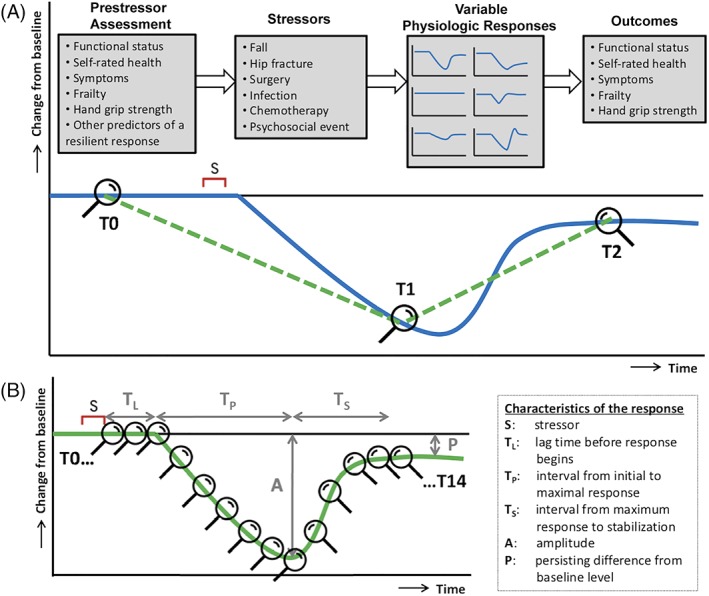
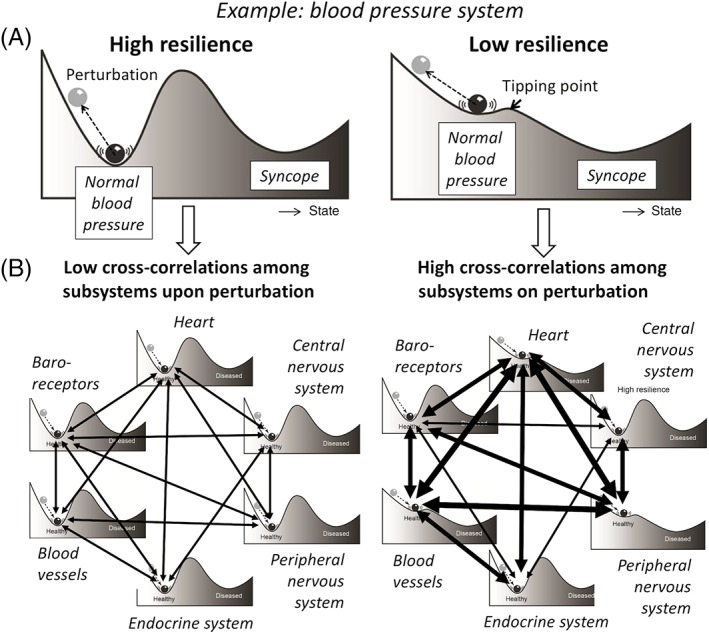
Verification
Claims the paper makes
The claims and statistics of this paper haven’t been checked yet.
Run the check — free, no account needed. It reads the open-access text and checks the sources it cites.
Claims other papers make about this one
Each is checked against this paper’s own text: does it say what the citing paper says it does?
The cited source says what the claim attributes to it.
In the citing paper
“In addition to that, by analogy to resilience in ecological systems, the dynamic properties such as physiological resilience measured as the recovery rate from the organism state perturbations20,21 were also associated with mortality22 and thus may serve as an early warning sign of impending health outcomes23,24.”
From Longitudinal Analysis of Blood Markers Reveals Progressive Loss of Resilience and Predicts Human Lifespan Limit (2021) · cites this paper as [20]
Self-check
Percentages, sums and reported differences re-computed from the paper’s own numbers.
The self-check needs the paper’s full text.
Citations
Cites
Early-warning signals for critical transitions
Scheffer, M., Bascompte, J., Brock, W. A., Brovkin, V., Carpenter, S. R., Dakos, V., Held, H., van Nes, E. H., Rietkerk, M., & Sugihara, G. (2009) · Nature · doi:10.1038/nature08227 · Cited by 4,854
Self-citationA network theory of mental disorders
Borsboom, D. (2017) · World Psychiatry · doi:10.1002/wps.20375 · Cited by 3,482
The resilience framework as a strategy to combat stress-related disorders
Kalisch, R., Baker, D. G., Basten, U., Boks, M. P., Bonanno, G. A., Brummelman, E., Chmitorz, A., Fernàndez, G., Fiebach, C. J., Galatzer-Levy, I., et al. (2017) · Nature Human Behaviour · doi:10.1038/s41562-017-0200-8 · Cited by 782
Evidence for the Domains Supporting the Construct of Intrinsic Capacity
Cesari, M., Araujo de Carvalho, I., Amuthavalli Thiyagarajan, J., Cooper, C., Martin, F. C., Reginster, J.-Y., Vellas, B., & Beard, J. R. (2018) · The Journals of Gerontology: Series A · doi:10.1093/gerona/gly011 · Cited by 745
Statistical pitfalls of personalized medicine
Senn, S. (2018) · Nature · doi:10.1038/d41586-018-07535-2 · Cited by 174 · cited 1×
“Overlooking patients’ variable physiological responses over time by performing too few measurements is a common pitfall of biomedical research and hinders progress in the development of personalized medicine.(12) Many of the selected articles directly or indirectly referred to the difficulty of studying real-world fun…”
BackgroundReport: NIA Workshop on Measures of Physiologic Resiliencies in Human Aging
Hadley, E. C., Kuchel, G. A., Newman, A. B., Allore, H. G., Bartley, J. M., Bergeman, C. S., Blinov, M. L., Colon-Emeric, C. S., Dabhar, F. S., Dugan, L. L., et al. (2017) · The Journals of Gerontology: Series A · doi:10.1093/gerona/glx015 · Cited by 173 · cited 5×
“Finding ways to measure a person’s physical resilience was termed as one of the research priorities by the National Institute of Aging.(4) This article is based on an updated review of the literature on physical resilience, presented in Supplementary Materials.”
BackgroundMethodInfluentialSelf-citationCosco, T. D., Kaushal, A., Hardy, R., Richards, M., Kuh, D., & Stafford, M. (2017) · Journal of Epidemiology and Community Health · doi:10.1136/jech-2015-206980 · Cited by 155
Research works printed but not linked: 52
- 10.1056/NEJMp1606402 · DOI
- 10.1126/sageke.2005.31.pe24 · DOI
- 10.1016/j.mad.2008.09.013 · DOI
- 10.1001/jamapsychiatry.2017.0001 · DOI
- 10.1111/jgs.15409 · DOI
- 10.1111/jgs.15233 · DOI
- 10.1093/gerona/glv202 · DOI · Paper page
- 10.1093/gerona/glz097 · DOI
- 10.1111/j.1532-5415.2009.02621.x · DOI
- Colón‐Emeric CS, 2013, Functional decline in older adults, Am Fam Physician, 88, 388
- 10.1186/s11556-016-0166-y · DOI
- Ellis G, 2017, Comprehensive geriatric assessment for older adults admitted to hospital, Cochrane Database Syst Rev, 9, CD006211
- 10.1001/archinte.160.7.977 · DOI
- Kuchel GA, 2017, Hazzard's Geriatric Medicine and Gerontology, 681
- 10.1016/j.ejim.2018.11.009 · DOI
- 10.1037/a0017915 · DOI
- 10.1097/TA.0000000000000929 · DOI
- 10.1016/j.jamcollsurg.2004.05.280 · DOI
- Hatheway OL, 2017, Frailty affects the initial treatment response and time to recovery of mobility in acutely ill older adults admitted to hospital, Age Ageing, 46, 920
- 10.1007/s11606-011-1821-7 · DOI
- 10.1016/j.athoracsur.2013.05.092 · DOI
- 10.1136/bmjopen-2016-011538 · DOI
- 10.1016/j.jpedsurg.2017.09.016 · DOI
- 10.1093/geronb/gbq095 · DOI
- 10.1093/gerona/glx028 · DOI
- 10.1034/j.1601-5215.2002.51011.x · DOI
- 10.1111/jgs.15327 · DOI
- 10.1093/gerona/glt111 · DOI
- 10.1093/gerona/glr141 · DOI
- 10.1073/pnas.1810630115 · DOI
- 10.1097/CCM.0000000000001564 · DOI · Paper page
- 10.1093/gerona/glx065 · DOI
- 10.1093/gerona/gly170 · DOI
- 10.1073/pnas.1312114110 · DOI
- 10.1159/000441458 · DOI · Paper page
- 10.1093/gerona/57.3.B115 · DOI · Paper page
- 10.1007/s11606-017-4204-x · DOI
- 10.1093/gerona/glw126 · DOI · Paper page
- 10.1088/1367-2630/18/10/100201 · DOI
- 10.1056/NEJMms1706744 · DOI
- 10.1007/s00127-016-1319-z · DOI
- 10.1111/j.1532-5415.2007.01156.x · DOI
- 10.1093/med/9780198701590.003.0048 · DOI
- 10.1038/srep00342 · DOI
- 10.1007/s12080-009-0060-6 · DOI
- 10.1016/j.exger.2017.08.027 · DOI
- 10.1088/1367-2630/16/11/115013 · DOI
- 10.1093/geront/gnv099 · DOI
- 10.1016/S0140-6736(18)31371-0 · DOI
- 10.1136/bmj.318.7175.48 · DOI · Paper page
- 10.1097/DCC.0b013e31827680e4 · DOI
- 10.1093/geront/gnv065 · DOI
Cited by
Sorted by citations
Pyrkov, T. V., Avchaciov, K., Tarkhov, A. E., Menshikov, L. I., Gudkov, A. V., & Fedichev, P. O. (2021) · Nature Communications · doi:10.1038/s41467-021-23014-1 · Cited by 139
Using Physiological System Networks to Elaborate Resilience Across Frailty States
Hao, M., Zhang, H., Li, Y., Hu, X., Hu, Z., Jiang, X., Wang, J., Sun, X., Liu, Z., Davis, D., et al. (2024) · The Journals of Gerontology: Series A · doi:10.1093/gerona/glad243 · Cited by 12
Metadata
- Authors
- Gijzel, S. M. W., Whitson, H. E., van de Leemput, I. A., Scheffer, M., van Asselt, D., Rector, J. L., Olde Rikkert, M. G. M., & Melis, R. J. F.
- Affiliations
- Department of Geriatrics, Radboud Institute for Health Sciences Radboud University Medical Center Nijmegen The Netherlands
- Department of Medicine Duke University School of Medicine Durham North Carolina
- Department of Environmental Sciences Wageningen University Wageningen The Netherlands
- ORCID
- Gijzel, Sanne M. W.
- Venue
- Journal of the American Geriatrics Society
- Publisher
- Wiley
- Published
- 2019-09-09
- Volume
- 67
- Issue
- 12
- Pages
- 2650-2657
- ISSN
- 0002-8614
- 1532-5415
- PMC
- PMC6916426
- Cited by
- 92
- References
- 7
- Language
- en
About these checks
Registry, retraction, Cites and statistics results are computed, not judged, with one exception: a printed reference that no index lists is read once by a model before it counts as a citation error. Claims are extracted by a model and kept only when their quote appears verbatim in the text; each cited source is then checked, with a model’s help, for whether it says what the claim relies on. Those verdicts can be wrong — read the claim’s quote and the cited source before relying on one.
Statistics and arithmetic are recomputed, not judged.
Confidence bands are shown only for fields calibrated on our annotated test set. None is calibrated yet, so no band is shown.
What counts as a claim ›How we measure confidence ›How we check this ›
Are you an author, or do you see a problem with this page? Request a review
