

The DOI matches its Crossref record; 59 of the 59 references it cites were found in a registry or an index; none of the 30 sources its claims cite is checked for support yet.
‘Just like I thought’: Street‐level bureaucrats trust AI recommendations if they confirm their professional judgment
Open accessAbstract
Artificial Intelligence is increasingly used to support and improve street‐level decision‐making, but empirical evidence on how street‐level bureaucrats' work is affected by AI technologies is scarce. We investigate how AI recommendations affect street‐level bureaucrats' decision‐making and if explainable AI increases trust in such recommendations. We experimentally tested a realistic mock predictive policing system in a sample of Dutch police officers using a 2 × 2 factorial design. We found that police officers trust and follow AI recommendations that are congruent with their intuitive professional judgment. We found no effect of explanations on trust in AI recommendations. We conclude that police officers do not blindly trust AI technologies, but follow AI recommendations that confirm what they already thought. This highlights the potential of street‐level discretion in correcting faulty AI recommendations on the one hand, but, on the other hand, poses serious limits to the hope that fair AI systems can correct human biases.
Overview
CoChat Summary
TL;DR
In a 2×2 vignette experiment with 124 Dutch police officers and 294 observations, officers trusted AI recommendations more when they were congruent with their professional judgment, while explanations did not significantly affect trust. Higher trust was associated with greater likelihood of following the AI recommendation, suggesting confirmation bias rather than automation bias.
Key findings
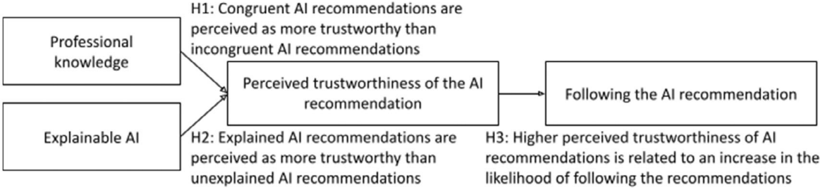
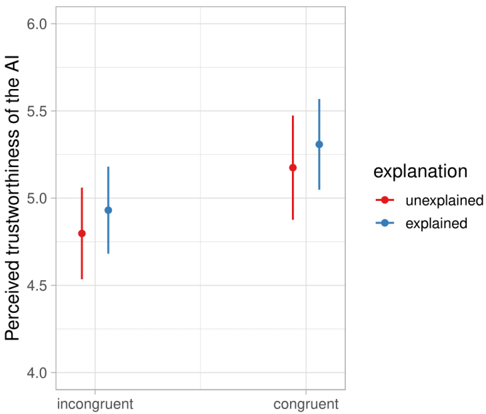
- H1 supported: police officers perceived AI recommendations congruent with their professional knowledge as more trustworthy than incongruent recommendations (β = −.377 [−.622, −.132], p = .003; group means on 1–7 trust scale: incongruent unexplained 4.73, incongruent explained 4.98, congruent unexplained 5.26, congruent explained 5.25).
- H2 not supported: explained versus unexplained AI recommendations had no statistically significant effect on trust (β = −.133 [−.400, .134], p = .328); the interaction between congruence and explanation was also not significant (β = −.259 [−.888, .371], p = .42).
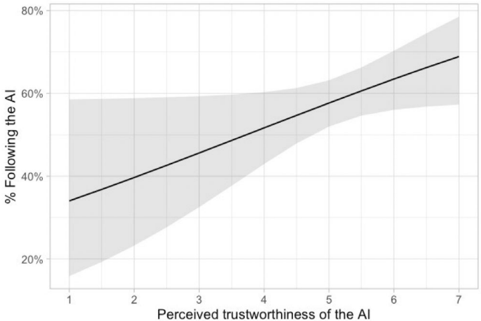
- H3 supported: higher perceived trustworthiness was associated with increased likelihood of following the AI recommendation (β = .243 [.006, .480], p = .045).
- Manipulation checks: congruency check mean 4.65, SD 1.63, t = 5.65, p < .001; explanation-detail check mean 4.49, SD 1.48, t = 3.34, p < .001; mundane realism mean 5.24, SD 1.25.
Methods
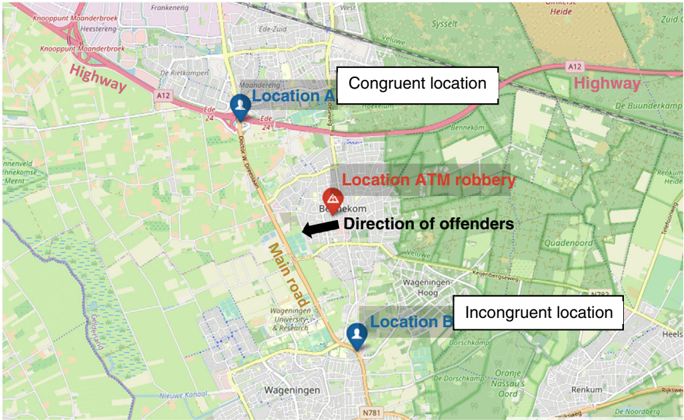
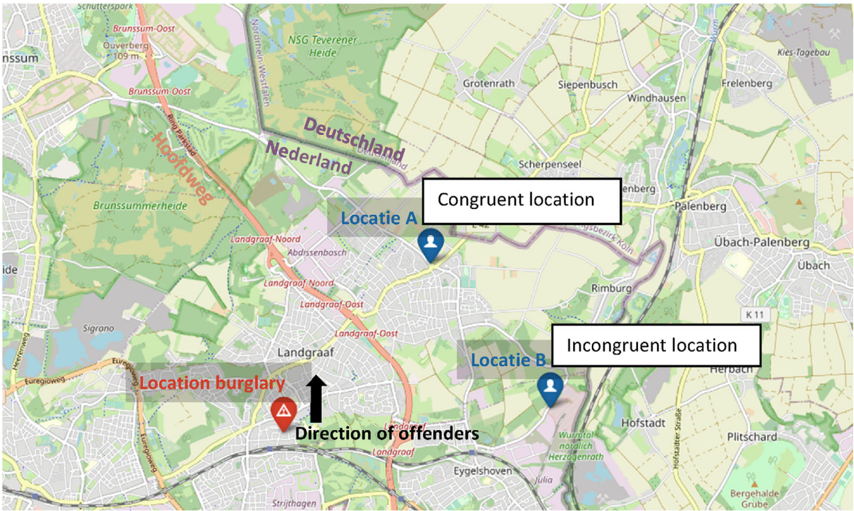
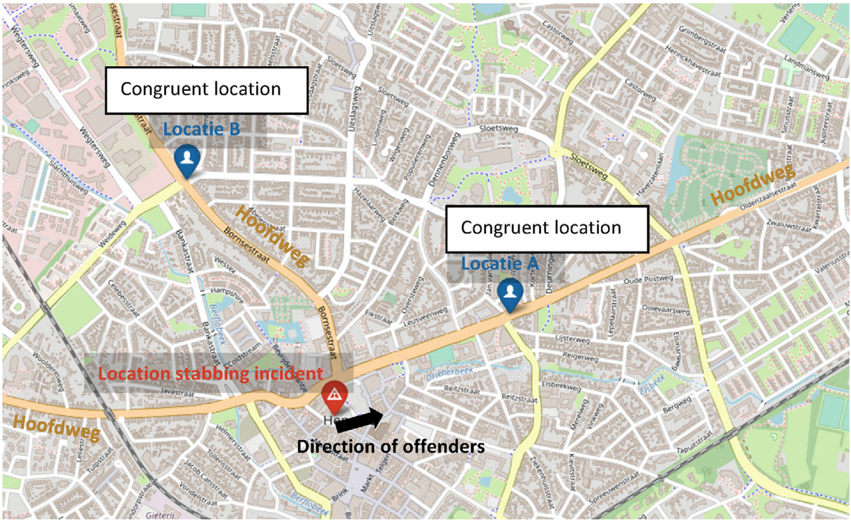
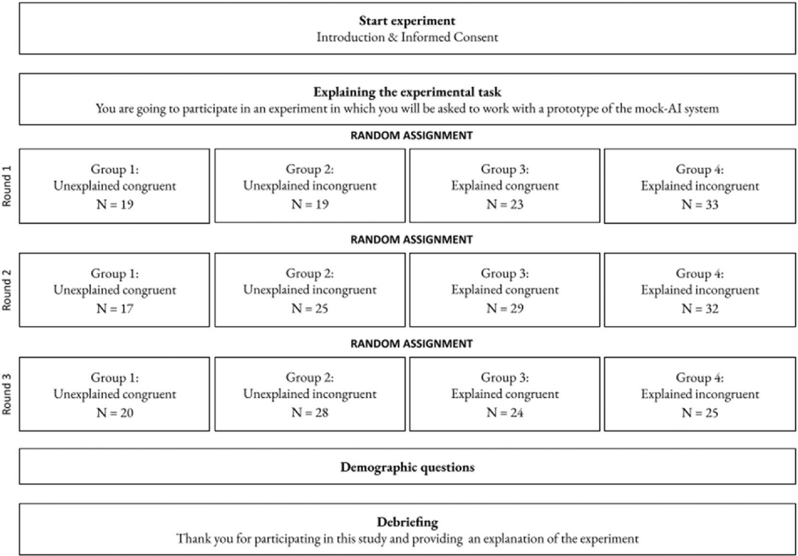
- Design: 2×2 repeated measures factorial vignette experiment with three scenarios (burglary, ATM robbery, stabbing incident); factors were AI recommendation congruent/incongruent with intuitive professional knowledge and explained/unexplained; the mock predictive policing system was based on a system developed by the Dutch police.
- Sample/data: population-based sample of Dutch street-level police officers; survey sent to approximately 400 officers, 152 responded, 28 excluded, final N = 124 officers and 294 vignettes; average age approximately 47.9, 25% female, 93% executive status; data collected May–June 2021.
- Analysis: Generalized Estimating Equations (GEE) using the Geepack package in R to account for repeated measures; trust scale included four items plus a direct trust item (Cronbach’s alpha above .92; factor loadings above .74); follow/override was a dummy variable; robustness checks with two-way ANOVA and logistic regression produced equal results.
Limitations
- The paper states that survey experiments remain artificial despite high mundane realism, and calls for field experiments in “messy” settings where police officers work in teams or under time pressure.
- The paper states that the study focuses on police officers and one type of local XAI; it calls for testing other street-level bureaucrats, other AI systems and organizational contexts, global explanations, and repeated use of reliable AI systems.
- Evident/paper-stated: no attention checks were used, and inclusion required completing at least one scenario, so inattentive responses may remain (the paper frames this as an intent-to-treat effect and external-validity strength); also, there was a small but statistically significant baseline difference in general trust in technology between the congruent unexplained and incongruent unexplained groups (less than 0.6 point on a 1–7 scale), which the authors do not believe substantially affected the findings.
Model-written summary. Check it against the paper before relying on it.
Integrity signals
Registry
Cites
Statistics
Figures
Verification
Claims the paper makes
0 Valid · 0 Not valid · 23 Not checked · 62 Own results and interpretations
A result the paper reports from its own data — it cites no other source for it, so there is none to check. The quote shows it is in the paper.
In the paper
“We also explored an interaction between the congruence and explanation manipulations but found no significant effect (β = À.259 [À.888, .371],p = .42).”
§ 'Just like I thought': Street-level bureaucrats trust AI recommendations if they confirm their professional judgment > RESULTS
plain- Asserted: passes — The authors put it forward as true.
- Checkable: passes — It can be checked against evidence.
- Load-bearing: unclear — It is unclear whether the paper’s conclusions depend on it.
- Based: passes — The paper gives a reason why it holds.
A result the paper reports from its own data — it cites no other source for it, so there is none to check. The quote shows it is in the paper.
In the paper
“As indicated in Table 2, this manipulation was also successful: police officers perceived the explained AI recommendation to be more detailed than the unexplained AI recommendation.”
§ 'Just like I thought': Street-level bureaucrats trust AI recommendations if they confirm their professional judgment > Manipulation checks
hedgedstates a cause- Asserted: passes — The authors put it forward as true.
- Checkable: passes — It can be checked against evidence.
- Load-bearing: passes — The paper’s conclusions depend on it.
- Based: passes — The paper gives a reason why it holds.
A result the paper reports from its own data — it cites no other source for it, so there is none to check. The quote shows it is in the paper.
In the paper
“In contrast, we found no support for H2.While Figure 3 seems to show the existence of some effect of explaining the AI recommendation on how trustworthy the police officers perceived the AI recommendation to be, the GEE demonstrates that this effect was not statistically significant (β = À.133 [À.400, .134],p = .328).”
§ 'Just like I thought': Street-level bureaucrats trust AI recommendations if they confirm their professional judgment > RESULTS
boosted- Asserted: passes — The authors put it forward as true.
- Checkable: passes — It can be checked against evidence.
- Load-bearing: passes — The paper’s conclusions depend on it.
- Based: passes — The paper gives a reason why it holds.
A result the paper reports from its own data — it cites no other source for it, so there is none to check. The quote shows it is in the paper.
In the paper
“An increase in perceived trustworthiness is statistically significantly related to an increase in the likelihood of police officers following the AI recommendation (β = .243[.006, .480],p = .045).”
§ 'Just like I thought': Street-level bureaucrats trust AI recommendations if they confirm their professional judgment > RESULTS
plainstates an association- Asserted: passes — The authors put it forward as true.
- Checkable: passes — It can be checked against evidence.
- Load-bearing: passes — The paper’s conclusions depend on it.
- Based: passes — The paper gives a reason why it holds.
- Rests on an assumption not shown here.
A result the paper reports from its own data — it cites no other source for it, so there is none to check. The quote shows it is in the paper.
In the paper
“We found no effect of explanations on trust in AI recommendations.”
- Also stated in: § What is the effect of AI recommendations and explainable AI on decision-making of street-level police officers? · plain
“Moreover, we found that police officers' trust in AI recommendations is not affected by AI-generated explanations (XAI)”
§ 'Just like I thought': Street-level bureaucrats trust AI recommendations if they confirm their professional judgment > Abstract
plain- Asserted: passes — The authors put it forward as true.
- Checkable: passes — It can be checked against evidence.
- Load-bearing: passes — The paper’s conclusions depend on it.
- Based: passes — The paper gives a reason why it holds.
- Also stated in: § What is the effect of AI recommendations and explainable AI on decision-making of street-level police officers? · plain
29 more claims
Create a free account to see all 85 claims and to verify the 19 references still open.
- Probably not a substantial claim. 41
- It may state two separate claims as one. 19
- The quote only partly states this claim. 1
Statistics that don’t add up
Each reported p-value recomputed from its test statistic and degrees of freedom.
Rated minor: it would not touch a result — a value no result rests on, a p-value that stays on the same side of the significance level, or a conflict that is clerical, resolved elsewhere in the paper, or outside its own findings.
In the paper
“F(3, 280) = 0.182, p = .14”
§ 'Just like I thought': Street-level bureaucrats trust AI recommendations if they confirm their professional judgment > A PP E N D IX B : SUMMARY OF EXPERIMENTAL SCENARIOS (TRANSLATED FROM DUTCH)
Reported p = .14 · recomputed p = .909
Statistics recomputed
Every reported test result, recomputed from its test statistic and degrees of freedom. A result shows as not adding up only once an independent check has confirmed it.
- Doesn’t add upF(3, 280) = 0.182reported p = .14 · recomputed p = .909
“F(3, 280) = 0.182, p = .14”
- ConsistentF(3, 280) = 0.81reported p = .49 · recomputed p = .489
“F(3, 280) = 0.81, p = .49”
- ConsistentF(3, 280) = 0.53reported p = .66 · recomputed p = .662
“F(3, 280) = 0.53, p = .66”
- ConsistentF(3, 280) = 2.89reported p = .04 · recomputed p = .036
“F(3, 280) = 2.89, p = .04”
Self-check
Percentages, sums and reported differences re-computed from the paper’s own numbers.
Each contradiction between two passages listed here was confirmed by an independent check.
Rated minor: it would not touch a result — a value no result rests on, a p-value that stays on the same side of the significance level, or a conflict that is clerical, resolved elsewhere in the paper, or outside its own findings.
In the paper
§ 'Just like I thought': Street-level bureaucrats trust AI recommendations if they confirm their professional judgment > ARTIFICIAL INTELLIGENCE IN STREET-LEVEL BUREAUCRACY
“H1. Street-level bureaucrats perceive AI recommendations that are congruent with their professional judgment as more trustworthy than AI recommendations that are incongruent with their professional judgment.”
§ 'Just like I thought': Street-level bureaucrats trust AI recommendations if they confirm their professional judgment > A PP E N D I X D : DEVIATIONS FROM PRE-ANALYSIS PLAN
“H2 The second hypothesis in the pre-registry (In general, police officers are more likely to trust algorithmic advice that complies with their tacit knowledge than algorithmic advice that conflicts with their tacit knowledge) is rephrased in the article to H2 (Street-level bureaucrats perceive AI recommendations that are congruent with their professional judgment as more trustworthy than AI recommendations that are incongruent with their professional judgment).”
Citations
Cites
Longitudinal data analysis using generalized linear models
LIANG, K.-Y., & ZEGER, S. L. (1986) · Biometrika · doi:10.1093/biomet/73.1.13 · Cited by 18,550
"Why Should I Trust You?": Explaining the Predictions of Any Classifier
Ribeiro, M. T., Singh, S., & Guestrin, C. (2016) · Proceedings of the 22nd ACM SIGKDD International Conference on Knowledge Discovery and Data Mining · doi:10.1145/2939672.2939778 · Cited by 17,555
An integrative model of organizational trust
Mayer, R. C., Davis, J. H., & Schoorman, F. D. (1995) · The Academy of Management Review · doi:10.2307/258792 · Cited by 10,736
The case for motivated reasoning.
Kunda, Z. (1990) · Psychological Bulletin · doi:10.1037/0033-2909.108.3.480 · Cited by 9,022
Street-Level Bureaucracy: Dilemmas of the Individual in Public Services
Lipsky, M. (1981) · Michigan Law Review · doi:10.2307/1288305 · Cited by 8,981
Peeking Inside the Black-Box: A Survey on Explainable Artificial Intelligence (XAI)
Adadi, A., & Berrada, M. (2018) · IEEE Access · doi:10.1109/access.2018.2870052 · Cited by 6,294
Explanation in artificial intelligence: Insights from the social sciences
Miller, T. (2019) · Artificial Intelligence · doi:10.1016/j.artint.2018.07.007 · Cited by 5,302
Motivated Skepticism in the Evaluation of Political Beliefs
Taber, C. S., & Lodge, M. (2006) · American Journal of Political Science · doi:10.1111/j.1540-5907.2006.00214.x · Cited by 4,344
Kim, D. J., Ferrin, D. L., & Rao, H. R. (2008) · Decision Support Systems · doi:10.1016/j.dss.2007.07.001 · Cited by 3,613
How the machine “thinks”: Understanding opacity in machine learning algorithms
Burrell, J. (2016) · Big Data & Society · doi:10.1177/2053951715622512 · Cited by 3,196
Research works printed but not linked: 2
- Kahneman Daniel, 2013, Thinking, Fast and Slow
- O'Neill Cathy, 2016, Weapons of Math Destruction: How Big Data Increases Inequality and Threatens Democracy
Cited by
Items 101–153 of 153
He, G., Dong, X., & Lv, Y. (2025) · Chinese Journal of Communication · doi:10.1080/17544750.2025.2552246
Huang, H., Chen, D., & Chen, Y.-H. (2025) · Information Polity · doi:10.1177/15701255251375826
Germundsson, N. (2025) · KTH Publication Database DiVA (KTH Royal Institute of Technology) · doi:10.13140/rg.2.2.15870.91203
Lundström, M. (2024) · Hogskolan Ihalmstad (Halmstad University)
D'Ambrosio, M. (2025) · Archivio Istituzionale della Ricerca - Università degli Studi del Molise · doi:10.5281/zenodo.17524062
Policia, tecnologia i la "revolució" de la intel·ligència artificial
López Riba, J. M. (2025) · Dipòsit Digital de Documents de la UAB (Universitat Autònoma de Barcelona)
Shih, C. S. (2026) · Government Information Quarterly · doi:10.1016/j.giq.2026.102109
Barris i polítiques públiques de seguretat. Papers, 67
Metròpoli, I. (2025) · RECAM Metropolitan Knowledge Repository
Maryahin, R. (2026) · SSRN Electronic Journal · doi:10.2139/ssrn.6539278
Abbas, S., Alazzawi, M. S., Alnoor, A., & Valeri, M. (2026) · Lecture notes in networks and systems · doi:10.1007/978-3-032-15806-2_1
Alisaa, M. M., Ali, N. M., Alazzawi, M. S., & Alnoor, A. (2026) · Lecture notes in networks and systems · doi:10.1007/978-3-032-15806-2_20
Tekoälyn sovellus toimitusketjujen johtamisessa
Hoikkala, O. (2026) · Aaltodoc (Aalto University)
Agentic AI and the Algorithm of Good
Gounaris, A., & Kosteletos, G. (2026) · AI · doi:10.3390/ai7090352
Degen, H. (2026) · arXiv (Cornell University) · doi:10.48550/arxiv.2605.14207
Between Civic AI and the Agentic State: The Pathways of Post-Digital Democratic Governance
Pane, S. (2026) · Journal of artificial intelligence for sustainable development. · doi:10.69828/4d4ktj
For Those About to Rely—A Taxonomy of Experimental Studies on AI Reliance: Completed Research Paper
Schaschek, M., Spatscheck, N., & Winkelmann, A. (2026) · Lecture notes in information systems and organisation · doi:10.1007/978-3-032-08480-4_2
Negativity trumps source: exploring the perceptions of AI-advice among public officials
Cao, Y., & Liang, X. (2026) · Public Management Review · doi:10.1080/14719037.2026.2685255
Urrashid, H., & Fitriyanti, F. (2026) · Open Access Indonesia Journal of Social Sciences · doi:10.37275/oaijss.v9i3.325
A Technical Typology of AI Systems in Public AdministrationPreprint
Rystrøm, J., Schmitz, C., Davies, N., Hammerschmid, G., Meijer, A. J., & Russell, C. (2026) · arXiv (Cornell University) · doi:10.48550/arxiv.2606.31755
IANUSHEVYCH, I., & Губанова, Т. О. (2026) · Multidisciplinary Reviews · doi:10.31893/multirev.2026spe014
Parsons, S. P. (2026) · International Journal of Public Sector Management · doi:10.1108/ijpsm-08-2025-0356
A Technical Typology of AI Systems in Public AdministrationPreprint
Rystrøm, J. H., Schmitz, C., Davies, N., Hammerschmid, G., Russell, C., & Meijer, A. J. (2026) · SSRN Electronic Journal · doi:10.2139/ssrn.7028740
Wang, Y., & Tang, Y. (2026) · International Journal of Information Management · doi:10.1016/j.ijinfomgt.2026.103109
Wang, S., Zhang, Y., & Liang, Z. (2026) · International Public Management Journal · doi:10.1080/10967494.2026.2706796
ARTIFICIAL INTELLIGENCE IN PUBLIC WELFARE POLICIES: ADOPTIONS, PERCEPTIONS AND TRUST
Pavolini, E., Guerci, M., & Prelle, G. (2026) · Archivio Istituzionale della Ricerca (Universita Degli Studi Di Milano)
Panday, P. K. (2026) · De Gruyter eBooks · doi:10.1515/9783112237687-025
Digital eyes, human hands: aI, discretion, and welfare blind spots in South Korea
Kim, Y., Hong, I., & Choi, J.-E. (2026) · Journal of Asian Public Policy · doi:10.1080/17516234.2026.2727633
Shofwatin, T. D. (2026) · Journal of Marketing Breakthroughs · doi:10.70764/gdpu-jmb.2026.2(1)-04
Li, J., Qin, C., & Xue, L. (2026) · Government Information Quarterly · doi:10.1016/j.giq.2026.102174
A Public Values Framework for AI Governance: Evidence From US Federal AI Policymaking
Enwereazu, O., Schiff, K. J., Girard, T., Wilhelm, A., & Schiff, D. S. (2026) · Public Administration · doi:10.1111/padm.70079
Meijer, A. J., Lorenz, L., Donatz-Fest, I., & Hoff, J.-L. (2026) · Public Administration · doi:10.1111/padm.70092
Kordoni, A., Sachoulidou, A., & de Oliveira, C. R. (2026) · Cambridge University Press eBooks · doi:10.1017/9781009623605.006
Fernández, R. C., & Solórzano, M. (2026) · Applied Artificial Intelligence · doi:10.1080/08839514.2026.2726917
Sapian, M. S. M., Musa, H., Rashid, N., Ibrahim, M. S., Krishnan, I. A., Low, Y. Y., & Kamarudin, S. M. (2026) · International Journal of Research and Innovation in Social Science · doi:10.47772/ijriss.2026.100800676
The Impact of Relative Performance Information on Public Trust in AI-enabled Public Services
Ya-bin, D. (2026) · China Public Administration Review · doi:10.26599/cpar.2026.9680207
Wu, J., Liu, Y. "., Panwang, Y., & Liao, L. (2026) · International Journal of Human-Computer Interaction · doi:10.1080/10447318.2026.2734055
Wen, X., Xiao, J., & Wang, H. (2026) · Current Science
Administrative Discretion and the Risk of Abuse of Authority in Indonesian Public Administration
Wahyudi, H., Maulana, J., & Rosidin, A. (2026) · LEGAL BRIEF · doi:10.35335/legal.v15i2.1648
Knowledge Based AI Technologies
Koppalkar, S. R. (2026) · International Journal of Computer Science and Artificial Intelligence · doi:10.64823/ijcsa.2601012
Gen AI Transformation in Public Sector Organisations: An Action ResearchPreprint
ji, S., & Jha, A. K. (2026) · SSRN Electronic Journal · doi:10.2139/ssrn.7570820
Freeburg, D. (2026) · Journal of Documentation · doi:10.1108/jd-05-2026-0253
Yamamoto, K., Tanikawa, T., & Kuzuoka, H. (2026) · Discover Artificial Intelligence · doi:10.1007/s44163-026-02469-5
The “Triple identity” of generative AI in public governance: dilemmas and adaptive solutions
Lu, S., Zhou, Y., & Hong, T. (2026) · Humanities and Social Sciences Communications · doi:10.1057/s41599-026-09400-4
Zipperling, D., Deck, L., Lanzl, J., & Kühl, N. (2026) · ACM Transactions on Interactive Intelligent Systems · doi:10.1145/3858913
Routinized deference: predictive screening and bureaucratic capacity in child protective services
Wu, J. (2026) · Journal of Public Administration Research and Theory · doi:10.1093/jopart/muag032
When AI Delegation Becomes Dependence: Administrative Judgment at Risk
Chuan, S. (2026) · AI & Future Society · doi:10.63802/afs.v2.i2.364
Algorithmic Control, Technostress, and Gaming Behavior in China’s Public Sector
Wang, P., Tang, D., & Lu, L. (2026) · Journal of Chinese Political Science · doi:10.1007/s11366-026-09953-w
Jarallah, J. A. A., Edwan, H. A. A., & Alharbi, F. S. (2026) · International Journal of Artificial Intelligence and Machine Learning · doi:10.51483/ijaiml.2946
Usulor, N. E., & Atolagbe, U. K. (2026) · IIAR Journal of Law Ethics and Policy · doi:10.68854/ndmw4s52
Palimpsestic Accountability in the US Federal AI InventoriesPreprint
Das, D., Ahmed, S. I., Vashistha, A., & Guha, S. (2026) · arXiv (Cornell University) · doi:10.48550/arxiv.2611.04153
Ineizeh, R. N. (2026) · Universal Journal of Future Intelligence Innovations and Artificial Intelligence · doi:10.70568/ujfiiai.3.1.5
John, V. S., & Ramdath, C. (2026) · Public Policy Journal · doi:10.55845/3ae7f252
Choi, S., Sung, W., & Lee, J. (2026) · Public Organization Review · doi:10.1007/s11115-026-01060-x
Metadata
- Authors
- Selten, F., Robeer, M., & Grimmelikhuijsen, S.
- Affiliations
- Leiden University (NL)
- Utrecht University (NL)
- Corresponding author
- Selten, Friso
- Venue
- Public Administration Review
- Publisher
- Wiley
- Published
- 2023-01-22
- Volume
- 83
- Issue
- 2
- Pages
- 263-278
- ISSN
- 0033-3352 (ISSN-L)
- 1540-6210
- OpenAlex
- W4313590506
- Cited by
- 153
- References
- 58
- Citations by year
- 2026: 73 · 2025: 52 · 2024: 19 · 2023: 8
- FWCI
- 10.53
- Type
- journal article
- Language
- en
- Open access
- hybrid
- doi.org
- Licence
- Locations
- Public Administration Review (publishedVersion, cc-by)
- Utrecht University Repository (Utrecht University) (submittedVersion, other-oa)
- Funders
- Nederlandse Organisatie voor Wetenschappelijk Onderzoek (406.DI.19.011)
- Topics
- Physical Sciences › Computer Science › Artificial Intelligence › Ethics and Social Impacts of AI
- Social Sciences › Political Science and International Relations › Policing Practices and Perceptions
- Social Sciences › Law › Artificial Intelligence in Law
- Keywords
- street-level bureaucracy, artificial intelligence, trust in AI, explainable AI, police decision-making, predictive policing, professional judgment, algorithmic decision support, human-AI interaction, algorithmic fairness, human bias
About these checks
Registry, retraction, Cites and statistics results are computed, not judged, with one exception: a printed reference that no index lists is read once by a model before it counts as a citation error. Claims are extracted by a model and kept only when their quote appears verbatim in the text; each cited source is then checked, with a model’s help, for whether it says what the claim relies on. Those verdicts can be wrong — read the claim’s quote and the cited source before relying on one.
A language model drew the claims from the paper on 2026-11-14, under version 3 of the claim definition (model deepseek-v4.1-flash, prompt extract-v3).
A second model labelled each claim on 2026-11-14 (model jev-1.13-20260917, definition revision gold-guideline-v0.2).
Statistics and arithmetic are recomputed, not judged.
Confidence bands are shown only for fields calibrated on our annotated test set. None is calibrated yet, so no band is shown.
What counts as a claim ›How we measure confidence ›How we check this ›
Are you an author, or do you see a problem with this page? Request a review
Data sources
Bibliographic data: Semantic Scholar, OpenAlex, Crossref.
Contains information from the Semantic Scholar Academic Graph Datasets, made available under the ODC Attribution License (ODC-BY 1.0).
Semantic Scholar’s data is described in: Kinney, R., et al. (2023). The Semantic Scholar Open Data Platform. arXiv:2301.10140.
