

The DOI matches its Crossref record; 45 of the 46 references it cites were found in a registry or an index, and 1 are not checked yet; none of the 59 sources its claims cite is checked for support yet.
Understanding the regulator–regulatee relationship for developing safety culture
Open accessAbstract
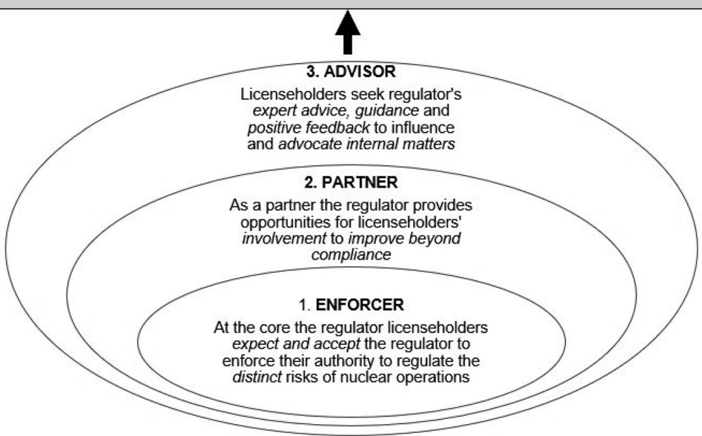
Regulatory authorities in safety‐critical industries typically seek to influence the safety culture of the organizations they oversee. However, we know little about how regulatory authorities achieve this influence (e.g., what roles are adopted, relationship characteristics) and, more generally, about how external actors shape an organization's safety culture. Using a qualitative design in the nuclear industry, we developed our conceptual and empirical understanding of the roles through which a regulator influences the safety culture of their regulated organizations and what characteristics within the regulator–regulatee relationship facilitate positive safety culture developments. Data were collected through interviews with inspectors from a nuclear regulator and employees of regulated nuclear organizations, and from an inspection of regulatory documents. The findings identified that the regulator was perceived to hold three complementary roles for safety culture development: being an enforcer, working as a partner (providing opportunities for licenseholders to improve beyond compliance), and acting as an advisor to regulated organizations. Analysis also showed that effective relationships in these roles, and which were central to influencing safety culture, were perceived to be characterized by professionalism, transparency, and balance between formal enforcement and informal exchange. Theoretical implications to advance conceptualizations of safety culture as well as practical implications for risk regulators are discussed.
Checked 2026-11-15 · 1 reference not checked yet
Overview
CoChat Summary
TL;DR
This qualitative nuclear-industry study finds that regulators influence regulatee safety culture through three perceived roles—enforcer, partner, and advisor/consultant—supported by relationships marked by professionalism, transparency, and balance between formal enforcement and informal exchange. It also identifies self-development facilitation and implicit influence as mechanisms, with regulator roles serving content, credibility, and will.
Key findings
- The regulator was perceived to hold three complementary roles for safety culture development: enforcer, partner/collaborator, and consultant/advisor. Dutyholders expected and accepted a strong enforcement role, while regulator inspectors noted that influence powers were used more often than formal enforcement.
- Effective regulator–regulatee relationships were characterized by three themes: balance between formal enforcement and informal exchange, professionalism, and transparency. Dutyholders reported never losing sight of the regulator’s enforcement powers, and regulators emphasized independence and appropriate, proportionate action.
- The roles were linked to three higher-order purposes: providing content/knowledge, stimulating will/motivation, and awarding credibility. These mapped onto Vogus et al.’s safety culture development processes of enablement, enactment, and elaboration.
- Mechanisms facilitating safety culture development were facilitating dutyholder self-development and implicit regulation, where safety culture was often addressed indirectly through other areas such as leadership. Some dutyholders wanted a more formal, explicit regulatory approach, such as a license condition.
Methods
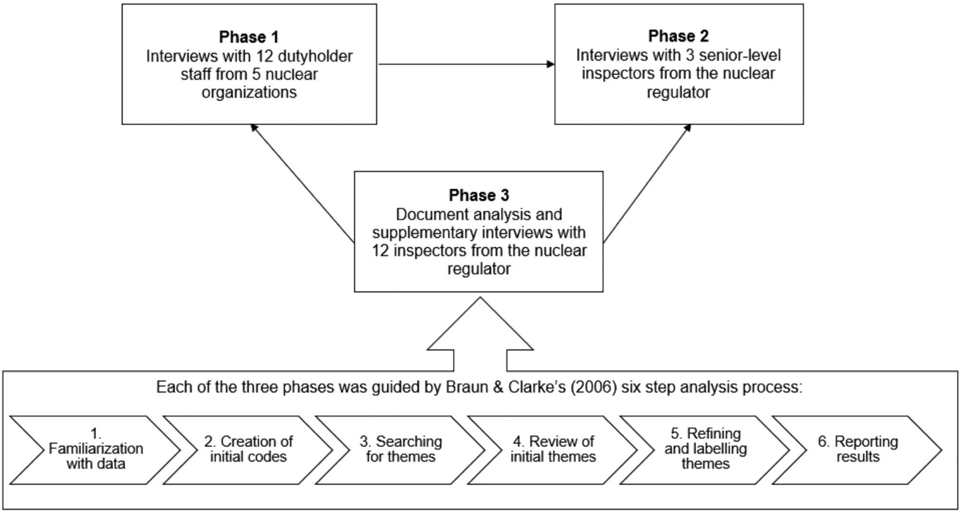
- Qualitative iterative design in the nuclear industry. Data included 12 semi-structured interviews with employees from five nuclear dutyholder organizations, three follow-up interviews with senior nuclear inspectors, 12 supplementary interviews with nuclear regulator inspectors, and analysis of two regulator documents. Interviews were conducted July 2020–January 2021, averaged 60 min, and were transcribed verbatim.
- Thematic analysis followed Braun and Clarke’s six steps. Phase 1 was predominantly inductive; phases 2 and 3 used a more deductive approach with some inductive review. Semantic and latent coding were used, with triangulation, cross-coding, member checking, and NVivo for an audit trail.
Limitations
- Stated: the study is primarily interview-based and reflects individuals’ experiences at a given point in time; it did not include more objective data on regulator influence; question wording such as “collaboration” may have primed participants toward informal interactions; participants knew the regulator would receive a summary, which may have influenced responses. Future research is suggested in other industries and with quantitative or longitudinal designs.
- Evident from the text: the findings come from a small qualitative sample in one heavily regulated nuclear context and are based on perceptions, limiting generalizability and causal inference.
Model-written summary. Check it against the paper before relying on it.
Integrity signals
Registry
Cites
Statistics
Figures
Verification
Claims the paper makes
0 Valid · 4 Not valid · 39 Not checked · 163 Own results and interpretations
A result the paper reports from its own data — it cites no other source for it, so there is none to check. The quote shows it is in the paper.
In the paper
“The findings identified that the regulator was perceived to hold three complementary roles for safety culture development: being an enforcer, working as a partner (providing opportunities for licenseholders to improve beyond compliance), and acting as an advisor to regulated organizations.”
§ Understanding the regulator-regulatee relationship for developing safety culture > Abstract
plain- Asserted: passes — The authors put it forward as true.
- Checkable: passes — It can be checked against evidence.
- Load-bearing: passes — The paper’s conclusions depend on it.
- Based: passes — The paper gives a reason why it holds.
A result the paper reports from its own data — it cites no other source for it, so there is none to check. The quote shows it is in the paper.
In the paper
“Analysis also showed that effective relationships in these roles, and which were central to influencing safety culture, were perceived to be characterized by professionalism, transparency, and balance between formal enforcement and informal exchange.”
§ Understanding the regulator-regulatee relationship for developing safety culture > Abstract
plainstates an association- Asserted: passes — The authors put it forward as true.
- Checkable: passes — It can be checked against evidence.
- Load-bearing: passes — The paper’s conclusions depend on it.
- Based: passes — The paper gives a reason why it holds.
A result the paper reports from its own data — it cites no other source for it, so there is none to check. The quote shows it is in the paper.
In the paper
“The findings identified that the regulator was perceived to hold three complementary roles for safety culture development: being an enforcer, working as a partner (providing opportunities for licenseholders to improve beyond compliance), and acting as an advisor to regulated organizations.”
§ Understanding the regulator-regulatee relationship for developing safety culture > Abstract
plain- Asserted: passes — The authors put it forward as true.
- Checkable: passes — It can be checked against evidence.
- Load-bearing: passes — The paper’s conclusions depend on it.
- Based: passes — The paper gives a reason why it holds.
A result the paper reports from its own data — it cites no other source for it, so there is none to check. The quote shows it is in the paper.
In the paper
“Analysis also showed that effective relationships in these roles, and which were central to influencing safety culture, were perceived to be characterized by professionalism, transparency, and balance between formal enforcement and informal exchange.”
§ Understanding the regulator-regulatee relationship for developing safety culture > Abstract
plainstates an association- Asserted: passes — The authors put it forward as true.
- Checkable: passes — It can be checked against evidence.
- Load-bearing: passes — The paper’s conclusions depend on it.
- Based: passes — The paper gives a reason why it holds.
82 more claims
Create a free account to see all 206 claims and to verify the 24 references still open.
- Probably not a substantial claim. 74
- It may state two separate claims as one. 63
- The quote only partly states this claim. 2
Self-check
Percentages, sums and reported differences re-computed from the paper’s own numbers.
Each contradiction between two passages listed here was confirmed by an independent check.
Rated minor: it would not touch a result — a value no result rests on, a p-value that stays on the same side of the significance level, or a conflict that is clerical, resolved elsewhere in the paper, or outside its own findings.
In the paper
§ Understanding the regulator-regulatee relationship for developing safety culture > 1.3 Safety culture and its development
“Vogus et al. (2010) present a three-dimensional model of safety culture development, which proposes that actors create, sustain, and evolve safety culture through three behavioral processes: (a) enablement, (b) enactment, and (c) elaboration.”
§ Understanding the regulator-regulatee relationship for developing safety culture > 5.1 Regulators' three roles for safety culture development
“Vogus et al.'s (2010) model, which describes that safety culture develops through enablement, enactment, and enlargement.”
Rated minor: it would not touch a result — a value no result rests on, a p-value that stays on the same side of the significance level, or a conflict that is clerical, resolved elsewhere in the paper, or outside its own findings.
In the paper
§ Understanding the regulator-regulatee relationship for developing safety culture > 4.1 Research question 1
“analysis resulted in four categories that describe different types of roles of the regulator: an enforcement role, a partner/collaborator role, and a consultant/advisor role.”
§ Understanding the regulator-regulatee relationship for developing safety culture > 5.1 Regulators' three roles for safety culture development
“Participants perceptions reflected three key roles that were ascribed to the regulator: the enforcement agency, the partner, and the consultant.”
Citations
Cites
Using thematic analysis in psychology
Braun, V., & Clarke, V. (2006) · Qualitative Research in Psychology · doi:10.1191/1478088706qp063oa · Cited by 194,414
Designing and Conducting Mixed Methods Research
Robinson, P. (2007) · Australian and New Zealand Journal of Public Health · doi:10.1111/j.1753-6405.2007.00096.x · Cited by 23,258
Document Analysis as a Qualitative Research Method
Bowen, G. A. (2009) · Qualitative Research Journal · doi:10.3316/qrj0902027 · Cited by 13,013
One size fits all? What counts as quality practice in (reflexive) thematic analysis?
Braun, V., & Clarke, V. (2021) · Qualitative Research in Psychology · doi:10.1080/14780887.2020.1769238 · Cited by 9,727
(2006) · Cited by 7,081
Successful Qualitative Research: A practical guide for beginners
(2014) · QMiP Bulletin · doi:10.53841/bpsqmip.2014.1.18.39 · Cited by 6,661
Managing the Risks of Organizational Accidents
Reason, J. (2016) · Routledge eBooks · doi:10.4324/9781315543543 · Cited by 4,430
Organizational culture and leadership
Tohidi, H., & Jabbari, M. M. (2012) · Procedia - Social and Behavioral Sciences · doi:10.1016/j.sbspro.2011.12.156 · Cited by 4,303
Successful qualitative research: A practical guide for beginners
(2016) · QMiP Bulletin · doi:10.53841/bpsqmip.2016.1.21.48 · Cited by 4,019
The nature of safety culture: a review of theory and research
Guldenmund, F. W. (2000) · Safety Science · doi:10.1016/s0925-7535(00)00014-x · Cited by 1,831
Research works printed but not linked: 8
- 10.1177/001872081986887 · doi:10.1177/001872081986887
- Bradley C. S.(2017).Regulator safety (oversight) culture: How a regulator's culture influences safety outcomes in high hazard industries[Doctoral dissertation Fielding Graduate University]. ProQuest Dissertation Publishing. Regulator safety (oversight) culture: How a regulator's culture influences safety outcomes in high hazard industries—ProQuest.
- 10.1037/1076‐8998.11.4.315 · DOI · Paper page
- CNSC. (2019).The Canadian Nuclear regulator's perspective on safety culture[conference presentation abstract].International Conference on Effective Nuclear and Radiation Regulatory Systems The Hague Netherlands.
- Grote G., 2013, Trapping Safety into Rules, 225
- Le Coze J.‐C., 2013, Trapping safety into rules, 109
- 10.1177/160940691773384 · doi:10.1177/160940691773384
- Turner B., 1978, Man‐made disasters
Cited by
Chatzoglou, P., Kotzakolios, A. E., & Marhavilas, P. K. (2025) · Safety · doi:10.3390/safety11020052 · Cited by 20
van Duin, S. R., Dekker, H. C., Mendoza, J., & Wielhouwer, J. L. (2025) · Regulation & Governance · doi:10.1111/rego.70034 · Cited by 2
Chu, Z., & Cheng, M. (2025) · Work · doi:10.1177/10519815251350641 · Cited by 2
Gomargana, C., Wibowo, K. A., & Widjajakusuma, J. (2025) · FaST - Jurnal Sains dan Teknologi (Journal of Science and Technology) · doi:10.19166/jstfast.v9i2.10416 · Cited by 1
Clarke, S., Siegl, L., & Holman, D. J. (2025) · Risk Analysis · doi:10.1111/risa.70043
Self-citation
Metadata
- Authors
- Willis, S., Holman, D., Clarke, S., & Hartwig, A.
- Affiliations
- University of Manchester (GB)
- Corresponding author
- Willis, Sara
- Venue
- Risk Analysis
- Publisher
- Wiley
- Published
- 2023-09-05
- Volume
- 44
- Issue
- 4
- Pages
- 972-990
- ISSN
- 0272-4332 (ISSN-L)
- 1539-6924
- OpenAlex
- W4386466447
- Semantic Scholar
- 41c0f08e839d6fb383b9e078ea2eb1d29f34d3c1
- Cited by
- 9
- References
- 46
- Citations by year
- 2026: 4 · 2025: 5
- FWCI
- 2.33
- Type
- journal article
- Language
- en
- Open access
- hybrid
- doi.org
- Licence
- Locations
- Risk Analysis (publishedVersion, cc-by-nc-nd)
- PubMed (publishedVersion)
- Research Explorer (The University of Manchester) (submittedVersion, other-oa)
- Topics
- Social Sciences › Public Administration › Regulation and Compliance Studies
- Social Sciences › Safety Research › Occupational Health and Safety Research
- Social Sciences › Sociology and Political Science › Risk Perception and Management
- Keywords
- safety culture, regulatory influence, nuclear industry, safety regulations, regulatory function, advisory role, compliance, professionalism, transparency, risk regulation
- MeSH terms
- Humans, Safety Management
About these checks
Registry, retraction, Cites and statistics results are computed, not judged, with one exception: a printed reference that no index lists is read once by a model before it counts as a citation error. Claims are extracted by a model and kept only when their quote appears verbatim in the text; each cited source is then checked, with a model’s help, for whether it says what the claim relies on. Those verdicts can be wrong — read the claim’s quote and the cited source before relying on one.
A language model drew the claims from the paper on 2026-11-15, under version 3 of the claim definition (model deepseek-v4.1-flash, prompt extract-v3).
A second model labelled each claim on 2026-11-15 (model jev-1.13-20260917, definition revision gold-guideline-v0.2).
Statistics and arithmetic are recomputed, not judged.
Confidence bands are shown only for fields calibrated on our annotated test set. None is calibrated yet, so no band is shown.
What counts as a claim ›How we measure confidence ›How we check this ›
Are you an author, or do you see a problem with this page? Request a review
How to cite
Cite CoChat for the checks on this page, and the paper for its own findings.
- This page
- CoChat. (2026). Citation check: Understanding the regulator–regulatee relationship for developing safety culture. https://app.cochat.ai/papers/10.1111/risa.14214
- The paper
- Willis, S., Holman, D., Clarke, S., & Hartwig, A. (2024). Understanding the regulator–regulatee relationship for developing safety culture. Risk Analysis. https://doi.org/10.1111/risa.14214
Data sources
Bibliographic data: Semantic Scholar, OpenAlex, Crossref.
Contains information from the Semantic Scholar Academic Graph Datasets, made available under the ODC Attribution License (ODC-BY 1.0).
Semantic Scholar’s data is described in: Kinney, R., et al. (2023). The Semantic Scholar Open Data Platform. arXiv:2301.10140.
