

Staphylococcus aureus and the ecology of the nasal microbiome
Open accessThe DOI matches its Crossref record; 31 of the 31 references it cites were found in a registry or an index.
Abstract
Nasal turf wars may provide the secrets to stopping staph.
Overview
The claims and statistics of this paper haven’t been checked yet.
Free: it reads the open-access text and checks the first 5 claims that cite a source we can check. Create a free account to check every claim.
Integrity signals
Registry
Cites
Statistics
Figures
Verification
Claims the paper makes
The claims and statistics of this paper haven’t been checked yet.
Free: it reads the open-access text and checks the first 5 claims that cite a source we can check. Create a free account to check every claim.
Claims other papers make about this one
Each is checked against this paper’s own text: does it say what the citing paper says it does?
The source backs part of the claim, not all of it — or backs it for a different population, condition or comparison.
In the citing paper
“Host genetics seems to have a minor effect on the URT microbiota in healthy individuals, only influencing nasal bacterial density and not the composition of the microbiota36.”
From The microbiota of the respiratory tract: gatekeeper to respiratory health (2017) · cites this paper as [36]
Experimental — accuracy not yet measured
Self-check
Percentages, sums and reported differences re-computed from the paper’s own numbers.
The self-check needs the paper’s full text.
Citations
Cites
QIIME allows analysis of high-throughput community sequencing data
Caporaso, J. G., Kuczynski, J., Stombaugh, J., Bittinger, K., Bushman, F. D., Costello, E. K., Fierer, N., Peña, A. G., Goodrich, J. K., Gordon, J. I., et al. (2010) · Nature Methods · doi:10.1038/nmeth.f.303 · Cited by 34,887
vegan: Community Ecology Package
Oksanen, J., Simpson, G. L., Blanchet, F. G., Kindt, R., Legendre, P., Minchin, P. R., O'Hara, R. B., Solymos, P., Stevens, M. H. H., Szoecs, E., et al. (2001) · CRAN: Contributed Packages · doi:10.32614/cran.package.vegan · Cited by 22,615
Search and clustering orders of magnitude faster than BLAST
Edgar, R. C. (2010) · Bioinformatics · doi:10.1093/bioinformatics/btq461 · Cited by 20,826
UCHIME improves sensitivity and speed of chimera detection
Edgar, R. C., Haas, B. J., Clemente, J. C., Quince, C., & Knight, R. (2011) · Bioinformatics · doi:10.1093/bioinformatics/btr381 · Cited by 15,114
McDonald, D., Price, M. N., Goodrich, J., Nawrocki, E. P., DeSantis, T. Z., Probst, A., Andersen, G. L., Knight, R., & Hugenholtz, P. (2012) · The ISME Journal · doi:10.1038/ismej.2011.139 · Cited by 5,064
The Ribosomal Database Project: improved alignments and new tools for rRNA analysis
Cole, J. R., Wang, Q., Cardenas, E., Fish, J., Chai, B., Farris, R. J., Kulam-Syed-Mohideen, A. S., McGarrell, D. M., Marsh, T., Garrity, G. M., et al. (2009) · Nucleic Acids Research · doi:10.1093/nar/gkn879 · Cited by 4,762
Vaginal microbiome of reproductive-age women
Ravel, J., Gajer, P., Abdo, Z., Schneider, G. M., Koenig, S. S. K., McCulle, S. L., Karlebach, S., Gorle, R., Russell, J., Tacket, C. O., et al. (2011) · Proceedings of the National Academy of Sciences · doi:10.1073/pnas.1002611107 · Cited by 4,254
Methodology for Genetic Studies of Twins and Families
Neale, M. C., & Cardon, L. R. (1992) · doi:10.1007/978-94-015-8018-2 · Cited by 4,005
Gauze, G. F. (1934) · doi:10.5962/bhl.title.4489 · Cited by 3,285
Topographical and Temporal Diversity of the Human Skin Microbiome
Grice, E. A., Kong, H. H., Conlan, S., Deming, C. B., Davis, J., Young, A. C., Program, N. C. S., Bouffard, G. G., Blakesley, R. W., Murray, P. R., et al. (2009) · Science · doi:10.1126/science.1171700 · Cited by 2,953
Cited by
Items 201–260 of 260
Air Pollution as a Driver of Recurrent Upper-Airway Infections and Comorbid Health Issues
Hassan, A., Marinova, P., & Velikova, T. V. (2026) · Sinusitis · doi:10.3390/sinusitis10010009 · Cited by 3
“Reactive gases such as NO 2 , SO 2 , and O 3 further exacerbate this effect by generating oxidative radicals that selectively damage protective microbes, allowing stress-tolerant and potentially pathogenic species to proliferate [122].”
Characterizing the nasal microbiome using a nasal allergen challenge model
Linton, S., Sjaarda, C., Hossenbaccus, L., Davis, A., Greenlaw, J., Douchant, K., Thiele, J., Garvey, S., Botting, H., Steacy, L. M., et al. (2026) · Journal of Allergy and Clinical Immunology · doi:10.1016/j.jaci.2026.05.003 · Cited by 1
Navarro-Díaz, M., Bertram, K., Göbel, L., Camus, L., Ham, S., Angenent, L. T., Gómez, J. A. V., Heilbronner, S., Stincone, P., Rapp, J., et al. (2026) · The ISME Journal · doi:10.1093/ismejo/wrag268 · Cited by 2
Meyer, S., Padilla, A. C. H., & Barraud, O. (2020) · Revue Francophone des Laboratoires · doi:10.1016/s1773-035x(20)30355-5 · Cited by 1
Staphylococcus aureus and Its Proteins
Abdurrahman, G., & Bröker, B. M. (2022) · Springer eBooks · doi:10.1007/978-981-16-0784-4_14 · Cited by 1
Considering humans as habitat reveals evidence of successional disease ecology among human pathogens
Fefferman, N. H., Price, C. A., & Stringham, O. (2022) · PLoS Biology · doi:10.1371/journal.pbio.3001770 · Cited by 1
“Studies have provided both theoretical insight and clinical recommendations in application to gut [45,46], vaginal [47], oral [48], nasal [49], and dermal [50] microbiota, exploring the transition from established but harmless colonization, to clinical pathology, and what might be done to mitigate medical risks via re…”
BackgroundAreStaphylococcus aureusCarrier Types Evidence of Population Heterogeneity?
Beams, A. B., Keegan, L. T., Adler, F. R., Samore, M. H., Khader, K., & Toth, D. J. A. (2022) · American Journal of Epidemiology · doi:10.1093/aje/kwac201 · Cited by 1
Dalman, M. R., Simison, W. B., Nielsen, D. P., Bhatta, S., Ramahi, N., Yee, C., Thapaliya, D., Kadariya, J., Cheatham, S., Olson, H., et al. (2025) · Frontiers in Microbiomes · doi:10.3389/frmbi.2024.1457940 · Cited by 1
Hickman, E., Hinton, A. L., Zorn, B., Rebuli, M. E., Robinette, C., Wolfgang, M. C., Mucha, P. J., & Jaspers, I. (2021) · Research Square · doi:10.21203/rs.3.rs-725763/v2 · Cited by 2
Brülisauer, L., Boumasmoud, M., Fait, A., Pfrunder‐Cardozo, K. R., Brugger, S. D., & Hall, A. R. (2026) · bioRxiv (Cold Spring Harbor Laboratory) · doi:10.64898/2026.01.07.698121 · Cited by 1
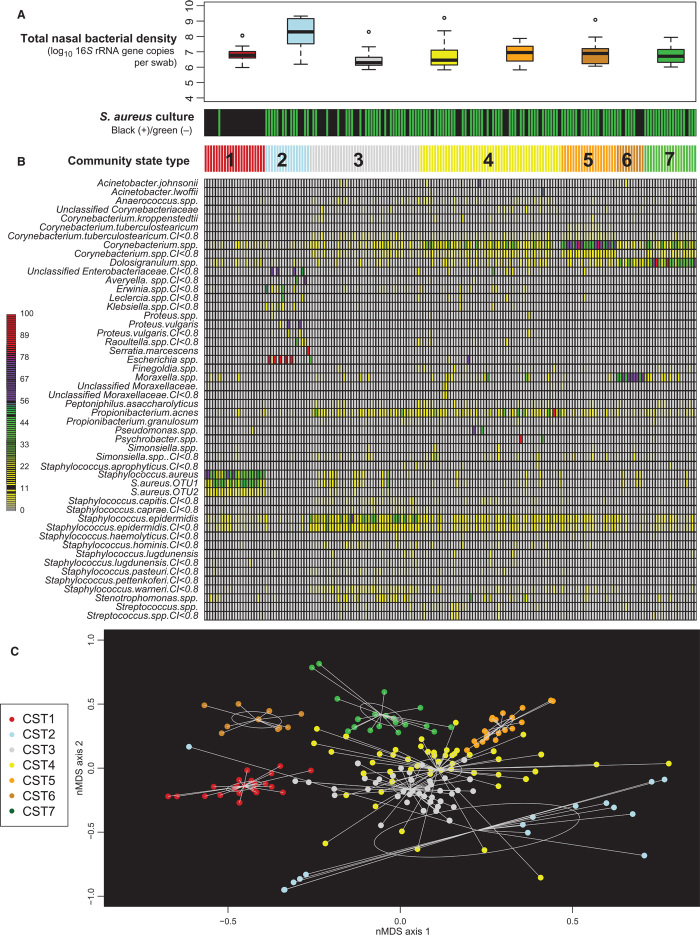
“…samples ( Staphylococcus, Moraxella, Citrobacter, Corynebacterium and Dolosigranulum ) and represented three previously described nasal community state types (CSTs) [19]: CST1 (dominated by S. aureus ; MC_D10), CST2 (dominated by Enterobacteriaceae; MC_D04), and CST6 (dominated by Moraxella spp .”
InfluentialLa microbiota en el control de la colonización nasal por Staphylococcus Aureus
Revilla, G., & de Jesus, V. N. (2017) · UCrea (University of Cantabria)
Development of a Non-Human Primate Model for Staphylococcus aureus Nasal Carriage
Lasseter, A. G. (2018) · STARS (University of Central Florida)
Respiratory Microbiome in Children
Kim, D. H. (2019) · Pediatric Infection & Vaccine · doi:10.14776/piv.2019.26.e24
Ibrahim, L. F. (2019) · Minerva Access (University of Melbourne)
Elimination and irrigation therapy to optimize the state of the nasal microbiome in children
Chelpachenko, O. E., Danilova, E. I., & In, C. (2021) · Meditsinskiy sovet = Medical Council · doi:10.21518/2079-701x-2021-1-50-58
Calicaran, J. R., & Penuliar, G. M. (2021) · The Philippine journal of science · doi:10.56899/150.04.18
“Similar findings were reported by Liu et al. (2015), where 81% of their CA-MRSA isolates – from the skin and soft tissue infections – harbored the hla gene.”
ResultWootton, C. I., & Elliott, I. (2024) · Wiley eBooks · doi:10.1002/9781119709268.rook026
Invasion muqueuse au cours de la colonisation nasale à Staphylococcus aureus
Rigaill, J. (2022) · theses.fr (ABES) · doi:10.70675/c7eb76b0z0712z4e85z838bz018afa6ace89
Additional file 1 of Secretory IgA impacts the microbiota density in the human nose
van Dalen, R., Elsherbini, A. M. A., Harms, M., Alber, S., Stemmler, R., & Peschel, A. (2023) · Figshare · doi:10.6084/m9.figshare.24417572
Women in Infectious Agents and Disease: 2023
Chen, Z. (2024) · Frontiers research topics · doi:10.3389/978-2-8325-5069-4
van den Munckhof, E. H. A., Hafkamp, H. C., de Kluijver, J., Kuijper, E. J., de Koning, M. N. C., Quint, W. G. V., & Knetsch, C. W. (2020) · Figshare · doi:10.6084/m9.figshare.12655643
Raineri, E. J. M., Maaß, S., Wang, M., Brushett, S., Medina, L. M. P., Escandell, N. S., Altulea, D., Raangs, E. C., de Jong, A., Vera Murguia, E., et al. (2024) · Figshare · doi:10.6084/m9.figshare.26557394
Raineri, E. J. M., Maaß, S., Wang, M., Brushett, S., Medina, L. M. P., Escandell, N. S., Altulea, D., Raangs, E. C., de Jong, A., Vera Murguia, E., et al. (2024) · Figshare · doi:10.6084/m9.figshare.26557385
Additional file 4 of Secretory IgA impacts the microbiota density in the human nose
van Dalen, R., Elsherbini, A. M. A., Harms, M., Alber, S., Stemmler, R., & Peschel, A. (2024) · Figshare · doi:10.6084/m9.figshare.26630179
Additional file 6 of Secretory IgA impacts the microbiota density in the human nose
van Dalen, R., Elsherbini, A. M. A., Harms, M., Alber, S., Stemmler, R., & Peschel, A. (2024) · Figshare · doi:10.6084/m9.figshare.26630185
Raineri, E. J. M., Maaß, S., Wang, M., Brushett, S., Medina, L. M. P., Escandell, N. S., Altulea, D., Raangs, E. C., de Jong, A., Vera Murguia, E., et al. (2024) · Figshare · doi:10.6084/m9.figshare.26557406
van den Munckhof, E. H. A., Hafkamp, H. C., de Kluijver, J., Kuijper, E. J., de Koning, M. N. C., Quint, W. G. V., & Knetsch, C. W. (2020) · Figshare · doi:10.6084/m9.figshare.12655646
Additional file 5 of Secretory IgA impacts the microbiota density in the human nose
van Dalen, R., Elsherbini, A. M. A., Harms, M., Alber, S., Stemmler, R., & Peschel, A. (2024) · Figshare · doi:10.6084/m9.figshare.26630182
Raineri, E. J. M., Maaß, S., Wang, M., Brushett, S., Medina, L. M. P., Escandell, N. S., Altulea, D., Raangs, E. C., de Jong, A., Vera Murguia, E., et al. (2024) · Figshare · doi:10.6084/m9.figshare.26557400
Raineri, E. J. M., Maaß, S., Wang, M., Brushett, S., Medina, L. M. P., Escandell, N. S., Altulea, D., Raangs, E. C., de Jong, A., Vera Murguia, E., et al. (2024) · Figshare · doi:10.6084/m9.figshare.26557397
Additional file 7 of Secretory IgA impacts the microbiota density in the human nose
van Dalen, R., Elsherbini, A. M. A., Harms, M., Alber, S., Stemmler, R., & Peschel, A. (2024) · Figshare · doi:10.6084/m9.figshare.26630188
Raineri, E. J. M., Maaß, S., Wang, M., Brushett, S., Medina, L. M. P., Escandell, N. S., Altulea, D., Raangs, E. C., de Jong, A., Vera Murguia, E., et al. (2024) · Figshare · doi:10.6084/m9.figshare.26557391
Accorsi, E. K., Franzosa, E. A., Hsu, T. Y., Joice Cordy, R., Maayan‐Metzger, A., Jaber, H., Reiss-Mandel, A., Kline, M., DuLong, C. R., Lipsitch, M., et al. (2020) · Figshare · doi:10.6084/m9.figshare.13467281
Accorsi, E. K., Franzosa, E. A., Hsu, T. Y., Joice Cordy, R., Maayan‐Metzger, A., Jaber, H., Reiss-Mandel, A., Kline, M., DuLong, C. R., Lipsitch, M., et al. (2020) · Figshare · doi:10.6084/m9.figshare.13467285
Techasupaboon, T., Vasikasin, V., Varothai, N., Raknaisil, N., & Nasomsong, W. (2022) · Figshare · doi:10.6084/m9.figshare.21018981
van den Munckhof, E. H. A., Hafkamp, H. C., de Kluijver, J., Kuijper, E. J., de Koning, M. N. C., Quint, W. G. V., & Knetsch, C. W. (2020) · Figshare · doi:10.6084/m9.figshare.12655640
Raineri, E. J. M., Maaß, S., Wang, M., Brushett, S., Medina, L. M. P., Escandell, N. S., Altulea, D., Raangs, E. C., de Jong, A., Vera Murguia, E., et al. (2024) · Figshare · doi:10.6084/m9.figshare.26557409
Raineri, E. J. M., Maaß, S., Wang, M., Brushett, S., Medina, L. M. P., Escandell, N. S., Altulea, D., Raangs, E. C., de Jong, A., Vera Murguia, E., et al. (2024) · Figshare · doi:10.6084/m9.figshare.26557403
van den Munckhof, E. H. A., Hafkamp, H. C., de Kluijver, J., Kuijper, E. J., de Koning, M. N. C., Quint, W. G. V., & Knetsch, C. W. (2020) · Figshare · doi:10.6084/m9.figshare.12655649
Additional file 8 of Secretory IgA impacts the microbiota density in the human nose
van Dalen, R., Elsherbini, A. M. A., Harms, M., Alber, S., Stemmler, R., & Peschel, A. (2024) · Figshare · doi:10.6084/m9.figshare.26630191
Additional file 2 of Secretory IgA impacts the microbiota density in the human nose
van Dalen, R., Elsherbini, A. M. A., Harms, M., Alber, S., Stemmler, R., & Peschel, A. (2024) · Figshare · doi:10.6084/m9.figshare.24417603
Additional file 3 of Secretory IgA impacts the microbiota density in the human nose
van Dalen, R., Elsherbini, A. M. A., Harms, M., Alber, S., Stemmler, R., & Peschel, A. (2024) · Figshare · doi:10.6084/m9.figshare.26630176
Raineri, E. J. M., Maaß, S., Wang, M., Brushett, S., Medina, L. M. P., Escandell, N. S., Altulea, D., Raangs, E. C., de Jong, A., Vera Murguia, E., et al. (2024) · Figshare · doi:10.6084/m9.figshare.26557388
The role of the microbiome in rheumatoid arthritis
Hammad, D. B. M. (2020) · Keele Research Repository (Keele University) · Cited by 1
Fernández‐Fernández, R. (2023) · RIUR (Universidad de La Rioja)
Carraro, D. C. (2019) · LA Referencia (Red Federada de Repositorios Institucionales de Publicaciones Científicas)
Modeling assembly dynamics and stability of microbial communitiesPreprint
Eilersen, A., Sneppen, K., & Bonhoeffer, S. (2025) · bioRxiv (Cold Spring Harbor Laboratory) · doi:10.64898/2025.12.17.694811
Pathogens as commensals: microbial priming of the immune system and heterologous protection
Belcher, T., & Stevens, E. J. (2026) · Microbiology · doi:10.1099/mic.0.001680
“Their findings demonstrate, in line with the findings of Liu et al. [110], a distinct CST, dominated and shaped by S. aureus, and an additional six CSTs in which S. aureus is rare or absent.”
Infant Nasal Microbiome and Respiratory Health Outcomes in Early Childhood in the CHILD Cohort
Qian, Y. C. (2023) · TSpace (University of Toronto)
Fait, A., Angst, D. C., Stylianou, V., Brülisauer, L., Brugger, S. D., & Hall, A. R. (2026) · bioRxiv (Cold Spring Harbor Laboratory) · doi:10.64898/2026.02.27.708567 · Cited by 1
Ham, S., Navarro-Díaz, M., Camus, L., Lucas, T. N., Stincone, P., Heilbronner, S., Link, H., Petras, D., Huson, D. H., & Angenent, L. T. (2026) · bioRxiv (Cold Spring Harbor Laboratory) · doi:10.64898/2026.03.16.712028 · Cited by 1
Impact du métabolisme des molécules odorantes sur la perception olfactive chez l'Homme
Robert‐Hazotte, A. (2018) · theses.fr (ABES) · doi:10.70675/b59a8807z6e65z4c9dz84deze02c2c0fdd83
The Sinonasal Microbiome in ENP
Cavaliere, C., & Loperfido, A. (2026) · Springer eBooks · doi:10.1007/978-3-032-17378-2_28-1
Microbiome and Diseases: Allergy
Amar, Y., Faihs, V., Hils, M., Köberle, M., & Biedermann, T. (2026) · Springer eBooks · doi:10.1007/978-3-032-26410-7_12
Metadata
- Authors
- Liu, C. M., Price, L. B., Hungate, B. A., Abraham, A. G., Larsen, L. A., Christensen, K., Stegger, M., Skov, R., & Andersen, P. S.
- Affiliations
- Translational Genomics Research Institute (US)
- Northern Arizona University (US)
- Johns Hopkins University (US)
- University of Southern Denmark (DK)
- Statens Serum Institut (DK)
- Corresponding author
- Liu, Cindy M.
- ORCID
- Venue
- Science Advances
- Published
- 2015-06-05
- Volume
- 1
- Issue
- 5
- Pages
- e1400216-e1400216
- ISSN
- 2375-2548 (ISSN-L)
- PMC
- PMC4640600
- OpenAlex
- W1753698591
- Cited by
- 253
- References
- 31
- Citations by year
- 2026: 14 · 2025: 24 · 2024: 38 · 2023: 14 · 2022: 27 · 2021: 33 · 2020: 31 · 2019: 22 · 2018: 18 · 2017: 15 · 2016: 16 · 2015: 1
- FWCI
- 12.95
- Type
- journal article
- Language
- en
- Open access
- gold
- doi.org
- Licence
- cc-by-nc
- Locations
- Science Advances (publishedVersion, cc-by-nc)
- PubMed Central (publishedVersion, cc-by-nc)
- PubMed (publishedVersion)
- Research at the University of Copenhagen (University of Copenhagen) (publishedVersion, cc-by-nc)
- University of Southern Denmark Research Portal (University of Southern Denmark) (submittedVersion, other-oa)
- Funders
- National Institute of Allergy and Infectious Diseases (ID0ET5AE1304, 1R15DE021194-01, ID0EOJAG1306)
- National Institute of Dental and Craniofacial Research (ID0EBEAG1305, 1R15DE021194-01, ID0EILAG1307)
- Topics
- Health Sciences › Medicine › Infectious Diseases › Antimicrobial Resistance in Staphylococcus
- Life Sciences › Biochemistry, Genetics and Molecular Biology › Molecular Biology › Gut microbiota and health
- Health Sciences › Medicine › Dermatology › Dermatology and Skin Diseases
- Keywords
- Staphylococcus aureus, nasal microbiota, bacterial colonization, monozygotic twins, dizygotic twins, host genetics, sex differences, lactic acid bacteria, bacterial interactions
About these checks
Registry, retraction, Cites and statistics results are computed, not judged, with one exception: a printed reference that no index lists is read once by a model before it counts as a citation error. Claims are extracted by a model and kept only when their quote appears verbatim in the text; each cited source is then checked, with a model’s help, for whether it says what the claim relies on. Those verdicts can be wrong — read the claim’s quote and the cited source before relying on one.
Statistics and arithmetic are recomputed, not judged.
Confidence bands are shown only for fields calibrated on our annotated test set. None is calibrated yet, so no band is shown.
What counts as a claim ›How we measure confidence ›How we check this ›
Are you an author, or do you see a problem with this page? Request a review
Data sources
Bibliographic data: Semantic Scholar, OpenAlex, Crossref.
Contains information from the Semantic Scholar Academic Graph Datasets, made available under the ODC Attribution License (ODC-BY 1.0).
Semantic Scholar’s data is described in: Kinney, R., et al. (2023). The Semantic Scholar Open Data Platform. arXiv:2301.10140.
