

The DOI matches its Crossref record; 39 of the 39 references it cites were found in a registry or an index.
Magnetosensitive e-skins with directional perception for augmented reality
Open accessAbstract
We demonstrate magnetosensitive e-skins for magnetic cognition, body position tracking, and touchless object manipulation.
Overview
The claims and statistics of this paper haven’t been checked yet.
Free: it reads the open-access text and checks the first 5 claims that cite a source we can check. Create a free account to check every claim.
Integrity signals
Registry
Cites
Statistics
Figures
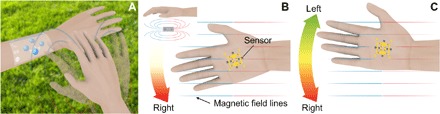


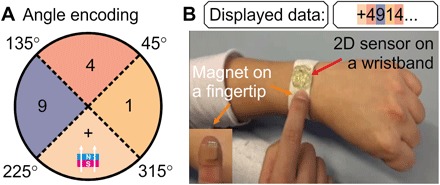
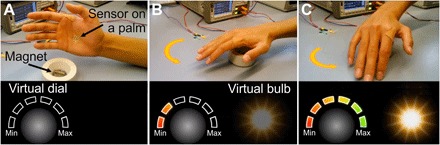
Verification
Claims the paper makes
The claims and statistics of this paper haven’t been checked yet.
Free: it reads the open-access text and checks the first 5 claims that cite a source we can check. Create a free account to check every claim.
Claims other papers make about this one
Each is checked against this paper’s own text: does it say what the citing paper says it does?
The cited source says what the claim attributes to it.
In the citing paper
“Due to new sensing mechanisms, e-skin can exhibit greater functionality beyond the human skin, such as proximity[259,260] and magnetic field sensing,[261,262] which can be seen as complements to the natural skin capabilities, allowing HMI devices to obtain richer information about the external environment.”
From Flexible Electronics and Devices as Human–Machine Interfaces for Medical Robotics (2022) · cites this paper as [261]
Self-check
Percentages, sums and reported differences re-computed from the paper’s own numbers.
The self-check needs the paper’s full text.
Citations
Cites
Fully integrated wearable sensor arrays for multiplexed in situ perspiration analysis
Gao, W., Emaminejad, S., Nyein, H. Y. Y., Challa, S., Chen, K., Peck, A., Fahad, H. M., Ota, H., Shiraki, H., Kiriya, D., et al. (2016) · Nature · doi:10.1038/nature16521 · Cited by 5,087
Nogués, J., & Schuller, I. K. (1999) · Journal of Magnetism and Magnetic Materials · doi:10.1016/s0304-8853(98)00266-2 · Cited by 4,677
An ultra-lightweight design for imperceptible plastic electronics
Kaltenbrunner, M., Sekitani, T., Reeder, J., Yokota, T., Kuribara, K., Tokuhara, T., Drack, M., Schwödiauer, R., Graz, I., Bauer-Gogonea, S., et al. (2013) · Nature · doi:10.1038/nature12314 · Cited by 2,485
Self-citationPursuing prosthetic electronic skin
Chortos, A., Liu, J., & Bao, Z. (2016) · Nature Materials · doi:10.1038/nmat4671 · Cited by 2,396
Fiber‐Based Wearable Electronics: A Review of Materials, Fabrication, Devices, and Applications
Zeng, W., Shu, L., Li, Q., Chen, S., Wang, F., & Tao, X. (2014) · Advanced Materials · doi:10.1002/adma.201400633 · Cited by 2,019
Recent Advances in Flexible and Stretchable Bio‐Electronic Devices Integrated with Nanomaterials
Choi, S., Lee, H., Ghaffari, R., Hyeon, T., & Kim, D. (2016) · Advanced Materials · doi:10.1002/adma.201504150 · Cited by 1,104
Ultraflexible organic photonic skin
Yokota, T., Zalar, P., Kaltenbrunner, M., Jinno, H., Matsuhisa, N., Kitanosako, H., Tachibana, Y., Yukita, W., Koizumi, M., & Someya, T. (2016) · Science Advances · doi:10.1126/sciadv.1501856 · Cited by 1,024
Self-citationMaterials and Optimized Designs for Human‐Machine Interfaces Via Epidermal Electronics
Jeong, J., Yeo, W., Akhtar, A., Norton, J. J. S., Kwack, Y., Li, S., Jung, S., Su, Y., Lee, W., Xia, J., et al. (2013) · Advanced Materials · doi:10.1002/adma.201301921 · Cited by 827
Wearable Chemical Sensors: Present Challenges and Future Prospects
Bandodkar, A. J., Jeerapan, I., & Wang, J. (2016) · ACS Sensors · doi:10.1021/acssensors.6b00250 · Cited by 778
Pu, X., Li, L., Song, H., Du, C., Zhao, Z., Jiang, C., Cao, G., Hu, W., & Wang, Z. L. (2015) · Advanced Materials · doi:10.1002/adma.201500311 · Cited by 731
Cited by
Wearable Sensors‐Enabled Human–Machine Interaction Systems: From Design to Application
Yin, R., Wang, D., Zhao, S., Lou, Z., & Shen, G. (2021) · Advanced Functional Materials · doi:10.1002/adfm.202008936 · Cited by 769
Pham, P. V., Bodepudi, S. C., Shehzad, K., Liu, Y., Xu, Y., Yu, B., & Duan, X. (2022) · Chemical Reviews · doi:10.1021/acs.chemrev.1c00735 · Cited by 708
Flexible Electronics and Devices as Human–Machine Interfaces for Medical Robotics
Heng, W., Solomon, S., & Gao, W. (2022) · Advanced Materials · doi:10.1002/adma.202107902 · Cited by 609
Koo, J. H., Kim, D. C., Shim, H. J., Kim, T., & Kim, D. (2018) · Advanced Functional Materials · doi:10.1002/adfm.201801834 · Cited by 562
Bioinspired Electronics for Artificial Sensory Systems
Jung, Y. H., Park, B., Kim, J. U., & Kim, T. (2019) · Advanced Materials · doi:10.1002/adma.201803637 · Cited by 336
Metadata
- Authors
- Cañón Bermúdez, G. S., Karnaushenko, D. D., Karnaushenko, D., Lebanov, A., Bischoff, L., Kaltenbrunner, M., Fassbender, J., Schmidt, O. G., & Makarov, D.
- Affiliations
- Helmholtz-Zentrum Dresden-Rossendorf e.V., Institute of Ion Beam Physics and Materials Research, Bautzner Landstrasse 400, 01328 Dresden, Germany.
- Leibniz Institute for Solid State and Materials Research (DE)
- Helmholtz-Zentrum Dresden-Rossendorf (DE)
- Johannes Kepler University of Linz (AT)
- Chemnitz University of Technology (DE)
- Corresponding author
- Makarov, Denys
- ORCID
- Venue
- Science Advances
- Published
- 2018-01-05
- Volume
- 4
- Issue
- 1
- Pages
- eaao2623-eaao2623
- ISSN
- 2375-2548 (ISSN-L)
- PMC
- PMC5777399
- OpenAlex
- W2787854852
- Cited by
- 147
- References
- 39
- Citations by year
- 2026: 8 · 2025: 15 · 2024: 25 · 2023: 15 · 2022: 19 · 2021: 24 · 2020: 17 · 2019: 13 · 2018: 11
- FWCI
- 6.50
- Type
- journal article
- Language
- en
- Open access
- gold
- doi.org
- Licence
- cc-by-nc
- Locations
- Science Advances (publishedVersion, cc-by-nc)
- Europe PMC (PubMed Central) (publishedVersion, cc-by-nc)
- PubMed Central (publishedVersion, cc-by-nc)
- PubMed (publishedVersion)
- RENATE (submittedVersion, cc-by-nc-nd)
- RENATE
- Funders
- FP7 Ideas: European Research Council (award342119, 306277)
- LIT Startup (award358304, LIT013144001SEL)
- Topics
- Physical Sciences › Engineering › Biomedical Engineering › Advanced Sensor and Energy Harvesting Materials
- Life Sciences › Neuroscience › Cognitive Neuroscience › Tactile and Sensory Interactions
- Physical Sciences › Physics and Astronomy › Condensed Matter Physics › Magnetic properties of thin films
- Keywords
- spin valve sensors, Wheatstone bridge, transfer printing, polyimide foil, augmented reality
- MeSH terms
- Wearable Electronic Devices, Humans, Magnetics, Robotics, Skin
About these checks
Registry, retraction, Cites and statistics results are computed, not judged, with one exception: a printed reference that no index lists is read once by a model before it counts as a citation error. Claims are extracted by a model and kept only when their quote appears verbatim in the text; each cited source is then checked, with a model’s help, for whether it says what the claim relies on. Those verdicts can be wrong — read the claim’s quote and the cited source before relying on one.
Statistics and arithmetic are recomputed, not judged.
Confidence bands are shown only for fields calibrated on our annotated test set. None is calibrated yet, so no band is shown.
What counts as a claim ›How we measure confidence ›How we check this ›
Are you an author, or do you see a problem with this page? Request a review
Data sources
Bibliographic data: Semantic Scholar, OpenAlex, Crossref.
Contains information from the Semantic Scholar Academic Graph Datasets, made available under the ODC Attribution License (ODC-BY 1.0).
Semantic Scholar’s data is described in: Kinney, R., et al. (2023). The Semantic Scholar Open Data Platform. arXiv:2301.10140.
