

Nonlinear integrated quantum electro-optic circuits
Open accessThe DOI matches its Crossref record; 34 of the 34 references it cites were found in a registry or an index; 3 of the 9 sources its claims cite were checked for support.
Abstract
An integrated chip with quantum state generation, active polarization manipulation, and precise time control is demonstrated.
Overview
CoChat Summary
TL;DR
The paper demonstrates a monolithic Ti:LiNbO₃ electro-optic quantum circuit that integrates photon-pair generation, polarization routing/rotation, electro-optic switching, and adjustable on-chip time delay for Hong-Ou-Mandel interference. It reports on-chip HOM interference with 93.5 ± 1.8% visibility and programmable delays from ~1.3 ps to more than 12 ps.
Key findings
- A single Ti:LiNbO₃ chip generated degenerate telecom photon pairs via type II quasi-phase-matched PDC, separated them with an integrated PBS, actively rotated polarization with electro-optic PCs, and recombined them at a voltage-tunable balanced BS.
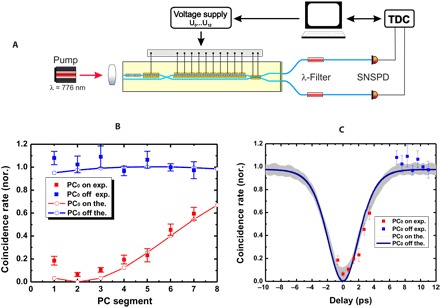
- On-chip HOM interference was observed with visibility 93.5 ± 1.8% at a pump power of ~100 μW, significantly above the 50% classical limit.
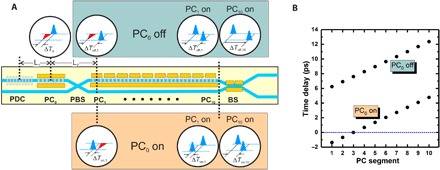
- The birefringent electro-optic delay (BED) line provided a relative time delay variable from ~1.3 ps to more than 12 ps, with discrete steps and resolution down to ~0.6 ps; 16 delays were designed, but only 14 were possible experimentally because the PC10 electrode was broken.
- The measured HOM dip temporal width was around 5.5 ps, and the device had total loss around 11 dB, corresponding to a Klyshko efficiency of 5%; PDC brightness was estimated at ~3 × 10⁵ pairs/(s·mW·nm).
Methods
- The circuit was fabricated on z-cut LiNbO₃ by Ti indiffusion, with periodically poled PDC and PC sections, SiO₂ buffer, patterned Al electrodes, AR/HR coatings, and temperature-stabilized mounting.
- Component lengths included a 20.7-mm PDC section (Λ_PDC = 9.04 μm), 7.62-mm PC0, 4.0-mm PBS, 10 segmented PC elements of 2.54 mm each, and a 13.1-mm BS; overall structure length was slightly more than 70 mm.
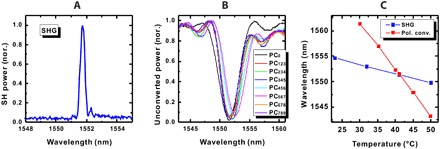
- Classical characterization used SHG, broadband spectral transmission, and temperature dependence to set the operating point at T = 43.6°C and λ = 1551.7 nm; quantum measurements used a ~776-nm pump, fiber filters, SNSPDs, and a TDC, with unitary-transformation simulations for comparison.
Limitations
- Stated: the discrete on-chip time delay prevented resolving the real shape of the HOM dip, and only seven triples of the segmented PC could be addressed because the PC10 electrode was broken, allowing only 14 different delays.
- Stated: simulations ignored the slight spectral shift of different PCs and the consequent spectral mismatch among PDC photons and fiber filters; incomplete conversion of PC0 strongly affected the HOM dip and could produce fast oscillations not resolvable with the current discrete delay resolution.
- Evident from the text: the demonstration is limited to one Ti:LiNbO₃ device and does not measure the full HOM dip; non-unity visibility is attributed to accumulated imperfections from individual components.
Model-written summary. Check it against the paper before relying on it.
Integrity signals
Registry
Cites
Statistics
Figures

Verification
Claims the paper makes
3 Valid · 5 Not valid · 5 Not checked · 43 Own results and interpretations
Every source the paper cites for this claim was checked and supports it.
In the paper
“After PC0, the H- and V-polarized photons are spatially separated at the PBS (29).”
§ Nonlinear integrated quantum electro-optic circuits > RESULTS > Birefringent electro-optic delay
What the sources say
- Supportedcites [29] Sansoni L., Luo K. H., Eigner C., Ricken R., Quiring V., Herrmann H., Silberhorn C., A two-channel, spectrally degenerate polarization entangled source on chip. NPJ Quant. Inf. 3, 5 (2017). source
The attributed content — that a PBS sends the H- and V-polarized photons into different spatial outputs — is stated repeatedly in our copy: the RESULTS (p. 1) describe type II pairs 'split on an integrated polarizing beam splitter (PBS)' giving |HA,VB〉 / |VA,HB〉, and RESULTS (p. 2) formalize the PBS input-to-output mode transformation with transmissivity/reflected amplitudes; MATERIALS AND METHODS (p. 3) give measured transmission for H and reflectivity for V (T_H = 0.996 ± 0.002, R_V = 0.968 ± 0.003), and the abstract/DISCUSSION (pp. 1, 3) stress emission of entangled photons 'into different spatial modes'. The 'PC0' element is a component of the citing authors' own apparatus and does not appear in this source (its setup uses a Sagnac loop, waveplates, LCD, PMFs and FBGs, Materials and Methods pp. 3-4); it is not part of what the citation asserts, so it does not weaken the verdict. (LLM, conf=0.85)
plainstates a cause- Asserted: passes — The authors put it forward as true.
- Checkable: passes — It can be checked against evidence.
- Load-bearing: passes — The paper’s conclusions depend on it.
- Based: passes — The paper gives a reason why it holds.
- Supported
The cited sources support only part of this claim — read each source’s verdict below.
In the paper
“In particular, even when the PC is driven to yield an incomplete conversion, it can produce programmable superpositions of quantum states (i.e., the generic polarization-encoded qubit α|H⟩ + β|V⟩) for subsequent quantum logic operations (31).”
§ Nonlinear integrated quantum electro-optic circuits > DISCUSSION
What the sources say
- Partly supportedcites [31] Crespi A., Ramponi R., Osellame R., Sansoni L., Bongioanni I., Sciarrino F., Vallone G., Mataloni P., Integrated photonic quantum gates for polarization qubits. Nat. Commun. 2, 566 (2011). 22127062 PMC3482629 sourceExperimental — accuracy not yet measured
Our copy supports the framing half of the claim: the Results section 'Integrated quantum gates for polarization-encoded qubits' defines the generic polarization-encoded qubit as the coherent superposition α|H〉+β|V〉 of single photons, and the Abstract plus 'Directional couplers as partially polarizing beam splitters' show integrated PPBSs with fine, independent control of the H and V splitting ratios, used to run quantum logic (the CNOT) on such qubits. What the paper does not state is the specific attribution: that driving the converter into an incomplete-conversion regime yields *programmable* α| +β| superpositions for subsequent gates — the couplers are fabricated with fixed designed transmissivities (T_H=0 for PPDC1, balanced for PPDC2/3), single-qubit operations are said to be 'straightforwardly implemented by using birefringent waveplates' (Results), and the Discussion lists on-chip preoriented and tunable waveplates as future research. So the programmable-state-preparation part of the sentence is not this paper's result. (LLM, conf=0.72)
plainstates a cause- Asserted: passes — The authors put it forward as true.
- Checkable: passes — It can be checked against evidence.
- Load-bearing: unclear — It is unclear whether the paper’s conclusions depend on it.
- Based: passes — The paper gives a reason why it holds.
- Partly supported
Every source the paper cites for this claim was checked and supports it.
In the paper
“For example, when PC0 only converts half of the polarization, hyperentanglement can be generated if the design parameters are carefully chosen (32).”
§ Nonlinear integrated quantum electro-optic circuits > DISCUSSION
What the sources say
- Supportedcites [32] Sharapova P. R., Luo K. H., Herrmann H., Reichelt M., Silberhorn C., Meier T., Modified two-photon interference achieved by the manipulation of entanglement. Phys. Rev. A 96, 043857 (2017). source
The paper calls the converter PC1 rather than PC0. It states that a π/4 rotation puts the photons in equal-amplitude polarization superpositions (p. 3), and that, with an appropriate channel length, the resulting spatial entanglement combines with preserved frequency entanglement to create hyperentanglement (pp. 3–4). (LLM, conf=0.90)
plainstates a possible cause- Asserted: passes — The authors put it forward as true.
- Checkable: passes — It can be checked against evidence.
- Load-bearing: unclear — It is unclear whether the paper’s conclusions depend on it.
- Based: passes — The paper gives a reason why it holds.
- Supported
A result the paper reports from its own data — it cites no other source for it, so there is none to check. The quote shows it is in the paper.
In the paper
“With the configuration of the present device, we can vary the relative time delay between ~1.3 ps and more than 12 ps, as shown in Fig. 2B.”
§ Nonlinear integrated quantum electro-optic circuits > RESULTS > Birefringent electro-optic delay
plain- Asserted: passes — The authors put it forward as true.
- Checkable: passes — It can be checked against evidence.
- Load-bearing: passes — The paper’s conclusions depend on it.
- Based: passes — The paper gives a reason why it holds.
In the paper
“Our monolithic solution is realized on the Ti:LiNbO3 platform (26), which exploits the strong χ(2) nonlinearity for both photon pair generation and electro-optic manipulation of the qubits.”
§ Nonlinear integrated quantum electro-optic circuits > RESULTS
What the sources say
- Not checked yetcites [26] K.-H. Luo, S. Brauner, C. Eigner, P. R. Sharapova, R. Ricken, T. Meier, H. Herrmann, C. Silberhorn, Monolithically integrated Hong-Ou-Mandel experiment in LiNbO3, in Conference on Lasers and Electro-Optics, OSA Terchnical Digest (online) (Optical Society of America, 2018), paper FM1G.3. source
boostedstates a cause- Asserted: passes — The authors put it forward as true.
- Checkable: passes — It can be checked against evidence.
- Load-bearing: passes — The paper’s conclusions depend on it.
- Based: passes — The paper gives a reason why it holds.
18 more claims
Create a free account to see all 56 claims and to verify the 6 references still open.
- It may state two separate claims as one. 24
- Probably not a substantial claim. 12
Claims other papers make about this one
Each is checked against this paper’s own text: does it say what the citing paper says it does?
The cited source says what the claim attributes to it.
In the citing paper
“LN will possibly be a valuable material for future photonic chips at is has a strong χ (2) nonlinearity and can be used to provide precise timing control via EO modulation [238].”
From 2022 Roadmap on integrated quantum photonics (2022) · cites this paper as [238]
Self-check
Percentages, sums and reported differences re-computed from the paper’s own numbers.
Each contradiction between two passages listed here was confirmed by an independent check.
Rated minor: it would not touch a result — a value no result rests on, a p-value that stays on the same side of the significance level, or a conflict that is clerical, resolved elsewhere in the paper, or outside its own findings.
In the paper
§ Nonlinear integrated quantum electro-optic circuits > RESULTS
“The H-polarized photons leave the splitter at the bar-state output, and V photons leave the splitter at the cross-state output.”
§ Nonlinear integrated quantum electro-optic circuits > MATERIALS AND METHODS > Components and circuit design
“routing of the H-polarized photons to the cross-state output of the coupler, whereas the V-polarized photons are directed into the bar-state output.”
Citations
Cites
A scheme for efficient quantum computation with linear optics
Knill, E., Laflamme, R., & Milburn, G. J. (2001) · Nature · doi:10.1038/35051009 · Cited by 5,880 · cited 1×
“For example, boson sampling [4, 5], Bell-state measurement for quantum repeaters, and KLM protocol for quantum computing [25] rely on HOM interference.”
MethodMeasurement of subpicosecond time intervals between two photons by interference
Hong, C. K., Ou, Z. Y., & Mandel, L. (1987) · Physical Review Letters · doi:10.1103/physrevlett.59.2044 · Cited by 4,369 · cited 2×
“[22] C.”
MethodGiovannetti, V., Lloyd, S., & Maccone, L. (2011) · Nature Photonics · doi:10.1038/nphoton.2011.35 · Cited by 3,894 · cited 1×
“In the past decade, many optical circuits for quantum gates [1], quantum interference [2], quantum metrology [3], boson sampling [4, 5] and quantum walks [6, 7] in different materials have been demonstrated.”
BackgroundNew CMOS-compatible platforms based on silicon nitride and Hydex for nonlinear optics
Moss, D. J., Morandotti, R., Gaeta, A. L., & Lipson, M. (2013) · Nature Photonics · doi:10.1038/nphoton.2013.183 · Cited by 1,792 · cited 1×
“Most of these circuits are realized in materials with χ((3)) nonlinearities like glass [8, 9], silicon nitride [10], silicon-on insulator [11] and silica-on-silicon [12– 15].”
BackgroundA review of lithium niobate modulators for fiber-optic communications systems
Wooten, E. L., Kissa, K. M., Yi-Yan, A., Murphy, E. J., Lafaw, D. A., Hallemeier, P. F., Maack, D., Attanasio, D. V., Fritz, D. J., McBrien, G. J., et al. (2000) · IEEE Journal of Selected Topics in Quantum Electronics · doi:10.1109/2944.826874 · Cited by 1,330
Carolan, J., Harrold, C., Sparrow, C., Martín-López, E., Russell, N. J., Silverstone, J. W., Shadbolt, P. J., Matsuda, N., Oguma, M., Itoh, M., et al. (2015) · Science · doi:10.1126/science.aab3642 · Cited by 1,093
Silica-on-silicon waveguide quantum circuits
Politi, A., Cryan, M. J., Rarity, J. G., Yu, S., & O'Brien, J. L. (2008) · Science · doi:10.1126/science.1155441 · Cited by 1,084
Quantum Walks of Correlated Photons
Peruzzo, A., Lobino, M., Matthews, J. C. F., Matsuda, N., Politi, A., Poulios, K., Zhou, X.-Q., Lahini, Y., Ismail, N., Wörhoff, K., et al. (2010) · Science · doi:10.1126/science.1193515 · Cited by 929
Boson Sampling on a Photonic Chip
Spring, J. B., Metcalf, B. J., Humphreys, P. C., Kolthammer, W. S., Jin, X.-M., Barbieri, M., Datta, A., Thomas-Peter, N., Langford, N. K., Kundys, D., et al. (2013) · Science · doi:10.1126/science.1231692 · Cited by 837
Tillmann, M., Dakić, B., Heilmann, R., Nolte, S., Szameit, A., & Walther, P. (2013) · Nature Photonics · doi:10.1038/nphoton.2013.102 · Cited by 709
Cited by
Nonvolatile programmable silicon photonics using an ultralow-loss Sb 2 Se 3 phase change material
Delaney, M., Zeimpekis, I., Du, H., Yan, X., Banakar, M., Thomson, D. J., Hewak, D. W., & Muskens, O. L. (2021) · Science Advances · doi:10.1126/sciadv.abg3500 · Cited by 283
Lithium Niobate on Insulator: An Emerging Platform for Integrated Quantum Photonics
Saravi, S., Pertsch, T., & Setzpfandt, F. (2021) · Advanced Optical Materials · doi:10.1002/adom.202100789 · Cited by 184
Rejuvenating a Versatile Photonic Material: Thin‐Film Lithium Niobate
Honardoost, A., Abdelsalam, K., & Fathpour, S. (2020) · Laser & Photonics Reviews · doi:10.1002/lpor.202000088 · Cited by 174
Sun, D., Zhang, Y., Wang, D., Song, W., Liu, X., Pang, J., Geng, D., Sang, Y., & Liu, H. (2020) · Light: Science & Applications · doi:10.1038/s41377-020-00434-0 · Cited by 174
Wang, M., Wu, R., Lin, J., Zhang, J., Fang, Z., Chai, Z., & Cheng, Y. (2019) · Quantum Engineering · doi:10.1002/que2.9 · Cited by 136
Xue, G.-T., Niu, Y.-F., Liu, X., Duan, J.-C., Chen, W., Pan, Y., Jia, K., Wang, X., Liu, H.-Y., Zhang, Y., et al. (2021) · Physical Review Applied · doi:10.1103/physrevapplied.15.064059 · Cited by 109
“Quantum states can be generated with unparalleled brightness by spontaneous parametric down-conversion (SPDC), and further tailored and modulated by domain engineering [17-19] and electro-optic modulation [20-22].”
BackgroundOn-chip heralded single photon sources
Signorini, S., & Pavesi, L. (2020) · AVS Quantum Science · doi:10.1116/5.0018594 · Cited by 100
Twisted van der Waals Quantum Materials: Fundamentals, Tunability, and Applications
Sun, X., Suriyage, M., Khan, A. R., Gao, M., Zhao, J., Liu, B., Hasan, M. M., Rahman, S., Chen, R., Lam, P. K., et al. (2024) · Chemical Reviews · doi:10.1021/acs.chemrev.3c00627 · Cited by 86
High-extinction electro-optic modulation on lithium niobate thin film
Jin, M., Chen, J.-Y., Sua, Y. M., & Huang, Y.-P. (2019) · Optics Letters · doi:10.1364/ol.44.001265 · Cited by 65
Interdisciplinary advances in microcombs: bridging physics and information technology
Yao, B., Wang, W., Xie, Z., Zhou, Q., Tan, T., Zhou, H., Guo, G., Zhu, S. N., Zhu, N., & Wong, C. W. (2024) · eLight · doi:10.1186/s43593-024-00071-9 · Cited by 74
Fabrication and photonic applications of Si-integrated LiNbO3 and BaTiO3 ferroelectric thin films
Wen, Y., Chen, H., Wu, Z., Li, W., & Zhang, Y. (2024) · APL Materials · doi:10.1063/5.0192018 · Cited by 62
Photonic Integrated Quantum Memory in Rare‐Earth Doped Solids
Zhou, Z., Liu, C., Li, C., Guo, G., Oblak, D., Lei, M., Faraon, A., Mazzera, M., & de Riedmatten, H. (2023) · Laser & Photonics Review · doi:10.1002/lpor.202300257 · Cited by 68
Mandal, M., De, P., Lakshan, S., Sarfaraj, M. N., Hazra, S., Dey, A., & Mukhopadhyay, S. (2022) · Journal of Optics · doi:10.1007/s12596-022-01045-1 · Cited by 45
Heterogeneously Integrated Photonics Based on Thin Film Lithium Niobate Platform
Han, H., Ruan, S., & Xiang, B. (2024) · Laser & Photonics Review · doi:10.1002/lpor.202400649 · Cited by 50
Quantum interferometers: Principles and applications
Jin, R., Zeng, Z.-Q., You, C., & Yuan, C. (2024) · Progress in Quantum Electronics · doi:10.1016/j.pquantelec.2024.100519 · Cited by 59
Unveiling the Pockels coefficient of ferroelectric nitride ScAlN
Yang, G., Wang, H., Mu, S., Xie, H., Wang, T., He, C. F., Shen, M., Liu, M., de Walle, C. G. V., & Tang, H. X. (2024) · Nature Communications · doi:10.1038/s41467-024-53895-x · Cited by 57
Sun, C., Wu, S.-H., Duan, J.-C., Zhou, J., Xia, J., Xu, P., Xie, Z., Gong, Y.-X., & Zhu, S. N. (2019) · Optics Letters · doi:10.1364/ol.44.005598 · Cited by 36
Li, D., Huang, X., Wu, Q., Zhang, L., Lu, Y., & Hong, X. (2022) · Advanced Materials · doi:10.1002/adma.202208825 · Cited by 33
Bright photon-pair source based on a silicon dual-Mach-Zehnder microring
Wu, C., Liu, Y., Gu, X., Yu, X., Kong, Y., Wang, Y., Qiang, X., Wu, J., Zhu, Z., Yang, X., et al. (2019) · Science China Physics Mechanics and Astronomy · doi:10.1007/s11433-019-1429-1 · Cited by 25
Tunable polarization mode conversion using thin-film lithium niobate ridge waveguide
Yang, G. H., Sergienko, A. V., & Ndao, A. (2021) · Optics Express · doi:10.1364/oe.426672 · Cited by 24
Massaro, A. S. (2023) · Electronics · doi:10.3390/electronics12183772 · Cited by 31
Duan, J.-C., Zhang, J.-N., Zhu, Y.-J., Sun, C., Liu, Y., Xu, P., Xie, Z., Gong, Y.-X., & Zhu, S. N. (2020) · Journal of the Optical Society of America B · doi:10.1364/josab.395108 · Cited by 21
Quantum optical coherence: From linear to nonlinear interferometers
Luo, K.-H., Santandrea, M., Stefszky, M., Sperling, J., Massaro, M., Ferreri, A., Sharapova, P. R., Herrmann, H., & Silberhorn, C. (2021) · Physical Review A · doi:10.1103/physreva.104.043707 · Cited by 24
“Furthermore, this experimental setup exploits a nonlinear waveguide as the core component, thereby increasing the strength of the nonlinear interaction and opening up the possibility for more complicated future devices in integrated architectures [41].”
Self-citationQuantum hydrodynamics of a single particle
Suárez-Forero, D. G., Ardizzone, V., da Silva, S. F. C., Reindl, M., Fieramosca, A., Polimeno, L., Giorgi, M. D., Dominici, L., Pfeiffer, L. N., Gigli, G., et al. (2020) · Light Science & Applications · doi:10.1038/s41377-020-0324-x · Cited by 24
Nonlinearity of Piezoelectric Micromachined Ultrasonic Transducer Using AlN Thin Film
Luo, Z., Cai, J., Zhang, S., Gu, Y. A., Lou, L., & Wu, T. (2022) · IEEE Open Journal of Ultrasonics Ferroelectrics and Frequency Control · doi:10.1109/ojuffc.2022.3182926 · Cited by 18
“However, the harmonics have a wide variety of applications in RF communications, quantum communications, and spectroscopy [13]–[15].”
BackgroundCryogenic integrated spontaneous parametric down-conversion
Lange, N. A., Höpker, J. P., Ricken, R., Quiring, V., Eigner, C., Silberhorn, C., & Bartley, T. J. (2021) · Optica · doi:10.1364/optica.445576 · Cited by 25
Self-citationIntegrated quantum polariton interferometry
Nigro, D., D’Ambrosio, V., Sanvitto, D., & Gerace, D. (2022) · Communications Physics · doi:10.1038/s42005-022-00810-9 · Cited by 19
Mandal, M., Goswami, I., & Mukhopadhyay, S. (2022) · Journal of Optics · doi:10.1007/s12596-022-00869-1 · Cited by 15
Spychala, K. J., Mackwitz, P., Widhalm, A., Berth, G., & Zrenner, A. (2020) · Journal of Applied Physics · doi:10.1063/1.5133476 · Cited by 17
Höpker, J. P., Verma, V., Protte, M., Ricken, R., Quiring, V., Eigner, C., Ebers, L., Hammer, M., Förstner, J., Silberhorn, C., et al. (2021) · Journal of Physics Photonics · doi:10.1088/2515-7647/ac105b · Cited by 14
“The high second-order nonlinear properties of lithium niobate, combined with quasi-phasematching by periodic poling, enable a range of nonlinear interactions relevant to quantum photonics [6], including photon-pair generation [5], frequency conversion, and spectral-temporal mode manipulation [7].”
BackgroundSelf-citationThomas, O., McCutcheon, W., & McCutcheon, D. P. S. (2021) · APL Photonics · doi:10.1063/5.0044036 · Cited by 22
“47 We introduce the term interference parameter to allow us to compare different degrees of freedom in one framework.”
BackgroundSurface-near domain engineering in multi-domain x-cut lithium niobate tantalate mixed crystals
Bollmers, L., Babai-Hemati, T., Koppitz, B., Eigner, C., Padberg, L., Rüsing, M., Eng, L. M., & Silberhorn, C. (2024) · Applied Physics Letters · doi:10.1063/5.0210972 · Cited by 17
Self-citationResetting directional couplers for high-fidelity quantum photonic integrated chips
Yu, F., Tian, Z., Piacentini, S., Li, X., Chen, Q., Osellame, R., & Sun, H. (2021) · Optics Letters · doi:10.1364/ol.439178 · Cited by 13
Wide Bandwidth Silicon Nitride Strip-Loaded Grating Coupler on Lithium Niobate Thin Film
Yang, F., Fang, H., Han, H., & Xiang, B. (2022) · Crystals · doi:10.3390/cryst12010070 · Cited by 12
Pillai, G., & Li, S. (2021) · Scientific Reports · doi:10.1038/s41598-021-90248-w · Cited by 13
Wavelength-Sensitive Superconducting Single-Photon Detectors on Thin Film Lithium Niobate Waveguides
Prencipe, A., Gyger, S., Baghban, M. A., Zichi, J., Zeuner, K. D., Lettner, T., Schweickert, L., Steinhauer, S., Elshaari, A. W., Gallo, K., et al. (2023) · Nano Letters · doi:10.1021/acs.nanolett.3c02324 · Cited by 14
Cryogenic electro-optic modulation in titanium in-diffused lithium niobate waveguides
Thiele, F., Bruch, F. V., Brockmeier, J., Protte, M., Hummel, T., Ricken, R., Quiring, V., Lengeling, S., Herrmann, H., Eigner, C., et al. (2022) · Journal of Physics Photonics · doi:10.1088/2515-7647/ac6c63 · Cited by 18
“Electro-optic phase modulators are therefore an essential tool for quantum optic networks [19, 51].”
BackgroundMethodSelf-citationConfigurable heralded two-photon Fock-states on a chip
Hua, X., Lunghi, T., Doutre, F., Vergyris, P., Sauder, G., Charlier, P., Labonté, L., D’Auria, V., Martin, A., Tascu, S., et al. (2020) · Optics Express · doi:10.1364/oe.403552 · Cited by 11
Tseng, Q.-H., Niko, A., Pham, T.-D., Chung, H.-P., Deng, L.-M., & Chen, Y.-H. (2022) · Optics Express · doi:10.1364/oe.460414 · Cited by 9
New effective technique to produce waveguides in lithium niobate on insulator (LNOI)
Osellame, R. (2019) · Quantum Engineering · doi:10.1002/que2.11 · Cited by 9
Programmable photon pair source
Cui, L., Wang, J., Li, J., Ma, M., Ou, Z. Y., & Li, X. (2022) · APL Photonics · doi:10.1063/5.0069383 · Cited by 10
Flexible source of correlated photons based on LNOI rib waveguides
Ebers, L., Ferreri, A., Hammer, M., Albert, M., Meier, C., Förstner, J., & Sharapova, P. R. (2022) · Journal of Physics Photonics · doi:10.1088/2515-7647/ac5a5b · Cited by 11
“Unlike free space, a compensation technique for integrated platforms is challenging due to their fixed size [42], therefore other methods such as the use of multiple poling periods [43] or a smart spectral engineering of the source [44] are strongly required.”
BackgroundSelf-citationMain, P. B., Mosley, P. J., & Gorbach, A. V. (2019) · Physical Review A · doi:10.1103/physreva.100.053815 · Cited by 9
Multifunction integrated lithium niobate photonic chip for photon pairs generation and manipulation
Pham, T.-D., Chiu, C.-C., Tsai, P.-J., & Chen, Y.-H. (2024) · Optics Express · doi:10.1364/oe.509229 · Cited by 6
Gain-Induced Group Delay in Spontaneous Parametric Down-Conversion
Thekkadath, G., Houde, M., England, D. G., Bustard, P. J., Bouchard, F., Quesada, N., & Sussman, B. (2024) · Physical Review Letters · doi:10.1103/physrevlett.133.203601 · Cited by 15
Q-factor modification of LN based WGM resonator
Yang, L., Zhuang, Y., Zhao, W., et al. (2022) · Materials Letters · doi:10.1016/j.matlet.2021.131292 · Cited by 6
2022 Roadmap on integrated quantum photonics
Moody, G., Sorger, V. J., Blumenthal, D. J., Juodawlkis, P. W., Loh, W., Sorace-Agaskar, C., Jones, A. E., Balram, K. C., Matthews, J. C. F., Laing, A., et al. (2022) · Journal of Physics: Photonics · doi:10.1088/2515-7647/ac1ef4 · Cited by 6
“LN will possibly be a valuable material for future photonic chips at is has a strong χ(2) nonlinearity and can be used to provide precise timing control via EO modulation [238].”
MethodQi, X., Lühder, T. A. K., Scheibinger, R., et al. (2024) · Laser & Photonics Reviews · doi:10.1002/lpor.202301302 · Cited by 6
Varo, S., Juška, G., & Pelucchi, E. (2022) · Scientific Reports · doi:10.1038/s41598-022-08535-z · Cited by 6
Broadband Biphoton Generation and Polarization Splitting in a Monolithic AlGaAs Chip
Appas, F., Meskine, O., Lemaître, A., Palomo, J. M., Baboux, F., Amanti, M. I., & Ducci, S. (2023) · ACS Photonics · doi:10.1021/acsphotonics.2c01900 · Cited by 7
All‐Optical Nonlinear Neuron Based on Metallic Quantum Wells
Niu, J., Shao, H., Feng, Y., Gao, B., Zhang, Y., Li, Y., Chen, H., & Qian, H. (2023) · Advanced Optical Materials · doi:10.1002/adom.202300223 · Cited by 5
Waveguide resonator with an integrated phase modulator for second harmonic generation
Stefszky, M., Santandrea, M., Bruch, F. V., Krapick, S., Eigner, C., Ricken, R., Quiring, V., Herrmann, H., & Silberhorn, C. (2020) · Optics Express · doi:10.1364/oe.412824 · Cited by 5
Self-citation4780 nm ultra-broadband entangled biphotons from a chirped PPLN
Zhu, W.-X., & Jin, R. (2025) · Applied Physics Letters · doi:10.1063/5.0237968 · Cited by 5
Stefszky, M., Bruch, F. V., Santandrea, M., Ricken, R., Quiring, V., Eigner, C., Herrmann, H., & Silberhorn, C. (2023) · Optics Express · doi:10.1364/oe.498423 · Cited by 5
Self-citationPolarization-Splitting Grating Coupler on Lithium Niobate Thin Film
Chen, Z., Chen, L., Meng, X., Ning, Y., & Xun, Y. (2024) · Crystals · doi:10.3390/cryst14030226 · Cited by 4
Electrically induced directional self-focusing in electrochromic NiO thin solid films
Carrillo-Delgado, C., Arano-Martínez, J. A., Vidales-Hurtado, M. A., et al. (2023) · Journal of Materials Science: Materials in Electronics · doi:10.1007/s10854-023-10379-w · Cited by 4
Wave-Shape-Tolerant Photonic Quantum Gates
Babushkin, I., Demircan, A., Kues, M., & Morgner, U. (2022) · Physical Review Letters · doi:10.1103/physrevlett.128.090502 · Cited by 5
“The waveshapes either in time [17–21] or in frequency [22–24] (or both together [25]) may themselves represent qubits.”
BackgroundRaj, A., Sahu, S., Narayani, P. L., Sharma, L., Banerjee, S., & Tripathi, L. N. (2025) · Advanced Quantum Technologies · doi:10.1002/qute.202400648 · Cited by 6
Two-Colour Spectrally Multimode Integrated SU(1,1) Interferometer
Ferreri, A., & Sharapova, P. R. (2022) · Symmetry · doi:10.3390/sym14030552 · Cited by 3
Self-citationPassive polarization splitter using zero-gap directional coupler in LiNbO3
Sattibabu, R., Kumar Dey, P., Shivakiran Bhaktha, B. N., et al. (2022) · Results in Optics · doi:10.1016/j.rio.2022.100262 · Cited by 3
Cryogenic feedforward of a photonic quantum state
Thiele, F., Lamberty, N., Hummel, T., Lange, N. A., Procopio, L. M., Barua, A., Lengeling, S., Quiring, V., Eigner, C., Silberhorn, C., et al. (2025) · Optica · doi:10.1364/optica.551287 · Cited by 13
“Indeed, lithium niobate has the added advantage of being an excellent photonic integration platform [35, 36], with capacity for cryogenic sources [37–39], cryogenic modulation [33, 40–43] and integrated superconducting detectors [43–46].”
BackgroundSelf-citationThird order nonlinear correlation of the electromagnetic vacuum at near-infrared frequencies
Settembrini, F. F., Herter, A., & Faist, J. (2024) · New Journal of Physics · doi:10.1088/1367-2630/ad3b32 · Cited by 3
Chanana, A., Larocque, H., Moreira, R., Carolan, J., Guha, B., Anant, V., Song, J. D., Englund, D., Blumenthal, D. J., Srinivasan, K., et al. (2022) · arXiv · doi:10.48550/arxiv.2202.04615 · Cited by 119
Hydrodynamical self-interference of a scattered polariton quanta
Huang, J., Liu, W., & Wong, C. W. (2020) · Light Science & Applications · doi:10.1038/s41377-020-00397-2 · Cited by 2
Nonlinearity Analysis of Dual-electrode Piezoelectric Micromachined Ultrasonic Transducer
Cai, J., Du, M., & Wu, T. (2024) · IEEE Ultrasonics, Ferroelectrics, and Frequency Control Joint Symposium (UFFC-JS) · doi:10.1109/uffc-js60046.2024.10794070 · Cited by 2
Full time-dependent counting statistics of highly entangled biphoton states
Nauth, J. K. (2022) · Physical Review A · doi:10.1103/physreva.106.053716 · Cited by 2
Effect of titanium in LiNbO3 on domain growth during e-beam writing
Kokhanchik, L. S., Shandarov, S. M., Volk, T. R., Savchenkov, E. N., & Borodin, M. V. (2019) · Materials Research Express · doi:10.1088/2053-1591/ab42f8 · Cited by 2
Non-reciprocal Synchronization in Thermal Rydberg Ensembles
Xue, Y., & Bai, Z. (2025) · Chinese Physics Letters · doi:10.1088/0256-307x/43/1/010302 · Cited by 3
Lange, N. A., Lengeling, S., Mues, M. P., Quiring, V., Ridder, W., Eigner, C., Herrmann, H., Silberhorn, C., & Bartley, T. J. (2025) · Optics Express · doi:10.1364/oe.578108 · Cited by 4
Self-citationElectro-optic polarisation conversion at 0.8 K in titanium in-diffused lithium niobate waveguides
Thiele, F., Höpker, J. P., Bartnick, M., Bruch, F. V., Herrmann, H., Ricken, R., Quiring, V., Eigner, C., Siberhorn, C., & Bartley, T. J. (2020) · Conference on Lasers and Electro-Optics · doi:10.1364/cleo_si.2020.sth1f.2 · Cited by 2
Self-citationScalable low-latency entanglement distribution for distributed quantum computing
Zhao, J., Xu, Y., Lu, X., Kaur, E., Kilzer, M., Kompella, R. R., Boyd, R. W., & Nejabati, R. (2025) · Optica Quantum · doi:10.1364/opticaq.569352 · Cited by 9
Integrated Broadband Tunable Electro-Optic Switch in Lithium Niobate Waveguide Circuits
Tseng, Q.-H., Niko, A., Pham, T.-D., Chung, H.-P., Deng, L.-M., & Chen, Y.-H. (2022) · Conference on Lasers and Electro-Optics Pacific Rim (CLEO-PR) · doi:10.1109/cleo-pr62338.2022.10432578 · Cited by 1
“[4], where EO PMC and directional coupler PBS are used to manipulate photonic states and perform the quantum interference.”
MethodInfluentialPyroelectricity in Lithium Niobate Waveguides in the Thermal Transition to Cryogenic Temperatures
Thiele, F., Hummel, T., Lange, N. A., Dreher, F., Protte, M., Bruch, F. V., Lengeling, S., Herrmann, H., Eigner, C., Silberhorn, C., et al. (2024) · Conference on Lasers and Electro-Optics · doi:10.1364/cleo_at.2024.jth2a.13 · Cited by 2
“These features facilitate the creation of integrated quantum optical circuits [2].”
BackgroundSelf-citationOptical readout of a superconducting single photon detector with a cryogenic modulator
Thiele, F., Hummel, T., Bruch, F. V., Quiring, V., Ricken, R., Herrmann, H., Eigner, C., Silberhorn, C., & Bartley, T. J. (2021) · Conference on Lasers and Electro-Optics Europe & European Quantum Electronics Conference (CLEO/Europe-EQEC) · doi:10.1109/cleo/europe-eqec52157.2021.9541832 · Cited by 1
“Titanium in-diffused waveguides in lithium niobate is a promising candidate for quantum communication applications [1,2], however, single photon detection with superconducting photon detectors (SNSPDs) require cryogenic temperatures.”
BackgroundSelf-citationElectro-optic tunable racetrack resonator based on periodically poled lithium niobate on insulator
Cui, X., Hu, X., Luo, K., & Zhang, Y. (2026) · Optics Express · doi:10.1364/oe.591070 · Cited by 2
Self-citationGeneral analytic theory of classical collinear three-wave mixing in a monolithic cavity
Santandrea, M., Stefszky, M., & Silberhorn, C. (2021) · Journal of Optics · doi:10.1088/2040-8986/ac0b90 · Cited by 2
“second harmonic generation stage and polarization converter) components on the chip [2, 3].”
BackgroundSelf-citationLiao, Y.-S., Lee, P.-H., Shen, H.-Q., et al. (2021) · Plasmonics · doi:10.1007/s11468-020-01290-9 · Cited by 1
Pockels effect in CVD-grown monolayer MoS2
Tanabe, M., Okukawa, R., Yokouchi, T., Miyata, Y., & Shiomi, Y. (2025) · Japanese Journal of Applied Physics · doi:10.35848/1347-4065/add5b2 · Cited by 1
Wave-Shape-Tolerant Photonic Quantum GatesPreprint
Babushkin, I., Demircan, A., Kues, M., & Morgner, U. (2021) · arXiv (Cornell University) · doi:10.48550/arxiv.2105.13814
“The waveshapes either in time [17–21] or in frequency [22–24] (or both together [25]) may themselves represent qubits.”
BackgroundTailored dispersive wave generation in quasi-phase-matched liquid core fibers
Qi, X., Lühder, T., & Schmidt, M. (2023) · Quantum and Nonlinear Optics X · doi:10.1117/12.2687494
“14 In the realm of fiber optics, our recent research delved into the subject of QPM in the context of dispersive wave (DW) generation.”
BackgroundQuantum information processing with a multimode fibre
Leedumrongwatthanakun, S. (2019) · theses.fr (ABES) · doi:10.70675/6e171a4cz051bz46cczaee4z55183ff5bb6b · Cited by 2
Sahu, P. P. (2023) · Quantum Information Processing · doi:10.1007/s11128-023-04006-0
Thyagarajan, K. (2025) · Graduate texts in physics · doi:10.1007/978-3-031-85728-7_1
Broadband Tunable Electro-Optic Switch in Integrated Lithium Niobate Waveguide Circuits
Niko, A., Tseng, Q.-H., Pham, T.-D., Chung, H.-P., Deng, L.-M., & Chen, Y.-H. (2022) · Conference on Lasers and Electro-Optics · doi:10.1364/cleo_at.2022.jth3b.18
Time-frequency multiplexed single-photon source based on LiNbO3 modulators
Massaro, M., Ansari, V., Schlue, F., Luo, K.-H., Herrmann, H., Brecht, B., Silberhorn, C., Dirmeier, T., Marquardt, C., & Leuchs, G. (2020) · Conference on Lasers and Electro-Optics · doi:10.1364/cleo_qels.2020.ftu3c.7
“This has been demonstrated to be working in a particular setting [6], but its uses, as demonstrated in this work, are more diverse.”
BackgroundSelf-citationStudy of Free‐Space Optical Quantum Network: Review and Prospectives
Liu, H., Xie, Z., & Zhu, S. Z. S. (2026) · Advanced Science · doi:10.1002/advs.202521923
“The strong electro-optic effect in LN has also been used for high-speed and high-fidelity manipulation of photon states [ 168, 172–175 ].”
Hong-Ou-Mandel Interference in LNOI
Babel, S., Bollmers, L., Massaro, M., Luo, K. H., Stefszky, M., Pegoraro, F., Held, P., Herrmann, H., Eigner, C., Brecht, B., et al. (2023) · Conference on Lasers and Electro-Optics · doi:10.1364/cleo_fs.2023.ftu3a.3
Self-citationPhotonic quantum router with microcavity exciton polaritons
Yu, Z.-F., Zhang, Y., Gao, J.-M., Hu, F.-Q., Xu, H.-P., Zhang, A., & Xue, J.-K. (2025) · Europhysics Letters (EPL) · doi:10.1209/0295-5075/ae0499
Duan, J., Sun, Y., Sun, C., Gong, Y., Zhu, S. K., & Xu, P. (2026) · Laser & Photonics Review · doi:10.1002/lpor.202502621
Large-scale array of squeezed light and synchronization using atomic vapor
Wang, L., Zhang, X., Manannikov, K. S., Davidson, N., Hu, Y., Hao, D., & Xiao, Y. (2026) · Light Science & Applications · doi:10.1038/s41377-026-02428-w
“Integrated photonic platforms provide an alternative route toward scalable non-classical light generation 17 – 19 , offering compactness and chip-level integration, though predominantly operate near telecommunication wave-lengths, and scaling the number of spatial channels remains constrained.”
On-Chip Generation of Copolarized and Spectrally Separable Photon Pairs
Wang, X., Zhou, L., Li, Y., Mohanraj, S. S., Shi, X., Yu, Z., Yang, R., Chen, X., Wu, G., Hao, H., et al. (2026) · Physical Review Letters · doi:10.1103/cpwf-k58g · Cited by 5
“While effective, type-II implementations require polarization management[21], including rotators, splitters, and combiners, which complicates photonic circuit design and may introduce additional losses.”
Programmable interferometer: An application in quantum channels
Araújo, J. S., Khan, K., & Coelho, A. S. (2025) · Physical Review A · doi:10.1103/x2px-wvcr · Cited by 1
“The ideas presented in this work extend beyond this specific implementation and can be applied to other photonic platforms, such as photonic chips[1–3], which contain the necessary elements for constructing a fully programmable inter-ferometer.”
Metadata
- Authors
- Luo, K.-H., Brauner, S., Eigner, C., Sharapova, P. R., Ricken, R., Meier, T., Herrmann, H., & Silberhorn, C.
- Affiliations
- Paderborn University (DE)
- Corresponding author
- Luo, Kai-Hong
- ORCID
- Venue
- Science Advances
- Published
- 2019-01-04
- Volume
- 5
- Issue
- 1
- Pages
- eaat1451-eaat1451
- ISSN
- 2375-2548 (ISSN-L)
- PMC
- PMC6314874
- OpenAlex
- W2898930929
- Cited by
- 98
- References
- 34
- Citations by year
- 2026: 6 · 2025: 11 · 2024: 14 · 2023: 10 · 2022: 19 · 2021: 17 · 2020: 12 · 2019: 9
- FWCI
- 6.21
- Type
- journal article
- Language
- en
- Open access
- gold
- doi.org
- Licence
- cc-by-nc
- Locations
- Science Advances (publishedVersion, cc-by-nc)
- Europe PMC (PubMed Central) (publishedVersion, cc-by-nc)
- PubMed Central (publishedVersion, cc-by-nc)
- PubMed (publishedVersion)
- arXiv (Cornell University) (submittedVersion)
- Figshare (submittedVersion, cc-by)
- arXiv (Cornell University)
- Funders
- Deutsche Forschungsgemeinschaft (SFB TRR 142 (project C02), Gottfried Wilhelm Leibniz-Preis (grant SI1115/3-1))
- Topics
- Physical Sciences › Physics and Astronomy › Atomic and Molecular Physics, and Optics › Photorefractive and Nonlinear Optics
- Physical Sciences › Physics and Astronomy › Atomic and Molecular Physics, and Optics › Quantum Information and Cryptography
- Physical Sciences › Engineering › Electrical and Electronic Engineering › Photonic and Optical Devices
- Keywords
- nonlinear optics, Hong-Ou-Mandel interference, silicon photonics, polarization control, time control, single-qubit operations
About these checks
Registry, retraction, Cites and statistics results are computed, not judged, with one exception: a printed reference that no index lists is read once by a model before it counts as a citation error. Claims are extracted by a model and kept only when their quote appears verbatim in the text; each cited source is then checked, with a model’s help, for whether it says what the claim relies on. Those verdicts can be wrong — read the claim’s quote and the cited source before relying on one.
The claim verdicts this report counts are experimental: their accuracy is not yet measured.
A language model drew the claims from the paper on 2026-10-05, under version 3 of the claim definition (model deepseek-v4.1-flash, prompt extract-v3).
A second model labelled each claim on 2026-10-05 (model jev-1.13-20260917, definition revision gold-guideline-v0.2).
Cited sources are checked with a language model’s help (qwen3.8-omni-flash and gpt-6-sol).
Statistics and arithmetic are recomputed, not judged.
Confidence bands are shown only for fields calibrated on our annotated test set. None is calibrated yet, so no band is shown.
What counts as a claim ›How we measure confidence ›How we check this ›
Are you an author, or do you see a problem with this page? Request a review
Data sources
Bibliographic data: Semantic Scholar, OpenAlex, Crossref.
Contains information from the Semantic Scholar Academic Graph Datasets, made available under the ODC Attribution License (ODC-BY 1.0).
Semantic Scholar’s data is described in: Kinney, R., et al. (2023). The Semantic Scholar Open Data Platform. arXiv:2301.10140.
