

Verification of extreme event attribution: Using out-of-sample observations to assess changes in probabilities of unprecedented events
Open accessThe DOI matches its Crossref record; 60 of the 60 references it cites were found in a registry or an index.
Abstract
Using out-of-sample observations to verify extreme event attribution results.
Overview
The claims and statistics of this paper haven’t been checked yet.
Free: it reads the open-access text and checks the first 5 claims that cite a source we can check. Create a free account to check every claim.
Integrity signals
Registry
Cites
Statistics
Figures
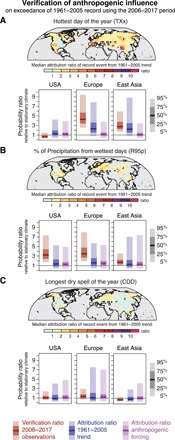
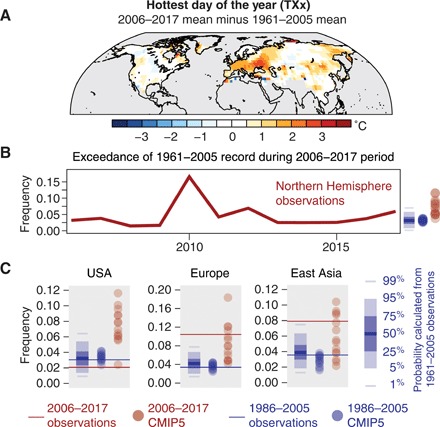
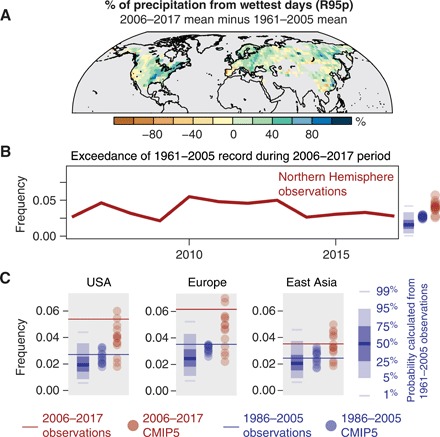
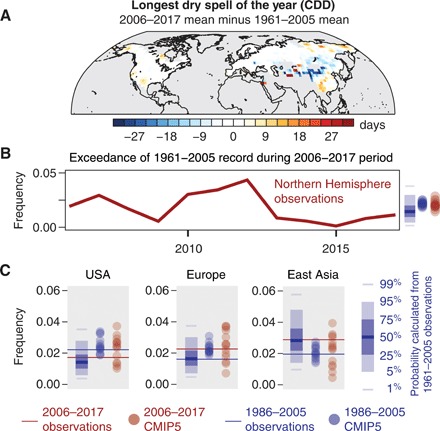
Verification
Claims the paper makes
The claims and statistics of this paper haven’t been checked yet.
Free: it reads the open-access text and checks the first 5 claims that cite a source we can check. Create a free account to check every claim.
Claims other papers make about this one
Each is checked against this paper’s own text: does it say what the citing paper says it does?
The source backs part of the claim, not all of it — or backs it for a different population, condition or comparison.
In the citing paper
“Studies based on an older attribution period frequently underestimate the effect of global warming on the probability of unprecedented recent extremes, reflecting the difference between frequencies during the attribution period and out-of-sample verification period (Diffenbaugh, 2020).”
From Artificial intelligence for climate prediction of extremes: State of the art, challenges, and future perspectives (2024) · cites this paper as Diffenbaugh, 2020
Experimental — accuracy not yet measured
Self-check
Percentages, sums and reported differences re-computed from the paper’s own numbers.
The self-check needs the paper’s full text.
Citations
Cites
An Overview of CMIP5 and the Experiment Design
Taylor, K. E., Stouffer, R. J., & Meehl, G. A. (2012) · Bulletin of the American Meteorological Society · doi:10.1175/bams-d-11-00094.1 · Cited by 14,052
Stationarity Is Dead: Whither Water Management?
Milly, P. C. D., Betancourt, J., Falkenmark, M., Hirsch, R. M., Kundzewicz, Z. W., Lettenmaier, D. P., & Stouffer, R. J. (2008) · Science · doi:10.1126/science.1151915 · Cited by 4,537
Human contribution to the European heatwave of 2003
Stott, P. A., Stone, D. A., & Allen, M. R. (2004) · Nature · doi:10.1038/nature03089 · Cited by 1,735
Sillmann, J., Kharin, V. V., Zhang, X., Zwiers, F. W., & Bronaugh, D. (2013) · Journal of Geophysical Research: Atmospheres · doi:10.1002/jgrd.50203 · Cited by 1,461
Anthropogenic contribution to global occurrence of heavy-precipitation and high-temperature extremes
Fischer, E. M., & Knutti, R. (2015) · Nature Climate Change · doi:10.1038/nclimate2617 · Cited by 1,427
Anthropogenic warming has increased drought risk in California
Diffenbaugh, N. S., Swain, D. L., & Touma, D. (2015) · Proceedings of the National Academy of Sciences · doi:10.1073/pnas.1422385112 · Cited by 1,386 · cited 1×
“, (12)], tropical cyclone precipitation [e.”
Self-citationAttribution of climate extreme events
Trenberth, K. E., Fasullo, J. T., & Shepherd, T. G. (2015) · Nature Climate Change · doi:10.1038/nclimate2657 · Cited by 982
Global climate changes as forecast by Goddard Institute for Space Studies three‐dimensional model
Hansen, J., Fung, I., Lacis, A., Rind, D., Lebedeff, S., Ruedy, R., Russell, G., & Stone, P. (1988) · Journal of Geophysical Research: Atmospheres · doi:10.1029/jd093id08p09341 · Cited by 980
Anthropogenic greenhouse gas contribution to flood risk in England and Wales in autumn 2000
Pall, P., Aina, T., Stone, D. A., Stott, P. A., Nozawa, T., Hilberts, A. G. J., Lohmann, D., & Allen, M. R. (2011) · Nature · doi:10.1038/nature09762 · Cited by 871
Research works printed but not linked: 2
- The National Academies Press, Attribution of Extreme Weather Events in the Context of Climate Change (The National Academies Press, 2016).
- IPCC, Managing the Risks of Extreme Events and Disasters to Advance Climate Change Adaptation (Cambridge Univ. Press, 2012). 22766781
Cited by
Items 101–123 of 123
Development of response-controlled tall buildings through own-mass mobilisation
Martinez‐Paneda, M., Elghazouli, A. Y., Gouder, K., & Algaard, W. (2026) · Nature Communications · doi:10.1038/s41467-026-74868-2 · Cited by 2
“…in global urban population, designing tall buildings that are safe, resilient, and resource-ef fi cient has become central to creating sustainable urban infrastructure 1,2 , particularly in developing economies 3,4 with a high risk from extremewind ina changing climate, and/or seismic loads 5 – 8 .”
Global Emissions Since the Paris Agreement Have Intensified Europe's Recent Heatwaves
Trok, J. T., Barnes, E. A., Gordon, E. M., Davenport, F. V., & Diffenbaugh, N. S. (2026) · Geophysical Research Letters · doi:10.1029/2026gl125079 · Cited by 2
“While it is challenging to verify attribution results for individual events (Diffenbaugh, 2020), evaluating the diffusion model's prediction of long‐term temperature trends (Figures 1d–1i) provides a useful test of the model's ability to predict the response of daily temperature to changes in…”
Self-citationExtreme Rainfall Trends and their Statistical Significance
Kumar, S., Thakural, L. N., Gurrapu, S., & Patra, J. P. (2022) · Society of Earth Scientists series · doi:10.1007/978-3-031-13119-6_17 · Cited by 1
Ma, Y., Zhao, L., Wang, J., Wu, Q., Li, X., Li, Q., Cheng, W. X., Yu, T., & Sun, L. (2024) · Polar Science · doi:10.1016/j.polar.2024.101133 · Cited by 1
Weather shocks, prices and productivity: Evidence from staples in Mexico
González, J. A., Juárez‐Torres, M., & Borboa, F. Z. (2023) · doi:10.36095/banxico/di.2023.16 · Cited by 2
Statistical and dynamical aspects of extreme heatwaves in the mid-latitudes
Noyelle, R. (2024) · theses.fr (ABES) · doi:10.70675/b512aebfz4979z4354z8d4czfb0a45eac387 · Cited by 7
Introduction to Analysis Methods for Big Earth Data
Lynnes, C. S. (2022) · Special publications · doi:10.1002/9781119467557.ch8
Никрошкина, С. В. (2009) · Мир науки, культуры, образования
Savage, A. (2021) · Queensland University of Technology · doi:10.5204/thesis.eprints.214101
GAUGING GREENHOUSE EMISSION THROUGH CBA, TRADE, FDI, AND POPULATION GROWTH
Nisa’, M. (2022) · Jurnal Ekonomi dan Bisnis Airlangga · doi:10.20473/jeba.v32i22022.204-214
“A desert, for example, has an arid climate since it receives minimal rain or snow throughout the year and for tropical climates, which become hot and humid (Diffenbaugh, 2020).”
BackgroundSnapshots of (Ill)Health Around the World
Sanders, D., Ceukelaire, W. D., & Hutton, B. (2023) · Oxford University Press eBooks · doi:10.1093/oso/9780192858450.003.0001
Ökologische Nachhaltigkeit als Herausforderung für die Krankenhäuser
Oswald, J., & Blase, N. (2024) · Springer eBooks · doi:10.1007/978-3-662-68792-5_18
Ringim, S. H., & Güngör, H. (2024) · SSRN Electronic Journal · doi:10.2139/ssrn.4816362
Vasilić, N., Đuričin, S. O., & Beraha, I. A. (2024) · Emerald Group Publishing Limited eBooks · doi:10.1108/978-1-83549-780-720241001 · Cited by 1
Pendleton, E. A., Lentz, E. E., Henderson, R. E., Heslin, J. L., Bartlett, M. K., & Sterne, T. K. (2025) · Journal of Coastal Research · doi:10.2112/jcoastres-d-24-00072.1
Court, E. (2025) · Pūhau ana te rā Tailwinds · doi:10.11157/patr.v3i2.77
Clarke, B. J. (2023) · Oxford University Research Archive (ORA) (University of Oxford) · doi:10.5287/ora-bp4ngdqxz · Cited by 1
Oliveira, P. M. A. (2022) · Portuguese National Funding Agency for Science, Research and Technology (RCAAP Project by FCT)
Physiological and Transcriptomic Insights into Waterlogging Responses of Liriodendron Hybrids
Hu, M., Yang, X., Yang, A., Hu, P., Yu, X., 余发新, Chen, C., & Ouyang, X. (2025) · Forests · doi:10.3390/f17010050
“Climate change in the 21st century has increased the frequency and intensity of extreme weather events [1,2], thereby raising the risk of unprecedented heat waves and flooding [3,4] and threatening ecosystem stability, plant growth, and survival.”
Water scarcity in a changing climate: A global perspective
Bhat, M. A., Nisa, F. U., Dar, T. A., Khurshid, Z., Ali, I., Mir, J. A., Ahmed, R., & Lone, F. A. (2026) · Elsevier eBooks · doi:10.1016/b978-0-443-45116-4.00001-5
El efecto de choques climáticos en los precios: el caso de cultivos básicos en México
Arellano-González, J., Juárez‐Torres, M., & Zazueta-Borboa, F. (2026) · Revista de Economía Facultad de Economía Universidad Autónoma de Yucatán · doi:10.33937/reveco.2026.550
Kim, T., Kim, J., Kim, I., & Kim, J. (2026) · Information Sciences · doi:10.1016/j.ins.2026.124082
Sun, L., Chang, Z., Nitta, M., Masayuki, M. A. E., & Imaizumi, T. (2026) · Building and Environment · doi:10.1016/j.buildenv.2026.115514
Metadata
- Authors
- Diffenbaugh, N. S.
- Affiliations
- Stanford University (US)
- Corresponding author
- Diffenbaugh, Noah S.
- ORCID
- Diffenbaugh, Noah S.
- Venue
- Science Advances
- Published
- 2020-03-20
- Volume
- 6
- Issue
- 12
- Pages
- eaay2368-eaay2368
- ISSN
- 2375-2548 (ISSN-L)
- PMC
- PMC7080452
- OpenAlex
- W3011110771
- Semantic Scholar
- 3d1229e83f8f5f190e65b531eae46326303cb6e5
- Cited by
- 120
- References
- 60
- Citations by year
- 2026: 9 · 2025: 11 · 2024: 19 · 2023: 27 · 2022: 18 · 2021: 25 · 2020: 9
- FWCI
- 7.35
- Type
- journal article
- Language
- en
- Open access
- gold
- doi.org
- Licence
- cc-by-nc
- Locations
- Science Advances (publishedVersion, cc-by-nc)
- PubMed Central (publishedVersion, cc-by-nc)
- PubMed (publishedVersion)
- Funders
- Stanford University
- Topics
- Physical Sciences › Environmental Science › Global and Planetary Change › Climate variability and models
- Physical Sciences › Environmental Science › Global and Planetary Change › Climate Change and Environmental Impact
- Physical Sciences › Earth and Planetary Sciences › Atmospheric Science › Meteorological Phenomena and Simulations
- Keywords
- extreme event attribution, verification, anthropogenic climate change, global warming, radiative forcing, extreme event probability
About these checks
Registry, retraction, Cites and statistics results are computed, not judged, with one exception: a printed reference that no index lists is read once by a model before it counts as a citation error. Claims are extracted by a model and kept only when their quote appears verbatim in the text; each cited source is then checked, with a model’s help, for whether it says what the claim relies on. Those verdicts can be wrong — read the claim’s quote and the cited source before relying on one.
Statistics and arithmetic are recomputed, not judged.
Confidence bands are shown only for fields calibrated on our annotated test set. None is calibrated yet, so no band is shown.
What counts as a claim ›How we measure confidence ›How we check this ›
Are you an author, or do you see a problem with this page? Request a review
Data sources
Bibliographic data: Semantic Scholar, OpenAlex, Crossref.
Contains information from the Semantic Scholar Academic Graph Datasets, made available under the ODC Attribution License (ODC-BY 1.0).
Semantic Scholar’s data is described in: Kinney, R., et al. (2023). The Semantic Scholar Open Data Platform. arXiv:2301.10140.
