

Verification of extreme event attribution: Using out-of-sample observations to assess changes in probabilities of unprecedented events
Open accessThe DOI matches its Crossref record; 60 of the 60 references it cites were found in a registry or an index.
Abstract
Using out-of-sample observations to verify extreme event attribution results.
Overview
The claims and statistics of this paper haven’t been checked yet.
Free: it reads the open-access text and checks the first 5 claims that cite a source we can check. Create a free account to check every claim.
Integrity signals
Registry
Cites
Statistics
Figures
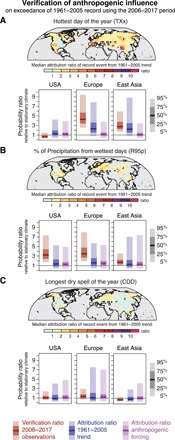
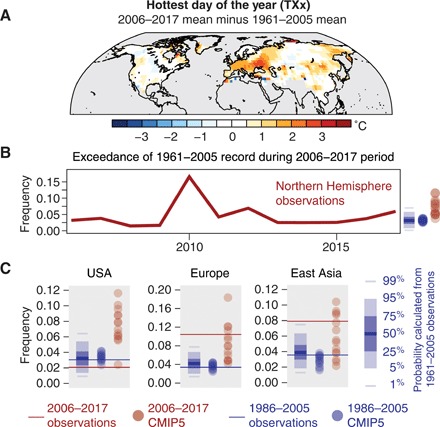
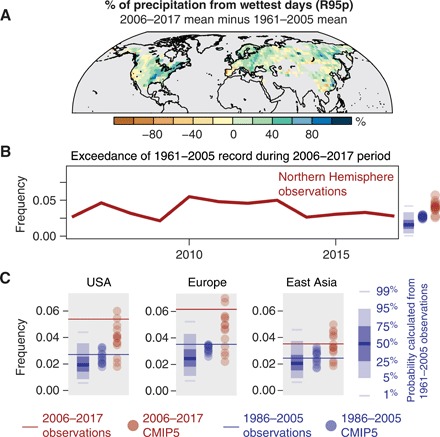
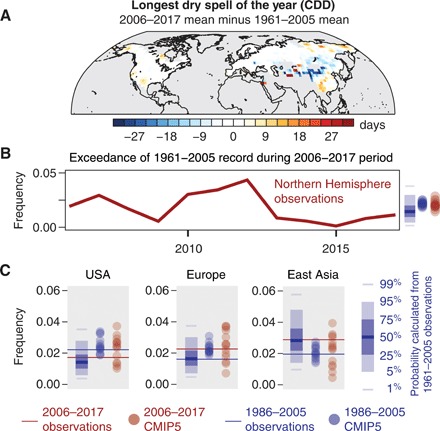
Verification
Claims the paper makes
The claims and statistics of this paper haven’t been checked yet.
Free: it reads the open-access text and checks the first 5 claims that cite a source we can check. Create a free account to check every claim.
Claims other papers make about this one
Each is checked against this paper’s own text: does it say what the citing paper says it does?
The source backs part of the claim, not all of it — or backs it for a different population, condition or comparison.
In the citing paper
“Studies based on an older attribution period frequently underestimate the effect of global warming on the probability of unprecedented recent extremes, reflecting the difference between frequencies during the attribution period and out-of-sample verification period (Diffenbaugh, 2020).”
From Artificial intelligence for climate prediction of extremes: State of the art, challenges, and future perspectives (2024) · cites this paper as Diffenbaugh, 2020
Experimental — accuracy not yet measured
Self-check
Percentages, sums and reported differences re-computed from the paper’s own numbers.
The self-check needs the paper’s full text.
Citations
Cites
An Overview of CMIP5 and the Experiment Design
Taylor, K. E., Stouffer, R. J., & Meehl, G. A. (2012) · Bulletin of the American Meteorological Society · doi:10.1175/bams-d-11-00094.1 · Cited by 14,052
Stationarity Is Dead: Whither Water Management?
Milly, P. C. D., Betancourt, J., Falkenmark, M., Hirsch, R. M., Kundzewicz, Z. W., Lettenmaier, D. P., & Stouffer, R. J. (2008) · Science · doi:10.1126/science.1151915 · Cited by 4,537
Human contribution to the European heatwave of 2003
Stott, P. A., Stone, D. A., & Allen, M. R. (2004) · Nature · doi:10.1038/nature03089 · Cited by 1,735
Sillmann, J., Kharin, V. V., Zhang, X., Zwiers, F. W., & Bronaugh, D. (2013) · Journal of Geophysical Research: Atmospheres · doi:10.1002/jgrd.50203 · Cited by 1,461
Anthropogenic contribution to global occurrence of heavy-precipitation and high-temperature extremes
Fischer, E. M., & Knutti, R. (2015) · Nature Climate Change · doi:10.1038/nclimate2617 · Cited by 1,427
Anthropogenic warming has increased drought risk in California
Diffenbaugh, N. S., Swain, D. L., & Touma, D. (2015) · Proceedings of the National Academy of Sciences · doi:10.1073/pnas.1422385112 · Cited by 1,386 · cited 1×
“, (12)], tropical cyclone precipitation [e.”
Self-citationAttribution of climate extreme events
Trenberth, K. E., Fasullo, J. T., & Shepherd, T. G. (2015) · Nature Climate Change · doi:10.1038/nclimate2657 · Cited by 982
Global climate changes as forecast by Goddard Institute for Space Studies three‐dimensional model
Hansen, J., Fung, I., Lacis, A., Rind, D., Lebedeff, S., Ruedy, R., Russell, G., & Stone, P. (1988) · Journal of Geophysical Research: Atmospheres · doi:10.1029/jd093id08p09341 · Cited by 980
Anthropogenic greenhouse gas contribution to flood risk in England and Wales in autumn 2000
Pall, P., Aina, T., Stone, D. A., Stott, P. A., Nozawa, T., Hilberts, A. G. J., Lohmann, D., & Allen, M. R. (2011) · Nature · doi:10.1038/nature09762 · Cited by 871
Quantifying the influence of global warming on unprecedented extreme climate events
Diffenbaugh, N. S., Singh, D., Mankin, J. S., Horton, D. E., Swain, D. L., Touma, D., Charland, A., Liu, Y., Haugen, M., Tsiang, M., et al. (2017) · Proceedings of the National Academy of Sciences · doi:10.1073/pnas.1618082114 · Cited by 766
Self-citationMurray, V., & Ebi, K. L. (2012) · Journal of Epidemiology and Community Health · doi:10.1136/jech-2012-201045 · Cited by 557
Non-stationary extreme value analysis in a changing climate
Cheng, L., AghaKouchak, A., Gilleland, E., & Katz, R. W. (2014) · Climatic Change · doi:10.1007/s10584-014-1254-5 · Cited by 537 · cited 2×
“, (50, 51)] and poses specific challenges for event attribution (4).”
BackgroundAssessing the present and future probability of Hurricane Harvey’s rainfall
Emanuel, K. (2017) · Proceedings of the National Academy of Sciences · doi:10.1073/pnas.1716222114 · Cited by 526
Attribution of extreme rainfall from Hurricane Harvey, August 2017
van Oldenborgh, G. J., van der Wiel, K., Sebastian, A., Singh, R., Arrighi, J., Otto, F., Haustein, K., Li, S., Vecchi, G., & Cullen, H. (2017) · Environmental Research Letters · doi:10.1088/1748-9326/aa9ef2 · Cited by 481
Peterson, T. C., Heim, R. R., Hirsch, R., Kaiser, D. P., Brooks, H., Diffenbaugh, N. S., Dole, R. M., Giovannettone, J. P., Guirguis, K., Karl, T. R., et al. (2013) · Bulletin of the American Meteorological Society · doi:10.1175/bams-d-12-00066.1 · Cited by 464
Self-citationVolcanic contribution to decadal changes in tropospheric temperature
Santer, B. D., Bonfils, C., Painter, J. F., Zelinka, M. D., Mears, C., Solomon, S., Schmidt, G. A., Fyfe, J. C., Cole, J. N. S., Nazarenko, L., et al. (2014) · Nature Geoscience · doi:10.1038/ngeo2098 · Cited by 459
Insurance in a Climate of Change
Mills, E. (2005) · Science · doi:10.1126/science.1112121 · Cited by 415
Climatic Change: Are We on the Brink of a Pronounced Global Warming?
Broecker, W. S. (1975) · Science · doi:10.1126/science.189.4201.460 · Cited by 411
Influence of Anthropogenic Climate Change on Planetary Wave Resonance and Extreme Weather Events
Mann, M. E., Rahmstorf, S., Kornhuber, K., Steinman, B. A., Miller, S. K., & Coumou, D. (2017) · Scientific Reports · doi:10.1038/srep45242 · Cited by 379
Concurrent 2018 Hot Extremes Across Northern Hemisphere Due to Human‐Induced Climate Change
Vogel, M. M., Zscheischler, J., Wartenburger, R., Dee, D., & Seneviratne, S. I. (2019) · Earth's Future · doi:10.1029/2019ef001189 · Cited by 360 · cited 2×
“, (8, 38)] and because the early period of the climate model projections does not include the actual forcings that occurred, which can hamper accurate attri bution (60).”
BackgroundCoumou, D., Petoukhov, V., Rahmstorf, S., Petri, S., & Schellnhuber, H. J. (2014) · Proceedings of the National Academy of Sciences · doi:10.1073/pnas.1412797111 · Cited by 350
Hurricane Harvey Links to Ocean Heat Content and Climate Change Adaptation
Trenberth, K. E., Cheng, L., Jacobs, P., Zhang, Y., & Fasullo, J. (2018) · Earth's Future · doi:10.1029/2018ef000825 · Cited by 339
Attribution of the Influence of Human‐Induced Climate Change on an Extreme Fire Season
Kirchmeier‐Young, M. C., Gillett, N. P., Zwiers, F. W., Cannon, A. J., & Anslow, F. S. (2019) · Earth's Future · doi:10.1029/2018ef001050 · Cited by 323
Global increase in record-breaking monthly-mean temperatures
Coumou, D., Robinson, A., & Rahmstorf, S. (2013) · Climatic Change · doi:10.1007/s10584-012-0668-1 · Cited by 312
Attribution of Extreme Events in Arctic Sea Ice Extent
Kirchmeier-Young, M. C., Zwiers, F. W., & Gillett, N. P. (2017) · Journal of Climate · doi:10.1175/jcli-d-16-0412.1 · Cited by 274
A Common Framework for Approaches to Extreme Event Attribution
Shepherd, T. G. (2016) · Current Climate Change Reports · doi:10.1007/s40641-016-0033-y · Cited by 273
Wang, S. ‐., Hipps, L., Gillies, R. R., & Yoon, J. (2014) · Geophysical Research Letters · doi:10.1002/2014gl059748 · Cited by 264
Swain, D. L., Tsiang, M., Haugen, M. A., Singh, D. K., Charland, A., Rajaratnam, B., & Diffenbaugh, N. S. (2014) · AGU Fall Meeting Abstracts · Cited by 253
Self-citationAdvances in weather prediction
Alley, R. B., Emanuel, K. A., & Zhang, F. (2019) · Science · doi:10.1126/science.aav7274 · Cited by 242
Altered hydrologic feedback in a warming climate introduces a “warming hole”
Pan, Z., Arritt, R. W., Takle, E. S., Gutowski, W. J., Anderson, C. J., & Segal, M. (2004) · Geophysical Research Letters · doi:10.1029/2004gl020528 · Cited by 223
van der Wiel, K., Kapnick, S. B., van Oldenborgh, G. J., Whan, K., Philip, S., Vecchi, G. A., Singh, R. K., Arrighi, J., & Cullen, H. (2017) · Hydrology and Earth System Sciences · doi:10.5194/hess-21-897-2017 · Cited by 202
Hurricane Sandy’s flood frequency increasing from year 1800 to 2100
Lin, N., Kopp, R. E., Horton, B. P., & Donnelly, J. P. (2016) · Proceedings of the National Academy of Sciences · doi:10.1073/pnas.1604386113 · Cited by 202
Causal Counterfactual Theory for the Attribution of Weather and Climate-Related Events
Hannart, A., Pearl, J., Otto, F. E. L., Naveau, P., & Ghil, M. (2016) · Bulletin of the American Meteorological Society · doi:10.1175/bams-d-14-00034.1 · Cited by 195
Towards reliable extreme weather and climate event attribution
Bellprat, O., Guemas, V., Doblas-Reyes, F., & Donat, M. G. (2019) · Nature Communications · doi:10.1038/s41467-019-09729-2 · Cited by 176
Weisheimer, A., Schaller, N., O’Reilly, C., MacLeod, D. A., & Palmer, T. N. (2016) · Quarterly Journal of the Royal Meteorological Society · doi:10.1002/qj.2976 · Cited by 159
Otto, F. E. L., van der Wiel, K., van Oldenborgh, G. J., Philip, S., Kew, S. F., Uhe, P., & Cullen, H. (2018) · Environmental Research Letters · doi:10.1088/1748-9326/aa9663 · Cited by 124
Quantifying statistical uncertainty in the attribution of human influence on severe weather
Paciorek, C. J., Stone, D. A., & Wehner, M. F. (2018) · Weather and Climate Extremes · doi:10.1016/j.wace.2018.01.002 · Cited by 122
Angélil, O., Stone, D. A., Wehner, M. F., Paciorek, C. J., Krishnan, H., & Collins, W. D. (2016) · Journal of Climate · doi:10.1175/jcli-d-16-0077.1 · Cited by 112 · cited 1×
“2 of 10 reanalysis of multiple published results (3, 33).”
BackgroundRecent amplification of the North American winter temperature dipole
Singh, D., Swain, D. L., Mankin, J., Horton, D. E., Thomas, L. N., Rajaratnam, B., & Diffenbaugh, N. S. (2016) · Journal of Geophysical Research Atmospheres · doi:10.1002/2016jd025116 · Cited by 106
Self-citationUnprecedented climate events: Historical changes, aspirational targets, and national commitments
Diffenbaugh, N. S., Singh, D., & Mankin, J. S. (2018) · Science Advances · doi:10.1126/sciadv.aao3354 · Cited by 98
Self-citationAttribution of extreme weather and climate events overestimated by unreliable climate simulations
Bellprat, O., & Doblas‐Reyes, F. (2016) · Geophysical Research Letters · doi:10.1002/2015gl067189 · Cited by 94
Yu, S., Alapaty, K., Mathur, R., Pleim, J., Zhang, Y., Nolte, C. G., Eder, B. K., Foley, K. M., & Nagashima, T. (2014) · Scientific Reports · doi:10.1038/srep06929 · Cited by 89
Methods and Model Dependency of Extreme Event Attribution: The 2015 European Drought
Hauser, M., Gudmundsson, L., Orth, R., Jézéquel, A., Haustein, K., Vautard, R., van Oldenborgh, G. J., Wilcox, L., & Seneviratne, S. I. (2017) · Earth's Future · doi:10.1002/2017ef000612 · Cited by 88
Huggel, C., Stone, D. A., Eicken, H. S., & Hansen, G. (2015) · Climatic Change · doi:10.1007/s10584-015-1441-z · Cited by 87 · cited 2×
“Further, attribution quantification is now being used to assign specific responsibility for the damages resulting from individual events (55).”
BackgroundMethodBehind the veil of extreme event attribution
Jézéquel, A., Dépoues, V., Guillemot, H., Trolliet, M., Vanderlinden, J., & Yiou, P. (2018) · Climatic Change · doi:10.1007/s10584-018-2252-9 · Cited by 84
Jeon, S., Paciorek, C. J., & Wehner, M. F. (2016) · Weather and Climate Extremes · doi:10.1016/j.wace.2016.02.001 · Cited by 73
MANN, M. E., Lloyd, E. A., & Орескес, Н. (2017) · Climatic Change · doi:10.1007/s10584-017-2048-3 · Cited by 72
Meehl, G. A., Arblaster, J. M., & Chung, C. T. Y. (2015) · Geophysical Research Letters · doi:10.1002/2015gl064586 · Cited by 67
Sippel, S., Mitchell, D., Black, M. T., Dittus, A. J., Harrington, L., Schaller, N., & Otto, F. E. L. (2015) · Weather and Climate Extremes · doi:10.1016/j.wace.2015.06.004 · Cited by 64
Real-time extreme weather event attribution with forecast seasonal SSTs
Haustein, K., Otto, F. E. L., Uhe, P. F., Schaller, N., Allen, M. R., Hermanson, L., Christidis, N., McLean, P., & Cullen, H. M. (2016) · Environmental Research Letters · doi:10.1088/1748-9326/11/6/064006 · Cited by 57
Jeon, S., Paciorek, C. J., & Wehner, M. F. (2015) · eScholarship (California Digital Library) · Cited by 54
Diffenbaugh, N. S., Ashfaq, M., & Scherer, M. (2011) · Journal of Geophysical Research: Atmospheres · doi:10.1029/2011jd016458 · Cited by 45
Self-citationDADA: data assimilation for the detection and attribution of weather and climate-related events
Hannart, A., Carrassi, A., Bocquet, M., Ghil, M., Naveau, P., Pulido, M., Ruiz, J., & Tandeo, P. (2016) · Climatic Change · doi:10.1007/s10584-016-1595-3 · Cited by 45
Christidis, N., Stott, P. A., & Zwiers, F. W. (2014) · Climate Dynamics · doi:10.1007/s00382-014-2408-x · Cited by 41
CMIP5 Model-based Assessment of Anthropogenic Influence on Record Global Warmth During 2016
Knutson, T. R., Kam, J., Zeng, F. J., & Wittenberg, A. T. (2018) · Bulletin of the American Meteorological Society · doi:10.1175/bams-d-17-0104.1 · Cited by 40
Multiple perspectives on the attribution of the extreme European summer of 2012 to climate change
Wilcox, L. J., Yiou, P., Hauser, M., Lott, F. C., van Oldenborgh, G. J., Colfescu, I., Dong, B., Hegerl, G., Shaffrey, L., & Sutton, R. T. (2017) · Climate Dynamics · doi:10.1007/s00382-017-3822-7 · Cited by 37
Is the choice of statistical paradigm critical in extreme event attribution studies?
Stott, P. A., Karoly, D. J., & Zwiers, F. W. (2017) · Climatic Change · doi:10.1007/s10584-017-2049-2 · Cited by 29
Christiansen, B. (2015) · Journal of Climate · doi:10.1175/jcli-d-15-0318.1 · Cited by 24
Reliability of African climate prediction and attribution across timescales
Lott, F. C., Gordon, M., Graham, R., Scaife, A. A., & Vellinga, M. (2014) · Environmental Research Letters · doi:10.1088/1748-9326/9/10/104017 · Cited by 9
Research works printed but not linked: 2
- The National Academies Press, Attribution of Extreme Weather Events in the Context of Climate Change (The National Academies Press, 2016).
- IPCC, Managing the Risks of Extreme Events and Disasters to Advance Climate Change Adaptation (Cambridge Univ. Press, 2012). 22766781
Cited by
Climate change impacts on plant pathogens, food security and paths forward
Singh, B. K., Delgado-Baquerizo, M., Egidi, E., Guirado, E., Leach, J. E., Liu, H., & Trivedi, P. (2023) · Nature Reviews Microbiology · doi:10.1038/s41579-023-00900-7 · Cited by 1,334
Our future in the Anthropocene biosphere
Folke, C., Polasky, S., Rockström, J., Galaz, V., Westley, F., Lamont, M., Scheffer, M., Österblom, H., Carpenter, S. R., Chapin, F. S., et al. (2021) · Ambio · doi:10.1007/s13280-021-01544-8 · Cited by 696
“Climate change impacts are hitting people harder and sooner than envisioned a decade ago (Diffenbaugh 2020).”
Khan, Z., Ali, S., Umar, M., Kirikkaleli, D., & Jiao, Z. (2020) · Science of The Total Environment · doi:10.1016/j.scitotenv.2020.138945 · Cited by 694
Guo, J., Zhou, Y., Ali, S., Shahzad, U., & Cui, L. (2021) · Journal of Environmental Management · doi:10.1016/j.jenvman.2021.112779 · Cited by 334
Contribution of historical precipitation change to US flood damages
Davenport, F. V., Burke, M., & Diffenbaugh, N. S. (2021) · Proceedings of the National Academy of Sciences · doi:10.1073/pnas.2017524118 · Cited by 293
“Prior studies have attributed increases in short-duration precipitation extremes over the United States to anthropogenic climate forcing by comparing historical trends with climate model simulations (10, 30), isolating forced changes from those driven by modes of natural climate variability (31–34), or calculating the…”
BackgroundSelf-citation
Metadata
- Authors
- Diffenbaugh, N. S.
- Affiliations
- Stanford University (US)
- Corresponding author
- Diffenbaugh, Noah S.
- ORCID
- Diffenbaugh, Noah S.
- Venue
- Science Advances
- Published
- 2020-03-20
- Volume
- 6
- Issue
- 12
- Pages
- eaay2368-eaay2368
- ISSN
- 2375-2548 (ISSN-L)
- PMC
- PMC7080452
- OpenAlex
- W3011110771
- Cited by
- 120
- References
- 60
- Citations by year
- 2026: 9 · 2025: 11 · 2024: 19 · 2023: 27 · 2022: 18 · 2021: 25 · 2020: 9
- FWCI
- 7.35
- Type
- journal article
- Language
- en
- Open access
- gold
- doi.org
- Licence
- cc-by-nc
- Locations
- Science Advances (publishedVersion, cc-by-nc)
- PubMed Central (publishedVersion, cc-by-nc)
- PubMed (publishedVersion)
- Funders
- Stanford University
- Topics
- Physical Sciences › Environmental Science › Global and Planetary Change › Climate variability and models
- Physical Sciences › Environmental Science › Global and Planetary Change › Climate Change and Environmental Impact
- Physical Sciences › Earth and Planetary Sciences › Atmospheric Science › Meteorological Phenomena and Simulations
- Keywords
- extreme event attribution, verification, anthropogenic climate change, global warming, radiative forcing, extreme event probability
About these checks
Registry, retraction, Cites and statistics results are computed, not judged, with one exception: a printed reference that no index lists is read once by a model before it counts as a citation error. Claims are extracted by a model and kept only when their quote appears verbatim in the text; each cited source is then checked, with a model’s help, for whether it says what the claim relies on. Those verdicts can be wrong — read the claim’s quote and the cited source before relying on one.
Statistics and arithmetic are recomputed, not judged.
Confidence bands are shown only for fields calibrated on our annotated test set. None is calibrated yet, so no band is shown.
What counts as a claim ›How we measure confidence ›How we check this ›
Are you an author, or do you see a problem with this page? Request a review
Data sources
Bibliographic data: Semantic Scholar, OpenAlex, Crossref.
Contains information from the Semantic Scholar Academic Graph Datasets, made available under the ODC Attribution License (ODC-BY 1.0).
Semantic Scholar’s data is described in: Kinney, R., et al. (2023). The Semantic Scholar Open Data Platform. arXiv:2301.10140.
