

Optimal trade-off control in machine learning–based library design, with application to adeno-associated virus (AAV) for gene therapy
Open accessPublished version of a preprint
The DOI matches its Crossref record; 68 of the 68 references it cites were found in a registry or an index.
Abstract
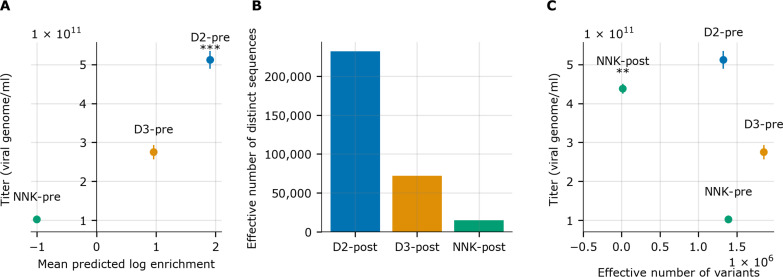
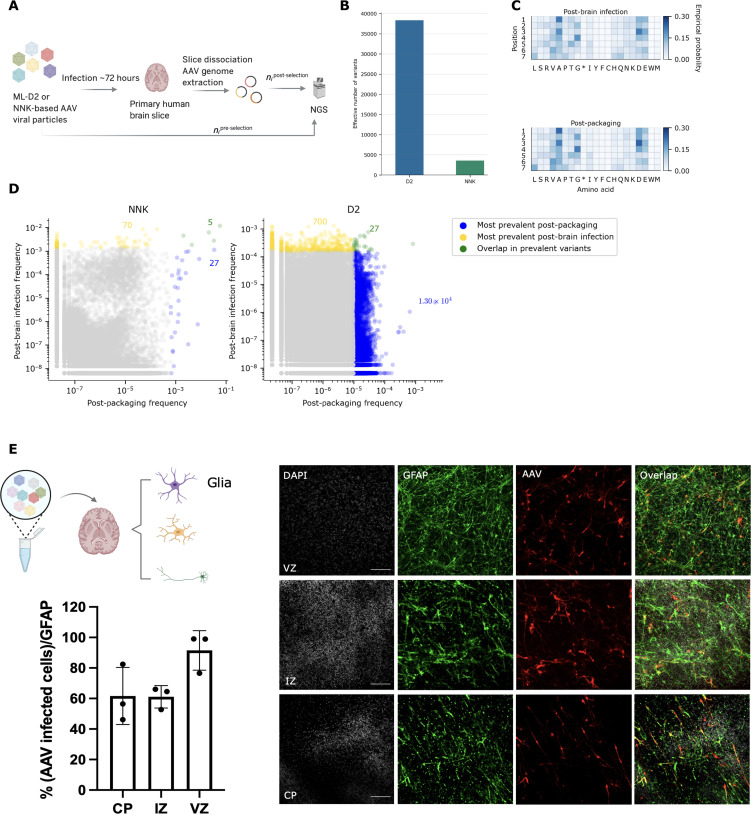
Adeno-associated viruses (AAVs) hold tremendous promise as delivery vectors for gene therapies. AAVs have been successfully engineered—for instance, for more efficient and/or cell-specific delivery to numerous tissues—by creating large, diverse starting libraries and selecting for desired properties. However, these starting libraries often contain a high proportion of variants unable to assemble or package their genomes, a prerequisite for any gene delivery goal. Here, we present and showcase a machine learning (ML) method for designing AAV peptide insertion libraries that achieve fivefold higher packaging fitness than the standard NNK library with negligible reduction in diversity. To demonstrate our ML-designed library’s utility for downstream engineering goals, we show that it yields approximately 10-fold more successful variants than the NNK library after selection for infection of human brain tissue, leading to a promising glial-specific variant. Moreover, our design approach can be applied to other types of libraries for AAV and beyond.
Overview
The claims and statistics of this paper haven’t been checked yet.
Free: it reads the open-access text and checks the first 5 claims that cite a source we can check. Create a free account to check every claim.
Integrity signals
Registry
Cites
Statistics
Figures
Verification
Claims the paper makes
The claims and statistics of this paper haven’t been checked yet.
Free: it reads the open-access text and checks the first 5 claims that cite a source we can check. Create a free account to check every claim.
Claims other papers make about this one
Each is checked against this paper’s own text: does it say what the citing paper says it does?
The source backs part of the claim, not all of it — or backs it for a different population, condition or comparison.
In the citing paper
“The fact that that not all peptide inserts (including 7-mer sequences) at the 587-588 position are amenable to capsid assembly, is well documented [59,60].”
From The AAV2.7m8 capsid packages a higher degree of heterogeneous vector genomes than AAV2 (2024) · cites this paper as [59]
Experimental — accuracy not yet measured
Self-check
Percentages, sums and reported differences re-computed from the paper’s own numbers.
The self-check needs the paper’s full text.
Citations
Cites
Adam: A Method for Stochastic Optimization
Kingma, D. P., & Ba, J. (2014) · arXiv · doi:10.48550/arxiv.1412.6980 · Cited by 98,946
Information theory and statistical mechanics
Jaynes, E. T. (1957) · Physical Review · doi:10.1103/physrev.106.620 · Cited by 12,931
TensorFlow: A system for large-scale machine learning
Abadi, M., Barham, P., Chen, J., Chen, Z., Davis, A., Dean, J., Devin, M., Ghemawat, S., Irving, G., Isard, M., et al. (2016) · arXiv (Cornell University) · doi:10.48550/arxiv.1605.08695 · Cited by 11,822
EVOLUTION IN MENDELIAN POPULATIONS
Wright, S. (1931) · Genetics · doi:10.1093/genetics/16.2.97 · Cited by 8,916
Development and Evolution of the Human Neocortex
Lui, J. H., Hansen, D. V., & Kriegstein, A. R. (2011) · Cell · doi:10.1016/j.cell.2011.06.030 · Cited by 1,342
Zolotukhin, S., Byrne, B. J., Mason, E., Zolotukhin, I., Potter, M., Chesnut, K., Summerford, C., Samulski, R. J., & Muzyczka, N. (1999) · Gene Therapy · doi:10.1038/sj.gt.3300938 · Cited by 1,312
An efficient one-step site-directed and site-saturation mutagenesis protocol
Zheng, L. (2004) · Nucleic Acids Research · doi:10.1093/nar/gnh110 · Cited by 1,178
Exploring protein fitness landscapes by directed evolution
Romero, P. A., & Arnold, F. H. (2009) · Nature Reviews Molecular Cell Biology · doi:10.1038/nrm2805 · Cited by 1,161
Cre-dependent selection yields AAV variants for widespread gene transfer to the adult brain
Deverman, B. E., Pravdo, P. L., Simpson, B. P., Kumar, S. R., Chan, K. Y., Banerjee, A., Wu, W.-L., Yang, B., Huber, N., Pasca, S. P., et al. (2016) · Nature Biotechnology · doi:10.1038/nbt.3440 · Cited by 1,061 · cited 3×
“For example, genomic junctions that minimize AAV structure disruptions, suitable for recombination libraries, were computationally identified ( 9 ).”
BackgroundTuomisto, H. (2010) · Ecography · doi:10.1111/j.1600-0587.2009.05880.x · Cited by 1,024
Research works printed but not linked: 1
- K. P. Murphy Machine Learning: A Probabilistic Perspective (MIT Press 2012).
Cited by
Machine learning for functional protein design
Notin, P., Rollins, N., Gal, Y., Sander, C., & Marks, D. (2024) · Nature Biotechnology · doi:10.1038/s41587-024-02127-0 · Cited by 270
Opportunities and Challenges for Machine Learning-Assisted Enzyme Engineering
Yang, J., Li, F.-Z., & Arnold, F. H. (2024) · ACS Central Science · doi:10.1021/acscentsci.3c01275 · Cited by 246
Ding, K., Chin, M., Zhao, Y., Huang, W., Mai, B. K., Wang, H., Liu, P., Yang, Y., & Luo, Y. (2024) · Nature Communications · doi:10.1038/s41467-024-50698-y · Cited by 107
Nisanov, A. M., de Jesús, J. A. R., & Schaffer, D. V. (2025) · Molecular Therapy · doi:10.1016/j.ymthe.2025.03.056 · Cited by 92
Self-citationSystematic multi-trait AAV capsid engineering for efficient gene delivery
Eid, F.-E., Chen, A. T., Chan, K. Y., Huang, Q., Zheng, Q., Tobey, I. G., Pacouret, S., Brauer, P. P., Keyes, C., Powell, M. M., et al. (2024) · Nature Communications · doi:10.1038/s41467-024-50555-y · Cited by 86
AAV Engineering for Improving Tropism to the Central Nervous System
Ghauri, M. S., & Ou, L. (2023) · Biology · doi:10.3390/biology12020186 · Cited by 73
Protein language models are biased by unequal sequence sampling across the tree of life
Ding, F., & Steinhardt, J. (2024) · doi:10.1101/2024.03.07.584001 · Cited by 57
Yadav, J., Marwah, H., & Kumar, C. (2025) · Energy Advances · doi:10.1039/d5ya00118h · Cited by 56
Conformal prediction under feedback covariate shift for biomolecular design
Fannjiang, C., Bates, S., Angelopoulos, A. N., Listgarten, J., & Jordan, M. I. (2022) · Proceedings of the National Academy of Sciences · doi:10.1073/pnas.2204569119 · Cited by 128
Self-citationMultimodal evaluation of network activity and optogenetic interventions in human hippocampal slices
Andrews, J. P., Geng, J., Voitiuk, K., Elliott, M. A. T., Shin, D. S., Robbins, A., Spaeth, A., Wang, A., Li, L., Solis, D., et al. (2024) · Nature Neuroscience · doi:10.1038/s41593-024-01782-5 · Cited by 45
Self-citationEngineering highly active nuclease enzymes with machine learning and high-throughput screening
Thomas, N., Belanger, D., Xu, C. A., Lee, H., Hirano, K., Iwai, K., Polic, V., Nyberg, K. D., Hoff, K. G., Frenz, L., et al. (2025) · Cell Systems · doi:10.1016/j.cels.2025.101236 · Cited by 56
Large-scale neurophysiology and single-cell profiling in human neuroscience
Lee, A. T., Chang, E. F., Paredes, M. F., & Nowakowski, T. J. (2024) · Nature · doi:10.1038/s41586-024-07405-0 · Cited by 40
Self-citationZhou, X., Liu, J., Xiao, S., Liang, X., Li, Y., Mo, F., Xin, X., Yang, Y., & Gao, C. (2024) · International Journal of Nanomedicine · doi:10.2147/ijn.s459905 · Cited by 34
Computationally guided AAV engineering for enhanced gene delivery
Guo, J., Lin, L. F., Oraskovich, S. V., de Jesús, J. A. R., Listgarten, J., & Schaffer, D. V. (2024) · Trends in Biochemical Sciences · doi:10.1016/j.tibs.2024.03.002 · Cited by 33
Self-citationMachine-learning-guided Directed Evolution for AAV Capsid Engineering
Fu, X., Suo, H., Zhang, J., & Chen, D. (2024) · Current Pharmaceutical Design · doi:10.2174/0113816128286593240226060318 · Cited by 25
Synthetic macromolecular switches for precision control of therapeutic cell functions
Teixeira, A. P., & Fussenegger, M. (2024) · Nature Reviews Bioengineering · doi:10.1038/s44222-024-00235-9 · Cited by 34
Liu, X., Wang, S., Sun, Y., Liao, Y., Jiang, G., Sun, B., Yu, J., & Zhao, D. (2025) · EBioMedicine · doi:10.1016/j.ebiom.2025.105638 · Cited by 27
Engineering CAR‐T Therapeutics for Enhanced Solid Tumor Targeting
Zhu, D., Kim, W., Lee, H., Bao, X., & Kim, P. (2025) · Advanced Materials · doi:10.1002/adma.202414882 · Cited by 32
Self-citationRetina-directed gene therapy: Achievements and remaining challenges
Biber, J., Gandor, C. L. A., Bećirović, E., & Michalakis, S. (2025) · Pharmacology & Therapeutics · doi:10.1016/j.pharmthera.2025.108862 · Cited by 25
Revolution of AAV in Drug Discovery: From Delivery System to Clinical Application
Yin, L., He, H., Zhang, H., Shang, Y., Fu, C., Wu, S., & Jin, T. (2025) · Journal of Medical Virology · doi:10.1002/jmv.70447 · Cited by 26
The AAV2.7m8 capsid packages a higher degree of heterogeneous vector genomes than AAV2
Cui, M., Su, Q., Yip, M., McGowan, J., Punzo, C., Gao, G., & Tai, P. W. L. (2024) · Gene Therapy · doi:10.1038/s41434-024-00477-7 · Cited by 20
Engineering novel adeno-associated viruses (AAVs) for improved delivery in the nervous system
Carneiro, A. D., & Schaffer, D. V. (2024) · Current Opinion in Chemical Biology · doi:10.1016/j.cbpa.2024.102532 · Cited by 22
Self-citationFannjiang, C., & Listgarten, J. (2023) · Cold Spring Harbor Perspectives in Biology · doi:10.1101/cshperspect.a041469 · Cited by 24
Self-citationAdvances in Recombinant Adeno-Associated Virus Vectors for Neurodegenerative Diseases
Li, L., Vasan, L., Kartono, B., Clifford, K. P., Attarpour, A., Sharma, R., Mandrozos, M., Kim, A., Zhao, W., Belotserkovsky, A., et al. (2023) · Biomedicines · doi:10.3390/biomedicines11102725 · Cited by 20
Materiomically Designed Polymeric Vehicles for Nucleic Acids: Quo Vadis?
Kumar, R. (2022) · ACS Applied Bio Materials · doi:10.1021/acsabm.2c00346 · Cited by 19
DeCOIL: Optimization of Degenerate Codon Libraries for Machine Learning-Assisted Protein Engineering
Yang, J., Ducharme, J., Johnston, K. E., Li, F.-Z., Yue, Y., & Arnold, F. H. (2023) · ACS Synthetic Biology · doi:10.1021/acssynbio.3c00301 · Cited by 22
Enhancement of CRISPR-Cas12a system through universal circular RNA design
Wang, J., Zhang, W., Li, W., Xie, Q., Zang, Z., & Liu, C. (2025) · Cell Reports Methods · doi:10.1016/j.crmeth.2025.101076 · Cited by 31
Fast and efficient template-mediated synthesis of genetic variants
Liu, L., Huang, Y., & Wang, H. H. (2023) · Nature Methods · doi:10.1038/s41592-023-01868-1 · Cited by 16
Cerbo, V. D., Song, H. W., Herbst, L., Hart, S. J., Ladi, R., Jiang, S., Madbouly, A. S., Redmond, L., Stickland, S., Srinivasan, A., et al. (2025) · Cytotherapy · doi:10.1016/j.jcyt.2025.05.003 · Cited by 18
How artificial intelligence is reengineering protein engineering
Listgarten, J., & Jiang, H. (2026) · Science · doi:10.1126/science.aec8444 · Cited by 31
Self-citationDeep Learning for Bidirectional Translation between Molecular Structures and Vibrational Spectra
Hu, T., Zou, Z., Li, B., Zhu, T., Gu, S., Jiang, J., Luo, Y., & Hu, W. (2025) · Journal of the American Chemical Society · doi:10.1021/jacs.5c05010 · Cited by 23
Meierrieks, F., Weltken, A., Pflanz, K. B., Pickl, A., Graf, B., & Wolff, M. W. (2024) · Biotechnology Journal · doi:10.1002/biot.202400430 · Cited by 16
Illuminating the universe of enzyme catalysis in the era of artificial intelligence
Yang, J., Li, F.-Z., Long, Y., & Arnold, F. H. (2025) · Cell Systems · doi:10.1016/j.cels.2025.101372 · Cited by 25
Wu, F., He, W., Xiao, Y., Wu, Q., Zhang, Q., Zhang, T., Xu, L., & Pang, X. (2025) · Advanced Science · doi:10.1002/advs.202408397 · Cited by 17
Optimized AAV capsids for basal ganglia diseases show robust potency and distribution
Leib, D. E., Chen, Y. H., Tecedor, L., Ranum, P. T., Keiser, M. S., Lewandowski, B. C., Carrell, E. M., Arora, S., Huerta-Ocampo, I., Lai, D., et al. (2025) · Nature Communications · doi:10.1038/s41467-025-60000-3 · Cited by 18
Systematic multi-trait AAV capsid engineering for efficient gene deliveryPreprint
Eid, F.-E., Chen, A. T., Chan, K. Y., Huang, Q., Zheng, Q., Tobey, I. G., Pacouret, S., Brauer, P. P., Keyes, C., Powell, M. M., et al. (2022) · bioRxiv (Cold Spring Harbor Laboratory) · doi:10.1101/2022.12.22.521680 · Cited by 10
Prediction of Adeno-Associated Virus Fitness with a Protein Language-Based Machine Learning Model
Wu, J., Qiu, Y., Lyashenko, E., Torregrosa, T., Pfister, E. L., Ryan, M. J., Mueller, C., & Choudhury, S. (2025) · Human Gene Therapy · doi:10.1089/hum.2024.227 · Cited by 11
Proceeding artificial intelligence technology towards vaccine designs
Zhao, F., & Zai, X. (2025) · The Innovation Life · doi:10.59717/j.xinn-life.2025.100162 · Cited by 9
MBE: model-based enrichment estimation and prediction for differential sequencing data
Busia, A., & Listgarten, J. (2023) · Genome biology · doi:10.1186/s13059-023-03058-w · Cited by 8
Self-citationMeierrieks, F., Rosario, J.-C., Rübeling, L., Asikoglu, H. C., Pflanz, K. B., Pickl, A., Kusch, K., Wolff, M. W., & Graf, B. (2025) · Journal of Chromatography A · doi:10.1016/j.chroma.2025.465674 · Cited by 7
Wu, J., Hua, Y., Zheng, Y., Liu, X., & Li, Y. (2025) · Biomedicines · doi:10.3390/biomedicines13081994 · Cited by 7
Beware of Data Leakage from Protein LLM PretrainingPreprint
Hermann, L., Fiedler, T., Nguyen, H. A., Nowicka, M., & Bartoszewicz, J. M. (2024) · bioRxiv (Cold Spring Harbor Laboratory) · doi:10.1101/2024.07.23.604678 · Cited by 8
Intrinsic dataset features drive mutational effect prediction by protein language modelsPreprint
Vieira, L. C., Lin, S., & Wilke, C. O. (2026) · bioRxiv (Cold Spring Harbor Laboratory) · doi:10.64898/2026.03.08.710389 · Cited by 14
Common AAV gene therapy vectors show nonselective transduction of ex vivo human brain tissue
McGinnis, J. P., Ortiz‐Guzman, J., Guevara, M. C., Mallannagari, S., Belfort, B. D. W., Bao, S., Srivastava, S., Morkas, M., Ji, E., Addison, A. P., et al. (2025) · Molecular Therapy — Methods & Clinical Development · doi:10.1016/j.omtm.2025.101494 · Cited by 6
Tuned Fitness Landscapes for Benchmarking Model-Guided Protein Design
Thomas, N., Agarwala, A., Belanger, D., Song, Y. S., & Colwell, L. J. (2026) · Genetics · doi:10.1101/2022.10.28.514293 · Cited by 7
FLIGHTED: Inferring Fitness Landscapes from Noisy High-Throughput Experimental DataPreprint
Sundar, V., Tu, B., Guan, L., & Esvelt, K. M. (2024) · bioRxiv (Cold Spring Harbor Laboratory) · doi:10.1101/2024.03.26.586797 · Cited by 4
Butt, F. R., Dhivagaran, T., Li, B., Ashamalla, M., Tao, B. K.-L., Balas, M., Pereira, A., Yan, P., & Arjmand, P. (2025) · Journal of Personalized Medicine · doi:10.3390/jpm15120619 · Cited by 8
Directed evolution of novel AAV capsids for enhanced delivery to mouse and human Schwann cells
Carneiro, A. D., Nisanov, A. M., Lee, H., & Schaffer, D. V. (2026) · Molecular Therapy — Nucleic Acids · doi:10.1016/j.omtn.2026.102928 · Cited by 3
Self-citationLu, Y., Wei, G., Zhengle, Z., Xu, X., Huang, J., Zhou, J., Gu, X., Han, G., & Ding, Y. (2026) · Journal of Controlled Release · doi:10.1016/j.jconrel.2026.114946 · Cited by 7
Scott, S., Westhaus, A., Nazareth, D., Cabanes‐Creus, M., Navarro, R. G., Chandra, D., Zhu, E., Venkateswaran, A., Alexander, I. E., Bauer, D. C., et al. (2024) · Molecular Therapy — Methods & Clinical Development · doi:10.1016/j.omtm.2024.101351 · Cited by 4
Classification of adeno-associated viruses with semi-supervised learning algorithm
Hossain, A., Konok, U. H., Islam, R. U., Hossain, M. S., & Dutta, P. (2025) · Array · doi:10.1016/j.array.2025.100648 · Cited by 3
Artificial Intelligence for Drug Delivery
Yu, X., Jiang, X., Sheng, T., Tiong, P. N., Yu, J., Zhu, F., Ouyang, D., Alonso, M. J., Gao, J., Gu, Z., et al. (2026) · ACS Nano · doi:10.1021/acsnano.6c02126 · Cited by 2
Adeno-associated viral vector targeted evolution for neurofibromatosis gene delivery
Henshey, B., Carneiro, A., Lei, K., Schaffer, D. V., & Boulis, N. M. (2025) · Trends in Molecular Medicine · doi:10.1016/j.molmed.2025.01.004 · Cited by 3
Self-citationLee, M., & Park, J. E. (2026) · Biotechnology Advances · doi:10.1016/j.biotechadv.2026.108906 · Cited by 1
Common AAV gene therapy vectors show indiscriminate transduction of living human brain cell typesPreprint
McGinnis, J. P., Ortiz‐Guzman, J., Guevara, M. C., Mallannagari, S., Belfort, B. D. W., Bao, S., Srivastava, S., Morkas, M., Ji, E., Addison, A. P., et al. (2024) · bioRxiv (Cold Spring Harbor Laboratory) · doi:10.1101/2024.11.14.623624 · Cited by 1
Zempel, H. (2026) · Journal of Translational Genetics and Genomics · doi:10.20517/jtgg.2025.100
Mapping AAV capsid sequences to functions through function-guided in silico evolution
Guo, B., Zheng, H., Lin, X., Jiang, H., Mo, A., Wei, H., Zhang, R., Yuan, Y., Wu, Y., Li, H., et al. (2026) · Cell Press Blue · doi:10.1016/j.cpblue.2026.100016 · Cited by 3
Deep Ensemble Approach for Adeno-Associated Virus Serotype Classification
Ayrin, F. J., Mahmud, T., Eshkuvvat, B., Rakhimov, R. R., Uglu, V. S. O., & Hossain, M. S. (2026) · International Conference on Inventive Computation Technologies (ICICT) · doi:10.1109/icict68280.2026.11511140
Combinatorial Optimization of Antibody Libraries via Constrained Integer Programming
Hayes, C. F., Gonçalves, A. R., Magana-Zook, S. A., Pettit, J. F., Solak, A. C., Faissol, D., & Landajuela, M. (2026) · Adaptive Agents and Multi-Agents Systems · doi:10.65109/dugn7746 · Cited by 1
Viability of engineered AAVs via protein language modelsPreprint
Desrosiers, M., Ocari, T., Trinquier, J., Zin, E. A., Meter, T. V., Delmas, M., Tekinsoy, M., Planul, A., Nemoto, T., Dalkara, D., et al. (2026) · bioRxiv (Cold Spring Harbor Laboratory) · doi:10.64898/2026.06.11.731521
Site-Specific Chemical Conjugation of Recombinant Proteins onto the AAV Capsid
Pham, Q. T., Glicksman, J., & Chatterjee, A. (2026) · Methods in molecular biology · doi:10.1007/978-1-0716-5112-4_1
Evolution of peptide-mediated siRNA delivery – from early design to next generation platform
Chow, M. Y. T., & Lam, J. K. W. (2026) · Nanomedicine · doi:10.1080/17435889.2026.2711703
Artificial intelligence-guided engineering of precision ocular therapeutics
Sayana, R., Wang, S. K., Ting, D. S. W., & Guo, L. Y. (2026) · Current Opinion in Ophthalmology · doi:10.1097/icu.0000000000001251
A Vast Navigable Protein Sequence Subspace
Sinai, S., Gane, A., Jain, N., Bryant, D., Bileschi, M., Bashir, A., Church, G. M., Kelsic, E., & Colwell, L. (2026) · doi:10.64898/2026.10.18.759989
Metadata
- Authors
- Zhu, D., Brookes, D. H., Busia, A., Carneiro, A., Fannjiang, C., Popova, G., Shin, D., Donohue, K. C., Lin, L. F., Miller, Z. M., Williams, E. R., Chang, E. F., Nowakowski, T. J., Listgarten, J., & Schaffer, D. V.
- Affiliations
- QB3 (US)
- University of California, Berkeley (US)
- University of California, San Francisco (US)
- Corresponding author
- Zhu, Danqing
- Brookes, David H.
- Busia, Akosua
- Listgarten, Jennifer
- Schaffer, David V.
- ORCID
- Venue
- Science Advances
- Published
- 2024-01-26
- Volume
- 10
- Issue
- 4
- Pages
- eadj3786-eadj3786
- ISSN
- 2375-2548 (ISSN-L)
- PMC
- PMC10807795
- OpenAlex
- W4391203107
- Cited by
- 63
- References
- 65
- Citations by year
- 2026: 14 · 2025: 21 · 2024: 18
- FWCI
- 14.02
- Type
- journal article
- Language
- en
- Open access
- gold
- doi.org
- Licence
- cc-by-nc
- Locations
- Science Advances (publishedVersion, cc-by-nc)
- bioRxiv (Cold Spring Harbor Laboratory) (acceptedVersion, cc-by-nc-nd)
- PubMed Central (publishedVersion, cc-by-nc)
- PubMed (publishedVersion)
- eScholarship (California Digital Library) (submittedVersion, cc-by-nc)
- Rare & Special e-Zone (The Hong Kong University of Science and Technology) (submittedVersion)
- Funders
- National Science Foundation (1752814, 2146752, DGE 2146 752)
- Shurl and Kay Curci Foundation
- National Institutes of Health (5r01gm139338-04, 1752814, 5R01GM139338)
- National Institute of Mental Health (UF1MH130700, F32MH118785)
- National Institute of General Medical Sciences (R01 GM139338)
- National Institute of Neurological Disorders and Stroke (R01NS126397)
- Topics
- Life Sciences › Biochemistry, Genetics and Molecular Biology › Genetics › Virus-based gene therapy research
- Life Sciences › Biochemistry, Genetics and Molecular Biology › Molecular Biology › RNA Interference and Gene Delivery
- Life Sciences › Biochemistry, Genetics and Molecular Biology › Molecular Biology › CRISPR and Genetic Engineering
- Keywords
- adeno-associated virus, library design, machine learning, gene therapy vectors, human brain tissue, viral genome assembly
- MeSH terms
- Machine Learning, Dependovirus, Brain, Humans, Genetic Therapy, Peptide Library
About these checks
Registry, retraction, Cites and statistics results are computed, not judged, with one exception: a printed reference that no index lists is read once by a model before it counts as a citation error. Claims are extracted by a model and kept only when their quote appears verbatim in the text; each cited source is then checked, with a model’s help, for whether it says what the claim relies on. Those verdicts can be wrong — read the claim’s quote and the cited source before relying on one.
Statistics and arithmetic are recomputed, not judged.
Confidence bands are shown only for fields calibrated on our annotated test set. None is calibrated yet, so no band is shown.
What counts as a claim ›How we measure confidence ›How we check this ›
Are you an author, or do you see a problem with this page? Request a review
Data sources
Bibliographic data: Semantic Scholar, OpenAlex, Crossref.
Contains information from the Semantic Scholar Academic Graph Datasets, made available under the ODC Attribution License (ODC-BY 1.0).
Semantic Scholar’s data is described in: Kinney, R., et al. (2023). The Semantic Scholar Open Data Platform. arXiv:2301.10140.
