

Generative artificial intelligence enhances creativity but reduces the diversity of novel content
Open accessThe DOI matches its Crossref record; 56 of the 56 references it cites were found in a registry or an index; 4 of the 9 sources its claims cite were checked for support.
Abstract
Creativity is core to being human. Generative artificial intelligence (GenAI) holds promise for humans to be more creative by offering new ideas, or less creative by anchoring on GenAI ideas. We study the causal impact of GenAI on the production of a creative output in an online experimental study where some writers are could obtain ideas for a story from a GenAI platform. Access to GenAI ideas causes an increase in the writer’s creativity with stories being evaluated as better written and more enjoyable, especially among less creative writers. However, GenAI-enabled stories are more similar to each other than stories by humans alone. Our results have implications for researchers, policy-makers and practitioners interested in bolstering creativity, but point to potential downstream consequences from over-reliance.
Overview
CoChat Summary
TL;DR
In a preregistered online experiment, writers given generative AI story ideas produced stories rated as more creative, better written, and more enjoyable, especially less inherently creative writers. However, AI-assisted stories were more similar to one another and to the AI ideas, suggesting individual gains at the cost of collective novelty.
Key findings
- Access to generative AI increased third-party evaluator ratings of novelty and usefulness: one AI idea raised novelty by 5.4% (b = 0.207, P = 0.021) and usefulness by 3.7% (b = 0.185, P = 0.039); five AI ideas raised novelty by 8.1% (b = 0.311, P < 0.001) and usefulness by 9.0% (b = 0.453, P < 0.001) versus Human-only.
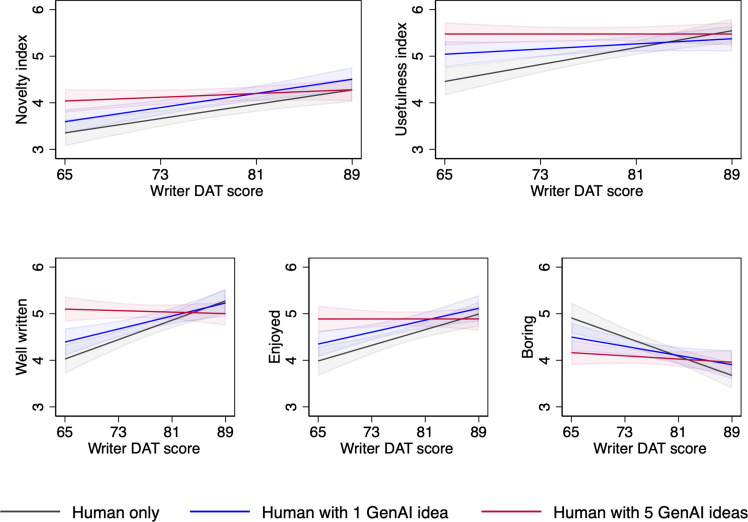
- Benefits were concentrated among less inherently creative writers: low-DAT writers with five AI ideas improved novelty by 10.7%, usefulness by 11.5%, how well written by up to 26.6%, enjoyment by up to 22.6%, and boringness decreased by up to 15.2%; high-DAT writers saw little effect.
- AI-assisted stories were more similar to other stories in the same condition (one idea: b = 0.871, P < 0.001; five ideas: b = 0.718, P = 0.003) and more similar to the AI ideas (5.2% and 5.0% increases, respectively).
- Writers’ self-assessments showed no statistically significant differences in novelty or usefulness across conditions; evaluators imposed an ownership penalty of at least 25% on writers who received AI ideas.
Methods
- Preregistered two-phase online experiment: N = 293 writers on Prolific were randomized to Human-only, Human with one GenAI idea, or Human with five GenAI ideas; they wrote an eight-sentence story for a teenage/young adult audience, with GPT-4 providing three-sentence story ideas in AI conditions.
- Writers completed the divergent association task (DAT) before writing; DAT mean was 77.24, SD = 6.48, computed for 291 of 293 writers.
- N = 600 separate evaluators rated six randomly assigned stories each, yielding 3,519 evaluations; outcomes were analyzed with OLS regressions using robust standard errors, clustered at evaluator level for evaluator outcomes, plus cosine similarity of OpenAI embeddings.
Limitations
- The paper states the creative task was constrained in length (eight sentences), medium (writing), and output type (short story), with no interactiveness with the LLM or variation in prompts, limiting generalizability.
- The paper states the sample was relatively “typical” study participants, not professional writers or unusually creative individuals, and that the usefulness construct was adapted to this context.
- Evident from the text: writers could opt into receiving AI ideas rather than being forced to use them, though the authors argue intention-to-treat analysis and high uptake (88.4%) support causal interpretation; no financial incentives for creativity were introduced.
Model-written summary. Check it against the paper before relying on it.
Integrity signals
Registry
Cites
Statistics
Figures



Verification
Claims the paper makes
3 Valid · 1 Not valid · 3 Not checked · 93 Own results and interpretations
The cited sources that could be checked couldn’t confirm or dispute this claim.
In the paper
“First, having access to generative AI effectively equalizes the evaluations of stories, removing any disadvantage or advantage based on the writers’ inherent creativity (25).”
§ Generative AI enhances individual creativity but reduces the collective diversity of novel content > DISCUSSION
What the sources say
- Could not verifycites [25] H Wang, 2023, Scientific discovery in the age of artificial intelligence, Nature sourceExperimental — accuracy not yet measured
The Abstract describes a task for measuring verbal creativity, and the Discussion > Strengths describes its automatic scoring; neither addresses AI-assisted story writing or story evaluations. Searches for generative AI, story writing, and equalized ratings found no passage supporting the claimed effect. (LLM, conf=0.76)
plainstates a cause- Asserted: passes — The authors put it forward as true.
- Checkable: passes — It can be checked against evidence.
- Load-bearing: passes — The paper’s conclusions depend on it.
- Based: passes — The paper gives a reason why it holds.
- Rests on 2 assumptions not shown here.
- Could not verify
A result the paper reports from its own data — it cites no other source for it, so there is none to check. The quote shows it is in the paper.
In the paper
“We find that access to generative AI ideas causes stories to be evaluated as more creative, better written, and more enjoyable, especially among less creative writers.”
§ Generative AI enhances individual creativity but reduces the collective diversity of novel content > Abstract
plainstates a cause- Asserted: passes — The authors put it forward as true.
- Checkable: passes — It can be checked against evidence.
- Load-bearing: passes — The paper’s conclusions depend on it.
- Based: passes — The paper gives a reason why it holds.
- Rests on 2 assumptions not shown here.
A result the paper reports from its own data — it cites no other source for it, so there is none to check. The quote shows it is in the paper.
In the paper
“We find that access to generative AI ideas causes stories to be evaluated as more creative, better written, and more enjoyable, especially among less creative writers.”
- Also stated in: another passage · plain
“However, the gains from writing more creative stories benefit some more than others: Less creative writers experience greater uplifts for their stories, seeing increases of 10 to 11% for creativity and of 22 to 26% for how enjoyable and well written the story is.”
§ Generative AI enhances individual creativity but reduces the collective diversity of novel content > Abstract
plainstates a cause- Asserted: passes — The authors put it forward as true.
- Checkable: passes — It can be checked against evidence.
- Load-bearing: unclear — It is unclear whether the paper’s conclusions depend on it.
- Based: passes — The paper gives a reason why it holds.
- Rests on 2 assumptions not shown here.
- Also stated in: another passage · plain
A result the paper reports from its own data — it cites no other source for it, so there is none to check. The quote shows it is in the paper.
In the paper
“We find that access to generative AI ideas causes stories to be evaluated as more creative, better written, and more enjoyable, especially among less creative writers.”
- Also stated in: another passage · plain
“we find that stories written by writers with access to generative AI ideas are more enjoyable (Human with one GenAI idea condition: b = 0.216, P = 0.028; Human with five GenAI ideas condition: b = 0.375, P < 0.001, see table S6)”
§ Generative AI enhances individual creativity but reduces the collective diversity of novel content > Abstract
plainstates a cause- Asserted: passes — The authors put it forward as true.
- Checkable: passes — It can be checked against evidence.
- Load-bearing: passes — The paper’s conclusions depend on it.
- Based: passes — The paper gives a reason why it holds.
- Rests on 2 assumptions not shown here.
- Also stated in: another passage · plain
A result the paper reports from its own data — it cites no other source for it, so there is none to check. The quote shows it is in the paper.
In the paper
“However, generative AI–enabled stories are more similar to each other than stories by humans alone.”
§ Generative AI enhances individual creativity but reduces the collective diversity of novel content > Abstract
plainstates an association- Asserted: passes — The authors put it forward as true.
- Checkable: passes — It can be checked against evidence.
- Load-bearing: passes — The paper’s conclusions depend on it.
- Based: passes — The paper gives a reason why it holds.
- Rests on 2 assumptions not shown here.
47 more claims
Create a free account to see all 100 claims and every source verdict.
- Probably not a substantial claim. 35
- It may state two separate claims as one. 23
- The quote only partly states this claim. 1
Claims other papers make about this one
Each is checked against this paper’s own text: does it say what the citing paper says it does?
The cited source doesn’t support the claim as written.
In the citing paper
“First, prior studies compared essays written entirely by students and those generated entirely by ChatGPT 7-8,14,15 . However, this may not accurately reflect how most students interact with AI chatbots in reality.”
From Style, sentiment, and quality of undergraduate writing in the AI era: A cross-sectional and longitudinal analysis of 4,820 authentic empirical reports (2025) · cites this paper as [8]
Checked by a reasoning model — may be wrong.
Experimental — accuracy not yet measuredThe source backs part of the claim, not all of it — or backs it for a different population, condition or comparison.
In the citing paper
“While such self-directed engagement has potential benefits, as suggested by recent articles, such as expanding access to new forms of expression and augmenting creativity [16,18]”
From Child-AI Co-Creation: A Review of the Current Research Landscape and a Proposal for Six Design Considerations (2025) · cites this paper as [16]
Experimental — accuracy not yet measuredThe source backs part of the claim, not all of it — or backs it for a different population, condition or comparison.
In the citing paper
“The most widely accepted framework evaluates innovation across two primary dimensions: novelty and usefulness (Amabile, 1982; Doshi and Hauser, 2024; Harvey and Berry, 2022).”
From AI-assisted design synthesis and human creativity in engineering education (2026) · cites this paper as Doshi and Hauser, 2024
Experimental — accuracy not yet measuredThe source backs part of the claim, not all of it — or backs it for a different population, condition or comparison.
In the citing paper
“Hence, simply by means of the training data of GenAI, the generated ideas may also be less diverse than those of humans [16].”
From Generative AI and Creativity: A Systematic Literature Review and Meta-Analysis (2025) · cites this paper as [16]
Experimental — accuracy not yet measuredThe source backs part of the claim, not all of it — or backs it for a different population, condition or comparison.
In the citing paper
“Equipped with a vast knowledge base and divergent thinking, AI can generate unexpected ideas and thus evoke a stronger sense of novelty (Doshi and Hauser, 2024; Tigre Moura et al., 2023)”
From From humans to AI: understanding why AI is perceived as the preferred co-creation partner (2025) · cites this paper as Doshi and Hauser, 2024
Experimental — accuracy not yet measured
26 more claims about this paper
Create a free account to see every claim other papers make about this one.
Citations
Cites
Hardin, G. (1968) · Science · doi:10.1126/science.162.3859.1243 · Cited by 25,167
Prolific.ac—A subject pool for online experiments
Palan, S., & Schitter, C. (2018) · Journal of Behavioral and Experimental Finance · doi:10.1016/j.jbef.2017.12.004 · Cited by 3,450
GPTs are GPTs: An Early Look at the Labor Market Impact Potential of Large Language Models
Eloundou, T., Manning, S., Mishkin, P., & Rock, D. (2023) · arXiv · doi:10.48550/arxiv.2303.10130 · Cited by 2,330
Social psychology of creativity: A consensual assessment technique.
Amabile, T. M. (1982) · Journal of Personality and Social Psychology · doi:10.1037/0022-3514.43.5.997 · Cited by 2,278
Experimental Evidence on the Productivity Effects of Generative Artificial Intelligence
Noy, S., & Zhang, W. (2023) · doi:10.2139/ssrn.4375283 · Cited by 2,157
Experimental evidence on the productivity effects of generative artificial intelligence
Noy, S., & Zhang, W. (2023) · Science · doi:10.1126/science.adh2586 · Cited by 2,150 · cited 2×
“That generative AI particularly benefited less able writers is paralleled in recent studies focusing on other domains in which generative AI has been shown to help less productive workers ( 4 , 5 ).”
Scientific discovery in the age of artificial intelligence.
Wang, H., Fu, T., Du, Y., Gao, W., Huang, K., Liu, Z., Chandak, P., Liu, S., Van Katwyk, P., Deac, A., et al. (2023) · Nature · doi:10.1038/s41586-023-06221-2 · Cited by 1,823
Brynjolfsson, E., Li, D., & Raymond, L. (2023) · National Bureau of Economic Research · doi:10.3386/w31161 · Cited by 995 · cited 1×
“…( 3 ), increase quality and efficiency of production of typical white-collar work ( 4 ), promote productivity in customer support relations ( 5 , 6 ), speed up programming tasks ( 7 ), and enhance persuasion messaging ( 8 ), little is known about generative AI’s potential impact on a…”
Art and the science of generative AI
Epstein, Z., Hertzmann, A., the Investigators of Human Creativity, Akten, M., Farid, H., Fjeld, J., Frank, M. R., Groh, M., Herman, L., Leach, N., et al. (2023) · Science · doi:10.1126/science.adh4451 · Cited by 788
When and How Artificial Intelligence Augments Employee Creativity
Jia, N., Luo, X., Fang, Z., & Liao, C. (2024) · Academy of Management Journal · doi:10.5465/amj.2022.0426 · Cited by 768
Research works printed but not linked: 18
- W Kenower, 2020, The Cold Open: Facing the Blank Page. Writer's Diget
- K Girotra, 2023, Ideas are Dimes a Dozen: Large Language Models for Idea Generation in Innovation
- If a human creator (author) uses AI in part of the writing of a story, the AI-generated content should be accessible alongside the final story
- $&4&*+2
- (*('622+&
- &(-$""(*& 5'6'$-"#+
- (&'("''''"(# #+"$
- #* (-1"",#(&%)'(#"'#
- #&('!')&'0'+ ' ##((&"*) #!$#
- (("-'''(" 49-&9#, 8
- +, #")((#,!"(!"%)'(#"3-$#
- ), #* (-")') "''-#"(#"0"&)"('&&''#
- ), &#)'("''('('#&#('0++ " )&
- #"'&"#('(('( -'""(&#! #(&26+ '( &$#&(, 70+$ "(##!"((+# #"(#"'"(##"#"(#"(#"#&#)&!"" -''(!"#)(#!*& '"(#'(+##
- -#&" -''$)&$#''2+ '#&#$&'$#
- A>::(&4$&(-* )(#&'6#+* )('','(#&'&+
- #", #&#&"('(#&-'0(27#" ' &#!;(#?0#&+++ '(
- + '##"'& ; #)(#!'"&), Writer study screenshots Condition: Human only Condition: Human with 1 AI idea (before story has been generated) Condition: Human with 1 AI idea (after story has been generated) Condition: Human with 5 AI ideas (before story has been generated) Condition: Human with 5 AI ideas (after story has been generated) Only shown in condition: Human only Only shown in condition: Human only and answered "yes" on previous page Only shown in condition: Human with 1 AI idea Only shown in condition: Human with 5 AI ideas (before rating any story) Only shown in condition: Human with 5 AI ideas (after rating a story) Section 6. Evaluator study screenshot Example of a story from the Human Only condition: the writer said they did not use an outside AI tool Example of a story from the Human Only condition: the writer said they did use an outside AI tool Example of a story from the Human with 1 or 5 AI idea(s) condition but the author did not access the GenAI idea Example of a story from the Human
Cited by
Lee, H.-P. (., Sarkar, A., Tankelevitch, L., Drosos, I., Rintel, S., Banks, R., & Wilson, N. (2025) · Proceedings of the 2025 CHI Conference on Human Factors in Computing Systems · doi:10.1145/3706598.3713778 · Cited by 490
A Comprehensive Review on Generative AI for Education
Mittal, U., Sai, S., Chamola, V., & Sangwan, D. (2024) · IEEE Access · doi:10.1109/access.2024.3468368 · Cited by 383
“It adapts to individual students’ inputs, providing personalized instruction, thereby enhancing the effectiveness of distance learning [69].”
BackgroundThe Crowdless Future? Generative AI and Creative Problem-Solving
Boussioux, L., Lane, J. N., Zhang, M., Jacimovic, V., & Lakhani, K. R. (2024) · Organization Science · doi:10.1287/orsc.2023.18430 · Cited by 329
Generative artificial intelligence and evaluating strategic decisions
Doshi, A. R., Bell, J. J., Mirzayev, E., & Vanneste, B. S. (2025) · Strategic Management Journal · doi:10.1002/smj.3677 · Cited by 216
Self-citationAI and Its Impact on Creativity and Diversity: An Empirical Study of LLM-Generated Product Ideas
Terwiesch, C., Meincke, L., Girotra, K., Mollick, E. R., Nave, G., & Ulrich, K. T. (2023) · doi:10.2139/ssrn.4526071 · Cited by 174
Metadata
- Authors
- Doshi, A., & Hauser, O.
- Affiliations
- University College London (GB)
- University of Exeter (GB)
- Corresponding author
- Doshi, Anil
- Hauser, Oliver
- Venue
- Science Advances
- Publisher
- Elsevier BV
- Published
- 2023
- Volume
- 10
- Issue
- 28
- Pages
- eadn5290-eadn5290
- ISSN
- 2375-2548 (ISSN-L)
- PMC
- PMC11244532
- OpenAlex
- W4400578758
- Semantic Scholar
- 5409f3fa0d9e1a7ffea029557a5871a25b3b1b7e
- Cited by
- 1,350
- References
- 42
- Citations by year
- 2026: 843 · 2025: 409 · 2024: 90 · 2023: 8
- FWCI
- 377.46
- Type
- journal article
- Language
- en
- Open access
- gold
- doi.org
- Licence
- cc-by
- Locations
- Science Advances (publishedVersion, cc-by)
- SSRN Electronic Journal (submittedVersion)
- PubMed Central (publishedVersion, cc-by)
- PubMed (publishedVersion)
- arXiv (Cornell University) (submittedVersion, cc-by-nc-nd)
- UCL Discovery (University College London) (submittedVersion, cc-by)
- Figshare (submittedVersion, cc-by)
- Open Research Exeter (University of Exeter) (submittedVersion, cc-by)
- arXiv (Cornell University)
- Funders
- Harvard Business School
- University of Exeter
- University of Oxford
- Topics
- Social Sciences › Psychology › Experimental and Cognitive Psychology › Creativity in Education and Neuroscience
- Physical Sciences › Computer Science › Artificial Intelligence › Ethics and Social Impacts of AI
- Physical Sciences › Computer Science › Artificial Intelligence › Artificial Intelligence in Games
- Keywords
- generative AI, large language models, creativity, short stories, story ideas, individual creativity, novelty, social dilemmas
- MeSH terms
- Artificial Intelligence, Creativity, Humans, Language, Writing
About these checks
Registry, retraction, Cites and statistics results are computed, not judged, with one exception: a printed reference that no index lists is read once by a model before it counts as a citation error. Claims are extracted by a model and kept only when their quote appears verbatim in the text; each cited source is then checked, with a model’s help, for whether it says what the claim relies on. Those verdicts can be wrong — read the claim’s quote and the cited source before relying on one.
The claim verdicts this report counts are experimental: their accuracy is not yet measured.
A language model drew the claims from the paper on 2026-09-28, under version 3 of the claim definition (model deepseek-v4.1-flash, prompt extract-v3).
A second model labelled each claim on 2026-09-28 (model jev-1.13-20260917, definition revision gold-guideline-v0.2).
Cited sources are checked with a language model’s help (gpt-6-sol).
Statistics and arithmetic are recomputed, not judged.
Confidence bands are shown only for fields calibrated on our annotated test set. None is calibrated yet, so no band is shown.
What counts as a claim ›How we measure confidence ›How we check this ›
Are you an author, or do you see a problem with this page? Request a review
How to cite
Cite CoChat for the checks on this page, and the paper for its own findings.
- This page
- CoChat. (2026). Citation check: Generative artificial intelligence enhances creativity but reduces the diversity of novel content. https://app.cochat.ai/papers/10.2139/ssrn.4535536
- The paper
- Doshi, A., & Hauser, O. (2023). Generative artificial intelligence enhances creativity but reduces the diversity of novel content. Science Advances. https://doi.org/10.2139/ssrn.4535536
Data sources
Bibliographic data: Semantic Scholar, OpenAlex, Crossref.
Contains information from the Semantic Scholar Academic Graph Datasets, made available under the ODC Attribution License (ODC-BY 1.0).
Semantic Scholar’s data is described in: Kinney, R., et al. (2023). The Semantic Scholar Open Data Platform. arXiv:2301.10140.
