

Emergence of Echinocandin Resistance Due to a Point Mutation in the fks1 Gene of Aspergillus fumigatus in a Patient with Chronic Pulmonary Aspergillosis
Open accessThe DOI matches its Crossref record; 16 of the 16 references it cites were found in a registry or an index.
Abstract
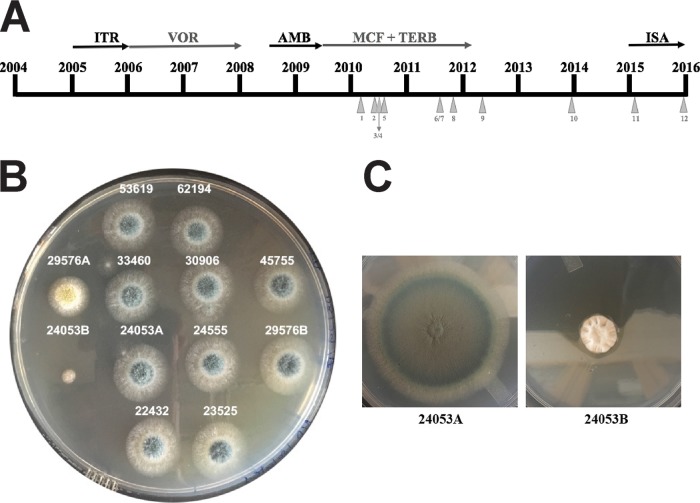
We have identified the first case of an fks1 hot spot 1 point mutation causing echinocandin resistance in a clinical Aspergillus fumigatus isolate recovered from a chronic pulmonary aspergillosis patient with an aspergilloma who first failed azole and polyene therapy and subsequently failed micafungin treatment.
Overview
The claims and statistics of this paper haven’t been checked yet.
Free: it reads the open-access text and checks the first 5 claims that cite a source we can check. Create a free account to check every claim.
Integrity signals
Registry
Cites
Statistics
Figures
Verification
Claims the paper makes
The claims and statistics of this paper haven’t been checked yet.
Free: it reads the open-access text and checks the first 5 claims that cite a source we can check. Create a free account to check every claim.
Claims other papers make about this one
Each is checked against this paper’s own text: does it say what the citing paper says it does?
The source backs part of the claim, not all of it — or backs it for a different population, condition or comparison.
In the citing paper
“echinocandin-resistant mutants can be induced easily in vitro (630, 631), and hot spots for point mutations inducing the resistance to amphotericin were identified in A. fumigatus after use of natamycin (632–634) and are starting to be seen in laboratories (635, 636).”
From Aspergillus fumigatus and Aspergillosis in 2019 (2019) · cites this paper as [631]
Experimental — accuracy not yet measured
Self-check
Percentages, sums and reported differences re-computed from the paper’s own numbers.
The self-check needs the paper’s full text.
Citations
Cites
Antifungal drug resistance: mechanisms, epidemiology, and consequences for treatment
Pfaller, M. A. (2012) · The American Journal of Medicine · doi:10.1016/j.amjmed.2011.11.001 · Cited by 903
Prospective Multicenter International Surveillance of Azole Resistance in Aspergillus fumigatus
van der Linden, J. W. M., Arendrup, M. C., Warris, A., Lagrou, K., Pelloux, H., Hauser, P. M., Chryssanthou, E., Mellado, E., Kidd, S. E., Tortorano, A. M., et al. (2015) · Emerging Infectious Diseases · doi:10.3201/eid2106.140717 · Cited by 371 · cited 9×
“has been linked to mutations in the FKS genes, which encode the -(1,3)-glucan synthase enzymes (9–11).”
BackgroundMethodResultSelf-citationGarcia-Effron, G., Katiyar, S. K., Park, S., Edlind, T. D., & Perlin, D. S. (2008) · Antimicrobial Agents and Chemotherapy · doi:10.1128/aac.00262-08 · Cited by 323
Self-citationGarcia-Effron, G., Lee, S., Park, S., Cleary, J. D., & Perlin, D. S. (2009) · Antimicrobial Agents and Chemotherapy · doi:10.1128/aac.00443-09 · Cited by 323
Self-citationAzole-resistance in Aspergillus: Proposed nomenclature and breakpoints
Verweij, P. E., Howard, S. J., Melchers, W. J. G., & Denning, D. W. (2009) · Drug Resistance Updates · doi:10.1016/j.drup.2009.09.002 · Cited by 260
Self-citationGarcia-Effron, G., Park, S., & Perlin, D. S. (2009) · Antimicrobial Agents and Chemotherapy · doi:10.1128/aac.01162-08 · Cited by 256 · cited 1×
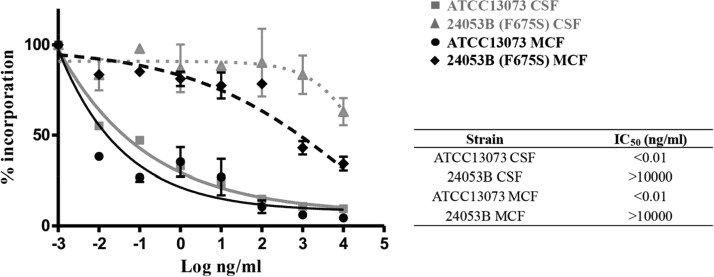
“Product-entrapped -(1,3)-glucan synthase complexes were extracted from the prototype WT strain ATCC 13073 and the 24053B clinical isolate, as previously described (10, 11), and the echinocandin inhibition parameter 50% inhibitory concentration (IC50) was determined.”
MethodSelf-citationTherapeutic Drug Monitoring of Posaconazole: an Update
Dekkers, B. G. J., Bakker, M., van der Elst, K. C. M., Sturkenboom, M. G. G., Veringa, A., Span, L. F. R., & Alffenaar, J.-W. C. (2016) · Current Fungal Infection Reports · doi:10.1007/s12281-016-0255-4 · Cited by 177
Multilocus Sequence Typing of the Pathogenic Fungus Aspergillus fumigatus
Bain, J. M., Tavanti, A., Davidson, A. D., Jacobsen, M. D., Shaw, D., Gow, N. A. R., & Odds, F. C. (2007) · Journal of Clinical Microbiology · doi:10.1128/jcm.00064-07 · Cited by 143
A Ser678Pro Substitution in Fks1p Confers Resistance to Echinocandin Drugs in Aspergillus fumigatus
Rocha, E. M. F., Garcia-Effron, G., Park, S., & Perlin, D. S. (2007) · Antimicrobial Agents and Chemotherapy · doi:10.1128/aac.00917-07 · Cited by 141
Self-citationChowdhary, A., Sharma, C., Hagen, F., & Meis, J. F. (2014) · Future Microbiology · doi:10.2217/fmb.14.27 · Cited by 130
Research works printed but not linked: 2
- Clinical and Laboratory Standards Institute. 2008 Reference method for broth dilution antifungal susceptibility testing of filamentous fungi; approved standard, vol 28 CLSI document M38-A2. Clinical and Laboratory Standards Institute, Wayne, PA.
- Clinical and Laboratory Standards Institute. 2016 Epidemiological cut off values for antifungal susceptibility testing, 1st ed CLSI document M59. Clinical and Laboratory Standards Institute, Wayne, PA.
Cited by
Aspergillus fumigatus and Aspergillosis in 2019
Latgé, J.-P., & Chamilos, G. (2019) · Clinical Microbiology Reviews · doi:10.1128/cmr.00140-18 · Cited by 1,400
The Antifungal Pipeline: Fosmanogepix, Ibrexafungerp, Olorofim, Opelconazole, and Rezafungin
Hoenigl, M., Sprute, R., Egger, M., Arastehfar, A., Cornely, O. A., Krause, R., Lass-Flörl, C., Prattes, J., Spec, A., Thompson, G. R., et al. (2021) · Drugs · doi:10.1007/s40265-021-01611-0 · Cited by 467
Drug-Resistant Fungi: An Emerging Challenge Threatening Our Limited Antifungal Armamentarium
Arastehfar, A., Gabaldón, T., Garcia-Rubio, R., Jenks, J. D., Hoenigl, M., Salzer, H. J. F., Ilkit, M., Lass-Flörl, C., & Perlin, D. S. (2020) · Antibiotics · doi:10.3390/antibiotics9120877 · Cited by 292
“Unlike complicated resistance mechanisms for azoles involving numerous components, echinocandin resistance is dominated by a single mechanism of action involving mutations in hotspots (HS) regions of FKS genes encoding amino acid substitutions within the catalytic subunits of β-1,3-D-glucan synthase [152,153].”
BackgroundSelf-citationGenomic epidemiology of the UK outbreak of the emerging human fungal pathogen Candida auris
Rhodes, J., Abdolrasouli, A., Farrer, R. A., Cuomo, C. A., Aanensen, D. M., Armstrong-James, D., Fisher, M. C., & Schelenz, S. (2018) · Emerging Microbes & Infections · doi:10.1038/s41426-018-0045-x · Cited by 246
Aspergillus fumigatus and aspergillosis: From basics to clinics
Arastehfar, A., Carvalho, A., Houbraken, J., Lombardi, L., Garcia-Rubio, R., Jenks, J. D., Rivero-Menendez, O., Aljohani, R., Jacobsen, I. D., Berman, J., et al. (2021) · Studies in Mycology · doi:10.1016/j.simyco.2021.100115 · Cited by 241
Self-citation
Metadata
- Authors
- Jiménez-Ortigosa, C., Moore, C., Denning, D. W., & Perlin, D. S.
- Affiliations
- Public Health Research Institute-New Jersey Medical School-Rutgers Biomedical Health Sciences, Newark, New Jersey, USA
- University of Manchester (GB)
- Rutgers, The State University of New Jersey (US)
- Venue
- Antimicrobial Agents and Chemotherapy
- Publisher
- American Society for Microbiology
- Published
- 2017-12
- Volume
- 61
- Issue
- 12
- ISSN
- 0066-4804 (ISSN-L)
- 1098-6596
- PMC
- PMC5700295
- OpenAlex
- W2755840805
- Cited by
- 72
- References
- 16
- Citations by year
- 2026: 7 · 2025: 5 · 2024: 5 · 2023: 9 · 2022: 8 · 2021: 11 · 2020: 13 · 2019: 6 · 2018: 8
- FWCI
- 5.68
- Type
- journal article
- Language
- en
- Open access
- hybrid
- doi.org
- Licence
- cc-by
- creativecommons.org/licenses/by/4.0/ (vor)
- journals.asm.org/non-commercial-tdm-license (tdm)
- Locations
- Antimicrobial Agents and Chemotherapy (publishedVersion, cc-by)
- PubMed Central (publishedVersion, cc-by)
- PubMed (publishedVersion)
- Research Explorer (The University of Manchester) (submittedVersion, cc-by)
- Funders
- Astellas Pharma US (813386)
- Topics
- Health Sciences › Medicine › Infectious Diseases › Antifungal resistance and susceptibility
- Life Sciences › Biochemistry, Genetics and Molecular Biology › Molecular Biology › Fungal and yeast genetics research
- Health Sciences › Medicine › Microbiology (medical) › Antibiotic Resistance in Bacteria
- Keywords
- echinocandin resistance, Aspergillus fumigatus, point mutations, chronic pulmonary aspergillosis, aspergilloma, micafungin, antifungal resistance
- MeSH terms
- Aged, Antifungal Agents, Aspergillus fumigatus, Chronic Disease, Female, Fungal Proteins, Genes, Fungal, Glucosyltransferases, Hemoptysis, Humans, Point Mutation, Drug Resistance, Fungal, Echinocandins, Pulmonary Aspergillosis
About these checks
Registry, retraction, Cites and statistics results are computed, not judged, with one exception: a printed reference that no index lists is read once by a model before it counts as a citation error. Claims are extracted by a model and kept only when their quote appears verbatim in the text; each cited source is then checked, with a model’s help, for whether it says what the claim relies on. Those verdicts can be wrong — read the claim’s quote and the cited source before relying on one.
Statistics and arithmetic are recomputed, not judged.
Confidence bands are shown only for fields calibrated on our annotated test set. None is calibrated yet, so no band is shown.
What counts as a claim ›How we measure confidence ›How we check this ›
Are you an author, or do you see a problem with this page? Request a review
Data sources
Bibliographic data: Semantic Scholar, OpenAlex, Crossref.
Contains information from the Semantic Scholar Academic Graph Datasets, made available under the ODC Attribution License (ODC-BY 1.0).
Semantic Scholar’s data is described in: Kinney, R., et al. (2023). The Semantic Scholar Open Data Platform. arXiv:2301.10140.
