

Novel Zinc-Attenuating Compounds as Potent Broad-Spectrum Antifungal Agents with In Vitro and In Vivo Efficacy
Open accessThe DOI matches its Crossref record; 45 of the 45 references it cites were found in a registry or an index.
Abstract
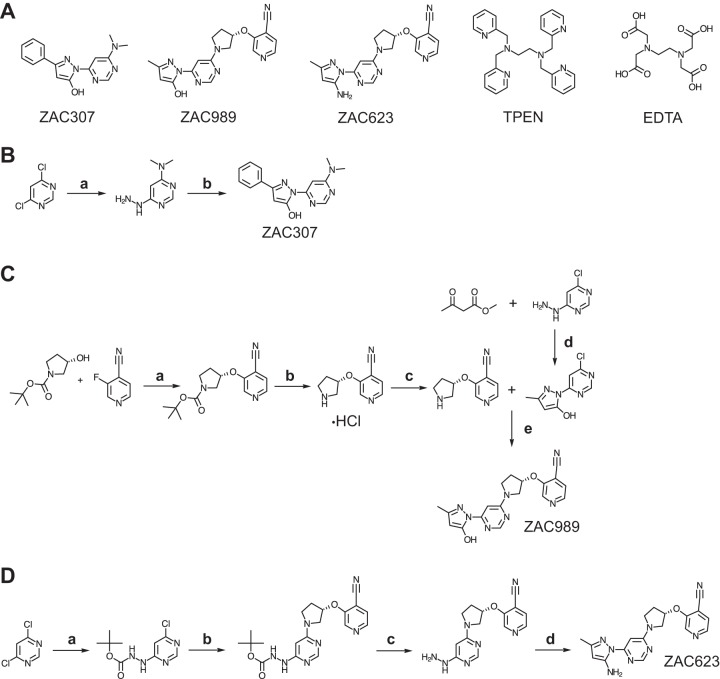
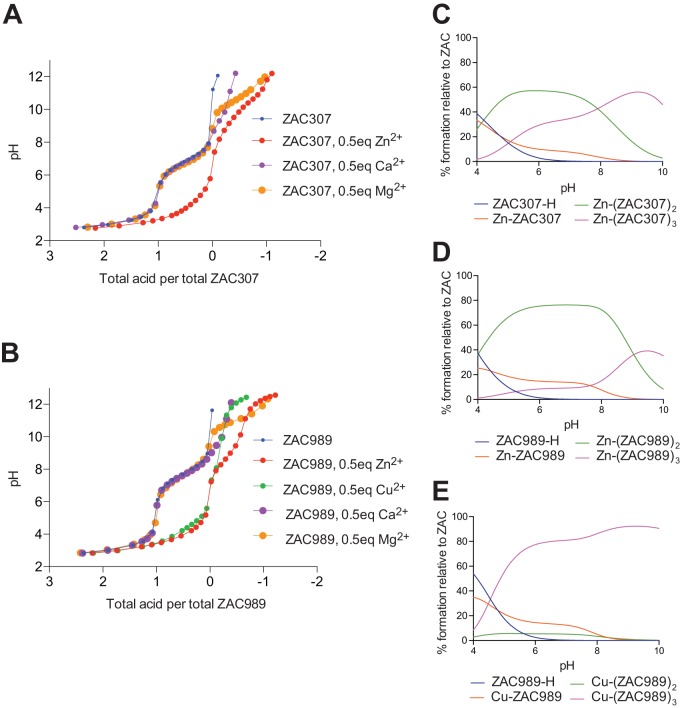
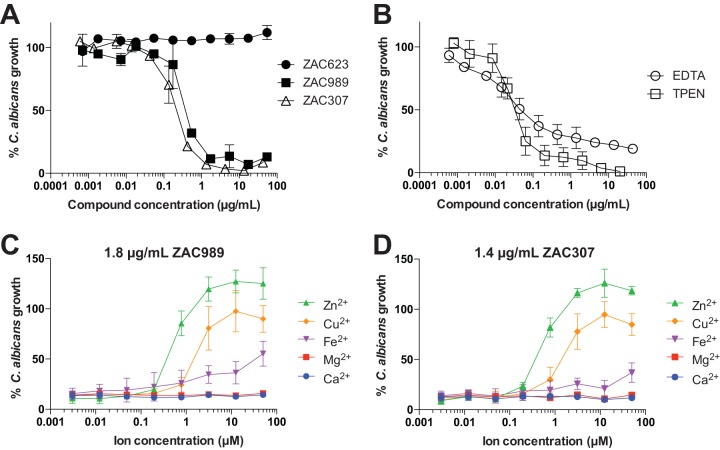
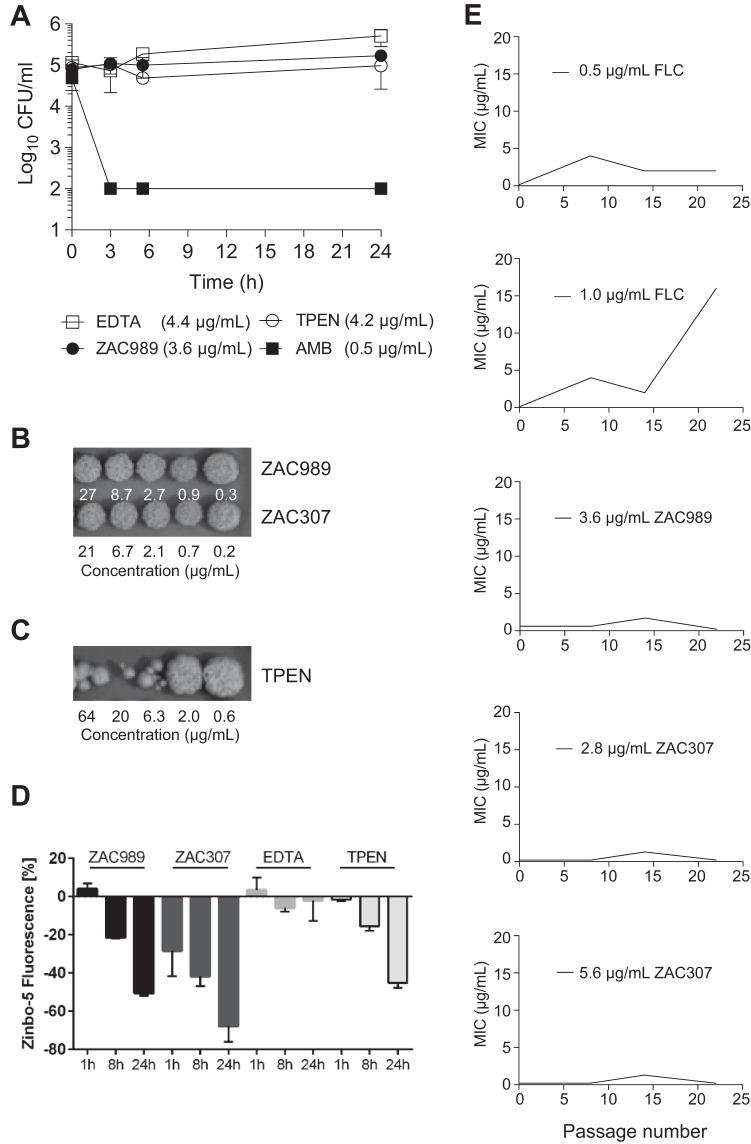
An increase in the incidence of rare but hard-to-treat invasive fungal pathogens as well as resistance to the currently available antifungal drugs calls for new broad-spectrum antifungals with a novel mechanism of action. Here we report the identification and characterization of two novel zinc-attenuating compounds, ZAC307 and ZAC989, which exhibit broad-spectrum in vitro antifungal activity and in vivo efficacy in a fungal kidney burden candidiasis model. The compounds were identified serendipitously as part of a drug discovery process aimed at finding novel inhibitors of the fungal plasma membrane proton ATPase Pma1. Based on their structure, we hypothesized that they might act as zinc chelators. Indeed, both fluorescence-based affinity determination and potentiometric assays revealed these compounds, subsequently termed zinc-attenuating compounds (ZACs), to have strong affinity for zinc, and their growth inhibitory effects on Candida albicans and Aspergillus fumigatus could be inactivated by the addition of exogenous zinc to fungal growth media. We determined the ZACs to be fungistatic, with a low propensity for resistance development. Gene expression analysis suggested that the ZACs interfere negatively with the expression of genes encoding the major components of the A. fumigatus zinc uptake system, thus supporting perturbance of zinc homeostasis as the likely mode of action. With demonstrated in vitro and in vivo antifungal activity, low propensity for resistance development, and a novel mode of action, the ZACs represent a promising new class of antifungal compounds, and their advancement in a drug development program is therefore warranted.
Overview
The claims and statistics of this paper haven’t been checked yet.
Free: it reads the open-access text and checks the first 5 claims that cite a source we can check. Create a free account to check every claim.
Integrity signals
Registry
Cites
Statistics
Figures
Verification
Claims the paper makes
The claims and statistics of this paper haven’t been checked yet.
Free: it reads the open-access text and checks the first 5 claims that cite a source we can check. Create a free account to check every claim.
Claims other papers make about this one
Each is checked against this paper’s own text: does it say what the citing paper says it does?
The source backs part of the claim, not all of it — or backs it for a different population, condition or comparison.
In the citing paper
“Consequently, the ZafA and ZrfC proteins can be considered specific fungal targets, since zinc-chelating compounds can inhibit fungal growth both in vitro and in vivo (372–374).”
From Aspergillus fumigatus and Aspergillosis in 2019 (2019) · cites this paper as [373]
Experimental — accuracy not yet measuredThe source backs part of the claim, not all of it — or backs it for a different population, condition or comparison.
In the citing paper
“TPEN also exhibits growth inhibition rather than killing activity against Candida species (21), as does the zinc chelator pyrvinium pamoate (58).”
From Selective Metal Chelation by a Thiosemicarbazone Derivative Interferes with Mitochondrial Respiration and Ribosome Biogenesis in Candida albicans (2022) · cites this paper as [21]
Experimental — accuracy not yet measured
Self-check
Percentages, sums and reported differences re-computed from the paper’s own numbers.
The self-check needs the paper’s full text.
Citations
Cites
Analysis of Relative Gene Expression Data Using Real-Time Quantitative PCR and the 2−ΔΔCT Method
Livak, K. J., & Schmittgen, T. D. (2001) · Methods · doi:10.1006/meth.2001.1262 · Cited by 180,860
Yung-Chi, C., & Prusoff, W. H. (1973) · Biochemical Pharmacology · doi:10.1016/0006-2952(73)90196-2 · Cited by 12,922 · cited 1×
“The Kds were calculated 475 using the equation: Kd (compound:Zn 2+ ) = IC50 / (1 + [Fluozin-3] / Kd,Fluozin-3:Zn 2+ ) (36).”
Mutation of the mouse klotho gene leads to a syndrome resembling ageing
Kuro-o, M., Matsumura, Y., Aizawa, H., Kawaguchi, H., Suga, T., Utsugi, T., Ohyama, Y., Kurabayashi, M., Kaname, T., Kume, E., et al. (1997) · Nature · doi:10.1038/36285 · Cited by 3,837
GANS, P., SABATINI, A., & VACCA, A. (1996) · Talanta · doi:10.1016/0039-9140(96)01958-3 · Cited by 3,264 · cited 2×
“The titration data were refined by the nonlinear least squares 486 refinement program Hyperquad2013 (37) to determine the deprotonation and stability constants.”
MethodScudiero, D. A., Shoemaker, R. H., Paull, K. D., Monks, A. P., Tierney, S., Nofziger, T. H., Currens, M. J., Seniff, D. A., & Boyd, M. R. (1988) · PubMed · Cited by 2,737
Urban, C. F., Ermert, D., Schmid, M., Abu-Abed, U., Goosmann, C., Nacken, W., Brinkmann, V., Jungblut, P. R., & Zychlinsky, A. (2009) · PLoS Pathogens · doi:10.1371/journal.ppat.1000639 · Cited by 1,673 · cited 2×
“Although iron acquisition is recognized as a virulence factor for many fungal pathogens (7), research in recent years has highlighted the important contribution that zinc sequestration makes to fungal pathogenesis and virulence (4, 9).”
BackgroundNutritional immunity: transition metals at the pathogen–host interface
Hood, M. I., & Skaar, E. P. (2012) · Nature Reviews Microbiology · doi:10.1038/nrmicro2836 · Cited by 1,535 · cited 3×
“The mechanisms for iron sequestration are best described, 59 and include the expression of high affinity iron transporters, iron-chelating siderophores and iron60 binding proteins (1, 7, 8).”
BackgroundMethodMetal Chelation and Inhibition of Bacterial Growth in Tissue Abscesses
Corbin, B. D., Seeley, E. H., Raab, A., Feldmann, J., Miller, M. R., Torres, V. J., Anderson, K. L., Dattilo, B. M., Dunman, P. M., Gerads, R., et al. (2008) · Science · doi:10.1126/science.1152449 · Cited by 857 · cited 2×
“In further 74 support of this notion, calprotectin comprises ~40% of total protein content in the neutrophil 75 cytoplasm during infection, and its antifungal effect can be reversed in vitro by micromolar 76 quantities of zinc (3, 4, 9).”
BackgroundRodriguez-Tudela, J. L., Arendrup, M. C., Barchiesi, F., Bille, J., Chryssanthou, E., Cuenca-Estrella, M., Dannaoui, E., Denning, D. W., Donnelly, J. P., Dromer, F., et al. (2008) · Clinical Microbiology and Infection · doi:10.1111/j.1469-0691.2007.01935.x · Cited by 652
Coordination Dynamics of Zinc in Proteins
Maret, W., & Li, Y. (2009) · Chemical Reviews · doi:10.1021/cr800556u · Cited by 644 · cited 1×
“0 pM) (28), it is more likely that these compounds interfere with the regulation of zinc homeostasis by promoting the release of Zn2 ions from intracellular storage compartments.”
Background
Cited by
Aspergillus fumigatus and Aspergillosis in 2019
Latgé, J.-P., & Chamilos, G. (2019) · Clinical Microbiology Reviews · doi:10.1128/cmr.00140-18 · Cited by 1,400
Promising Antifungal Targets Against Candida albicans Based on Ion Homeostasis
Li, Y., Sun, L., Lu, C., Gong, Y., Li, M., & Sun, S. (2018) · Frontiers in Cellular and Infection Microbiology · doi:10.3389/fcimb.2018.00286 · Cited by 85
“Researchers identified two novel zinc-attenuating compounds (ZACs) ZAC307 and ZAC989, which showed antifungal activity against C. albicans by chelating zinc in vitro (O’Hanlon Cohrt et al., 2018).”
BackgroundDisruption of Intracellular Calcium Homeostasis as a Therapeutic Target Against Trypanosoma cruzi
Benaím, G., Paniz‐Mondolfi, A., Sordillo, E. M., & Martinez-Sotillo, N. (2020) · Frontiers in Cellular and Infection Microbiology · doi:10.3389/fcimb.2020.00046 · Cited by 63
Antifungal compounds from Streptomyces associated with attine ants also inhibit Leishmania donovani
Ortega, H. E., Ferreira, L. L. G., Melo, W. G. D. P., de Oliveira, A. L. L., Alvarenga, R. F. R., Lopes, N. P., Bugni, T. S., Andricopulo, A. D., & Pupo, M. T. (2019) · PLoS neglected tropical diseases · doi:10.1371/journal.pntd.0007643 · Cited by 61
Duan, X., Xie, Z., Ma, L., Jin, X., Zhang, M., Xu, Y., Liu, Y., Lou, H., & Chang, W. (2022) · Microbiology Spectrum · doi:10.1128/spectrum.01951-21 · Cited by 31
“albicans cells exposed to 19ak by using fluorescent probes FeRhoNox-1 and Zinbo-5, which specifically bind free ferrous ions and zinc, respectively (21, 35).”
BackgroundMethodRodríguez-Durán, J., Pinto-Martínez, A., Castillo, C., & Benaím, G. (2019) · FEBS Journal · doi:10.1111/febs.14947 · Cited by 31
Dias, V. M. D. C. H., da Silva, D. M. L., Burger, M., de Oliveira, A. A. S., Capelo, P. D. J., Specian, F. A. D. R., de Figueiredo, M. C., Tuon, F. F., & Baena, C. P. (2021) · The Brazilian Journal of Infectious Diseases · doi:10.1016/j.bjid.2021.101540 · Cited by 29
Banoth, K. K., Faheem, F., Sekhar, K. V. G. C., Nandikolla, A., & Murugesan, S. (2020) · Heliyon · doi:10.1016/j.heliyon.2020.e04916 · Cited by 27
Zinc and Iron Homeostasis: Target-Based Drug Screening as New Route for Antifungal Drug Development
Simm, C., & May, R. C. (2019) · Frontiers in Cellular and Infection Microbiology · doi:10.3389/fcimb.2019.00181 · Cited by 26
Riedelberger, M., Penninger, P., Tscherner, M., Hadriga, B., Brunnhofer, C., Jenull, S., Stoiber, A., Bourgeois, C., Petryshyn, A., Glaser, W., et al. (2020) · iScience · doi:10.1016/j.isci.2020.101121 · Cited by 23
“Indeed, EDTA, TPEN, and zinc-attenuating compounds that indirectly also target Zn-dependent fungal processes have been effectively used for fungal infections with C. albicans and A. fumigatus (Cohrt et al., 2018; Hachem et al., 2006; Hein et al., 2015; Laskaris et al., 2016).”
BackgroundDeveloping novel antifungals: lessons from G protein-coupled receptors
Velazhahan, V., McCann, B. L., Bignell, E., & Tate, C. G. (2023) · Trends in Pharmacological Sciences · doi:10.1016/j.tips.2022.12.002 · Cited by 23
“cerevisiae Pma1 through direct competition for ATP binding [71,72].”
BackgroundTraynor, A. M., Owens, R. A., Coughlin, C. M., Holton, M. C., Jones, G. W., Calera, J. A., & Doyle, S. (2021) · Microbiology · doi:10.1099/mic.0.001106 · Cited by 22
Self-citationNovel avenues for identification of new antifungal drugs and current challenges
Jampílek, J. (2022) · Expert Opinion on Drug Discovery · doi:10.1080/17460441.2022.2097659 · Cited by 21
“For example, concanamycin A affects H homeostasis [243], chlorogenic acid influences K/Na homeostasis [233,244–246], Ca homeostasis is affected by beauvericin [231] and silibinin [232], Fe homeostasis is influenced by geraniol [247– 249], and pyrazolylpyrimidines ZAC307, ZAC989, and ZAC623 affect Zn homeostasis [250],…”
BackgroundTranscriptomic meta-analysis to identify potential antifungal targets in Candida albicans
Hefny, Z. A., Ji, B., Elsemman, I. E., Nielsen, J., & Dijck, P. V. (2024) · BMC Microbiology · doi:10.1186/s12866-024-03213-8 · Cited by 18
“Zinc-attenuating compounds, such as ZAC307 and ZAC989, have been identified and demonstrated antifungal activity by chelating zinc in vitro [131].”
Background“Nutrient–fungi–host” tripartite interaction in cancer progression
Wu, D., Guan, Y., Li, C., Zheng, Q., Yin, Z., Wang, H., & Liu, N. (2024) · iMeta · doi:10.1002/imt2.170 · Cited by 15
Lopes, D. D. S., dos Santos, U. R., dos Anjos, D. O., Júnior, L. J. C. S., de Paula, V. F., Vannier-Santos, M. A., Silva-Jardim, I., Castro‐Gomes, T., Pirovani, C. P., & dos Santos, J. L. (2020) · Frontiers in Cellular and Infection Microbiology · doi:10.3389/fcimb.2020.00306 · Cited by 13
Oliveira, I. H. R., Figueiredo, H. C. P., Rezende, C. P., Verano‐Braga, T., Melo‐Braga, M. N., Reis-Cunha, J. L., & de Andrade, H. M. (2020) · Experimental Parasitology · doi:10.1016/j.exppara.2020.107964 · Cited by 13
Xie, F., Hao, Y., Liu, Y., Bao, J., Wang, R., Chi, X., Wang, T., Yu, S., Jin, Y., Li, L., et al. (2024) · Journal of Medicinal Chemistry · doi:10.1021/acs.jmedchem.3c02292 · Cited by 11
Kwofie, K. D., Sato, K., Sanjoba, C., Hino, A., Shimogawara, R., Amoa‐Bosompem, M., Ayi, I., Boakye, D. A., Anang, A. K., Chang, K.-S., et al. (2019) · PLoS neglected tropical diseases · doi:10.1371/journal.pntd.0007235 · Cited by 11
Mucormycosis in COVID-19: Is Zinc a Silent Killer in India?
Nath, S., & Baidya, D. K. (2021) · Indian Journal of Critical Care Medicine · doi:10.5005/jp-journals-10071-23938 · Cited by 8
Shinohara, T., Wada, A., Abe, M., Nakayama, N., Nagi, M., & Miyazaki, Y. (2023) · JAC-Antimicrobial Resistance · doi:10.1093/jacamr/dlad155 · Cited by 8
“17,18 In this study, we selected six alkyl polyamine compounds (APCs) that have not yet been evaluated as potential antifungal drugs, and we searched for compounds sequestering transition metals essential for fungal development.”
BackgroundHarnessing Metal Homeostasis Offers Novel and Promising Targets Against Candida albicans
Hameed, S., Hans, S., Singh, S., & Fatima, Z. (2019) · Current Drug Discovery Technologies · doi:10.2174/1570163816666190227231437 · Cited by 7
Bayona, J. V. M., Salvador-García, C., Tormo, N., & Gimeno-Cardona, C. (2021) · Enfermedades Infecciosas y Microbiología Clínica · doi:10.1016/j.eimc.2021.04.003 · Cited by 7
Tadele, M., Abay, S. M., Mac, P. A., Makonnen, E., & Hailu, A. (2021) · BMC Pharmacology and Toxicology · doi:10.1186/s40360-021-00538-2 · Cited by 3
Scott, J., & Amich, J. (2021) · Elsevier eBooks · doi:10.1016/b978-0-12-818731-9.00059-8 · Cited by 5
Shinohara, T., Wada, A., Abe, M., Oiki, S., Koizumi, A., Otani, A., Katano, H., & Miyazaki, Y. (2025) · Antimicrobial Agents and Chemotherapy · doi:10.1128/aac.00856-25 · Cited by 2
Drug Discovery and Development on Pma1, Where Are We Now? A Critical Review from 1995 to 2022
Tùng, T. T., & Nielsen, J. (2022) · ChemMedChem · doi:10.1002/cmdc.202200356 · Cited by 2
Tyurin, V. S., Babasieva, V. S., Grigoriev, M. S., Parshina, L. N., Zamilatskov, I. A., Smolyarchuk, E. A., Nesterova, O. V., Туренко, В. Н., Kolyganova, T. I., Arzumanian, V. G., et al. (2026) · Pharmaceuticals · doi:10.3390/ph19060874 · Cited by 1
Espinel-Ingroff, A. V. (2014) · Elsevier eBooks · doi:10.1016/b978-0-12-801238-3.02386-2 · Cited by 1
Wang, Y., Ye, S., Deng, Y., Huang, Y., & Zhu, X. (2025) · Research Square · doi:10.21203/rs.3.rs-5862334/v1
RetractedWang, Y., Ye, S., Deng, Y., Huang, Y., & Zhu, X. (2025) · Research Square · doi:10.21203/rs.3.rs-5862334/v2
RetractedKiplimo, R. U. T. O., AMONDI, S. L., OBANGO, S. K., Meshack, S., KIRUI, D. G., & Kagia, R. (2025) · African Journal of Pharmacy and Alternative Medicine · doi:10.58460/ajpam.v4i2.143
Zinc deficiency reverses biofilm azole resistance in Candida albicans
Wang, Y., Ye, S., Deng, Y., Huang, Y., & Zhu, X. (2025) · International Journal of Antimicrobial Agents · doi:10.1016/j.ijantimicag.2025.107695
Metadata
- Authors
- Cohrt, K. A. O., Marín, L., Kjellerup, L., Clausen, J. D., Dalby-Brown, W., Calera, J. A., & Winther, A.-M. L.
- Affiliations
- Pcovery, Copenhagen, Denmark
- Consejo Superior de Investigaciones Científicas (ES)
- University of Copenhagen (DK)
- Universidad de Salamanca (ES)
- Corresponding author
- Winther, Anne-Marie Lund
- Venue
- Antimicrobial Agents and Chemotherapy
- Publisher
- American Society for Microbiology
- Published
- 2018-05
- Volume
- 62
- Issue
- 5
- ISSN
- 0066-4804 (ISSN-L)
- 1098-6596
- PMC
- PMC5923171
- OpenAlex
- W2791455530
- Cited by
- 32
- References
- 45
- Citations by year
- 2026: 1 · 2025: 4 · 2024: 3 · 2023: 2 · 2022: 3 · 2021: 6 · 2020: 5 · 2019: 6 · 2018: 1
- FWCI
- 3.40
- Type
- journal article
- Language
- en
- Open access
- hybrid
- doi.org
- Licence
- cc-by
- creativecommons.org/licenses/by/4.0/ (vor)
- journals.asm.org/non-commercial-tdm-license (tdm)
- Locations
- Antimicrobial Agents and Chemotherapy (publishedVersion, cc-by)
- Europe PMC (PubMed Central) (publishedVersion, cc-by)
- PubMed Central (publishedVersion, cc-by)
- PubMed (publishedVersion)
- Research at the University of Copenhagen (University of Copenhagen) (publishedVersion, other-oa)
- DIGITAL.CSIC (Spanish National Research Council (CSIC)) (submittedVersion, cc-by)
- Gredos (University of Salamanca) (submittedVersion, cc-by-nc-nd)
- Hispana (submittedVersion, cc-by-nc-nd)
- Funders
- Wellcome Trust Research Councils, UK (100480/Z/12)
- Novo Seeds, Denmark
- Boehringer Ingelheim Venture Fund, Germany
- Spanish Ministry of Economy and Competitiveness (SAF2013-48382-R)
- Innovation Fund, Denmark (4019-00019B)
- Topics
- Health Sciences › Medicine › Infectious Diseases › Antifungal resistance and susceptibility
- Life Sciences › Agricultural and Biological Sciences › Plant Science › Fungal Plant Pathogen Control
- Life Sciences › Immunology and Microbiology › Applied Microbiology and Biotechnology › Antimicrobial agents and applications
- Keywords
- zinc chelators, antifungal agents, Candida albicans, Aspergillus fumigatus, candidiasis, zinc homeostasis, fungistatic activity, antifungal resistance, drug discovery
- MeSH terms
- Animals, Antifungal Agents, Aspergillosis, Aspergillus fumigatus, Candida albicans, Candidiasis, Proton-Translocating ATPases, Humans, Mice, Inbred BALB C, Microbial Sensitivity Tests, Zinc Compounds, Drug Resistance, Fungal, Cell Line, Tumor, Mice, Hep G2 Cells
About these checks
Registry, retraction, Cites and statistics results are computed, not judged, with one exception: a printed reference that no index lists is read once by a model before it counts as a citation error. Claims are extracted by a model and kept only when their quote appears verbatim in the text; each cited source is then checked, with a model’s help, for whether it says what the claim relies on. Those verdicts can be wrong — read the claim’s quote and the cited source before relying on one.
Statistics and arithmetic are recomputed, not judged.
Confidence bands are shown only for fields calibrated on our annotated test set. None is calibrated yet, so no band is shown.
What counts as a claim ›How we measure confidence ›How we check this ›
Are you an author, or do you see a problem with this page? Request a review
Data sources
Bibliographic data: Semantic Scholar, OpenAlex, Crossref.
Contains information from the Semantic Scholar Academic Graph Datasets, made available under the ODC Attribution License (ODC-BY 1.0).
Semantic Scholar’s data is described in: Kinney, R., et al. (2023). The Semantic Scholar Open Data Platform. arXiv:2301.10140.
