

Discovery of a Sexual Cycle in Aspergillus lentulus, a Close Relative of A. fumigatus
Open accessThe DOI matches its Crossref record; 70 of the 71 references it cites were found in a registry or an index.
Abstract
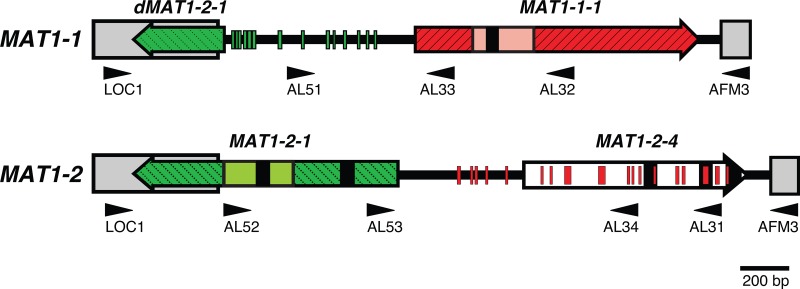
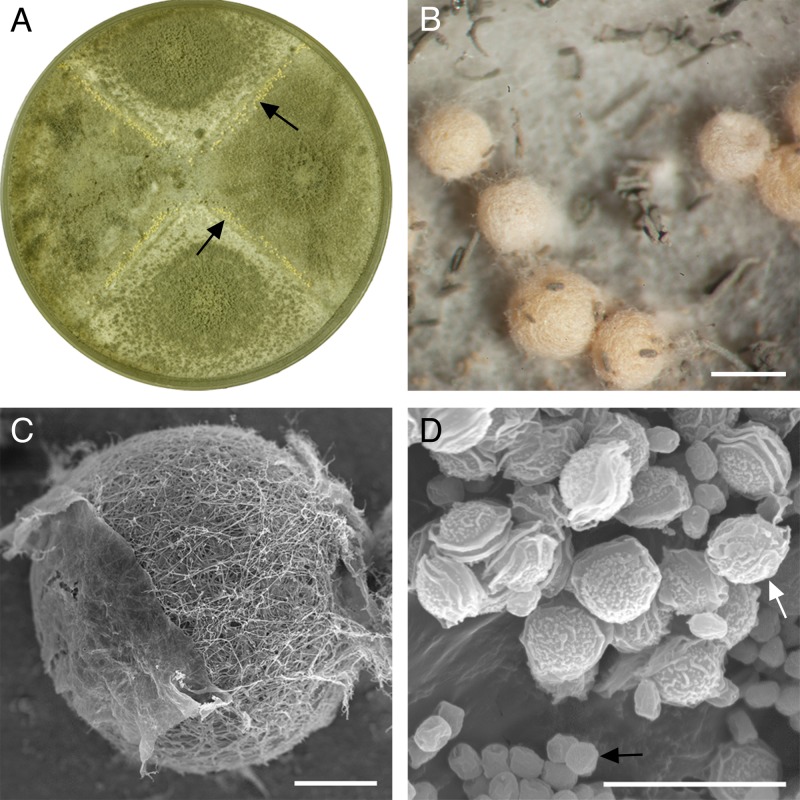
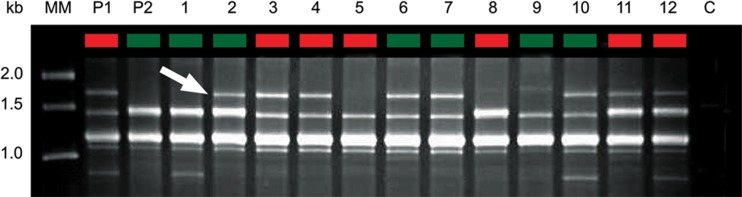
Aspergillus lentulus was described in 2005 as a new species within the A. fumigatus sensu lato complex. It is an opportunistic human pathogen causing invasive aspergillosis with high mortality rates, and it has been isolated from clinical and environmental sources. The species is morphologically nearly identical to A. fumigatus sensu stricto, and this similarity has resulted in their frequent misidentification. Comparative studies show that A. lentulus has some distinguishing growth features and decreased in vitro susceptibility to several antifungal agents, including amphotericin B and caspofungin. Similar to the once-presumed-asexual A. fumigatus, it has only been known to reproduce mitotically. However, we now show that A. lentulus has a heterothallic sexual breeding system. A PCR-based mating-type diagnostic detected isolates of either the MAT1-1 or MAT1-2 genotype, and examination of 26 worldwide clinical and environmental isolates revealed similar ratios of the two mating types (38% versus 62%, respectively).MAT1-1 and MAT1-2 idiomorph regions were analyzed, revealing the presence of characteristic alpha and high-mobility-group (HMG) domain genes, together with other more unusual features such as a MAT1-2-4 gene. We then demonstrated that A. lentulus possesses a functional sexual cycle with mature cleistothecia, containing heat-resistant ascospores, being produced after 3 weeks of incubation. Recombination was confirmed using molecular markers. However, isolates of A. lentulus failed to cross with highly fertile strains of A. fumigatus, demonstrating reproductive isolation between these sibling species. The discovery of the A. lentulus sexual stage has significant implications for the management of drug resistance and control of invasive aspergillosis associated with this emerging fungal pathogen.
Overview
The claims and statistics of this paper haven’t been checked yet.
Free: it reads the open-access text and checks the first 5 claims that cite a source we can check. Create a free account to check every claim.
Integrity signals
Registry
Cites
Statistics
Figures
Verification
Claims the paper makes
The claims and statistics of this paper haven’t been checked yet.
Free: it reads the open-access text and checks the first 5 claims that cite a source we can check. Create a free account to check every claim.
Claims other papers make about this one
Each is checked against this paper’s own text: does it say what the citing paper says it does?
The source backs part of the claim, not all of it — or backs it for a different population, condition or comparison.
In the citing paper
“Moreover, sex is very specific and exclusive for the species A. fumigatus. Attempted crosses between isolates of A. fumigatus and the close relative A. lentulus failed to produce cleistothecia.”
From Aspergillus fumigatus and Aspergillosis in 2019 (2019) · cites this paper as [16]
Experimental — accuracy not yet measuredIn the citing paper
“This phenomenon (of sexual preference strictly between A. fumigatus spp.) is of medical significance, because most isolates of A. lentulus exhibit natural resistance to antifungal agents with potent activity against A. fumigatus, limiting the risk of gene flow between different Aspergillus species (16).”
From Aspergillus fumigatus and Aspergillosis in 2019 (2019) · cites this paper as [16]
Self-check
Percentages, sums and reported differences re-computed from the paper’s own numbers.
The self-check needs the paper’s full text.
Citations
Cites
Statistical Methods for Research Workers
(1945) · American Journal of Clinical Pathology · doi:10.1093/ajcp/15.11.552b · Cited by 10,880
The Fungal Community: Its Organization and Role in the Ecosystem
Shearer, C. A., Carroll, G. C., & Wicklow, D. T. (1993) · Mycologia · doi:10.2307/3760630 · Cited by 696
Discovery of a sexual cycle in the opportunistic fungal pathogen Aspergillus fumigatus
O’Gorman, C. M., Fuller, H. T., & Dyer, P. S. (2009) · Nature · doi:10.1038/nature07528 · Cited by 555
Self-citationRECOMBINATION AND THE MULTILOCUS STRUCTURE OF FUNGAL POPULATIONS
Milgroom, M. G. (1996) · Annual Review of Phytopathology · doi:10.1146/annurev.phyto.34.1.457 · Cited by 549
Genomic Islands in the Pathogenic Filamentous Fungus Aspergillus fumigatus
Fedorova, N. D., Khaldi, N., Joardar, V. S., Maiti, R., Amedeo, P., Anderson, M. J., Crabtree, J., Silva, J. C., Badger, J. H., Albarraq, A., et al. (2008) · PLoS Genetics · doi:10.1371/journal.pgen.1000046 · Cited by 508
Self-citationCellular and Molecular Biology of Filamentous Fungi
(2010) · ASM Press eBooks · doi:10.1128/9781555816636 · Cited by 431
The Amsterdam Declaration on Fungal Nomenclature
Hawksworth, D. L., Crous, P. W., Redhead, S. A., Reynolds, D. R., Samson, R. A., Seifert, K. A., Taylor, J. W., Wingfield, M. J., Abaci, Ö., Aime, C., et al. (2011) · IMA Fungus · doi:10.5598/imafungus.2011.02.01.14 · Cited by 410
Self-citationAspergillus lentulus sp. nov., a New Sibling Species of A. fumigatus
Balajee, S. A., Gribskov, J. L., Hanley, E., Nickle, D., & Marr, K. A. (2005) · Eukaryotic Cell · doi:10.1128/ec.4.3.625-632.2005 · Cited by 404
Self-citationRecent advances in understanding of the evolution and maintenance of sex
Hurst, L. D., & Peck, J. R. (1996) · Trends in Ecology & Evolution · doi:10.1016/0169-5347(96)81041-x · Cited by 354
Evidence for Sexuality in the Opportunistic Fungal Pathogen Aspergillus fumigatus
Paoletti, M., Rydholm, C., Schwier, E. U., Anderson, M. J., Szakacs, G., Lutzoni, F., Debeaupuis, J.-P., Latgé, J.-P., Denning, D. W., & Dyer, P. S. (2005) · Current Biology · doi:10.1016/j.cub.2005.05.045 · Cited by 308
Self-citation
Research works printed but not linked: 2
- Dyer PS 2007 Sexual reproduction and significance of MAT in the aspergilli, p 123– 142 Heitman J Kronstad JWTaylor, JW, Casselton LA (ed), Sex in fungi: molecular determination and evolutionary principles. ASM Press, Washington, DC
- Takada M Udagawa SI Norizuki K 1986 Isolation of Neosartorya fennelliae and interspecific pairings between N. fennelliae, N. spathulata, and Aspergillus fumigatus. Trans. Mycol. Soc. Jpn. 27: 415– 423
Cited by
Aspergillus fumigatus and Aspergillosis in 2019
Latgé, J.-P., & Chamilos, G. (2019) · Clinical Microbiology Reviews · doi:10.1128/cmr.00140-18 · Cited by 1,400
Paulussen, C., Hallsworth, J. E., Álvarez‐Pérez, S., Nierman, W. C., Hamill, P. G., Blain, D., Rediers, H., & Lievens, B. (2017) · Microbial Biotechnology · doi:10.1111/1751-7915.12367 · Cited by 334
Clinical implications of globally emerging azole resistance in Aspergillus fumigatus
Meis, J. F., Chowdhary, A., Rhodes, J. L., Fisher, M. C., & Verweij, P. E. (2016) · Philosophical Transactions of the Royal Society B: Biological Sciences · doi:10.1098/rstb.2015.0460 · Cited by 308
Modern Taxonomy of Biotechnologically Important Aspergillus and Penicillium Species
Houbraken, J., de Vries, R. P., & Samson, R. A. (2014) · Advances in Applied Microbiology · doi:10.1016/b978-0-12-800262-9.00004-4 · Cited by 280
Aspergillus fumigatus and Related Species
Sugui, J. A., Kwon-Chung, K. J., Juvvadi, P. R., Latge, J.-P., & Steinbach, W. J. (2015) · Cold Spring Harbor Perspectives in Medicine · doi:10.1101/cshperspect.a019786 · Cited by 278
“The major species known to cause disease in humans are found in five Aspergillus sections: Fumigati, Flavi, Nigri, Terrei, and Nidulante.”
BackgroundInfluentialAspergillus fumigatus-Related Species in Clinical Practice
Lamoth, F. (2016) · Frontiers in Microbiology · doi:10.3389/fmicb.2016.00683 · Cited by 184
“However, many species thought to be strictly anamorphic further demonstrated the ability to reproduce sexually with an opposite mating type (e.g., A. fumigatus, and A. lentulus; O’Gorman et al., 2009; Swilaiman et al., 2013).”
BackgroundFungal evolution: cellular, genomic and metabolic complexity
Naranjo‐Ortiz, M. A., & Gabaldón, T. (2020) · Biological Reviews · doi:10.1111/brv.12605 · Cited by 159
“This was confirmed with the discovery of sexual cycles in Penicillium (Houbraken, Frisvad & Samson, 2010) and Aspergillus (O’Gorman, Fuller & Dyer, 2009; Swilaiman et al., 2013), widely studied fungi that were thought to be asexual for more than a century.”
BackgroundEvolution of asexual and sexual reproduction in the aspergilli
Ojeda-López, M., Chen, W., Eagle, C. E., Gutiérrez, G., Jia, L., Swilaiman, S. S., Huang, Z., Park, H., Yu, J.-H., Cánovas, D., et al. (2018) · Studies in Mycology · doi:10.1016/j.simyco.2018.10.002 · Cited by 159
“…caveat is that a fragment of the MAT1-2 gene was found bordering the MAT1-1 idiomorph of A. fumigatus (Paoletti et al. 2005) and the related A. lentulus (Swilaiman et al. 2013), which could indicate evolution from a homothallic ancestor containing both MAT1-1 and MAT1-2 genes (Galagan et al. 2005).”
BackgroundMethodResultInfluentialSelf-citationBennett, R. J., & Turgeon, B. G. (2016) · Microbiology Spectrum · doi:10.1128/microbiolspec.funk-0005-2016 · Cited by 119
The cryptic sexual strategies of human fungal pathogens
Ene, I. V., & Bennett, R. J. (2014) · Nature Reviews Microbiology · doi:10.1038/nrmicro3236 · Cited by 101
Extrolites of Aspergillus fumigatus and Other Pathogenic Species in Aspergillus Section Fumigati
Frisvad, J. C., & Larsen, T. O. (2016) · Frontiers in Microbiology · doi:10.3389/fmicb.2015.01485 · Cited by 108
“Several of the species originally thought to produce only the asexual state have later been shown to be able to produce mature ascomata when crossed with the opposite mating type, for example A. fumigatus (O’Gorman et al., 2009) and A. lentulus (Swilaiman et al., 2013).”
BackgroundSugui, J. A., Peterson, S. W., Figat, A., Hansen, B., Samson, R. A., Mellado, E., Cuenca-Estrella, M., & Kwon-Chung, K. J. (2014) · Journal of Clinical Microbiology · doi:10.1128/jcm.01704-14 · Cited by 80
Induction of sexual reproduction and genetic diversity in the cheese fungus P enicillium roqueforti
Ropars, J., López‐Villavicencio, M., Dupont, J., Snirc, A., Gillot, G., Coton, M., Jany, J., Coton, E., & Giraud, T. (2014) · Evolutionary Applications · doi:10.1111/eva.12140 · Cited by 81
“…variability in the time or medium required for ascospore development, or lower levels of fertility in domesticated clonal strains, as suggested for other ascomy-cetes, such as A. fumigatus or P. chrysogenum (Dyer and Paoletti 2005; O’Gorman et al. 2009; B € ohm et al. 2012; Swilaiman et al. 2013).”
14 Mating-Type Structure, Function, Regulation and Evolution in the Pezizomycotina
Dyer, P. S., Inderbitzin, P., & Debuchy, R. (2016) · The mycota · doi:10.1007/978-3-319-25844-7_14 · Cited by 82
Self-citationSexual Reproduction of Human Fungal Pathogens
Heitman, J., Carter, D. A., Dyer, P. S., & Soll, D. R. (2014) · Cold Spring Harbor Perspectives in Medicine · doi:10.1101/cshperspect.a019281 · Cited by 76
“…by wind-borne ascospores has also been reported for various plant pathogenic fungi (Camps et al. 2012), and the increased heat resistance of ascospores might allow survival in ecological niches where high temperatures might be encountered, such as composting vegetation (Swilaiman et al. 2013).”
BackgroundInfluentialSelf-citationMoore, G. G. (2021) · Critical Reviews in Food Science and Nutrition · doi:10.1080/10408398.2021.1873731 · Cited by 71
Dyer, P. S., & Kück, U. (2017) · Microbiology Spectrum · doi:10.1128/microbiolspec.funk-0043-2017 · Cited by 67
Self-citationHubka, V., Barrs, V. R., Dudová, Z., Sklenář, F., Kubátová, A., Matsuzawa, T., Yaguchi, T., Horie, Y., Nováková, A., Frisvad, J. C., et al. (2018) · Persoonia - Molecular Phylogeny and Evolution of Fungi · doi:10.3767/persoonia.2018.41.08 · Cited by 66
“Fumigati (O’Gorman et al. 2009, Barrs et al. 2013, Swilaiman et al. 2013, Nováková et al. 2014, Hubka et al. 2017).”
BackgroundResultInfluentialNováková, A., Hubka, V., Dudová, Z., Matsuzawa, T., Kubátová, A., Yaguchi, T., & Kolařík, M. (2013) · Fungal Diversity · doi:10.1007/s13225-013-0262-5 · Cited by 50
“lentulus (Swilaiman et al. 2013) have similar morphology with tuberculate convex surface and equatorial crests <1 μm (Céline M.”
BackgroundMating type genes and cryptic sexuality as tools for genetically manipulating industrial molds
Kück, U., & Böhm, J. W. (2013) · Applied Microbiology and Biotechnology · doi:10.1007/s00253-013-5268-0 · Cited by 42
Aspergillus: Sex and Recombination
Varga, J., Szigeti, G., Baranyi, N., Kocsubé́, S., O’Gorman, C. M., & Dyer, P. S. (2014) · Mycopathologia · doi:10.1007/s11046-014-9795-8 · Cited by 39
Self-citationYu, Y., Amich, J., Will, C., Eagle, C. E., Dyer, P. S., & Krappmann, S. (2017) · Fungal Genetics and Biology · doi:10.1016/j.fgb.2017.09.001 · Cited by 38
Self-citationBastos, V. R. D. A., Santos, D. W. D. C. L., Padovan, A. C. B., Melo, A. S. D. A., Mazzolin, M. D. A., Camargo, L. F. A., & Colombo, A. L. (2014) · Mycopathologia · doi:10.1007/s11046-014-9840-7 · Cited by 28
Induction of the Sexual Cycle in Filamentous Ascomycetes
Houbraken, J. A. M. P., & Dyer, P. S. (2014) · Fungal biology · doi:10.1007/978-3-319-10503-1_2 · Cited by 26
“…reesei (Seidl et al. 2009 ), the penicillin producer Penicillium chrysogenum (Böhm et al. 2013 ), the opportunistic pathogen Aspergillus lentulus (Swilaiman et al. 2013 ), the afl atoxin producers Aspergillus fl avus and Aspergillus parasiticus (Moore 2014 ), and the starter culture of blue…”
Self-citationMatsuzawa, T., de Campos‐Takaki, G. M., Yaguchi, T., Okada, K., Abliz, P., Gonoi, T., & Horie, Y. (2014) · Mycoscience · doi:10.1016/j.myc.2014.04.006 · Cited by 22
Zhang, C., Kong, Q., Cai, Z., Liu, F., Chen, P., Song, J., Lü, L., & Sang, H. (2015) · Fungal Genetics and Biology · doi:10.1016/j.fgb.2015.03.001 · Cited by 16
Swilaiman, S. S., O’Gorman, C. M., Du, W., Sugui, J. A., Buono, J. D., Brock, M., Kwon-Chung, K. J., Szakács, G., & Dyer, P. S. (2020) · Journal of Fungi · doi:10.3390/jof6040258 · Cited by 16
“[37] using either a phenol/chloroform protocol or DNeasy Plant Mini kit (Qiagen, Manchester, UK).”
MethodSelf-citationKing, K. M., Hawkins, N. J., Atkins, S. L., Dyer, P. S., West, J. S., & FRAAIJE, B. A. (2019) · Mycoses · doi:10.1111/myc.12959 · Cited by 16
Self-citationHubka, V., Dudová, Z., Kubátová, A., Frisvad, J. C., Yaguchi, T., Horie, Y., Jurjević, Ž., Hong, S., & Kolařík, M. (2017) · Plant Systematics and Evolution · doi:10.1007/s00606-017-1400-4 · Cited by 14
Korfanty, G. A., Stanley, K., Lammers, K., Fan, Y., & Xu, J. (2020) · Infection Genetics and Evolution · doi:10.1016/j.meegid.2020.104640 · Cited by 14
Ordonez, N. (2018) · doi:10.18174/453455 · Cited by 12
Hull, C. M., Purdy, N. J., & Moody, S. C. (2014) · Future Microbiology · doi:10.2217/fmb.13.160 · Cited by 11
Piontelli, E. (2014) · Boletín micológico · doi:10.22370/bolmicol.2014.29.2.868 · Cited by 10
Fungi associated with drug recalls and rare disease outbreaks
Ahearn, D. G., & Stulting, R. D. (2014) · Journal of Industrial Microbiology & Biotechnology · doi:10.1007/s10295-014-1503-7 · Cited by 10
Dyer, P. S., & Kück, U. (2017) · ASM Press eBooks · doi:10.1128/9781555819583.ch9 · Cited by 9
Self-citationBennett, R. J., & Turgeon, B. G. (2017) · ASM Press eBooks · doi:10.1128/9781555819583.ch6 · Cited by 9
Hennig, S., Wenzel, M., Haas, C., Hoffmann, A., Weber, J., Rödel, G., & Ostermann, K. (2018) · Engineering in Life Sciences · doi:10.1002/elsc.201700181 · Cited by 8
Examining Signatures of Natural Selection in Antifungal Resistance Genes Across Aspergillus Fungi
Santos, R., Mead, M. E., Steenwyk, J. L., Rivero-Menéndez, O., Alastruey‐Izquierdo, A., Goldman, G. H., & Rokas, A. (2021) · Frontiers in Fungal Biology · doi:10.3389/ffunb.2021.723051 · Cited by 7
Hirose, D., Watanabe, K., Hagiuda, R., Tachikawa, R., Kamijo, T., Yaguchi, T., & Hirota, M. (2022) · Medical Mycology Journal · doi:10.3314/mmj.22-00017 · Cited by 4
An immunoinformatics study to explore HTL epitopes for fungal pathogen Aspergillus lentulus
Dubey, S. K., Mishra, M. K., Khan, F., Akhtar, N., & Kumar, A. (2024) · Journal of Proteins and Proteomics · doi:10.1007/s42485-023-00125-5 · Cited by 3
“Swilaiman et al. (2013) discovered that A. lentulus has an operational sexual cycle in 2013.”
Dyer, P. S., Munro, C. A., & Bradshaw, R. E. (2017) · Oxford University Press eBooks · doi:10.1093/med/9780198755388.003.0005 · Cited by 2
Self-citationControl of sexual reproduction in Aspergillus species
Ashour, A. (2014) · Nottingham ePrints (University of Nottingham) · Cited by 2
Wang, X., Gao, C., Yusufu, A., Nuermaimait, X., & Abliz, P. (2025) · Infection and Drug Resistance · doi:10.2147/idr.s532973 · Cited by 1
“…with pale green hues, delayed sporulation, small columnar conidial heads, and the ability to produce ascospores (sexual reproductive structures), 16 while being unable to grow at temperatures >48°C. 6 Aspergillus lentulus and A. fumigatus can be distinguished rapidly by matrix-assisted laser…”
L., E. P., Cruz, R., & José Amaro, S. (2013) · Boletín micológico · doi:10.22370/bolmicol.2013.28.2.876
Böhm, J. W. (2016) · Dokumentenrepositorium der RUB (Ruhr University Bochum)
Chiaratto, J. (2019) · Digital Library of Theses and Dissertations (Universidade de São Paulo) · doi:10.11606/d.17.2019.tde-26072019-170555
Sun, Y., Zhang, Y., Xu, J., Wang, T., & Shi, X. (2021) · Research Square · doi:10.21203/rs.3.rs-1020737/v1
The Bio-utilization of Used and Unused car Lubricants by Autochthonous Microorganisms
Akubuenyi, F. C., Tarh, J. E., & Idoko, J. D. (2022) · Microbiology Research Journal International · doi:10.9734/mrji/2022/v32i11-121379
“Though these organisms are environmental opportunistic microorganisms, they also have documented medical importance [23-28].”
BackgroundStructure-function analyses of fungal mating-type transcription factors
Ramšak, B. (2022) · Dokumentenrepositorium der RUB (Ruhr University Bochum) · doi:10.13154/294-9212
Molecular genetics of the biotechnologically relevant \(\textit {Penicillium brevicompactum}\)
Mahmoudjanlou, Y. (2020) · Dokumentenrepositorium der RUB (Ruhr University Bochum) · doi:10.13154/294-7559
Population genetic and phenotypic analyses of Aspergillus fumigatus strains from global soil samples
Korfanty, G. A. (2023) · MacSphere (McMaster University) · doi:10.71548/12890
Sexual development and sclerotial formation in the black aspergilli
Brett, P. M. (2023) · Nottingham ePrints (University of Nottingham)
Etude de la diversité structurale et fonctionnelle au sein de l'espèce Penicillium roqueforti
Gillot, G. (2015) · theses.fr (ABES) · doi:10.70675/e2ccdc12z0d98z4847z8c96z583a5476899c
Castro-Fuentes, C. A., Duarte-Escalante, E., León, M. G. F.-D., González-Villaseñor, M. D. C. A., Cabello-Gutiérrrez, C., Palma, G., Meraz-Ríos, B., & Montes, M. D. R. R. (2026) · Frontiers in Tropical Diseases · doi:10.3389/fitd.2026.1892022
Metadata
- Authors
- Swilaiman, S. S., O'Gorman, C. M., Balajee, S. A., & Dyer, P. S.
- Affiliations
- University of Nottingham (GB)
- School of Biology, University of Nottingham, University Park, Nottingham, United Kingdom
- Centers for Disease Control and Prevention (US)
- Corresponding author
- Dyer, Paul S.
- Venue
- Eukaryotic Cell
- Publisher
- American Society for Microbiology
- Published
- 2013-07
- Volume
- 12
- Issue
- 7
- Pages
- 962-969
- ISSN
- 1535-9778 (ISSN-L)
- 1535-9786
- PMC
- PMC3697472
- OpenAlex
- W2001634520
- Cited by
- 50
- References
- 71
- Citations by year
- 2026: 1 · 2025: 1 · 2024: 1 · 2022: 1 · 2021: 4 · 2020: 3 · 2019: 3 · 2018: 5 · 2017: 6 · 2016: 6 · 2015: 1 · 2014: 14 · 2013: 4
- FWCI
- 3.73
- Type
- journal article
- Language
- en
- Open access
- diamond
- doi.org
- Licence
- cc-by
- creativecommons.org/licenses/by/3.0/ (vor)
- journals.asm.org/non-commercial-tdm-license (tdm)
- Locations
- Eukaryotic Cell (publishedVersion, cc-by)
- Europe PMC (PubMed Central) (publishedVersion, cc-by)
- PubMed Central (publishedVersion, cc-by)
- PubMed (publishedVersion)
- Funders
- Johns Hopkins University
- Wellcome Trust
- Topics
- Life Sciences › Biochemistry, Genetics and Molecular Biology › Molecular Biology › Fungal and yeast genetics research
- Health Sciences › Medicine › Infectious Diseases › Antifungal resistance and susceptibility
- Life Sciences › Agricultural and Biological Sciences › Plant Science › Plant Pathogens and Fungal Diseases
- Keywords
- Aspergillus lentulus, heterothallism, reproductive cycle, mating type genes, MAT1-1, MAT1-2, cleistothecia, ascospores, recombination, reproductive isolation, invasive aspergillosis, antifungal resistance, fungal pathogens
- MeSH terms
- Aspergillus, Aspergillus fumigatus, Crosses, Genetic, Genotype, Humans, Meiosis, Recombination, Genetic, Reproduction, Spores, Fungal, Genes, Mating Type, Fungal, Genetic Loci
About these checks
Registry, retraction, Cites and statistics results are computed, not judged, with one exception: a printed reference that no index lists is read once by a model before it counts as a citation error. Claims are extracted by a model and kept only when their quote appears verbatim in the text; each cited source is then checked, with a model’s help, for whether it says what the claim relies on. Those verdicts can be wrong — read the claim’s quote and the cited source before relying on one.
Statistics and arithmetic are recomputed, not judged.
Confidence bands are shown only for fields calibrated on our annotated test set. None is calibrated yet, so no band is shown.
What counts as a claim ›How we measure confidence ›How we check this ›
Are you an author, or do you see a problem with this page? Request a review
Data sources
Bibliographic data: Semantic Scholar, OpenAlex, Crossref.
Contains information from the Semantic Scholar Academic Graph Datasets, made available under the ODC Attribution License (ODC-BY 1.0).
Semantic Scholar’s data is described in: Kinney, R., et al. (2023). The Semantic Scholar Open Data Platform. arXiv:2301.10140.
