

Genomic Islands in the Pathogenic Filamentous Fungus Aspergillus fumigatus
Open accessThe DOI matches its Crossref record; 75 of the 75 references it cites were found in a registry or an index.
Abstract
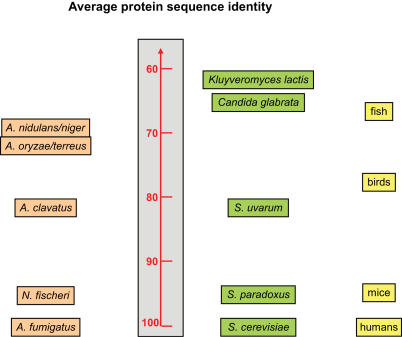
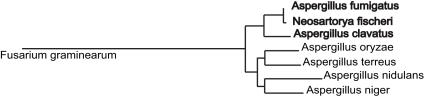
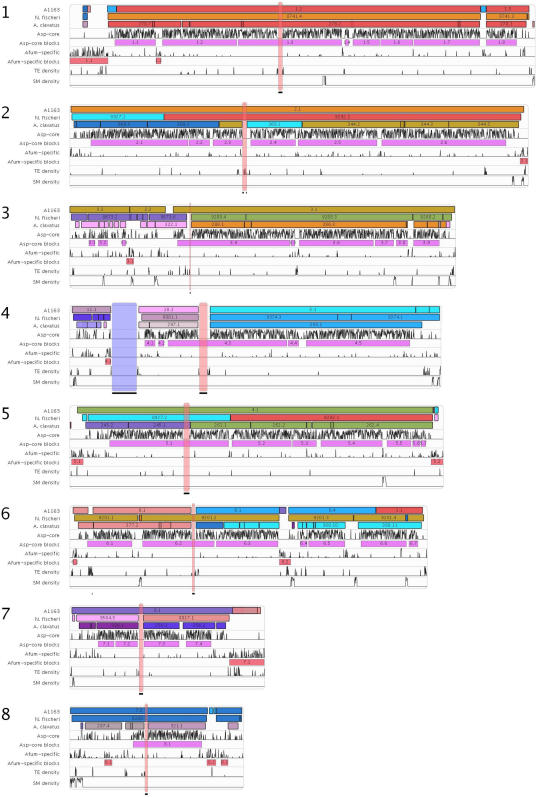
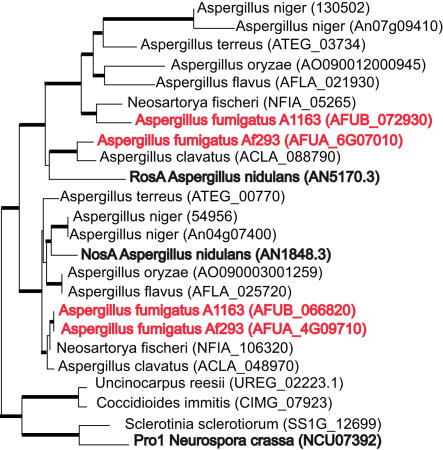
We present the genome sequences of a new clinical isolate of the important human pathogen, Aspergillus fumigatus, A1163, and two closely related but rarely pathogenic species, Neosartorya fischeri NRRL181 and Aspergillus clavatus NRRL1. Comparative genomic analysis of A1163 with the recently sequenced A. fumigatus isolate Af293 has identified core, variable and up to 2% unique genes in each genome. While the core genes are 99.8% identical at the nucleotide level, identity for variable genes can be as low 40%. The most divergent loci appear to contain heterokaryon incompatibility (het) genes associated with fungal programmed cell death such as developmental regulator rosA. Cross-species comparison has revealed that 8.5%, 13.5% and 12.6%, respectively, of A. fumigatus, N. fischeri and A. clavatus genes are species-specific. These genes are significantly smaller in size than core genes, contain fewer exons and exhibit a subtelomeric bias. Most of them cluster together in 13 chromosomal islands, which are enriched for pseudogenes, transposons and other repetitive elements. At least 20% of A. fumigatus-specific genes appear to be functional and involved in carbohydrate and chitin catabolism, transport, detoxification, secondary metabolism and other functions that may facilitate the adaptation to heterogeneous environments such as soil or a mammalian host. Contrary to what was suggested previously, their origin cannot be attributed to horizontal gene transfer (HGT), but instead is likely to involve duplication, diversification and differential gene loss (DDL). The role of duplication in the origin of lineage-specific genes is further underlined by the discovery of genomic islands that seem to function as designated "gene dumps" and, perhaps, simultaneously, as "gene factories".
Overview
The claims and statistics of this paper haven’t been checked yet.
Free: it reads the open-access text and checks the first 5 claims that cite a source we can check. Create a free account to check every claim.
Integrity signals
Registry
Cites
Statistics
Figures
Verification
Claims the paper makes
The claims and statistics of this paper haven’t been checked yet.
Free: it reads the open-access text and checks the first 5 claims that cite a source we can check. Create a free account to check every claim.
Claims other papers make about this one
Each is checked against this paper’s own text: does it say what the citing paper says it does?
The source backs part of the claim, not all of it — or backs it for a different population, condition or comparison.
In the citing paper
“Most of the studies have been performed with Neosartorya fischeri, a species very closely related taxonomically to A. fumigatus, which produced ascospores abundantly, in contrast to A. fumigatus (506).”
From Aspergillus fumigatus and Aspergillosis in 2019 (2019) · cites this paper as [506]
Experimental — accuracy not yet measured
Self-check
Percentages, sums and reported differences re-computed from the paper’s own numbers.
The self-check needs the paper’s full text.
Citations
Cites
Thompson, J. D., Higgins, D. G., & Gibson, T. J. (1994) · Nucleic Acids Research · doi:10.1093/nar/22.22.4673 · Cited by 64,617 · cited 1×
“Sequences were aligned using ClustalW [71].”
MUSCLE: multiple sequence alignment with high accuracy and high throughput
Edgar, R. C. (2004) · Nucleic Acids Research · doi:10.1093/nar/gkh340 · Cited by 44,662
Gene Ontology: tool for the unification of biology
Ashburner, M., Ball, C. A., Blake, J. A., Botstein, D., Butler, H., Cherry, J. M., Davis, A. P., Dolinski, K., Dwight, S. S., Eppig, J. T., et al. (2000) · Nature Genetics · doi:10.1038/75556 · Cited by 43,206
A Simple, Fast, and Accurate Algorithm to Estimate Large Phylogenies by Maximum Likelihood
Guindon, S., & Gascuel, O. (2003) · Systematic Biology · doi:10.1080/10635150390235520 · Cited by 16,806
Selection of Conserved Blocks from Multiple Alignments for Their Use in Phylogenetic Analysis
Castresana, J. (2000) · Molecular Biology and Evolution · doi:10.1093/oxfordjournals.molbev.a026334 · Cited by 10,508
Ohno, S. (1970) · doi:10.1007/978-3-642-86659-3 · Cited by 7,833
Whole-Genome Random Sequencing and Assembly of Haemophilus influenzae Rd
Fleischmann, R. D., Adams, M. D., White, O., Clayton, R. A., Kirkness, E. F., Kerlavage, A. R., Bult, C. J., Tomb, J.-F., Dougherty, B. A., Merrick, J. M., et al. (1995) · Science · doi:10.1126/science.7542800 · Cited by 5,654
Self-citationPAML: a program package for phylogenetic analysis by maximum likelihood
Yang, Z. (1997) · Bioinformatics · doi:10.1093/bioinformatics/13.5.555 · Cited by 5,373
Haas, B. J., Salzberg, S. L., Zhu, W., Pertea, M., Allen, J. E., Orvis, J., White, O., Buell, C. R., & Wortman, J. R. (2008) · Genome Biology · doi:10.1186/gb-2008-9-1-r7 · Cited by 4,079
Self-citationAspergillus fumigatus and Aspergillosis
Latgé, J.-P. (1999) · Clinical Microbiology Reviews · doi:10.1128/cmr.12.2.310 · Cited by 2,307 · cited 1×
“Aspergillus fumigatus is exceptional amongst the aspergilli in being both a primary and opportunistic pathogen as well as a major allergen associated with severe asthma and sinusitis [1–3].”
Background
Cited by
Aspergillus fumigatus and Aspergillosis in 2019
Latgé, J.-P., & Chamilos, G. (2019) · Clinical Microbiology Reviews · doi:10.1128/cmr.00140-18 · Cited by 1,400
Genomic Analysis of the Necrotrophic Fungal Pathogens Sclerotinia sclerotiorum and Botrytis cinerea
Amselem, J., Cuomo, C. A., van Kan, J. A. L., Viaud, M., Benito, E. P., Couloux, A., Coutinho, P. M., de Vries, R. P., Dyer, P. S., Fillinger, S., et al. (2011) · PLoS Genetics · doi:10.1371/journal.pgen.1002230 · Cited by 1,040
“Novel genes have also been reported in MAT loci of other ascomycete fungi [57–60].”
BackgroundSelf-citationSMURF: Genomic mapping of fungal secondary metabolite clusters
Khaldi, N., Seifuddin, F. T., Turner, G., Haft, D., Nierman, W. C., Wolfe, K. H., & Fedorova, N. D. (2010) · Fungal Genetics and Biology · doi:10.1016/j.fgb.2010.06.003 · Cited by 771
“To answer this question, we further analyzed the genomes of the three closely related species A. fumigatus Af293, A. clavatus , and Neosartorya fischeri (Fedorova et al., 2008; Nierman et al., 2005).”
Self-citationKubicek, C. P., Herrera-Estrella, A., Seidl-Seiboth, V., Martinez, D. A., Druzhinina, I. S., Thon, M., Zeilinger, S., Casas-Flores, S., Horwitz, B. A., Mukherjee, P. K., et al. (2011) · Genome Biology · doi:10.1186/gb-2011-12-4-r40 · Cited by 754
“The numbers of the synteny blocks increased with their decreased size, compatible with the random breakage model [14] as in aspergilli [15,17].”
BackgroundResultInfluentialFungal secondary metabolites – Strategies to activate silent gene clusters
Brakhage, A. A., & Schroeckh, V. (2011) · Fungal Genetics and Biology · doi:10.1016/j.fgb.2010.04.004 · Cited by 729
Metadata
- Authors
- Fedorova, N. D., Khaldi, N., Joardar, V. S., Maiti, R., Amedeo, P., Anderson, M. J., Crabtree, J., Silva, J. C., Badger, J. H., Albarraq, A., Angiuoli, S., Bussey, H., Bowyer, P., Cotty, P. J., Dyer, P. S., Egan, A., Galens, K., Fraser-Liggett, C. M., Haas, B. J., Inman, J. M., Kent, R., Lemieux, S., Malavazi, I., Orvis, J., Roemer, T., Ronning, C. M., Sundaram, J. P., Sutton, G., Turner, G., Venter, J. C., White, O. R., Whitty, B. R., Youngman, P., Wolfe, K. H., Goldman, G. H., Wortman, J. R., Jiang, B., Denning, D. W., & Nierman, W. C.
- Affiliations
- J. Craig Venter Institute (US)
- Trinity College Dublin (IE)
- University of Manchester (GB)
- McGill University (CA)
- Agricultural Research Service (US)
- University of Nottingham (GB)
- Universidade de São Paulo (BR)
- Merck & Co., Inc., Rahway, NJ, USA (United States) (US)
- University of Sheffield (GB)
- Corresponding author
- Nierman, William C.
- ORCID
- Joardar, Vinita S.
- Amedeo, Paolo
- Anderson, Michael J.
- Crabtree, Jonathan
- Silva, Joana C.
- Badger, Jonathan H.
- Albarraq, Ahmed
- Bowyer, Paul
- Cotty, Peter J.
- Dyer, Paul S.
- Haas, Brian J.
- Inman, Jason M.
- Malavazi, Iran
- Orvis, Joshua
- Venter, J. Craig
- White, Owen R.
- Whitty, Brett R.
- Wolfe, Kenneth H.
- Goldman, Gustavo H.
- Wortman, Jennifer R.
- Jiang, Bo
- Denning, David W.
- Nierman, William C.
- Venue
- PLoS Genetics
- Publisher
- Public Library of Science (PLoS)
- Published
- 2008-04-11
- Volume
- 4
- Issue
- 4
- Pages
- e1000046
- ISSN
- 1553-7390 (ISSN-L)
- 1553-7404
- PMC
- PMC2289846
- OpenAlex
- W2104863787
- Cited by
- 508
- References
- 75
- Citations by year
- 2026: 11 · 2025: 14 · 2024: 20 · 2023: 13 · 2022: 25 · 2021: 27 · 2020: 25 · 2019: 23 · 2018: 28 · 2017: 30 · 2016: 19 · 2015: 34 · 2014: 41 · 2013: 33 · 2012: 32
- FWCI
- 18.26
- Type
- journal article
- Language
- en
- Open access
- gold
- doi.org
- Locations
- PLoS Genetics (publishedVersion, cc-by)
- PubMed Central (publishedVersion, cc-by)
- PubMed (publishedVersion)
- Portuguese National Funding Agency for Science, Research and Technology (RCAAP Project by FCT) (publishedVersion)
- Arrow@dit (Dublin Institute of Technology) (submittedVersion)
- DOAJ (DOAJ: Directory of Open Access Journals) (submittedVersion, cc-by-sa)
- White Rose Research Online (University of Leeds, The University of Sheffield, University of York) (submittedVersion, cc-by)
- Figshare (submittedVersion, cc-by)
- Research Explorer (The University of Manchester) (submittedVersion)
- Funders
- Merck
- Fundação de Amparo à Pesquisa do Estado de São Paulo
- National Institutes of Health (n01ai30071-19-0-3)
- National Institute of Allergy and Infectious Diseases (U01 AI48830, AI30071, R21AI052236, AI052236, N01 AI030071, U01AI048830, N01 AI30071)
- Topics
- Life Sciences › Biochemistry, Genetics and Molecular Biology › Molecular Biology › Fungal and yeast genetics research
- Life Sciences › Agricultural and Biological Sciences › Plant Science › Plant Pathogens and Fungal Diseases
- Health Sciences › Medicine › Infectious Diseases › Antifungal resistance and susceptibility
- Keywords
- Aspergillus fumigatus, genomic islands, Neosartorya fischeri, Aspergillus clavatus, Rosa, species-specific genes, pseudogenes, transposable elements, repetitive elements, gene duplication, horizontal gene transfer, comparative genomics
- MeSH terms
- Allergens, Aspergillus, Aspergillus fumigatus, Fungal Proteins, Humans, Phylogeny, Species Specificity, Virulence, Chromosomes, Fungal, Genome, Fungal, Evolution, Molecular, Eurotiales, Genomic Islands
About these checks
Registry, retraction, Cites and statistics results are computed, not judged, with one exception: a printed reference that no index lists is read once by a model before it counts as a citation error. Claims are extracted by a model and kept only when their quote appears verbatim in the text; each cited source is then checked, with a model’s help, for whether it says what the claim relies on. Those verdicts can be wrong — read the claim’s quote and the cited source before relying on one.
Statistics and arithmetic are recomputed, not judged.
Confidence bands are shown only for fields calibrated on our annotated test set. None is calibrated yet, so no band is shown.
What counts as a claim ›How we measure confidence ›How we check this ›
Are you an author, or do you see a problem with this page? Request a review
How to cite
Cite CoChat for the checks on this page, and the paper for its own findings.
- This page
- CoChat. (2026). Citation check: Genomic Islands in the Pathogenic Filamentous Fungus Aspergillus fumigatus. https://app.cochat.ai/papers/10.1371/journal.pgen.1000046
- The paper
- Fedorova, N. D., Khaldi, N., Joardar, V. S., Maiti, R., Amedeo, P., Anderson, M. J., Crabtree, J., Silva, J. C., Badger, J. H., Albarraq, A., Angiuoli, S., Bussey, H., Bowyer, P., Cotty, P. J., Dyer, P. S., Egan, A., Galens, K., Fraser-Liggett, C. M., Haas, B. J., . . . Nierman, W. C. (2008). Genomic Islands in the Pathogenic Filamentous Fungus Aspergillus fumigatus. PLoS Genetics. https://doi.org/10.1371/journal.pgen.1000046
Data sources
Bibliographic data: Semantic Scholar, OpenAlex, Crossref.
Contains information from the Semantic Scholar Academic Graph Datasets, made available under the ODC Attribution License (ODC-BY 1.0).
Semantic Scholar’s data is described in: Kinney, R., et al. (2023). The Semantic Scholar Open Data Platform. arXiv:2301.10140.
