

The DOI matches its Crossref record; 46 of the 46 references it cites were found in a registry or an index.
Role of Dectin-2 for Host Defense against Systemic Infection with Candida glabrata
Open accessAbstract
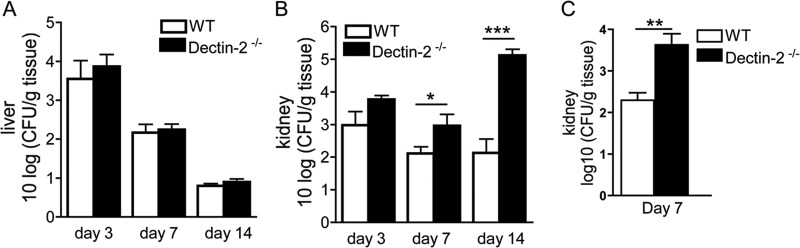
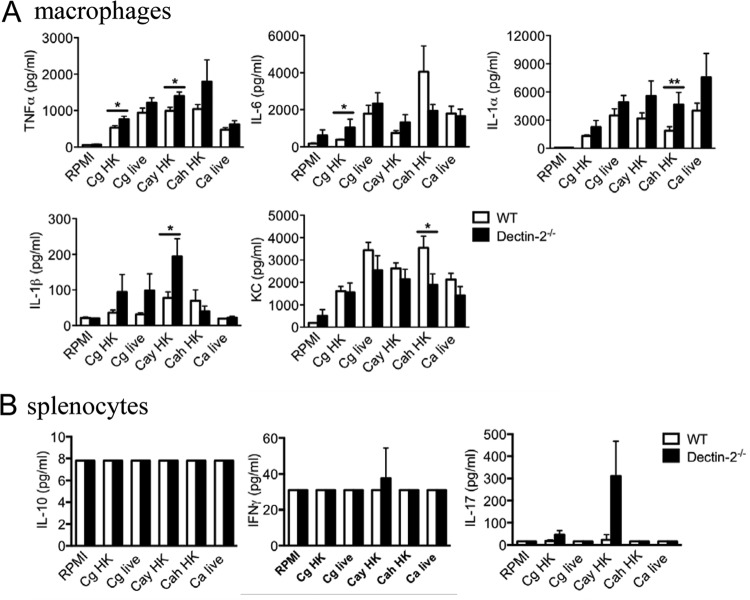
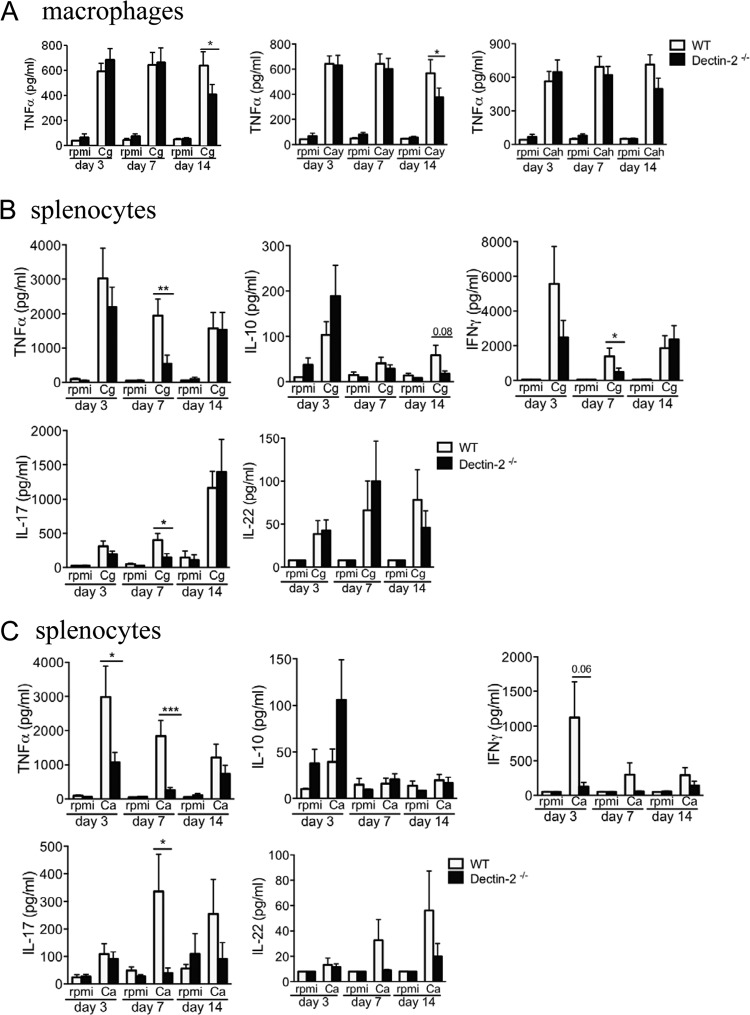
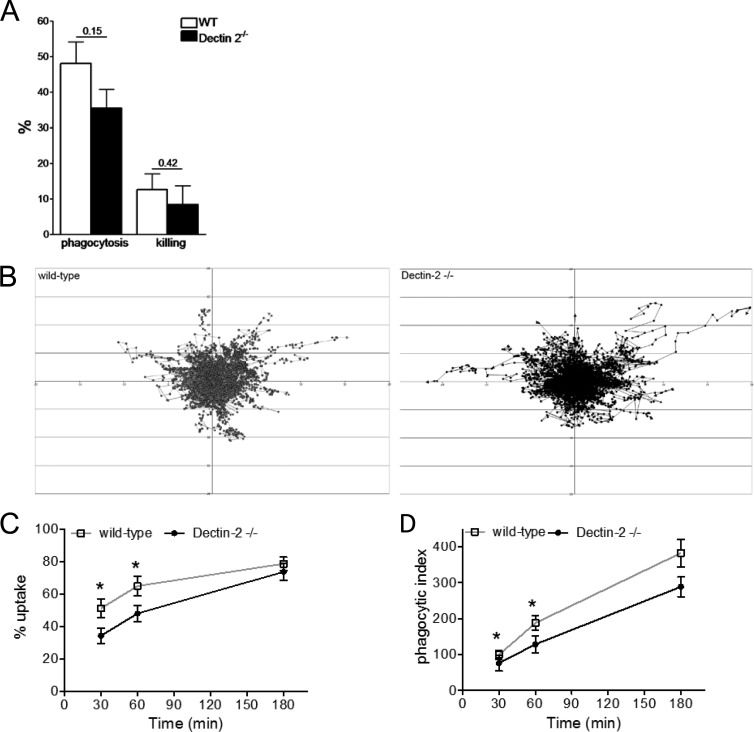
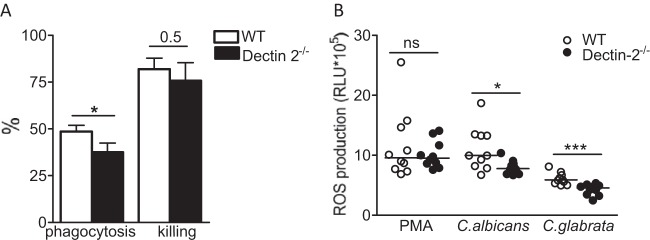
Although Candida glabrata is an important pathogenic Candida species, relatively little is known about its innate immune recognition. Here, we explore the potential role of Dectin-2 for host defense against C. glabrata. Dectin-2-deficient (Dectin-2(-/-)) mice were found to be more susceptible to C. glabrata infections, showing a defective fungal clearance in kidneys but not in the liver. The increased susceptibility to infection was accompanied by lower production of T helper 1 (Th1) and Th17-derived cytokines by splenocytes of Dectin-2(-/-) mice, while macrophage-derived cytokines were less affected. These defects were associated with a moderate yet significant decrease in phagocytosis of the fungus by the Dectin-2(-/-) macrophages and neutrophils. Neutrophils of Dectin-2(-/-) mice also displayed lower production of reactive oxygen species (ROS) upon challenge with opsonized C. glabrata or C. albicans. This study suggests that Dectin-2 is important in host defense against C. glabrata and provides new insights into the host defense mechanisms against this important fungal pathogen.
Overview
The claims and statistics of this paper haven’t been checked yet.
Run the check — free, no account needed. It reads the open-access text and checks the sources it cites.
Integrity signals
Registry
Cites
Statistics
Figures
Verification
Claims the paper makes
The claims and statistics of this paper haven’t been checked yet.
Run the check — free, no account needed. It reads the open-access text and checks the sources it cites.
Claims other papers make about this one
Each is checked against this paper’s own text: does it say what the citing paper says it does?
In the citing paper
“However, neutrophils of the dectin-2-/- knock out mice, which displayed elevated susceptibility to C. glabrata infections, have been reported to mount a deficient oxidative burst, pointing towards a role of the dectin-2 receptor and neutrophils in the control of C. glabrata infections [144].”
From Candida glabrata: A Lot More Than Meets the Eye (2019) · cites this paper as [144]
In the citing paper
“Among the pathogen recognition receptors, the C-type lectin receptors, dectin 1 and dectin-2, which recognize cell wall β-glucan, and α-mannan and β-glucan, respectively, have been implicated in the recognition of C. glabrata [144,148].”
From Candida glabrata: A Lot More Than Meets the Eye (2019) · cites this paper as [144]
In the citing paper
“However, neutrophils of the dectin-2-/- knock out mice, which displayed elevated susceptibility to C. glabrata infections, have been reported to mount a deficient oxidative burst, pointing towards a role of the dectin-2 receptor and neutrophils in the control of C. glabrata infections [144].”
From Candida glabrata: A Lot More Than Meets the Eye (2019) · cites this paper as [144]
Self-check
Percentages, sums and reported differences re-computed from the paper’s own numbers.
The self-check needs the paper’s full text.
Citations
Cites
Dectin-1 is required for β-glucan recognition and control of fungal infection
Taylor, P. R., Tsoni, S. V., Willment, J. A., Dennehy, K. M., Rosas, M., Findon, H., Haynes, K., Steele, C. H., Botto, M., Gordon, S., et al. (2006) · Nature Immunology · doi:10.1038/ni1408 · Cited by 1,185
Self-citationGoodman, J. L., Winston, D. J., Greenfield, R. A., Chandrasekar, P. H., Fox, B. C., Kaizer, H., Shadduck, R. K., Shea, T. C., Stiff, P. J., Friedman, D. J., et al. (1992) · New England Journal of Medicine · doi:10.1056/nejm199203263261301 · Cited by 1,164
Fidel, P. L., Vazquez, J. A., & Sobel, J. D. (1999) · Clinical Microbiology Reviews · doi:10.1128/cmr.12.1.80 · Cited by 953
An integrated model of the recognition of Candida albicans by the innate immune system
Netea, M. G., Brown, G. D., Kullberg, B. J., & Gow, N. A. R. (2008) · Nature Reviews Microbiology · doi:10.1038/nrmicro1815 · Cited by 946
Self-citationSaijo, S., Ikeda, S., Yamabe, K., Kakuta, S., Ishigame, H., Akitsu, A., Fujikado, N., Kusaka, T., Kubo, S., Chung, S.-H., et al. (2010) · Immunity · doi:10.1016/j.immuni.2010.05.001 · Cited by 760
The Epidemiology of Hematogenous Candidiasis Caused by Different Candida Species
Abi‐Said, D., Anaissie, E., Uzun, O., Raad, I., Pinzcowski, H., & Vartivarian, S. (1997) · Clinical Infectious Diseases · doi:10.1086/513663 · Cited by 755
STAT1 Mutations in Autosomal Dominant Chronic Mucocutaneous Candidiasis
van de Veerdonk, F. L., Plantinga, T. S., Hoischen, A., Smeekens, S. P., Joosten, L. A. B., Gilissen, C., Arts, P., Rosentul, D. C., Carmichael, A., der Graaf, C. A. A. S.-V., et al. (2011) · New England Journal of Medicine · doi:10.1056/nejmoa1100102 · Cited by 684
Self-citationHajjeh, R. A., Sofair, A. N., Harrison, L. H., Lyon, G. M., Arthington-Skaggs, B. A., Mirza, S. A., Phelan, M., Morgan, J., Lee-Yang, W., Ciblak, M. A., et al. (2004) · Journal of Clinical Microbiology · doi:10.1128/jcm.42.4.1519-1527.2004 · Cited by 649
Robinson, M. J., Osorio, F., Rosas, M., Freitas, R. P., Schweighoffer, E., Groß, O., Verbeek, J. S., Ruland, J., Tybulewicz, V. L. J., Brown, G. D., et al. (2009) · The Journal of Experimental Medicine · doi:10.1084/jem.20082818 · Cited by 483
Self-citationProspective Multicenter Surveillance Study of Funguria in Hospitalized Patients
Kauffman, C. A., Vazquez, J. A., Sobel, J. D., Gallis, H. A., McKinsey, D. S., Karchmer, A. W., Sugar, A. M., Sharkey, P. K., Wise, G. J., Mangi, R., et al. (2000) · Clinical Infectious Diseases · doi:10.1086/313583 · Cited by 483
Sato, K., Yang, X.-L., Yudate, T., Chung, J., Wu, J., Luby‐Phelps, K., Kimberly, R. P., Underhill, D. M., Cruz, P. D., & Ariizumi, K. (2006) · Journal of Biological Chemistry · doi:10.1074/jbc.m606542200 · Cited by 470
Phagosome Extrusion and Host-Cell Survival after Cryptococcus neoformans Phagocytosis by Macrophages
Alvarez, M., & Casadevall, A. (2006) · Current Biology · doi:10.1016/j.cub.2006.09.061 · Cited by 414
The carbohydrate-recognition domain of Dectin-2 is a C-type lectin with specificity for high mannose
McGreal, E. P., Rosas, M., Brown, G. D., ZAMZE, S. E., Wong, S. Y. C., Gordon, S., Martínez‐Pomares, L., & Taylor, P. R. (2006) · Glycobiology · doi:10.1093/glycob/cwj077 · Cited by 383
Self-citationZhu, L., Zhao, X.-Q., Jiang, C., You, Y., Chen, X., Jiang, Y.-Y., Jia, X., & Lin, X. (2013) · Immunity · doi:10.1016/j.immuni.2013.05.017 · Cited by 347
Strasser, D., Neumann, K., Bergmann, H., Marakalala, M. J., Guler, R., Rojowska, A., Hopfner, K., Brombacher, F., Urlaub, H., Baier, G., et al. (2012) · Immunity · doi:10.1016/j.immuni.2011.11.015 · Cited by 304
Self-citationOrgan-Specific Innate Immune Responses in a Mouse Model of Invasive Candidiasis
Lionakis, M. S., Lim, J. K., Lee, C.-C. R., & Murphy, P. M. (2011) · Journal of Innate Immunity · doi:10.1159/000321157 · Cited by 302
Kaur, R., Ma, B., & Cormack, B. P. (2007) · Proceedings of the National Academy of Sciences · doi:10.1073/pnas.0611195104 · Cited by 284
Invasive fungal infection and impaired neutrophil killing in human CARD9 deficiency
Drewniak, A., Gazendam, R. P., Tool, A. T. J., van Houdt, M., Jansen, M. H., van Hamme, J. L., van Leeuwen, E. M. M., Roos, D., Scalais, E., de Beaufort, C. E., et al. (2013) · Blood · doi:10.1182/blood-2012-08-450551 · Cited by 283
Pfaller, M. A., Messer, S. A., Moet, G. J., Jones, R. N., & Castanheira, M. (2011) · International Journal of Antimicrobial Agents · doi:10.1016/j.ijantimicag.2011.02.016 · Cited by 274
McKenzie, C. G. J., Koser, U., Lewis, L. E., Bain, J. M., Mora-Montes, H. M., Barker, R. N., Gow, N. A. R., & Erwig, L. P. (2010) · Infection and Immunity · doi:10.1128/iai.00001-10 · Cited by 250
Self-citationDectin-2 Recognition of House Dust Mite Triggers Cysteinyl Leukotriene Generation by Dendritic Cells
Barrett, N. A., Maekawa, A., Rahman, O. M., Austen, K. F., & Kanaoka, Y. (2009) · The Journal of Immunology · doi:10.4049/jimmunol.182.2.1119 · Cited by 247
Dendritic Cell Interaction with Candida albicans Critically Depends on N-Linked Mannan
Cambi, A., Netea, M. G., Mora-Montes, H. M., Gow, N. A. R., Hato, S. V., Lowman, D. W., Kullberg, B. J., Torensma, R., Williams, D. L., & Figdor, C. G. (2008) · Journal of Biological Chemistry · doi:10.1074/jbc.m709334200 · Cited by 247
Self-citationMice with Disseminated Candidiasis Die of Progressive Sepsis
Spellberg, B., Ibrahim, A. S., Edwards Jr., J. E., & Filler, S. G. (2005) · The Journal of Infectious Diseases · doi:10.1086/430952 · Cited by 230
The role of Syk/CARD9 coupled C-type lectins in antifungal immunity
Drummond, R. A., Saijo, S., Iwakura, Y., & Brown, G. D. (2011) · European Journal of Immunology · doi:10.1002/eji.201041252 · Cited by 221
Self-citationSeider, K., Brunke, S., Schild, L., Jablonowski, N., Wilson, D., Majer, O., Barz, D., Haas, A., Kuchler, K., Schaller, M., et al. (2011) · The Journal of Immunology · doi:10.4049/jimmunol.1003730 · Cited by 220
IL-12 prevents mortality in mice infected with Histoplasma capsulatum through induction of IFN-γ
Zhou, P., Sieve, M. C., Bennett, J. E., Kwon-Chung, K. J., Tewari, R. P., Gazzinelli, R. T., Sher, A., & Seder, R. A. (1995) · The Journal of Immunology · doi:10.4049/jimmunol.155.2.785 · Cited by 215
Anaissie, E. J., Vartivarian, S. E., Abi-Said, D., Uzun, Ö., Pinczowski, H., Kontoyiannis, D. P., Khoury, P. N., Papadakis, K., Gardner, A., RAAD, I. I., et al. (1996) · The American Journal of Medicine · doi:10.1016/s0002-9343(96)80072-6 · Cited by 184
Ariizumi, K., Shen, G.-L., Shikano, S., Ritter, R., Zukas, P. K., Edelbaum, D., Morita, A., & Takashima, A. (2000) · Journal of Biological Chemistry · doi:10.1074/jbc.275.16.11957 · Cited by 164
Candida albicans cell wall glycans, host receptors and responses: elements for a decisive crosstalk
Poulain, D., & Jouault, T. (2004) · Current Opinion in Microbiology · doi:10.1016/j.mib.2004.06.011 · Cited by 153
Recombinant Interferon- Enhances Resistance to Acute Disseminated Candida albicans Infection in Mice
Kullberg, B. J., Wout, J. W. V. ’., Hoogstraten, C., & van Furth, R. (1993) · The Journal of Infectious Diseases · doi:10.1093/infdis/168.2.436 · Cited by 148
Self-citationInflammatory Monocytes Mediate Early and Organ-Specific Innate Defense During Systemic Candidiasis
Ngo, L. Y., Kasahara, S., Kumasaka, D. K., Knoblaugh, S. E., Jhingran, A., & Hohl, T. M. (2013) · The Journal of Infectious Diseases · doi:10.1093/infdis/jit413 · Cited by 142
Bi, L., Gojestani, S., Wu, W., Hsu, Y.-M. S., Zhu, J., Ariizumi, K., & Lin, X. (2010) · Journal of Biological Chemistry · doi:10.1074/jbc.m110.131300 · Cited by 126
Lionakis, M. S., Fischer, B. G., Lim, J. K., Swamydas, M., Wan, W., Richard Lee, C.-C., Cohen, J. I., Scheinberg, P., Gao, J.-L., & Murphy, P. M. (2012) · PLoS Pathogens · doi:10.1371/journal.ppat.1002865 · Cited by 118
Kullberg, B. J., van 't Wout, J. W., & van Furth, R. (1990) · Infection and Immunity · doi:10.1128/iai.58.10.3319-3324.1990 · Cited by 105
Self-citationPhenotypic switching and filamentation in Candida glabrata
Lachke, S. A., Joly, S., Daniels, K., & Soll, D. R. (2002) · Microbiology · doi:10.1099/00221287-148-9-2661 · Cited by 103
Non-lytic expulsion/exocytosis of Candida albicans from macrophages
Bain, J. M., Lewis, L. E., Okai, B., Quinn, J., Gow, N. A. R., & Erwig, L. (2012) · Fungal Genetics and Biology · doi:10.1016/j.fgb.2012.01.008 · Cited by 102
Self-citationZhang, Z. (2002) · Nucleic Acids Research · doi:10.1093/nar/gnf089 · Cited by 101
Dejima, T., Shibata, K., Yamada, H., Hara, H., Iwakura, Y., Naito, S., & Yoshikai, Y. (2011) · Infection and Immunity · doi:10.1128/iai.05799-11 · Cited by 85
The complete mitochondrial genome sequence of the pathogenic yeast Candida (Torulopsis) glabrata
Koszul, R., Malpertuy, A., Frangeul, L., Bouchier, C., Wincker, P., Thierry, A., Duthoy, S., Ferris, S., Hennequin, C., & Dujon, B. (2002) · FEBS Letters · doi:10.1016/s0014-5793(02)03749-3 · Cited by 76
Gorjestani, S., Yu, M., Tang, B., Zhang, D., Wang, D., & Lin, X. (2011) · Journal of Biological Chemistry · doi:10.1074/jbc.m111.307389 · Cited by 52
Gavino, A. C. P., Chung, J., Sato, K., Ariizumi, K., & Cruz, P. D. (2005) · Experimental Dermatology · doi:10.1111/j.0906-6705.2005.00312.x · Cited by 52
Basu, S., Quilici, C., Zhang, H., Grail, D., & Dunn, A. R. (2008) · Growth Factors · doi:10.1080/08977190801987513 · Cited by 40
Gorjestani, S., Darnay, B. G., & Lin, X. (2012) · Journal of Biological Chemistry · doi:10.1074/jbc.m112.414276 · Cited by 28
Ruan, S., Chu, C., & Hsueh, P. (2008) · Antimicrobial Agents and Chemotherapy · doi:10.1128/aac.00323-08 · Cited by 28
Versleijen, M. W. J., Oyen, W. J. G., Roelofs, H. M. J., Vries, S. E. V. E., Willems, P. H. G. M., Jansen, J. B. �. �., & Wanten, G. J. A. (2008) · American Journal of Clinical Nutrition · doi:10.1093/ajcn/87.3.539 · Cited by 27
Live-cell Video Microscopy of Fungal Pathogen Phagocytosis
Lewis, L. E., Bain, J. M., Okai, B., Gow, N. A. R., & Erwig, L. P. (2013) · Journal of Visualized Experiments · doi:10.3791/50196 · Cited by 23
Self-citation
Cited by
Sorted by citations
Pappas, P. G., Lionakis, M. S., Arendrup, M. C., Ostrosky-Zeichner, L., & Kullberg, B. J. (2018) · Nature Reviews Disease Primers · doi:10.1038/nrdp.2018.26 · Cited by 1,636
Self-citationImmune defence against Candida fungal infections
Netea, M. G., Joosten, L. A. B., van der Meer, J. W. M., Kullberg, B.-J., & van de Veerdonk, F. L. (2015) · Nature Reviews Immunology · doi:10.1038/nri3897 · Cited by 642
Self-citationC-type lectins in immunity: recent developments
Dambuza, I. M., & Brown, G. D. (2015) · Current Opinion in Immunology · doi:10.1016/j.coi.2014.12.002 · Cited by 482
Self-citationC-type lectins: their network and roles in pathogen recognition and immunity
Mayer, S., Raulf, M., & Lepenies, B. (2016) · Histochemistry and Cell Biology · doi:10.1007/s00418-016-1523-7 · Cited by 263
Pattern recognition receptors in fungal immunity
Patin, E. C., Thompson, A., & Orr, S. J. (2018) · Seminars in Cell and Developmental Biology · doi:10.1016/j.semcdb.2018.03.003 · Cited by 236
Metadata
- Authors
- Ifrim, D. C., Bain, J. M., Reid, D. M., Oosting, M., Verschueren, I., Gow, N. A. R., van Krieken, J. H., Brown, G. D., Kullberg, B.-J., Joosten, L. A. B., van der Meer, J. W. M., Koentgen, F., Erwig, L. P., Quintin, J., & Netea, M. G.
- Affiliations
- Radboud University Medical Center (NL)
- University of Aberdeen (GB)
- Radboud University Medical Center, Department of Pathology, Nijmegen, The Netherlands
- Radboud University Medical Center, Department of Internal Medicine, Division of Experimental Internal Medicine, Nijmegen, The Netherlands
- Ozgene Pty Ltd., Bentley, Australia
- Corresponding author
- Netea, Mihai G.
- ORCID
- Venue
- Infection and Immunity
- Publisher
- American Society for Microbiology
- Published
- 2014-03
- Volume
- 82
- Issue
- 3
- Pages
- 1064-1073
- ISSN
- 0019-9567 (ISSN-L)
- 1098-5522
- PMC
- PMC3957982
- OpenAlex
- W2026106645
- Cited by
- 117
- References
- 46
- Citations by year
- 2026: 6 · 2025: 3 · 2024: 6 · 2023: 8 · 2022: 7 · 2021: 10 · 2020: 6 · 2019: 10 · 2018: 13 · 2017: 18 · 2016: 12 · 2015: 11 · 2014: 7
- FWCI
- 7.26
- Type
- journal article
- Language
- en
- Open access
- hybrid
- doi.org
- Licence
- Locations
- Infection and Immunity (publishedVersion, cc-by)
- Europe PMC (PubMed Central) (publishedVersion, cc-by)
- PubMed Central (publishedVersion, cc-by)
- PubMed (publishedVersion)
- Aberdeen University Research Archive (Aberdeen University) (submittedVersion)
- Radboud Repository (Radboud University) (submittedVersion)
- HAL (submittedVersion)
- Radboud Repository (Radboud University) (submittedVersion, other-oa)
- Funders
- Wellcome Trust (086558, 097377/Z/11/Z, 086827, 097377, 101873, 094847, 089930, 080088, 075470, 102705, 102705/Z/13/Z)
- European Commission (FP7/2007, 260338)
- University of Aberdeen
- Topics
- Health Sciences › Medicine › Infectious Diseases › Antifungal resistance and susceptibility
- Life Sciences › Immunology and Microbiology › Immunology › Immune Response and Inflammation
- Life Sciences › Immunology and Microbiology › Immunology › Neutrophil, Myeloperoxidase and Oxidative Mechanisms
- Keywords
- Dectin-2, Candida glabrata, innate immune recognition, host defense against fungi, Th1 cytokines, Th17 cytokines, macrophage phagocytosis, neutrophils, reactive oxygen species, Candida albicans, systemic fungal infection
- MeSH terms
- Animals, Candida albicans, Candidiasis, Female, Macrophages, Mice, Inbred C57BL, Neutrophils, Phagocytosis, Cytokines, Reactive Oxygen Species, Th1 Cells, Lectins, C-Type, Candida glabrata, Mice
About these checks
Registry, retraction, Cites and statistics results are computed, not judged, with one exception: a printed reference that no index lists is read once by a model before it counts as a citation error. Claims are extracted by a model and kept only when their quote appears verbatim in the text; each cited source is then checked, with a model’s help, for whether it says what the claim relies on. Those verdicts can be wrong — read the claim’s quote and the cited source before relying on one.
Statistics and arithmetic are recomputed, not judged.
Confidence bands are shown only for fields calibrated on our annotated test set. None is calibrated yet, so no band is shown.
What counts as a claim ›How we measure confidence ›How we check this ›
Are you an author, or do you see a problem with this page? Request a review
