

Cryptococcus neoformans Requires a Functional Glycolytic Pathway for Disease but Not Persistence in the Host
Open accessThe DOI matches its Crossref record; 77 of the 77 references it cites were found in a registry or an index.
Abstract
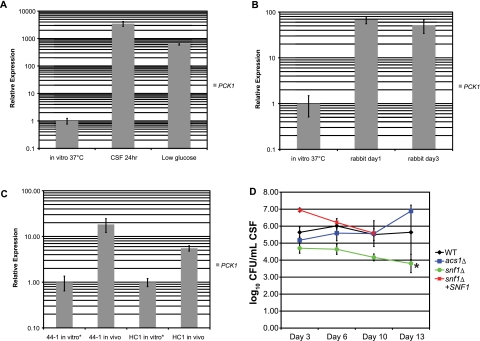
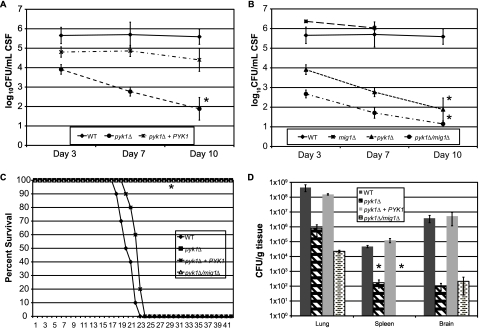
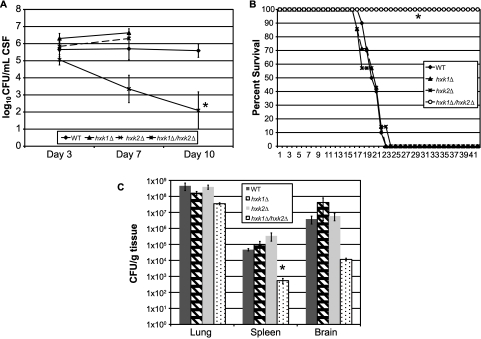
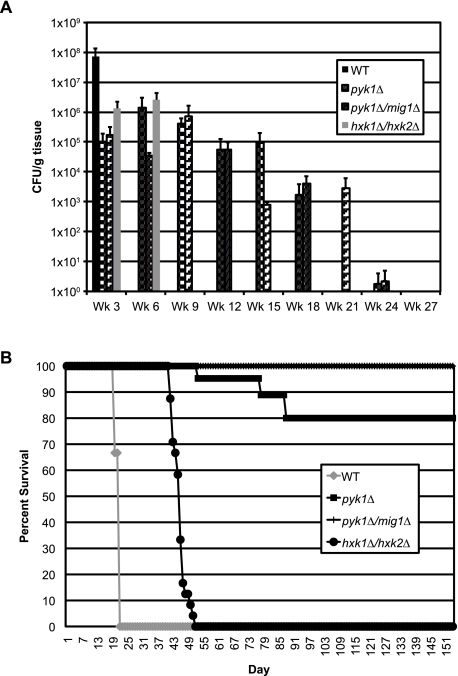
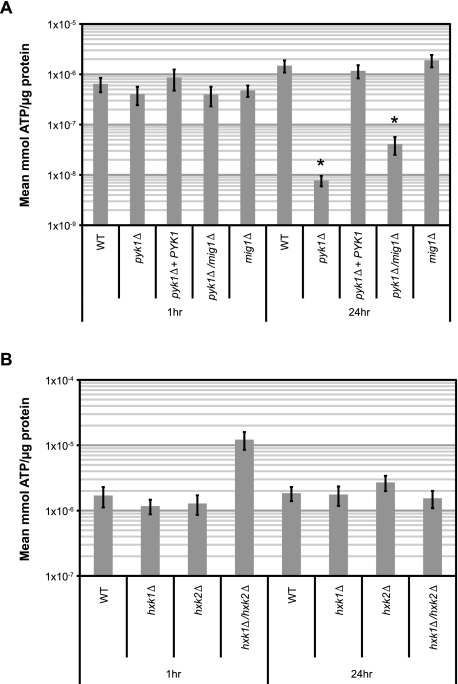
Cryptococcus neoformans is an important fungal pathogen of immunocompromised individuals, with a close relative,Cryptococcus gattii, emerging as a serious threat for the immunocompetent. During initial infection,C. neoformans colonizes the airspaces of the lungs, resulting in pneumonia, and subsequently migrates to the central nervous system (CNS). We sought to understand fungal carbon utilization during colonization of these fundamentally different niches within the host, in particular the roles of gluconeogenesis and glycolysis. We created mutants at key points in the gluconeogenesis/glycolysis metabolic pathways that are restricted for growth on lactate and glucose, respectively. A phosphoenolpyruvate carboxykinase mutant (the pck1∆mutant), blocked for entry of 2- and 3-carbon substrates into gluconeogenesis and attenuated for virulence in a murine inhalation model, showed wild-type (WT) persistence in a rabbit cerebrospinal fluid (CSF) model of cryptococcosis. Conversely, both the pyruvate kinase (pyk1∆) and the hexose kinase I and II (hxk1∆/hxk2∆) mutants, which show impaired glucose utilization, exhibited severely attenuated virulence in the murine inhalation model of cryptococcosis and decreased persistence in the CNS in both the rabbit CSF and the murine inhalation models while displaying adequate persistence in the lungs of mice. These data suggest that glucose utilization is critical for virulence of C. neoformans and persistence of the yeast in the CNS. IMPORTANCECryptococcus neoformans is an emerging fungal pathogen of humans and is responsible for approximately 625,000 deaths annually among those suffering from HIV infection/AIDS. The ability of this fungus to persist in the host, coupled with its propensity to colonize the CNS, makes the understanding of nutrient acquisition in the host a primary concern. In this study, we report a requirement of glucose utilization for virulence of C. neoformans that is separate from its role in ATP production in the pathogen. Furthermore, we show that inhibition of glycolysis is a viable antifungal drug target, and impaired ATP production via the PYK1 deletion may serve as a model for dormant/chronic fungal infection in the host. Taken together, these results demonstrate the critical importance of understanding basic metabolic processes of the fungus in the context of host-pathogen interactions.
Overview
The claims and statistics of this paper haven’t been checked yet.
Free: it reads the open-access text and checks the first 5 claims that cite a source we can check. Create a free account to check every claim.
Integrity signals
Registry
Cites
Statistics
Figures
Verification
Claims the paper makes
The claims and statistics of this paper haven’t been checked yet.
Free: it reads the open-access text and checks the first 5 claims that cite a source we can check. Create a free account to check every claim.
Self-check
Percentages, sums and reported differences re-computed from the paper’s own numbers.
The self-check needs the paper’s full text.
Citations
Cites
Bradford, M. M. (1976) · Analytical Biochemistry · doi:10.1016/0003-2697(76)90527-3 · Cited by 255,302
Detection of specific sequences among DNA fragments separated by gel electrophoresis
Southern, E. M. (1975) · Journal of Molecular Biology · doi:10.1016/s0022-2836(75)80083-0 · Cited by 32,249
Vandesompele, J., De Preter, K., Pattyn, F., Poppe, B., Van Roy, N., De Paepe, A., & Speleman, F. (2002) · Genome Biology · doi:10.1186/gb-2002-3-7-research0034 · Cited by 20,038
Understanding the Warburg Effect: The Metabolic Requirements of Cell Proliferation
Vander Heiden, M. G., Cantley, L. C., & Thompson, C. B. (2009) · Science · doi:10.1126/science.1160809 · Cited by 16,197
Sherman, F. (2002) · Methods in Enzymology · doi:10.1016/s0076-6879(02)50954-x · Cited by 4,121
[1] Getting started with yeast
Sherman, F. (1991) · Methods in Enzymology · doi:10.1016/0076-6879(91)94004-v · Cited by 4,067
Park, B. J., Wannemuehler, K. A., Marston, B. J., Govender, N., Pappas, P. G., & Chiller, T. M. (2009) · AIDS · doi:10.1097/qad.0b013e328322ffac · Cited by 2,014
Glycolysis inhibition for anticancer treatment
Pelicano, H., Martin, D. S., Xu, R.-H., & Huang, P. (2006) · Oncogene · doi:10.1038/sj.onc.1209597 · Cited by 1,516
Schibler, U., Wyler, T., & Hagenbüchle, O. (1975) · Journal of Molecular Biology · doi:10.1016/0022-2836(75)90217-x · Cited by 1,188
Xu, R.-H., Pelicano, H., Zhou, Y., Carew, J. S., Feng, L., Bhalla, K. N., Keating, M. J., & Huang, P. (2005) · Cancer Research · doi:10.1158/0008-5472.613.65.2 · Cited by 835
Cited by
Ene, I. V., Adya, A. K., Wehmeier, S., Brand, A. C., MacCallum, D. M., Gow, N. A. R., & Brown, A. J. P. (2012) · Cellular Microbiology · doi:10.1111/j.1462-5822.2012.01813.x · Cited by 313
“…drug resistance and virulence in a fungal pathogen Iuliana V. Ene,1 Ashok K. Adya,2 Silvia Wehmeier,1 Alexandra C. Brand,1 Donna M. MacCallum,1 Neil A. R. Gow1 and Alistair J. P. Brown1* 1Aberdeen Fungal Group, School of Medical Sciences, Institute of Medical Sciences, University of Aberdeen,”
BackgroundTucey, T. M., Verma, J., Harrison, P. F., Snelgrove, S. L., Lo, T. L., Scherer, A. K., Barugahare, A. A., Powell, D. R., Wheeler, R. T., Hickey, M. J., et al. (2018) · Cell Metabolism · doi:10.1016/j.cmet.2018.03.019 · Cited by 226
Shingu-Vazquez, M., & Traven, A. (2011) · Eukaryotic Cell · doi:10.1128/ec.05184-11 · Cited by 209
Systematic functional profiling of transcription factor networks in Cryptococcus neoformans
Jung, K.-W., Yang, D.-H., Maeng, S., Lee, K.-T., So, Y.-S., Hong, J., Choi, J., Byun, H.-J., Kim, H., Bang, S., et al. (2015) · Nature Communications · doi:10.1038/ncomms7757 · Cited by 203
Metabolism in fungal pathogenesis
Ene, I. V., Brunke, S., Brown, A. J. P., & Hube, B. (2014) · Cold Spring Harbor Perspectives in Medicine · doi:10.1101/cshperspect.a019695 · Cited by 169
“neoformans to a reasonable extent, as mutants with glycolytic defects ( pyk1D and hxk1D hxk2D) are severely attenuated in a murine inhalation model of cryptococcosis and display decreased persistence in the central nervous system (Price et al. 2011).”
Background
Metadata
- Authors
- Price, M. S., Betancourt-Quiroz, M., Price, J. L., Toffaletti, D. L., Vora, H., Hu, G., Kronstad, J. W., & Perfect, J. R.
- Affiliations
- Duke Medical Center (US)
- University of British Columbia (CA)
- ORCID
- Venue
- mBio
- Publisher
- American Society for Microbiology
- Published
- 2011-07
- Volume
- 2
- Issue
- 3
- Pages
- e00103-11
- ISSN
- 2150-7511 (ISSN-L)
- 2161-2129
- PMC
- PMC3110414
- OpenAlex
- W2156654507
- Cited by
- 115
- References
- 76
- Citations by year
- 2026: 5 · 2025: 7 · 2024: 7 · 2023: 4 · 2022: 5 · 2021: 9 · 2020: 8 · 2019: 5 · 2018: 5 · 2017: 5 · 2016: 8 · 2015: 11 · 2014: 9 · 2013: 9 · 2012: 13
- FWCI
- 8.64
- Type
- journal article
- Language
- en
- Open access
- gold
- doi.org
- Licence
- cc-by-nc-sa
- creativecommons.org/licenses/by-nc-sa/3.0/ (vor)
- journals.asm.org/non-commercial-tdm-license (tdm)
- Locations
- mBio (publishedVersion, cc-by-nc-sa)
- Europe PMC (PubMed Central) (publishedVersion, cc-by-nc-sa)
- PubMed Central (publishedVersion, cc-by-nc-sa)
- PubMed (publishedVersion)
- DOAJ (DOAJ: Directory of Open Access Journals) (submittedVersion, cc-by-sa)
- Funders
- National Institutes of Health
- National Institute of Allergy and Infectious Diseases (R56AI028388, R01AI073896, R01AI028388)
- Topics
- Health Sciences › Medicine › Infectious Diseases › Fungal Infections and Studies
- Health Sciences › Medicine › Infectious Diseases › Antifungal resistance and susceptibility
- Life Sciences › Biochemistry, Genetics and Molecular Biology › Molecular Biology › Fungal and yeast genetics research
- Keywords
- Cryptococcus neoformans, cryptococcosis, glycolysis, gluconeogenesis, glucose utilization, virulence, phosphoenolpyruvate carboxykinase, pyruvate kinase, fungal metabolism, host-pathogen interaction, antifungal drug targets, chronic fungal infection, immunocompromised patients
- MeSH terms
- Animals, Cryptococcosis, Cryptococcus neoformans, Disease Models, Animal, Female, Genes, Fungal, Gluconeogenesis, Glucose, Glycolysis, Humans, Male, Rabbits, Rodent Diseases, Virulence, Gene Deletion, Lactic Acid, Virulence Factors, Mice
About these checks
Registry, retraction, Cites and statistics results are computed, not judged, with one exception: a printed reference that no index lists is read once by a model before it counts as a citation error. Claims are extracted by a model and kept only when their quote appears verbatim in the text; each cited source is then checked, with a model’s help, for whether it says what the claim relies on. Those verdicts can be wrong — read the claim’s quote and the cited source before relying on one.
Statistics and arithmetic are recomputed, not judged.
Confidence bands are shown only for fields calibrated on our annotated test set. None is calibrated yet, so no band is shown.
What counts as a claim ›How we measure confidence ›How we check this ›
Are you an author, or do you see a problem with this page? Request a review
How to cite
Cite CoChat for the checks on this page, and the paper for its own findings.
- This page
- CoChat. (2026). Citation check: Cryptococcus neoformans Requires a Functional Glycolytic Pathway for Disease but Not Persistence in the Host. https://app.cochat.ai/papers/10.1128/mbio.00103-11
- The paper
- Price, M. S., Betancourt-Quiroz, M., Price, J. L., Toffaletti, D. L., Vora, H., Hu, G., Kronstad, J. W., & Perfect, J. R. (2011). Cryptococcus neoformans Requires a Functional Glycolytic Pathway for Disease but Not Persistence in the Host. mBio. https://doi.org/10.1128/mbio.00103-11
Data sources
Bibliographic data: Semantic Scholar, OpenAlex, Crossref.
Contains information from the Semantic Scholar Academic Graph Datasets, made available under the ODC Attribution License (ODC-BY 1.0).
Semantic Scholar’s data is described in: Kinney, R., et al. (2023). The Semantic Scholar Open Data Platform. arXiv:2301.10140.
