

Cryptococcus neoformans Requires a Functional Glycolytic Pathway for Disease but Not Persistence in the Host
Open accessThe DOI matches its Crossref record; 77 of the 77 references it cites were found in a registry or an index.
Abstract
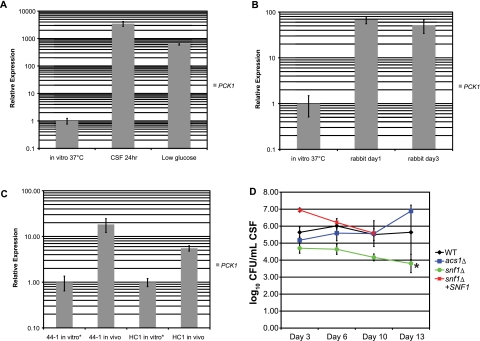
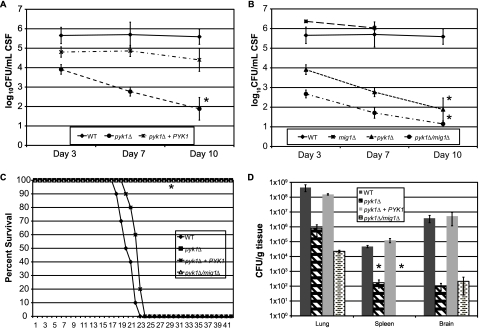
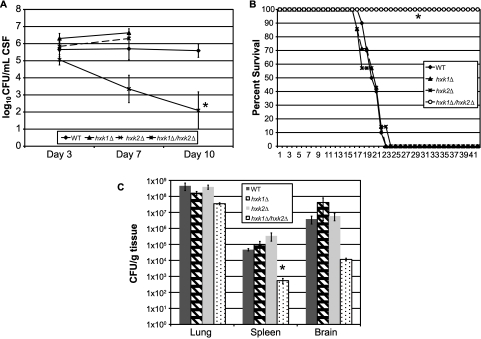
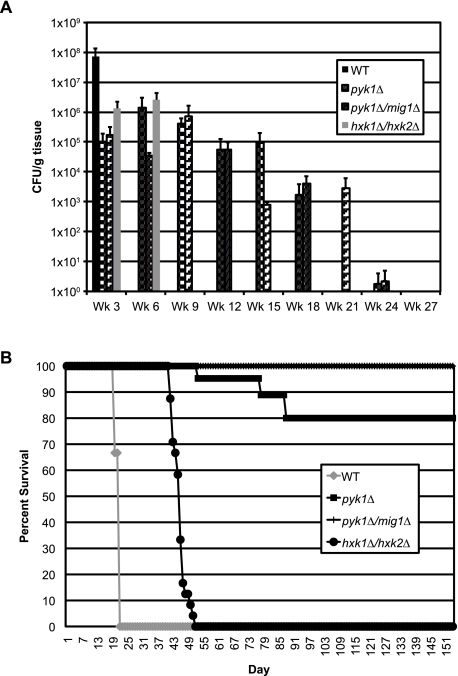
Cryptococcus neoformans is an important fungal pathogen of immunocompromised individuals, with a close relative,Cryptococcus gattii, emerging as a serious threat for the immunocompetent. During initial infection,C. neoformans colonizes the airspaces of the lungs, resulting in pneumonia, and subsequently migrates to the central nervous system (CNS). We sought to understand fungal carbon utilization during colonization of these fundamentally different niches within the host, in particular the roles of gluconeogenesis and glycolysis. We created mutants at key points in the gluconeogenesis/glycolysis metabolic pathways that are restricted for growth on lactate and glucose, respectively. A phosphoenolpyruvate carboxykinase mutant (the pck1∆mutant), blocked for entry of 2- and 3-carbon substrates into gluconeogenesis and attenuated for virulence in a murine inhalation model, showed wild-type (WT) persistence in a rabbit cerebrospinal fluid (CSF) model of cryptococcosis. Conversely, both the pyruvate kinase (pyk1∆) and the hexose kinase I and II (hxk1∆/hxk2∆) mutants, which show impaired glucose utilization, exhibited severely attenuated virulence in the murine inhalation model of cryptococcosis and decreased persistence in the CNS in both the rabbit CSF and the murine inhalation models while displaying adequate persistence in the lungs of mice. These data suggest that glucose utilization is critical for virulence of C. neoformans and persistence of the yeast in the CNS. IMPORTANCECryptococcus neoformans is an emerging fungal pathogen of humans and is responsible for approximately 625,000 deaths annually among those suffering from HIV infection/AIDS. The ability of this fungus to persist in the host, coupled with its propensity to colonize the CNS, makes the understanding of nutrient acquisition in the host a primary concern. In this study, we report a requirement of glucose utilization for virulence of C. neoformans that is separate from its role in ATP production in the pathogen. Furthermore, we show that inhibition of glycolysis is a viable antifungal drug target, and impaired ATP production via the PYK1 deletion may serve as a model for dormant/chronic fungal infection in the host. Taken together, these results demonstrate the critical importance of understanding basic metabolic processes of the fungus in the context of host-pathogen interactions.
Overview
The claims and statistics of this paper haven’t been checked yet.
Free: it reads the open-access text and checks the first 5 claims that cite a source we can check. Create a free account to check every claim.
Integrity signals
Registry
Cites
Statistics
Figures
Verification
Claims the paper makes
The claims and statistics of this paper haven’t been checked yet.
Free: it reads the open-access text and checks the first 5 claims that cite a source we can check. Create a free account to check every claim.
Self-check
Percentages, sums and reported differences re-computed from the paper’s own numbers.
The self-check needs the paper’s full text.
Citations
Cites
Bradford, M. M. (1976) · Analytical Biochemistry · doi:10.1016/0003-2697(76)90527-3 · Cited by 255,302
Detection of specific sequences among DNA fragments separated by gel electrophoresis
Southern, E. M. (1975) · Journal of Molecular Biology · doi:10.1016/s0022-2836(75)80083-0 · Cited by 32,249
Vandesompele, J., De Preter, K., Pattyn, F., Poppe, B., Van Roy, N., De Paepe, A., & Speleman, F. (2002) · Genome Biology · doi:10.1186/gb-2002-3-7-research0034 · Cited by 20,038
Understanding the Warburg Effect: The Metabolic Requirements of Cell Proliferation
Vander Heiden, M. G., Cantley, L. C., & Thompson, C. B. (2009) · Science · doi:10.1126/science.1160809 · Cited by 16,197
Sherman, F. (2002) · Methods in Enzymology · doi:10.1016/s0076-6879(02)50954-x · Cited by 4,121
[1] Getting started with yeast
Sherman, F. (1991) · Methods in Enzymology · doi:10.1016/0076-6879(91)94004-v · Cited by 4,067
Park, B. J., Wannemuehler, K. A., Marston, B. J., Govender, N., Pappas, P. G., & Chiller, T. M. (2009) · AIDS · doi:10.1097/qad.0b013e328322ffac · Cited by 2,014
Glycolysis inhibition for anticancer treatment
Pelicano, H., Martin, D. S., Xu, R.-H., & Huang, P. (2006) · Oncogene · doi:10.1038/sj.onc.1209597 · Cited by 1,516
Schibler, U., Wyler, T., & Hagenbüchle, O. (1975) · Journal of Molecular Biology · doi:10.1016/0022-2836(75)90217-x · Cited by 1,188
Xu, R.-H., Pelicano, H., Zhou, Y., Carew, J. S., Feng, L., Bhalla, K. N., Keating, M. J., & Huang, P. (2005) · Cancer Research · doi:10.1158/0008-5472.613.65.2 · Cited by 835
Overview of manual and automated DNA sequencing by the dideoxy chain termination method
CHEN, E., KUANG, W., & LEE, A. (1991) · Methods · doi:10.1016/s1046-2023(05)80158-6 · Cited by 833
Kidd, S. E., Hagen, F., Tscharke, R. L., Huynh, M., Bartlett, K. H., Fyfe, M., MacDougall, L., Boekhout, T., Kwon-Chung, K. J., & Meyer, W. (2004) · Proceedings of the National Academy of Sciences · doi:10.1073/pnas.0402981101 · Cited by 756
The glyoxylate cycle is required for fungal virulence
Lorenz, M. C., & Fink, G. R. (2001) · Nature · doi:10.1038/35083594 · Cited by 745 · cited 1×
“For example, isocitrate lyase is a gateway enzyme for the glyoxylate shunt that allows for the utilization of 2-carbon compounds such as acetate and ethanol (18, 33, 34).”
BackgroundTranscriptional Response of Candida albicans upon Internalization by Macrophages
Lorenz, M. C., Bender, J. A., & Fink, G. R. (2004) · Eukaryotic Cell · doi:10.1128/ec.3.5.1076-1087.2004 · Cited by 712
Casadevall, A., & Perfect, J. R. (1998) · ASM Press eBooks · doi:10.1128/9781555818241 · Cited by 661
Self-citationThe role and control of the glyoxylate cycle in Escherichia coli
Kornberg, H. (1966) · Biochemical Journal · doi:10.1042/bj0990001 · Cited by 603
A comprehensive strategy enabling high-resolution functional analysis of the yeast genome
Breslow, D. K., Cameron, D. M., Collins, S. R., Schuldiner, M., Stewart-Ornstein, J., Newman, H. W., Braun, S., Madhani, H. D., Krogan, N. J., & Weissman, J. S. (2008) · Nature Methods · doi:10.1038/nmeth.1234 · Cited by 534
Urease as a Virulence Factor in Experimental Cryptococcosis
Cox, G. M., Mukherjee, J., Cole, G. T., Casadevall, A., & Perfect, J. R. (2000) · Infection and Immunity · doi:10.1128/iai.68.2.443-448.2000 · Cited by 522 · cited 1×
“cryptococcosis as previously described (42, 69).”
Self-citationSame-sex mating and the origin of the Vancouver Island Cryptococcus gattii outbreak
Fraser, J. A., Giles, S. S., Wenink, E. C., Geunes-Boyer, S. G., Wright, J. R., Diezmann, S., Allen, A., Stajich, J. E., Dietrich, F. S., Perfect, J. R., et al. (2005) · Nature · doi:10.1038/nature04220 · Cited by 499
Self-citationGene transfer in Cryptococcus neoformans by use of biolistic delivery of DNA
Toffaletti, D. L., Rude, T. H., Johnston, S. A., Durack, D. T., & Perfect, J. R. (1993) · Journal of Bacteriology · doi:10.1128/jb.175.5.1405-1411.1993 · Cited by 488
Self-citationRonne, H. (1995) · Trends in Genetics · doi:10.1016/s0168-9525(00)88980-5 · Cited by 458
Cryptococcus neoformans Is a Facultative Intracellular Pathogen in Murine Pulmonary Infection
Feldmesser, M., Kress, Y., Novikoff, P., & Casadevall, A. (2000) · Infection and Immunity · doi:10.1128/iai.68.7.4225-4237.2000 · Cited by 423
Matrix Metalloproteinase-2 Contributes to Cancer Cell Migration on Collagen
Xu, X., Wang, Y., Chen, Z., Sternlicht, M. D., Hidalgo, M., & Steffensen, B. (2005) · Cancer Research · doi:10.1158/0008-5472.130.65.1 · Cited by 413
Wang, Z., Thornton, C. R., Kershaw, M. J., Debao, L., & Talbot, N. J. (2003) · Molecular Microbiology · doi:10.1046/j.1365-2958.2003.03412.x · Cited by 411
Cryptococcus neoformans mating and virulence are regulated by the G-protein α subunit GPA1 and cAMP
Alspaugh, J. A., Perfect, J. R., & Heitman, J. (1997) · Genes & Development · doi:10.1101/gad.11.23.3206 · Cited by 400
Self-citationChayakulkeeree, M., & Perfect, J. R. (2006) · Infectious Disease Clinics of North America · doi:10.1016/j.idc.2006.07.001 · Cited by 378
Self-citationPerfect, J. R., & Casadevall, A. (2002) · Infectious Disease Clinics of North America · doi:10.1016/s0891-5520(02)00036-3 · Cited by 363
Self-citationThe human cerebrospinal fluid metabolome
Wishart, D. S., Lewis, M. J., Morrissey, J. A., Flegel, M. D., Jeroncic, K., Xiong, Y., Cheng, D., Eisner, R., Gautam, B., Tzur, D., et al. (2008) · Journal of Chromatography B · doi:10.1016/j.jchromb.2008.05.001 · Cited by 346
Sites of inhibition of mitochondrial electron transport in macrophage-injured neoplastic cells.
Granger, D. L., & Lehninger, A. L. (1982) · The Journal of cell biology · doi:10.1083/jcb.95.2.527 · Cited by 345
Niche-specific regulation of central metabolic pathways in a fungal pathogen
Barelle, C. J., Priest, C. L., MacCallum, D. M., Gow, N. A. R., Odds, F. C., & Brown, A. J. P. (2006) · Cellular Microbiology · doi:10.1111/j.1462-5822.2005.00676.x · Cited by 336 · cited 2×
“, glycolysis) metabolism during the onset of systemic infection in mice (16).”
BackgroundWhat Makes Cryptococcus neoformans a Pathogen?
Buchanan, K. L., & Murphy, J. W. (1998) · Emerging Infectious Diseases · doi:10.3201/eid0401.980109 · Cited by 325 · cited 1×
“Several virulence-associated traits have clearly been identified as required for cryptococcal pathogenesis, including growth at 37°C, production of capsule, melanin biosynthesis, secretion of phospholipase, and production of mannitol (13, 14).”
BackgroundEpidemiological Evidence for Dormant Cryptococcus neoformans Infection
Garcia-Hermoso, D., Janbon, G., & Dromer, F. (1999) · Journal of Clinical Microbiology · doi:10.1128/jcm.37.10.3204-3209.1999 · Cited by 323
Expulsion of Live Pathogenic Yeast by Macrophages
Ma, H., Croudace, J. E., Lammas, D. A., & May, R. C. (2006) · Current Biology · doi:10.1016/j.cub.2006.09.032 · Cited by 310
A PCR-based strategy to generate integrative targeting alleles with large regions of homology
Davidson, R. C., Blankenship, J. R., Kraus, P. R., de Jesus Berrios, M., Hull, C. M., D’Souza, C., Wang, P., & Heitman, J. (2002) · Microbiology · doi:10.1099/00221287-148-8-2607 · Cited by 299
Fraser, J. A., Subaran, R. L., Nichols, C. B., & Heitman, J. (2003) · Eukaryotic Cell · doi:10.1128/ec.2.5.1036-1045.2003 · Cited by 292
Chronic cryptococcal meningitis: a new experimental model in rabbits.
Perfect, J. R., Lang, S. D. R., & Durack, D. T. (1980) · PubMed Central · Cited by 275
Self-citationThe early steps of glucose signalling in yeast
Gancedo, J. M. (2008) · FEMS Microbiology Reviews · doi:10.1111/j.1574-6976.2008.00117.x · Cited by 242
Cryptococcus neoformans Resides in an Acidic Phagolysosome of Human Macrophages
Levitz, S. M., Nong, S.-H., Seetoo, K. F., Harrison, T. S., Speizer, R. A., & Simons, E. R. (1999) · Infection and Immunity · doi:10.1128/iai.67.2.885-890.1999 · Cited by 231
Juhnke, H., Krems, B., Kötter, P., & Entian, K. D. (1996) · Molecular and General Genetics MGG · doi:10.1007/bf02173011 · Cited by 219
Intracellular parasitism of macrophages by Cryptococcus neoformans
Feldmesser, M., Tucker, S., & Casadevall, A. (2001) · Trends in Microbiology · doi:10.1016/s0966-842x(01)02035-2 · Cited by 209
Injury of neoplastic cells by murine macrophages leads to inhibition of mitochondrial respiration.
Granger, D. L., Taintor, R. R., Cook, J. L., & Hibbs, J. B. (1980) · Journal of Clinical Investigation · doi:10.1172/jci109679 · Cited by 180
Petzold, E. W., Himmelreich, U., Mylonakis, E., Rude, T., Toffaletti, D., Cox, G. M., Miller, J. L., & Perfect, J. R. (2006) · Infection and Immunity · doi:10.1128/iai.00624-06 · Cited by 171
Self-citationMetabolic adaptation in Cryptococcus neoformans during early murine pulmonary infection
Hu, G., Cheng, P., Sham, A., Perfect, J. R., & Kronstad, J. W. (2008) · Molecular Microbiology · doi:10.1111/j.1365-2958.2008.06374.x · Cited by 170
Self-citationIdnurm, A., & Howlett, B. J. (2002) · Eukaryotic Cell · doi:10.1128/ec.1.5.719-724.2002 · Cited by 164
Growth of Cryptococcus neoformans Within Human Macrophages In Vitro
Diamond, R. D., & Bennett, J. E. (1973) · Infection and Immunity · doi:10.1128/iai.7.2.231-236.1973 · Cited by 152
Molecular Principles of Fungal Pathogenesis
(2006) · ASM Press eBooks · doi:10.1128/9781555815776 · Cited by 143
Nielsen, K., Cox, G. M., Litvintseva, A. P., Mylonakis, E., Malliaris, S. D., Benjamin, D. K., Giles, S. S., Mitchell, T. G., Casadevall, A., Perfect, J. R., et al. (2005) · Infection and Immunity · doi:10.1128/iai.73.8.4922-4933.2005 · Cited by 139
Self-citationHaarasilta, S., & Oura, E. (1975) · European Journal of Biochemistry · doi:10.1111/j.1432-1033.1975.tb03966.x · Cited by 129
Relationship of the Glyoxylate Pathway to the Pathogenesis of Cryptococcus neoformans
Rude, T. H., Toffaletti, D. L., Cox, G. M., & Perfect, J. R. (2002) · Infection and Immunity · doi:10.1128/iai.70.10.5684-5694.2002 · Cited by 125
Self-citationPathogenicity of Stagonospora nodorum requires malate synthase
Solomon, P. S., Lee, R. C., Wilson, T. J. G., & Oliver, R. P. (2004) · Molecular Microbiology · doi:10.1111/j.1365-2958.2004.04178.x · Cited by 124
Chaskes, S., & Tyndall, R. L. (1975) · Journal of Clinical Microbiology · doi:10.1128/jcm.1.6.509-514.1975 · Cited by 120
Cramer, K. L., Gerrald, Q. D., Nichols, C. B., Price, M. S., & Alspaugh, J. A. (2006) · Eukaryotic Cell · doi:10.1128/ec.00145-06 · Cited by 108
Self-citationNgamskulrungroj, P., Himmelreich, U., Breger, J. A., Wilson, C., Chayakulkeeree, M., Krockenberger, M. B., Malik, R., Daniel, H.-M., Toffaletti, D., Djordjevic, J. T., et al. (2009) · Infection and Immunity · doi:10.1128/iai.00565-09 · Cited by 105
Self-citationIsolation and characterization of capsule structure mutant strains of Cryptococcus neoformans
Moyrand, F., Klaproth, B., Himmelreich, U., Dromer, F., & Janbon, G. (2002) · Molecular Microbiology · doi:10.1046/j.1365-2958.2002.03059.x · Cited by 103
Panepinto, J., Liu, L., Ramos, J., Zhu, X., Valyi-Nagy, T., Eksi, S., Fu, J., Jaffe, H. A., Wickes, B., & Williamson, P. R. (2005) · Journal of Clinical Investigation · doi:10.1172/jci200523048 · Cited by 99
On the metabolic function of glutamate dehydrogenase in rat liver
McGivan, J. D., & Chappell, J. (1975) · FEBS Letters · doi:10.1016/0014-5793(75)80624-7 · Cited by 98
Null Alleles ofcreA,the Regulator of Carbon Catabolite Repression inAspergillus nidulans
Shroff, R. A., O'Connor, S. M., Hynes, M. J., Lockington, R. A., & Kelly, J. M. (1997) · Fungal Genetics and Biology · doi:10.1006/fgbi.1997.0989 · Cited by 96
The ICL 1 gene from Saccharomyces cerevisiae
FERNÁNDEZ, E., MORENO, F., & RODICIO, R. (1992) · European Journal of Biochemistry · doi:10.1111/j.1432-1033.1992.tb16720.x · Cited by 94
Peroxisome Function Regulates Growth on Glucose in the Basidiomycete Fungus Cryptococcus neoformans
Idnurm, A., Giles, S. S., Perfect, J. R., & Heitman, J. (2007) · Eukaryotic Cell · doi:10.1128/ec.00214-06 · Cited by 93
Self-citationOnset of Carbon Catabolite Repression in Aspergillus nidulans
Flipphi, M. J. A., van de Vondervoort, P. J. I., Ruijter, G. J. G., Visser, J., Arst, H. N., & Felenbok, B. (2003) · Journal of Biological Chemistry · doi:10.1074/jbc.m209443200 · Cited by 89
Yin, Z., Wilson, S., Hauser, N. C., Tournu, H., Hoheisel, J. D., & Brown, A. J. P. (2003) · Molecular Microbiology · doi:10.1046/j.1365-2958.2003.03478.x · Cited by 83
Granger, D. L., Perfect, J. R., & Durack, D. T. (1986) · The Journal of Immunology · doi:10.4049/jimmunol.136.2.672 · Cited by 76
Self-citationYin, Z., Smith, R. J., & Brown, A. J. P. (1996) · Molecular Microbiology · doi:10.1111/j.1365-2958.1996.tb02514.x · Cited by 73
Lim, T. S., Murphy, J. W., & Cauley, L. K. (1980) · Infection and Immunity · doi:10.1128/iai.29.2.633-641.1980 · Cited by 69
Differential glucose repression in common yeast strains in response to HXK2 deletion
Kümmel, A., Ewald, J. C., Fendt, S.-M., Jol, S. J., Picotti, P., Aebersold, R., Sauer, U., Zamboni, N., & Heinemann, M. (2010) · FEMS Yeast Research · doi:10.1111/j.1567-1364.2010.00609.x · Cited by 62
Schöbel, F., Ibrahim-Granet, O., Avé, P., Latgé, J.-P., Brakhage, A. A., & Brock, M. (2007) · Infection and Immunity · doi:10.1128/iai.01416-06 · Cited by 61
Developmental regulation of the glyoxylate cycle in the human pathogen Penicillium marneffei
Cánovas, D., & Andrianopoulos, A. (2006) · Molecular Microbiology · doi:10.1111/j.1365-2958.2006.05477.x · Cited by 54
Lee, A., Toffaletti, D. L., Tenor, J., Soderblom, E. J., Thompson, J. W., Moseley, M. A., Price, M., & Perfect, J. R. (2010) · Infection and Immunity · doi:10.1128/iai.00551-10 · Cited by 53
Self-citationPrice, M. S., Nichols, C. B., & Alspaugh, J. A. (2008) · Infection and Immunity · doi:10.1128/iai.00896-08 · Cited by 49
Self-citationMathematical modeling of pathogenicity of Cryptococcus neoformans
Garcia, J., Shea, J., Alvarez‐Vasquez, F., Qureshi, A., Luberto, C., Voit, E. O., & Del Poeta, M. (2008) · Molecular Systems Biology · doi:10.1038/msb.2008.17 · Cited by 47
CreA influences the metabolic fluxes of Aspergillus nidulans during growth on glucose and xylose
David, H., Mørkeberg, A., Roca, C., Åkesson, M., & Nielsen, J. (2005) · Microbiology · doi:10.1099/mic.0.27787-0 · Cited by 45
Olivas, I., Royuela, M., Romero, B., Monteiro, M. C., Minguez, J. M., Laborda, F., & Lucas, J. R. D. (2007) · Fungal Genetics and Biology · doi:10.1016/j.fgb.2007.05.002 · Cited by 43
Varma, A., & Kwon-Chung, K. J. (1999) · Gene · doi:10.1016/s0378-1119(99)00132-8 · Cited by 33
Yang, J., Li, D., Liu, X., Pan, J., Yan, B., & Zhu, X. (2010) · Fungal Genetics and Biology · doi:10.1016/j.fgb.2010.08.002 · Cited by 28
Brown, S. M., Upadhya, R., Shoemaker, J. D., & Lodge, J. K. (2010) · Eukaryotic Cell · doi:10.1128/ec.00271-09 · Cited by 26
Cryptococcus neoformans : a Sugar-Coated Killer
Perfect, J. R. (2014) · ASM Press eBooks · doi:10.1128/9781555815776.ch21 · Cited by 9
Self-citationVarma, A., & Kwon-Chung, K. J. (1999) · Gene · doi:10.1016/s0378-1119(99)00327-3 · Cited by 3
Cited by
Ene, I. V., Adya, A. K., Wehmeier, S., Brand, A. C., MacCallum, D. M., Gow, N. A. R., & Brown, A. J. P. (2012) · Cellular Microbiology · doi:10.1111/j.1462-5822.2012.01813.x · Cited by 313
“…drug resistance and virulence in a fungal pathogen Iuliana V. Ene,1 Ashok K. Adya,2 Silvia Wehmeier,1 Alexandra C. Brand,1 Donna M. MacCallum,1 Neil A. R. Gow1 and Alistair J. P. Brown1* 1Aberdeen Fungal Group, School of Medical Sciences, Institute of Medical Sciences, University of Aberdeen,”
BackgroundTucey, T. M., Verma, J., Harrison, P. F., Snelgrove, S. L., Lo, T. L., Scherer, A. K., Barugahare, A. A., Powell, D. R., Wheeler, R. T., Hickey, M. J., et al. (2018) · Cell Metabolism · doi:10.1016/j.cmet.2018.03.019 · Cited by 226
Shingu-Vazquez, M., & Traven, A. (2011) · Eukaryotic Cell · doi:10.1128/ec.05184-11 · Cited by 209
Systematic functional profiling of transcription factor networks in Cryptococcus neoformans
Jung, K.-W., Yang, D.-H., Maeng, S., Lee, K.-T., So, Y.-S., Hong, J., Choi, J., Byun, H.-J., Kim, H., Bang, S., et al. (2015) · Nature Communications · doi:10.1038/ncomms7757 · Cited by 203
Metabolism in fungal pathogenesis
Ene, I. V., Brunke, S., Brown, A. J. P., & Hube, B. (2014) · Cold Spring Harbor Perspectives in Medicine · doi:10.1101/cshperspect.a019695 · Cited by 169
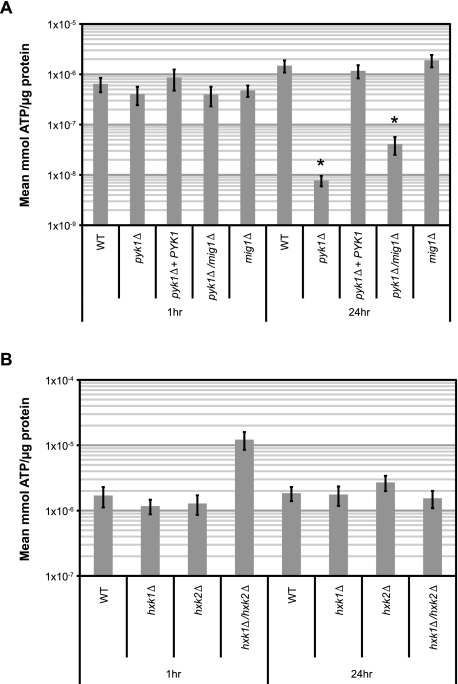
“neoformans to a reasonable extent, as mutants with glycolytic defects ( pyk1D and hxk1D hxk2D) are severely attenuated in a murine inhalation model of cryptococcosis and display decreased persistence in the central nervous system (Price et al. 2011).”
Background
Metadata
- Authors
- Price, M. S., Betancourt-Quiroz, M., Price, J. L., Toffaletti, D. L., Vora, H., Hu, G., Kronstad, J. W., & Perfect, J. R.
- Affiliations
- Duke Medical Center (US)
- University of British Columbia (CA)
- ORCID
- Venue
- mBio
- Publisher
- American Society for Microbiology
- Published
- 2011-07
- Volume
- 2
- Issue
- 3
- Pages
- e00103-11
- ISSN
- 2150-7511 (ISSN-L)
- 2161-2129
- PMC
- PMC3110414
- OpenAlex
- W2156654507
- Cited by
- 115
- References
- 76
- Citations by year
- 2026: 5 · 2025: 7 · 2024: 7 · 2023: 4 · 2022: 5 · 2021: 9 · 2020: 8 · 2019: 5 · 2018: 5 · 2017: 5 · 2016: 8 · 2015: 11 · 2014: 9 · 2013: 9 · 2012: 13
- FWCI
- 8.64
- Type
- journal article
- Language
- en
- Open access
- gold
- doi.org
- Licence
- cc-by-nc-sa
- creativecommons.org/licenses/by-nc-sa/3.0/ (vor)
- journals.asm.org/non-commercial-tdm-license (tdm)
- Locations
- mBio (publishedVersion, cc-by-nc-sa)
- Europe PMC (PubMed Central) (publishedVersion, cc-by-nc-sa)
- PubMed Central (publishedVersion, cc-by-nc-sa)
- PubMed (publishedVersion)
- DOAJ (DOAJ: Directory of Open Access Journals) (submittedVersion, cc-by-sa)
- Funders
- National Institutes of Health
- National Institute of Allergy and Infectious Diseases (R56AI028388, R01AI073896, R01AI028388)
- Topics
- Health Sciences › Medicine › Infectious Diseases › Fungal Infections and Studies
- Health Sciences › Medicine › Infectious Diseases › Antifungal resistance and susceptibility
- Life Sciences › Biochemistry, Genetics and Molecular Biology › Molecular Biology › Fungal and yeast genetics research
- Keywords
- Cryptococcus neoformans, cryptococcosis, glycolysis, gluconeogenesis, glucose utilization, virulence, phosphoenolpyruvate carboxykinase, pyruvate kinase, fungal metabolism, host-pathogen interaction, antifungal drug targets, chronic fungal infection, immunocompromised patients
- MeSH terms
- Animals, Cryptococcosis, Cryptococcus neoformans, Disease Models, Animal, Female, Genes, Fungal, Gluconeogenesis, Glucose, Glycolysis, Humans, Male, Rabbits, Rodent Diseases, Virulence, Gene Deletion, Lactic Acid, Virulence Factors, Mice
About these checks
Registry, retraction, Cites and statistics results are computed, not judged, with one exception: a printed reference that no index lists is read once by a model before it counts as a citation error. Claims are extracted by a model and kept only when their quote appears verbatim in the text; each cited source is then checked, with a model’s help, for whether it says what the claim relies on. Those verdicts can be wrong — read the claim’s quote and the cited source before relying on one.
Statistics and arithmetic are recomputed, not judged.
Confidence bands are shown only for fields calibrated on our annotated test set. None is calibrated yet, so no band is shown.
What counts as a claim ›How we measure confidence ›How we check this ›
Are you an author, or do you see a problem with this page? Request a review
Data sources
Bibliographic data: Semantic Scholar, OpenAlex, Crossref.
Contains information from the Semantic Scholar Academic Graph Datasets, made available under the ODC Attribution License (ODC-BY 1.0).
Semantic Scholar’s data is described in: Kinney, R., et al. (2023). The Semantic Scholar Open Data Platform. arXiv:2301.10140.
