

A Broadly Implementable Research Course in Phage Discovery and Genomics for First-Year Undergraduate Students
Open accessThe DOI matches its Crossref record; 63 of the 63 references it cites were found in a registry or an index.
Abstract
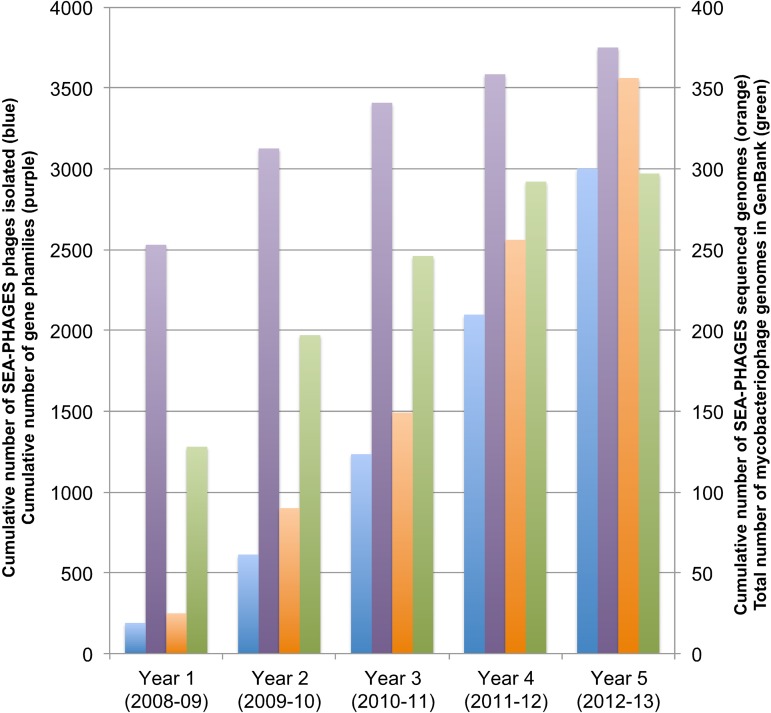
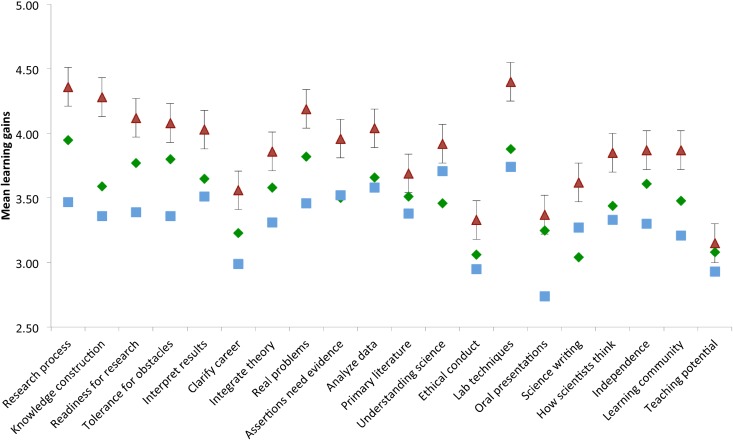
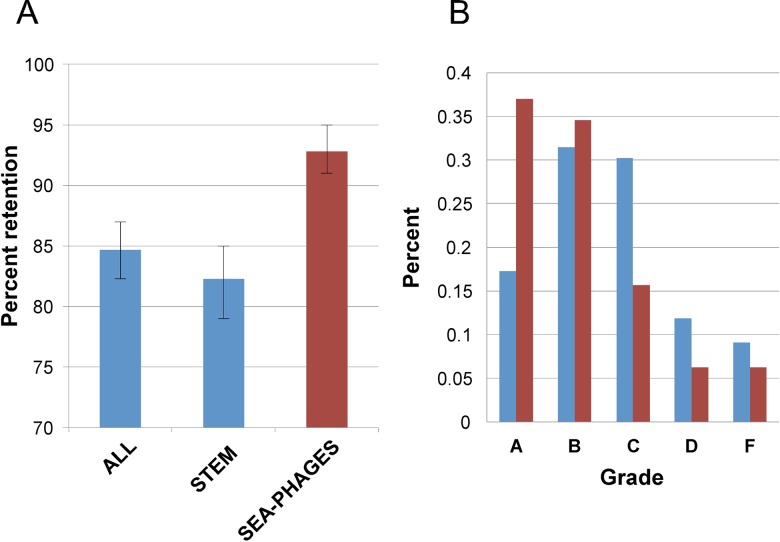
Engaging large numbers of undergraduates in authentic scientific discovery is desirable but difficult to achieve. We have developed a general model in which faculty and teaching assistants from diverse academic institutions are trained to teach a research course for first-year undergraduate students focused on bacteriophage discovery and genomics. The course is situated within a broader scientific context aimed at understanding viral diversity, such that faculty and students are collaborators with established researchers in the field. The Howard Hughes Medical Institute (HHMI) Science Education Alliance Phage Hunters Advancing Genomics and Evolutionary Science (SEA-PHAGES) course has been widely implemented and has been taken by over 4,800 students at 73 institutions. We show here that this alliance-sourced model not only substantially advances the field of phage genomics but also stimulates students’ interest in science, positively influences academic achievement, and enhances persistence in science, technology, engineering, and mathematics (STEM) disciplines. Broad application of this model by integrating other research areas with large numbers of early-career undergraduate students has the potential to be transformative in science education and research training. IMPORTANCE Engagement of undergraduate students in scientific research at early stages in their careers presents an opportunity to excite students about science, technology, engineering, and mathematics (STEM) disciplines and promote continued interests in these areas. Many excellent course-based undergraduate research experiences have been developed, but scaling these to a broader impact with larger numbers of students is challenging. The Howard Hughes Medical Institute (HHMI) Science Education Alliance Phage Hunting Advancing Genomics and Evolutionary Science (SEA-PHAGES) program takes advantage of the huge size and diversity of the bacteriophage population to engage students in discovery of new viruses, genome annotation, and comparative genomics, with strong impacts on bacteriophage research, increased persistence in STEM fields, and student self-identification with learning gains, motivation, attitude, and career aspirations.
Overview
The claims and statistics of this paper haven’t been checked yet.
Free: it reads the open-access text and checks the first 5 claims that cite a source we can check. Create a free account to check every claim.
Integrity signals
Registry
Cites
Statistics
Figures
Verification
Claims the paper makes
The claims and statistics of this paper haven’t been checked yet.
Free: it reads the open-access text and checks the first 5 claims that cite a source we can check. Create a free account to check every claim.
Claims other papers make about this one
Each is checked against this paper’s own text: does it say what the citing paper says it does?
The source backs part of the claim, not all of it — or backs it for a different population, condition or comparison.
In the citing paper
“It is an inclusive, community-oriented, course-based research experience that has served the education of thousands of students worldwide, while also providing the research community with a cornucopia of novel genes and functions.”
From Mycobacterium smegmatis: The Vanguard of Mycobacterial Research (2023) · cites this paper as [181]
Experimental — accuracy not yet measuredThe cited source says what the claim attributes to it.
In the citing paper
“while also providing the research community with a cornucopia of novel genes and functions”
From Mycobacterium smegmatis: The Vanguard of Mycobacterial Research (2023) · cites this paper as [181]
Self-check
Percentages, sums and reported differences re-computed from the paper’s own numbers.
The self-check needs the paper’s full text.
Citations
Cites
Improved microbial gene identification with GLIMMER
Delcher, A. (1999) · Nucleic Acids Research · doi:10.1093/nar/27.23.4636 · Cited by 2,493 · cited 1×
“Genome annotations were performed using various software platforms, including GBrowse (54), Apollo (55), DNAMaster (http://cobamide2.bio.pitt.edu/), Glim-mer(56),GeneMark(57),andanalysisprogramsavailableattheNational CenterforBiotechnologyInformation(NCBI).”
Rising Above The Gathering Storm: Energizing and Employing America for a Brighter Economic Future
Augustine, N. R. (2006) · Cited by 2,064
Benefits of Undergraduate Research Experiences
Russell, S. H., Hancock, M. P., & McCullough, J. (2007) · Science · doi:10.1126/science.1140384 · Cited by 1,380
Seymour, E., Hunter, A., Laursen, S. L., & DeAntoni, T. (2004) · Science Education · doi:10.1002/sce.10131 · Cited by 1,332
Hunter, A., Laursen, S. L., & Seymour, E. (2007) · Science Education · doi:10.1002/sce.20173 · Cited by 1,324 · cited 1×
“Thepositiveimpactsof thiscourse-basedresearchexperiencearesimilartowhathasbeen reportedforapprentice-basedresearchexperiences(5,53),repre-sentaneffectiveresponsetothecalltoactionintheNational ScienceFoundation(NSF) Vision and Change and PCAST reports (1, 4), and provide validation for this…”
The Generic Genome Browser: A Building Block for a Model Organism System Database
Stein, L. D., Mungall, C., Shu, S., Caudy, M., Mangone, M., Day, A., Nickerson, E., Stajich, J. E., Harris, T. W., Arva, A., et al. (2002) · Genome Research · doi:10.1101/gr.403602 · Cited by 1,145 · cited 2×
“Genome annotations were performed using various software platforms, including GBrowse (54), Apollo (55), DNAMaster (http://cobamide2.”
Undergraduate research experiences support science career decisions and active learning
Lopatto, D. (2007) · CBE—Life Sciences Education · doi:10.1187/cbe.07-06-0039 · Cited by 1,009 · cited 1×
“An abundance of evidence shows that involvement of undergraduate students in authentic research experiences has strong benefits for their engagement and interest in science (5–7) and that this often increases student interest in STEM careers (8).”
Self-citationSurvey of undergraduate research experiences (SURE): First findings
Lopatto, D. (2004) · Cell Biology Education · doi:10.1187/cbe.04-07-0045 · Cited by 969 · cited 1×
“The Survey of Undergraduate Research Experience (SURE) and the Classroom Undergraduate Research Experience (CURE) measure the students’ assessment of their understanding of science and scientists, confidenceintheirabilitytoperformresearch,andtheirperceived gainsinskills(50).”
Self-citationThe American Association for the Advancement of Science
HAULTAIN, A. (1889) · Nature · doi:10.1038/040556a0 · Cited by 946
BIO2010 : Transforming Undergraduate Education for Future Research Biologists
Earth, D. O. (2003) · Cited by 855
Research works printed but not linked: 1
- Goodner B Wheeler C Hall P Slater S 2003 Massively parallel undergraduates for bacterial genome finishing. ASM News 69: 584– 585
Cited by
Items 501–528 of 528
Niccum, H. N., & Niccum, H. N. (2025) · UA Campus Repository (The University of Arizona) · Cited by 1
Genome Sequences of Four Subcluster L2 Mycobacterium Phages, Finemlucis, Miley16, Wilder, and Zakai
Peister, A., Blumer, L. S., & al., E. (2017) · Atlanta University Center Robert W. Woodruff Library (Atlanta University Center Robert W. Woodruff Library)
Kerr, S. J. (2023) · Nottingham ePrints (University of Nottingham) · Cited by 1
Coté, L. E. (2024) · eScholarship (California Digital Library) · Cited by 2
Comparing Student Experiences from a Traditional Laboratory Course to a CURE Course
Kretchmer, M. (2025) · CU Scholar (University of Colorado Boulder) · Cited by 1
Harnessing the power of community to navigate biology education careers
Hughes, L. E. (2026) · Journal of Microbiology and Biology Education · doi:10.1128/jmbe.00039-26
Self-citationPhage Therapy and Global Health Equity: Opportunities in the Era of Antibiotic Resistance
Lewis, J. A., Turner, P. A., Chan, B. K., & Vong, G. (2026) · Annual Review of Virology · doi:10.1146/annurev-virology-092623-110310
Towards democratization of nucleic acid detection
Aidelberg, G. (2021) · theses.fr (ABES) · doi:10.70675/d5303232z2b0cz4c63za6d7zd2e750551996 · Cited by 2
Zajic, C. J., & Dolan, E. L. (2026) · bioRxiv (Cold Spring Harbor Laboratory) · doi:10.64898/2026.05.13.724928
“Several studies have indicated that completing a CURE in place of a non-research laboratory course can influence students’ persistence in STEM majors and completion of college degrees (Hanauer et al., 2017; Jordan et al., 2014; Rodenbusch et al., 2016).”
A practical low-cost course module for teaching bacteriophage isolation to undergraduate students
Coelho, L. F. L., Amaral, R. P., Terceti, M. D. S., dos Santos, Aio, B. R. F., de Carvalho, B. A., Malaquias, L. C. C., & Almeida, G. M. D. F. (2026) · Journal of Microbiology and Biology Education · doi:10.1128/jmbe.00065-26
“Science Education Alliance–Phage Hunters Advancing Genomics and Evolutionary Science (SEA-PHAGES) program is a widely implemented two-semester course that integrates environmental phage isolation, genome sequencing, and bioinformatic analysis within an authentic research framework (10, 11).”
InfluentialResourcing, Scalability and Sustainability of CUREs
Fuller, A. A. (2018) · Scholar Commons (Santa Clara University)
Kleinschmit, A. J., Gonzalez-Orta, E. T., Mathews, S. L., Smith, M. A., & Miller, S. (2026) · Journal of Microbiology and Biology Education · doi:10.1128/jmbe.00086-26
“The SEA-PHAGES program (47, 48) offers another opportunity for adapting this RECR learning resource, as the curriculum engages students in the discovery and genomic analysis of bacteriophages from environmental samples.”
Exploring Streptomyces bacteriophage genomes for CRISPR elements
Nath, S., & Hughes, L. E. (2026) · Academia molecular biology and genomics. · doi:10.20935/acadmolbiogen8361
Self-citationManukyan, A. K. (2026) · The journal of college science teaching · doi:10.1080/0047231x.2026.2700515
Advancing FAIR data towards comparable, organized, predictive AI-ready data for community validation
Wood‐Charlson, E. M., Åkerström, W. N., Anderson, L., Borton, M. A., Burley, S. K., Byers, N., Chandramouliswaran, I., Costes, S. V., Dehal, P., Doktycz, M. J., et al. (2026) · Communications Biology · doi:10.1038/s42003-026-10694-y · Cited by 1
Washeleski, E., Morrin, E., Parsons, R., Holmstrom, C., Guyer, M. E., Bekkala, A. P., & Goetsch, P. D. (2026) · Scientific Reports · doi:10.1038/s41598-026-66296-5
Su, J., Lyu, Y., Zhao, Y., Wang, Z., Wang, R., Wang, X., Zhou, Q. W., Peng, C., Li, Y., & Hu, W. (2026) · Learning and Individual Differences · doi:10.1016/j.lindif.2026.102977
Zuo, N., Hu, L., & Aradhyula, S. V. (2026) · Applied Economics Education and Extension · doi:10.71162/aeee.584778
Elmer, J. J. (2026) · ASEE Annual Conference & Exposition · doi:10.18260/1-2--59697
Building Methodological Skill and Confidence Through CUREs in Political Science
Kane, J. B. (2026) · Journal of Political Science Education · doi:10.1080/15512169.2026.2722081
Cira, M., Jimenez, K., Kong, Y., Shaaban, L., & Jay, J. A. (2026) · Journal of Microbiology and Biology Education · doi:10.1128/jmbe.00063-26
“SEA-PHAGES enhanced student learning, motivation, attitudes, and career aspirations (11).”
The µCURE Project: Lessons Learned from Developing a Networked CURE in Analytical Chemistry
Hunter, R. A., Howard, M. E., Neiles, K. Y., Scott, D. F., & Frederick, K. A. (2026) · doi:10.1021/bk-2026-1530.ch013
Garcia, A. O. (2026) · eScholarship (California Digital Library)
Washeleski, E. (2026) · Digital Commons - Michigan Tech (Michigan Technological University) · doi:10.37099/mtu.dc.etdr/2164
Aspects of Multilingual Writing of Biology Laboratory Reports
Roo, A.-K., & Davis, W. B. (2024) · WAESOL Educator
Implementing project-based learning in undergraduate STEM
Deb, D., Perera, N. A. T., Eddy, R. M., & Luna, R. E. (2026) · American Journal of STEM Education · doi:10.32674/64dv0v92
Anti-mycobacterial activity of phage-encoded lysterases
Maneekul, J., Freeman, K. G., Amarh, E. D., Kovalski, J. M., Skeel, E., Vannan, M., Montgomery, M. T., Moyer, C., Garlena, R. A., Singh, A. K., et al. (2026) · Journal of Bacteriology · doi:10.1128/jb.00410-26
“Through the Science Education Alliance Phage Hunters Advancing Genomics and Evolutionary Science (SEA-PHAGES) program (12), undergraduate researchers from 180 institutions have contributed to a collection of ~15,000 mycobacteriophages from environmental samples (11, 13).”
Self-citationMaking Learning Matter: Course-Based Undergraduate Research for the 21st-Century Student
Makarevitch, I. (2026) · Routledge eBooks · doi:10.4324/9781003768449
Metadata
- Authors
- Jordan, T. C., Burnett, S. H., Carson, S., Caruso, S. M., Clase, K., DeJong, R. J., Dennehy, J. J., Denver, D. R., Dunbar, D., Elgin, S. C. R., Findley, A. M., Gissendanner, C. R., Golebiewska, U. P., Guild, N., Hartzog, G. A., Grillo, W. H., Hollowell, G. P., Hughes, L. E., Johnson, A., King, R. A., Lewis, L. O., Li, W., Rosenzweig, F., Rubin, M. R., Saha, M. S., Sandoz, J., Shaffer, C. D., Taylor, B., Temple, L., Vazquez, E., Ware, V. C., Barker, L. P., Bradley, K. W., Jacobs-Sera, D., Pope, W. H., Russell, D. A., Cresawn, S. G., Lopatto, D., Bailey, C. P., & Hatfull, G. F.
- Affiliations
- Lewis & Clark College (US)
- Brigham Young University (US)
- North Carolina State University (US)
- University of Maryland, Baltimore County (US)
- Purdue University West Lafayette (US)
- Calvin University (US)
- Queens College, CUNY (US)
- Oregon State University (US)
- Cabrini University (US)
- Washington University in St. Louis (US)
- University of Louisiana at Monroe (US)
- City University of New York (US)
- University of Colorado Boulder (US)
- University of California, Santa Cruz (US)
- North Carolina Central University (US)
- University of North Texas (US)
- Virginia Commonwealth University (US)
- Western Kentucky University (US)
- University of Mary Washington (US)
- Indiana University Indianapolis (US)
- University of Montana (US)
- University of Puerto Rico at Cayey (PR)
- William & Mary (US)
- James Madison University (US)
- Lehigh University (US)
- Howard Hughes Medical Institute (US)
- Department of Biological Sciences, University of Pittsburgh, Pittsburgh, Pennsylvania, USA
- University of Pittsburgh (US)
- Grinnell College (US)
- ORCID
- Carson, Susan
- Caruso, Steven M.
- Clase, Kari
- DeJong, Randall J.
- Dennehy, John J.
- Denver, Dee R.
- Dunbar, David
- Elgin, Sarah C. R.
- Hartzog, Grant A.
- Grillo, Wendy H.
- Hollowell, Gail P.
- Hughes, Lee E.
- Johnson, Allison
- King, Rodney A.
- Lewis, Lynn O.
- Li, Wei
- Rosenzweig, Frank
- Saha, Margaret S.
- Shaffer, Christopher D.
- Temple, Louise
- Ware, Vassie C.
- Pope, Welkin H.
- Russell, Daniel A.
- Cresawn, Steven G.
- Bailey, Cheryl P.
- Hatfull, Graham F.
- Venue
- mBio
- Publisher
- American Society for Microbiology
- Published
- 2014-02-28
- Volume
- 5
- Issue
- 1
- Pages
- e01051-13
- ISSN
- 2150-7511 (ISSN-L)
- 2161-2129
- PMC
- PMC3950523
- OpenAlex
- W2110153690
- Cited by
- 509
- References
- 62
- Citations by year
- 2026: 16 · 2025: 24 · 2024: 43 · 2023: 48 · 2022: 64 · 2021: 62 · 2020: 51 · 2019: 43 · 2018: 42 · 2017: 43 · 2016: 38 · 2015: 29 · 2014: 6
- FWCI
- 198.87
- Type
- journal article
- Language
- en
- Open access
- gold
- doi.org
- Licence
- cc-by-nc-sa
- creativecommons.org/licenses/by-nc-sa/3.0/ (vor)
- journals.asm.org/non-commercial-tdm-license (tdm)
- Locations
- mBio (publishedVersion, cc-by-nc-sa)
- Europe PMC (PubMed Central) (publishedVersion, cc-by-nc-sa)
- PubMed Central (publishedVersion, cc-by-nc-sa)
- PubMed (publishedVersion)
- University of North Texas Digital Library (University of North Texas) (submittedVersion)
- CUNY Academic Works (City University of New York) (submittedVersion, cc-by-nc-sa)
- Digital Commons@Becker (Washington University School of Medicine) (submittedVersion)
- Open Scholarship Institutional Repository (Washington University in St. Louis) (submittedVersion, cc-by-nc-sa)
- The Mathematics Enthusiast (submittedVersion, cc-by-nc-sa)
- W&M Publish (College of William & Mary) (submittedVersion)
- DOAJ (DOAJ: Directory of Open Access Journals) (submittedVersion, cc-by-sa)
- eScholarship (California Digital Library) (submittedVersion)
- Maryland Shared Open Access Repository (USMAI Consortium) (submittedVersion, cc-by-nc-sa)
- Digital Repository at the University of Maryland (University of Maryland College Park)
- Funders
- Howard Hughes Medical Institute
- National Institute of General Medical Sciences (R25GM059429)
- National Institute on Minority Health and Health Disparities (P20MD006144)
- Topics
- Social Sciences › Education › Science Education and Pedagogy
- Life Sciences › Biochemistry, Genetics and Molecular Biology › Molecular Biology › Genetics, Bioinformatics, and Biomedical Research
- Social Sciences › Education › Undergraduate Neuroscience Education and Research
- Keywords
- phage genomics, undergraduate research experience, first-year students, STEM persistence, viral diversity, genome annotation, comparative genomics
- MeSH terms
- Adult, Bacteria, Bacteriophages, Female, Humans, Male, Microbiology, Students, Genomics, Young Adult
About these checks
Registry, retraction, Cites and statistics results are computed, not judged, with one exception: a printed reference that no index lists is read once by a model before it counts as a citation error. Claims are extracted by a model and kept only when their quote appears verbatim in the text; each cited source is then checked, with a model’s help, for whether it says what the claim relies on. Those verdicts can be wrong — read the claim’s quote and the cited source before relying on one.
Statistics and arithmetic are recomputed, not judged.
Confidence bands are shown only for fields calibrated on our annotated test set. None is calibrated yet, so no band is shown.
What counts as a claim ›How we measure confidence ›How we check this ›
Are you an author, or do you see a problem with this page? Request a review
Data sources
Bibliographic data: Semantic Scholar, OpenAlex, Crossref.
Contains information from the Semantic Scholar Academic Graph Datasets, made available under the ODC Attribution License (ODC-BY 1.0).
Semantic Scholar’s data is described in: Kinney, R., et al. (2023). The Semantic Scholar Open Data Platform. arXiv:2301.10140.
