

IFI207, a young and fast-evolving protein, controls retroviral replication via the STING pathway
Open accessPublished version of a preprint
The DOI matches its Crossref record; 61 of the 61 references it cites were found in a registry or an index.
Abstract
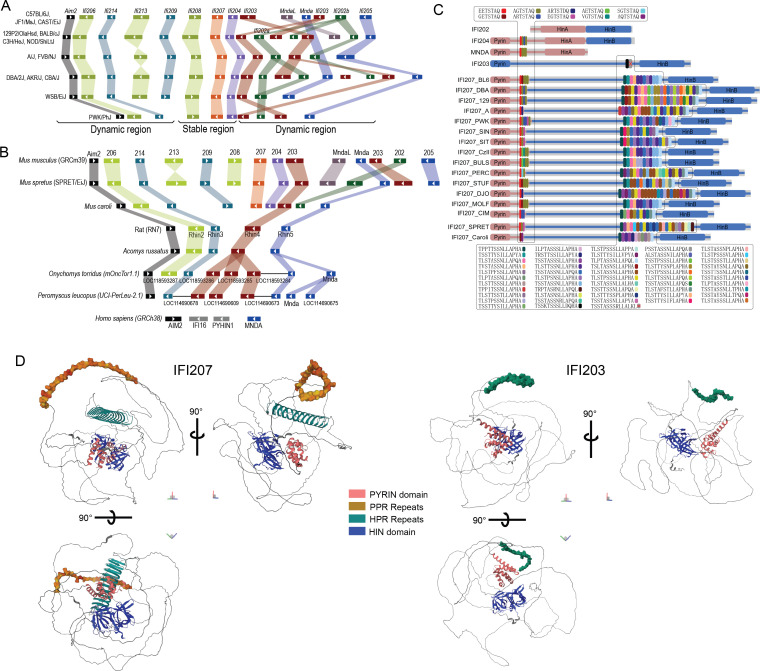
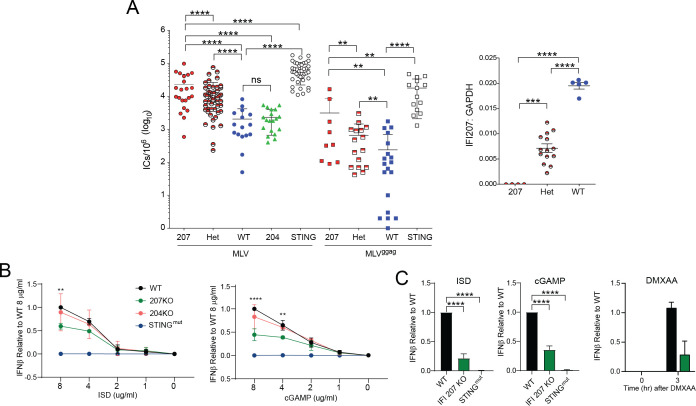
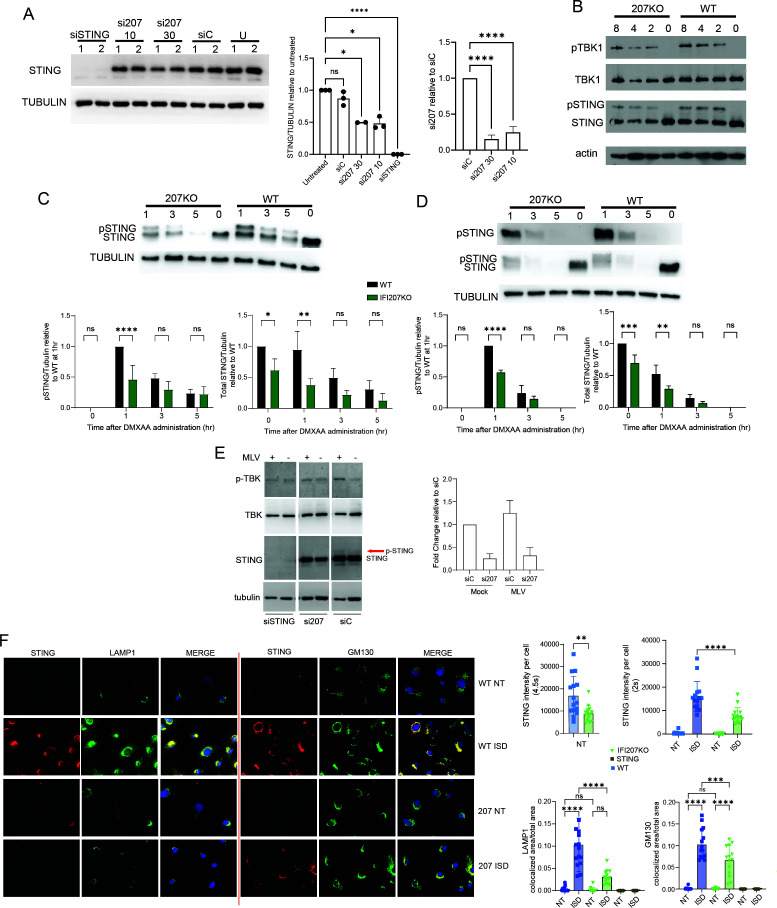
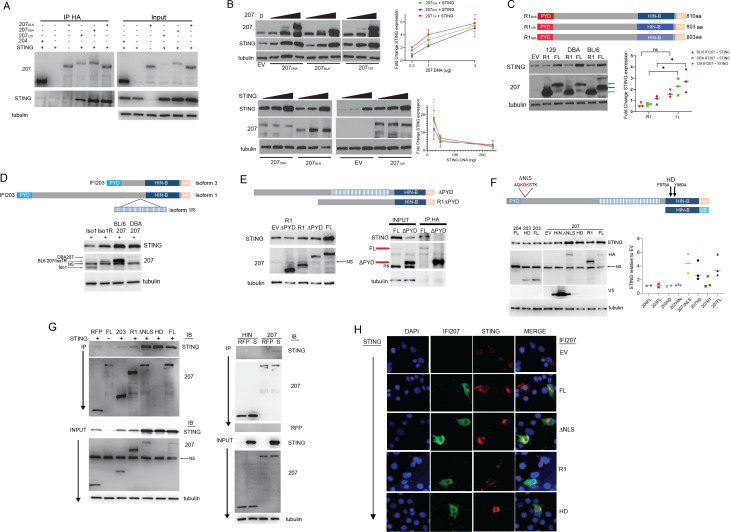
Mammalian AIM-2-like receptor (ALR) proteins bind nucleic acids and initiate production of type I interferons or inflammasome assembly, thereby contributing to host innate immunity. In mice, the Alr locus is highly polymorphic at the sequence and copy number level and we show here, is one of the most dynamic regions of the genome. One rapidly evolving gene within this region, Ifi207 , was introduced to the Mus genome by gene conversion or an unequal recombination event a few million years ago. Ifi207 has a large, distinctive repeat region that differs in sequence and length among Mus species and even closely related inbred Mus musculus strains. We show that IFI207 controls MLV infection in vivo and that it plays a role in the STING-mediated response to cGAMP, dsDNA, DMXXA and MLV. IFI207 binds to STING and inclusion of its repeat region appears to stabilize STING protein. The Alr locus and Ifi207 provide a clear example of the evolutionary innovation of gene function, possibly as a result of host-pathogen co-evolution. IMPORTANCE The Red Queen hypothesis predicts that the arms race between pathogens and the host may accelerate evolution of both sides, and therefore cause higher diversity in virulence factors and immune-related proteins, respectively (1). The Alr gene family in mice has undergone rapid evolution in the last few million years and includes the creation of two novel members, MndaL and Ifi207 . Ifi207 in particular became highly divergent, with significant genetic changes between highly related inbred mice. IFI207 protein acts in the STING pathway and contributes to anti-retroviral resistance via a novel mechanism. The data show that under the pressure of host-pathogen coevolution in a dynamic locus, gene conversion and recombination between gene family members creates new genes with novel and essential functions that play diverse roles in biological processes.
Overview
The claims and statistics of this paper haven’t been checked yet.
Free: it reads the open-access text and checks the first 5 claims that cite a source we can check. Create a free account to check every claim.
Integrity signals
Registry
Cites
Statistics
Figures
Verification
Claims the paper makes
The claims and statistics of this paper haven’t been checked yet.
Free: it reads the open-access text and checks the first 5 claims that cite a source we can check. Create a free account to check every claim.
Claims other papers make about this one
Each is checked against this paper’s own text: does it say what the citing paper says it does?
The source backs part of the claim, not all of it — or backs it for a different population, condition or comparison.
In the citing paper
“Recently, we reported that the 6th exon of the mouse gene Ifi207 encodes 11–25 copies of an exact 42 bp repeat, which have accumulated extremely high diversity (15% at the nucleotide level and 29% at the amino acid level) within a few million years.55”
From High-quality mouse reference genomes reveal the structural complexity of the murine protein-coding landscape (2026) · cites this paper as [55]
Experimental — accuracy not yet measuredThe cited source says what the claim attributes to it.
In the citing paper
“The repeat regions of Ifi207 are typical VNTRs, show essential roles for protein function, and are probably a result of host-pathogen coevolution.55”
From High-quality mouse reference genomes reveal the structural complexity of the murine protein-coding landscape (2026) · cites this paper as [55]
Self-check
Percentages, sums and reported differences re-computed from the paper’s own numbers.
The self-check needs the paper’s full text.
Citations
Cites
Pathogen Recognition and Innate Immunity
Akira, S., Uematsu, S., & Takeuchi, O. (2006) · Cell · doi:10.1016/j.cell.2006.02.015 · Cited by 11,952
The role of pattern-recognition receptors in innate immunity: update on Toll-like receptors
Kawai, T., & Akira, S. (2010) · Nature Immunology · doi:10.1038/ni.1863 · Cited by 9,304
STING is an endoplasmic reticulum adaptor that facilitates innate immune signalling
Ishikawa, H., & Barber, G. N. (2008) · Nature · doi:10.1038/nature07317 · Cited by 3,576 · cited 1×
“Activated STING dimerizes and interacts with TANK-binding kinase 1 (TBK1), thereby stimulating the dimerization and nuclear translocation of the transcription factors IFN regulatory factor 3 (IRF3) and NF-κB, leading to the production of type I IFNs and cytokines (23–26).”
BackgroundSTING regulates intracellular DNA-mediated, type I interferon-dependent innate immunity
Ishikawa, H., Ma, Z., & Barber, G. N. (2009) · Nature · doi:10.1038/nature08476 · Cited by 2,759
IFI16 is an innate immune sensor for intracellular DNA
Unterholzner, L., Keating, S. E., Baran, M., Horan, K. A., Jensen, S. B., Sharma, S., Sirois, C. M., Jin, T., Latz, E., Xiao, T. S., et al. (2010) · Nature Immunology · doi:10.1038/ni.1932 · Cited by 1,643 · cited 2×
“Human interferon-gamma inducible (IFI) 16 and mouse IFI204 are required for type I IFN and cytokine responses to herpes simplex virus-1 (HSV-1) and vaccinia virus (VACV) DNA (13).”
BackgroundSTING Specifies IRF3 Phosphorylation by TBK1 in the Cytosolic DNA Signaling Pathway
Tanaka, Y., & Chen, Z. J. (2012) · Science Signaling · doi:10.1126/scisignal.2002521 · Cited by 1,317
Distinct RIG-I and MDA5 Signaling by RNA Viruses in Innate Immunity
Loo, Y.-M., Fornek, J., Crochet, N., Bajwa, G., Perwitasari, O., Martinez-Sobrido, L., Akira, S., Gill, M. A., García-Sastre, A., Katze, M. G., et al. (2008) · Journal of Virology · doi:10.1128/jvi.01080-07 · Cited by 1,071
Cyclic GMP-AMP Synthase Is an Innate Immune Sensor of HIV and Other Retroviruses
Gao, D., Wu, J., Wu, Y.-T., Du, F., Aroh, C., Yan, N., Sun, L., & Chen, Z. J. (2013) · Science · doi:10.1126/science.1240933 · Cited by 992 · cited 1×
“These ALRs, as well as the innate immune sensors like cyclic GMP-AMP (cGAMP) synthase (cGAS) and DEAD-box helicase 41 (DDX41), mediate production of IFNs and cytokines in a stimulator of interferon genes (STING)-dependent manner (3, 11, 16–22).”
BackgroundPan-viral specificity of IFN-induced genes reveals new roles for cGAS in innate immunity
Schoggins, J. W., MacDuff, D. A., Imanaka, N., Gainey, M. D., Shrestha, B., Eitson, J. L., Mar, K. B., Richardson, R. B., Ratushny, A. V., Litvak, V., et al. (2014) · Nature · doi:10.1038/nature12862 · Cited by 896 · cited 1×
“Genotyping primers for the Ifi207, Ifi202, and Ifi204 knockout alleles are in Table S3B. cGAS KO mice [Mb21d1tm1d(EUCOMM)Hmgu] were originally provided by Michael Diamond and Skip Virgin (60).”
MethodThe helicase DDX41 senses intracellular DNA mediated by the adaptor STING in dendritic cells
Zhang, Z., Yuan, B., Bao, M., Lu, N., Kim, T., & Liu, Y.-J. (2011) · Nature Immunology · doi:10.1038/ni.2091 · Cited by 877
Research works printed but not linked: 1
- Van Valen L. 1973. A new evolutionary law. Evol Theory Evol Monogr 1: 1– 30.
Cited by
Innate Sensing of Viral Nucleic Acids and Their Use in Antiviral Vaccine Development
Enya, T., & Ross, S. R. (2025) · Vaccines · doi:10.3390/vaccines13020193 · Cited by 17
“IFI207 enhanced the STING signaling pathway, leading to an increased antiviral response by stabilizing STING protein [20].”
Self-citationXu, J., Luo, Y., Lu, F., Xu, X., Jiang, C., Kang, M., Chang, C., Wei, H., Long, T., Jiang, B., et al. (2025) · International Immunopharmacology · doi:10.1016/j.intimp.2025.115471 · Cited by 9
Helmy, M., Li, J. U., Yan, X. F., Meade, R. K., Anderson, E., Chen, P. B., Czechanski, A. M., Di Domenico, T., Flint, J., Garrison, E., et al. (2026) · Cell Genomics · doi:10.1016/j.xgen.2025.101074 · Cited by 8
“55 The repeat regions of Ifi207 are typical VNTRs, show essential roles for protein function, and are probably a result of host-pathogen coevolution.”
Self-citationXu, H., 米红波, Cheng, R., Gui, T., Hu, F., Yang, Y., Cheng, J., & Xue, Q. (2026) · CNS Neuroscience & Therapeutics · doi:10.1002/cns.70815
“Deeper analysis of the genes enriched in States 3 and 4 indicated that these genes were primarily involved in immunoregulation [40], cell migration and differentiation [41], tissue repair [42] and the inflammatory regulation of macrophages mediating tumor immune escape [43] (Figure 6H).”
IFI207 promotes antiviral responses by modulating STING ubiquitination and degradation
Enya, T., Zhao, W., Geetanjali, He, B., & Ross, S. R. (2026) · mBio · doi:10.1128/mbio.00612-26
Self-citation
Metadata
- Authors
- Moran, E. A., Salas-Briceno, K., Zhao, W., Enya, T., Aguilera, A. N., Acosta, I., Alonzo, F., Kiani, D., Behnsen, J., Alvarez, C., Keane, T. M., Adams, D. J., Lilue, J., & Ross, S. R.
- Affiliations
- University of Illinois Chicago (US)
- Gulbenkian Institute of Science, Oeiras, Portugal
- European Bioinformatics Institute (GB)
- Wellcome Sanger Institute (GB)
- Instituto Gulbenkian de Ciência (PT)
- Corresponding author
- Lilue, Jingtao
- Ross, Susan R.
- ORCID
- Venue
- mBio
- Publisher
- American Society for Microbiology
- Published
- 2024-07-17
- Volume
- 15
- Issue
- 7
- Pages
- e0120924-e0120924
- ISSN
- 2150-7511 (ISSN-L)
- PMC
- PMC11253629
- OpenAlex
- W4399541620
- Semantic Scholar
- a1e93083f5204b40efe0aec9b84ce3b22f7b2b04
- Cited by
- 4
- References
- 61
- Citations by year
- 2026: 1 · 2025: 3
- FWCI
- 0.67
- Type
- journal article
- Language
- en
- Open access
- gold
- doi.org
- Licence
- cc-by
- creativecommons.org/licenses/by/4.0/ (vor)
- journals.asm.org/non-commercial-tdm-license (tdm)
- Locations
- mBio (publishedVersion, cc-by)
- bioRxiv (Cold Spring Harbor Laboratory) (acceptedVersion)
- PubMed Central (publishedVersion, cc-by)
- PubMed (publishedVersion)
- DOAJ (DOAJ: Directory of Open Access Journals) (submittedVersion)
- Funders
- HHS | NIH | National Institute of Allergy and Infectious Diseases (R01AI121275, 1R01AI174538)
- Topics
- Life Sciences › Immunology and Microbiology › Immunology › interferon and immune responses
- Life Sciences › Immunology and Microbiology › Immunology › Immune Response and Inflammation
- Life Sciences › Biochemistry, Genetics and Molecular Biology › Genetics › Evolution and Genetic Dynamics
- Keywords
- AIM2-like receptors, STING pathway, retroviral replication, murine leukemia virus, type I interferon, gene conversion, unequal crossover, cGAMP, host-pathogen coevolution, Red Queen hypothesis, innate immunity, inbred mouse strains, gene family evolution
- MeSH terms
- STING Protein, Animals, Immunity, Innate, Membrane Proteins, Mice, Inbred C57BL, Leukemia Virus, Murine, Nuclear Proteins, Virus Replication, Evolution, Molecular, Mice, Host-Pathogen Interactions
About these checks
Registry, retraction, Cites and statistics results are computed, not judged, with one exception: a printed reference that no index lists is read once by a model before it counts as a citation error. Claims are extracted by a model and kept only when their quote appears verbatim in the text; each cited source is then checked, with a model’s help, for whether it says what the claim relies on. Those verdicts can be wrong — read the claim’s quote and the cited source before relying on one.
Statistics and arithmetic are recomputed, not judged.
Confidence bands are shown only for fields calibrated on our annotated test set. None is calibrated yet, so no band is shown.
What counts as a claim ›How we measure confidence ›How we check this ›
Are you an author, or do you see a problem with this page? Request a review
Data sources
Bibliographic data: Semantic Scholar, OpenAlex, Crossref.
Contains information from the Semantic Scholar Academic Graph Datasets, made available under the ODC Attribution License (ODC-BY 1.0).
Semantic Scholar’s data is described in: Kinney, R., et al. (2023). The Semantic Scholar Open Data Platform. arXiv:2301.10140.
