

The DOI matches its Crossref record; 104 of the 105 references it cites were found in a registry or an index.
Gene Essentiality Analyzed by In Vivo Transposon Mutagenesis and Machine Learning in a Stable Haploid Isolate of Candida albicans
Open accessAbstract
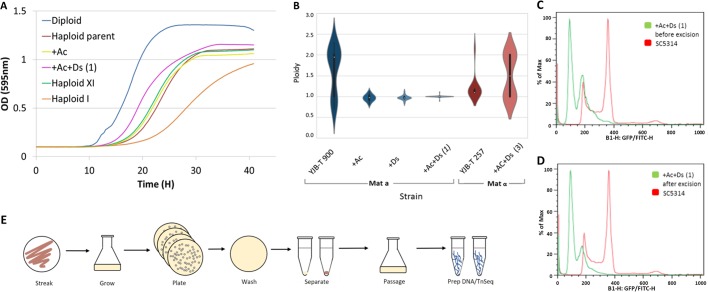
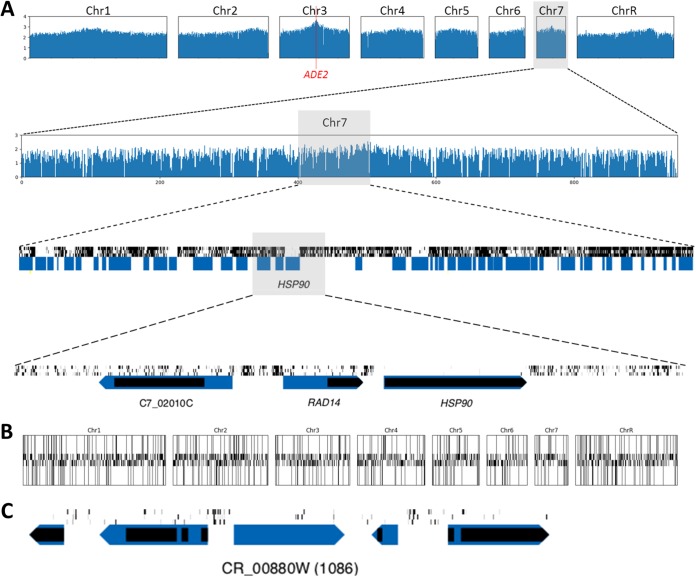
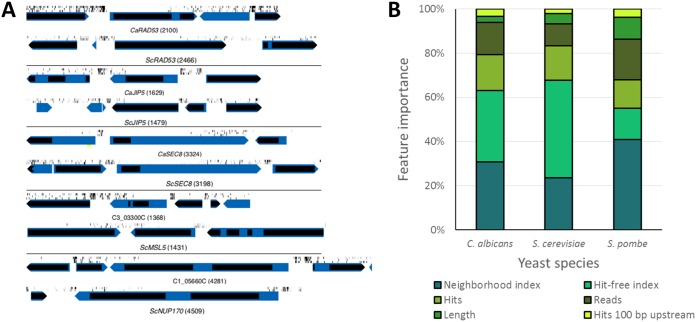
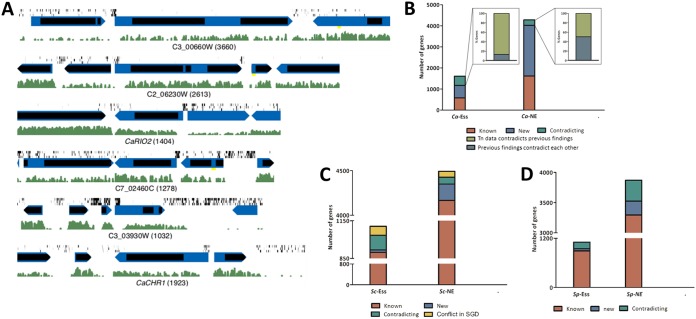
Comprehensive understanding of an organism requires that we understand the contributions of most, if not all, of its genes. Classical genetic approaches to this issue have involved systematic deletion of each gene in the genome, with comprehensive sets of mutants available only for very-well-studied model organisms. We took a different approach, harnessing the power of in vivo transposition coupled with deep sequencing to identify >500,000 different mutations, one per cell, in the prevalent human fungal pathogen Candida albicans and to map their positions across the genome. The transposition approach is efficient and less labor-intensive than classic approaches. Here, we describe the production and analysis (aided by machine learning) of a large collection of mutants and the comprehensive identification of 1,610 C. albicans genes that are essential for growth under standard laboratory conditions. Among these C. albicans essential genes, we identify those that are also essential in two distantly related model yeasts as well as those that are conserved in all four major human fungal pathogens and that are not conserved in the human genome. This list of genes with functions important for the survival of the pathogen provides a good starting point for the development of new antifungal drugs, which are greatly needed because of the emergence of fungal pathogens with elevated resistance and/or tolerance of the currently limited set of available antifungal drugs.
Overview
The claims and statistics of this paper haven’t been checked yet.
Run the check — free, no account needed. It reads the open-access text and checks the sources it cites.
Integrity signals
Registry
Cites
Statistics
Figures
Verification
Claims the paper makes
The claims and statistics of this paper haven’t been checked yet.
Run the check — free, no account needed. It reads the open-access text and checks the sources it cites.
Claims other papers make about this one
Each is checked against this paper’s own text: does it say what the citing paper says it does?
In the citing paper
“In several fungal species, including the model yeast Saccharomyces cerevisiae and the distantly related fungal pathogen C. albicans, it is estimated that ∼20% of the open reading frames in their genomes are essential (Winzeler et al. 1999; Segal et al. 2018).”
From Genetic analysis of Hsp90 function in Cryptococcus neoformans highlights key roles in stress tolerance and virulence (2022) · cites this paper as Segal et al. 2018
Self-check
Percentages, sums and reported differences re-computed from the paper’s own numbers.
The self-check needs the paper’s full text.
Citations
Cites
Breiman, L. (2001) · Machine Learning · doi:10.1023/a:1010933404324 · Cited by 133,538
Scikit-learn: Machine Learning in Python
Pedregosa, F., Varoquaux, G., Gramfort, A., Michel, V., Thirion, B., Grisel, O., Blondel, M., Müller, A., Nothman, J., Louppe, G., et al. (2012) · arXiv · doi:10.48550/arxiv.1201.0490 · Cited by 71,016
The Sequence Alignment/Map format and SAMtools
Li, H., Handsaker, B., Wysoker, A., Fennell, T., Ruan, J., Homer, N., Marth, G., Abecasis, G., Durbin, R., & 1000 Genome Project Data Processing Subgroup (2009) · Bioinformatics · doi:10.1093/bioinformatics/btp352 · Cited by 62,041
Fast gapped-read alignment with Bowtie 2
Langmead, B., & Salzberg, S. L. (2012) · Nature Methods · doi:10.1038/nmeth.1923 · Cited by 56,400
Cutadapt removes adapter sequences from high-throughput sequencing reads
Martin, M. (2011) · EMBnet.journal · doi:10.14806/ej.17.1.200 · Cited by 33,889
Classification And Regression Trees
Breiman, L., Friedman, J. H., Olshen, R. A., & Stone, C. J. (2017) · doi:10.1201/9781315139470 · Cited by 11,417
Database resources of the National Center for Biotechnology Information: update
Wheeler, D. L. (2003) · Nucleic Acids Research · doi:10.1093/nar/gkh073 · Cited by 10,695
Database resources of the National Center for Biotechnology Information
Agarwala, R., Barrett, T., Beck, J., Benson, D., Bollin, C., Bolton, E. E., Bourexis, D., Brister, J., Bryant, S. H., Canese, K., et al. (2017) · Nucleic Acids Res. · doi:10.1093/nar/gkx1095 · Cited by 6,277
Current protocols in molecular biology
Dudley, R. K. (1988) · FEBS Letters · doi:10.1016/0014-5793(88)80264-3 · Cited by 6,004
NWChem: A comprehensive and scalable open-source solution for large scale molecular simulations
Valiev, M., Bylaska, E. J., Govind, N., Kowalski, K., Straatsma, T. P., van Dam, H. J. J., Wang, D., Nieplocha, J., Aprà, E., Windus, T. L., et al. (2010) · Computer Physics Communications · doi:10.1016/j.cpc.2010.04.018 · Cited by 5,849
Cited by
Sorted by citations
Drug resistance and tolerance in fungi.
Berman, J., & Krysan, D. J. (2020) · Nature Reviews Microbiology · doi:10.1038/s41579-019-0322-2 · Cited by 642
Self-citationThe importance of antimicrobial resistance in medical mycology
Gow, N. A. R., Johnson, C., Berman, J. G., Coste, A. T., Cuomo, C. A., Perlin, D. S., Bicanic, T. A., Harrison, T. S., Wiederhold, N. P., Bromley, M., et al. (2022) · Nature Communications · doi:10.1038/s41467-022-32249-5 · Cited by 232
Self-citationCandida albicans and Candida glabrata : global priority pathogens
Katsipoulaki, M., Stappers, M. H. T., Malavia-Jones, D., Brunke, S., Hube, B., & Gow, N. A. R. (2024) · Microbiology and Molecular Biology Reviews · doi:10.1128/mmbr.00021-23 · Cited by 180
Self-citationExtensive loss of cell-cycle and DNA repair genes in an ancient lineage of bipolar budding yeasts
Steenwyk, J. L., Opulente, D. A., Kominek, J., Shen, X.-X., Zhou, X., Labella, A. L., Bradley, N. P., Eichman, B. F., Čadež, N., Libkind, D., et al. (2019) · PLoS Biology · doi:10.1371/journal.pbio.3000255 · Cited by 162
“cerevisiae [64], and 73% of Candida albicans [65] genes are 459 dispensable in laboratory conditions.”
BackgroundSelf-citationFrom Jekyll to Hyde: The Yeast–Hyphal Transition of Candida albicans
Chow, E. W. L., Pang, L. M., & Wang, Y. (2021) · Pathogens · doi:10.3390/pathogens10070859 · Cited by 154
Metadata
- Authors
- Segal, E. S., Gritsenko, V., Levitan, A., Yadav, B., Dror, N., Steenwyk, J. L., Silberberg, Y., Mielich, K., Rokas, A., Gow, N. A. R., Kunze, R., Sharan, R., & Berman, J.
- Affiliations
- Tel Aviv University (IL)
- University of Aberdeen (GB)
- Vanderbilt University (US)
- Freie Universität Berlin (DE)
- Corresponding author
- Berman, Judith
- ORCID
- Venue
- mBio
- Publisher
- American Society for Microbiology
- Published
- 2018-11-07
- Volume
- 9
- Issue
- 5
- ISSN
- 2150-7511 (ISSN-L)
- 2161-2129
- PMC
- PMC6212825
- OpenAlex
- W2898801056
- Cited by
- 150
- References
- 105
- Citations by year
- 2026: 11 · 2025: 20 · 2024: 18 · 2023: 9 · 2022: 21 · 2021: 20 · 2020: 26 · 2019: 24 · 2018: 1
- FWCI
- 6.31
- Type
- journal article
- Language
- en
- Open access
- gold
- doi.org
- Licence
- Locations
- mBio (publishedVersion, cc-by)
- Europe PMC (PubMed Central) (publishedVersion, cc-by)
- PubMed Central (publishedVersion, cc-by)
- PubMed (publishedVersion)
- Aberdeen University Research Archive (Aberdeen University) (submittedVersion)
- DOAJ (DOAJ: Directory of Open Access Journals) (submittedVersion, cc-by-sa)
- DOAJ (DOAJ: Directory of Open Access Journals) (submittedVersion)
- Refubium (Universitätsbibliothek der Freien Universität Berlin) (submittedVersion, cc-by)
- Universitätsbibliothek der FU Berlin Hochschulschriftenstelle u. Dokumentenserver (cc-by)
- Funders
- Wellcome Trust (086827 075470 101873 200208)
- MRC Center for Medical Mycology (N006364/1)
- European Research Council (340087 RAPLODAPT)
- Dahlem Center of Plant Sciences (DCPS)
- Israel Science Foundation (715/18)
- Topics
- Life Sciences › Biochemistry, Genetics and Molecular Biology › Molecular Biology › Fungal and yeast genetics research
- Health Sciences › Medicine › Infectious Diseases › Antifungal resistance and susceptibility
- Life Sciences › Biochemistry, Genetics and Molecular Biology › Genetics › Bacterial Genetics and Biotechnology
- Keywords
- gene essentiality, Candida albicans, transposon mutagenesis, essential genes, fungal pathogens, antifungal drug targets, machine learning, deep sequencing
- MeSH terms
- Machine Learning, Aspergillus fumigatus, Candida albicans, Cryptococcus neoformans, DNA Transposable Elements, Genes, Fungal, Genetics, Microbial, Haploidy, Histoplasma, Mutagenesis, Insertional, Genes, Essential
About these checks
Registry, retraction, Cites and statistics results are computed, not judged, with one exception: a printed reference that no index lists is read once by a model before it counts as a citation error. Claims are extracted by a model and kept only when their quote appears verbatim in the text; each cited source is then checked, with a model’s help, for whether it says what the claim relies on. Those verdicts can be wrong — read the claim’s quote and the cited source before relying on one.
Statistics and arithmetic are recomputed, not judged.
Confidence bands are shown only for fields calibrated on our annotated test set. None is calibrated yet, so no band is shown.
What counts as a claim ›How we measure confidence ›How we check this ›
Are you an author, or do you see a problem with this page? Request a review
