

The DOI matches its Crossref record; 43 of the 43 references it cites were found in a registry or an index.
Drug-Resistant Epimutants Exhibit Organ-Specific Stability and Induction during Murine Infections Caused by the Human Fungal Pathogen Mucor circinelloides
Open accessPublished version of a preprint
Abstract
The emerging fungal pathogen Mucor circinelloides causes a severe infection, mucormycosis, which leads to considerable morbidity and mortality. Treatment of Mucor infection is challenging because Mucor is inherently resistant to nearly all clinical antifungal agents. An RNAi-dependent and reversible mechanism of antifungal resistance, epimutation, was recently reported for Mucor . Epimutation has not been studied in vivo , and it was unclear whether it would contribute to antifungal resistance observed clinically. We demonstrate that epimutation can both be induced and reverted after in vivo passage through a mouse; rates of both induction and reversion are higher after brain infection than after infection of other organs (liver, spleen, kidneys, or lungs). Elucidating the roles played by epimutation in drug resistance and infection will improve our understanding of Mucor and other fungal pathogens and may have implications for antifungal treatment.
Overview
The claims and statistics of this paper haven’t been checked yet.
Run the check — free, no account needed. It reads the open-access text and checks the sources it cites.
Integrity signals
Registry
Cites
Statistics
Figures
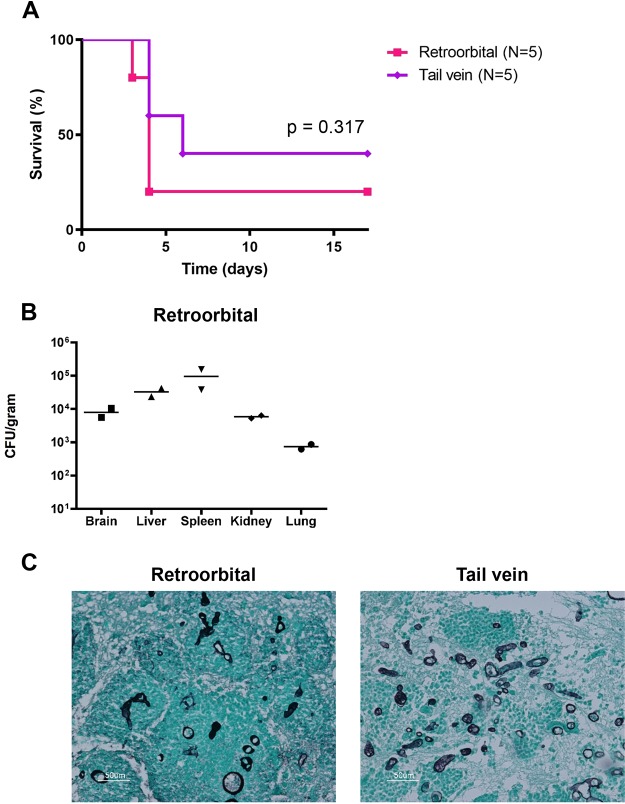
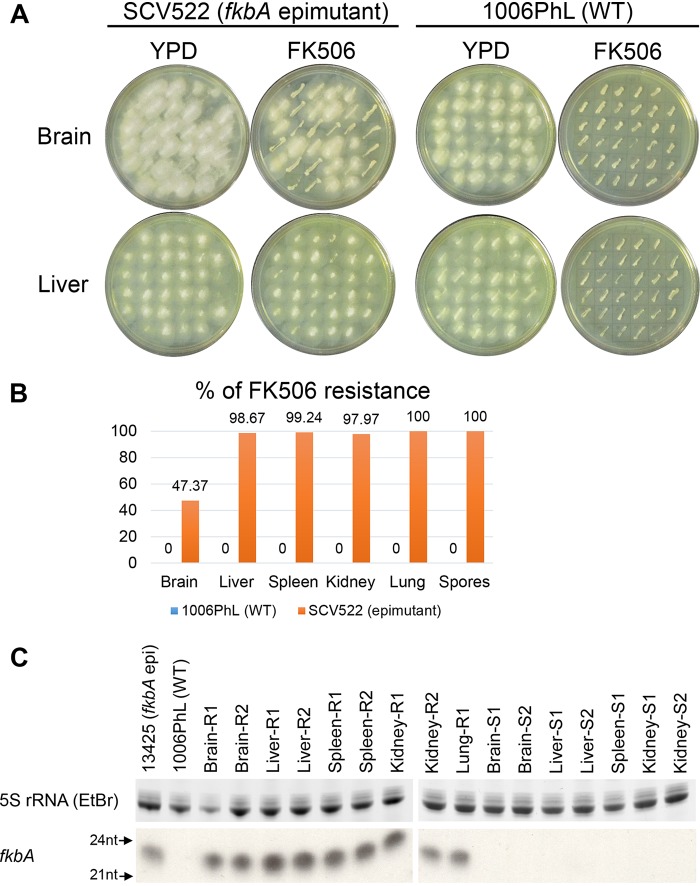
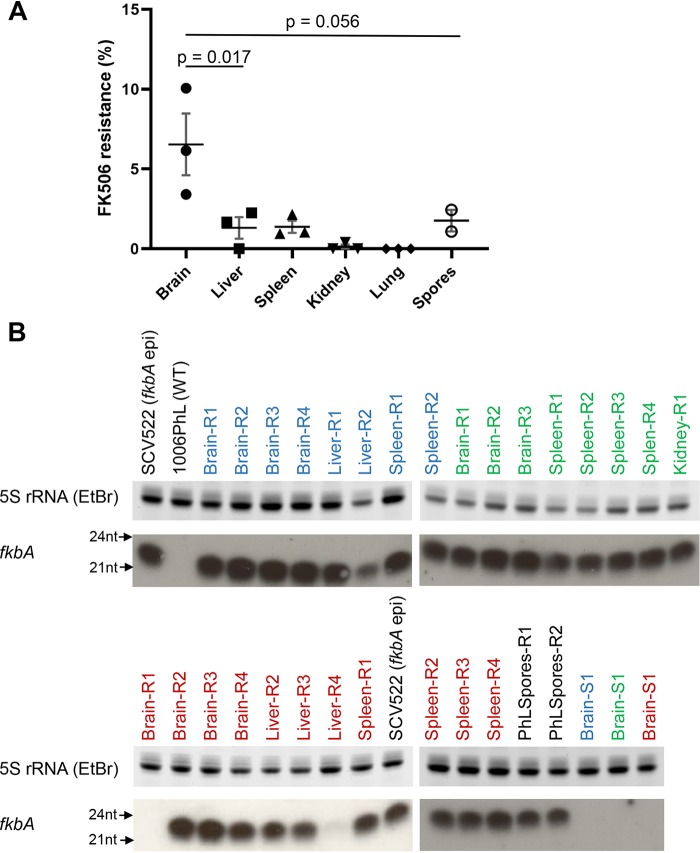
Verification
Claims the paper makes
The claims and statistics of this paper haven’t been checked yet.
Run the check — free, no account needed. It reads the open-access text and checks the sources it cites.
Claims other papers make about this one
Each is checked against this paper’s own text: does it say what the citing paper says it does?
In the citing paper
“In a systemic mouse model of Mucor infection, epimutation-mediated drug resistance can be rapidly induced and reverted over the course of the infection, and thus represents a potential clinically-relevant factor affecting drug resistance103.”
From Molecular mechanisms governing antifungal drug resistance (2023) · cites this paper as [103]
Self-check
Percentages, sums and reported differences re-computed from the paper’s own numbers.
The self-check needs the paper’s full text.
Citations
Cites
Epidemiology and Outcome of Zygomycosis: A Review of 929 Reported Cases
Roden, M. M., Zaoutis, T. E., Buchanan, W. L., Knudsen, T. A., Sarkisova, T. A., Schaufele, R. L., Sein, M. T., Sein, T., Chiou, C. C., Chu, J. H., et al. (2005) · Clinical Infectious Diseases · doi:10.1086/432579 · Cited by 3,094
Kino, T., Hatanaka, H., Hashimoto, M., Nishiyama, M., Goto, T., OKUHARA, M., KOHSAKA, M., AOKI, H., & Imanaka, H. (1987) · The Journal of Antibiotics · doi:10.7164/antibiotics.40.1249 · Cited by 1,244
Jeong, W., Keighley, C., Wolfe, R. S., Lee, W. L., Slavin, M. A., Kong, D. C. M., & Chen, S. C.-A. (2018) · Clinical Microbiology and Infection · doi:10.1016/j.cmi.2018.07.011 · Cited by 1,105
Sehgal, S. N., BAKER, H., & Vézina, C. (1975) · The Journal of Antibiotics · doi:10.7164/antibiotics.28.727 · Cited by 974
Global Epidemiology of Mucormycosis
Prakash, H., & Chakrabarti, A. (2019) · Journal of Fungi · doi:10.3390/jof5010026 · Cited by 955
Isavuconazole treatment for mucormycosis: a single-arm open-label trial and case-control analysis
Marty, F. M., Ostrosky‐Zeichner, L., Cornely, O. A., Mullane, K. M., Perfect, J. R., Thompson, G. R., Alangaden, G. J., Brown, J. W., Fredricks, D. N., Heinz, W., et al. (2016) · The Lancet Infectious Diseases · doi:10.1016/s1473-3099(16)00071-2 · Cited by 714
Retro-orbital injections in mice
Yardeni, T., Eckhaus, M., Morris, H. D., Huizing, M., & Hoogstraten-Miller, S. L. (2011) · Lab Animal · doi:10.1038/laban0511-155 · Cited by 533
Kontoyiannis, D. P., & Lewis, R. E. (2011) · Blood · doi:10.1182/blood-2011-03-316430 · Cited by 376
Necrotizing Cutaneous Mucormycosis after a Tornado in Joplin, Missouri, in 2011
Neblett Fanfair, R., Benedict, K., Bos, J., Bennett, S. D., Lo, Y.-C., Adebanjo, T., Etienne, K., Deak, E., Derado, G., Shieh, W.-J., et al. (2012) · New England Journal of Medicine · doi:10.1056/nejmoa1204781 · Cited by 360
Kelly, S. L., Lamb, D. C., Kelly, D. E., Manning, N. J., Loeffler, J., Hebart, H., Schumacher, U., & Einsele, H. (1997) · FEBS Letters · doi:10.1016/s0014-5793(96)01360-9 · Cited by 351
Cited by
Sorted by citations
Molecular mechanisms governing antifungal drug resistance
Lee, Y., Robbins, N., & Cowen, L. E. (2023) · npj Antimicrobials and Resistance · doi:10.1038/s44259-023-00007-2 · Cited by 304
Genome-scale phylogeny and contrasting modes of genome evolution in the fungal phylum Ascomycota
Shen, X., Steenwyk, J. L., LaBella, A. L., Opulente, D. A., Zhou, X., Kominek, J., Li, Y., Groenewald, M., Hittinger, C. T., & Rokas, A. (2020) · Science Advances · doi:10.1126/sciadv.abd0079 · Cited by 157
Genotypic and Phenotypic Diversity among Human Isolates of Akkermansia muciniphila
Becken, B., Davey, L., Middleton, D. R., Mueller, K. D., Sharma, A., Holmes, Z. C., Dallow, E., Remick, B., Barton, G. M., David, L. A., et al. (2021) · mBio · doi:10.1128/mbio.00478-21 · Cited by 125
Mucorales Species and Macrophages
Nicolás, F. E., Murcia, L., Navarro, E., Navarro-Mendoza, M. I., Arques, C. P., & Garre, V. (2020) · Journal of Fungi · doi:10.3390/jof6020094 · Cited by 83
Genes, Pathways, and Mechanisms Involved in the Virulence of Mucorales
Lax, C., Arques, C. P., Navarro-Mendoza, M. I., Cánovas-Márquez, J. T., Tahiri, G., Pérez-Ruiz, J. A., Osorio-Concepción, M., Murcia, L., Navarro, E., Garre, V., et al. (2020) · Genes · doi:10.3390/genes11030317 · Cited by 76
Metadata
- Authors
- Chang, Z., & Heitman, J.
- Affiliations
- Duke University (US)
- Corresponding author
- Heitman, Joseph
- Venue
- mBio
- Publisher
- American Society for Microbiology
- Published
- 2019-12-24
- Volume
- 10
- Issue
- 6
- ISSN
- 2150-7511 (ISSN-L)
- 2161-2129
- PMC
- PMC6831780
- OpenAlex
- W2985567791
- Cited by
- 202
- References
- 43
- Citations by year
- 2026: 21 · 2025: 16 · 2024: 22 · 2023: 30 · 2022: 42 · 2021: 39 · 2020: 30 · 2019: 2
- FWCI
- 21.85
- Type
- journal article
- Language
- en
- Open access
- gold
- doi.org
- Licence
- Locations
- mBio (publishedVersion, cc-by)
- bioRxiv (Cold Spring Harbor Laboratory) (acceptedVersion, cc-by-nc-nd)
- Europe PMC (PubMed Central) (publishedVersion, cc-by)
- PubMed Central (publishedVersion, cc-by)
- PubMed (publishedVersion)
- DOAJ (DOAJ: Directory of Open Access Journals) (submittedVersion)
- DOAJ (DOAJ: Directory of Open Access Journals) (submittedVersion, cc-by-sa)
- Funders
- HHS | National Institutes of Health (AI39115-21, AI50113-15, AI104533-05, AI112595-04)
- Topics
- Health Sciences › Medicine › Infectious Diseases › Antifungal resistance and susceptibility
- Life Sciences › Biochemistry, Genetics and Molecular Biology › Molecular Biology › Fungal and yeast genetics research
- Health Sciences › Medicine › Infectious Diseases › Fungal Infections and Studies
- Keywords
- Mucor circinelloides, mucormycosis, epimutations, antifungal resistance, brain infection, fungal pathogens
- MeSH terms
- Animals, Antifungal Agents, Disease Models, Animal, Humans, Male, Mice, Inbred BALB C, Mucor, Mucormycosis, Tacrolimus, Sirolimus, Drug Resistance, Fungal, RNA Interference, Epigenesis, Genetic, Mice
About these checks
Registry, retraction, Cites and statistics results are computed, not judged, with one exception: a printed reference that no index lists is read once by a model before it counts as a citation error. Claims are extracted by a model and kept only when their quote appears verbatim in the text; each cited source is then checked, with a model’s help, for whether it says what the claim relies on. Those verdicts can be wrong — read the claim’s quote and the cited source before relying on one.
Statistics and arithmetic are recomputed, not judged.
Confidence bands are shown only for fields calibrated on our annotated test set. None is calibrated yet, so no band is shown.
What counts as a claim ›How we measure confidence ›How we check this ›
Are you an author, or do you see a problem with this page? Request a review
