

The DOI matches its Crossref record; 4 of the 4 references it cites were found in a registry or an index.
Inverse stable isotope labeling (InverSIL) links predicted catecholate siderophore gene clusters to their products in diverse bacteria
Open accessPublished version of a preprint
Abstract
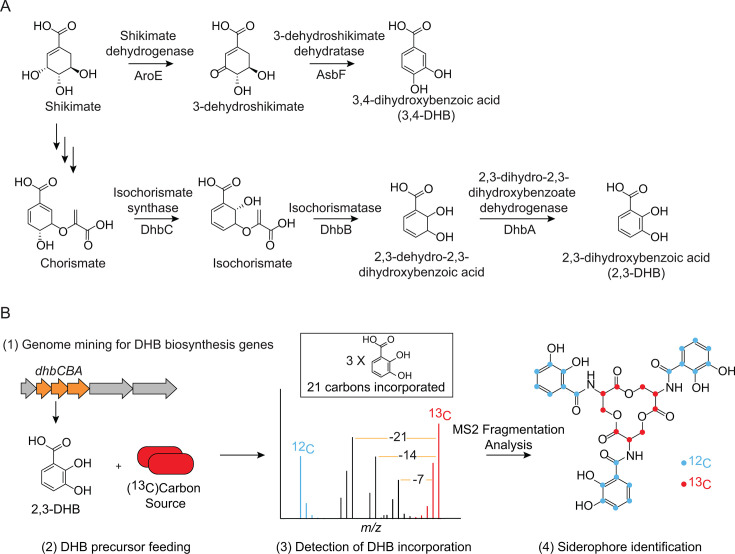
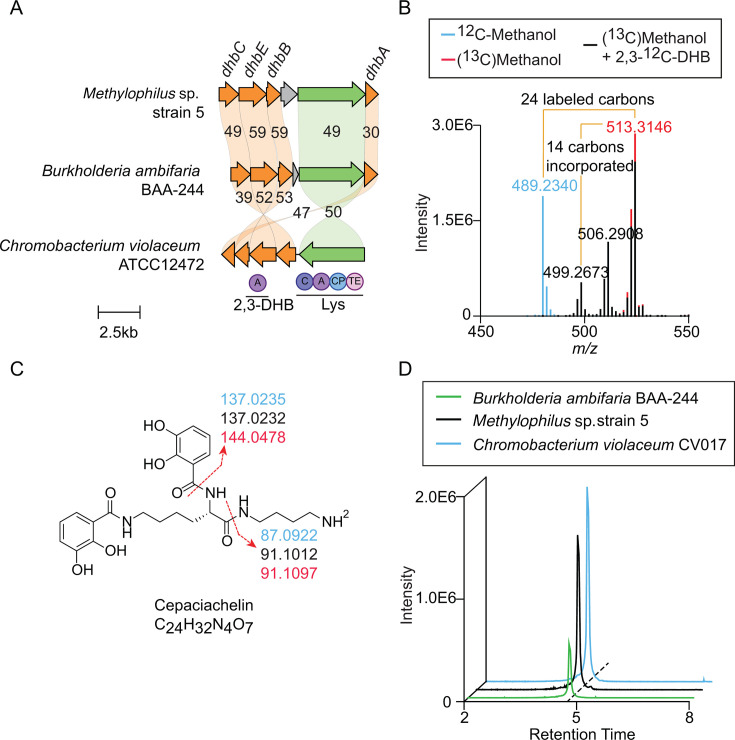
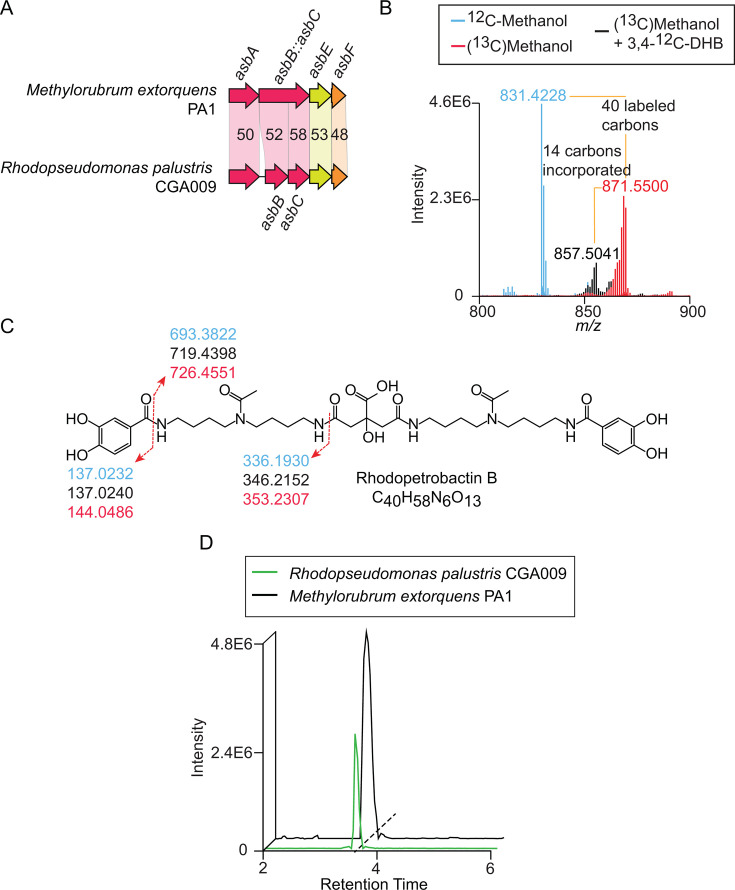
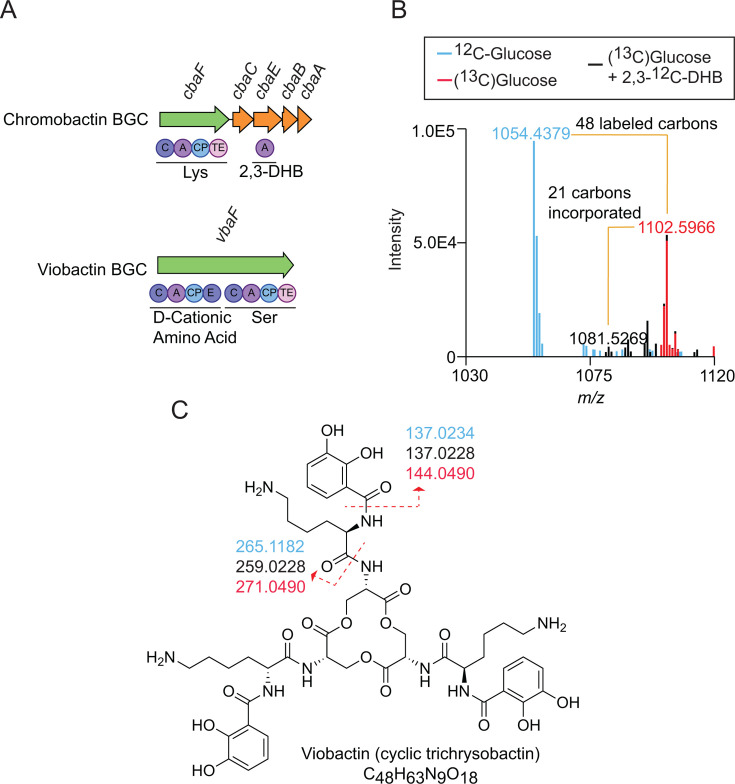
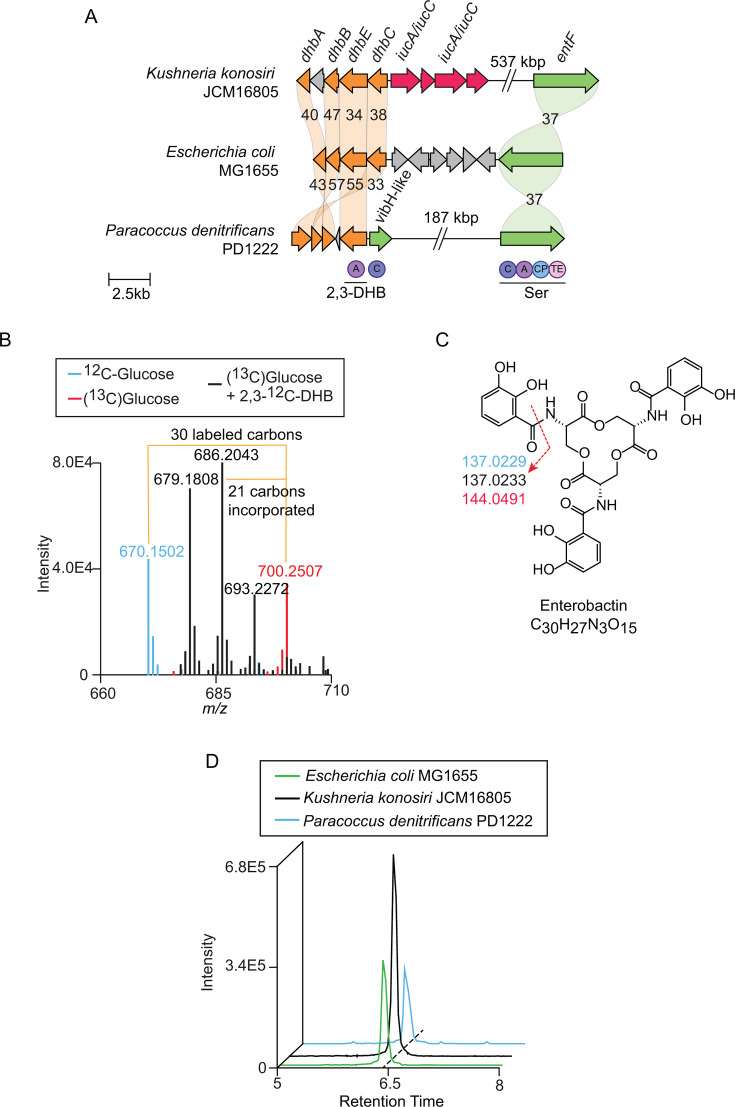
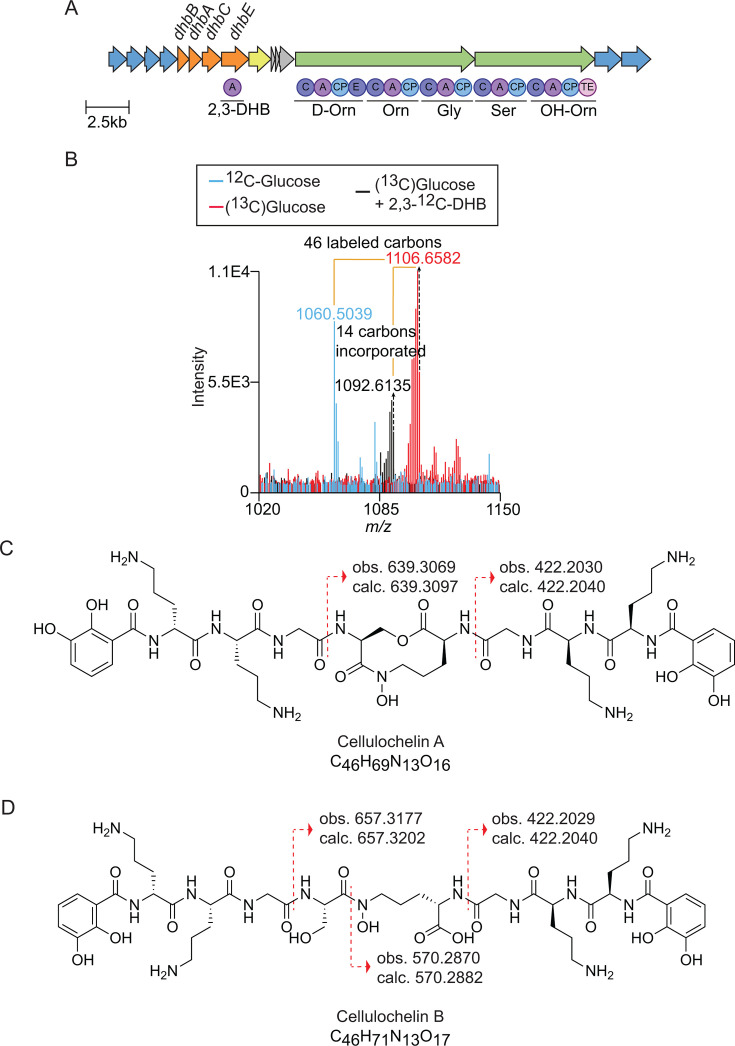
Bacteria produce high-affinity, iron-chelating secondary metabolites called siderophores to access insoluble Fe(III) in their environments. Genome mining has revealed many predicted siderophore biosynthetic gene clusters (BGCs) in bacterial genomes; however, the structures of their siderophore products remain mostly undetermined. This limits our molecular-level understanding of how bacteria acquire iron. Here, we apply inverse stable isotope labeling (InverSIL) to rapidly connect predicted siderophore BGCs to their products. With InverSIL, bacteria are grown on 13 C-substituted carbon sources and then fed predicted biosynthetic precursors at their natural isotopic abundance to identify BGC products by mass spectrometry, removing issues with the availability of isotopically substituted precursors. We use InverSIL to determine the structures of the siderophore products of predicted BGCs from the methylotrophic genera Methylophilus and Methylorubrum , as well as the siderophores produced by the opportunistic pathogen Chromobacterium violaceum , which were previously shown to be essential for virulence yet remained structurally uncharacterized. We next use this approach to reveal the unexpected production of enterobactin by the genera Kushneria and Paracoccus , which was difficult to predict from genome sequences due to the distributed nature of the biosynthetic genes within the genomes. Finally, we use InverSIL to discover new siderophores, the cellulochelins, from the cellulose-degrading plant symbiont Cellulomonas sp. strain Leaf334. These findings demonstrate the utility of InverSIL for functional BGC characterization and expand our molecular understanding of bacterial iron acquisition strategies. IMPORTANCE: Iron acquisition is important for microbial survival, and bacteria produce secondary metabolites called siderophores to scavenge iron from the environment. While bacterial genome sequences show many predicted genes for making siderophores, most remain unlinked to their metabolic products. Understanding which siderophores bacteria produce is critical for elucidating microbial iron acquisition strategies, ecological interactions, and potential roles in host-microbe interactions. Here, we demonstrate how inverse stable isotope labeling (InverSIL) can rapidly link predicted siderophore gene clusters to their corresponding metabolites. By applying InverSIL to diverse bacterial strains, we validate known siderophore products and uncover unexpected products, highlighting the limitations of current in silico predictions. This study highlights the value of combining experimental approaches with genome mining to advance our understanding of how bacteria acquire iron from their environment.
Overview
The claims and statistics of this paper haven’t been checked yet.
Run the check — free, no account needed. It reads the open-access text and checks the sources it cites.
Integrity signals
Registry
Cites
Statistics
Figures
Verification
Claims the paper makes
The claims and statistics of this paper haven’t been checked yet.
Run the check — free, no account needed. It reads the open-access text and checks the sources it cites.
Self-check
Percentages, sums and reported differences re-computed from the paper’s own numbers.
The self-check needs the paper’s full text.
Citations
Cites
Iron in infection and immunity
Cassat, J. E., & Skaar, E. P. (2013) · Cell Host & Microbe · doi:10.1016/j.chom.2013.04.010 · Cited by 1,214
Bacterial siderophores in community and host interactions
Kramer, J., Özkaya, Ö., & Kümmerli, R. (2020) · Nature Reviews Microbiology · doi:10.1038/s41579-019-0284-4 · Cited by 998
Solution equilibria of enterobactin and metal-enterobactin complexes
Loomis, L. D., & Raymond, K. N. (1991) · Inorganic Chemistry · doi:10.1021/ic00005a008 · Cited by 321
ChelomEx: Isotope-Assisted Discovery of Metal Chelates in Complex Media Using High-Resolution LC-MS
Baars, O., Morel, F. M. M., & Perlman, D. H. (2014) · Analytical Chemistry · doi:10.1021/ac503000e · Cited by 57
Research works printed but not linked: 65
- 10.3389/fmicb.2012.00383 · DOI
- 10.1039/b906679a · DOI · Paper page
- 10.1038/s41579-024-01090-6 · DOI
- 10.1007/s00775-018-1617-x · DOI
- 10.1080/10409238.2025.2476476 · DOI
- 10.1016/bs.mie.2024.06.007 · DOI
- 10.1016/j.copbio.2022.102757 · DOI
- 10.1093/nar/gkaf334 · DOI
- 10.1038/s41467-020-19986-1 · DOI
- 10.7554/eLife.109154 · DOI
- 10.1021/acschembio.5b00801 · DOI
- 10.1016/j.chembiol.2010.01.011 · DOI
- 10.1021/ja1109453 · DOI
- 10.1038/s41557-021-00803-1 · DOI · Paper page
- 10.1073/pnas.1516878112 · DOI
- 10.1016/j.chembiol.2006.11.007 · DOI
- 10.1038/s41589-021-00949-6 · DOI · Paper page
- 10.1128/mbio.01999-23 · DOI
- 10.1016/bs.mie.2024.06.005 · DOI
- 10.1002/anie.200501942 · DOI
- 10.1021/np060409n · DOI
- 10.1039/c7mt00111h · DOI
- 10.1007/s00775-002-0375-x · DOI
- 10.1099/00221287-144-7-1747 · DOI
- 10.1039/D3NP00037K · DOI
- 10.1074/jbc.M009140200 · DOI
- 10.1073/pnas.0808118105 · DOI
- 10.1021/bi801876q · DOI
- 10.1021/acs.analchem.4c03528 · DOI
- 10.1073/pnas.2507323122 · DOI
- 10.1007/s00253-015-6713-z · DOI
- 10.1128/mBio.02430-17 · DOI
- 10.1002/mbo3.347 · DOI
- 10.1128/AEM.03160-15 · DOI
- 10.1371/journal.pone.0102458 · DOI
- 10.1134/S0026261711040047 · DOI
- 10.1128/JCM.03561-13 · DOI
- 10.1073/pnas.2322096121 · DOI
- 10.1111/1462-2920.14078 · DOI
- 10.1007/s00248-010-9725-3 · DOI
- 10.1128/JB.01009-12 · DOI
- 10.1128/IAI.00577-19 · DOI
- 10.1002/1873-3468.14539 · DOI
- 10.1021/np200126z · DOI
- 10.1128/JB.180.17.4435-4441.1998 · DOI · Paper page
- 10.1128/genomeA.00080-16 · DOI
- 10.1099/ijsem.0.002897 · DOI
- 10.3390/microorganisms11122910 · DOI
- 10.1186/s40793-018-0324-0 · DOI
- 10.1073/pnas.0630018100 · DOI · Paper page
- 10.1007/BF00447011 · DOI
- 10.1016/S0040-4039(01)86717-4 · DOI
- 10.1042/bj1460191 · DOI
- 10.1073/pnas.1401734111 · DOI
- 10.1099/00221287-148-2-353 · DOI
- 10.1038/s41564-021-00997-7 · DOI
- 10.1073/pnas.0805451105 · DOI
- 10.1039/c8mt00252e · DOI
- 10.1021/acschembio.7b00597 · DOI
- 10.1099/00221287-128-9-1959 · DOI
- 10.1016/j.tim.2025.05.002 · DOI
- 10.1128/JB.06817-11 · DOI
- 10.1093/nar/gkr1044 · DOI
- 10.1186/s12859-023-05311-2 · DOI
- 10.1016/0003-2697(87)90612-9 · DOI
Metadata
- Authors
- Robes, J. M. D., Liebergesell, T. C. E., Medvedeva, V. P., & Puri, A. W.
- Affiliations
- University of Utah (US)
- University of California, Irvine (US)
- Corresponding author
- Puri, Aaron W.
- Venue
- mBio
- Publisher
- American Society for Microbiology
- Published
- 2026-06-10
- Volume
- 17
- Issue
- 6
- Pages
- e0339125-e0339125
- ISSN
- 2150-7511 (ISSN-L)
- PMC
- PMC13251462
- OpenAlex
- W4415946583
- Cited by
- 0
- References
- 4
- FWCI
- 0.00
- Type
- journal article
- Language
- en
- Open access
- gold
- doi.org
- Licence
- Locations
- mBio (publishedVersion, cc-by)
- bioRxiv (Cold Spring Harbor Laboratory) (acceptedVersion, cc-by-nc)
- PubMed (publishedVersion)
- PubMed Central (publishedVersion, cc-by)
- Europe PMC (PubMed Central) (submittedVersion, cc-by-nc)
- DOAJ (DOAJ: Directory of Open Access Journals) (submittedVersion, cc-by-sa)
- Funders
- National Institute of General Medical Sciences (R35 GM147018)
- Simons Foundation Early Career Investigator in Aquatic Microbial Ecology and Evolution (00006628)
- NIH training (T32 AI055434)
- Topics
- Life Sciences › Immunology and Microbiology › Applied Microbiology and Biotechnology › Microbial Natural Products and Biosynthesis
- Life Sciences › Biochemistry, Genetics and Molecular Biology › Genetics › Bacterial Genetics and Biotechnology
- Life Sciences › Biochemistry, Genetics and Molecular Biology › Biotechnology › Microbial Metabolism and Applications
- Keywords
- siderophores, iron acquisition, enterobactin, Methylobacterium, Methylophilus, Chromobacterium violaceum, Paracoccus, Cellulomonas, bacterial secondary metabolites
About these checks
Registry, retraction, Cites and statistics results are computed, not judged, with one exception: a printed reference that no index lists is read once by a model before it counts as a citation error. Claims are extracted by a model and kept only when their quote appears verbatim in the text; each cited source is then checked, with a model’s help, for whether it says what the claim relies on. Those verdicts can be wrong — read the claim’s quote and the cited source before relying on one.
Statistics and arithmetic are recomputed, not judged.
Confidence bands are shown only for fields calibrated on our annotated test set. None is calibrated yet, so no band is shown.
What counts as a claim ›How we measure confidence ›How we check this ›
Are you an author, or do you see a problem with this page? Request a review
How to cite
Cite CoChat for the checks on this page, and the paper for its own findings.
- This page
- CoChat. (2026). Citation check: Inverse stable isotope labeling (InverSIL) links predicted catecholate siderophore gene clusters to their products in diverse bacteria. https://app.cochat.ai/papers/10.1128/mbio.03391-25
- The paper
- Robes, J. M. D., Liebergesell, T. C. E., Medvedeva, V. P., & Puri, A. W. (2026). Inverse stable isotope labeling (InverSIL) links predicted catecholate siderophore gene clusters to their products in diverse bacteria. mBio. https://doi.org/10.1128/mbio.03391-25
