

The DOI matches its Crossref record; 3 of the 3 references it cites were found in a registry or an index.
Why Is the Biodegradation of Polyfluorinated Compounds So Rare?
Abstract
Thousands of heavily fluorinated chemicals are found in the environment, impact human and ecosystem health, and are relatively resistant to biological and chemical degradation. Their persistence in the environment is due to the inability of most microorganisms to biodegrade them.
Overview
The claims and statistics of this paper haven’t been checked yet.
Run the check — free, no account needed. It reads the open-access text and checks the sources it cites.
Integrity signals
Registry
Cites
Statistics
Figures
Verification
Claims the paper makes
The claims and statistics of this paper haven’t been checked yet.
Run the check — free, no account needed. It reads the open-access text and checks the sources it cites.
Claims other papers make about this one
Each is checked against this paper’s own text: does it say what the citing paper says it does?
The cited source says what the claim attributes to it.
In the citing paper
“One line of evidence against the feasibility of reductive defluorination of PFAS is that the redox midpoint potential of organofluorides may be too low to yield energy when used as terminal electron acceptors for biologically relevant electron donors (46).”
From Toward the development of a molecular toolkit for the microbial remediation of per-and polyfluoroalkyl substances (2024) · cites this paper as [46]
In the citing paper
“The perfluorinated structure makes C─F bond dissociation energies high enough to resist oxidative, reductive, and hydrolytic enzymes (3, 4).”
From Electron bifurcation and fluoride efflux systems implicated in defluorination of perfluorinated unsaturated carboxylic acids by Acetobacterium spp (2024) · cites this paper as [3]
In the citing paper
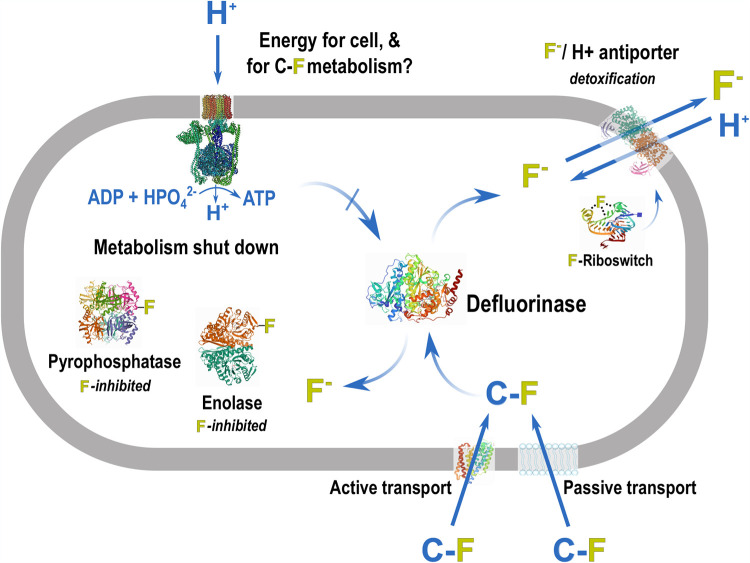
“Third, sustained biodegradation of PFAS is likely dependent on the presence of multiple systems, including low-potential redox transfer proteins, defluorinases, transport mechanisms for substrate uptake, fluoride export proteins, and enzymes with inherent resistance to fluoride inhibition (46, 47).”
From Toward the development of a molecular toolkit for the microbial remediation of per-and polyfluoroalkyl substances (2024) · cites this paper as [46]
Self-check
Percentages, sums and reported differences re-computed from the paper’s own numbers.
The self-check needs the paper’s full text.
Citations
Cites
Huang, S., & Jaffé, P. R. (2019) · Environmental Science & Technology · doi:10.1021/acs.est.9b04047 · Cited by 524
Mapping the reaction coordinates of enzymatic defluorination
Chan, P. W. Y., Yakunin, A. F., Edwards, E. A., & Pai, E. F. (2011) · Journal of the American Chemical Society · doi:10.1021/ja200277d · Cited by 107
Bacterial fluoride resistance, Fluc channels, and the weak acid accumulation effect
Ji, C., Stockbridge, R. B., & Miller, C. (2014) · Journal of General Physiology · doi:10.1085/jgp.201411243 · Cited by 97
Research works printed but not linked: 26
- 10.1021/acscentsci.1c00013 · DOI
- 10.47287/cen-09927-leadcon · DOI
- 10.1042/BCJ20190720 · DOI · Paper page
- 10.1016/S0022-1139(01)00375-X · DOI
- 10.1021/acs.est.1c00353 · DOI · Paper page
- 10.1021/acs.est.0c04483 · DOI · Paper page
- 10.1111/j.1574-6976.1998.tb00377.x · DOI · Paper page
- 10.1038/nature13901 · DOI
- 10.3390/md13074044 · DOI
- 10.1007/978-3-662-49875-0_12 · DOI · Paper page
- 10.1039/c4cs00027g · DOI
- 10.1016/0003-2670(61)80199-2 · DOI · Paper page
- 10.1016/j.nbt.2017.08.005 · DOI · Paper page
- 10.1073/pnas.1819636116 · DOI
- Neidhardt FC, Ingraham JL, Schaechter M. 1990. Physiology of the bacterial cell: a molecular approach. Sinauer Associates, Sunderland, MA.
- 10.1159/000336397 · DOI · Paper page
- 10.1080/20002297.2017.1344509 · DOI
- Smirnova IN, Baikov AA. 1983. Two-stage mechanism of the fluoride inhibition of inorganic pyrophosphatase using the fluoride ion. Biokhimiia 48:1643–1653.
- 10.1146/annurev.physiol.67.032003.153012 · DOI
- 10.1126/science.1215063 · DOI · Paper page
- 10.1038/s41594-018-0082-0 · DOI · Paper page
- 10.1146/annurev-biochem-061516-044829 · DOI · Paper page
- 10.1007/s002489900028 · DOI
- 10.1016/j.cej.2021.130149 · DOI · Paper page
- 10.1016/j.scitotenv.2021.146564 · DOI
- 10.1073/pnas.95.12.6578 · DOI · Paper page
Cited by
Sorted by citations
Berhanu, A., Mutanda, I., Taolin, J., Qaria, M. A., Yang, B., & Zhu, D. (2023) · Science of The Total Environment · doi:10.1016/j.scitotenv.2022.160010 · Cited by 294
Yu, Y., Xu, F., Zhao, W., Thoma, C., Che, S., Richman, J. E., Jin, B., Zhu, Y., Xing, Y., Wackett, L., et al. (2024) · Science Advances · doi:10.1126/sciadv.ado2957 · Cited by 63
Self-citationHu, M., & Scott, C. (2024) · Applied and Environmental Microbiology · doi:10.1128/aem.00157-24 · Cited by 63
Calero, P., Gurdo, N., & Nikel, P. I. (2022) · Environmental Microbiology · doi:10.1111/1462-2920.16110 · Cited by 56
Dodge, A. G., Thoma, C. J., O’Connor, M. R., & Wackett, L. P. (2024) · mBio · doi:10.1128/mbio.02785-23 · Cited by 23
Self-citation
Metadata
- Authors
- Wackett, L. P.
- Affiliations
- Department of Biochemistry, Molecular Biology and Biophysics, University of Minnesota, St. Paul, Minnesota, USA
- ORCID
- Wackett, Lawrence P.
- Venue
- mSphere
- Publisher
- American Society for Microbiology
- Published
- 2021-10-27
- Volume
- 6
- Issue
- 5
- ISSN
- 2379-5042
- PMC
- PMC8513679
- Cited by
- 77
- References
- 3
- Language
- en
About these checks
Registry, retraction, Cites and statistics results are computed, not judged, with one exception: a printed reference that no index lists is read once by a model before it counts as a citation error. Claims are extracted by a model and kept only when their quote appears verbatim in the text; each cited source is then checked, with a model’s help, for whether it says what the claim relies on. Those verdicts can be wrong — read the claim’s quote and the cited source before relying on one.
Statistics and arithmetic are recomputed, not judged.
Confidence bands are shown only for fields calibrated on our annotated test set. None is calibrated yet, so no band is shown.
What counts as a claim ›How we measure confidence ›How we check this ›
Are you an author, or do you see a problem with this page? Request a review
